Total Pageviews

Showing posts with label village communities. Show all posts

Saturday, 18 August 2012

Progress

There is no question that the ground on my allotment is becoming easier to work. I'm becoming a little better at gardening. Last year's work removing larger weed roots and clearing debris in the top soil makes present digging a lot easier. I suspect too that I'm more adept with fork and spade. It's pleasing to hear Gill's bees working - following their rules not ours. Φάγε μέλι υἱέ ἀγαθὸν γὰρ κηρίον ἵνα γλυκανθῇ σου ὁ φάρυγξ...Proverbs 13 Son, eat honey, for the honeycomb is good, that thy throat may be sweetened. 14 So shall the knowledge of wisdom be unto thy soul: when thou hast found it, then there shall be a reward, and thy expectation shall not be cut off....οὕτως αἰσθήσῃ σοφίαν τῇ σῇ ψυχῇ· ἐὰν γὰρ εὕρῃς, ἔσται καλὴ ἡ τελευτή σου, καὶ ἐλπίς σε οὐκ ἐγκαταλείψει. .

I see them through their net screen surrounded by Buddleia and flowers.
The two rows of potatoes I planted a fortnight ago are doing better than previous crops...

I've also have a line of spinach....
I pulled up the remaining onions; cropped the last of the broad beans - some pods suffering from the damp weather, slug infested - and took the sound ones home after rolling back more black polythene and preparing more ground for planting tomorrow.
Around July 2012 hardly a month after the new Victoria Jubilee Allotments (VJA) were opened Gill had to remove her beehive and bees from the site after a complaint by the wife of someone who had a plot next door that her husband was allergic to bee stings - subject to anaphylaxis.
Gill and I needed to run a health and safety relay with risk assessment and review before a new colony could be re-introduced. Jeevan, our secretary told me today that she has had many positive responses from other plot-holders welcoming bees on the allotment. We feel the bees are more secure now Gill's met the conditions for their introduction set by the Council - a precedent which should make it easier for more plot-holders to keep bees. (List of the conditions half way down this blog entry)
This year the Birmingham Honey Show is on 8/9 September at Martineau Gardens... 'a chance to find out all about the fascinating craft of beekeeping, ...talk to local beekeepers, view observation hives, make candles from beeswax and buy locally produced honey direct from the beekeepers.'
**** ****
Amy came round with Oliver. We skyped Scotland and spent an hour's chat with mum and Liz at Brin Croft as Oliver ate and played. The think I like about this still very new way of carrying on a telephone conversation is the way everyone if they want can walk about the room doing other errands and chores while all taking part in the conversation. I like too how I can move the screen camera around to show different things, and how, because the call is free - barring the WiFi subscription - you can just leave the   line open and allow long pauses and use gesture as well as voice and show small objects - like the miniature wedding album (1" x 1") full of tiny photos Lin has made for Amy which she showed to mum and Liz holding it close to the camera as she paged through it.
"I'm still unused enough to this technology Liz" I said "to think for a moment that you're here not there"
"That's because you want me to make you a cup of tea!"


Oliver's was in a high chair which was my mother's in 1918, mine in the 1940s, our children's in the 1980s and now our grandson's.
*******
Now here's a precious book just arrived; a classic by Lord Eversley, a reference sent me the other day by Minoti Chakravati-Kaul, who's about to begin her book on Sir Henry Maine. Lord Eversley is George John Shaw-Lefevre, 1st Baron Eversley PC, DL (12 June 1831 – 19 April 1928) - Eton and Trinity. Co-founder of the Commons Preservation Society...
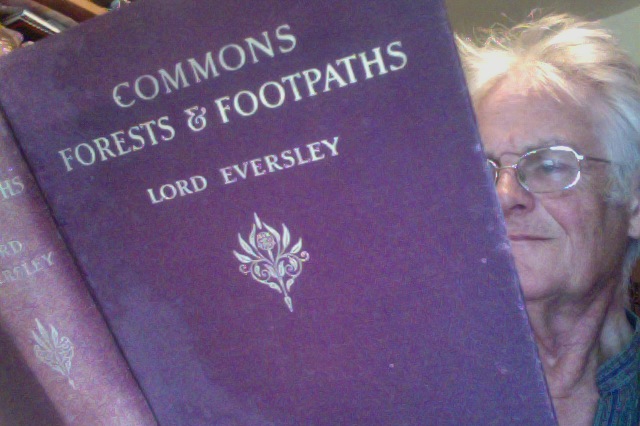
...The general assumption had been that common land was granted by ’superior lords’. On page 5 written in 1910, the author writes:
Owing, however, to the investigations of Professor Nasse, Von Maurer, Sir Henry Maine, Seebohm, and others, another theory has been advanced; namely' that common rights ‘are in most cases survivals of a system of collective ownership of land by the inhabitants of their several districts, the prevalence of which in the early stages of communitieshas been traced over the greater part of Europe. Under this system there was originally no individual ownership of land. It was owned in common by village communities.
Eversley ends with a quote from the poet Oliver Goldsmiths poem, The Deserted Village,
'Our fenceless fields the sons of wealth divide...'
Read of ecological depravity in the Amazon, but learn first how it began in our green and pleasant land. Minoti wrote:
Dear Simon. yes indeed that para will be in my book to be sure in the great debate. I was re-reading it to include in the chapter as I am likely to annotate all the correspondence of HSM around the whole issue of common lands instead of just a list of letters. So they will be organised in such a way as to throw light on his thinking about the topic and support from his overall insights on comparative historical analysis and jurisprudence.  Here is another book but it is to do with his major contribution to comparative historical analysis : his very useful way of filling gaps in history and historical analysis - if you do not get the book not to worry I have an old copy which I will bring to you if my Corfu trip does work next year. By that time I hope to get a rough draft on my Delhi book as well as this one and we can go through his letters together.
I am going to visit the Memorial bench for Eversley near New Forest and would like to have a copy of the photograph of the grave of Sir Henry if you have it somewhere. I would like to put that or a picture of the memorial in Westminster next to the Eversley one and see how it can then intersperse the letters of Sir Henry in communion with the future.
I will write more later I am about to leave for Tonbridge to visit a great environmental historian at a clinic and to also pay my respects to one of the greatest historians of GB and also of common lands Prof Joan Thirsk and her husband Jim* they are 90 and 100 years respectively. Love Minoti. PS You will be my major milestone on the way to HSM.  George Gomme : The Village Community : London, Walter Scott 1890. He is perhaps the most faithful follower of HSM. M
Prof. Dr. Minoti Chakravarty-Kaul, C-59 Uttaranchal, 5 I.P. Extension, Delhi
*Strange coincidence - that Joan's husband, James Thirsk, now 100, wrote Bletchley Park: an inmate's story and must have been there when my grandfather, Sir Henry Maine's grandson, was there, moving between work at Bletchley and his office at The Broadway by St James Park underground station, where he'd been involved since its inception in the Government Code and Cypher School. When I was about ten I learned Grandpa Henry - Henry Maine - had started doing hush-hush work around 1919. My mum had cautioned me about reticence and I've been reflexively incurious ever since - relaxing only with years, and far wider publicity for wartime intelligence, though even now my knowledge of what was involved is minimal.
"Did you go to grandpa's office ever?" I asked my mum last year
 "Oh yes. I used to drop him off there and pick him up when I started driving"
"What was it like?'
"An office. Very ordinary. You know my father also did ARP work during the blitz...night duty on a roof near St Paul's. It was a cover I suppose or maybe he just volunteered."
*** *** ***
Out of Town, I mentioned it a few days back; Charles Webster at Delta has drawn my attention to the pre-offer on Amazon of my stepfather's 9 DVD compilation made in 1986.

Delta are already displaying these DVDs at garden centres and other outlets across the UK with special offers in The Express and The Telegraph. These, with the exception of hitherto unpublished episodes on Stonehenge and Brickworking are the same films as have been available for a long time, though increasingly difficult to buy without looking for used copies on eBay. The previous licensee, Contender, lost interest in marketing 'Jack Hargreaves'. These films are titled Out of Town but they are not original broadcasts of a programme that ran for twenty plus years on Southern Television. Jack compiled them in 1986, five years after the company lost its franchise, using location film he'd bought from Southern for £1 - in lieu of pension. It will be later this year that Delta will be issuing copies of 34 original Out of Town broadcasts only discovered in 2011. The full set will include notes by me and Simon Winter, of Kaleidoscope, describing what was involved in this discovery (a sample sound track - about the ancient hybridity of the English and the land they encountered when they first arrived)

Tuesday, 13 September 2011

Gates of dawn

In the continuing heat, each room in the house gives off smells as though it were being slow cooked. In the dining room where we've drilled holes to start dealing with winter damp I can almost taste the stewing brick and stucco; in one of the lower kitchen cupboards an ancient mustiness mingles with the clinical smell of bleach where we've already washed and wiped. Shutters, under layers of old paint emanate baking wood, and the stones which in England only give off aromas when broken open, have identifying exhalations, tiles too - especially the trace whiff of cool marble caught and held on first entering a sheltered hallway from the hot street, remind me of my first visit to Athens fifty years ago, when heat like this was new. Despite the dryness Corfu remains deeply green; gardens are shaded by the large leaves of walnut, fig, orange and lemon, with exuberant vines cascading over balconies and alleyways, the aroma of jasmine caught in passing.
Working on the kitchen windows Lin and I had to climb on chairs to guide a large local Tiger Moth that had begun to flutter against the glass between it and the world a few inches away. 
*** ***
An email from Minoti Chakravarty-Kaul still in lowland Scotland:
Dear Simon... I am rushing to write this as I am in the midst of a jam most of which is now melting under the heat of rush but have to make decisions so I wrote to Sharon today as I need to be thinking of getting back in time for the 2nd round of presentations in India. Roughly she says Theodora gets tired with visitors if they stay for a long period and so no more than 2 nights which means 3 days. I will then try to be there by the 27th of September ... Let me know how you are. Cheers Minoti
Dear Minoti. We - Linda and I - are now at our home in Corfu until late October by which time I imagine you will have returned to India....Sharon is right. Mum loves the concentrated exchanges she has with you, but - yes - she does get tired. When I’m talking to her I tend to work in 30 minute sessions and then rest, go for a walk, go to my room or just sit quietly. Mum may sleep or go to her room. But when she’s in conversation she’s alert as ever. all the best, love, Simon
Dear Simon...Yes I have to be in India long before the 21st as that is the date for my first presentation in the India Habitat Centre on the issue of land acquisition and New Delhi.this will be, if I can pull it off, a great opportunity to challenge the GOI of today on inflicting a tragedy of the village commons. I intend inducing INTACH which is for conservation of India's heritage to consider the issue from the point of view of historic villages of Delhi. I realised too late that I would have liked you to see a book I had here on Delhi's heritage villages. But hope you come to India soon. My next one will be in November and they may webcast it. I will have to work very very hard to get that off the ground so to say as the maps will be exhibited and all that has to be prepared. I am writing all this to you for I have to struggle about this all by myself. I feel re-assured just telling you.   I thought over what you said about Theodora's getting tired -  you may not have considered that a lot of conversations one cannot carry on with one's family simply because they are the 'knowns' whereas she may have so much to share with an outsider;  also, she is alone for such a long time that there is a habit she may have developed to look inwards and looking back. Does she like music? I have a film which I would want her to see - would you know if she has seen it - 'Ladies in Lavender'- I can take it with me if she has not. besides I plan to cook a few things and I have already talked this over with Sharon - and she seems enthusiastic about it. What do you say? I am in awe about her attitude to life such that I think I will draw strength from her.  Besides I will be taking some of the copies of Maine's letters and show them to her. Any other ideas?  Minoti
Henry Maine at Cambridge
Dear Minoti. I think you may be right about the ‘knowns’ that can slow conversation between people in long connection with one other. I was inside my mother for 9 months and we've known one another for 69 years since. Even with Lin, we maintain long comfortable silences having been together since 1973, marrying in 1978, and having our two children in 1981 and 1985. We share an encyclopaedia of memories from which one of us may pick up a reference while the other - figuratively - peers over the other’s shoulder debating its accuracy, adding annotations that include additional details – debates and arguments. You and Theodora have - until last year - separate encyclopaedias which you are only starting to share. She and you can turn pages and pages that, were they being looked at within each other’s families, would be too well thumbed; not incidentally that I don’t like repeating happy memories, possibly gilding them with nostalgia.  What may interest you about both Theodora and me is that neither of us really knows very much about Sir Henry and his significance. We’ve always been aware of his fame and enduring reputation, but even after we read Feaver’s biography I felt little wiser about our ancestor.  It is only since you entered our lives that it has been possible for us, through your understanding and indeed reliance on his scholarship, that we have begun to gain insights into why this man is considered in a significant circle to be one of the great intellects of the last 150 years; only now as a result of your enthusiasm and generosity that I have begun to see links between Maine’s research into the governance of traditional Indian society, especially its villages, and his comparisons of these with village communities in the rest of Europe, and contemporary problems of governance and land usage; problems that I’ve so far viewed through different perspectives - environmentalism and sustainability. Much as I respected him in a general way, I hadn’t seen how Maine’s work might be so relevant to my enduring concerns about the urban environment, town and country relationships and new ways of organising the distribution of scare resources without resort to regulation by top-down government or exposure to the market. I know Theodora will be fascinated to see your copies of Maine’s letters. Neither of us have seen any of these, the only handwriting we’ve viewed being his signature. Indeed I feel very little sense of knowing this man as a human being, driven by the ambition of his intellect to excel among his peers at Cambridge, made a full professor at 25, well before the appearance of the books that made his name. He could have been arrogant, priggish and mean, but seems to have been none of these things, being regarded by those who new him as quite shy, generous, sweet mannered, always attentive. I still cannot imagine someone who writes with such originality and assurance and deals with such complex and difficult ideas in this light. I have not heard any more from Robin Peterson in distant Canada about the contents of those files she recovered from George Feaver’s estate. Except for the books Robin sent to Brin Croft in May, which I stacked on a lower shelf in my mum’s bedroom near her window, you now have all of the material my mother had on her great grandfather, - the obituary notices cut out by Jane in the late 1880s. I guess it’s just possible that new material will come to light but I suspect you are our unique link to Sir Henry, notwithstanding Karuna Mantena’s great talent as a scholar. She incidentally sent me a kind note a few months ago saying that she could not imagine a better person than you to help my mother and I to learn more about our ancestor. I read Village Communities - all 6 lectures - last time I was at Brin Croft in early August. I begin to see that what Maine was describing does not lend itself to any easy simplification; no idealistic paean for the simple and the traditional, no obvious opposition to the progress from status to contract.  I see considerable concern about the effects on village elites and more educated Indians of the day of offering uncompromised access to legal procedures that enabled them to draw on English law to detach themselves from the older forms of governance that had had traditionally determined the settlement of disputes within and between village communities. I suspect that in raising this issue and supporting it with evidence he drew attention to unforeseen side effects of British rule that had had more obvious and dire effects in that earlier insurrection we were taught at school to call The Indian Mutiny. The insensitivity that required Hindu’s to be in touch with beef fat and Muslims with pork was a notorious lesson that has curbed the arrogance of many an imperial governor over-confident about imposing what he took for granted as being the universal and superior benefits of ‘our' way of doing things. What strikes me about Maine’s writing are the careful conditions and limitation he places around any too obvious or simple assumptions about the motives, mores and logic of other cultures. I see now why when I was at Cambridge reading Anthropology, at Trinity Hall with Sir Henry’s portrait - not very good - on the wall of the dining room at whose High Table he, as Master, once presided, I was told by one of our lecturers, that Henry Maine was 'a father of Anthropology'. It was not until I met you and, on your second visit to Brin Croft earlier this year, you gave us that fascinating tutorial on Maine’s research base, missing in George Feaver’s biography of him, that I’ve begun to digest the full import of that conclusion. I still haven’t read any of your written work though I’ve seen reviews, and you showed me your village maps. I very much hope that when I do I can strengthen my understanding of Maine’s work enough to make a clear connection between it and my committed interest in the commons and their governance, allotments and urban green space.I realise from your words how urgent it is for you to prepare a challenge to the Government of India that may be instrumental in averting the infliction of a tragedy of the village commons. Linda and I are enjoying the dry heat of September in Corfu, grateful for the breezes that start in the afternoon and blow cooler air through our house on Democracy Street.
We’ve enjoyed eating ripe grapes clustered on vines enveloping deserted houses in the village, picking dates sticky and sweet from overhanging trees that grow so abundantly some treat them as weeds. We've even found a few blackberries where the bramble roots have worked through the walls of old wells giving them the moisture needed to ripen rather than shrivel in the rainless weather. Cats and kittens roam everywhere scratching a living from throwaway scraps, occasional lizards and crickets.
I hope you will have a good journey to the Highlands (which I always miss) and enjoy again seeing Theodora and imbibing with her the spirit of Sir Henry Maine in whom we all share such interest and in the case of my mother and I, similar genes and DNA if not brain cells (:)).
I forgot to add an answer to a couple of your questions. Yes, Mum loves music. We have a radio programme you may know on the BBC called Desert Island Discs, in which a well known person is asked what they’d miss if they were marooned on a desert island. They are allowed to choose eight favourite recordings; extracts from these are played during the conversation. At the end they are asked what book “other than the Bible and works of Shakespeare” which are taken as givens, and what object,  they would most like to have with them on their desert island. I think my mother’s book was The Wind in the Willows and she especially liked a small Rembrandt sketch of a child learning to walk…I did a home-made version of Desert Island Discs with Theodora about 18 months ago with these results:
Mum enjoys Jacqueline du Pré playing Elgar's Cello Concerto
She was entranced, listening avidly through earphones and watching the screen. She has a lot of interest in the potential of internet and was impressed at how easy it was to find not only the music or aria she wanted to hear, but versions by her favourite singers, musicans and conductors.I don’t know of she’s seen Ladies in Lavender but I suspect she would enjoy watching it with you and talking about it. Simon
In Venetia above Ano Korakiana

Sunday, 26 June 2011

Seeking Sir Henry in British Columbia

George Feaver, Canadian political scientist, born May 12, 1937 in Hamilton, Ontario, died on 12 May 2008 on his 71st birthday in Vancouver, British Columbia. In 1969 he published From Status to Contract: A Biography of Sir Henry Maine 1822-1888, London:Longmans.
George Feaver
I read Feaver's biography of my great great grandfather - far too cursorily - at the time it came out. It wasn't even my own book but a complimentary copy sent by George to my mother, Barbara or Theodora (to use Minoti's preferred name for her) after Grandpa Henry, Sir Henry's grandson, who'd died a year before publication, in 1968 had shared his sparse collection of Sir Henry's material with George.
I was aware Sir Henry James Sumner Maine was quite a well known ancestor, but his reputation and work passed me by. I got glimpses of others' opinions of his unique contribution to understanding the origins of law and the ancient traditions that underlay the government of rural communities - superlative but elusive opinions.
Jane Maine
At home we've an oil painting of his wife Jane, who on lived many years as his widow after his death in Cannes. In her childhood my mum knew Grannie Maine. I recall my tutor at Trinity Hall, Graham Storey, of which Maine was Master from 1877 until his death, apologising after the College had decided to remove a heavily varnished oil portrait from its dining room wall.
"It's not a good painting. In fact it's awful" he said.
I agreed, entirely unaffected. I recall reading later, in Feaver's biography, that Maine was an impatient sitter, not much interested in being portrayed.
Henry Sumner Maine
Henry James Sumner Maine
It's only in the last year that my interest in Maine has quickened, not so much in his distinctions, his title and a plaque (see p.31 in link) in Westminster Abbey, which I never saw all the years I was at Westminster School, but in his writing and ideas and their significance during his life, and after his death. Again it was the interest and knowledge of others that spurred my present interest - especially their interest in the governance of village communities and the origins of law.
Having already begun to make adjustments to Maine's Wikipedia article - almost entirely lifted from the 1911 Encyclopaedia Britannica - I was scanning the internet and came upon a publication by the young political scientist Karuna Mantena. She had just published Alibis of Empire: Henry Maine and the Ends of Liberal Imperialism (Princeton, 2010). I found her address on the faculty list at Yale, also on Facebook, and wrote to her. She replied almost by return:
Dear Simon Baddeley. Thank for very much for your kind and encouraging note. What a humbling and extraordinary thing to feel connected to Maine in this way! Please allow me to send you and/or your family a copy of the book. It has also appeared in a South Asia edition, which I can send since you may already have the UK/USA edition. If ever I can make a visit to Birmingham, I will be sure to be in touch. all my best, Karuna. Karuna Mantena, Assistant Professor of Political Science, Yale University
I replied with thanks and enthusiasm, hoping I'd said nothing tactless. I'd bought a copy of her book and was reading it. She wrote again:
Karuna Mantena
Dear Simon. It would be my pleasure to send a signed book for your mother. I do hope we can meet one day soon. And certainly if I make it up to the Highlands, I would so delighted to meet your mother. Yes, the book tracks a change from a more liberal-utilitarian moment of imperial civilizers to one more interested in cultural protection and integrity. Maine was at the cusp of that change, and incredible intelligent and perceptive in the debate (others in his camp were more strategically oriented). Indeed, he has had a long reputation in Indian as a friend and defender of Indian village communities. Gandhi was a great admirer of Maine's on this account. And since then a whole host of Indian legal historians have found Maine's work on the impact of English law in India to be especially illuminating. It is wonderful to hear from you, so there is nothing to apologize for. all my best, Karuna
Last September, I got another email - while we were in Corfu:
Dear Mr. Baddeley. A friend of mine, at the University of Hertfordshire  just successfully discovered your exchange with Karuna Mantena who had sent me her dissertation on Sir Henry Sumner Maine since I have written about him in my book on Common Lands and Customary Law: Institutional Change in North India Over the Past Two Centuries published by Oxford University Press, 1996. I knew George Feaver very well who as you know wrote Sir Henry's biography  ... and felt the lack of some of the known sources known to exist in the family's archives to which I had 'lost the trail' so to say. You cannot imagine my excitement, or perhaps you can for I have been living with the research on his papers since 1978. Is it possible for me to meet you sometime as I am in England right now and will be making a presentation at Hallam University on the 17th of this month? Best wishes and look forward to hearing from you. Prof. Minoti Chakravarty-Kaul
And so the view halloo. Since last September Minoti (one of her reviews) has visited my mother in Scotland - twice.
Minoti and Theodora
Her first visit was last September. George Feaver's book sits on the table in front of Minto and Mum. The second visit was earlier this month when I was staying at Brin Croft and Minoti stayed two nights with us there and talked to us both about Sir Henry. Before she left she wondered if I could approach the late George Feaver's family and possibly his university to see if by chance George's estate had any Maine material that might be shared. I quickly found and posted to a Facebook site commemorating Feaver asking if anyone could help and was almost immediately referred to his niece, Robin Peterson, who replied equally quickly to my email, saying she did have things of her uncle's that might interest me. She and her family live in Aldergrove, on the edge of Vancouver, under an hour from the Pacific, and a lot less from the US border hardly 10 miles to the south; about 4700 miles from Birmingham:
Hi Simon. I just received you message and would love to help. I have approx forty boxes to search thru. I know my Uncle had been collecting these books for years. I had tried to donate them to UBC, the University where he taught, but suffice to say they where more interested in me categorising the lot, than receiving it. I know these are quite valuable and want them to go to a good home, where they will be given their due respect. If you know of anyone who is a collector and interested in these, please let me know. Some are in disrepair and need a loving restoration, others are in good  to excellent condition for being over 130 years old.
Maine, Henry Sumner, Early History of Institutions, London, John Murray, Third edition 1880
Maine, Henry Sumner, Dissertations on Early Law and Custom, London, John Murray, 1883
Maine, Henry Sumner, Popular Government, London, John Murray 1885
Maine, Henry Sumner, Popular Government, London, John Murray, Third edition 1886
Maine, Henry Sumner, Village-communities in the East and West; six lectures delivered at Oxford, London, John Murray 1871 - 2 copies ( one in excellent condition )
Maine, Henry Sumner, Village-communities in the East and West; six lectures delivered at Oxford, London, John Murray Third edition 1876
Maine, Henry Sumner, The Whewell Lectures, International Law; a series of lectures delivered before the University of Cambridge, London John Murray, 1888

There may be more. I still have to go thru the boxes. I will try to find the information you wanted,  i.e. Uncle George's working papers, etc. Please let me know if there is anything else you are looking for, and by all means, please  forward this information to Dr.Minoti Chakravarti-Kaul. Cheers, Robin 
Last Friday we had a conversation on Skype - about 7.00am in the morning for me and around midnight for Robin and her family.
In the course of this conversation Robin told me that after his death George Feaver's home was cleared of most of his possession by his family - a perfectly normal process - but that forty boxes of papers, including the books listed above, had been left for disposal by auction. A friend of Robin's daughter (I think) who worked at the auctioneers sent a message to Robin about the sale. She dropped everything and dashed down to the auction, and rescued the boxes - selling at C$1 each - and has them stored in her garage. As we chatted - for over an hour - she showed me George's original bound dissertation on which his book on my great great grandfather had been based with illustrations not in the book, as well as first edition copies of Maine's books that had been in her uncles' library. On 25 June I got this email:
Hi Simon. The books are safely on their way to you Mum's place in Scotland! Darrell took them down to the Fed Ex office in Langley this afternoon. They were picked up for sorting and VIA (Vancouver International Airport), by 3:00PM PST. The tracking number is  **** **** ****, which you can track on the Fed Ex website. The clerk wrapped them with bubble wrap and commented - 'these look old'.  LOL. I feel so much better that they are going home...They should arrive in Inverness no later than July 1st., so your Mum can have a peak thru them before you get there.... I think you'll have fun looking thru these. I just wanted to tell you how much I enjoyed our conversation last night. I'll have to at least  get dressed for the next, lol.  Maybe a little more heads up before the camera starts rolling. Looking as glamorous as Olive from On the Buses takes time. Robin, Darrell, and Family 
*** *** ***
Yesterday afternoon I tried out my new azada on the plot and was delighted at its superiority over the fork and grubbing mattock when it came to clearing more of the untouched weed-riven soil, and I was joined by two spectators - Robin who I know and someone I often see on Victoria Jubilee Allotments - his name Tsitsan - but that's only the sound. I don't know the spelling.  He was curious about my azada and offered to have a go with it.  Verdict? I wish I'd discovered the azada when I started getting the plot ready for planting.
Who breaketh up, timely, his fallow or ley,
sets forward his husbandry many a way ~ Thomas Tusser 1524-80
The azada is a gem of a digging tool. Thanks to those gardeners who recommended I get one, and thanks to Simon at the web mail-order firm Getdigging for sending it so swiftly, and thanks to my friend Robin for another good argument  - about scientific creativity and strimmers.
Earlier I had taken my scythe over again and had a go at cutting the grass strips on either side of Scylla Parkyn's plot. She our Hon.Sec. I found that I could not cut the narrow strips as close as with the strimmer that making such a noise a few plots away. I reminded myself  I need to get better at sharpening my blade and choosing a time when the grass is wetter. All the same Scylla will now be able to use the allotment association's handmower on much shorter grass. I'll hone my scything skills.
Back to the future - a flattering email on 19 July from Simon at getdigging:
Hello Simon. Just a quick note to say I saw your piece on Youtube with your “new Azada” – I didn’t realise it was there until a customer said she had seen it. You look as though you were born with an Azada in your hand - and apparently not even out of breath when, after giving short shrift to a goodly area of sod, you casually strode off with the bell cap for a sip of water; very impressive! Almost as impressive was the deep philosophical discussion which you managed to have with your neighbour at the same time!  Anyway, many thanks for the kind mention; it’s always nice to have a helping hand – being a small one-man band my advertising budget of £5.00/year doesn’t stretch very far so every bit of publicity is always appreciated. All the best, Simon 

Back numbers

Simon Baddeley