Total Pageviews

Showing posts with label Dora Bakoyannis. Show all posts

Monday, 2 August 2010

Αλλά μη βιάζεις το ταξίδι διόλου...

'But do not rush the voyage in the least'
We've long enjoyed coming to Dog Rose Pool in winter, spring and in summer for picnics near the constant sound of water, paddling, sitting on grassy banks surrounded by wild flowers and heather and rounded lichened stones near the head of Strath Nairn, a natural amphitheatre made of gentle hills behind us and the panorama of the strath all the way to Farr to the north and the profile of Brin Rock, carved by ancient glaciers, in the middle distance.
Summer 1996
Today as yesterday with Sharon we eased my mother into her car and I drove slowly south via Dunlichity, past loch Clachan, loch Duntelchaig to the cross roads beyond loch Ashie, where on a whim we turned left towards Whitebridge, the Great Glen to our right invisible, skirting loch Ceoglais, travelling on the narrow roads in a circle back towards East Croachy where, looking for a place to walk the terriers, I turned up the gravel road that leads after a mile to a few isolated houses and a semi-derelict set of buildings near the headwaters of the Nairn.
Winter 1998
Rabbits scattered maddening the dogs as we drove up to broken houses and a collapsed caravan and stopped at a gated meadow with horses. I went to the shack where a Highland terrier sat peacefully on a low veranda. A man came to the door - friendly. "May we pass through your gates?" "Of course". I took the car a little way up the uncropped slope as deep into the long grass beyond the meadow and left my mother to gaze at the view and with the dogs ranging around me picked my way along and between the divided peaty streams that run down from higher up the Strath and mark the sound of the place as they tumble over boulders joining and separating narrow islands of grass and heather. After a few hundred yards I came to where we've often stopped and paddled, building dams of heavier stones to extend the natural pools. When Mum could walk she'd come here even in winter with me and Amy and Richard. I came after a while to the dog roses, two bushes, one a little smaller, but neither much changed in size or proportion since the children were small. I wandered around seeing no sheep nor birds, just the occasional fly. Too much breeze for midges. I went back, treading carefully between stones and streams and boggy patches, water seeping into my shoes and, for a moment missed the car, then saw where I'd left it in the greenery Mum now sleeping, sunk in her seat so the car seemed to be empty. "For a moment I thought you'd been kidnapped!" "Did you have a good walk? I glimpsed the dogs," "Isn't it just impossible to imagine how things were last winter. Can you remember just six months ago? All this covered in snow." *** *** Searching John's Corfu World - a blog I've long enjoyed - I find he's dug out this 1986 clip of the Youth Philharmonia playing on the bandstand on Corfu Town's Spianada. Κάθε λιμάνι και καημός - 'Every port and sorrow' 'Every port, every sorrow' (I suspect it's untranslatable) but I get the meaning.
* * * The government has persuaded truck drivers to end their week strike. The left will see the the union members' narrow majority to vote to end industrial action as a betrayal of socialism; the middle and right claims a victory for a PASOK government in their drive to end the professional monopoly of drivers - many of whom have invested house-price sums to acquire a limited pool of heavy goods vehicle licences. The government will now continue trying to open up the market for these licences, in the process devaluing the investment of existing drivers. Barnaby Phillips at Al-Jazeera on these events.
Greek strikes normally follow a certain pattern; a day or two of protests, a loud march to parliament, hurried government concessions, and everything goes back to normal. This time, however, the government has raised the stakes. It's passed an emergency order, which means that truck drivers who refuse to return to work could be arrested or lose their licenses. And it's said that the army and navy will be used to transport fuel to hospitals, airports and other "critical sectors". Why does this strike matter? Because it's become a key test of the government's willingness to pursue the reforms which it says will restore competitiveness to the Greek economy. Trucking is one of dozens of so-called "closed professions" in Greece. This means it's a profession that is virtually impossible for an outsider to enter. The holders of trucking licences belong to a lucrative closed-shop. Consequently, a licence is a valuable commodity, often traded informally between friends and family, and worth tens, or possibly even hundreds, of thousands of Euros...
Richard Pine has written in his Letter from Greece in The Irish Times 4 August '10 under the heading 'Which weighs more on the state - assassination or economics?' - a piece addressing 'moral and structural confusion', 'the vortex', 'massive social danger to this still-developing nation':
To accomplish a turnaround in Greek society – and its economy – depends not only on fiscal rectitude but also on a new understanding of what the Greek state means to the Greek people. Papandreou is faced with a dichotomy: which is more serious, the threat from terrorism (which steals lives in order to bring down the democratic state) or the kleptocracy (which allows the rich to get richer and the poor to get poorer)? If you want to maintain the fabric of the state, then that fabric must be durable and acceptable to the members of the state. No one – other than the terrorists themselves – would argue that the state is worthless, yet few would accept the present vortex as a sustainable society.In the middle, between the stabilisers and the terrorists, are the trade unions, which, quite understandably, are seeking the bes
t deal for their members. Few union leaders, other than the ideologically focused and well-positioned communists, can see the vortex for what it is: that, beyond the economic circumstances, there is a massive social danger to this still-developing nation.
The death of a journalist affects his wife and children (one, in Giolias’s case, as yet unborn), his colleagues at Thema Radio, and the whole media hinterland. Ten cent on a litre of petrol (currently €1.60-€1.80) and a hike in VAT from 19 to 23%, affect everyone. Which is the greater tragedy? Which story tells us more about the society in which we live? Thou shalt not kill. Thou shalt not put another 10% tax on a bottle of ouzo. Thou shalt not raise the retirement age.
Ironically, in the midst of all this moral and structural confusion, Dora Bakoyannis, one of Greece’s most able politicians (and Papandreou’s predecessor as foreign minister), who is critical of the innate clientelism of the Greek state, is forming a new party. It started with a “Forum for Greece”(forum για την Ελλάδα.....See also)...
****
23 July 2010 - From a bridge on the road to Fillipidi Konstanta - οδό Φιλλιπίδη με Κωνσταντά - near Volos on the Gulf of Pagastikos in Pelion, news of a debt-ridden truck driver's suicide by hanging:
...Η οικονομική κρίση χειροτέρεψε την κατάσταση και φέρεται να αδυνατούσε να ανταπεξέλθει στο βάρος των οικονομικών υποχρεώσεων, με το άνοιγμα των χρεών να ανοίγει διαρκώς και το μεροκάματο να περιορίζεται δραματικά...
On 'Communist views from Merseaside' - Dreaming Neon Black - blogger Adam Ford, comments on 6 August, including this:
This social tragedy claimed a victim in the days leading up to the strike, when a sixty-seven year old, debt-ridden trucker took his life, hanging himself on a bridge over a motorway. Indeed, the Greek suicide rate has nearly tripled this year, according to suicide helpline Klimaka.
Furthermore, confident in the knowledge that trade union bureaucracies will help them if disputes get out of hand, the Greek state must now turn its attentions to lawyers, notaries, pharmacists, architects, civil engineers and accountants, according to the EU/IMF prescription. If these groups are to have a chance of surviving the onslaught, they must break with the bureaucracy and reach out to working people around Greece and throughout Europe.
[13 Aug '10: Surge in Greek suicides?] I'm not a Communist, or indeed any other -ist. Karl Marx is often misquoted saying something similar, but anyone attempting to comment on the state of the human world; to understand the wave form of present social and economic change would be careless not to read one of the great prose piece of the 19th century - the essay by Marx and Engels called The Communist Manifesto. My stepfather, working in advertising in the early 1960s, handed me the notorious pamphlet - the English edition of 1888 - republished again and again. "A spectre is haunting Europe..What a piece of copyrighting's there!" he remarked.
The bourgeoisie, wherever it has got the upper hand, has put an end to all feudal, patriarchal, idyllic relations. It has pitilessly torn asunder the motley feudal ties that bound man to his "natural superiors," and has left remaining no other nexus between man and man than naked self-interest, than callous "cash payment." It has drowned the most heavenly ecstasies of religious fervour, of chivalrous enthusiasm, of philistine sentimentalism, in the icy water of egotistical calculation. It has resolved personal worth into exchange value. And in place of the numberless and feasible chartered freedoms, has set up that single, unconscionable freedom - Free Trade. In one word, for exploitation, veiled by religious and political illusions, naked, shameless, direct, brutal exploitation.
The bourgeoisie has stripped of its halo every occupation hitherto honoured and looked up to with reverent awe. It has converted the physician, the lawyer, the priest, the poet, the man of science, into its paid wage labourers.
The bourgeoisie has torn away from the family its sentimental veil, and has reduced the family relation to a mere money relation.
The bourgeoisie has disclosed how it came to pass that the brutal display of vigour in the Middle Ages, which Reactionists so much admire, found its fitting complement in the most slothful indolence. It has been the first to show what man's activity can bring about. It has accomplished wonders far surpassing Egyptian pyramids, Roman aqueducts, and Gothic cathedrals; it has conducted expeditions that put in the shade all former Exoduses of nations and crusades.
The bourgeoisie cannot exist without constantly revolutionizing the instruments of production, and thereby the relations of production, and with them the whole relations of society. Conservation of the old modes of production in unaltered form, was, on the contrary, the first condition of existence for all earlier industrial classes. Constant revolutionising of production, uninterrupted disturbance of all social conditions, everlasting uncertainty and agitation distinguish the bourgeois epoch from all earlier ones. All fixed, fast-frozen relations, with their train of ancient and venerable prejudices and opinions, are swept away, all new-formed ones become antiquated before they can ossify. All that is solid melts into air, all that is holy is profaned, and man is at last compelled to face with sober senses, his real conditions of life, and his relations with his kind.
The need of a constantly expanding market for its products chases the bourgeoisie over the whole surface of the globe. It must nestle everywhere, settle everywhere, establish connexions everywhere...
The Communist Manifesto, published in 1948's year of European revolutions, has the vigour, momentum and analytic rigour - comprehensively rebutted, so I thought, by one of my undergraduate lecturers - when I was at Cambridge long ago ("Why did the 1917 revolution end up in Russia where capitalism was still at a primitive stage rather than in the USA where it had evolved into the economic driver of the world?") - of Dostoyevsky, Dickens, Tolstoy, and certainly Henry Mayhew, who's 1851 map of the state of London's poor presented the evidence that nearly a century later inspired the Beveridge Report, which argued the case for social insurance and, in November 1942 eight months after I was born amid world war, laid one of the foundation stones of Britain's welfare state - 'the object of government in peace and in war is not the glory of rulers or of races, but the happiness of common man' and the object of the state is to provide a standard of living 'below which no one should be allowed to fall' recommending ways of fighting the five 'Giant Evils' of 'Want, Disease, Ignorance, Squalor and Idleness.'
For some reason the 'spectre' that's stuck in my mind is not Marx and Engel's 'communism' (incidentally I read somewhere that the 'spectre' phrase was neither Friedrich's - I remember the spelling by thinking of 'fried rich' - nor Karl's but Jenny von Westphalen's, to whom he was married) but the relentless diffusion of embourgeoisment they describe at the start of their famous essay.
All fixed, fast-frozen relations, with their train of ancient and venerable prejudices and opinions, are swept away, all new-formed ones become antiquated before they can ossify. All that is solid melts into air, all that is holy is profaned...
The constant sound of water

Monday, 30 November 2009

In Jersey

Arriving over Jersey in a gale
So after getting home on Friday with the joy of seeing Lin - in the flesh - since we'd been chatting on Skype all the time I was away, and also Richard and Amy and Oscar dog, I've flown south to Jersey for two days, descending through driven clouds across a south westerly gale joyously stirring white caps in the distinctive blue of the English Channel below;
that dreaded tide rip harrying the rocks beween Alderney and France, as our medium size prop plane descended for a brief stop in rain and wind swept Guernsey.
Last time I made that journey was in Two Pearls - and it was summer, but she was a sweet sea boat. One advantage of so-called jetlag is that there's a whiff of an antipodean afternoon in my time clock even though I'm sitting preparing for tomorrow's seminars for members and officers of the States of Jersey at 2.00am in my hotel room in the Pomme D'Or. Tomorrow - well - later this Monday morning, I'm leading two seminars on Chairing Scrutiny. I'm not to say 'Chair'. Members, including women, will remind me they aren't 'furniture'. Trickier is members' animus against the idea of scrutiny as a 'critical friend' to the executive.
CHAIRING SKILLS FOR SCRUTINY
Seminars for the States Assembly of Jersey
30 November 2009, 0900-1300 and 1330-1730
The effectiveness of scrutiny depends on refining the skills and knowledge needed to raise the profile of a process still relatively novel. Scrutiny chairmen, and those who work with them, are usually the first to recognise that steering scrutiny differs from more traditional chairmanship tasks in government. These workshops offer an opportunity to rehearse the competencies involved. There will be brief presentations with discussion to guide analysis and reflection with a refreshment break during each seminar.
AIMS:
• to identify and review the responsibilities of scrutiny chairmen in the government of Jersey,
• to explore and clarify the skills and knowledge required by those chairing the scrutiny function, including scoping, questioning and weighing evidence,
• to consider how chairmen, members and officers can plan to develop and maintain these skills.
PROGRAMME
Introductions and overview of the seminar
The roles of scrutiny chairmen
Challenges of chairing scrutiny
Skills and knowledge before, during and after meetings
Future learning
Summary and final observations
What is it about that term 'critical friend'? It's an issue on the horizon of nearly every chair/chairman of scrutiny I encounter. The political context in Jersey is of course unique to the history and personalities involved and despite studying their impressive website - 'Scrutiny: ensuring transparency and citizen involvement in our government' - I am strong in my ignorance of its traditions, but the matter of scrutiny's relationship to the executive has generic qualities existing in the relationship between the government and select committees at Westminster, where scrutiny has a 30 year start - at least - on its equivalent in sub-national government in the UK. In our Parliament there've been recurrent attempts to whip chairmen, resisted with increasing success after many more years of select committee existence than constitutionally established scrutiny in Jersey and similar functions across English local government. It's an inevitable constitution conundrum; one of the more recent of the stream of attempts to tweak that cumbersome system we call 'democracy' into better working order. It would be foolish of me not to anticipate opinions on this, if for no other reason that if I try to ignore it, the concerns I've been cautioned about will rear up anyway, because anyone seeking to make headway with scrutiny will have encountered this tension. If they do not give it thought, they'll be reminded of it by their colleagues. Understanding and handling relations with the executive is part of effective chairing of scrutiny, which doesn't mean there shouldn't be reciprocity, and readiness among executive members to agree quid pro quos, and indeed an understanding that ineffectual scrutiny can mean ineffectual executive. Is there a problem that being a 'critical friend' runs counter to the long tradition in law and government of adversarial debate, so that being 'a friend' - critical or otherwise - suggests collusion, collaboration and weakness. I was first introduced to the important principle that opposing the government of England was not treason when I was about 12 - when introduced to the term 'Her Majesty's Opposition', an idea that enshrined the notion that it was for certain subjects of the sovereign their duty to oppose.
* * *
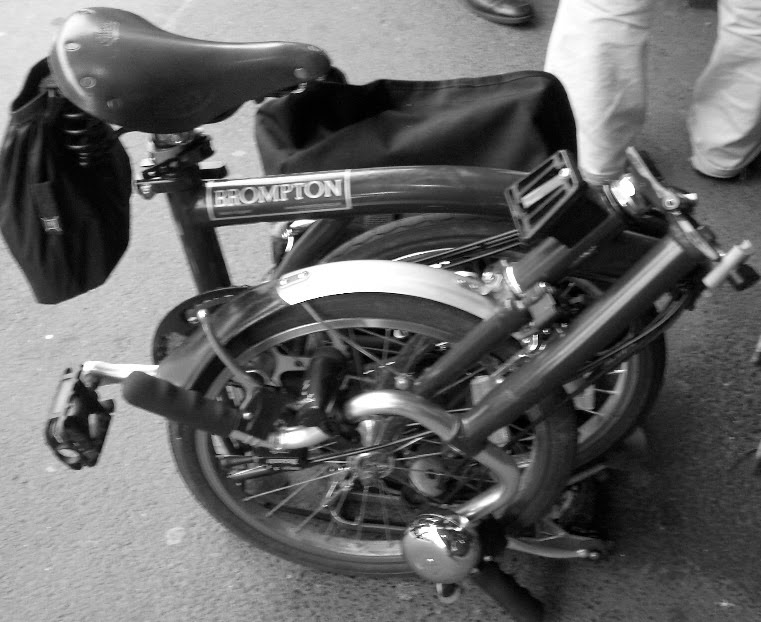
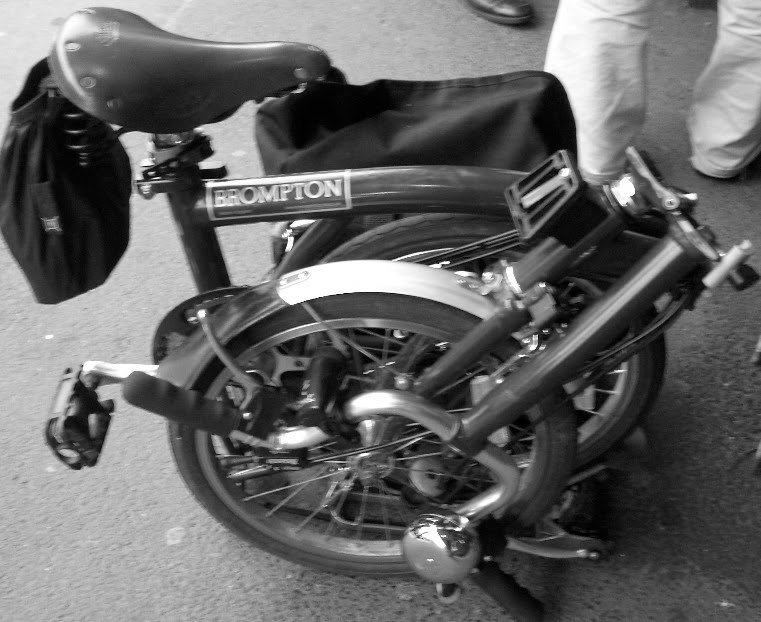
In Birmingham before going to Jersey I had Saturday clear. From the bike kennel in our cluttered garage I chose - not my usual Brompton - but my full sized bicycle. The habit of using my folder has been interrupted by the cycling in Australia. Feeling slightly disloyal I took out the Eco Real to enjoy the extra speed of a full sized bicycle. The contrast is marked. The wind rushed, chilly, despite my warm clothes, into unguarded crannies around my neck as I swept over the Hockley flyover, enjoying the choice of 16 rather than 6 gears. But the bigger bike can't be taken inside places. I have to keep locking it. I can't take it on buses or trams. On the inter-city trains I have to buy a ticket to have it with me and put it a special compartment and worry whether there'll be space on trains back if I take it to other cities. For work I'll be sticking to my Brompton but I'm exhilarated by the novel sensations of the larger bicycle as I was on Geoff's Orbea in Melbourne and John's MTB in Bendigo. The additional pleasure here is being free from the Australian compulsion to wear a helmet.
At the city centre I worked my way into the cheerful crowd enjoying the German Market, sipped a mug of mulled wine and savoured a plate of fresh fried mushrooms and diced potatoes mingling with a generous covering of creamy garlic sauce. Then out again to Handsworth for an excellent haircut at a little barber in Nineveh Road. I'll go there again, especially as I can see the large bicycle through the window, where it's locked to a lamp-post. I was reading something I wrote about 9 years ago about the trend towards urban utility cycling - wondering how things would be in ten years time. There are more people relying on bicycles but the car continues to proliferate - still the preferred way to get from A to B. Is there any acceleration of change?
I doubt it, though in London increases in cycle commuting are evident. Lin drives. Richard drives. Amy drives, though she's been experimenting with cycle commuting "but not now it's turned cold and dark" she admitted to me slightly ruefully on Friday. So while I have fun, my hopes that many more would share it, seem confounded. I console myself by enjoying the benefits of escaping the inconveniences of autodependency, while little by little people of vision lower the profile of the car in plans for the city.
* * * * *
The Agiot Newsletter for December '09 has used an old piece of mine on the Parthenon Marbles - pages 8-10. Written in November 2007 when New Democracy are still in power it looks odd, but the argument survives - more or less. And to show my hopelessness as a predictor of political fortunes, Dora Bakoyannis lost a fight with Antonis Samaras for the Leadership of New Democracy, in opposition since PASOK won a General Election in October '09. Op-Ed from Kathimerini

Saturday, 27 June 2009

Thunder, lightning and lots of rain

After ripping, capturing, editing and compressing a film of a second political-management conversation mailed me by John Martin from Australia I cycled into town. The sky grew heavier. At the markets people began looking for cover, scattering as lightning and thunder converged and the skies opened, water dripping from awnings and gutters, running down gullies, shining the streets. People watched from cover. Others scurried between shelters under umbrellas and hoods. - enjoying the wet.
I returned home along the mainline canal, its water drifting from the city centre. The drains on the lower roads were overflowing, a sign of how the Birmingham water table has risen with the end of industry, while loss of green space from a thousand thousand hard surfaced garden has taken away absorbency.
Once home I find my e-mail connection has gone. Rare and vexing, though I can always use Lin's for sending urgent material. A woman working evenings at the campus IT helpdesk said I'd need to wait until Monday before anyone could look at the problem. The cat staring up draws my attention to a moth circling inside the kitchen lampshade. I reach up, catch it and let it out into the warm night.
[By midnight on Sunday the university has restored my e-mail. I leave a message of thanks and close the Helpdesk log]
* * *
Twitter: CORFU, Greece, 28 June 2009 - The informal meeting of OSCE foreign ministers on the Greek island of Corfu concluded today with the launch of the 'Corfu Process' ... Ministers concurred that it is also time to consider that "much work remains undone." Bakoyannis said that traditional security problems remained unresolved as new threats and challenges continued to emerge ... protracted conflicts and other unresolved tensions, the suspended CFE Treaty, the need to strengthen democracy and rule of law in parts of the region, the economic crisis, terrorism, trafficking and instability in neighbouring regions. The meeting ended with agreement on the 'Corfu Process' - steps to take the dialogue on European security forward...
[See RIZOSPASTIS news story]
Earlier reflections on the history of civil society in Europe, the extinction and survival of democracy
.....Something must be invented that matched the vigour of Fascism or Communism – whose epic encounter at Stalingrad was probably the pivotal battle of WW2. This had to be democracy’s second chance – a system and philosophy of government that could not only survive and defeat fascism and resist communism but also replace with new policies, popular consent and civic competencies the failures of its predecessors.
* * * As Corfucius says "He was damned good". I like the invention in 'black or white'
* * * Note on the British Library on-line feedback form:
The `Rizospastai': politics and nationalism in the British Protectorate of the Ionian Islands 1815-1964 (sic - surely 1864). Calligas, E., 1994, A9m British Library Shelfmark DX187456 Ph.D., London, London School of Economics, 44-9204
After being unable to download this thesis on 15 June 2009 I have been e-mailed by a librarian - Mr J Dixon - on 27 June 09 that this thesis which your system says is available for download has become ' corrupted' He goes on to say 'I will contact our technical support department and have them check the file at their end, when they come back to say all is ok, we will contact you and ask you to submit a new order. Yours Sincerely, Jonathan Dixon.' This reply suggests an indefinite period before I can access the Calligas thesis, despite your catalogue appearing to be open to order an immediate download. Mr Dixon cannot now be directly contacted as his e-mail is 'non-reply'. I can imagine how busy you are but I plan to be in Corfu from 25 August 09 and was hoping to have been able to start reading the Calligas thesis before then. Is there any other way i can get to at least start reading it? Is it possible to come into the library or is it also unavailable in hard copy? I am next in London on 9 July 2009...
Reply:
Dear Simon, Thank you for your email. I'm sorry my reply did not satisfy your query. I forwarded your query to our technicians and have as yet received no reply, we no longer accept theses in their original hardback format and these cannot be read in the reading room, Ethos is the ONLY way to view and order British Theses from the British Library. I appreciate your frustration we have so far digitised over 16,000 theses and some of these have had corrupt files and we have to solve each one on a case by case basis, the service has been immensely popular and regrettably we do not have the resources to fully cope with the initial interest that has been generated. I can assure you we are doing all that we can to resolve this situation. If you are in desperate need of the thesis I can only suggest you contact the university direct and they may be able to source a copy for you or you can wait for a response from us, however your query is in a long backlog of emails and queries we receive everyday and we have to deal with each one in turn. Yours Sincerely, Jonathan Dixon, British Library Ethos Help
I phoned the LSE. No record in their catalogue but I was directed to Archives where, though she could find no record of Calligas' thesis, a helpful voice spoke the name of Eleni's supervisor, "...but he's left." I googled the name and found a Professor of International History at the University of East Anglia. I've sent him an e-mail. 'Have you a copy of Eleni C's dissertation, or do you know where I can find her?' It'll turn up.

Thursday, 8 January 2009

Politics of food growing in the city

From Cllr Kim Brom
Hi Simon, The Ward Committee is on Wednesday, 21 January, 2009 at 1930 hours, at Welford Primary School, Welford Road. Awaiting confirmation of attendance. Regards Kim
From Simon
Dear Cllr Brom. Since I can't be there, I wonder if it would be OK if on 21 January at the ward committee our ally from the Friends of the Earth had an opportunity to say a little about city-wide support for the VJA project? I am well aware that you and Cllr Hussain are as well acquainted as anyone and committed to resolving this issue, but it would be good to have a minute showing support from outside the ward. FoE plan to put something in their newsletter towards the end of Jan start of Feb 09. This is not about a speech ­ just an expression of support and possibly a query to Alan Orr. Can you ensure there’s a place on the 21 Jan agenda for this? Charles and Glynis told me they plan to ask questions about the VJA S106A that evening. I wish we could get Cliff Nixon from Persimmon Homes along too but I doubt that would be possible even though he doesn’t live so far away. Kindest regards, Simon. Handsworth Allotments Information Group (HAIG)
From Karen, Friends of the Earth, to me Subject: Re: Victoria Jubilee Allotments - date and place of next ward meeting:
Ferry has been booked for the 22nd - hooray - so I can attend on evening of 21st. Karen
Me to Karen:
That’s brilliant, Karen. We can perhaps chat by phone. I’m just going over some of the things about current government policy on allotments that I got from a meeting in London just before Christmas with my friend Richard Wiltshire – co-author of the Local Government Association’s report on Growing in the Community (with David Crouch and Joe Sempik) - and someone who’s followed the progress of our campaign re the VJA. One of the questions he asked me was what exactly were the design criteria for the new allotments. I had no idea beyond the 8o plots shown on the developer’s application map of April 2004. Richard said there were elements that we should press for, drawing on latest thinking about laying out allotments as well as matters like where’s the water supply and will there be concrete paths between rows of plots. Richard mentioned Longbarrow in Bournemouth as a model prize-winning site. I guess we ought to draw attention to such things, even though the greatest concern relates to Persimmon Homes intentions and capacity regarding the implementation of the S106A. My impression from Richard is that London is leading on releasing land for food growing with a number of initiatives based on the assumption that inner city land comes at high premium, that the government now acknowledges that there is not only demand, but that if it is to fulfil the 1908 Smallholders and Allotments Act 'requirement to provide' they are facing a loss of slack in the system – unprecedented since the second world war. Allotments are full up in many places especially in the capital, where waiting lists are growing. There's the Allotments Regeneration Initiative, but the government's policy of trying to get people into work could mean pushing policies that favour younger people’s employment at the expense of a growing population of old people. Someone has already coined the slogan 'vegetate or grow vegetables'. Urban food growing which, as you will know, is attracting many more younger people, is also seen as a part of policy relating to quality of life for an ageing population. Another more worrying element here is that the 1908 default dimension for plots (effectively 250 square metres) might be too large, The 1908 dimensions were supposed to feed a family – but average family sizes have halved in the last century, so.... That suggests one way to help solve problems of scarcity and I suspect some allotment sites have done this already. I’d like to know if Birmingham’s Big City Plan has any plans for allotments other than those that exist. In London Rosie Boycott is stumping for London Food. There's a policy initiative in London called Capital Growth ('2,012 new food growing spaces for London by 2012') focused on identifying new growing spaces for London which includes allotments (also city farms) but is also looking at the use of waste land and interestingly at domestic gardens – talking of short term leasing and other legal arrangements right through to compulsory purchase. Urgent terms like peak oil and the coming famine are circulating. Tim Lang, Professor of Food Policy at City University (advising DEFRA) is pushing a policy in London of reduced food miles. The Greater London Authority has published a report on the waiting lists problem (scroll down to 'A lot to lose'). There is talk even in the city centre, where land prices are astronomic, for finding temporary ‘meanwhile’ gardens – very popular in New York in the 1980s – growing food on properties taken over by the city in lieu of unpaid taxes by landowners in financial difficulties. There is a politics of food growing in London for which we need a Birmingham equivalent. one on which FoE and its allies could have a say. I’d really like to see one of Birmingham’s Scrutiny Committees having a look at this. There was a debate in Westminster Hall on 5 November 08 where the government said they would not impose time scales on local authorities regarding the duty to provide, on the basis they are already being accused of not allowing LAs enough autonomy. I hope this is helpful. I’m not suggesting any of this gets raised on January 21 at the Ward Committee but it’s very useful policy background. I’d really like to use some of it in responding to the invitation to comment (between 12/12/08-06/02/09) on Birmingham’s Big City Plan – emails to inquiries@bigcityplan.org.uk If I could say that a response by HAIG was endorsed by FoE and other groups that would be good too. I realise the immediate concern is the delayed S106A on the VJA. Best Simon [11/01/09 See UK town embraces urban farming on a massive scale, and the map of Middlesborough posted with many other exciting projects on David Barrie's blog] (See The Edible Town]
From me to Kim Brom cc: Karen Subject: Victoria Jubilee Allotments - ward meeting 21 Jan 09 at Welford School
Dear Kim. Karen Leach from Friends of the Earth is able to come to this meeting in my absence. FoE have been supportive of earlier campaigning for the VJA and Karen is well appraised with the issues. Kind regards Simon
From Councillor Kim Brom
Alan Orr has confirmed attendance and will ask Persimmon Homes. Sent from my BlackBerry Wireless Handheld
* * * The long expected Greek cabinet reshuffle was reported in Kathimerini on Thursday. Stavros Lygeros' commentary doubts the PM can recover from his government's current poll position. His final sentence:
...While Samaras may not hold much sway within the government, he does have political clout, and this will become of significance should Karamanlis decide to step down either before or after elections, because his supporters and those who remain unaligned will either stand back and watch Dora Bakoyannis’s ascent to the party’s leadership or will seek out the one person around whom they can rally to prevent that from happening
* * *Crossing the Drumochter watershed by the head of Loch Garry SUSTRANS cycle path running beside the railway
The Sow of Atholl and the Boar of Badenoch, Drumochter Pass
I left Brin Croft this morning and caught the morning train to Glasgow and on to Birmingham where Lin met me and Oscar after 6pm. Drumochter Pass is the transition point between the Highlands and the rest of Scotland, something that's marked my journeys for fifty years. In the old days two steam trains were used to get up the gradient on what is still a single track line. It's rare but if heavy enough snow falls it will be Drumochter that will be the first part of the route between Inverness and the south to become unpassable. Looking out of the window you see a river flowing north. Moments later, past the watershed, you see another, flowing south. * * * A late night, early morning exchange, with Johnny Prodromous on an forum On the Greek Riots. I wrote:
“The world’s at war with tyrants, shall I crouch?” I’m not an alias for Fontas (Fontas Varidakis, an engineer based in the UK, on the same thread who had been challenging the obfuscatory writing of 'anarchists' and been momentarily confused with me - described as similarly 'deranged'), though I concur with just about everything he says and especially respect his profession. I too can give you my name and address though I’m sure you have it already from my blog ‘democracystreet’ whose URL I always aim to leave. Thanks for respecting me with your ready reply Johnny B4 the Road. You’re up late, watchkeeper. I appreciate the possibility that I’m deranged. Indeed it sounds like a compliment given your feelings about sanity or worse, normality. I’m not ignorant of the history of Anglo-Hellenic relations. Our Lord Byron gave his life for Greek freedom - ‘The dead have been awakened - shall I sleep? The World’s at war with tyrants - shall I crouch?’ (19 June 1823) but see this extract from his journal, as he and his companions waited in Cephalonia, ten months before his death at Missolonghi in April:
As I did not come here to join a faction but a nation, and to deal with honest men and not with speculators or peculators, (charges bandied about daily by the Greeks of each other) it will require much circumspection to avoid the character of a partizan, and I perceive it to be the more difficult as I have already received invitations from more than one of the contending parties, always under the pretext that they are the ‘real Simon Pure’. After all, one should not despair, though all the foreigners that I have hitherto met with from amongst the Greeks are going or gone back disgusted. Whoever goes into Greece at present should do it as Mrs Fry went into Newgate - not in the expectation of meeting with any especial indication of existing probity, but in the hope that time and better treatment will reclaim the present burglarious and larcenous tendencies which have followed this General Gaol delivery. When the limbs of the Greeks are a little less stiff from the shackles of four centuries, they will not march so much ‘as if they had gyves on their legs’. At present the Chains are broken indeed; but the links are still clanking, and the Saturnalia is still too recent to have converted the Slave into a sober Citizen. The worst of them is that (to use a coarse but the only expression that will not fall short of the truth) they are such damned liars; there never was such an incapacity for veracity shown since Eve lived in Paradise. One of them found fault the other day with the English language, because it had so few shades of a Negative, whereas a Greek can so modify a ‘No’ to a ‘Yes’, and vice versa, by the slippery qualities of his language, that prevarication may be carried to any extent and still leave a loop-hole through which perjury may slip without being perceived. This was the Gentleman’s own talk, and is only to be doubted because in the words of the Syllogism ‘Now Epimenides was a Cretan’. But they may be mended by and bye. (28 Sept 1823 from Cephalonia)
It is one of the core characteristics of Philhellenic sentiment that Greece - classical and modern - is so much in our psychological DNA that we cannot easily separate that in us which is Greek and that which is British.
Friday, January 9, 2009 at 3:57 am. Johnny B4 the Road - Pro-dromos - wrote:
SIMON Thank you too for this almost poetical glimpse into your thoughts, “well spoken phile”, I might add as my regular cliche. At least I reckon we have you inspired. With god’s speed sir.
From Fontas Varidakis
Simon. Greetings. You have articulated your concerns in the most eloquent and relevant way, i.e. by reminding us all how the struggles of today and tomorrow are the same as the struggles of yesterday. It never ceases to amaze me when I learn of, or come across, genuine Philellenes whose core is more ‘Hellenic’ than that of many of our citizens will ever be. As you rightly pointed out, the influences in thought and far beyond (architecture, science, drama, etc.) of the ancients are all around one who walks the streets of London and any European polis. It makes me proud more often than not to see that we modern Greeks have maintained a lot of the political nous of our forefathers…for better and for worse. The Brits are worthy friends and adversaries for the Greeks and I am always amazed at how similar English humour is to the zany Cretan variety. As to who is sane and who is crazy…well, normality is a concept of the majority so you can never win, and what is the point anyway?

Sunday, 4 January 2009

'Cher Michel. Pouvez-vous m'aider avec un problème...'

X to Y:
Here's the link to that piece. You're very right that we're still only at the beginning of this business. Until Greece elects a Thatcher - and Greeks would have to grow a spine first in order to do that - no-one will be there to tell the hoi-polloi that the happy days of anemelia (Greek for carelessness) are over and we need to radically downsize our expectations. The proletariat are proletariat and no amount of feel-good sloganeering and post-dictatorship populist govts will change the fact that if you work as a plumber you don't get two houses and three cars (except if you were a farmer during the Delors packets in the mid-90s in which case you have that and sex-tourism to Bangkok). Sounds harsh, I know, but it points to the other great danger of our commodified consumerist culture: that the have-nots are not only exposed but full-frontally assaulted by what the haves have. The walls have come down from around the villas, and they have migrated to the corner of our living room inside our TV sets. Again, many thanks for your valuable insight. All best. X
Y to X:
I would be careful about wishing for a Thatcher. She sent inequality soaring to pre-war levels, ruined a generation and was allowed to do so by our rather pitiful trade unions. She created the economic conditions we now face by turning Britain into a giant hedge fund - all financial bubble and no substance. Thanks to her and latterly to Blair/Brown, we are as badly exposed to the crisis as any country in the World. Ultimately, that's capitalism; increasingly speculative booms alongside increasingly vicious and globalized crises. I cannot see anything but despair in the Thatcher road I'm afraid and I honestly think the Greek working classes would have defeated her - as would the French for that matter. She only looked strong because the opposition was so weak. Cheers Y
X to Y:
Of course you're right, and Thatcher is not the way to go. But what I was trying to express was that we need someone of Thatcher's willpower to crush trade unions that are out of touch with where the world economy stands and where we stand with it in relation to our productivity and what we can contribute to the world economy. In the world economy, Greece's tourist sites and energy crossroads geography are its greatest assets. Not much else. The EU has pigeonholed our highly-educated workforce as becoming the economic bloc's middling white collar managers in the Balkans region and maybe even the Levant. But that's about it. The trade unions have nooooooooo clue of where the world is headed and where it's at now. They do not access the Internet even. Forgive me if I sound parochial (they don't access the Internet) :)
Y to X:
The big question is how one conceives of the world economy and what it should look like. Until now, it has been left exclusively to the rich and powerful (including a few Greeks), who have indulged themselves at the expense of everyone else for a generation and they are directly responsible for the crisis now. My question is, if not the trade unions, who will make them pay for their crimes? Put another way, the weaker the trade unions are, the more capitalism will be allowed to run rampant and the greater the eventual cost to the whole of society will be. A 'modernized' Greek economy based on longer working hours and lower wages is a recipe for misery and that is what would happen if the trade unions were smashed. David Harvey's work expresses this perspective most eloquently - his short book 'A brief history of neoliberalism' is well worth a read. Best Y
X to Y:
It's not about Greece though, is it? The average Greek worker has it a hell of a lot better than the average Chinese or Indonesian one. That is the tableau we're now playing on. As for the second juncture of your thinking which I interpret as self-regulation, it is to be hoped that the EU will be better at regulating Greek elite excess (I chortle as I write this, knowing how deeply we're scraping the barrel at this point) than the unions can be. The trade unions have never regulated the Greek elites. They have just sought to get a better deal for their workers. In so doing, they have only constrained the Greek elites minimally. The root of the problem is far far deeper. X
Y to X:
Well, that is true - and the average British worker has a far better wage than the average Greek. No doubt Gordon Brown will remind us of our privileges in that regard when people complain about falling working class living standards. At the same time, he will continue to indulge parasitic bankers and ignore rising relative inequality, which is the real source of misery and alienation in so-called developed economies. So, are we arguing for a race to the bottom, which is what the globalizers have wanted all along? In my view, the answer is for Chinese, African and Indonesian wages to rise and militant trade unionism will have an important role to play there. Contrary to what one might think, Chinese workers are becoming quite belligerent in that regard (see Bill Dunn's work), as are South Africans as ANC hegemony slowly starts to weaken. Re: the piece you sent I cannot honestly claim to be an expert in trade union matters - there's an industrial relations group in WBS who are - but I'll take the compliment and hope they don't see it! Best Y
Me to X: So now Y has said you can't have Mrs T who's it going to be? X: Dora... ;)
Me: Well now. That's interesting. She made a good job of being Mayor of Athens and she's got a feel for international politics. The camera likes her. Do you know something I don't – as to why that might be impossible or possible? Best S
X:...and she's as tough as thatcher. it's no secret that she's been groomed to be PM since she could walk. She's now waiting out Karamanlis to become so unpopular that she can step in and save ND from disaster... or so goes the scenario...X:
Me: I was looking back through my blog. DB came on my radar in November 2007 and she’s neither klepht nor diaspora. Simon
(Her speech at Oxford in November 2007 - about strengthening the capacity of the European Union to govern, rather than rule; a shrewd distinction) * * * European government's are faltering in exercising authority reminding me - painfully - of my flailing inadequacy as a father of teenagers in the 1990s. When our children rebelled I had nothing robust nor central to offer but love and frustration. We struggled to set boundaries, arguing furiously, apportioning blame. Our fragile centre just about held despite our inconsistencies. We'd take it in turn to drive around town waiting outside, even wandering into city nightclubs when they’d gone there under age. I’d threaten, uselessly, to sue managers for allowing under-age entry. Drugs were rife. We got the police out once when one child refused to come home. Then they turned 16 and we lost even more control clinging to the tattered moral authority given at the cost of constant endeavour - supported by regular conversations with equally frustrated teachers (who, oddly, liked them both a lot). From age 16 the banks took them with pressing offers of free loans, plastic cards and gifts for starting an account. To our complaints at this soliciting, bank employees, when you could reach them, would repeat “they’re adults now.” In law they were... Cut to 2009; one’s in the police – and good at it; the other designs websites - well. But talk about a rollercoaster ride – for them and us – and we’re a fairly boring respectable family of means. An unlikely authority on these shenanigans - a gay French intellectual of global fame - Michel Foucault - explored the links between government of self, household and state. He referred to governmentality. I've written about this. Thought about it. But writing and doing can be so separate - and certainly are for me. Foucault's thinking is often used as a way of analysing ingenious mechanisms of state control, but I would have loved to have sought that man's advice on parenting. "Cher Michel. Pouvez-vous m'aider avec un problème..." I like the subversion of seeking guidance from Foucault on family rule. It's too late now. We lost him in 1984. Now I hear my adult children playing piano when they drop round and my heart turns over (treat these revelations with discretion says the bourgeois in me – for their sakes. They never read my blog which is fine). So I suppose this was what I'm on about when I wrote ‘parents of Greece could stop this’. I suspect the Greek education system lacks the openness needed to even begin to deal with the ugly rebellious transition to modernity that is now the ordeal of growing up. For every enfuriatingly childish action by immature adolescents there's a counter reaction in the soulless world of turbo-capitalism (see Luttwak). How do you arm a young person with the personal and authoritative capacity for judgement that will enable them to navigate the moral wasteland that surrounds them, undermining them, undermining parents, schools and all those delicate linkages that make up Foucault's ideal of a robust connection between self, household and state? I'm not seeking scapegoats - they're everywhere. I'm searching for ways to hold the centre. Self-improvement is not of itself enough. There needs to be a domus - a household. And that household needs a firm link to the idea of a state. Each levers the other. Each can weaken the other. But what is the state today? From whence comes it's legitimacy and its contract with its citizens, and what do citizens do to confer that legitimacy when they struggle to exercise authority over their children? For me, for us, this is a storm part weathered - but at no small cost in wear and tear, and the horizon's got a cold sharp edge to it.
'I would now like to start looking at that dimension which I have called by that rather nasty word "governmentality". Let us suppose that "governing" is not the same thing as "reigning", that it is not the same thing as "commanding" or "making the law", let us suppose that governing is not the same thing as being a sovereign, a suzerain, being lord, being judge, being a general, owner, master, professor. Let us suppose that there is a specificity to what it is to govern and we must now find out a little what type of power is covered by this notion.' Michel Foucault. (2004). Sécurité, Territoire, Population. Cours au Collège de France. 1977-1978. Paris: Gallimard, 2004. p. 119

Tuesday, 20 November 2007

"The entire state, local governments, scientific community and social bodies have for years being trying to hide behind their finger"

Dora Bakoyannis (Athens News Agency 19:11:07), ex-mayor of Athens and now Foreign Minister of Greece, gave the finishing speech to the Central Union of Municipalities and Communities of Greece (KEDKE) conference in Ileia last Friday. She underlined the work done by the government and the interior ministry to strengthen and support local authorities since 2004.
They have acted to boost local government developmentally and institutionally through the Thiseas programme [this link - para C - shows where DB is coming from. Thiseas* is referred to halfway through] and by revising the Municipalities and Communities Code.
Bakoyannis stressed the role of local government in the protection of the environment, saying that they should be at the forefront of this struggle:
Development cannot exist unless it is combined with organised environmental actions. Urban waste management as the greatest of these problems...the most important threat now before us. The entire state, local governments, scientific community and social bodies have for years being trying to hide behind their finger. The time to act responsibly is here. Solutions are needed and solutions exist. There is national and regional planning, that must finally be put into action. But there are also new technologies that we must adopt in order to protect the environment.
[see my Flickr group 'International flytipping - fouling our nest'. See this image of flytipping on the road to Ano Korakiana] [*Thiseas supports investments and local development projects and has allocated around €174 million to the region’s local authorities, i.e. 81% of a total of €214 million earmarked for them. Bakoyannis Feb 2007] [Back to the future 14 July 2008:John Aravosis, AMERICAblog.com, interviews Dora Bakoyannis] * * * The nutter on the bus? I was stirred by a remark on a cycling forum. A fellow member said he didn't do buses, adding remarks about his dislike of associating with passengers because 'I always get the nutter':
Pompous I know, but the nutter is your brother or sister. This reason for not ‘doing’ buses is familiar and widespread, evidence of apprehension about the ‘other’ helping create suburban sprawl and autodependent isolation. The ‘nutter’ on the bus parallels the ‘nutter’ in the car – the hitchhiker to whom you'd never give a ride. Cycling the line to work, the majority of queueing cars hold one person. This fear of associating with passengers – in trains and buses and trams – removes the experience of negotiating difference in public. Fellow passengers remind us of how multivariate is the population. I meet people on buses who understand football – a game I find a wee bit tedious – who make it exciting by their excitement. I get to chat with them about theories of the incorporeality of matter, usually through analysis of the notorious ‘hand of god’ incident (among strangers you can revisit the same story again and again). I've been gently persuaded to give Islam a deeper look in discussion of the Holy Qu’ran which I suggest lacks good yarns compared to the Bible, which gives me a chance to tell a tale of lust and betrayal – David and Bathsheba – before we get to Colmore Row. We compare examples of love “Look mate could you say ‘forgive them they know not what they do while someone was hammering a nail in your wrist?” I may mention my atheism, which will give some a chance to bring a lost soul back to the faith – well, their faith. I’ve been nearly converted on buses, especially in India after hearing a shortened version of the Mahabharata that lasted no more than half-an-hour, a time lengthened by my entranced questions. On buses things happen – a man is taken ill. The driver and all on board try to help and are drawn together in solicitousness. A youth plays loud music! No-one says anything, then ‘DO YOU MIND?’ says a big woman. Music switched off. Fellow passengers grin at each other for their lack of pluck, amused but nervous at having a battleaxe in their midst. On buses, especially, the weather is discussed – even when there’s only one other passenger. I take my foreign students on buses to learn about Britain. Last October I had some young Japanese between Dudley and West Bromwich in conversation with fellow travellers. One of them did origami to an increasingly entertained circle of fellow passengers. No-one said ‘are you from China? Enough different strains of our species share space on city buses for recognition to be pretty accurate. I'd broken the ice in the first instance by asking directions, which I sort of knew, but wanted to check. Advice came from all angles. Conversations followed. I have had moments of animosity and danger on buses. Ever changing bus assemblies require cautious assessment, from the moment one enters their space and sometimes on the road outside as one enters or descends. I dislike the smell of cannabis. Nicotine I don’t mind. Others balk at it. Personal noise I detest – not the noise but the self-isolation of the earphone zombie. I will mischievously ask a question moving only my lips, until and if they remove their headphones. (You’ve guessed. I’m one of the nutters!). I've conducted surveys on buses, showing my camous ID and asking their opinion of the service. Evidence-based policy making! The skills of negotiating a minefield are tested. On buses the concept of respect must be a living practice, quite as much as in the world of Debrett. Buses are where very different people have encounters, where every now and again I see people of enchanting handsomeness and and beauty – not on a billboard or TV commercial - and even get to talk to them. Regular moments of separation make the exchange of complements safer. Buses, even more than trains, are where you can have your concerns about society tested but also where you can be reassured, in ordinary ways, of the kindness of strangers. Best. Simon

Thursday, 8 November 2007

A missing commentary - the debate between sea and olives


Dora Bakoyannis, Greece's impressive Foreign Minister, and ex-Mayor of Athens, was doing things in London this week - like talking with David Miliband about Greek-Turkish relations and the FYROM issue. She brought a signed copy of Alexander the Great's birth certificate issued well south of the Slav upstart state claiming his history. No seriously, that's a squabble that has to be talked out by diplomacy - so it never gets fought out.
[Back to the future - 17 Dec '09: At the end of November 09, DB lost a fight with Antonis Samaras for the Leadership of New Democracy, in opposition since PASOK won a General Election in October '09. Op-Ed from Kathimerini]
DB is a politician who tends not to put a foot wrong. (Future PM?) Bakoyannis, in the Mercouri tradition, met the British Committee for the Restitution of the Parthenon Marbles. She thanked them for their campaigning, stressing that Athens' goal (diplomatic metonymy) was to "reunite" the Marbles being held at the British Museum in London with those in Greece - a shrewdly used word; a change of name.
'They do not only belong to Greece but the world has a right to see them united at the new Acropolis Museum'

Consider the blank space on the west pediment above our heads in this snap taken by another couple who we'd just snapped for their album. Whether you have the place to yourself - which can happen - or whether it teems with visitors, its genius loci is undeniable, yet in this world of 'signage' designed to teach visitors and remind locals about their history - the most finely crafted commentary on the Acropolis is missing. Blast away its roof and scar its pillars, it is the story told in marble on the pediments and friezes of the Parthenon that is as important to its integrity as Genesis is to the Bible or the statue of Romulus and Remus suckling a wolf is to Rome.
The theme of the western pediment is the rivalry between Athena and her uncle, Poseidon, as to who should be patron of their favourite city. Witnessed by Cecrops, the Goddess offers an olive branch; the God, a saltwater spring. What's that about? Ponder pethia! Think visitors! Or head to northern climes and check it while I have a skirto.
Olives are good food, good wood and their oil fuelled lamps. Both could be traded. Poseidon's gift was about sea power - important for defence and trading. Which is the best gift? What qualifies Cecrops to judge? Poseidon and Athena occupy the central, high point of the west pediment's triangle - or should. Also up there - or should be were he not in the British Museum - is Cecrops, half man and half serpent, born from the soil, ancestor of the Greeks, who, by preferring Athena's gift, founded Athens teaching her citizens to bury the dead, honour the contract of marriage, to read and write. A civiliser. The Parthenon was named Cecropia in his honour. It became home to Phidias' building-high ivory and gold statue of Athena. Can you see the problem here - a tension between peace and war; between the practicality of the olive, not to mention its beauty, and the fact of Piraeus and the security of the broad blue highway from whence came the trading economy of the Aegean basin and littorals beyond? Some lesson! Did the neat little recording gadget tell you that while you were gazing in wonder at the remains of the marble narrative - chipped and bowdlerised by ill advised cleaning - in the British Museum? [one of my students stands before the east pediment marbles a few weeks ago] Erichthonius, also on the west pediment, was the second king of Athens. I am confused about him. There seems to be speculation about his history and identity. He wasn't Athena's son but she brought him up. He taught his subjects to work silver, put horses to chariots, and to pull the plough. I don't think Poseidon liked him. I need to learn more. Then there are more water divinities - Iris and Hermes among them - joining in a debate which, for the moment, remains muted and remote since the chamber above our heads is sadly empty. When I was last there, I was looking at the miniature reconstructions of the pediments in the museum on the Acropolis. I got into conversation with a Greek visitor from Thessalonika. I said I'd very much like to see the marbles returned, since their absence made me ignorant, stopping me shifting my gaze in a helpful way from pediments to frieze - a four-fold lesson there - to the larger structure, to the city below and towards the sea to the south. He said 'Yes they must come back, but we are not ready for them. Because of the air pollution in Athens they will have to go from your museum to our museum.' Having first seen the incomparable Parthenon in the late 1950s I was indeed struck by the pollution damage since then; more harm in 30 years than in many previous decades. I saw his point. More pragmatic than moral. Athens' pollution problems are not helped by her magnificent topography. The great city is located in a basin surrounded by high mountains and the dear dark faced sea that has served her so well. Air dispersion despite the etesian winds of summer is minimal. It is the only city where I - a traveller - have suffered as much from the humid heat of August and which makes cooler suburbs like Kifissia so seductive. The main sources of air pollution - motorised traffic, industry, domestic heating and air-conditioning - is increased by solar radiation during spring and summer. Athenians know 'the nefos'. The fires on Parnitha and closer in Kifissia amplify the problem - driven by ill-chance and yearning for land. Traffic congestion seems as bad as ever. [19/01/08 Problem continues: Stavros Dimas to Parliament on CO2 emissions measurement “This issue can create a problem for the entire EU – imagine the ridicule for our country" ] In 1977 the pollution of Athens was so bad, that, according to then Greek Minister of Culture, Constantine Trypanis, the caryatids of the Erechtheum had seriously degenerated, while the face of the horseman still on the Parthenon's west side was all but obliterated. Strict measures during the 1990s improved air quality. Five of the caryatids were replaced with replicas - the orginals placed in the Acropolis Museum. Elgin had the sixth. [He's got a receipt. 'Hold on it was in my pocket just now. Wait. it's somewhere here, I promise.']. The nefos is rarer, but summer 2007 saw great palls of smoke blanketing the city. All the same, more Athenians are on bicycles. Many more rely on the superb rapid transit system that came with the Olympics. But people are people. They love their cars. They covet, they yearn and sometimes they burn. The National Law 1650/86 contains the main legal framework for the protection of the environment. Air is monitored in a highly detailed scientific way, but...so much depends on human beings, corporate responsibility and confident government. ['The pilfering lords have gone, but the hungry clouds of pollution do damage in Athens nearly as bad.' Richard Stoneman (ed) Land of Lost Gods: The Search for Classical Greece, London: Hutchinson, 1987, p.300] If the Parthenon marbles return to their pediments - not just to a superb air-conditioned humidity-controlled museum nearby (politically correct as that would be) - Greece will have achieved more than a just restoration, she will have tackled one of the great urban problems of the world. The statue of Romulus and Remus is in the Musei Capitolini not in the open on the Capitoline Hill, needing similar protection from air pollution. If the Parthenon marbles do not return to their original place, then can you reproach those with the means who also retreat to 'superb' air-conditioned humidity-controlled environments separated from their fellows, shielded from the effects of their way of life? The message on the west pediment - the debate between Poseidon and Athena, between sea and olives should be renewed and resolved. They may argue. They may quarrel. But if they cannot share the same space then nor can we. The next time I enjoy an olive from Kalamata or Halkidiki I will be more aware of its salty taste.
[Back to the future: For another juxtaposition of sea and tree or rather 'boat vs. tree' see this blog entry on how toy-sized boats are being replacing by trees in Greek Christmas celebrations. Christmas trees came to Greece rather as they came to Britain - in King Otto's Bavarian baggage to Greece and in Prince Albert's German baggage to Victorian England] [Who owns the Codex Sinaiticus, until the 19thC in the Monastery of St Catherine, Sinai - probably the earliest copy of the Holy Bible in Greek?]

* * *
What British things have been taken to another place? I can't think of any that are a bone of contention. US universities have bought quite a few original manuscripts, and now and again we hear of British Museums trying to save certain works 'for the nation' in competition with overseas private collectors. I'm failing to imagine what it must feel like to want the Parthenon Marbles back - because they are 'ours'. Cargo cults are driven by a shared feeling in a subject population that a powerful tribe has run off with their forefathers' wealth and magic powers, their technology and art. I wonder if growing Greek self-confidence will lessen demands for the return of the marbles so that when they come back, as I think they should and eventually will as part of the integrity of Pericles' Acropolis, the party will be ill-attended. Had Elgin not completed his mission for which he suffered famous abuse from Byron*, illness, impoverishment and gross disfigurement, the world might not have the marbles that now exist.
*Cold is the heart, fair Greece! that looks on thee,
Nor feels as lovers o'er the dust they lov'd ;
Dull is the eye that will not weep to see
Thy walls defac'd, thy mouldering shrines remov'd
By British hands, which it had best behov'd
To guard those relics ne'er to be restor'd.
Curst be the hour when from their isle they rov'd,
And once again thy hopeless bosom gor'd,
And snatch'd thy shrinking Gods to northern climes abhorr'd.
Childe Harold: Canto 2 (15) 1812
[Back to the future: 5 Aug 2009 - Since writing this I've learned of a sturdy intellectual thread in Modern Hellenic culture that has mixed feelings about widely venerated emblems of Classical Greece such as the Parthenon, including growing political sophistication about the way regimes exploit the supposedly objective work of archaeologists - preserving, rebuilding and destroying resonant symbols. As a discipline it's referred to as 'socio' - or 'social archaeology'. See for instance Liana Giannakopoulou 'Perceptions of the Parthenon in Modern Greek Poetry' Journal of Modern Greek Studies, 20 (2) Oct 2002, pp. 241-272
The Parthenon is not a popular source of inspiration for modern Greek poets. Only a few poems are devoted to it, expressing either the poet's grief for bygone ages of glory or his praise of the immortal Greek spirit. Against this background, three poets can be distinguished for being different and original. For Palamas, who fights for the cause of Demoticism, the attitudes of his contemporaries towards the Parthenon encapsulate what he takes to be a sterile veneration of the ancestors. He thus opposes the idea of the restoration of the Parthenon, promoting the Modern Greek language instead. For Sikelianos, the Parthenon is only one monument among many. This weighty symbol of ancient Greek tradition is not a source of awe or embarrassment, but the yardstick that indicates the importance of the modern poet's achievement. For Calas, finally, the Parthenon is associated with the declining values of a doomed bourgeoisie and should therefore be blown up and replaced by new standards in life and art.
And see also Yannis Hamilakis 'The Other "Parthenon": Antiquity and National Memory at Makronisos' Journal of Modern Greek Studies, vol 20 (2) Oct 2002, pp. 307-338
Makronisos, the small, uninhabited island off the Attica coast, was the location of the most notorious concentration camp set up by the Greek government during the Civil War (1946-1949). It was a place of brutality, torture, and death, but its distinctive feature was its role as an indoctrination centre for many thousands of political dissidents (mostly left-wing soldiers and citizens, but also ethnic and religious minorities) who, after they were "re-educated" in the national dogmas, were sent to fight against their ex-comrades. Classical antiquity was one of the main ideological foundations of this "experiment," the audience for which was the whole of Greece and the international community. In the island, still known as "The New Parthenon," the "redeemed" inmates were encouraged to build replicas of classical monuments, and the regime's discourse emphasized the perceived incompatibility of the inmates' "destiny" (as descendants of ancient Greeks) with left-wing ideologies....]
[Back to the future: a 21 August 2009 op-ed on the debate about the ownership of antiquities]
[Back to the future - 19 Dec 2009: 'The Parthenon frieze can now be digitally observed, piece by piece' - a website in Greek analysing the frieze with superb images...also see p.14 of 11 Dec 09 Athens Plus in which there's a piece about modern marble craftsmen working on the Acropolis]

Back numbers

Simon Baddeley