
On Thursday - in Athens - some of us left the hotel in a small coach with a guide to visit Poseidon’s temple at Sounion on the southernmost tip of the mainland, marking the entry to the Saronic Gulf, with safety for wind blown sailors both north or south of the Cape. I’d read, as a child, how King Aegeus had waited on this headland for his son’s return from challenging the Minotaur in the maze at Knossus. His ship stopped at Naxos where he abandoned Ariadne who'd helped him overcome the Minotaur, then on to neighbouring Delos where, amid celebrations for his victory, Theseus forgot to change his black sail to the prearranged white one to signal his safe return. From beside the temple, I gazed south and thought how, waiting for my son, I might have seen many vessels with white sails heading north and hoped, but then, at about the expected time for the annual return of the tribute vessel from Crete, glimpsed or pretended not to see, slowly rounding a hazy island headland from within the cyclades, a sail of undoubted blackness on course for Athens, and known the boy lost and a sheer drop close to hand. The temple occupies less land than nearby hotels – slender-scaled to the human physique - despite, as Anna, our guide, said, the craft being available to build on the scale of the pyramids. ‘Harmony between man and the earth - the thing we’ve lost … have always been losing and finding again,’ she said.


While I toured, Lin read by the hotel pool, later taking the train with Richard and Amy to

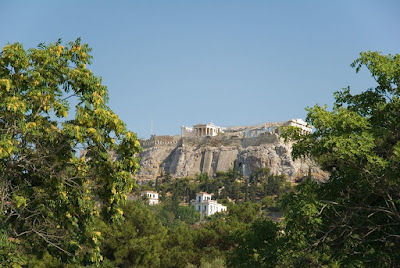
Monastiriki to stroll the Agora museum while Richard took his camera up to the Acropolis – his first visit.
* * *
On Friday afternoon we got back from the birthday party in Athens and were in Ano Korakiana – this time with Richard and Amy. Richard, especially, was fidgety “We’re stuck here in the middle of nowhere”. Hurt, I almost but didn’t reply that he’d said that as tho’ it was something bad. Later in the day Lin drove us by flowering oleander to our pebbly beach inside Cape Kephalopsos – entered via a small track through the growing rubble at the south edge of Ipsos harbour. In no time Richard was off to hire a scooter. Amy and I swam leisurely in the warm sea while Lin read in the shade of the myrtle, wavelets slapping the shore by her toes in this blighted Eden. Before she and Amy had arrived I’d filled a bin bag with rubbish washed up on our tiny strand alone, while reverberating across the grand vista stretching between the Albanian shore, Epirus’ haze and the villa'd slopes of Pantokrator the engine noise of cars, motor boats and aircraft. The serenity of this place, before we learned the art of capturing energy from exploding oil, can still be glimpsed at sunrise in winter. Slower economies make the poor picturesque, donkey-born poverty invisible. The sail strewn past is history. And still my jaded metropolitan eye notes the travel pimps' descriptions
‘unspoilt’ (over 2000000 hits on Google!) above italicised details on ‘how to get there’. Always, said JH, to avoid disappointment, go and live somewhere ‘already ruined’. In 1993, the year before he died, Jack wrote, for our reading: ‘Love of the Country - Ode to a book I never wrote’:
Did they think about the skylarks when they built Mayfair
on the grazings that ran down to the Shepherd’s Market?
Did they worry about the snipe when they drained the marshes
behind St.James’s Palace to build Belgravia?
Where did the kite go when they dug the London sewers?
Do the piles they drove down through the beaver’s dam hold
firm the supermarket in Newbury High Street?
Who cooked the big trout that lay under the village bridge
at Wandsworth? Who feasted on the last salmon that was
netted at Tower Hamlets?
Now they come to put central heating in the ploughman’s hovel.
They claim the sun that used to bake the hay. And breathe
the breeze in which the pointing dog caught a hundred scents.
They walk out in trainers and T-shirts that say “Save the
Rain Forest”.
“Stand back!” they say. “We have a right to walk where we please!”
But we look where they trod before and shudder for what
follows in their footsteps.
I said I must write a warning. But I was angry and - as the
Japanese say - to be angry is only to make yourself ridiculous.
So we will live out our days in the cracks between the
concrete. And then they will pour cement on top of us.
I note the reproach, knowing ‘us’ excluded no-one. J wanted to write, I think, a final book about how to live without vexed dissimulation, arrogance or isolation. One element was a modern transhumance – the old pastoral seasonal journeys aimed at getting the best for their stock from different but familiar places, observing the migratory cues of flocks and herds. This included mental travel, moving at mind-speed across the patchwork eiderdown of his learning about the past and curiosity about the future. I wonder if J read
The Songlines. It was published in 1987, hardly a year before Bruce Chatwin died in January 1989, when Chatwin must have known his future. I read it just now, after my short adventure in Australia. Chatwin wanted to learn ‘not from other men’s books, what a songline was – and how it worked’. His exploration, guided by a selection of unique and richly self-educated people, is deep referenced to insights from earlier travels…‘the more I read, the more convinced I became that nomads had been the crankhandle of history…’ (p.19). Chatwin followed my reading of a
concise history of Australia, in particular a chapter about the catastrophic two century encounter of European and pre-neolithic peoples in Australia. History, to quote Durrell (in P
rospero’s Cell 1945) ‘with her painful and unexpected changes cannot be made to pity or remember: that is our function’. This function Chatwin fulfils with engaging wit, finding just the tone for the mess strewn across the commonwealth by that collision – not ‘the
fatal shore’, no ‘
black armbands’, even an open-eyed optimism (given Chatwin’s closeness to death). Of another group of destitute outcasts in the Saharan Empty Quarter - the Nemadi - Chatwin told his chief Australian guide, Arkady Volchok (I don’t want to know where he is now, or not at once) a story of a greeting, ‘a few warbled notes’ and a three minute smile - over a chasm of separate experiences - from a woman of ‘more than a hundred’ called Lemina. That smile, C told A, was something he lived with:
‘...like a message from the Golden Age. It had taught me to reject out of hand all arguments for the nastiness of human nature. The idea of returning to an ‘original simplicity’ was not naïve or unscientific or out of touch with reality. “Renunciation”, I said, “even at this late date, can work.” “I’d agree with that,” said A. “The world, if it has a future, has an ascetic future.”’ (p.133)
* * *

On Thursday evening the family and friends sat in a restaurant in Kifissia overlooking the vastly scattered lights of greater Athens. A breeze blew across Attica, ruffling hair – almost cool. My sister-in-law Kate was enjoying a barney across the white table cloth, beneath plentiful food, water, wine and Diet Pepsi, about the virtues of a hybrid car – she and G having bought one - the boon of supermarkets, railing at sentimentalist dreams among the prosperous about the mulish drudge of local shopping for sweated food, while arguing for global unions to regulate food prices. I’d started the evening by saying, jokingly, “hurray, we can talk about allotments”, a matter on which my assumptions are muddied, especially amid the joy of family table talk. I faltered and Lin entered the debate. Later I smiled quits to Kate as we headed back to our hotel. “Did you respect the way I deployed my relentless logic to demolish your case?”. “Yeah yeah. I love a good debate” she smiled her quits.
* * *
R, me, Lin and A went out for supper in Ipsos at the Bonita. Lots of scooters, strollers and boom boys passing pell mell – though word is that
Ipsos is ‘dead’, lacking the spending numbers it needs to thrive. A & R stayed on to seek a nightclub, finding one place with the critical mass to make an evening. Lin and I were home by 11.00 and found the neighbour’s family and friends spread across the steps outside their house celebrating young Leftheri’s 7th birthday.

Wending our way through the path to 208 we were beckoned to their table; served meat and cakes and wine from grandpa L’s garden. Young L’s sister, Dimitra and her friend Maria, - about 11 and 12 I think - spoke lots of English, taught by Katya S, wife of Thanassis. We shared favourites: school subjects, composers, musical instruments, football teams (we weren’t much good there. “Football – then katalaveno!” we grinned sheepishly), while everyone chatted to and fro and young L’s friends played in the alley and spilled onto Democracy Street, to be called back into the light around their table.
* * *
On out first evening back in the village – Friday late – we strolled, my family, up the gentle slope beyond the bandstand and towards the narrowing street that goes through little Venice. Some dogs barked, others sought stroking.


A hedgehog scampered across our path. Another played dead to avoid confronting two waiting kittens. Cats chased grasshoppers skipping between light and shadow. We saw glow worms in the verges; a large cricket sat squat on a wall where Democracy Street narrowed;


geckos hugged warm lintels scuttling away if any of us approached. Richard found a shed snake skin in a wall drain; hefted it gently out with Mark’s gift stick. In the house we saw and left cobwebs - a wasp trussed and husked in one.

Later in Corfu in the afternoon we saw lizards, irridescent beetles, a cicada, a hornet, fishermen watching another preparing a fish he’d caught and in our garden the shed husk of a grasshopper.

 On Thursday - in Athens - some of us left the hotel in a small coach with a guide to visit Poseidon’s temple at Sounion on the southernmost tip of the mainland, marking the entry to the Saronic Gulf, with safety for wind blown sailors both north or south of the Cape. I’d read, as a child, how King Aegeus had waited on this headland for his son’s return from challenging the Minotaur in the maze at Knossus. His ship stopped at Naxos where he abandoned Ariadne who'd helped him overcome the Minotaur, then on to neighbouring Delos where, amid celebrations for his victory, Theseus forgot to change his black sail to the prearranged white one to signal his safe return. From beside the temple, I gazed south and thought how, waiting for my son, I might have seen many vessels with white sails heading north and hoped, but then, at about the expected time for the annual return of the tribute vessel from Crete, glimpsed or pretended not to see, slowly rounding a hazy island headland from within the cyclades, a sail of undoubted blackness on course for Athens, and known the boy lost and a sheer drop close to hand. The temple occupies less land than nearby hotels – slender-scaled to the human physique - despite, as Anna, our guide, said, the craft being available to build on the scale of the pyramids. ‘Harmony between man and the earth - the thing we’ve lost … have always been losing and finding again,’ she said.
 While I toured, Lin read by the hotel pool, later taking the train with Richard and Amy to
 Monastiriki to stroll the Agora museum while Richard took his camera up to the Acropolis – his first visit.
 * * *
On Friday afternoon we got back from the birthday party in Athens and were in Ano Korakiana – this time with Richard and Amy. Richard, especially, was fidgety “We’re stuck here in the middle of nowhere”. Hurt, I almost but didn’t reply that he’d said that as tho’ it was something bad. Later in the day Lin drove us by flowering oleander to our pebbly beach inside Cape Kephalopsos – entered via a small track through the growing rubble at the south edge of Ipsos harbour. In no time Richard was off to hire a scooter. Amy and I swam leisurely in the warm sea while Lin read in the shade of the myrtle, wavelets slapping the shore by her toes in this blighted Eden. Before she and Amy had arrived I’d filled a bin bag with rubbish washed up on our tiny strand alone, while reverberating across the grand vista stretching between the Albanian shore, Epirus’ haze and the villa'd slopes of Pantokrator the engine noise of cars, motor boats and aircraft. The serenity of this place, before we learned the art of capturing energy from exploding oil, can still be glimpsed at sunrise in winter. Slower economies make the poor picturesque, donkey-born poverty invisible. The sail strewn past is history. And still my jaded metropolitan eye notes the travel pimps' descriptions ‘unspoilt’ (over 2000000 hits on Google!) above italicised details on ‘how to get there’. Always, said JH, to avoid disappointment, go and live somewhere ‘already ruined’. In 1993, the year before he died, Jack wrote, for our reading: ‘Love of the Country - Ode to a book I never wrote’:
* * *
On Friday afternoon we got back from the birthday party in Athens and were in Ano Korakiana – this time with Richard and Amy. Richard, especially, was fidgety “We’re stuck here in the middle of nowhere”. Hurt, I almost but didn’t reply that he’d said that as tho’ it was something bad. Later in the day Lin drove us by flowering oleander to our pebbly beach inside Cape Kephalopsos – entered via a small track through the growing rubble at the south edge of Ipsos harbour. In no time Richard was off to hire a scooter. Amy and I swam leisurely in the warm sea while Lin read in the shade of the myrtle, wavelets slapping the shore by her toes in this blighted Eden. Before she and Amy had arrived I’d filled a bin bag with rubbish washed up on our tiny strand alone, while reverberating across the grand vista stretching between the Albanian shore, Epirus’ haze and the villa'd slopes of Pantokrator the engine noise of cars, motor boats and aircraft. The serenity of this place, before we learned the art of capturing energy from exploding oil, can still be glimpsed at sunrise in winter. Slower economies make the poor picturesque, donkey-born poverty invisible. The sail strewn past is history. And still my jaded metropolitan eye notes the travel pimps' descriptions ‘unspoilt’ (over 2000000 hits on Google!) above italicised details on ‘how to get there’. Always, said JH, to avoid disappointment, go and live somewhere ‘already ruined’. In 1993, the year before he died, Jack wrote, for our reading: ‘Love of the Country - Ode to a book I never wrote’:
 On Thursday evening the family and friends sat in a restaurant in Kifissia overlooking the vastly scattered lights of greater Athens. A breeze blew across Attica, ruffling hair – almost cool. My sister-in-law Kate was enjoying a barney across the white table cloth, beneath plentiful food, water, wine and Diet Pepsi, about the virtues of a hybrid car – she and G having bought one - the boon of supermarkets, railing at sentimentalist dreams among the prosperous about the mulish drudge of local shopping for sweated food, while arguing for global unions to regulate food prices. I’d started the evening by saying, jokingly, “hurray, we can talk about allotments”, a matter on which my assumptions are muddied, especially amid the joy of family table talk. I faltered and Lin entered the debate. Later I smiled quits to Kate as we headed back to our hotel. “Did you respect the way I deployed my relentless logic to demolish your case?”. “Yeah yeah. I love a good debate” she smiled her quits.
* * *
R, me, Lin and A went out for supper in Ipsos at the Bonita. Lots of scooters, strollers and boom boys passing pell mell – though word is that Ipsos is ‘dead’, lacking the spending numbers it needs to thrive. A & R stayed on to seek a nightclub, finding one place with the critical mass to make an evening. Lin and I were home by 11.00 and found the neighbour’s family and friends spread across the steps outside their house celebrating young Leftheri’s 7th birthday.
On Thursday evening the family and friends sat in a restaurant in Kifissia overlooking the vastly scattered lights of greater Athens. A breeze blew across Attica, ruffling hair – almost cool. My sister-in-law Kate was enjoying a barney across the white table cloth, beneath plentiful food, water, wine and Diet Pepsi, about the virtues of a hybrid car – she and G having bought one - the boon of supermarkets, railing at sentimentalist dreams among the prosperous about the mulish drudge of local shopping for sweated food, while arguing for global unions to regulate food prices. I’d started the evening by saying, jokingly, “hurray, we can talk about allotments”, a matter on which my assumptions are muddied, especially amid the joy of family table talk. I faltered and Lin entered the debate. Later I smiled quits to Kate as we headed back to our hotel. “Did you respect the way I deployed my relentless logic to demolish your case?”. “Yeah yeah. I love a good debate” she smiled her quits.
* * *
R, me, Lin and A went out for supper in Ipsos at the Bonita. Lots of scooters, strollers and boom boys passing pell mell – though word is that Ipsos is ‘dead’, lacking the spending numbers it needs to thrive. A & R stayed on to seek a nightclub, finding one place with the critical mass to make an evening. Lin and I were home by 11.00 and found the neighbour’s family and friends spread across the steps outside their house celebrating young Leftheri’s 7th birthday. Wending our way through the path to 208 we were beckoned to their table; served meat and cakes and wine from grandpa L’s garden. Young L’s sister, Dimitra and her friend Maria, - about 11 and 12 I think - spoke lots of English, taught by Katya S, wife of Thanassis. We shared favourites: school subjects, composers, musical instruments, football teams (we weren’t much good there. “Football – then katalaveno!” we grinned sheepishly), while everyone chatted to and fro and young L’s friends played in the alley and spilled onto Democracy Street, to be called back into the light around their table.
* * *
On out first evening back in the village – Friday late – we strolled, my family, up the gentle slope beyond the bandstand and towards the narrowing street that goes through little Venice. Some dogs barked, others sought stroking.
Wending our way through the path to 208 we were beckoned to their table; served meat and cakes and wine from grandpa L’s garden. Young L’s sister, Dimitra and her friend Maria, - about 11 and 12 I think - spoke lots of English, taught by Katya S, wife of Thanassis. We shared favourites: school subjects, composers, musical instruments, football teams (we weren’t much good there. “Football – then katalaveno!” we grinned sheepishly), while everyone chatted to and fro and young L’s friends played in the alley and spilled onto Democracy Street, to be called back into the light around their table.
* * *
On out first evening back in the village – Friday late – we strolled, my family, up the gentle slope beyond the bandstand and towards the narrowing street that goes through little Venice. Some dogs barked, others sought stroking. 
 A hedgehog scampered across our path. Another played dead to avoid confronting two waiting kittens. Cats chased grasshoppers skipping between light and shadow. We saw glow worms in the verges; a large cricket sat squat on a wall where Democracy Street narrowed;

 geckos hugged warm lintels scuttling away if any of us approached. Richard found a shed snake skin in a wall drain; hefted it gently out with Mark’s gift stick. In the house we saw and left cobwebs - a wasp trussed and husked in one.
  Later in Corfu in the afternoon we saw lizards, irridescent beetles, a cicada, a hornet, fishermen watching another preparing a fish he’d caught and in our garden the shed husk of a grasshopper.


