Total Pageviews

Showing posts sorted by relevance for query "sea and olives". Sort by date Show all posts

Friday, 18 June 2010

Red sky in the morning

From Handsworth our son photographed a midsummer dawn
I'm miles apart in culture, experience and history from Tolstoy's character Levin but I was grateful to Google for recovering lines I remembered - vaguely - from the end of Anna Karenina, the part that has a happy ending for Levin and Kitty:
And Levin, a happy father and husband, in perfect health, was several times so near suicide that he hid the cord that he might not be tempted to hang himself, and was afraid to go out with his gun for fear of shooting himself.
It was those lines I recalled because as Tolstoy points out Levin has all that might be associated with content - a long loved woman as his wife, delightful children, material security, good health. Finding that memorable passage again I saw it was preceded by Tolstoy's speaking of himself.
All that spring he was not himself, and went through fearful moments of horror. "Without knowing what I am and why I am here, life's impossible....In infinite time, in infinite matter, in infinite space, is formed a bubble-organism, and that bubble lasts a while and bursts, and that bubble is Me." It was an agonizing error, but it was the sole logical result of ages of human thought in that direction...
War and Peace and Anna Karenina - Tolstoy's most majestic works; their indirect narrators Pierre Besuhov and Konstantin Levin - both embodiments of their author, sensitive to the charged implications of privileged status amid casual oppression, unrelenting servitude, the ebbing sea of faith, the improbability of God despite fervent attention to liturgy, holy text, observance of the rituals of penitence and devotion. Happiness harbours grim contemplation.
A damp day in Birmingham
The worst economic depression of our times is still not that obvious. History books compact the 'depression' into points on a time-line, an event with a beginning and an end; a word. I'm primed by distant reading to expect a contemporary re-enacting of sepia images; cloth capped queues, shuffling figures in ragged trousers on fluttery film glancing askance at a man with a camera, freeze-framed misery from the nation's family album. I'm a high latitude tourist cruising close to the sheer of a tidewater glacier from which chunks of ice crash into the sea, or, breaking away underwater, surge from the depths. Spectacular but not disastrous. All glaciers calve at the sea. Like peine forte et dure in which weights were gradually piled on the condemned there's no abrupt dislocation. Functionaries keep reminding semi-stupefied participants of the formidable seriousness of the situation...repeatedly...to a point where, like Giles Corey, we cry for "more weight!"
The process is unpredictable, probably inexorable, and because its woven into the present, nothing like the neatly composed narratives of past crises. Everything's mixed up; daily highs and lows obscuring a longer wave - mild until it steepens, curls, trips and breaks. We hear less about 'green shoots of recovery'; less about light at the end of the tunnel; more about changing our way of life, about hard times into the future.... and 'hard times' means? Our leaders avoid being drawn on detail. They can't surrender the appearance of being in control. Big projects are being abandoned, construction workers laid off as banks foreclose or governments cut. Middle class investment becomes negative equity. Nest eggs dissolve. Pensionable age advances. Pensions lose their value. Hospital waiting lists lengthen. There are fewer and lower benefits and concessions - like winter fuel payments; fewer government training schemes, fewer business start-up grants, more expensive care - for young and old. Less respite for carers. The mesh in the net grows wider, protecting fewer. Sovereign risk becomes normal. Failure the fault of the failed.
Latest from the Independent Treasury Economic Model - ITEM - interpreted by Ernst & Young - 'tightening of more than £48bn required to eradicate structural deficit...'
From the YouGov site these polls:

Consumer Confidence Trackers

Economy Perform Chart

Standard of Living Chart

Kathimerini 19/06/10 on the end of the Greek welfare state. See also 'Young Greeks' in LA Times 12/06/10 See Teacherdude's photostream from Thessaloniki - this for instance and the accompanying words...
Sometimes it's the little thing that show you how grim things are getting here in Thessaloniki, the long lines of taxis waiting at ranks for customers to turn up even in the middle of the day when up till recently getting a cab was next to impossible. Or perhaps its the accents of wandering street vendors who are now more likely to be people from the city than some recently arrived immigrants from West Africa or a member of Greece's Rom community. The city centre has become a near ghost town on week nights, a mere shadow of its former, vibrant self with cafes uncharacteristically quiet and empty streets, this in a place that prided itself on 4am traffic jams...
** ** **
As a PCSO Amy was a steward of public space - armed with her wits and connections via radio and CCTV to the police. Now, though still in training, she's becoming a centurion - with powers of arrest, doing intensive homework on the legal framework within which she must exercise those powers; armed in a literal sense, with a baton, handcuffs, pepper spray and a stab-proof tabard, techniques for interpersonal negotiation, self-defence and methods of 'taking down' someone resisting arrest - things I've learned about, not from my daughter who's discrete about her work, but from the internet and observation.
* * *
An informative overview of the Greek pension system and how it will be reformed.
Led by Prime Minister George Papandreou, lawmakers will begin passing legislation this month to overhaul the system, which the EU and IMF say contributed to the country’s debt crisis. Under terms of last month’s 110 billion-euro ($123 billion) (note: in UK a billion equals 100 million; in US it is 1,000 million) bailout agreement, Greece will increase the retirement age to 65 from as early as 58, curtail early retirement and calculate payments over a longer period of employment...The bill will be the first enacted by Papandreou’s government since the May 6 package that pledged 30 billion euros of wage and pension cuts and tax increases over the next three years.
* * * Aris & Katie on their blog are stirring greater curiosity about olives - in particular the suggestion that British understanding of olive oil is akin to our understanding of wine in the 1950s.
I said that, at heart, I'm not sure English people actually like olive oil. They like the idea of it, or the idea of liking it (like Kundera's "second tear"), but not the actual product. Hence the concept of extra-virgin olive oil- actually a very technical assessment of its acidity- is transmuted into a fetish for the wateriest, most pallid, flavourless liquid. Despite its fabled parthenogenic origin, any Corfiot farmer would rather a blowsy dockside strumpet of an oil than a timid virgin; though it would be a job to convince, say, Jamie Oliver, that cloudy green Greek oil is better than translucent bottled-in-Tuscany olive water...He said - I think astutely- that olive oil in the UK now is where wine was in the 1960s. We know it's a good idea, but we still think Blue Nun is the best the world has to offer. Corfu Olive Oil blog ~ 9 June 2010
Leftheris has educated me about some of the varieties. I'd like to learn more, that for instance the Corfu olive is called Lianolia Kerkyra. Perhaps we should visit the Triklino Vineyard, off the Pelekas Road out of Corfu Town, where a fire in 2000 destroyed a thousand of the family's olives, so that now they specialise in wine while showcasing olive cultivation. This table, among many, introduces the range of Greek olives - a first lesson, my heart full hearing a Greek friend reciting the names - an olive oil litany - Ποικιλίες ελιάς. In the centre our own rain loving Lianolia Kerkyra - Λιανολιά Κερκύρας - Souvlolia, Korfolia, Prevezana, Dafnofylli - Σουβλολιά, Κορφολιά, Πρεβεζάνα, Δαφνόφυλλη - from Corfu, Paxi, Cephalonia, Zakynthos and the dry shores of Epirus.
The Most Important Olive Varieties In Greece
Variety
Other Names
Main Regions
Table Olives
ConservoleaAmfissis, Artas, Violiotiki, Hondrolia HalkidikesCentral and W. Greece, Halkidike
KalamataKalamatiani, Aetonychia, KorakoliaPeloponnese, Crete, W. Greece
Oil-Producing Olives
KoroneikiLianolia, Psilolia, Ladolia, KritikiaPeloponnese, Crete, Lonian Islands
Lianolia Kerkyras(Corfu)Souvlolia, Korfolia, Prevezana, DafnofylliCorfu, Paxi, Cephalonia, Zakynthos, Epirus Coast
KoutsoureliaPatrini, Patrinia, Lianolia, LadoliaPeloponnese, Nafpaktos
MastoedesTsounati, Matsolia, MouratoliaPeloponnese, Crete
Double Use
MegareitikiPerachoritiki, Vovoditiki, Hondrolia AigiansAttica, Boeotia, Kynouria
KoloviMytilinia, ValanoliaLesbos, Chios
KothreikiManaki, Manakolia, KorinthiakiDelphi, Amfissa, Troezen, Kynouria
ThruboleaThasitiki, Hondrolia EvoiasAegean Islands, Attica, Euboea
Durrell in Prospero's Cell:
The entire Mediterranean seems to rise out of the sour, pungent taste of black olives between the teeth. A taste older than meat or wine, a taste as old as cold water. Only the sea itself seems as ancient a part of the region as the olive and its oil, that like no other products of nature, have shaped civilizations from remotest antiquity to the present..
Our little black island olives aren't the best to eat on their own, but Durrell's conflation of sea and olive reminds me of that commentary on the rivalry between Poseidon and Athena missing from the Parthenon pediment. No it doesn't, not really. It makes me long to be with Lin on Democracy Street gazing towards Prophet Elias on the hill and over the narrow sea to the Pindus mountains. That bright orange drawer - mouse-gnawed and wood-wormed - is now stripped, sanded, strengthened and polished and part of a cupboard we made from recovered wood.

Saturday, 7 May 2011

On such a day as this

Round about now – before we go to England for fourteen weeks with the various tasks awaiting there – I start to preen my pinions for departure, thinking of pleasant things to compensate for the hurt of leaving the village. Seeing our children, being reunited with Oscar dog, getting to work on the allotment, cycling again (I could do it here but the time hasn’t seemed right), working on Central Handsworth Practical Care Project - next meeting 19 May - with Edmund and the others involved, rejoining the Friends of Black Patch Park, going to the Highlands, walking there and making more films of my mother’s memories, continuing the project to find more of my stepfather’s programmes, tending the garden in Handsworth….watching the days pass until our return to dear Ano Korakiana looms closer.
** **
I call my construction a 'Zorba table' with no slur on Hellenic joinery - which we recognise as second to none - but because this convergence of an old set of table legs we found deep in nettles and abandoned floor planks amid greenery below our garden, imitates Z’s enthusiasm for impulsive imperfect contrivance as well as being a souvenir of the a fine day, the only sunny day in an April fortnight fourteen years ago, when we enjoyed a picnic by the sea in Crete. It was in a location that had recognisably - for anyone who'd seen the film - been used by Cacoyannis and now overflowed with eponymous tributes – Zorba’s Hotel, Zorba’s Taverna, Zorba’s taxis, Zorba’s whatever. At that time of the year we had the shore to ourselves and found to our delight a sunburnt shack with a rickety veranda on which stood a whitened table rimed with sea salt and a set of chairs similarly aged and there, under a cloudless sky and a chilly sea sparkling on the pebble beach still littered with last year’s plastic waste Linda, myself and my mum enjoyed cheese, bread, olives, tomatoes (with salt) and, retsina (fake of course but with a hint of the old resin).
“Put your table where we need it in the garden” said Lin “Let the summer sun go to work on it.”
It's strange to think that in a few weeks I'll be off to the Highlands to distress a vanload of new Barbour jackets being paid a generous fee to hang them on local barbed wire fences where they can be elbowed by Highland cattle, beaten with birch twigs, bombarded with sheep dung and genuine Scottish mud, trailed through the braes, steeped in peaty water, left in the game larder with some well hung game from 12 August on, so that by next winter they can be worn with pride by families collecting their children from schools between Highgate, Blackheath and Kew.
** ** **
This morning the weather’s jocund. A brisk warm wind has the sea bustling with white tops, slamming unattended doors, rattling shutters, jostling our washing as we hung it out to dry.
“My knickers only need one peg, yours need two”
“I have pants”
“Same difference”
“No way. What’s sexier? Off with your pants, or off with your knickers?”
“Take off your kecks?”
“Your kecks?”
“That’s a northern word”
“Hm. I like it”
Contented as we are on shore, it would be a joy, on such a day as this, to set sail for a day enjoying a steady breeze, seeing the passing coast as we head for a place to eat, a shoreside taverna or a cove to picnic and swim, but we’ve neglected our boat Summersong; lost our enthusiasm for sailing her. I who prided myself on my seamanship, who once sailed smaller boats across oceans alone and with a crew, have grown older, more nervous of the sea than when I’d set out on my open 17 foot gaff cutter to explore the Solent. Lin, whose sailed with me here and, shortly after we met in the early 70s down the unfriendly north Devon coast to the Channel Islands, during a summer of gales and in swells that hid a fishing boat a hundred yards away, is less confident of my competence now than she was. I’m loth to delegate any responsibility for this sad circumstance to Summersong, a 27” sloop boat that’s brought such happy adventures to its previous owners – Norman and Pauline who’d spent a decade coast-hopping her from Spain to Greece and beyond - and which after we’d bought her impulsively on eBay, brought us here to live, to make new friends and know new and lovely places. A bad carpenter and so on. Summersong is a safe sturdy boat but she’s not in an ideal condition to be taken out on a tideless sea subject to calms, zephyrs and local squalls – her rig, though in good repair and renewed, not handy for swift reefing, her engine untrustworthy. Engines and I have not been friends on sailboats. I prefer to sail from mooring to mooring, wait for a breeze, lie to or run before strong weather, but my age, the need to moor stern or bow to, the long calms and the need when short waves blow up to motorsail to get home before nightfall on a day out with friends, makes a stronger more reliable engine than then the rusty old 9hp Yanmar in Summersong essential. Apart from being difficult to start, the engine’s so old now, she probably delivers under 5hp.
I mentioned this to Mark. He said “Why not let Ollie have a look?” and arranged for his friend and workmate to look at Summersong at her mooring.
I was a little shamed to have Ollie see our old boat in the condition she's in after we've left her unsailed for a year, but here he was, standing on our cabin sole, assessing prospects. Lin and I waited for a verdict – he being an Australian navy trained marine engineer working for one of the finest-run yacht charter businesses in Greece. It came – modestly presented – as music. Something could be done, given hull, sails and rigging were in good repair; not at once, as until winter O was totally preoccupied with his work. "This engine's seen it's best days"  We needed a new one - or a good second hand one - in the region of 16 to 18 hp. He’d install it, replace the stern gland and tidy up its electrics. He suggested we buy engine and spares in UK, possibly on ebay; have them shipped here; a Volvo Penta MD2020 or a Yanmar 2YM16
"There are easily available spares around here for both of those"
“So what’d this all cost…and what can we do and what can you do?”
O mentioned a rough figure. I looked to Lin. She nodded.
“How long would it take?”
“The whole job could be done in a day and a half.”
“Blimey!” Kerkyra kelpies at bay, we could have a serviceable Summersong by next spring.
*****
Along the edge of Corfu’s five kilometers of dual carriageway between a large T-junction at Tzavros and the city lies the linear concretion that almost invariably gathers along big roads for motorized traffic making it difficult to identify places along the coast with which we’ve now become familiar.  The visitor, in the season, leaving the city to head up the east coast of the island, is treated, often amid hurrying trucks, coaches and cars, to a magnificent vista of mountainous Epirus and the edge of more precipitous Albania – peaks whitecapped into April. Between the mainland and the island lies the sea of Kerkyra, broadening to the south where even on clear days the mainland disappears into hazy distance, narrowing to the Corfu Channel to the north, where hardly a mile of water separates the two – the foreign shore almost treeless, rising bare and scrubby with few buildings, the other sprouting houses vying for the view amid thick groves of olives and clusters of tall cypress trees, the spinach green of Corfu, subject for a philippic against bad building and corrupt planning.
Along this shore – sometimes nicknamed Corfu's 'Kensington' for its wealthy and English reputation, it is possible, when sailing, to detect the unfortunate aesthetic effects, not of over-popularity which is utterly understandable, but of ill-judged architecture. The green complexion of Corfu, like so much of the Mediterranean littoral, is the victim of an infection, often not visible from the shore, especially from the terraces that afford such coveted views. From the sea it is possible, as did Gulliver on the delicate skins of Brobdingnagian royalty, to see budding wens, pustulant cysts. The rocky land, which once grew olives, extrudes concrete, attached to scarred escarpments as new tracks for cars rip zig-zag amid wrenched olive trunks, and pretentious new walls encroach upon ancient rights of way. The ass that carried olives is replaced by the tracked hydraulic digger. These are not the finely wrought mansions and outhouses of the signorini – houses that long ago created their own genius loci, but like the homes of the nobles amid their estates they are built isolated from villages, in which people who want to enjoy Corfu, could find a hundred lovely houses but which in the minds of those who encroach on the islands greenery present insufficient opportunity for display, the parking of many cars and the digging of swimming pools – yes water-appropriating swimming pools on the sea girt gem of Corfu (Alan Barratt several years ago applied his inventiveness to finding a substitute for these chemically made baths that would allow a rich home to enjoy its own clear water). These suppurating Lopachkin constructions coarsen the landscape of Corfu as once its signorini exploited the island’s peasantry.  Callousness towards people becomes callousness toward land. These injustices are not separate. Memories, conscious and unconscious, of inferiority, humiliation and poverty inform the aspiration of new builders, who unable to do what the signorini could do by way of dominating their ancestors, have determined instead to dominate the rural landscape, gradually, but remorselessly, turning it into a tree lined suburb of isolated mountebank mansions owned by absentees.
*** ***
I don’t need to be reminded that ugly buildings don’t make ugly people - there's no connection. I’m from Birmingham for goodness sake. At Kontokali, where it blends with Gouvia there’s an unpromising peninsular of newish building between the old road that once connected separate villages, and the short motorway out of the city.
Here at number 24 on The National Road of Paleokastritsa, has been since this January, The Lighthouse, Ο Φάρος, a new community centre, its undistinguished front on the main road across from a Mercedes showroom, and its back on the old road. It’s financed and managed by the Greek Evangelical Church of Corfu, Πνευματικό Κέντρο, Ελληνυκής Εναγγελικής Εκκλησίας Κέρκυρας   – www.geccorfu.gr.  Carol Murphy would nowadays be described - probably not her preference - by that superflous compound, an ‘active citizen’. Among many other things she organizes table top sales at weekends which is how we’ve been coming across her since arriving in Corfu. She told us of The Lighthouse.
Carol Murphy at The Lighthouse
The other Saturday we visited a bazaar there. The church and its congregation including Carol have initiated an impressive new facility – providing open house to all faiths and – as Carol said “no faith too. All welcome.”  On two spacious floors the place is open mornings and afternoons all week except Sunday and Monday, with evenings reserved for events, which the Pastor, Miltiades Pantelios, Μιλτιάδες Παντελιός, told me would make the place self-financing.
Pastor Miltiades Pantelios
There’s a lecture room with audio-visuals which can also be a function room for exhibitions, meetings, seminars, parties and weddings. There’s a well furnished drop-in space with comfortable chairs, sofas and tables with WiFi and computer consoles with games, table tennis, a music player and children’s library with a serving area for coffee, tea, orange drinks and light snacks. There’s also a secure space for young parents and their children with a play area monitored with CCTV. We liked the filter coffee there, the lack of blaring musak allowing us to make phone calls and do our email and sit and chat with Carol and briefly with the Pastor. It’s a good place and these are pleasant good people with an especial concern for young people who may be at a loose end or indeed anyone seeking succour in this busy fragmented world. I hadn’t realised that the Greek Evangelic Church had been around so long, the first founded in Athens in 1858. The Corfu Ministry was started nearly 80 years ago by women. Under the leadership of John Boukis it grew and spread believing in the Nicene Creed but with no allegiances that maintain the old filioque disagreement that has so long separated Latin and Greek Christians welcoming all who are tired, disappointed and scared. The Pastor told me of the Church where he holds regular services at 1100 on Sundays in the city at 3 lakavou Polila Street near the seafront of Garitsa Bay, services in Greek with simultaneous translation.
*** ***
So the UK referendum on Alternative Voting has ended with a continued preference for the existing First-past-the-post system. Results. And see via Corfu Blues what Bagehot has to say.

Sunday, 11 May 2014

Walking in the rain

"That's the most sinister olive"
It stood on its own in a meadow beside our path to Ipsos from Ano Korakiana
Pouring rain had set-in for the day.
Amy said “I’m walking with Oliver to Ipsos”
She and I have enjoyed walks since she was a baby.
“Can I come?”
“If you like”
Oliver’s in his raincoat. Amy and I have waterproof jackets. She carries a push chair down the rough narrow path to National Opposition Street, which runs three kilometres to the sea at Ipsos. We strolled eastwards along it until we came to Angeliki’s house, a kilometre outside the village.
“Shall we take the low road?” I said.

Just there, a concrete track leads down into the woods through olives and cypress, edged by brambles reaching out their salad tips, hollyoak and elder, vines, proliferating wild flowers and long grasses. We could have been walking in Scotland. So much fauna is the same, especially in the rain. Our route does the descent to sea level more swiftly than the metalled road hill from Agios Marcos, whose houses we glimpsed above us. Now and then the rain relented. But, even when it returned as we reached the estancias near Ipsos, it mattered little. Oliver enjoyed delaying us to stand and paw the puddles. Captive dogs barked furiously through the chicken wire of the small-holdings, where we glimpsed the heads of sheep and goats peering from their damp shelters.  I enjoyed imitating chickens and trying to gobble like the turkeys.

We came across an ostrich. I mistook it in the shade of dripping trees for a pile of brush. It unwound itself and came silently to inspect us; next, a damp pasture, shoulder high with greenery and yellow flowers, goats and their kids feeding beside a dry stone wall...
A meadow near Ipsos

...then up a small slope and round a bend between houses and we were on the Ipsos seafront edged by a glassy grey sea, with under a kilometre to Sally’s bar, where Guy met us with a load of wet things to get tumble dried at the local laundromat
*** *** ***

Lin and Amy collaborated hanging up the blue tarp we’d brought from England to shield us from rain falling through the planks of the timber balcony. They got me inserting eight cup-hooks in the beam that runs along the house side. The tarp was neatly stretched to these. The challenge; how without over tensioning it to suspend it at a gentle angle out from the house above the veranda so that rain falling through the balcony would not form pockets that would split the fabric, at the same time making it firm enough to hold steady when the wind blows strong. Makeshift guys were attached along with thin rope to give under-support.

“Later we can replace these with bungee cords and hooks, so it’s simpler to put up and take down”. They worked at it all morning under grey skies...

...left it hanging neatly before heading off to enjoy the north of the island and even find sun. Rain came sweeping over the village. The awning worked, coping with the weight of the small puddles that collected at the foot, maintaining a dry area in the veranda
“Mark one awning is good” I said
Abruptly, as we'd hoped but not expected, the rain and mist cleared. Our children and friends had found their way to a taverna at Palia Perithia. As they sat to eat at the first taverna on the left - Foros being closed for three days - the sun came out for the rest of the day.
What enjoyable events we managed to fit into the time our visitors were here!
The weather played with us and we with it. One moment the washing’s on the line to dry in early sun; but then grey cloulds gather and it rains and the washing’s bought swiftly inside to dry in front of the stove…
“A log-fire? In Greece at the end of April?”
“Yes indeed”

But a hope of warmth as the sun re-appears has us lifting the loaded clothes horse onto the balcony, not quite risking the clothes line again. Sure enough the rain returns and the clothes stay indoors to dry – slowly.
But we set out in the two cars – Liz, Matt and baby Sophia, Amy and Guy and small Oliver, and Lin and I. We find parking in town and walk to the Liston looking in shops, then head for Kanoni where a hundred feet above the sea we gaze out to Mouse island, Vlacherna Monastery and the airport runway.
At Kanoni

Voyage to Mouse Island

Oliver lands with mouse on Mouse Island
Liz, Matt, Sophia and small dog, on Pontikonisi


The boatman had taken us out to Pontikonisi - 'Mouse Island' for the wriggly white zig-zag ascent to the church on its summit that looks from the further shore like a tail to a mouse - the church - and left the small place to us, but for two yappy but friendly white dogs, one with a litter of pups behind the tiny counter of the small shop next to the church; a peacock perched on its porch. Returning we strolled on to Vlacherna. A cat carefully posed for us and other tourists.
At Vlacherna Monastery


A few days later, another walk on a sunnier day;
Liz, Amy, Lin and Oliver on Democracy Street

...we strolled down the west end of the village to the Sidari road, crossed over to the back road that wound upwards through woods and fields, past a smooth grazed meadow...

....beside oaks and olives and the wild flowers, now bright, welcoming bees.
Old friends - Liz and Amy - walk on ahead

I pushed Oliver and watched the beloved ones strolling ahead chattering – like the many walks we’ve taken in other lovely places, especially by the sparkling Farnack...
Liz by the Farnack in Strathnairn

by the ruffled sea of the Moray Firth...
Lulu by the Moray Firth

... and in Handsworth Park. Heaven must include walking. At the highest point we arrived where we could glimpse the two pronged outline of the old fort in the city glinting in the sun and the blue ribbon of the sea of Kerkyra running south toward hazy mainland mountains.
*** *** ***
Visiting the city again...
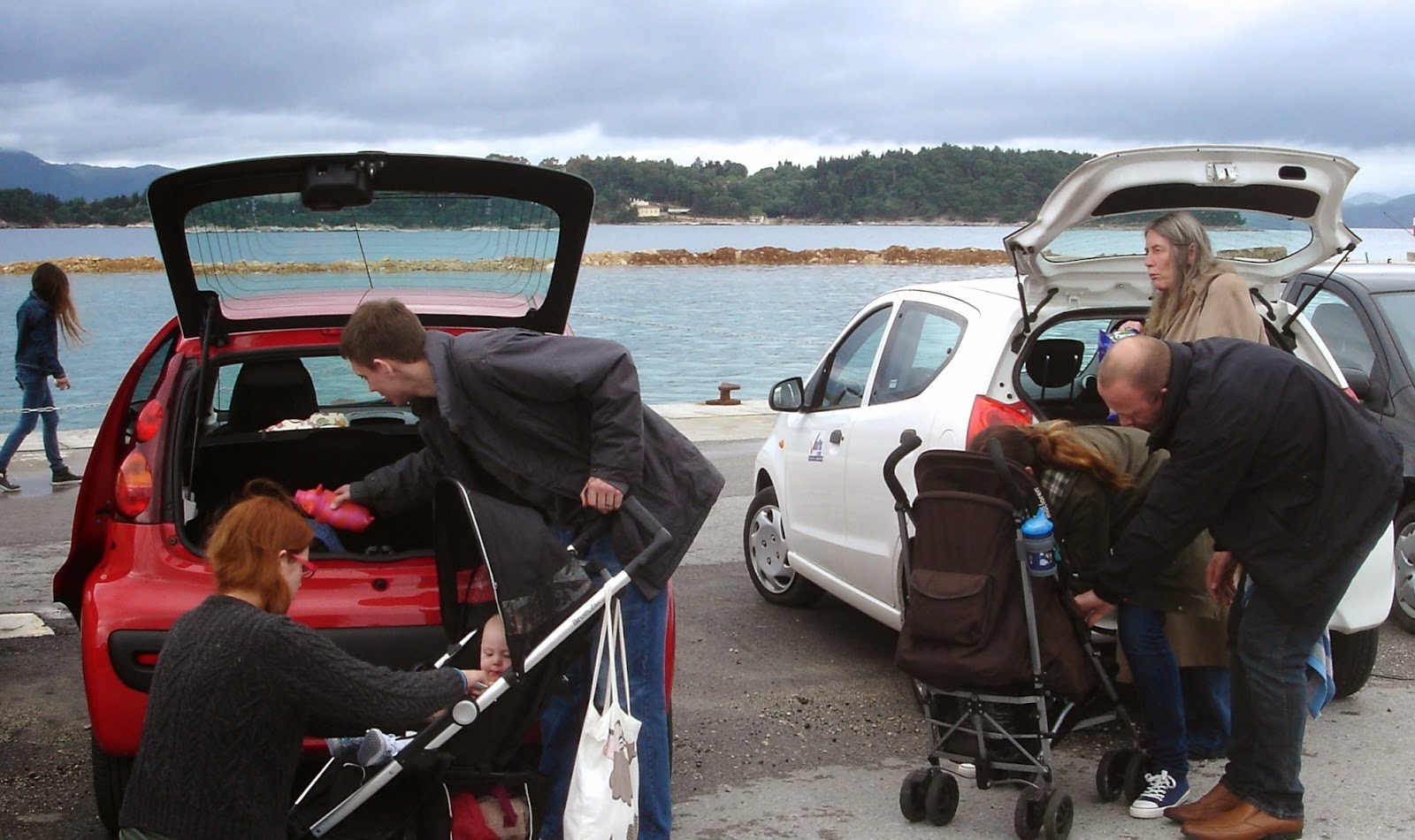
The car park next to the sea in Corfu Town

...we parked the cars, loaded push-chairs, split up and separately wandered the streets of the city meeting up for ice creams and heading back to the car park by the sea.
The Liston

It had rained all morning but now the sun showed. We sat on the quayside below Faliraki gazing at a tug nudging a rubble-filled barge into place at the end of the rough mole that will form the outer edge of a long-planned marina.
“Only a year ago” said Lin “there were high blocks of concrete all along here blocking the view. Three metres high! They were going to be part of a new marina. Loads of protests! Common sense prevailed”
“Where did all that concrete go?”
“Floated out to sea. Sunk in deep water, I suppose”
“Broken up too”
One of the two cruise liners for which the new harbour at Corfu is so perfect sounded a long bass siren to alert passengers to wander back on board from a day visit to the city.
Matt had been reassuring me that yet another day’s familiar mix of sun and rain – so unexpected after Easter and on the edge of May – afforded intriguing mixtures of cloudscape...
The view south from Ano Korakiana

...that “in many ways” made his views of Corfu more interesting than the unconditionally sunny days Lin and I had hoped for our dear guests. It was polite of him, but indeed he was right. The play of light on the sea, the ships, the buildings and the coast of Greece across the changing surface of the narrow sea that lapped placidly below our dangling feet gave us panoramas of altering colour and shadow.
The tug shunted back and forth for half an hour before the small crew aboard the barge were satisfied with its position. We sat and watched and chatted and joked about yelling “You don’t want to do it like that”.


As work continued on the mole, the cruise liner slipped elegantly from her berth into the channel between us and Vido. We tried to read her Russian name as she headed briefly south into deeper water. A small fish splashed as it jumped from the clear water of the harbour.
“Being chased by something larger, I expect”
Abruptly the barge’s position was right. A rumbling tumbling sound came to us across the silvery water. A mound of sandy rubble sank; the hull of the barge rose from the water.
“Look the barge has unfolded!” I shouted.
Unloading rubble in the Old Port

It had indeed split stem to stern port and starboard. We could see the dark wedges of its unfolding as it opened itself; its sides, from sea level, swinging out from the perpendicular. Rubble slid into the sea churning the calm. The tug headed off almost invisible behind its emptied charge whose hull slowly closed again. Once in the open sea beyond Vido, the liner had turned north to head through the Corfu Channel and into the Adriatic.

“Next stop Dubrovnik?”
Minutes later the waves of her wake and those from the precisely dumped gravel arrived - mildly larger ripples lapped our perch. We watched the liner's progress; her sunlit hull growing small against the greenery of the mainland shore, dappled with sunlight through shifting clouds - sometimes dazzling...

*** ***
Whether by bee or by hand or by self-pollination, there are signs of fruit - almost certainly orange - on our small recovered tree.


**** ****
Feeling ill emphasises age. Things ache. Joints hurt; stairs, especially holding a tray, become a nuisance; sluggishness is a predominant sensation – a hint of that point made in survival situations
“Don’t let yourself go to sleep”
 “I wonder how Oliver will be when he’s in his teens?”
 “Don’t know but you don’t have to worry. We’ll probably have snuffed it by then” says Lin from another room “I think we’re tired out after having the house full for ten days”
 “You may be. All that cooking! I was mostly just being entertained”
Perhaps so much joy has to be followed by lethargy-breeding anti-climax, especially as we spent so much time getting the house ready for the family.
 *** ***
I was listening weeks ago to a chat on Radio 4 about the calculation of longitude and recalled how long ago I’d sat in a rocky cockpit in the Atlantic taking noon sites while my crew recorded the time. On impulse I picked up the phone:
Dear Simon. So lovely to hear you on the phone and sorry had to rush off. Every other Friday morning we run a 'Have-a-go Shakespeare' session in the local Arts Centre, and although Phil had gone on ahead I realised I had the scripts in the car. Haven’t looked at your link yet, but looking forward so much to seeing it and hopefully you all up to all sorts. If you want to see what we get up then look at www.shakespearelink.co.uk, its still a bit under construction but gives you an idea! If I started to tell you would take an age. We're having a bit of a refit on Vickie our 22 - she's 50 years old and deserves it, tho’ she does seem to get smaller as we get creakier. Lovely that you sail in Greece, how restful without the tides. It would be great to see you sometime - I suppose you would never come West? Love to you and Lin and all you guys, and from Phil xx Sue 
Dear Sue. I enjoyed reading your account of creating a meadow. I must scythe it for you!
The even mead, that erst brought sweetly forth the freckled cowslip, burnet, and green clover, wanting the scythe, all uncorrected, rank.
I’ve an allotment which is teaching me the aptness of the ancient curse ‘In the sweat of thy face..." I wish we did have tides. They make it easier to get around when there’s no wind and cheaper when anti-fouling. We have a grandson – Oliver, coming up 2, and a grand-daughter due in July...That Lin and I would be living a good part of the year in a village on Corfu struggling to learn the language...It was an impulse, now 8 years past. We go to and fro. You and Phil seem to have brought pleasure and happiness and understanding to so many people. Lin and I and some neighbours have started up (or rather turned round from insolvency) a local caretaker service in Handsworth.
I’m a white van man with tough gloves and we do street litter clearing, gardening of street planters and helping vulnerable people clearing gardens and moving furniture. Sounds like a penance I know, but we’re almost enjoying ourselves making something work...I’ve always felt in touch via that shared adventure in the dawn of our lives. Don’t worry about writing unless time and the right moment allows. I rejoice that you and those around you are OK, loved and happy, and that you have always made your life an adventure. X Simon 

Dear Simon. You put it so wonderfully, that's what it was, a shared adventure in the dawn of our lives, and we are inextricably bound because of it, for always, life and death and everything. I'm so very glad that you and all yours are happy and loved too, and sailing and I fully expect adventuring too...Meanwhile xxx S
Young Tiger in Bequia 1966

Memories occupy more of my mental ramblings than when I was younger. Of course.
What I cannot find words to explain is the glaze that seems to lie over those ancient experiences. Wordsworth wrote of infant sensations being bathed in celestial light. He was referring to the earliest recollections, of infancy; Proust pursued the spoors of his childhood; Eliot, the simultaneity of time past and time present. It’s a near unshareable subjectivity. But when I recall sitting at the tiller sailing gently eastward on a warm Mediterranean night - sailing towards Greece - bright with moon light sparkling small waves – the attempt at capture, as with a thousand other memories, sends the sensation into hiding. It’s the same with charts – the old ones that were normal until the 1970s; with hachures, used with the relevant Admiralty Pilot with silhouettes of coast lines and their features – for compass-bearing navigation; the throat constricting excitement - in a city chart-dealer on a grey winter day - of buying charts of distant places with foreign names where I planned to voyage. Those are a tiny sample. I was a child in my experiences until my 20s. The intervening half-century, full of the earthy shortening of expectations; earning a living, full of wholly different achievements according to standards that would have seemed disconcertingly banal – things that other people did, people I saw askance with a mix of pity, even contempt; striving for financially security, paying for a house, doing solid work for a salary, making a marriage permanent, planning licensed holidays of unfamiliar brevity. It was late that I adjusted to taking small pride in the grind. Now I respect and admire others who live in the 'light of common day’. Perhaps that adjustment explains the tingling sparkle of the memory of these early experiences - viewed through a distorting glass of a shifted consciousness; one that long ago would have seen my present as a failure to live anything but ordinariness. It’s not that I’m reading time-travelled postcards to myself saying ‘wish you were here’. I was undoubtedly enchanted, entranced; inside a waking dream. Yet at the time I am sure I would have been thinking not about the magic I think that I'm remembering, but about the duration of my watch and when I’d get to have a mug of tea and turn in as Chris, my skipper, took over, and where these charts and in what order they should be filed. Perhaps the part of my brain set aside for sorting my life’s plot was storing future delight
‘This will give you pleasure in old age. Now and at the time of your dying, that you had so much happiness and adventure to set you going.’
Agni in Corfu - we arrived in Summer Song


From the balcony at dawn yesterday (photo: Linda Baddeley)
Cycling up to the village
Talking breeze
With family at Strapunto

Back numbers

Simon Baddeley