Total Pageviews

Showing posts with label wine pressing. Show all posts

Wednesday, 9 October 2013

Cheese dream days

“It’s a cheese dream day” said Lin
“Go on”
“On days when it rained too much to go out, my mum promised 'cheese dreams' – cheese spread on buttered bread and fried”
“Toasted cheese sandwich”
“No 'cheese dreams'”
It has rained from the afternoon. I’m in vest, shirt and sweater. At night we need the quilt. Summer’s furnace light no long leaks through shutters, dancing bright motes of dust and sparkling mum's little chandelier we brought, so carefully packed, from Scotland.
“A few more days like this and the house will have lost the heat in its walls”
“We’ll be lighting the stove. Putting on our electric blanket”
But for brief patines of silver on the sea, rain and clouds advance our landscape from the south. There’s still an absence of the penetrating cold I take for granted in the Highlands, which - plus grief - set me back last winter until we returned to Greece at the end of March, when 30 minutes with a Greek doctor cossetted me to health, along with antibiotics an English GP wouldn’t prescribe, plus generous possets, at the Pyrgi doctor's suggestion, of chicken soup from Cinty down the road.
On Wednesday in sunny weather I was helping Lefteris, Foti and Adoni with pressing the last of their wine – some juice from Zakinthos grapes but some, this year, from Lefteris’ own garden, the weather not so hot as to wither them on the vine as has happened the previous two years.
After the final turn of the screw the press is unscrewed and taken apart and we dig our hands into the spongy cake of tsipira (what we call pomace) pulling it out in crude wedges to add to the garden compost.
Lin and I were invited to lunch as a reward for our help (as if helping is not reward enough!) and we laughed and enjoyed small crispy skinned fried fish, cold cod, bean soup, salad, bread and wine with all the family. We lingered as conversation grew into debate
“We are talking Politics” explained Natasha in English. You know Golden Dawn?”
 “Ne” I replied “Chryssí avga χρυσή  αυγά”
I know quite well the difference between αvgí and αvga, but, having decided to call them the 'eggvolk' I thought I’d try it out on Greek neighbours and was rewarded with hilarity. Lefteris observed how well the BNP are doing in UK, mentioning a double figure percentage he’d seen on TV. “They are thriving on present misery” we agreed.
I disagreed that the British National Party was having as much success in the UK as Golden Dawn in Greece; rather the opposite.
Cinty’s view, she shared with me later, is that one thing a lot of young Greeks especially won’t stand for, people who might, because of the crisis, be inclined to sympathy with the eggvolk, is the suppression of a right to speak your mind...“with the murder of Pavlos Fyssas they have shot themselves in their Greek foot”
*** *** ***
Lin and I have been using the rain to work indoors on the wardrobe in our bedroom. She's taken over management after I retreated frustrated at the intractability of the angles involved.
Drawers from Brin Croft; doors recovered from beside wheelie bins below Ano Korakiana
Under her guidance I’ve been planing and trimming surfaces, creating angles that accommodate the illogical geometry of the space in which we’re working. Shavings and saw dust proliferate but it’s slowly and steadily coming together.
This Saturday evening there was a knocking at our door. It was Angeliki and her mum Anna Metallinos. No they wouldn’t have a drink, wouldn’t stay, but asked if we’d like to come to the village museum.
“We never knew you wanted to see it. I’m so sorry”
This ισ a conspicuous slightly narrow building in the centre of Ano Korakiana we’d given up hope of visiting.

In the seven years we’ve been here it has never been open. Tactful attempts to seek an invite had not succeeded. We’d decided that the Metallinos Museum was not one, in the sense we had understood the term; not really a place open to visitors; rather a private house that happened to be called ‘ΜΟΥΣΕΙΟ’. A plaque tells passersby in Greek and English that ‘In this house lived and created his great work of art the first self-taught popular from Corfu sculptor Arestides Zach.Metallinos’. Two days ahead – meta-avrio - at 10.00 suited our bi-lingual friend and neighbour Cinty. She agreed to join us to help with conversation.
**** ****
I got an email from our solicitor in Scotland:
Dear Simon and Bay. Just a quick note to confirm that the sale of Brin Croft and the Lochan has successfully settled. The Purchasers’ Agents have authorised release of the funds and accordingly the keys have been handed over. With kind regards. Yours sincerely,  James Wotherspoon. Macandrew and Jenkins WS LLP
I could hardly not be anything but beholden to a house that stood close above the sweet river Farnack where, with my sister, I’d sat with mum as, at teatime on November 1, she breathed her last. The sale for a sum that derided shared pessimism and a rather mean Home Report – required in Scotland – vindicated mum’s good choice
Barbara, and her grandson Richard, at Brin Croft

*** *** ***
It seems hardly possible but it looks as if I may get my wish - a loose footed mainsail on Summer Song. I'm not a fan of the almost universal rig of modern yachts over the last 50 years - the Bermudan - preferring gunter or gaff. The Bermudan mast feels too tall. The sail though elegant is unwieldy and without a generous belly, and, in a world of sudden squalls, not easy, especially when single handed, to lower or even reef in a hurry. (see - parts of a sail) In the search for a seamless luff the Bermudan main is near married to its mast, running up a groove or hanging on slugs in that groove; an arrangement that's all about getting a tight luff to improve sailing close to the wind in competition - no great concern of mine. Summer Song's main has been a challenge when it come to reefing or furling.
Summer Song's main is a handful to furl or reef

Her previous owner, Norman, had been wont to stuff towels in the canvas he rolled round the boom to try and give Summer Song's main a wind-friendly shape when reefed. Imagine doing that in a sea and a stiffening breeze. So Dave has been drawing diagrams.
At Sally's Bar in Ipsos, Dave draws a loose footed furling main for Summer Song. Rob Groove looks on.

At first we thought of using another genoa rigged in the main triangle, but now he's found a mainsail that rolls up between head and tack, like a roller reefing jib; the type that reefs into a 'box' attached all up the back of a Bermudan mast; almost universal on modern charter boats. On the clew there's a sturdy pulley linked along the boom to a roller furling gear just below the gooseneck. All up the luff runs a stiff length of aluminium around which the mainsail furls and unfurls. The furling sheet runs from the clew pulley, just above where the main sheet attaches, to the furling gear and back to the cockpit so that both main and jib can be reefed from there.
"Blimey Dave! Make it happen"
"I've got the main and I think there's a furling reel fell in the sea up by the harbour. I'll go look in a moment"

Friday, 28 September 2012

Μέρες φθινοπώρου

From the Ano Korakiana website - 25 September - and Autumn is official
Katerina Fakiola
Μπήκαμε πια στο Φθινόπωρο και ο καιρός φρόντισε ήδη μια-διό φορές να μας το υπενθυμίσει… Οι διαδικασίες του τρύγου βρίσκεται σε πλήρη εξέλιξη, παρότι οι φετινές παρατεταμένες υψηλές θερμοκρασίες προξένησαν φθορά στην παραγωγή των αμπελιών. Ο κυρ Βασίλης Σαββανής υπολόγιζε τις προάλλες πως έχασε κοντά στο σαράντα τοις εκατό των σταφυλιών του και δεν είναι ο μόνος. Άλλα όμως αμπέλια τα πήγαν καλύτερα, όπως της Κατερίνας Φακιολά, που εκτός από τα δικά της, πάχτωσε φέτος και μερικές περγουλιές. Έτσι, με τον έναν ή άλλο τρόπο, το κρασί δεν θα λείψει και φέτος από το κορακιανίτικο τραπέζι…
The Kafeneon in Ano Korakiana
Όμως η αλλαγή εποχής έχει επηρεάσει και τη λειτουργία του καφενείου. Οι θαμώνες πλέον έχουν μεταφερθεί από την αυλή στο εσωτερικό, όπου μετά το «παιγνίδι» εκτυλίσσονται ενίοτε φλογερές συζητήσεις για τα τεκταινόμενα της εποχής…

It's wine making time in the village. The heat of summer caused many to lose most if not all their grapes. For at least the last two years this has not happened to Katerina Fakiola and her family. The  other evening, on our way to a delectable chicken curry on Mark and Sally's balcony, we passed by her house. Wine making was in full swing; pomace piling up and grape skins and water swirling down the steps, the unmistakable scent of fermentation wafting down Democracy Street. Katerina told me last year that her family grow a white grape better adapted to very hot summers. Others have to buy their grapes from the Zakinthos trucks parked at intervals along the main roads, bringing home what they need to press for wine in plastic crates. Meanwhile the cooler evenings has brought the regulars indoors from the terrace of the kafeneon, continuing their debates about what's happening in the world.
*** *** ***
On Nicholas Theotoki ~ 26 Sept'12
I was in town on Wednesday getting insurance for Summer Song from a new company via an agent recommended by Paul. I'd walked away from the previous provider after one of their employees started giving me the run around, angling I suspected for something extra in my annual payment. The new supplier knows his job, understands boats and gave me confidence. On the way to his office I stood to support a long march of public sector staff marching with banners up Theotoki towards San Rocco Square - all ages, occasional babies and toddlers and one or two dogs.


In Athens and Madrid there were thousands on the streets, mostly peaceful but by the end of the day, smoke, flames and violence. The news is always dire. There is no light at the end of this tunnel without imagining a different way of living.
Degrowth is becoming better understood - by a few - tho' across the world the numbers look significant. It's not a word that sounds good in English. I prefer décroissance, decrecimiento, decrescita. But even in English it's an improvement on the compromise phrase sustainable development.
Def: Degrowth is a downscaling of production and consumption that increases human well-being and enhances the planet's ecology and equity in its population; where societies live within their ecological means, with open, localised economies and resources more equally distributed through new forms of democratic institutions. Such societies will no longer have to 'grow or die.' Material accumulation will no longer hold a prime position in the population’s cultural imagination. The primacy of efficiency will be substituted by a focus on sufficiency, and innovation will concentrate on new social and technical arrangements that enable us to live convivially and frugally. Degrowth does not only challenge the centrality of GDP as the dominant policy objective but proposes a framework for transformation to a lower and sustainable level of production and consumption, a shrinking of the economic system to leave more space for human cooperation.
*** *** ***
I measured and drew diagrams and ordered the wood frame pieces back in April, having rescued a set of wooden shutters from the back of our apothiki and checked they'd suit the upstairs window of the sitting room - the one with the view towards Epirus and the sea. I dug out four hinges, collected the frames - cut and planed - from a timber yard in town, and treated them with sealant. Then we had to scrape down the old shutters, cleaning off flaking paint.
This September Lin applied the first coat of new green paint on frame and shutters; work made tedious by the detail of the louvres. Then came the delicate business we've never mastered of fixing a pair of male hinges on each upright of the frame. How do carpenters ensure they get this right? There are wrinkles we've not grasped. We laid glue in the chiseled-out insets for each hinge; then closed each shutter on them, having fixed the cross-bar of the frame to the top of the uprights - the whole assembly laid as flat as possible on a table under the veranda. When the glue was dry, with the shutter as tight as we could get it up against its upright, we opened it, and drilled - where necessary countersinking the hinge screw hole up into which glue had risen - into the wood to screw each hinge firmly into its upright.
The whole assembly was now ready for inserting inside the window just outside the mosquito net. We removed the shutters from the hinges; offered up the frame, held open at the correct width with a temporary strut screwed firmly across the two uprights.
To our delight it fitted.
"With all that measuring it bloody well should!"
"But for Sod's Law"
Now I drill through the frame, through countersunk holes already made, into the plaster and brick side and top walls of the window. The 9 holes are now marked with a small drill. I remove the frame again, and with a larger masonry drill make 9 holes into which I can fit rawlplugs. Amazingly the drill makes the holes where I want them rather than slipping off on a stone or entering a soft spot and making a far larger hole. We put back the frame and insert the nine holding screws.
"My god. They all match"
I screw them well in, the screw heads sinking into the countersinks, and the frame is firmly in place.
"Cup of tea!"
"Don't count your chickens"
We fix the shutters to the hinges. They nearly close. I sand some wood off the the places where the shutters are bumping into the top of the frame and try again until they fit near perfectly.
"Cup of tea!"
I fix a short rod in a hole carefully drilled through the marble windowsill, and another on a block attached to the top of the frame, against which to close and secure the shutters with the metal hooks originally attached.
All that's now needed is a second coat of paint and filling round the frame where it meets or doesn't meet the wall...oh, and some turnbuckles on bolts in the exterior wall to hold the shutters open in a wind.

Thursday, 13 October 2011

Grape pressing

A heady scent rises from Lefteris’ garden. The weather’s clear enough of rain for pressing grapes. The juice that’s begun fermenting in the large tub from last week’s crushing has been siphoned through a sieve into a tall barrel from where it’s been siphoned into glass flagons. The crushed grapes, left in the tub after most of the liquid’s been bottled, are now hand decanted into the barrel of the press, with a big saucepan.
The shallow threaded screw press turned with an iron bar ensures a steady stream of juice into a plastic bath from where it’s transferred in a wasp-waisted metal canister to a tall plastic barrel from which it’s siphoned into more flagons stored in Lefteris’ apothiki. The ratchet on the press is reversed – while working this I was minded of the Sherlock Holmes story about the engineer’s thumb – its hub turned back to the head of the screw, the wedges removed, and two halves of the press barrel held by sturdy iron twist bolts are removed from the cylinder of smooth pressed pomace, tsipoura, and left in the tub where they can’t collect dirt.
The pomace is eased apart and set aside as compost; not to make tsipouro. My small work on the press and earlier on the crusher attempts an exchange for all the bottles of wine Lefteris and Vasiliki hand us over the year.
Monday morning I collected Emma and my son Richard from the airport. Yianni makes it easy for them to share the car, so Richard drives us back to the village.
“Had a good flight?”
“Terrible. Turbulence from the time we took off and the plane was freezing. Then they said we could have blankets – for only £5.00”
Once home having not slept the night before they disappeared until evening.
By late afternoon I’ve finished helping Lin attach the rest of an old wooden blind, recovered from a flytip last year, over the scrawny wire fencing between us and the neighbours, so we can still see through and over to chat.
“I’m going for a ride on my large bicycle”
“OK. I’ll go on preparing the last set of shutters”
Guiltless I set about extracting the bicycle from where it hangs in the apothiki, blowing up the tyres, preparing a snack. I want to see if I can get up the 29 hairpin bend ascent to Sokraki, Σωκράκι - the village invisible above us on a ridge of the Trompetta Range, Τρουμπέτος  Οροσειρά, that runs east-west across the north of the island. At 4.30, gingerly, I set off. In 15 minutes I’m resting at Ag. Isidorus on the ninth bend above Ano Korakiana.
If I can pedal up this road I reckon I can cycle any road on Corfu. I expect to walk some of the way, but this zig-zag route has persistently kindly gradients. At each bend I skirt round the left hand edge of the bend – unworried by being on the wrong side of the road. Motors can be easily heard. The higher I go, still pedalling, the quiet envelops me. Nothing but the breeze, increasing with height. Unfolding below, the island's limits become clearer. On the first stretch of the road above Venetia I see between the slopes above Doukades, about six kilometres west, a wedge of glittering sea, while on the east of the island I can see the widening Sea of Kerkyra, θάλασσα Κέρκυρα, blue as blue skirting the island’s blighted shores and the distant bare slopes of the Greek mainland towards ugly Igoumenitsa in the haze, and all below the deep green of the island’s interior, in which nestle and blend traditional buildings – new and old - while here and there the thoughtless proportions and angles of buildings constructed in uncouth isolation from time and place.
Staying in the lowest of my 21 gears I find pedalling up each stretch easy. I’m pleasantly surprised, having expected to dismount and walk at several points on the ascent. I lose count of the corners, stopping now and then to rest and gaze at the widening panorama. In under an hour I’m sipping cold ginger beer at Emily’s Taverna in Sokraki along with a toasted cheese and ham sandwich.
I am pleased with myself and the bicycle. The sign at the southern entry to the village reads Trompettas. This is a new road built only a few years ago, to a lower specification than the ascent road, and here, heading west on the north side of the Trompetta ridge approaching mount TsoukaI I come to the only hill on which I have to walk for a kilometre. Beyond either verges are abandoned or ill-worked allotments with makeshift gates and collapsed fences containing a couple of rows of vines and a cluster of olive trees, in some cases a few rows of vegetables.
Rounding a bend I see the higher mountains of Albania north of Saranda and, down the northern slopes below me, villages - Klimatia, Episkopi, the hamlets of Kiprianades, Valaneo, Ag Douli, and further away Nimfes, Mili, Xanthates, Platonas and Sfakera, between the high road and Roda on the windy northern coast. Then my road snakes down to the hamlet of Trompetta on the busy main road between Corfu Town and Sidari and I hardly turn a pedal for six kilometres to Skripero. A couple of kilometres more and I turn for Ano Korakiana, up gentle slopes to home – the whole circuit in two hours with breaks for rest and a snack. As I pedal the last half kilometre a couple of people wave and I boast, in halting Greek, of my climb to Sokraki and return to the village
“Mono theo oras!”
“Bravo, Simon”
*** *** ***
On Tuesday the weather is once again sunny, as predicted by our neighbour who, being born 69 years ago in the same house he lives in now, knows pretty well how Corfu weather works. October, like Easter, is a good time to be in Greece. The rich who invented the present concept of the ‘holiday’ – not religious feast or holy days but secular relaxation – later offered the idea, as a utility for the rest of the population. The gift is topsy-turvy in that the prosperous could afford when they chose to follow the weather, leaving cold England to winter in the Caribbean, or North Africa, enjoying spring and early Autumn along the Mediterranean littoral. Holidays for the majority, when they were introduced as a result of social reform in the late 19th century, were taken in July and August – the warmest weather in the north, thus trains and charabancs decamped in thousands to the occasionally warm beach resorts of England and Wales – Blackpool, Brighton, Hayling Island, Rhyl, Yarmouth, Ramsgate, Morecambe, Torquay, Bournemouth and Ilfracombe to name a few. Then when in the 1960s mass tourism was invented, flying large numbers at low cost to the Mediterranean and beyond, guess which months were chosen, were indeed the only ones available to most? The months of a British summer, which in southern Europe are the ones when even local people, used to the heat of June, July and August, swelter, staying indoors in the day, observing siesta. In hundreds, then thousands and then millions, people travelled for a week or a fortnight at a time to the Mediterranean at the least salubrious times, suffering in their package sojourns sunburn and sweat, welcoming air conditioning, freezing drinks, and swimming pools with plenty of the shade less available on burning beaches. Now that package tours encompass the Pacific and Caribbean, guess again when the unrich have their holidays – in the humid heat of the hurricane season. Meantime the rich who’d wintered under waving palms by the bathwater warm seas of the Leeward islands, are yachting in the Baltic archipelago, fishing in the remote lakes of Saskatchewan, surveying the fiords of Norway, and observing the summer wildlife of Alaska, cycling in the Highlands of Scotland, chasing seasons of choice in both hemispheres.
** ** **
We carted our some loose plaka back to the house. Lin laid it to cover the rather pointless 'flower bed' that guided damp into the wall below the lower bedroom window.
I found a large floor membrane left by the builder under debris in our apothiki.
“Let’s try this on the wooden balcony”  I suggested “as an additional shield for the polythene sheet from sun wind and rain.”
Lin’s good with large ungainly pieces of fabric. In twenty minutes the membrane – part folded – was covering the balcony and with that protection for the polythene I laid out tables and chairs.
“There’s more needs doing” says Lin “Let’s put additional roofing felt patches, fixed with a silicone bead, on the outside edge of the balcony where we had to cut the felt and polythene to fit them round the nine banister pillars. The rain we had the other day found a way in there.”
Emma on the balcony, with its new covering
We peeled back the plastic and the felt from the damp edges to let the damp wood, felt and wet polythene dry under the sun. After a couple of hours we cut and laid the felt patches. Doing that properly took an hour. Then I nailed battens to the balcony plank edges all round after putting further silicone beads round every exposed joint at the base of each pillar.
“Rain’s due on Friday. Let’s see what happens.”
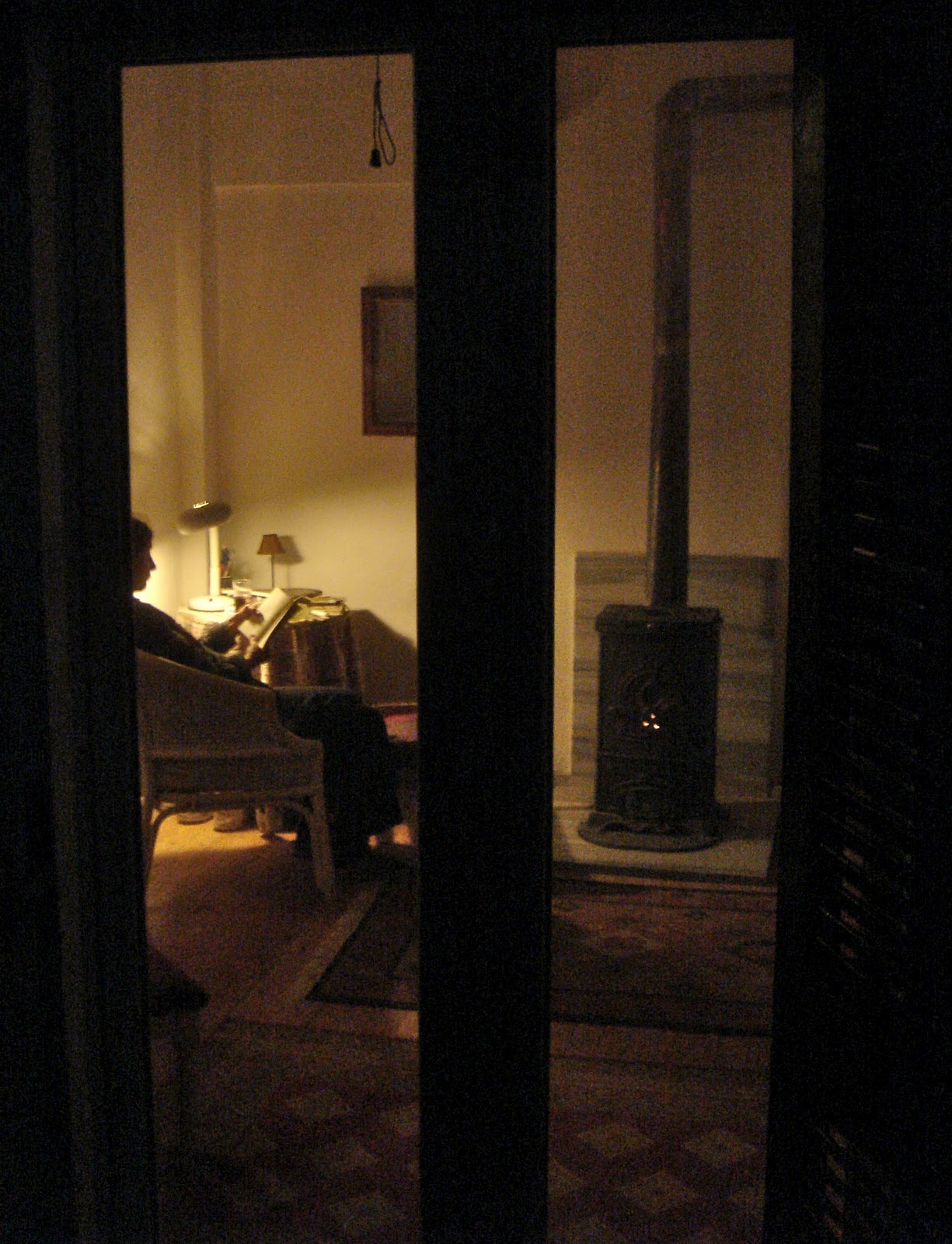
The last two evenings I’ve lit the stove.
**** ****
“You must have your work cut out at the moment”
I was talking to the evangelical pastor, Miltiades Pantelios, at the Lighthouse the other day - a place we go for the table top sales on Saturdays, the free WiFi and nice filter coffee.
“Yes indeed. The worst thing for people is the feeling that there’s no end in sight.”
“It brings out the worst but also the best in us, I guess” I added lamely, feeling an ache in my stomach, part of me wanting a kind of restoration of things as they were, but the larger part hoping this long storm of blighted hopes, this absurd and dangerous sequence of increasingly desperate attempts to kick-start a deeply unresponsive engine – with different kinds of stimuli, austerity, taxation, collateralisation, quantitative easing, selective devaluation, financial restructuring - will be as futile as I suspect, leading through many crises to wiser ways of living on the earth.
*** *** ***
Yesterday we went via Krini to Angelocastro; climbed the steps to the high fortress and had a family picnic under the oak tree there.
In the evening Richard showed us his three minute video of Handsworth Park. A pure delight. We all watched a few episodes of Little Mosque on the Prairie. I'm reading The Tiger's Wife by Téa Obreht, having just finished Kingdom of Ashes by Robert Edric - a novelist I'm more than glad I've come across.
Richard on Angelokastro Αγγελόκαστρο

Back numbers

Simon Baddeley