Total Pageviews

Showing posts with label Richard and Emma. Show all posts

Sunday, 3 March 2013

Travel


We slipped out of Ano Korakiana during a rain shower and caught one of the smaller ferries to Igoumenitsa - fares reduced 50%, it said 'military' on our tickets.  It was dark on the mainland and we dragged our bags along the rutted concrete to the Adriatic terminal, strewn with large friendly dogs and people watching TV football. We checked in to wait for hours for the Superfast ferry to Bari. We are familiar with this place. No-one we ask behind a glass screen is ever able to tell us just when these boats, equipped with 21st century communication technology and time to milliseconds, will arrive and depart. At best it's "soon" and "maybe". The digital arrival and departure signs are inscrutable, announcing events that don't quite occur. In the end we were on quay10 as a behemoth backed slowly up to the dock and lowered its ramps gently onto the concrete, inviting coaches, trucks and walking passengers to board.


We settle in the semi-darkness of the airseat lounge; stretch across several seats, sleep - fitfully - amid the rumble of the ship. In the morning the moon's still up, the sea mildly ruffled...

... and our time of arrival familiarly untrustworthy, an A4 sheet cellotaped on the purser's counter - so she needn't repeat herself - says 'ETA 11.00am Greek time'. By 11.00, land, which has appeared intermittently to port, is vaguely visible to the north east. Then a sharp turn and Bari mole emerged from the haze. By 1120 - 1020 local time - we were boarding Bus /20, buying tickets on board and being driven circuitously through chicanes out of the harbour and to Bari Station. On platform 3 we sat in the sun, ate our picnic, drank wine from plastic cups and read, until, after two hours, the express train to Rome drew in and we took up our reservations. After a stop in Foggia, our route turned west across Italy. At 4pm we dropped off at Caserta and crossed the platform for a double decker stopping train to Naples, where we'd been seven weeks earlier.
A man with a bicycle in a field south of Caserta


Small unfinished plots drifted by. I snoozed and read. The hotel had lost our reservation and was full. The receptionist phoned around and got us a room at the same price in the Hotel de la Ville on the opposite side of the square. We ate as we had when last in Naples, at Da Ettore...then to bed to catch a bus in the morning.
At the stop outside Central Station we were intercepted by a taxi driver who promised to take us to the airport quicker than the bus
"Just give me your bus tickets"
Inside the cab he asked for €10 more.
"Oh no" says Lin "we agreed just our tickets"
But at Departures I gave him €5.
"You're too soft, Baddeley"
He shrugged and we were dropped at the airport -  only a few miles away.  In the terminal we had deep chocolate ice cream and more reading.
Another hour and we were away to England, a train to London from Gatwick, then a coach to Birmingham and - our only one - a taxi home. We'd left the village at four on Wednesday afternoon and were home by 8.30pm Friday.
Leaving Naples

*** *** ***
In our hotel I'd had an email from Mike Tye in Handsworth - some passages in red:
Hope you can all make Monday night's Special Ward meeting at Welford School, 7pm. We need to be of one voice against these proposals to reduce services...(attachment)
Service changes to make waste management savings – February 7, 2013 Posted by Cllr McKay. A number of changes to waste collection services have been announced by Birmingham City Council in its 2013/14 budget following central government cuts to the authority’s finances.
For the 2013/14 financial year the council’s overall savings requirement is £102million. Of this, £6.57million relates to waste services and includes:
Bulky waste: providing households with ONE free collection per year (maximum 6 items). For each subsequent collection (maximum 6 items), there will be a charge of £25 per collection. This compares to the existing system of 3 free collections per year, with a maximum of 6 items per collection. The new charge is in line with fees charged by other councils (that typically range from £15 to £44).
Special street collections: A city-wide subsidy is being dropped, meaning that individual districts will have to use their own budgets if they wish to continue this service, which is a service uncommon amongst local authorities. These collections are a service that gives residents in an area a fixed day(s) beyond regular bin collection dates on which to put out additional bulky waste items out, to be collected by the council at no cost to the households taking advantage.
The provision of black and green sacks: The council spends £1million per year issuing one sack per week to households. Many residents already buy their own waste sacks. Residents will now be required to provide all of their own sacks from April 1, ahead of the council plan to roll out wheelie bins at a later date.
Green waste collections: In line with many other local authorities, the council will introduce a chargeable service from February/March 2014. This will be an optional service, and those wishing to take advantage will be given a free 240-litre wheeled bin. The annual collection charge, to be paid in advance, will be £35. Those not wishing to take up the service will have the option of buying a composter, at cost, via the council’s website. Fees charged by other councils who provide this service generally range from £18 to £56.
In addition to this, other measures are set to be introduced to meet the budget challenge caused by the cuts. They include:
City centre street cleansing: There will be a reduction in the overall level of cleaning – but there will be no compulsory redundancies. However the council is introducing larger capacity bins, fitted with a compactor to reduce emptying frequencies, and more automated technology to increase productivity.
Mechanical sweeping: The number of large mechanical sweepers that clear main arterial routes and some residential roads will be reduced from 20 to 15. This will not lead to compulsory redundancies but there will be a reduction in the level of service offered.
Your City Your Birmingham: It is proposed to discontinue these enhanced services (services provided over and above the standard service) and can relate to environmental crime such as fly tipping, fly posting, littering and dog fouling etc.
Cllr James McKay, Cabinet Member for a Green, Safe and Smart City, said: “Cuts to the services that help make our city a cleaner and greener place are not something that sit easy with me.
“However, given that the controllable part of the council’s budget – which we can choose to prioritise – will be halved by 2017, we are simply left with little or no option but to consider some major changes to our waste management service. What we have done is come up with a package that tries to minimise the impact felt by citizens, embracing innovation and modern ways of working where possible – such as with the introduction of wheelie bins, to replace a system that is firmly stuck in the last century. But we want to be open and transparent about some of the less palatable changes helping up meet our financial challenge - that is why we are giving as much notice as possible of our intention to introduce fees and reduce the level of services where applicable.
At home there was a letter from Connecticut dated January 14:
Dear Simon. I loved reading of your Mother’s Service, and most of all, loved the pictures down the generations. Clearly a very beautiful woman in the pictures of her, your father (I assume) and you as young child. I can see the evolution persisting after all the years have done and favoured us with.
The Thomas Hardy poem you read is a great tribute – to one who notices things. But I wonder whether Hardy hasn’t got the generations wrong in his poem. Isn’t the real gift of the living that they have imparted to others – family, children, friends – the gift of noticing, of being curious which causes one to notice all the wonders cited by Hardy. Clearly your mother is one who did so.
The death of one’s mother, one’s father and brother or sister is so intimate. One feels a hole in one’s life – even if the time for departure had come. But the hole is not nothing. As we have come to understand in the cosmos, the black hole, the emptiness is not no-thing. It is all possibility. That, I have come to believe is the gift of death to the living – the gift of possibility. Clearly your mother imparted that to you and her grandchildren.
Best wishes and warm hugs to you and Lin. Tony
Email from Jan D:
Simon. Hope next Friday is still on. Be good to chew over some ideas with you. Every day seems to bring something new and often unpleasant. Bankers bonuses are back in the news. It simply beggars belief that what are in effect publically owned assets can allow such total misuse of resources. It is difficult to comprehend how a business loosing £5.5 billion can still be allowed to allocate £650 mill in bonuses. The real worrying factor is that democratic processes and players are powerless or unwilling to stop it, even in a nationalised business. This demonstrates how ‘castrated’ democracy is becoming. Democracy, through elected government, appears no longer able to shape events and they even struggle to react properly to them. Instead they are becoming the mouthpiece of vested interests, trying to persuade us that the interests of the 1% equals the national interest. Very different moralities and psychologies are at play here. If you already earn millions you need even more millions to stay motivated whereas if you are on benefits you need your income cut further in order to be motivated to find work – a bit simplistic I know but to quote George Monbiot ‘Our own ruling class...lives in a world of its own from which it can project power without understanding or even noticing the consequences’ and ‘frontbenchers can rock with laughter as it truncates the livelihoods of the poorest people in this country.’ In conclusion he says ‘those who govern us do not in their hearts belong here. They belong to a different culture, different world which knows as little of its own acts as it knows of those who suffer them’  Not certain I fully accept this ignorance of their own actions but this sums up nicely the new ‘feudal’ elite. There is something strange going on here whereby democracy is spawning forces which are totally incompatible with it or perhaps it is not that strange at all (remember the Weimar Republic!). Look forward to hearing your views. Best Jan
*** *** ***
Saturday morning, The waste paper basket is full of junk mail. We'd clear most of the letters needing a reply the night before. Lin went off to see her parents for the day. I rode into town to post replies and to enjoy a mug of tea and a baked potato soaked in butter in the Rag Market and to buy paperclips and envelopes but mainly to be with Oscar on the canal towpath and in and out of the city side roads and through the walking centre on what feels like the first of Spring.
Round 2.00pm I met up with Richard and Emma at Cafe Soya for a swift-served delectable all day lunch special. My son's using a friend's version of Rosetta to learn Mandarin in readiness for his and Emma's visit to Beijing in April. I described our Michel Thomas Greek course which Lin had picked up for peanuts at a table-top sale in Corfu.
"I'm suspicious of any thing that says this sort of thing is easy, but we really like the method, a sort of three way conversation with pauses between the tutor and two students who now and then make typical mistakes. We've been leaving it on as we do work round the house. We've got a good friend who tutors, but I'd be interested in the Greek version of Rosetta. Whatever works! How much is your flight costing?"
"Very good deal. We reckon it's because the air pollution has become so bad there."
Back in Birmingham
We are going to miss Carnival in Ano Korakiana this March and we've just missed the opening of Stamatis' project - the café that replaces his shop opened for the first time on Saturday

Εγκαίνια απόψε στο χωριό… Ο παλιός φούρνος του Γιάννη Σαββανή στην Πλάστιγγα, αφού πέρασε από τη φάση του μινι-μάρκετ, μετατράπηκε σήμερα σε ένα πολύ όμορφο χώρο καφε-ποτείου. Η διακόσμηση περίτεχνη, με αποκάλυψη των παλιών υλικών (ξύλου, τούβλου, πέτρας), με προσεγμένο φωτισμό και με φωτογραφικά ασπρόμαυρα ενθυμήματα από παλαιότερες δεκαετίες. Ο Σταμάτης, επικουρούμενος από τους τρεις γιούς του, τον Αλέξανδρο, το Γιάννη και τον Άγγελο υποδέχτηκαν απόψε τους πρώτους πελάτες και πέρασαν με επιτυχία τη δοκιμή της εξυπηρέτησής τους. Στη νέα επιχείρηση που υπόσχεται ζωντάνεμα της «Πιάτσας», ευχόμαστε «καλές δουλειές»… 
Opening tonight at the village ... The old bakery that belonged to John Savvani, after passing through the phase of being a local grocery, was today transformed into a really beautiful place for coffee-drinkers - with elaborate decoration, display of old wood, brick, and stone, with imaginative lighting and black and white photo memorabilia from past decades. Stamatis, assisted by his three sons - Alexander, John, and Angelo - tonight welcomed their first customers and successfully passed the test of entertaining them. The new enterprise promises to revive the 'Piazza' and provide new jobs...(note: and the grocer's shop at the other end of the village will do more trade and we can still get our bread, wine and confectionary and mail just across the street from Piazza)

Saturday, 12 May 2012

Leviathan

Linda laid these tiles on our apothiki
We seem unable to avoid bickering. I suspect I am being pointed somewhere – on villages? communities? getting old?
“When I was very young” I said to Lin “I thought the default condition was tidiness."
People I hardly noticed cleared up after me and I didn’t even notice – having my nappies changed - I suppose I must have had them - my washing done, my food prepared. Later it was housework. I knew how to muck out a stable and clean tack – from enthusiasm for a pony – long before compunction to make a bed or clean up a room. The first space I learned to keep tidy – immaculately so - was the inside of a sailing boat – from enthusiasm for not scraping a mélange of glass, broken eggs, cutlery and clothing from the cabin sole the first time we hit a sea. I didn’t know houses needed maintaining until I was thirty. And I didn’t think about whether a community was sustainable – let alone worry about whether a village or a street worked until late middle age – 50 or older? apart
Now I’m seventy I recognise the default condition is mess, collapse, corrosion – a relentless conspiracy of moth and rust to corrupt. Without work- constant energy - things fall. I’m acquainted with the dust to which I shall return. Lin sees entropy all about – paintwork fades and blackens with smoke, walls that mould and bleed efflorescence, roof tiles that loosen and crack, invasive weeds, woodworm and termites, dry rot, wet rot, leaking joints, speckles of oxide lifting paint, bleaching wood shrinking in the sun. Something Graham Hurley wrote he’d learned researching his brilliant procedurals ‘that so-called “vol crime” would never go away.  It was like the weather, or gravity.’
Lin thinks a house can be made good; gets morose when I behave and sound unconvinced, but the Naz knew “The poor you have with you always”. Graham puts it ‘Pompey scrotes would never give up.  Never.  You could depend on it.’
Lin still seeks to drive up our Performance Indicators, but as the Bible’s first atheist wrote – to get past a censor – ‘Canst thou draw out Leviathan with a hook?’ Greeks invented philosophies that engaged with the despair that can attend housework, stoicism to confront the inevitability of unending maintenance, irony about its ultimate futility. Fatalism - μοιρολατρίαin - knowing dust will never give up.
Δύνασαι νὰ σύρης ἒξω τὸν Λευϊάθαν διὰ ἀγκίστρου; ἦ νά περιδέσης τὴν γλῶσσαν αὐτοῦ μὲ Φορβιὰν;

Villages? What makes them work. Why the question even? Because cities are imbalanced in their relation to their surroundings. They parasite on the land, forcing people off it into their slums and sprawling suburbs. The world’s trend is towards vaster cities. Towards citification. My stepfather would speak of the coming city of England, where on some busy weekends you'd have to book your visit to the countryside as otherwise it would be 'full'. In the advanced economies the countryside has become a metro recreation ground – commodified views, picturesque with footpaths that circuit back to carparks off big roads, a place for second homes and transit hubs for big box distribution and factory farms. In England now hardly 4% of those who live in the countryside make their living there. The urban bourgeois yearn to live there and buy second homes in villages. The poorer like a spin in the countryside. What’s left of villagers, especially youth, find nothing to do there and look to the city for a life, for education, training, for health and for the possibility of work.
Is this an approximate diagnosis of a problem? How could the picture be enriched, its crude brushstrokes made more precise while maintaining the general impression? If the countryside is so congenial to townspeople why do some people crave Dubai? Now there’s my idea of a netherworld – concrete Mordor-on-Sea. But lots of people love it. There’s no crime to see, the apartments are spotless and spiderless, the pools blue and the domestic help upon which this sanitized limbo depends pliable, almost invisible – unless like us, you take a bendy bus from the mighty airport before first light to see Satwa Bus Station...
...Give me a bicycle and a map and I’d end up liking the place – don’t I come from Birmingham? – pedaling round the underbelly, trunkless lots, amputated pipes of various gauges sticking up from nowhere, premature Ozymandias. Look upon Dubai and despair.
*** ***
What if the earth refused credit? "For your seeds I loan you nutrients and space." It’s not like that among men. The first question isn’t about the earth but about human property. Who lets you use this plot of land on which to grow your crops? Whose army protects it from invasion? Whose local government decides this land is for growing food rather than providing space for building, road, rail, runway or car park? What laws protect your rights to use this land, enjoy its usufruct? Who contests its ownership? What if the sun demanded a down payment, or the weather allowed you a slate? It’s not like that among us.
When does a child learn about ancient lights? About the law as it relates to casting shadow? What a row is in preparation about selling the sun, and rights over its harvest. Come come, of course the sun is free, as was coal, oil and wood. Where the law and money enter is in the knowledge that made – makes - them into easily available energy. The cost of solar energy will contain profit to recover the investment in education and technology that allows us to focus the sun, as through a magnifying glass we used it to make a flame or to signal with a heliograph. Without human inventiveness the sun’s heat, for all the divinity men ascribe its source for the myriad use of sunlight, is hardly more useful than water vapour from a boiling kettle. Fruit dropped on men’s head for millennia. Isaac Newton struck by an apple mid-muse thought gravity. Steam bubbled too, even powered the playful aeolipile, but James Watt ignored the vapour streaming from the kettle spout, mused on the unharnessed power in the invisible gas heaving at its lid. For the sun to power a train or a hand-drill, to fry an egg in winter or deliver a hot shower in Reykjavik, someone’s going to want to be paid. It's for the intensification we’ll be taxed. I’m not sure William Blake decrying the sequestration by men of what should be God’s gift understood this.
*** ***
So what can be done?


The Leaders of SYRIZA, PASOK and ND have separately and successively tried and failed to form a government; some rainbow coalition that would support continued austerity. Lock in, or rather lock-out. We watch and pray and paddle and I feel an almost constant nagging worry in the pit of my stomach.  

An English-language summary of the transcripts of the meetings held on 13/05/2012 between the President of the Republic, Karolos Papoulias, and the leaders of all the political parties that were elected to parliament following the 06/05/2012 elections, in an attempt to form a coalition government.         
Emma and Richard in Corfu

Thursday, 13 October 2011

Grape pressing

A heady scent rises from Lefteris’ garden. The weather’s clear enough of rain for pressing grapes. The juice that’s begun fermenting in the large tub from last week’s crushing has been siphoned through a sieve into a tall barrel from where it’s been siphoned into glass flagons. The crushed grapes, left in the tub after most of the liquid’s been bottled, are now hand decanted into the barrel of the press, with a big saucepan.
The shallow threaded screw press turned with an iron bar ensures a steady stream of juice into a plastic bath from where it’s transferred in a wasp-waisted metal canister to a tall plastic barrel from which it’s siphoned into more flagons stored in Lefteris’ apothiki. The ratchet on the press is reversed – while working this I was minded of the Sherlock Holmes story about the engineer’s thumb – its hub turned back to the head of the screw, the wedges removed, and two halves of the press barrel held by sturdy iron twist bolts are removed from the cylinder of smooth pressed pomace, tsipoura, and left in the tub where they can’t collect dirt.
The pomace is eased apart and set aside as compost; not to make tsipouro. My small work on the press and earlier on the crusher attempts an exchange for all the bottles of wine Lefteris and Vasiliki hand us over the year.
Monday morning I collected Emma and my son Richard from the airport. Yianni makes it easy for them to share the car, so Richard drives us back to the village.
“Had a good flight?”
“Terrible. Turbulence from the time we took off and the plane was freezing. Then they said we could have blankets – for only £5.00”
Once home having not slept the night before they disappeared until evening.
By late afternoon I’ve finished helping Lin attach the rest of an old wooden blind, recovered from a flytip last year, over the scrawny wire fencing between us and the neighbours, so we can still see through and over to chat.
“I’m going for a ride on my large bicycle”
“OK. I’ll go on preparing the last set of shutters”
Guiltless I set about extracting the bicycle from where it hangs in the apothiki, blowing up the tyres, preparing a snack. I want to see if I can get up the 29 hairpin bend ascent to Sokraki, Σωκράκι - the village invisible above us on a ridge of the Trompetta Range, Τρουμπέτος  Οροσειρά, that runs east-west across the north of the island. At 4.30, gingerly, I set off. In 15 minutes I’m resting at Ag. Isidorus on the ninth bend above Ano Korakiana.
If I can pedal up this road I reckon I can cycle any road on Corfu. I expect to walk some of the way, but this zig-zag route has persistently kindly gradients. At each bend I skirt round the left hand edge of the bend – unworried by being on the wrong side of the road. Motors can be easily heard. The higher I go, still pedalling, the quiet envelops me. Nothing but the breeze, increasing with height. Unfolding below, the island's limits become clearer. On the first stretch of the road above Venetia I see between the slopes above Doukades, about six kilometres west, a wedge of glittering sea, while on the east of the island I can see the widening Sea of Kerkyra, θάλασσα Κέρκυρα, blue as blue skirting the island’s blighted shores and the distant bare slopes of the Greek mainland towards ugly Igoumenitsa in the haze, and all below the deep green of the island’s interior, in which nestle and blend traditional buildings – new and old - while here and there the thoughtless proportions and angles of buildings constructed in uncouth isolation from time and place.
Staying in the lowest of my 21 gears I find pedalling up each stretch easy. I’m pleasantly surprised, having expected to dismount and walk at several points on the ascent. I lose count of the corners, stopping now and then to rest and gaze at the widening panorama. In under an hour I’m sipping cold ginger beer at Emily’s Taverna in Sokraki along with a toasted cheese and ham sandwich.
I am pleased with myself and the bicycle. The sign at the southern entry to the village reads Trompettas. This is a new road built only a few years ago, to a lower specification than the ascent road, and here, heading west on the north side of the Trompetta ridge approaching mount TsoukaI I come to the only hill on which I have to walk for a kilometre. Beyond either verges are abandoned or ill-worked allotments with makeshift gates and collapsed fences containing a couple of rows of vines and a cluster of olive trees, in some cases a few rows of vegetables.
Rounding a bend I see the higher mountains of Albania north of Saranda and, down the northern slopes below me, villages - Klimatia, Episkopi, the hamlets of Kiprianades, Valaneo, Ag Douli, and further away Nimfes, Mili, Xanthates, Platonas and Sfakera, between the high road and Roda on the windy northern coast. Then my road snakes down to the hamlet of Trompetta on the busy main road between Corfu Town and Sidari and I hardly turn a pedal for six kilometres to Skripero. A couple of kilometres more and I turn for Ano Korakiana, up gentle slopes to home – the whole circuit in two hours with breaks for rest and a snack. As I pedal the last half kilometre a couple of people wave and I boast, in halting Greek, of my climb to Sokraki and return to the village
“Mono theo oras!”
“Bravo, Simon”
*** *** ***
On Tuesday the weather is once again sunny, as predicted by our neighbour who, being born 69 years ago in the same house he lives in now, knows pretty well how Corfu weather works. October, like Easter, is a good time to be in Greece. The rich who invented the present concept of the ‘holiday’ – not religious feast or holy days but secular relaxation – later offered the idea, as a utility for the rest of the population. The gift is topsy-turvy in that the prosperous could afford when they chose to follow the weather, leaving cold England to winter in the Caribbean, or North Africa, enjoying spring and early Autumn along the Mediterranean littoral. Holidays for the majority, when they were introduced as a result of social reform in the late 19th century, were taken in July and August – the warmest weather in the north, thus trains and charabancs decamped in thousands to the occasionally warm beach resorts of England and Wales – Blackpool, Brighton, Hayling Island, Rhyl, Yarmouth, Ramsgate, Morecambe, Torquay, Bournemouth and Ilfracombe to name a few. Then when in the 1960s mass tourism was invented, flying large numbers at low cost to the Mediterranean and beyond, guess which months were chosen, were indeed the only ones available to most? The months of a British summer, which in southern Europe are the ones when even local people, used to the heat of June, July and August, swelter, staying indoors in the day, observing siesta. In hundreds, then thousands and then millions, people travelled for a week or a fortnight at a time to the Mediterranean at the least salubrious times, suffering in their package sojourns sunburn and sweat, welcoming air conditioning, freezing drinks, and swimming pools with plenty of the shade less available on burning beaches. Now that package tours encompass the Pacific and Caribbean, guess again when the unrich have their holidays – in the humid heat of the hurricane season. Meantime the rich who’d wintered under waving palms by the bathwater warm seas of the Leeward islands, are yachting in the Baltic archipelago, fishing in the remote lakes of Saskatchewan, surveying the fiords of Norway, and observing the summer wildlife of Alaska, cycling in the Highlands of Scotland, chasing seasons of choice in both hemispheres.
** ** **
We carted our some loose plaka back to the house. Lin laid it to cover the rather pointless 'flower bed' that guided damp into the wall below the lower bedroom window.
I found a large floor membrane left by the builder under debris in our apothiki.
“Let’s try this on the wooden balcony”  I suggested “as an additional shield for the polythene sheet from sun wind and rain.”
Lin’s good with large ungainly pieces of fabric. In twenty minutes the membrane – part folded – was covering the balcony and with that protection for the polythene I laid out tables and chairs.
“There’s more needs doing” says Lin “Let’s put additional roofing felt patches, fixed with a silicone bead, on the outside edge of the balcony where we had to cut the felt and polythene to fit them round the nine banister pillars. The rain we had the other day found a way in there.”
Emma on the balcony, with its new covering
We peeled back the plastic and the felt from the damp edges to let the damp wood, felt and wet polythene dry under the sun. After a couple of hours we cut and laid the felt patches. Doing that properly took an hour. Then I nailed battens to the balcony plank edges all round after putting further silicone beads round every exposed joint at the base of each pillar.
“Rain’s due on Friday. Let’s see what happens.”
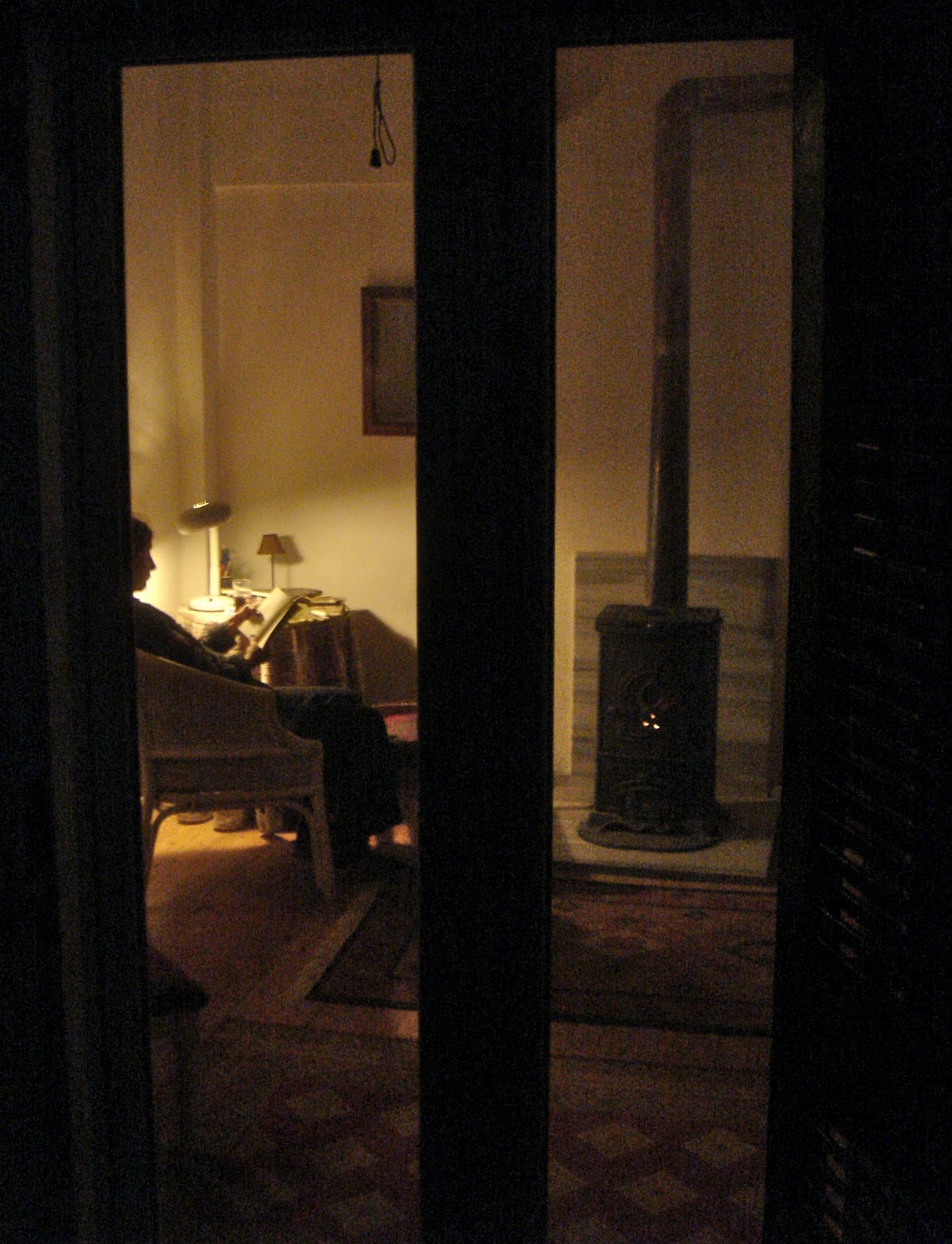
The last two evenings I’ve lit the stove.
**** ****
“You must have your work cut out at the moment”
I was talking to the evangelical pastor, Miltiades Pantelios, at the Lighthouse the other day - a place we go for the table top sales on Saturdays, the free WiFi and nice filter coffee.
“Yes indeed. The worst thing for people is the feeling that there’s no end in sight.”
“It brings out the worst but also the best in us, I guess” I added lamely, feeling an ache in my stomach, part of me wanting a kind of restoration of things as they were, but the larger part hoping this long storm of blighted hopes, this absurd and dangerous sequence of increasingly desperate attempts to kick-start a deeply unresponsive engine – with different kinds of stimuli, austerity, taxation, collateralisation, quantitative easing, selective devaluation, financial restructuring - will be as futile as I suspect, leading through many crises to wiser ways of living on the earth.
*** *** ***
Yesterday we went via Krini to Angelocastro; climbed the steps to the high fortress and had a family picnic under the oak tree there.
In the evening Richard showed us his three minute video of Handsworth Park. A pure delight. We all watched a few episodes of Little Mosque on the Prairie. I'm reading The Tiger's Wife by Téa Obreht, having just finished Kingdom of Ashes by Robert Edric - a novelist I'm more than glad I've come across.
Richard on Angelokastro Αγγελόκαστρο

Back numbers

Simon Baddeley