Total Pageviews

Showing posts with label Naples. Show all posts

Sunday, 3 March 2013

Travel


We slipped out of Ano Korakiana during a rain shower and caught one of the smaller ferries to Igoumenitsa - fares reduced 50%, it said 'military' on our tickets.  It was dark on the mainland and we dragged our bags along the rutted concrete to the Adriatic terminal, strewn with large friendly dogs and people watching TV football. We checked in to wait for hours for the Superfast ferry to Bari. We are familiar with this place. No-one we ask behind a glass screen is ever able to tell us just when these boats, equipped with 21st century communication technology and time to milliseconds, will arrive and depart. At best it's "soon" and "maybe". The digital arrival and departure signs are inscrutable, announcing events that don't quite occur. In the end we were on quay10 as a behemoth backed slowly up to the dock and lowered its ramps gently onto the concrete, inviting coaches, trucks and walking passengers to board.


We settle in the semi-darkness of the airseat lounge; stretch across several seats, sleep - fitfully - amid the rumble of the ship. In the morning the moon's still up, the sea mildly ruffled...

... and our time of arrival familiarly untrustworthy, an A4 sheet cellotaped on the purser's counter - so she needn't repeat herself - says 'ETA 11.00am Greek time'. By 11.00, land, which has appeared intermittently to port, is vaguely visible to the north east. Then a sharp turn and Bari mole emerged from the haze. By 1120 - 1020 local time - we were boarding Bus /20, buying tickets on board and being driven circuitously through chicanes out of the harbour and to Bari Station. On platform 3 we sat in the sun, ate our picnic, drank wine from plastic cups and read, until, after two hours, the express train to Rome drew in and we took up our reservations. After a stop in Foggia, our route turned west across Italy. At 4pm we dropped off at Caserta and crossed the platform for a double decker stopping train to Naples, where we'd been seven weeks earlier.
A man with a bicycle in a field south of Caserta


Small unfinished plots drifted by. I snoozed and read. The hotel had lost our reservation and was full. The receptionist phoned around and got us a room at the same price in the Hotel de la Ville on the opposite side of the square. We ate as we had when last in Naples, at Da Ettore...then to bed to catch a bus in the morning.
At the stop outside Central Station we were intercepted by a taxi driver who promised to take us to the airport quicker than the bus
"Just give me your bus tickets"
Inside the cab he asked for €10 more.
"Oh no" says Lin "we agreed just our tickets"
But at Departures I gave him €5.
"You're too soft, Baddeley"
He shrugged and we were dropped at the airport -  only a few miles away.  In the terminal we had deep chocolate ice cream and more reading.
Another hour and we were away to England, a train to London from Gatwick, then a coach to Birmingham and - our only one - a taxi home. We'd left the village at four on Wednesday afternoon and were home by 8.30pm Friday.
Leaving Naples

*** *** ***
In our hotel I'd had an email from Mike Tye in Handsworth - some passages in red:
Hope you can all make Monday night's Special Ward meeting at Welford School, 7pm. We need to be of one voice against these proposals to reduce services...(attachment)
Service changes to make waste management savings – February 7, 2013 Posted by Cllr McKay. A number of changes to waste collection services have been announced by Birmingham City Council in its 2013/14 budget following central government cuts to the authority’s finances.
For the 2013/14 financial year the council’s overall savings requirement is £102million. Of this, £6.57million relates to waste services and includes:
Bulky waste: providing households with ONE free collection per year (maximum 6 items). For each subsequent collection (maximum 6 items), there will be a charge of £25 per collection. This compares to the existing system of 3 free collections per year, with a maximum of 6 items per collection. The new charge is in line with fees charged by other councils (that typically range from £15 to £44).
Special street collections: A city-wide subsidy is being dropped, meaning that individual districts will have to use their own budgets if they wish to continue this service, which is a service uncommon amongst local authorities. These collections are a service that gives residents in an area a fixed day(s) beyond regular bin collection dates on which to put out additional bulky waste items out, to be collected by the council at no cost to the households taking advantage.
The provision of black and green sacks: The council spends £1million per year issuing one sack per week to households. Many residents already buy their own waste sacks. Residents will now be required to provide all of their own sacks from April 1, ahead of the council plan to roll out wheelie bins at a later date.
Green waste collections: In line with many other local authorities, the council will introduce a chargeable service from February/March 2014. This will be an optional service, and those wishing to take advantage will be given a free 240-litre wheeled bin. The annual collection charge, to be paid in advance, will be £35. Those not wishing to take up the service will have the option of buying a composter, at cost, via the council’s website. Fees charged by other councils who provide this service generally range from £18 to £56.
In addition to this, other measures are set to be introduced to meet the budget challenge caused by the cuts. They include:
City centre street cleansing: There will be a reduction in the overall level of cleaning – but there will be no compulsory redundancies. However the council is introducing larger capacity bins, fitted with a compactor to reduce emptying frequencies, and more automated technology to increase productivity.
Mechanical sweeping: The number of large mechanical sweepers that clear main arterial routes and some residential roads will be reduced from 20 to 15. This will not lead to compulsory redundancies but there will be a reduction in the level of service offered.
Your City Your Birmingham: It is proposed to discontinue these enhanced services (services provided over and above the standard service) and can relate to environmental crime such as fly tipping, fly posting, littering and dog fouling etc.
Cllr James McKay, Cabinet Member for a Green, Safe and Smart City, said: “Cuts to the services that help make our city a cleaner and greener place are not something that sit easy with me.
“However, given that the controllable part of the council’s budget – which we can choose to prioritise – will be halved by 2017, we are simply left with little or no option but to consider some major changes to our waste management service. What we have done is come up with a package that tries to minimise the impact felt by citizens, embracing innovation and modern ways of working where possible – such as with the introduction of wheelie bins, to replace a system that is firmly stuck in the last century. But we want to be open and transparent about some of the less palatable changes helping up meet our financial challenge - that is why we are giving as much notice as possible of our intention to introduce fees and reduce the level of services where applicable.
At home there was a letter from Connecticut dated January 14:
Dear Simon. I loved reading of your Mother’s Service, and most of all, loved the pictures down the generations. Clearly a very beautiful woman in the pictures of her, your father (I assume) and you as young child. I can see the evolution persisting after all the years have done and favoured us with.
The Thomas Hardy poem you read is a great tribute – to one who notices things. But I wonder whether Hardy hasn’t got the generations wrong in his poem. Isn’t the real gift of the living that they have imparted to others – family, children, friends – the gift of noticing, of being curious which causes one to notice all the wonders cited by Hardy. Clearly your mother is one who did so.
The death of one’s mother, one’s father and brother or sister is so intimate. One feels a hole in one’s life – even if the time for departure had come. But the hole is not nothing. As we have come to understand in the cosmos, the black hole, the emptiness is not no-thing. It is all possibility. That, I have come to believe is the gift of death to the living – the gift of possibility. Clearly your mother imparted that to you and her grandchildren.
Best wishes and warm hugs to you and Lin. Tony
Email from Jan D:
Simon. Hope next Friday is still on. Be good to chew over some ideas with you. Every day seems to bring something new and often unpleasant. Bankers bonuses are back in the news. It simply beggars belief that what are in effect publically owned assets can allow such total misuse of resources. It is difficult to comprehend how a business loosing £5.5 billion can still be allowed to allocate £650 mill in bonuses. The real worrying factor is that democratic processes and players are powerless or unwilling to stop it, even in a nationalised business. This demonstrates how ‘castrated’ democracy is becoming. Democracy, through elected government, appears no longer able to shape events and they even struggle to react properly to them. Instead they are becoming the mouthpiece of vested interests, trying to persuade us that the interests of the 1% equals the national interest. Very different moralities and psychologies are at play here. If you already earn millions you need even more millions to stay motivated whereas if you are on benefits you need your income cut further in order to be motivated to find work – a bit simplistic I know but to quote George Monbiot ‘Our own ruling class...lives in a world of its own from which it can project power without understanding or even noticing the consequences’ and ‘frontbenchers can rock with laughter as it truncates the livelihoods of the poorest people in this country.’ In conclusion he says ‘those who govern us do not in their hearts belong here. They belong to a different culture, different world which knows as little of its own acts as it knows of those who suffer them’  Not certain I fully accept this ignorance of their own actions but this sums up nicely the new ‘feudal’ elite. There is something strange going on here whereby democracy is spawning forces which are totally incompatible with it or perhaps it is not that strange at all (remember the Weimar Republic!). Look forward to hearing your views. Best Jan
*** *** ***
Saturday morning, The waste paper basket is full of junk mail. We'd clear most of the letters needing a reply the night before. Lin went off to see her parents for the day. I rode into town to post replies and to enjoy a mug of tea and a baked potato soaked in butter in the Rag Market and to buy paperclips and envelopes but mainly to be with Oscar on the canal towpath and in and out of the city side roads and through the walking centre on what feels like the first of Spring.
Round 2.00pm I met up with Richard and Emma at Cafe Soya for a swift-served delectable all day lunch special. My son's using a friend's version of Rosetta to learn Mandarin in readiness for his and Emma's visit to Beijing in April. I described our Michel Thomas Greek course which Lin had picked up for peanuts at a table-top sale in Corfu.
"I'm suspicious of any thing that says this sort of thing is easy, but we really like the method, a sort of three way conversation with pauses between the tutor and two students who now and then make typical mistakes. We've been leaving it on as we do work round the house. We've got a good friend who tutors, but I'd be interested in the Greek version of Rosetta. Whatever works! How much is your flight costing?"
"Very good deal. We reckon it's because the air pollution has become so bad there."
Back in Birmingham
We are going to miss Carnival in Ano Korakiana this March and we've just missed the opening of Stamatis' project - the café that replaces his shop opened for the first time on Saturday

Εγκαίνια απόψε στο χωριό… Ο παλιός φούρνος του Γιάννη Σαββανή στην Πλάστιγγα, αφού πέρασε από τη φάση του μινι-μάρκετ, μετατράπηκε σήμερα σε ένα πολύ όμορφο χώρο καφε-ποτείου. Η διακόσμηση περίτεχνη, με αποκάλυψη των παλιών υλικών (ξύλου, τούβλου, πέτρας), με προσεγμένο φωτισμό και με φωτογραφικά ασπρόμαυρα ενθυμήματα από παλαιότερες δεκαετίες. Ο Σταμάτης, επικουρούμενος από τους τρεις γιούς του, τον Αλέξανδρο, το Γιάννη και τον Άγγελο υποδέχτηκαν απόψε τους πρώτους πελάτες και πέρασαν με επιτυχία τη δοκιμή της εξυπηρέτησής τους. Στη νέα επιχείρηση που υπόσχεται ζωντάνεμα της «Πιάτσας», ευχόμαστε «καλές δουλειές»… 
Opening tonight at the village ... The old bakery that belonged to John Savvani, after passing through the phase of being a local grocery, was today transformed into a really beautiful place for coffee-drinkers - with elaborate decoration, display of old wood, brick, and stone, with imaginative lighting and black and white photo memorabilia from past decades. Stamatis, assisted by his three sons - Alexander, John, and Angelo - tonight welcomed their first customers and successfully passed the test of entertaining them. The new enterprise promises to revive the 'Piazza' and provide new jobs...(note: and the grocer's shop at the other end of the village will do more trade and we can still get our bread, wine and confectionary and mail just across the street from Piazza)

Saturday, 19 January 2013

Ano Korakiana again

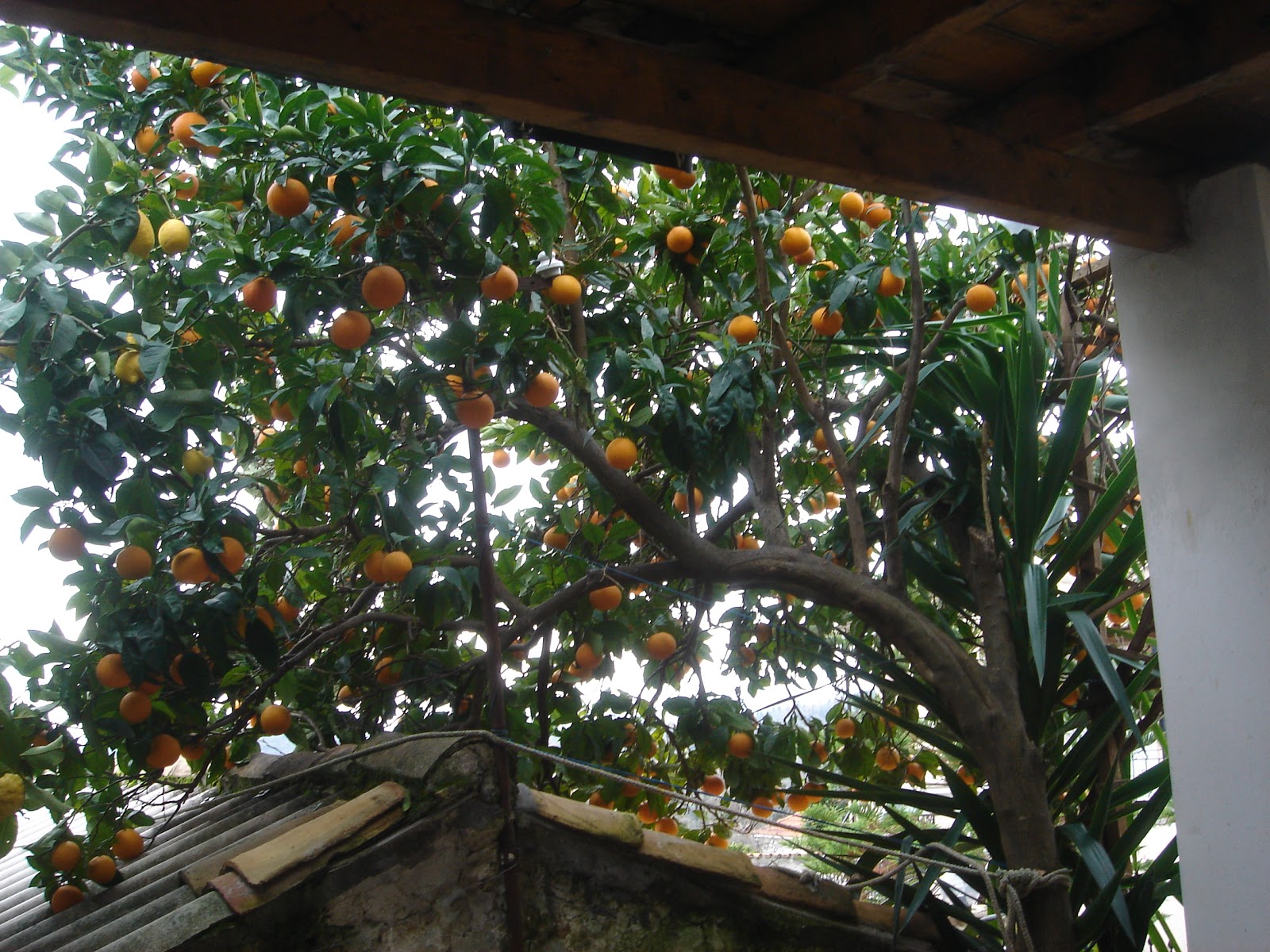
Our blood orange tree is heavy with fruit; our lemon trees too. I soak up the village, feel it through the soles of my feet, gathering strength – a feeling that began even as we disembarked from the ferry at shabby Igoumenitsa....
Igoumenitsa at dawn


...a port that takes no account of travellers on foot, and trailed our bags across two kilometres of concrete to where we could catch the smaller ferry to Corfu, name Doris – ΔΩΡΙΕΥΣ. Greece, far from wounding me, embraces and supports me. My chest swells and my eyes glisten with the joy of return. I feel brave.
Arriving at the Port of Corfu
I want Ano Korakiana – ‘our’ village - to be timeless; timeless for me; nothing must change without I know of it, yet as Lin drives down Democracy Street under an overcast sky, as you’d expect in January, I see the shop – Stamatis' small shop yards from us - is gutted, with builders inside. After unloading the car of our luggage and shopping on the way, I find our neighbour, Vasiliki, is putting up washing below a polythene sheet that crackles and slaps in the wind. I greet her over our garden fence.
“To pantopolei, to magassi, το μαγαζί? Pou agoraso psomi? Που αγοράζω ψωμί; where do I buy bread?
She said ‘supermarket - σούπερμάρκετ’.
I groan inwardly. Our nearest is miles away. I go down into the house, turning on the water and the power including the water heater. I stroll to the shop. Stamatis is there. It’s OK. The place is being refurbished - ανακαινίζουν το μαγαζί. Bread is across the road at Pepe’s where they sell cakes. Phew. But if I want vegetables I must walk three hundred metres to the other end of the street to the other shop, which only reopened two years ago. So now who’s receiving the mail I wonder?
But I’m relieved. It’ll sort itself out; a change that need not bring anxiety. Later the sky grows clearer, a strong almost warm south wind blows below ragged racing clouds.
[21/01/13 Stamatis explained his plan to me. He is not redoing the shop but making a small bar which will serve coffee and drinks and mezes. It will be called Piazza - Πιάτσα. He gets a temporary relief from tax as this is a starter business and he has installed toilets and wash basin. On reflection I think this is a very good project and I hope it prospers.]
But abruptly the sky darkens. Hail falls in a burst, lashing leaves from the trees, beating a staccato on the shutters and doors, heaping ice stones against the outer walls, making such a din I’m momentarily alarmed the weather’s made a breach, assaulting the cosy house where our stove burns old building wood I sawed late in summer, dry as a bone. The electrics flicker – come on again, go off, come on and then go off for several hours. We’ve candles ready with matches near and a small propane stove to boil water.
At dawn, a blue-grey mat stands across the island southward. Rain pours through the day. I collect it from the downpipes in big bowls for when the pumping fails and the village loses tap water; which for several hours it did. I spin the washing twice and hang it on the drier in front of the stove.
“That just makes condensation” grumbles Lin
“Well what do you suggest?”
“Wait until you can hang it outside”
“When would that be?”
In a short relent yesterday afternoon Lin and I got out our sticks and trudged up the village through Venetia to Ag. Isadoras on the ninth bend of the road to Sokraki above. The south wind moaned in the electric wires twirling the tops of trees and shrubs, spreading our coat tails and streaming Lin’s hair beneath her hat. We had the road all to ourselves, ample warning of rare approaching cars.


On the way up the hill I drop off two bags of litter I’ve collected from the path beside our garden. Vasiliki told me her husband Lefteris’ brother had died on Saturday - έπεσε νεκρός. He’d had a home in Athens. Lefteris has gone there; I think to bring him home. Vasiliki knew my mother had died - πεθαίνω πλήρης ημερών. We both gave the worn look, a shared sad shrug – our fate.
Around 7.00pm I sat in on a lecture about - so Dr Savannis told me - ‘The Poverty of the Greek Language’ or perhaps 'The bankruptcy of our language'. It was in the Philharmonia Room in the centre of the village. I understood little - a sort of self-imposed fasting from comprehension; to allow myself to feel uneducated and dense. The lecturer was on a panel – fascinated, amused – all engaged in a two hour debate.
Lecture and debate in Ano Korakiana "Η πτώχευση της γλώσσα μας'
There were at least forty present – grey hairs and young, even a child of 10 or 12. She sat attentive as her mother took part in the discussion. These evening debates are regular in Ano Korakiana – covering music, poetry, novels and themes like tonight’s. In what other village would I encounter such a thing? I long to be involved as more than just an observer of such animation.
**** ****
Near Cavour in the city centre of Naples
We left Naples by train on Monday morning and travelled to Bari via Caserta.
Across Campania
Under the Volcano was a book about a talented man drinking himself into stupor; people who love him, powerless against his compulsion. With the help of murderous rogues he is destroyed. So Naples.
Chiesa S.Giuseppi di Ruffi

Imagine Venice invaded by Mestre and oil-drenched Marghera, drab Treviso and the outlying settlements kept away by the lagoon. Naples, without such protection, is infected by cement. Where once were walls and separation between town and country, the once great city of Bourbon, Austrian and imperial Spanish architecture with Roman-Greek infrastructure - famous wondrous Naples - is now an uninviting settlement of semi-derelict ticky tack strewn between fabled Sorrento and Mondragone, north of the Gulf of Naples, thirty miles up the Domitian coast and outward across a mess of temporary building and depopulated farmland reaching to Caserta.  
Placeless in Torre del Greco
Six lane succubus
We learned at school the eulogy ‘See Naples and die’. Old paintings, even old photos attest its sublime beauty. I'm not nostalgic.
Near Piazza Dante in the centre of Naples
I sailed here in 1962, enjoying ice cream as I'd never tasted it, but I doubt - but for intervals - the human condition was better or worse, yet the blighting of this once great city and its environs is worse than the ancient disasters that attract visitors to Herculaneum and Pompeii, but the pizza is excellent. Eloquent Roberto Saviano struggles to find the words to describe, ‘to construct…an image of the economy’. He falls back on picturing what ‘it leaves behind…as it marches onward’.
‘The most concrete emblem of every economic cycle is the dump (Ch.10 in Gomorrah: Land of Fires pp.282)…the true aftermath of consumption. The south of Italy is the end of the line for the dregs of production, useless leftovers, and toxic waste.’
Campania and its companion provinces, Sicily, Basilicata, Calabria and Puglia are centres of environmental crime. Worst are the outskirts of Naples.
‘On no other land in the Western world has a greater amount of toxic and non-toxic waste been illegally dumped.’ 
Saviano’s statistics drawn from Italian government reports and the office of the Naples public prosecutor are telling.
‘…the trash, accumulated over decades, has reconfigured the horizons, created previously non-existent hills, invented new odours, and suddenly restored lost mass to mountains devoured by quarries’.
He describes a new managerial class of post-graduates with degrees in environmental studies who know waste, acting as middlemen between those with waste to dispose and those with places to dump it. These ‘stakeholders’ become rich mediating between industrialists wanting to reduce the costs of legal disposal and the Camorrah clans’ trash disposers. ‘The stakeholder’s office is his car, and he moves hundreds of thousands of tons of waste with a phone and a portable computer’ undercutting the cost of legal disposal, handling enormous volumes, making exponential profits. Saviano describes one stakeholder who gave up his job to teach his profession in Hongkong, where the local stakeholders’ dream...
‘is to make the Port of Naples the hub for European refuse, a floating collection centre where the gold of trash can be crammed into containers for burial in China’ (p.291)
Listening to a stakeholder on the phone to customers he overhears advice on 
‘how and where to dump toxic waste…copper, arsenic, mercury, cadmium, lead, chrome, nickel, cobalt, and molybdenum…from tannery residues to hospital waste, from urban trash to tyres…’ 
The irony? The clans with their criminal waste disposal services...
‘relaunched and energized the Italian economy…Tuscany the most environmentally conscious region of Italy, plays a significant role in the geography of illicit traffic…the 2003 Midas investigation reported that waste disposal traffickers were already making contacts in Albania and Costa Rica…every channel is open now: to the east, to Romania…to Africa, to Mozambique, Somalia and Nigeria…the local agriculture, which used to export fruit and vegetables as far as Scandinavia, is collapsing. Plants sprout diseased, and the land grows infertile. But this disaster and the farmers’ rage are only the umpteenth advantage for the Camorrah: desperate landowners sell off their fields, and the clans acquire new landfill sites at low – very low – costs…In the land of the Camorrah knowing the clans’mechanisms for success, their modes of extraction, their investments, means understanding how everything works today everywhere, not merely here.’
There remains a city core in Naples, the old paved and cobbled streets, narrow and inviting, but here the streets are ravaged by motorized traffic – an object lesson in the 20th century plague of private wealth and public squalor. Public transport struggles; is notoriously sporadic, frequently delayed. Over most of our stay we were content to walk, but in doing so experienced the rank accorded pedestrians. Cycling was non-existent. Unsurprising given the cobbles and hills, but most of all because of the dominance of motorized traffic, only now and then kept at bay by bollards, but colonizing much of the city whether parked across a walkway, cutting through alleyways or charging along roads designed for their privileged circulation and the subordination of people who walk. You must drive or be driven in a car or on a scooter to gain the freedom of the city. We made it to what we thought was the seafront by Castella...
...,to find ourselves barred from the sea by a ribbon of fences, walls, private roads and a dual carriageway four lanes wide of speeding vehicles.
It was different once...
Strolling along straight - once magnificent - Via Cristoforo Columbus, the civic statues that watched our passage had become bathetic, too grand for the scabbed uneven pavements; the cement and asphalt patchwork superimposed over 19th century patterned cobbles; empty shops selling heavily discounted fashionwear announcing sales covered in crossed out price labels; stuffed wheelie bins and windblown garbage...
...beneath grandiose six and seven floored mansions with tall windows and ornate balconies, distinctly under occupied, their antique high-ceilinged rooms converted to temporary offices and store rooms. The road was divided by a crude concrete barrier heavily grafitt’d. Car and trucks ruled our surroundings, taking their possession of city space for granted. We scuttled warily, skirting what might once have been a promenade, once a shared public space. I fumed. I learned and knew it was different once.
Highlighting the fate of yet another city running out of civic space, are its public treasures. The National Archeological Museum seen the afternoon of our arrival. All our time here was worth the things we enjoyed there, even as our limbs ached with walking on stone and climbing steps.

 Never was marble more caressable; mosaic more touchable...
It made me think Hokusai's Octopus and Shell Diver 蛸と海女
...This wistful face -  no deity or ideal form - hardly 10 inches high, crafted in small pieces of stone perfectfully placed. Someone adored her. Did she die under the volcano? Was she already a memorial enjoyed by her descendants in a Greek town that stood on the shore for centuries before the Romans, before the great eruption. The picture with many others lay unknown beneath hardened mud and ash for 18 centuries; now emerged into light to delight me. Alone these were worth my tiny transit. In Herculaneum I saw no signs to the Villa of the Papyri – the house I’d learned of in The Swerve, where a treasure of scrolled books was found illegibly charred. Archaeological invention is gradually deciphering them. In the garden, now in the museum, was a marble statue – not large – of Pan and a nannygoat making languorous love, smiling into each other’s eyes
“Aren’t we enjoying ourselves?”
Why have I never come across this sweet piece, antonym to porn’s bilious exaggeration, a most explicit recognition of Donne’s Ecstasy ‘to our bodies turn we then…else a great prince in prison lies’? (When I was sixteen and my mother told me of her love of this poem. I was embarrassed)
...That subtle knot which makes us man,
So must pure lovers' souls descend
T' affections, and to faculties,
Which sense may reach and apprehend,
Else a great prince in prison lies.
To'our bodies turn we then...
There’s no power play here, no sentimental innocence. The mutual connection – above and below – even on a stand displayed in a museum, radiates happy and solicitous pleasure.
On Sunday we took the Metro to Cavour again and walked, where Jamie and Maria had marked our map, to Via Duomo off which a narrow street led to an entrance into Napoli Sotteranea, where seven of us descended, with a guide, down “a hundred and nineteen steps” into one small part of a great system of man-made caverns, shafts and corridors spread beneath the city.
Prehistoric settlers mined a layer of volcanic tufa for stones to build Naples, creating spaces into which in classical times rivers were diverted, so that anyone wanting water sank a well into the workings, which expanded over thousands of years - a network of connected cisterns, with aqueducts over a 100 kilometres, long bringing water to outlying towns. Only near the end of the 19th century did cholera put an end to drawing water from this vast underground.
I took the visit on trust; felt none of the sensible apprehension that would have made me more than fearful of walking on the rim of a volcano or descending many metres underground. The idea of this great area beneath Naples was fascinating; the experience less so. I’d become more intrigued with what was above ground – the teeming mess of contemporary Campagna. We had talked of dystopia with Jamie and Maria. He referred me to the 'anti-state'...I found and read this on a US site:
Known as the “anti-state” or simply the “system,” the “Camorra” dominates the city of Naples, Italy. The Neapolitan equivalent of Sicily’s Mafia operates a multibillion dollar a year enterprise ranging from international smuggling to street level crime to providing material support to terrorists. The epicenter of the system is the neighborhoods of Scampia and Secondigliano, called the Red Zone due to the amount of power that Camorra exerts over the area...The Camorra came on the international stage in the early 1990s. The Sicilian Mafia had traditionally been the most powerful of the organized crime groups in Italy, but following the assassination of two prominent anti-mafia judges, Giovanni Falcone and Paolo Borselino, in 1992, it faced an unprecedented level of crackdowns by law enforcement*...This created the opportunity for the Camorra to fill the void for international drug trafficking, and subsequently the bulk of drug trafficking shifted from Sicily to Naples. The conditions in Naples itself, particularly Scampia and Secondigliano, have allowed the Camorra to continue to operate on the international level. Following the earthquake of 1980, thousands migrated to the public housing complexes known as the Vele di Scampia (Sails of Scampia). This influx exacerbated already existing problems of poverty, drugs, and street crime, in which an estimated 60,000 residents were now living in the complexes seriously lacking public services, not even a single police station initially. The lack of commercial development coupled with extremely high unemployment made this a perfect area for criminal enterprise....(The Case of Scampia and Secondigliano, Italy. Egon Donnarumma Summer 2011,Vol 20 (3) www.nationalstrategy.com)
Naples and its suburbs from Vesuvius


But Egon Donnarumma’s essay for the US National Strategy is for a ‘homeland’ audience warning that Naples is a portal for terrorism against the US and infiltration of American business in Italy.
 … If left unobstructed, terrorist groups can continue to use Naples as a point to safely enter Europe, which may eventually result in a major terrorist attack…A partnership of Italian and American intelligence operations to track terrorist activity in Naples would also be in both countries’ interest….for American businesses. The implications of facing organized crime elements must be considered…While this does not apply to every industry, those involved with shipping and especially waste disposal should be aware of the likelihood of crossing paths with elements of the Camorra…so embedded in society that they are unlikely to go away anytime soon. 
Donnarumma writes pragmatically as a US foreign policy expert, as though describing risks attached to the aims and activities of another nation. Within his essay are warnings of how the Camorra get their grip, which is indeed to be not so much anti-state, in the sense promoted by anarchists who recognize that any moral calculation shows states as lethal and as murderous as the criminal agencies Donnarumma describes, but to show how, in Naples, the criminals are recreating government, ruling a local state with embassies and consulates spreading across the world. I recall being struck by an opinion of Judge Giovanni Falcone, scourge of the Mafia, murdered by them in Sicily in 1992, that the Mafia ‘understood the responsibilities of government better than Rome’, the seat of a national government that failed to protect him and his legal work to eliminate the Mafia. The Camorra protect their own. Donnarumma points out that, especially in Scampia and Secondigliano in Naples, they provide a substitute for the services of local government...
... illicit sale of cigarettes and other goods is tolerated by authorities under an “air of casual illegality”. With little in the way of commercial infrastructure and social services, it functions as the only viable economic organization in these neighborhoods. It also serves as a welfare agency, in essence, by providing care for families of any member who ends up in prison. This tightens its grasp on the neighbourhoods by making the population dependent on its services, which pushes out state services, thus further integrating Camorra into society. Following the global economic crisis, organized crime in Italy is one of the few businesses with liquidity and is lending lots of money (although with extremely high interest rate) to businesses. (The Case of Scampia and Secondigliano, Italy. Egon Donnarumma Summer 2011,Vol 20 (3) www.nationalstrategy.com) 
Father Don Peppino Diana
The most famous man to come from Casal di Principe, a town embedded in Naples’ unwholesome sprawl nine miles north west of Scampia and Secondigliano, is not a gang chief, but the priest Father Don Peppino Diana (or Don Giuseppe Diana). In an especially powerful chapter Roberto Saviano reports how the Camorra have infiltrated the church, adopting and adapting Christian theology (as, of course, have states) to their ends ‘Killing is a sin that Christ will understand and forgive in the name of necessity’. Thus Israel circumvents Yawa’s commandment in Gaza, thus Islamists can kill for the religion of peace they ever proclaim, thus the Christian nation of America and its allies…(no need to labour the point).
‘Religion is a constant point of reference for the Camorra, not merely a propitiary gesture or cultural relic but a spiritual force that determines the most intimate decisions. Camorra families, especially the most charismatic bosses, often consider their own actions as a Calvary, their own consciences bearing the pain and weight of sin for the well being of the group and the men they rule.’ (Gomorrah p.226-227) 
I realize something I’d not grasped; that in challenging a system that has taken on the moral and physical methods of a state, it is not enough to side with it against another state; to side with local and national government against an upstart criminal state. The state and anti-state are not exactly in collaboration any more than are warring Camorra clans but they are mutually infiltrated via a host of quotidian interactions – the issuing of a trading licence, the collection of a tax, the willingness of a priest to celebrate a clan wedding or baptism and hear confessions. Into this fuzzy space between state and anti-state come exceptional individuals seldom popular with either. Roberto Saviano decribes the brief life, cut short by his murder, of the priest Don Peppino Diana, a man who for a short time strove to make black and white, what most people would prefer left as shades of grey.
‘Don Peppino wanted to bring some clarity to words, meanings and values’ ‘We must’ he said ‘divide the people so as to throw them into crisis’. ‘… (p.229) his priority was to fight political power as an expression of criminal business power’
“… the candidates favoured by the Camorrah have neither policy nor party, but merely a role as player or a post to fill.” 
Words, meanings, values…. “The Camorrah gives the name family to a clan organised for criminal purposes, in which absolute loyalty is the law, and expression of autonomy is denied, and not only defection but the conversion to honesty is considered a betrayal worthy of death; the Camorrah uses every means to extend and consolidate this type of family, even exploitation of the sacraments. For the Christian, shaped to the school of the Word of God, family means only a group of people united by shared love, in which love means means disinterested and attentive service, in which service exalts him who offers it and him who receives it… 
Weapons in hand, the Camorristi violently impose unacceptable rules: extortions that have turned our region into subsidized areas with no potential on their own for development; bribes of 20% or more on construction projects, which would discourage the most reckless businessmen; illicit traffic in narcotics, whose use creates gangs of marginalized youngsters and unskilled workers at the beck and call of criminal organisations; clashes among factions that descend like a ruinous plague on the families of our region; negative examples for the entire teenage population, veritable laboratories of violence and organised crime.” 
'Don Peppino didn’t want to believe the clan was an evil choice a person makes, but rather the result of clear conditions, fixed mechanisms, identifiable and gangrenous causes. No church or individual in the region had ever been so determined to clarify things.'
'…His killers did not pick a date by chance. March 19, 1994, was the feast of San Giuseppe, his name day…Early morning, Don Peppino was in the church meeting room near his study. “Who is Don Peppino?” “I am”  Two bullets hit him in the face, others pierced his head, neck and hand, and one hit the bunch of keys on his belt…He was thirty six years old.’ 
One of the more ingeniously unpleasant aftermaths of this crime, which the naïve might think unwise, raising the power of the priest's words through martyrdom, was the posthumous campaign aided by some local journalists to sully Peppino's name; to take away not only his life but his character, hinting that the was in fact a Camorrista caught up in a clan feud; had evaded his priestly duties – in refusing to give the sacrament to criminals – had consorted with prostitutes; that his reason for going up against the clans was not a stance against all for which they stood but a personal vendetta, that Peppino ‘wallows in the same filth’. He was isolated, made alone.

*My ignorance of history, tho' vaguely remembered. Norman Lewis in his autobiography- I came, I saw (1985) - records in Chap 22, how after the allied carpet bombing of Naples while held by the Germans, the area was under the rule of AMGOT - the Allied Military Government of Occupation -
'largely officered by Americans of Italian origin. AMGOT 'stood between us and justice and truth'....'They had made a start by replacing all fascist-appointed Mayors with the nominees of the Mafia freshly released from gaol. Vito Genovese, ex-head of the American Mafia, now their principal adviser, was ready with his list of names, and soon these sinister ruffians became the real rulers of Southern Italy'

Sunday, 13 January 2013

Circumvesuviana

Hotel Ideal on Piazza Garibaldi, Naples

We took a train - Circumvesuviana - from Piazza Garibaldi to Ercolano Scavi, then a minibus to near the mountain's summit, walking up for another 20 minutes to the edge, where a path runs half way around the circumference of the crater. Vapour rose lazily to meet the gathering clouds.


Later we went down to Herculaneum - destroyed and buried by the eruption of Vesuvius in 79AD

But between the ascent of the mountain and our walk around Herculaneum, Lin visited casualty in Torre del Greco. She fell on the path near the rim of the mountain, leaving a gout of blood on the tufa gravel.
"Oh no no" she said, momentarily spreadeagled on her front, almost sobbing "I've spoiled everything"
I helped her up, swiftly assisted by a sweet guide called Antonio, who gave us a lift in his little car, parked by the Guide hut, back to the minibus a few hundred feet of zigzag below, while Lin applied copious kitchen roll paper to her bleeding lip. In the hospital, where Lin was seen almost at once, two young doctors inserted several stitches, and gave her a small bag of ice to press to her mouth.
We walked together a few kilometres through an unpeopled surburban landscape...
Torre del Greco
...until we came to the railway station and took two stops to Ercolano Scavi, where we walked a kilometre down to the ruined town nested amid modern building founded on the 30 metres of compacted mud and ash that had buried the town and its inhabitants so long ago.
That evening we met up with my nephew Jamie and Maria living high up in Naples, to enjoy a meal at busy Pizza Starita on Materdei.
All evening the rain came with thunder and lightning making the dark streets brighter with reflections, chaotic, messy, littered, graffiti'd, layered and altogether - like most old cities not commodified for tourists - past its ancient prime.
Past its ancient prime

Piazza Garibaldi in the rain
Naples Metro


How magic are these grand Spanish apartment blocks. You confront vast wooden doors freighted with locks and brass fittings, fine mouldings and mighty hinges. To enter there's no need to budge the big doors, instead you stoop to enter through a small street level door finely carpentered into the big ones. You step over a high lintel and find yourself inside a great staired space, a domestic theatre of private apartments rising in tiers around a grand atrium, five, six floors, dizzying and yet cosy with the separate aromas of different cooking as you ascend to the skylights, pressing switches that give a temporary increase of light to your tenebrous passage. These old buildings once lit by candles and oil lamps, are twined with overpainted circuitry poking out of the oddest corners, sometimes showing ranks of dusty meters and switches, to which now and then are the intrusions of new plumbing, air-conditioning slightly awry, and, here and there, a new door or window - but ultimately the buildings hold their integrity, honouring their original construction.
We walked to our hotel from Cavour as the trains ceased long before midnight and buses were scarce. On the way we found ice cream, cold tasty chocolate in the rain. Bedtime reading a Naples police procedural These Dark Things by Jan Merete Weiss and - perhaps one of the finest guidebooks I've come across - Gomorrah by Roberto Saviano - about modern Naples but also the rest of the world.

Back numbers

Simon Baddeley