Total Pageviews

Showing posts with label Jan D. Show all posts

Wednesday, 10 July 2013

Greenery

I don't know if it's a Newton or a Granny Smith. Its apples are both cookers and eaters. It might be the same cultivar that, as the story goes, dropped an apple on the head of a genius. I'd have said "Ouch!" Isaac Newton said "Gravity"
"Why should that apple always descend perpendicularly to the ground," thought he to himself: occasion'd by the fall of an apple, as he sat in a comtemplative mood: "why should it not go sideways, or upwards? but constantly to the earths centre? assuredly, the reason is, that the earth draws it. there must be a drawing power in matter. & the sum of the drawing power in the matter of the earth must be in the earths centre, not in any side of the earth. therefore dos this apple fall perpendicularly, or toward the centre. if matter thus draws matter; it must be in proportion of its quantity. therefore the apple draws the earth, as well as the earth draws the apple."
"It's being strangled by ivy" said Lin
"You want me to kill it?"
"I'm always telling you. It's a parasite"
I rather like that big clump of variegated green at the end of the garden.
"No. Ivy has it's own roots"
"That tree is being suffocated"
I got the bow saw and severed the main trunks of the ivy, not where they grip the apple tree but as they climb a stake I set up years ago to prevent further leaning by the main tree. That stake is rotting and will need replacing.
I've also been clearing ivy from the rough arrangement of wood that holds a profusion of honeysuckle and supports a pink climbing rose that's grown in this garden since long before we came here in the late 1970s. My woodwork creating a rough bridge between rockery and fence had rotted and needs replacing - with a tanalised stake and a couple of new spas - held together with coach bolts.

*** ***
My friend Paul Peacock, biographer of my stepfather, is about to bring out the book about Jack that he wrote and published in 2005 as an ebook
*** ***
Yesterday morning I was helping deliver an in-authority course - repeated in the afternoon - on  political management skills...
Teaching mode

...working with Catherine, our director. Part way into the course she used a most efficient piece of anonymous polling technology to see how participants voted on whether certain tasks in local government should be done by politicians, by officers or both. I was impressed by this addition to the inventory of teaching methods for conveying a subject that, by and large, leaves people more alert, more aware, more sensitive but not necessarily more sure of themselves. This course shows that an apparently straightforward matter covered by codes of conduct is a lot messier and more ambiguous that they might have realised. As Churchill said "The English seldom draw a line without blurring it" and as Weber wrote, more portentously, 'the relationship between democracy and bureaucracy creates the most profound source of tension in the modern social order".


Political management skills: negotiating contested leadership spaces 
Good government is where the best of politics and management combine. This seminar for senior managers in xxx focuses on the skills, codes and values that strengthen trust between elected members and officers. 
Objectives: To explore techniques, processes and ways of working that can be used by those leading in a political environment; to enhance understanding of how the roles of political and managerial leaders are changing and how this is manifested in these councils. 
Style: short talks, written materials and film clips showing senior managers and politicians describing the way their work overlaps and workshops enabling participants to explore the verbal and non verbal communication vital to constructing trust at the point where politics and management overlap. 
Programme
Brief introduction - overview of the seminar

Workshop 1 - Our political leadership – mapping political space (see also)
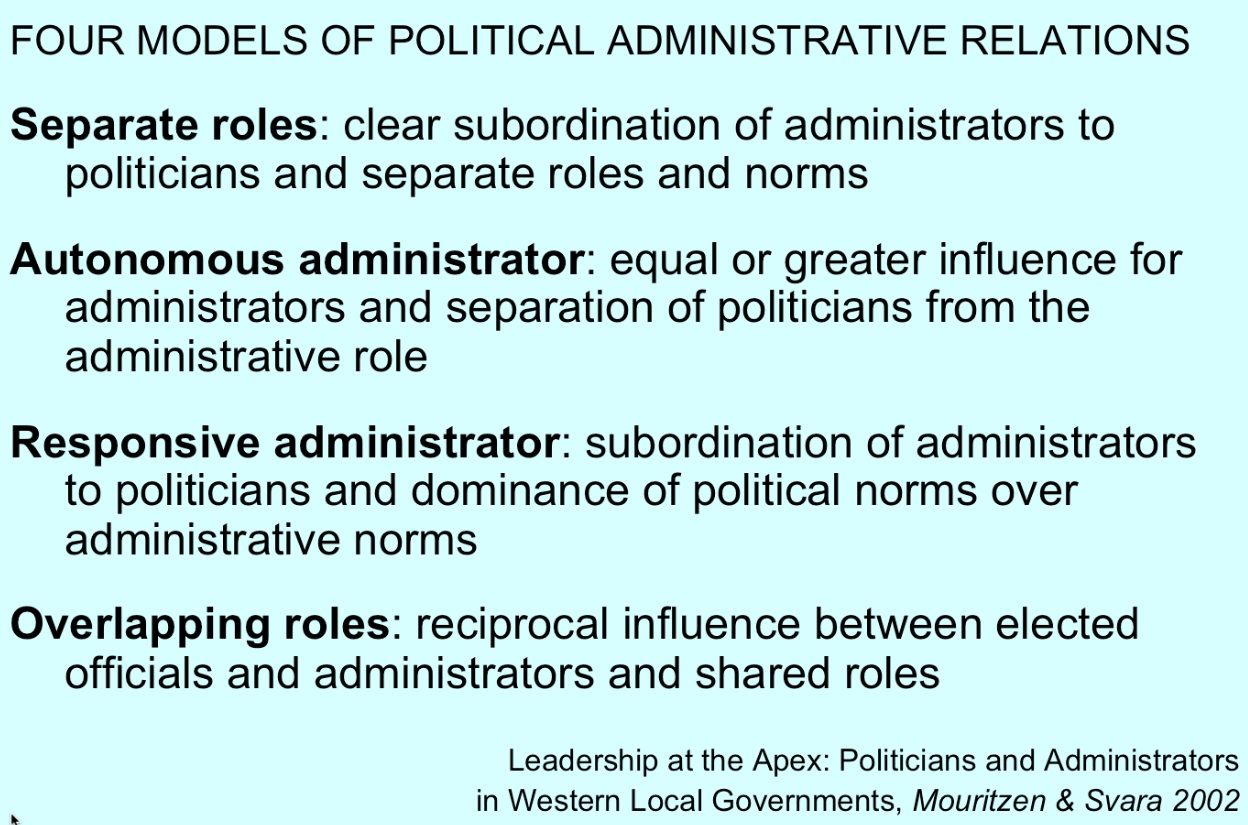
Workshop 2 - Leadership at the apex: overlapping spaces – testing perceptions of boundaries and relationships

Workshop 3 - Member-officer conversations - officers and members talking about complexities of their relationships (film extracts)
Tea
Workshop 4 - Exploring and defining skills and values
Workshop 5 - Using examples of ‘critical incidents’ to examine how officers can navigate contested leadership spaces – sharing experience
Summary and feedback: Q & A
Close
Simon Baddeley: As a visiting lecturer at Birmingham University where he has worked since 1973, Simon Baddeley’s fascination is with the working relationships of politicians and managers and how these relationships  contribute good local government. He’s taught in Australia, Sweden, Japan, and Canada and more recently in New Zealand. He has invented many training approaches to this sensitive subject, including the ‘owl/fox/donkey/sheep’ model (co-author Kim James), and created a film collection of interviews with politicians and managers working across political-managerial boundaries. He runs events for local councils across the UK on ‘political-management leadership’ and ‘political sensitivity’ for members and officers and carries out film research on political-management working relationships. He was a member of the 2005 SOLACE Commission, convened by Cheryl Miller CBE, examining the challenges of working in a political environment. 
Catherine Staite, Director of INLOGOV.  Catherine teaches community engagement, collaborative strategy and strategic commissioning to Masters level.  Her research interests include collaboration between local authorities and the skills and capacities which elected members will need to meet the challenges of the future. As Director, she leads and coordinates INLOGOV’s collaboration with a wide range of organisations, including the LGA, NLGN, Nesta, iMPOWER and SOLACE as well as universities in the USA, Europe and Japan, to help support creative thinking, innovation and improvement in local government and the wider public sector.
Papers:  'Political-management leadership'
'Owl, fox, donkey or sheep: political skills for managers'

Dilemmas we worked on:
1. The good old days: The Leader asks you to attend a meeting with some of his group. When you arrive, you are confronted with some very vocal members unhappy about changes you are making in line with the wishes of the administration. The criticism is that it is not “like the good old days”. The Leader allows the criticism to continue. You feel confident you are dealing with it but backbench councillors are clearly unhappy. After the meeting the Leader thanks you for your robust response.  What would you do next? 
2. Alternative Opposition Proposals: The Opposition Shadow Executive Committee member asks you to produce alternative proposals for making savings in your budget which is being presented by the portfolio holder to the Executive.  She intends to speak at the Executive meeting and wishes to oppose the proposed budget proposals and substitute the alternative. What do you say to the Opposition member and what do you tell your portfolio holder?
3. “Our” Council: The lead member for your service at one council asks you to arrange a meeting with councillors “to discuss arrangements for ‘social’ events to help “this council’s members to get to know your new integrated staff team” and ensure they are clear as to what “we want you and your service to do”. The member tells you they’re convinced your team is more focused on “our partner council”. “Can you” asks the member “make sure that your team know they also work for this council?” How would you respond?
4. Council tax rebate: Local authorities have delegated responsibility for managing the council tax rebate. The numbers qualifying for the rebate will be reduced as has the cash allocated to the council to pay it. It would be prudent to assume that that money will be reduced further next year. You feel it is essential to raise with members your concern that current council policies and procedures to deal with the impact of changes are no longer fit for purpose and that there may be social consequences that could catch the council ‘on the hop’. How would you raise this with the Leader? With Cabinet? 
5. Political Split: You have been asked to present to a private meeting of the portfolio holders, your proposals for ceasing to provide grants to local community organisation. You know that the Leader supports the proposals and encouraged you to bring them forward; but the portfolio holder for your services wishes you to exclude his own ward from the proposals. How would you manage the process? 
6. Victimisation: The relative of a Councillor is a user of your service.  That Councillor is a member of a user group that has been highly critical of your service. The Councillor has also served on a scrutiny review, which has produced recommendations with which you personally disagree. The Councillor has complained to the Monitoring Officer that his relative is not receiving the same level of service as other users and claims that the officers are victimising him and his relative because of his criticisms of the service. What would you do? 
7. Queue Jumping: A member of the Executive Committee - although not the portfolio holder for your service-  has a relative who wants their son enrolled for swimming lessons at the local pool for which there’s a 12-month waiting list. The Executive member instructs you to put his relative on the next course.  What would you do? 
8. Contrary policies: One council decides to adopt a council tax freeze and the other decides to increase council tax.   You’ve been asked by the Leader of each Council to explain the implications of these choices for your service area in each council’s area. You are very concerned that the added financial pressure of a council tax freeze will impact adversely and have advised against a freeze. You know there are savings that could be made in other service areas that would help meet the financial limits of a council tax freeze. You are approached by an opposition councillor in the council which is increasing council tax and asked to explain what advice you have given to whom. What do you tell her?
 9. Untrue Statements: You attend a local area forum in your own time and as an interested member of the local community.  One of the Councillors there is talking about your service and making statements which you know are completely untrue. The public are able to speak at the meeting. What might you do?
10. One of us?: You are at a meeting with councillors from one council which happens to be the one where you worked for many years before taking up your current joint management post. A short way into the meeting, it is clear that councillors are not happy about what the other council is doing on something within your area. It is clear that they see you as an ally because you are used to their way of doing things and want you to agree with them. What do you do? What don’t you do?    
11. Interest in Contract: You are responsible for managing a number of contracts for supplying catering for your services.  A Councillor approaches you asking for details of previous contracts let and future tenders.  You have a suspicion that the Councillor is acting as a consultant to a large catering company in the area. What do you do?
12. Public promise: Immediately before a local area forum meeting your Executive Lead member suggests he intends to make a public promise that the local theatre will not be considered for budget reductions. You are aware this is not the case and the Leader will announce to the press the following day the proposed closure of the theatre without telling his cabinet lead first. How do you deal with the matter? 
13. Spare room subsidy: The CEO is at a senior management team meeting. “As we know government has passed responsibility for implementing the spare bedroom subsidy to us. We’ve all done some analysis and come up with implications. The council may not have enough suitable accommodation for the people who fall within the criteria. People to whom the ‘tax’ applies will have less income. That could impact on other issues - family pressures, social cohesion and so on. Some just won't be able to pay. We could run up uncollectable rent arrears. If we evict, the cost of B&B will be greater than the loss of revenue, not to mention disrupting some children’s schooling with ‘knock on effects’. Administration has no wish to run into conflict with government. I’m seeing the Leader later. Any thoughts on what I should suggest by way of avoiding extra costs?”
14. Members’ deputation: You are working at one council’s offices preparing an important briefing note for a lead member of the other council, ready for an urgent meeting that needs to take place at the other office that afternoon. The meeting is to confirm an informed financial decision that will directly affect that council's economic growth agenda. You are interrupted by a deputation of councillors from the council where you’re working. They insist you see them at once. There has been a heated political incident involving the main town council.  How do you respond?
*** *** ***
On 13 June Lin composed a detailed letter - sent in my name - to Highland Council; an appeal for refund and reduction of charges in line with executor's exemption on mum's house. Yesterday I got an email, a letter attached:
Apologies for the delay in replying. Below is a copy of the letter I have issued to you today. I have also issued a copy to Mxxxx and Jxxxx, Solicitors to keep them informed. I trust this helps to clarify the position and thank your for your help in resolving the matter.
Yours Sincerely, Willie Munro, Exchequer Team Leader, Highland Council
       Contact Number:  0800 393811
       Email Address:   Operations.Team@highland.gov.uk
       Our Ref: 06xxxx04
       Your Ref:
       Date: 9 July 2013
Dear Mr Baddeley 
Council Tax Appeal - Liability
Account 06xxxx04 - Brin Croft
 
Thank you for your emails and letter received on 14/06/13, concerning the above. I have now reviewed the case and decided as follows: 
1 - Account 06xxxx02
Following the death of the late Barbara Burnett-Stuart an exemption under the category of "Executory before grant of confirmation" should have been awarded. This would be for the period (01/11/12 - 16/04/13).
Following the grant of confirmation, which was on 17/04/13, as confirmed by Mxxx and Jxxx Solicitors when I contacted them on 08/07/13, an exemption will be awarded on the basis of the category "where confirmation of an estate has been made"; this would be for a maximum of 6 months, dependant upon any changes to the ownership of the property taking place. 
2 - Refund of Council Tax - Account 06xxxx03 (Mrs E Bxxxx)
From your emails and letter it is clear that payment of the sum of £563.75 was made by the estate on behalf of Mrs Bxxxx for the liability that was billed for the period (15/11/12 - 31/03/13). I will arrange for a refund of monies to be made to the estate and sent to Macandrew and Jenkins who are dealing with  these matters. 
3 - Transfer of Ownership of Property
If there is a transfer of ownership of the property the Council will require to be notified as the exemption currently awarded with effect from 17/04/13 can only be awarded for a maximum period of 6 months following grant of confirmation and so long as there has been no change to ownership. I am sure that the estate solicitors Mxxxx and Jxxxx will deal with these matters if and when they arise. 
Summary
I will arrange for the above actions to be carried out to ensure that there is only one council tax account in place; namely account 06xxxx02. The appropriate exemptions will be awarded for the respective circumstances i.e. "before grant of confirmation" and where "confirmation has been made".
Any monies that have been overpaid will be refunded to the estate accordingly. I trust this helps to clarify the position and I will issue a copy of this letter to :
Mr J K  of Mxxxxx and Jxxxxx who is dealing with the estate concerned.
Should you have any further queries regarding this matter please contact the Freephone number 0800 393811 or email the Operations.Team@highland.gov.uk, or write to the Operations Team, PO Box 5650, Inverness, IV3 5YX.
Yours sincerely
Willie Munro, Exchequer Team Leader, Exchequer Operations Team
*** *** ***
Email from Jan D:
Simon. Hope yesterday went well. Here is something to bring a dose of reality to the debate although you and I have for a long time believed that current policy is mainly ideology driven rather than evidence driven. Eric Pickles said the following to the LGA conference last week: “Citizens should be large and the state small.” Leaving aside the fact that this is meaningless drivel from an evidence perspective, it is a crystal clear statement that current policy is not about austerity or financial problems (these are the catalysts) but an ideological commitment to 'roll back the state' and 'slim down' the public sector, esp local authorities, through a cynical combination of delegating more and more politically 'toxic' responsibilities to Local Authorities, whilst drastically cutting their funding to carry out these tasks. It is calculated that by 2020 LAs will be £14.4 billion in the red - in other words 'insolvent'. The National Audit Office believes that it is no longer if, but when a large council will go bust. They are alarmed that there is no strategy for dealing with this. It is reported that neither Pickles nor Osborne are impressed with the recent LGA report arguing for more powers and freedoms for local councils so it will be interesting to see how LGA proceeds with this. I remain concerned that LAs do not really grasp the nature of the monster they are dealing with, or if they do they are remarkably quiet and subservient. They have accepted the dominant narrative that this is about austerity, necessary to balance the  books and achieve economic growth in the future. Whatever validity this has ( and it would be ridiculous to deny the financial fallout from 2008) this is not the main challenge for LAs: it is survival in any meaningful way. This means that 'innovation', 'redesign,' 'transformation', and similar concepts, worthy and necessary though they are, can never provide the strategic impetus to deal with an ideologically driven policy. These are mainly managerial and technical exercises (albeit with political implications) at a time when a new political approach at local level is required. This is the time for local councillors to show their mettle on behalf of their local population, but will they? I am no longer Inside The Box but I can’t see any evidence that this analysis is accepted or more importantly acted upon in  the political-managerial framework.  There should be some critical incidents to be devised
One issue related to this, which we have spoken about, is Housing. It is reported today that homeless households in London are being sent to B&B accommodation as far away as Newcastle, Manchester, Leeds and Birmingham without the host authority being informed let alone being involved in it seeing that these are  mostly vulnerable and poor people the consequences are fairly predictable , this is no longer a problem for the wealthy councils around London. In fact it seems that the wealthy south is exporting their poor to the poorer north. 580 families were sent out of London last year alone; probably just the tip of the iceberg. Newham Council in London reports a 429% increase in last 2 years. These are not accidental developments but the consequences of current policies re housing benefit and welfare benefits combined with housing shortage esp in social housing. This means that there are likely to be serious tensions between Councils at a time when unity is critical. The government must think Xmas has arrived early.
The facts (evidence) re consequences were know prior to policy being implemented but still it went ahead. A 'critical incident' perhaps - of ideology vs evidence and the supremacy of the former. What is the role of 'neutral' public servants in this? A case for the ethical dimension to the reading/carrying model? Some interesting discussions between CX and Leader could take place around  these issues. How do LAs develop their own narrative? How do they recalibrate 'their relationship to Government?' Best, Jan
****** *******
Aftab asked if I'd send Legacy WM a letter supporting his latest local history project:
Aftab with one of his daughters, Maya


TIME CAPSULE
Having been associated with Legacy WM’s ‘Lozells and Handsworth Heritage Trail’, and before that Aftab Rahman's 'Cultivation to Consumption' events, I have just learned about their latest proposal – the ‘Time Capsule’ project. Its purpose is to develop ‘community journalists’ who will seek out ‘time capsules’ in the local community – not traditional ‘time capsules’, but real people who lived through and experienced, and still recall, times which for younger people have become ‘history’; but history at risk of disappearing. I support Legacy WM in collecting and sharing the past of this area for the benefit of future generations.
I strongly support the training of young people in the skills and understanding needed to collect and collate the history of Handsworth’s older communities. I may be able to assist in recruiting volunteers to be community journalists, pointing them towards neighbours, friends and other contacts who might become interviewees.
Legacy WM have developed an impressive track record, having, in only two years, delivered two high quality heritage projects - ‘Bangla Food Journeys’ focusing on the Bangladeshi community, and the ‘Lozells & Handsworth Heritage Trail’.
The narrative of this, and other inner suburbs of British cities, has too often focused on urban pathology. We, who live in Handsworth, know that that ‘notoriety’ is grossly exaggerated, even groundless; that even with its problems, the area is full of good surprises. Legacy WM’s Heritage Trail explores local places and spaces. This latest project will explore the memories and reflections of older people, building up a composite picture of their local childhood, youth and middle age. It promises to impart to young people, and newcomers of all ages, a truer and more detailed picture of a fascinating place, helping them appreciate in what rich soil they are putting down their own roots.
I am more than happy to support this initiative; willing to join a steering group that might help the project into fruition; willing to offer my experience as a local historian as the proposal evolves.
Yours sincerely, Simon Baddeley

8 July 2013 - Hello Simon, Thank you so much for this letter - beautifully written and captures the essence of what we aim to do. Thank you for support - I know this is a busy period for you. Kind regards, Aftab

Monday, 8 July 2013

...the present model of a highly centralised state “will not see us through for very much longer”...'

'...the shadows they make real...'

Crumbs from a year's conversation with Jan D:
...There is a tendency to respond to problems by adopting legal or bureaucratic means (sometimes these are necessary) rather than solving the underlying real causes which in most cases are cultural and behavioural.  These are more difficult to deal with and do not  easily fit into a climate of Quick Fix and Sound Bites peppered with blame games and finger pointing (very different to true accountability). I can't remember last time I heard the phrase ‘Big Society’. It has disappeared from the political narrative I fail to see how (or understand ) the reduction of the public sector or the rolling back of the state will promote the Big Society. I think the government don't understand it either or can find any credible narrative for it, hence it has been allowed to fade away. It is more likely that the vacuum will be filled by economic interests and/or ‘intelligent’ criminals....
...I have mentioned before the need to recalibrate the relationship between LAs and government and for LAs to have their own 'narrative' for this. Whilst this remain important, I am coming more and more to the conclusion that it is the relationship between LAs, their population and local community, which requires more attention and recalibration. The traditional models are becoming increasingly irrelevant; no longer fit for purpose. The old saying that “all politics are local” remains true, but a narrative (and practice) based on delegated democracy, selective engagement and top-down consultations is not going to promote Localism...more likely it will be used to drive the current policy objectives. Perhaps the time has come to  phase out this narrative or reconstruct it within an overall narrative of 'mobilisation and support'; for LAs to make this focus a priority because if (when) successful this would impact significantly on the LA-government relationship, simply because the political foundations of LAs would strengthen. No government could ignore that for long. This will take courage and persistence. The starting point is to ditch the parent-child relationship of local to centre; 'cleanse' local government of its Stockholm syndrome with Whitehall...a tall order; to get  hundreds of LAs to 'sign up' is near impossible, but what is the alternative? What I find frustrating is that no such narrative, backed up by analysis, leading to  a Localism Agenda has even started to emerge. This may be unfair but it seems that the mind-set is stuck in the past and past methods are being rolled out to deal with the new agenda when in reality something very different is called for...
...So you and I are in tune on the matter of narrative – the need for one that can get some grip on the reality of our current circumstances. To borrow from Lord Grey “plots are being lost all over Europe” - probably beyond – and we may not see them recovered in our lifetime. The many headed public is gathering snake-oil narratives with enthusiasm inventing the facts to make them work, as we can all do so well. ‘Intelligent criminals’, mountebanks, hucksters, profiteers (especially) and populists are enjoying the confusion, fashioning common-sense interpretations of what’s going on from rumour, speculations, distortion and amplification – the common vice of gossip. The shadows they make real include a profusion of lurking invasive ‘others’; proliferating foreigners, a continent of bureaucrats, a mass of work shy benefit thieves, neighbourhood fanatics plotting destruction, malign and invisible forces conspiring to contaminate and destroy what matters to decent folk. Best wishes, Simon...
...I am trying to weave this into the dialogue we have had so far. I am trying to create a framework which can accommodate these trends and hook the other points we have made on to it but I am struggling a bit. When are you back. I am happy to make the trip down to Birmingham. Could do with chewing these things over with you. Best Jan... 
Meeting Jan D


From Jan D on 2 July:
Simon. At long last the Local Government Association (LGA) has come up with something worthwhile - see attachment, news of the speech at the LGA Conference by its Leader Sir Merrick Cockell.
What they now need to do is to work this into a strategy for making it happen. Governments do not give up power easily nor do their civil servants! I don’t think that any of the main parties are really serious about devolution beyond paying lip service to it. More delegated responsibilities do not necessarily mean more devolved powers. Rather the reverse. The key to this is to come up with a radically different taxation system and much legislative powers at local level; but the real challenge is how to wrestle power away from Whitehall. Cunning and stealth are key factors. I think this report plus the recent LGIU report - Connected Localism - offer a way forward. Should not INLOGOV start to do some work on this?* Perhaps you and I should join the affray! It would really invigorate me. Best Jan
The LGA has proposed a radical devolution of public services and financial power to localities in a bid to lead debate for the scheduled 2015 general election. It said that handing responsibility for all public services and resources to ‘local treasuries’ in elected authorities would foster faster economic growth while offering a solution to over-centralisation in England. Public services could be transformed through local leadership “rebuilding democratic participation, fixing public services and revitalising the economy,” LGA chairman Sir Merrick Cockell (Con) said.
With ideas to appeal to national politicians in all main parties, the LGA’s Rewiring Public Services report said the present model of a highly centralised state “will not see us through for very much longer”. Devolution and local financial autonomy would reinvigorate democracy with local politicians taking responsibility for tax and service standards, so voters would no longer hold national ministers responsible. Local services decisions would be “together in one place, for each place,” with resources fixed by national government but shared out by English local government collectively, not ministers. This would help answer the ‘English Question’, where voters have been angered that devolution has lagged behind Scotland and Wales, the LGA argued. Voter engagement with local politics would increase because the public would see direct consequences from voting, taxation and service standards if an elected ‘local treasury’ were visibly responsible for these.
Sir Merrick (Conservative) said politicians in all three parties were sympathetic to these ideas.
“It certainly seems to chime with some of the things being said by people in different parties,” he said "Things cannot stay as they are now. We are looking for the three main parties to adopt these ideas in their manifestos and then one would expect any party to deliver on that.”
Sir Merrick said the coalition had supported pooling and devolution of local public service resources to a limited extent, “but logically if you believe in community budgets and city deals the consequence is that you need structural change and things cannot stay the same”.
The paper stressed the need for single places to control public services and resources but did not explicitly say what should happen in two-tier areas.
“A local treasury could be based on a city or large town but also on a county – not necessarily a county council – with all partners including districts coming together and looking to the long term rather than current structures,” he said.
“Seeing a further cut of 10% we will have to think hard about the viability of councils to operate in the way they have been”
The LGA has also sought to appeal to the political parties by offering a route to faster economic growth. Localities could alter business rates and local tourist or sales taxes – to support their economies and target investment “in projects that will unlock growth potential and improve productivity,” the report said
This would end the “top-down bidding culture and refocus decision-making decisively on local employer-led priorities; enabling the public sector to provide a better tailored service to local businesses”.
Sir Merrick said that despite the paper’s concerns about local political apathy, the LGA did not look at changes to the voting system.
“I don’t think first- past-the-post is the problem in causing the stagnation, it is that people want to feel that their vote matters because it will have consequences in local taxation and services,” he said.
Were this to happen, the role of councillors would change substantially as they would be responsible for all public services not just those of one council, Sir Merrick said.
The paper also suggests that a large though unspecific number of council leaders should sit in the House of Lords and raises the possibility of MPs being involved in local treasuries, possibly as formal consultees.
The LGA’s plan for devolution of public services and the accompanying money to localities is based around six propositions it claims would revive local democracy, transform service standards and boost economic growth.
Independent local government - This would see each ‘place’ act as a local treasury. The departments of communities and local government, transport, environment, energy, culture and parts of the Home office would be combined in an England Office to discourage the silo culture in Whitehall when it engages with localities. England’s share of UK resources would be based on need, not the Barnett formula and be shared out by local authorities collectively. This settlement would have formal constitutional protection to put it “beyond future Whitehall revision”.
Growth - Local treasuries would budget for growth and be able to impose local taxes and vary business rates. There would be local leadership of skills and jobs initiatives.
Adult social care and health - Local commissioners would direct resources through place-based public service budgets where they have the greatest impact on the health and wellbeing, with savings in acute services from more effective prevention and re-ablement reinvested in the local community.
Children - Councils would have the flexibility to redesign services around individual and family needs, bringing services and decisions together in education and children’ social care, so allowing greater investment in early intervention.
Financial sustainability - Local government would become self-funded through council tax, business rates and other taxes, all under local control with the right to set new local taxes and fees which fully recover costs.
Borrowing would be freed from Treasury restrictions scene it must already meet prudential rules. There would be a local government bond agency and the right to develop earnback deals to reinvest the proceeds of growth.
Transforming local government - The time is right to transform local government, the LGA argued, because it is more trusted than national government. It cited Ipsos MORI polling shows that 79% of people trust councils to make decisions about local services, while only 11% similarly trust central government. LGA research showed 70% of residents think councils do a good job and it said the sector was “in a strong and credible position to develop a workable model for the delivery of local public services”.

**** ****
*INLOGOV's new book: 'Making sense of the future: do we need a new model of public services?'

Chapter 1 - Catherine StaiteWhy do we need a new model of public services? 

Public services, including those commissioned and delivered by local government, have changed substantially in the past ten years. There have been changes in service delivery mechanisms, in relationships between users and services, in organisational structures and in partnership arrangements. It appears likely that the next ten years will bring at least as much change, if not more. INLOGOV is developing a new model of public services, in partnership with public service leaders, as a way of drawing together many of the themes in current debates about the ways in which the public sector will have to change. In particular, we are looking at how public services can manage demand, build capacity and strengthen mutual understanding, through the development of stronger relationships with communities as well as through co-production and behaviour change. The purpose of this model is to provide a framework to support public service leaders – both political and managerial – to make better sense of a complex world and find workable solutions to previously intractable problems.


Chapter 2 Lawrence PietroniThe relational revolution

Why do we need a relational revolution? The challenge of enabling genuinely relational services is not new, but it is growing and becoming more urgent. It is a simple fact of demography that personal social care is going to become an even greater part of public service and (for the foreseeable future at least) a political reality that the financial resources available to support it are going to be even fewer. Working out how to meet the needs of vulnerable older people with humanity is one of the most pressing issues facing local public services. The relational challenge, however, goes much further.


Chapter 3 Beyond NudgeBeyond 'nudge'. 

A three-fold change to the design and delivery of public services has been taking place over the past decade. Expectations of user choice or personalisation, emergent localism and most particularly the implications of cuts in public spending, increase tensions within the public service framework. One key factor underpins all of them: they require fundamental change in the expectations of individuals, communities and service providers if best use is to be made of ever diminishing resources and whilst securing public well-being. Many experts have said that the critical public service challenge of the decade is to encourage behaviour that benefits both the individual and the state, whilst preventing long term expense. They want to discourage behaviour which creates user dependency and attracts further costs. Behaviour change is vitally important, they say, because we can no longer provide the services we have always done, in the way we have always provided them. Various approaches to altering the behaviour of citizens have been outlined in a growing body of evidence including Nudge (Thaler and Sustein) ‘Think’ (John et al) and MINDSPACE (Dolan et al). However, in this chapter we set out our belief that behaviour change is a necessary but not a sufficient response to the challenges facing public services, because it focuses too heavily on individuals and not on the system as a whole. There is too much reliance on service users choosing to do something different when actually the need is for the individual and the community to think differently. We believe that this requires an attitudinal or cultural change and not simply behavioural change. INLOGOV’s new model for public services provides a useful distinction between individual co-production, community co-production and self-help activities (see Chapter 4) which this chapter will draw upon.


Chapter 4 Bovaird and LoefflerWe’re all in this together: harnessing user and community co-production of public outcomes.

 Co-production is big – it is rapidly becoming one of the most talked-about themes in public services internationally (Bovaird, 2007; Alford, 2009) and in the UK (nef, 2008; Loeffler, 2009; Department of Health, 2010).In this chapter, we set out what co-production is, why it matters and its implications for public services, as part of the INLOGOV model. We argue that the movement towards co-production can be conceptualized as a shift from ‘public services for the public’ towards ‘public services by the public’, within the framework of a public sector which continues to represent the public interest, not simply the interests of ‘consumers’ of public services.


Chapter 5 Bovaird and Quirke: Risk and Resilience. 

In this paper we suggest that the conceptualisation of risk depends on the character of uncertainty in which public service organisations operate and the content of the knowledge domain in which they make decisions. Very different approaches to risk management are appropriate to different parts of public organisations, depending on their specific cultures and the issues being handled.Risk management needs to focus more on those risks to the actual outcomes experienced by service users, communities and citizens generally; and less on the institutional risks to the organisations themselves and the people within them. A key element of future strategies must be to embed resilience within service users, communities, service providers and service systems. We propose an approach to managing risk and resilience which is based on an integrated risk enablement strategy.

*** *** ***

*** *** I pottered in our garden on Sunday, still reluctant to face our allotment.
A mown space amid profuse greenery, close cut grass now and then drizzled with petals, and a damp brick path to the shaded compost barrel, the pond water clean and clear protected by weed from too much sun; water lilies crowding the rushes. Early this morning, barefoot on our balcony, it occurred to me how long it's taken to get this semi-balance of neatness and mess, chaos and order, weeds and flowers, that we enjoy, debate and bicker over. The garden's husbandry is just within our skills and inclinations. In the case of oir allotment, can this wabi-sabi process be speeded up? Could some accumulation of gardening wisdom help bring me sooner to a similar relationship with 200 square metres of vegetable growing space barely a quarter mile away?

*** *** ***
Karen Leach of Localise West Midlands, who I knew from shared membership of Birmingham Friends of the Earth wrote a few days back of a localised approach to supply chains, money flow, ownership and decision-making...
When we saw the “new ideas in economics” strand of the Barrow Cadbury Trust’s Poverty and Inclusion programme [now the Resources and Resilience programme], we were surprised, and pleased. It’s long been an ironic state of affairs that charitable trusts have shown limited interest in exploring the systems by which we organise our livelihoods that cause the social problems the trusts exist to solve.
To us, it was an opportunity to research the assumption at the heart of Localise West Midlands mission: that in a more localised economy, more people have a stake, which redistributes economic power and resilience, reducing disconnection and inequality. Not, perhaps, a ‘new’ idea, when you consider 1960s Schumacher – but newly in need of exploration in the face of growing inequality and economic failure.
The chasm between charity and economic development thinking is mutual. There are plentiful ideas around what we have been calling community economic development: social inclusion as CSR, community-led job creation, co-ops and social enterprises, local procurement initiatives. To many economic development practitioners these are very nice projects that go into a little box labelled “voluntary sector” and have little to do with the real economy, which is about big sites, tax breaks for multinational corporations – “prostituting ourselves for inward investment” as the Centre for Local Economic Strategies‘ Neil McInroy colourfully puts it.
Our project, Mainstreaming Community Economic Development, is an attempt to take localised economies out of this little box. Firstly, to see the social potential not only of voluntary sector initiatives with social objectives, but also of private sector activity that is locally controlled and based, where the community’s participation is as owners, investors, purchasers and networkers.
And secondly to challenge what is given economic priority. Given the benefits of localised approaches, shouldn’t we try to integrate them better into our economic interventions? Shouldn’t they get a fair crack at subsidies and support structures? Shouldn’t we use cost benefit analysis to see which types of activity most maximise the returns to the local area and to those in disadvantage? It doesn’t fit into a little box, it’s just a consideration in all good decisions.
In its first stage, a review of the literature evidence for the benefits of localised economies, we found good evidence that local economies with higher levels of SMEs and local ownership perform better in terms of employment growth (especially disadvantaged and peripheral areas), social inclusion, income redistribution, health, civic engagement and wellbeing.
Such economies also support local distinctiveness and diversity, which we see as positives because of their contribution to economic resilience, economic options to suit a diversity of people, sense of place and belonging, area quality, added interest and richness of experience.
We found that a local economy largely controlled by ‘absentee landlords’ – distant private and public sector controllers with little understanding of the local area – is a recipe for economic failure. Locally-inappropriate decisions and ‘footloose’ businesses leaving the area for better economic conditions seem to combine to weaken local businesses and create a self-reinforcing cycle of decline and exclusion.
Many of our private sector case studies showed local commitment. From Birmingham Wholesale Markets to renewable energy consultancies, they demonstrated ‘enlightened self-interest’ in understanding their interdependency with local communities. Their role in an inclusive economy can’t be underestimated. If only their voices were louder than those of absentee landlords in today’s ‘pro business’, London-centric political environment.
Informed by this and our case studies we set out proposals for a strategic approach centred on local supply and demand chains, participation and control. Taken strategically, every regeneration project, every economic development decision, every spatial plan, would be based on maximising benefit to and ownership by local people, and particularly its excluded communities.
While much can be done locally, to enable CED to scale up requires national change to decentralise economic and governmental power and make changes around policy, support services, subsidies, tax, banking, infrastructure and measures of success, creating a level playing field for indigenous economic activity.
Politically, it’s helpful that localisation approaches are inherently pro-business, but also respond to public concerns over the concentrations of wealth and power that created the 2008 Crash. As we take it forward, civil society interest, international examples like Mondragon and careful use of language may help this agenda to stay out of that little box long enough to contribute towards a better economy.
Neoliberalism As Water Balloon from Tim McCaskell on Vimeo.
** ** ** **
Jan. I’ve done this blog page on the latest LGA narrative, which meshes with others (including I hope Inlogov’s)...Let’s get together soon in York after I’ve refined the critical incidents we worked on and see how it can help evolve the political-management-professional spaces model. I like the film at the end that I’ve embedded on how neo-liberalism works. Best S 
Simon. I like this. Good that we have joined the fray. I ‘m  reading all the reports and documents at the moment incl those by INLOGOV. It’s good to see that some new ideas are now emerging. Without sounding too critical and acknowledging they are much better than anything I have read for a long time, there are still crucial elements missing in these publications, e.g. 'new feudalism', managing the 'vacuum', the 'intelligent criminal', inequality, strategy for managing a change in the central-local relationship i.e. how to manage a change in the power relationship and conduct the 'power struggle' this entails. All of these and related elements are necessary. These have profound implications for the political-managerial arena and what is required of the people who inhabit it. The first step is to work out how to get LAs and their partners to run with these. The LGA report may be a good start. Two perspectives need to come together. The Inside of the Box needs to meet The Outside of the Box...we could organise something for late summer/early autumn? Best Jan

Sunday, 3 March 2013

Travel


We slipped out of Ano Korakiana during a rain shower and caught one of the smaller ferries to Igoumenitsa - fares reduced 50%, it said 'military' on our tickets.  It was dark on the mainland and we dragged our bags along the rutted concrete to the Adriatic terminal, strewn with large friendly dogs and people watching TV football. We checked in to wait for hours for the Superfast ferry to Bari. We are familiar with this place. No-one we ask behind a glass screen is ever able to tell us just when these boats, equipped with 21st century communication technology and time to milliseconds, will arrive and depart. At best it's "soon" and "maybe". The digital arrival and departure signs are inscrutable, announcing events that don't quite occur. In the end we were on quay10 as a behemoth backed slowly up to the dock and lowered its ramps gently onto the concrete, inviting coaches, trucks and walking passengers to board.


We settle in the semi-darkness of the airseat lounge; stretch across several seats, sleep - fitfully - amid the rumble of the ship. In the morning the moon's still up, the sea mildly ruffled...

... and our time of arrival familiarly untrustworthy, an A4 sheet cellotaped on the purser's counter - so she needn't repeat herself - says 'ETA 11.00am Greek time'. By 11.00, land, which has appeared intermittently to port, is vaguely visible to the north east. Then a sharp turn and Bari mole emerged from the haze. By 1120 - 1020 local time - we were boarding Bus /20, buying tickets on board and being driven circuitously through chicanes out of the harbour and to Bari Station. On platform 3 we sat in the sun, ate our picnic, drank wine from plastic cups and read, until, after two hours, the express train to Rome drew in and we took up our reservations. After a stop in Foggia, our route turned west across Italy. At 4pm we dropped off at Caserta and crossed the platform for a double decker stopping train to Naples, where we'd been seven weeks earlier.
A man with a bicycle in a field south of Caserta


Small unfinished plots drifted by. I snoozed and read. The hotel had lost our reservation and was full. The receptionist phoned around and got us a room at the same price in the Hotel de la Ville on the opposite side of the square. We ate as we had when last in Naples, at Da Ettore...then to bed to catch a bus in the morning.
At the stop outside Central Station we were intercepted by a taxi driver who promised to take us to the airport quicker than the bus
"Just give me your bus tickets"
Inside the cab he asked for €10 more.
"Oh no" says Lin "we agreed just our tickets"
But at Departures I gave him €5.
"You're too soft, Baddeley"
He shrugged and we were dropped at the airport -  only a few miles away.  In the terminal we had deep chocolate ice cream and more reading.
Another hour and we were away to England, a train to London from Gatwick, then a coach to Birmingham and - our only one - a taxi home. We'd left the village at four on Wednesday afternoon and were home by 8.30pm Friday.
Leaving Naples

*** *** ***
In our hotel I'd had an email from Mike Tye in Handsworth - some passages in red:
Hope you can all make Monday night's Special Ward meeting at Welford School, 7pm. We need to be of one voice against these proposals to reduce services...(attachment)
Service changes to make waste management savings – February 7, 2013 Posted by Cllr McKay. A number of changes to waste collection services have been announced by Birmingham City Council in its 2013/14 budget following central government cuts to the authority’s finances.
For the 2013/14 financial year the council’s overall savings requirement is £102million. Of this, £6.57million relates to waste services and includes:
Bulky waste: providing households with ONE free collection per year (maximum 6 items). For each subsequent collection (maximum 6 items), there will be a charge of £25 per collection. This compares to the existing system of 3 free collections per year, with a maximum of 6 items per collection. The new charge is in line with fees charged by other councils (that typically range from £15 to £44).
Special street collections: A city-wide subsidy is being dropped, meaning that individual districts will have to use their own budgets if they wish to continue this service, which is a service uncommon amongst local authorities. These collections are a service that gives residents in an area a fixed day(s) beyond regular bin collection dates on which to put out additional bulky waste items out, to be collected by the council at no cost to the households taking advantage.
The provision of black and green sacks: The council spends £1million per year issuing one sack per week to households. Many residents already buy their own waste sacks. Residents will now be required to provide all of their own sacks from April 1, ahead of the council plan to roll out wheelie bins at a later date.
Green waste collections: In line with many other local authorities, the council will introduce a chargeable service from February/March 2014. This will be an optional service, and those wishing to take advantage will be given a free 240-litre wheeled bin. The annual collection charge, to be paid in advance, will be £35. Those not wishing to take up the service will have the option of buying a composter, at cost, via the council’s website. Fees charged by other councils who provide this service generally range from £18 to £56.
In addition to this, other measures are set to be introduced to meet the budget challenge caused by the cuts. They include:
City centre street cleansing: There will be a reduction in the overall level of cleaning – but there will be no compulsory redundancies. However the council is introducing larger capacity bins, fitted with a compactor to reduce emptying frequencies, and more automated technology to increase productivity.
Mechanical sweeping: The number of large mechanical sweepers that clear main arterial routes and some residential roads will be reduced from 20 to 15. This will not lead to compulsory redundancies but there will be a reduction in the level of service offered.
Your City Your Birmingham: It is proposed to discontinue these enhanced services (services provided over and above the standard service) and can relate to environmental crime such as fly tipping, fly posting, littering and dog fouling etc.
Cllr James McKay, Cabinet Member for a Green, Safe and Smart City, said: “Cuts to the services that help make our city a cleaner and greener place are not something that sit easy with me.
“However, given that the controllable part of the council’s budget – which we can choose to prioritise – will be halved by 2017, we are simply left with little or no option but to consider some major changes to our waste management service. What we have done is come up with a package that tries to minimise the impact felt by citizens, embracing innovation and modern ways of working where possible – such as with the introduction of wheelie bins, to replace a system that is firmly stuck in the last century. But we want to be open and transparent about some of the less palatable changes helping up meet our financial challenge - that is why we are giving as much notice as possible of our intention to introduce fees and reduce the level of services where applicable.
At home there was a letter from Connecticut dated January 14:
Dear Simon. I loved reading of your Mother’s Service, and most of all, loved the pictures down the generations. Clearly a very beautiful woman in the pictures of her, your father (I assume) and you as young child. I can see the evolution persisting after all the years have done and favoured us with.
The Thomas Hardy poem you read is a great tribute – to one who notices things. But I wonder whether Hardy hasn’t got the generations wrong in his poem. Isn’t the real gift of the living that they have imparted to others – family, children, friends – the gift of noticing, of being curious which causes one to notice all the wonders cited by Hardy. Clearly your mother is one who did so.
The death of one’s mother, one’s father and brother or sister is so intimate. One feels a hole in one’s life – even if the time for departure had come. But the hole is not nothing. As we have come to understand in the cosmos, the black hole, the emptiness is not no-thing. It is all possibility. That, I have come to believe is the gift of death to the living – the gift of possibility. Clearly your mother imparted that to you and her grandchildren.
Best wishes and warm hugs to you and Lin. Tony
Email from Jan D:
Simon. Hope next Friday is still on. Be good to chew over some ideas with you. Every day seems to bring something new and often unpleasant. Bankers bonuses are back in the news. It simply beggars belief that what are in effect publically owned assets can allow such total misuse of resources. It is difficult to comprehend how a business loosing £5.5 billion can still be allowed to allocate £650 mill in bonuses. The real worrying factor is that democratic processes and players are powerless or unwilling to stop it, even in a nationalised business. This demonstrates how ‘castrated’ democracy is becoming. Democracy, through elected government, appears no longer able to shape events and they even struggle to react properly to them. Instead they are becoming the mouthpiece of vested interests, trying to persuade us that the interests of the 1% equals the national interest. Very different moralities and psychologies are at play here. If you already earn millions you need even more millions to stay motivated whereas if you are on benefits you need your income cut further in order to be motivated to find work – a bit simplistic I know but to quote George Monbiot ‘Our own ruling class...lives in a world of its own from which it can project power without understanding or even noticing the consequences’ and ‘frontbenchers can rock with laughter as it truncates the livelihoods of the poorest people in this country.’ In conclusion he says ‘those who govern us do not in their hearts belong here. They belong to a different culture, different world which knows as little of its own acts as it knows of those who suffer them’  Not certain I fully accept this ignorance of their own actions but this sums up nicely the new ‘feudal’ elite. There is something strange going on here whereby democracy is spawning forces which are totally incompatible with it or perhaps it is not that strange at all (remember the Weimar Republic!). Look forward to hearing your views. Best Jan
*** *** ***
Saturday morning, The waste paper basket is full of junk mail. We'd clear most of the letters needing a reply the night before. Lin went off to see her parents for the day. I rode into town to post replies and to enjoy a mug of tea and a baked potato soaked in butter in the Rag Market and to buy paperclips and envelopes but mainly to be with Oscar on the canal towpath and in and out of the city side roads and through the walking centre on what feels like the first of Spring.
Round 2.00pm I met up with Richard and Emma at Cafe Soya for a swift-served delectable all day lunch special. My son's using a friend's version of Rosetta to learn Mandarin in readiness for his and Emma's visit to Beijing in April. I described our Michel Thomas Greek course which Lin had picked up for peanuts at a table-top sale in Corfu.
"I'm suspicious of any thing that says this sort of thing is easy, but we really like the method, a sort of three way conversation with pauses between the tutor and two students who now and then make typical mistakes. We've been leaving it on as we do work round the house. We've got a good friend who tutors, but I'd be interested in the Greek version of Rosetta. Whatever works! How much is your flight costing?"
"Very good deal. We reckon it's because the air pollution has become so bad there."
Back in Birmingham
We are going to miss Carnival in Ano Korakiana this March and we've just missed the opening of Stamatis' project - the café that replaces his shop opened for the first time on Saturday

Εγκαίνια απόψε στο χωριό… Ο παλιός φούρνος του Γιάννη Σαββανή στην Πλάστιγγα, αφού πέρασε από τη φάση του μινι-μάρκετ, μετατράπηκε σήμερα σε ένα πολύ όμορφο χώρο καφε-ποτείου. Η διακόσμηση περίτεχνη, με αποκάλυψη των παλιών υλικών (ξύλου, τούβλου, πέτρας), με προσεγμένο φωτισμό και με φωτογραφικά ασπρόμαυρα ενθυμήματα από παλαιότερες δεκαετίες. Ο Σταμάτης, επικουρούμενος από τους τρεις γιούς του, τον Αλέξανδρο, το Γιάννη και τον Άγγελο υποδέχτηκαν απόψε τους πρώτους πελάτες και πέρασαν με επιτυχία τη δοκιμή της εξυπηρέτησής τους. Στη νέα επιχείρηση που υπόσχεται ζωντάνεμα της «Πιάτσας», ευχόμαστε «καλές δουλειές»… 
Opening tonight at the village ... The old bakery that belonged to John Savvani, after passing through the phase of being a local grocery, was today transformed into a really beautiful place for coffee-drinkers - with elaborate decoration, display of old wood, brick, and stone, with imaginative lighting and black and white photo memorabilia from past decades. Stamatis, assisted by his three sons - Alexander, John, and Angelo - tonight welcomed their first customers and successfully passed the test of entertaining them. The new enterprise promises to revive the 'Piazza' and provide new jobs...(note: and the grocer's shop at the other end of the village will do more trade and we can still get our bread, wine and confectionary and mail just across the street from Piazza)

Back numbers

Simon Baddeley