
"Why should that apple always descend perpendicularly to the ground," thought he to himself: occasion'd by the fall of an apple, as he sat in a comtemplative mood: "why should it not go sideways, or upwards? but constantly to the earths centre? assuredly, the reason is, that the earth draws it. there must be a drawing power in matter. & the sum of the drawing power in the matter of the earth must be in the earths centre, not in any side of the earth. therefore dos this apple fall perpendicularly, or toward the centre. if matter thus draws matter; it must be in proportion of its quantity. therefore the apple draws the earth, as well as the earth draws the apple.""It's being strangled by ivy" said Lin
"You want me to kill it?"
"I'm always telling you. It's a parasite"
I rather like that big clump of variegated green at the end of the garden.
"No. Ivy has it's own roots"
"That tree is being suffocated"
I got the bow saw and severed the main trunks of the ivy, not where they grip the apple tree but as they climb a stake I set up years ago to prevent further leaning by the main tree. That stake is rotting and will need replacing.


*** ***
My friend Paul Peacock, biographer of my stepfather, is about to bring out the book about Jack that he wrote and published in 2005 as an ebook

Yesterday morning I was helping deliver an in-authority course - repeated in the afternoon - on political management skills...
 |
| Teaching mode |
...working with Catherine, our director. Part way into the course she used a most efficient piece of anonymous polling technology to see how participants voted on whether certain tasks in local government should be done by politicians, by officers or both. I was impressed by this addition to the inventory of teaching methods for conveying a subject that, by and large, leaves people more alert, more aware, more sensitive but not necessarily more sure of themselves. This course shows that an apparently straightforward matter covered by codes of conduct is a lot messier and more ambiguous that they might have realised. As Churchill said "The English seldom draw a line without blurring it" and as Weber wrote, more portentously, 'the relationship between democracy and bureaucracy creates the most profound source of tension in the modern social order".

Political management skills: negotiating contested leadership spaces
Good government is where the best of politics and management combine. This seminar for senior managers in xxx focuses on the skills, codes and values that strengthen trust between elected members and officers.
Objectives: To explore techniques, processes and ways of working that can be used by those leading in a political environment; to enhance understanding of how the roles of political and managerial leaders are changing and how this is manifested in these councils.
Style: short talks, written materials and film clips showing senior managers and politicians describing the way their work overlaps and workshops enabling participants to explore the verbal and non verbal communication vital to constructing trust at the point where politics and management overlap.
Programme
Brief introduction - overview of the seminar
Workshop 1 - Our political leadership – mapping political space (see also)
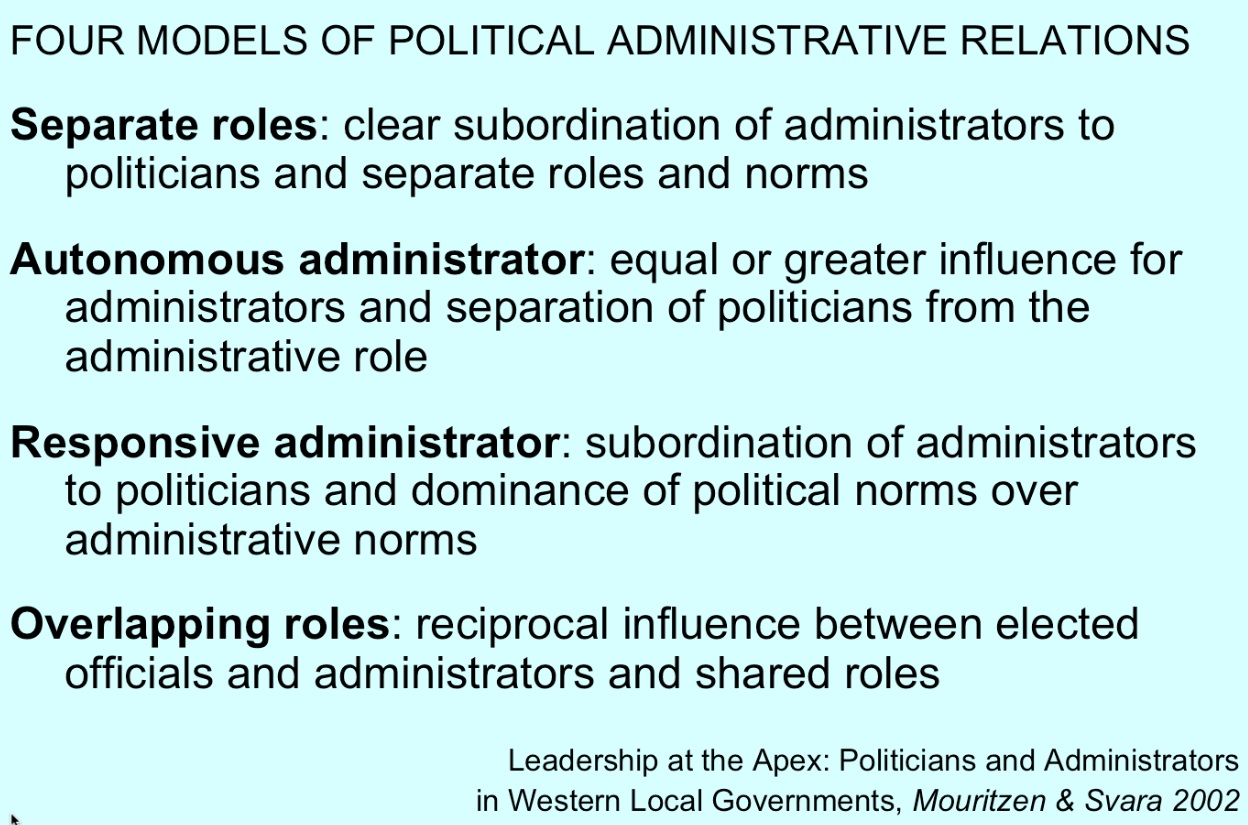
Workshop 2 - Leadership at the apex: overlapping spaces – testing perceptions of boundaries and relationships

Workshop 3 - Member-officer conversations - officers and members talking about complexities of their relationships (film extracts)
Tea
Workshop 4 - Exploring and defining skills and values
Workshop 5 - Using examples of ‘critical incidents’ to examine how officers can navigate contested leadership spaces – sharing experience
Summary and feedback: Q & A
Close
Simon Baddeley: As a visiting lecturer at Birmingham University where he has worked since 1973, Simon Baddeley’s fascination is with the working relationships of politicians and managers and how these relationships contribute good local government. He’s taught in Australia, Sweden, Japan, and Canada and more recently in New Zealand. He has invented many training approaches to this sensitive subject, including the ‘owl/fox/donkey/sheep’ model (co-author Kim James), and created a film collection of interviews with politicians and managers working across political-managerial boundaries. He runs events for local councils across the UK on ‘political-management leadership’ and ‘political sensitivity’ for members and officers and carries out film research on political-management working relationships. He was a member of the 2005 SOLACE Commission, convened by Cheryl Miller CBE, examining the challenges of working in a political environment.
Catherine Staite, Director of INLOGOV. Catherine teaches community engagement, collaborative strategy and strategic commissioning to Masters level. Her research interests include collaboration between local authorities and the skills and capacities which elected members will need to meet the challenges of the future. As Director, she leads and coordinates INLOGOV’s collaboration with a wide range of organisations, including the LGA, NLGN, Nesta, iMPOWER and SOLACE as well as universities in the USA, Europe and Japan, to help support creative thinking, innovation and improvement in local government and the wider public sector.Papers: 'Political-management leadership'
'Owl, fox, donkey or sheep: political skills for managers'
Dilemmas we worked on:
1. The good old days: The Leader asks you to attend a meeting with some of his group. When you arrive, you are confronted with some very vocal members unhappy about changes you are making in line with the wishes of the administration. The criticism is that it is not “like the good old days”. The Leader allows the criticism to continue. You feel confident you are dealing with it but backbench councillors are clearly unhappy. After the meeting the Leader thanks you for your robust response. What would you do next?
2. Alternative Opposition Proposals: The Opposition Shadow Executive Committee member asks you to produce alternative proposals for making savings in your budget which is being presented by the portfolio holder to the Executive. She intends to speak at the Executive meeting and wishes to oppose the proposed budget proposals and substitute the alternative. What do you say to the Opposition member and what do you tell your portfolio holder?
3. “Our” Council: The lead member for your service at one council asks you to arrange a meeting with councillors “to discuss arrangements for ‘social’ events to help “this council’s members to get to know your new integrated staff team” and ensure they are clear as to what “we want you and your service to do”. The member tells you they’re convinced your team is more focused on “our partner council”. “Can you” asks the member “make sure that your team know they also work for this council?” How would you respond?
4. Council tax rebate: Local authorities have delegated responsibility for managing the council tax rebate. The numbers qualifying for the rebate will be reduced as has the cash allocated to the council to pay it. It would be prudent to assume that that money will be reduced further next year. You feel it is essential to raise with members your concern that current council policies and procedures to deal with the impact of changes are no longer fit for purpose and that there may be social consequences that could catch the council ‘on the hop’. How would you raise this with the Leader? With Cabinet?
5. Political Split: You have been asked to present to a private meeting of the portfolio holders, your proposals for ceasing to provide grants to local community organisation. You know that the Leader supports the proposals and encouraged you to bring them forward; but the portfolio holder for your services wishes you to exclude his own ward from the proposals. How would you manage the process?
6. Victimisation: The relative of a Councillor is a user of your service. That Councillor is a member of a user group that has been highly critical of your service. The Councillor has also served on a scrutiny review, which has produced recommendations with which you personally disagree. The Councillor has complained to the Monitoring Officer that his relative is not receiving the same level of service as other users and claims that the officers are victimising him and his relative because of his criticisms of the service. What would you do?
7. Queue Jumping: A member of the Executive Committee - although not the portfolio holder for your service- has a relative who wants their son enrolled for swimming lessons at the local pool for which there’s a 12-month waiting list. The Executive member instructs you to put his relative on the next course. What would you do?
8. Contrary policies: One council decides to adopt a council tax freeze and the other decides to increase council tax. You’ve been asked by the Leader of each Council to explain the implications of these choices for your service area in each council’s area. You are very concerned that the added financial pressure of a council tax freeze will impact adversely and have advised against a freeze. You know there are savings that could be made in other service areas that would help meet the financial limits of a council tax freeze. You are approached by an opposition councillor in the council which is increasing council tax and asked to explain what advice you have given to whom. What do you tell her?
9. Untrue Statements: You attend a local area forum in your own time and as an interested member of the local community. One of the Councillors there is talking about your service and making statements which you know are completely untrue. The public are able to speak at the meeting. What might you do?
10. One of us?: You are at a meeting with councillors from one council which happens to be the one where you worked for many years before taking up your current joint management post. A short way into the meeting, it is clear that councillors are not happy about what the other council is doing on something within your area. It is clear that they see you as an ally because you are used to their way of doing things and want you to agree with them. What do you do? What don’t you do?
11. Interest in Contract: You are responsible for managing a number of contracts for supplying catering for your services. A Councillor approaches you asking for details of previous contracts let and future tenders. You have a suspicion that the Councillor is acting as a consultant to a large catering company in the area. What do you do?
12. Public promise: Immediately before a local area forum meeting your Executive Lead member suggests he intends to make a public promise that the local theatre will not be considered for budget reductions. You are aware this is not the case and the Leader will announce to the press the following day the proposed closure of the theatre without telling his cabinet lead first. How do you deal with the matter?
13. Spare room subsidy: The CEO is at a senior management team meeting. “As we know government has passed responsibility for implementing the spare bedroom subsidy to us. We’ve all done some analysis and come up with implications. The council may not have enough suitable accommodation for the people who fall within the criteria. People to whom the ‘tax’ applies will have less income. That could impact on other issues - family pressures, social cohesion and so on. Some just won't be able to pay. We could run up uncollectable rent arrears. If we evict, the cost of B&B will be greater than the loss of revenue, not to mention disrupting some children’s schooling with ‘knock on effects’. Administration has no wish to run into conflict with government. I’m seeing the Leader later. Any thoughts on what I should suggest by way of avoiding extra costs?”
14. Members’ deputation: You are working at one council’s offices preparing an important briefing note for a lead member of the other council, ready for an urgent meeting that needs to take place at the other office that afternoon. The meeting is to confirm an informed financial decision that will directly affect that council's economic growth agenda. You are interrupted by a deputation of councillors from the council where you’re working. They insist you see them at once. There has been a heated political incident involving the main town council. How do you respond?
On 13 June Lin composed a detailed letter - sent in my name - to Highland Council; an appeal for refund and reduction of charges in line with executor's exemption on mum's house. Yesterday I got an email, a letter attached:
Apologies for the delay in replying. Below is a copy of the letter I have issued to you today. I have also issued a copy to Mxxxx and Jxxxx, Solicitors to keep them informed. I trust this helps to clarify the position and thank your for your help in resolving the matter.
Yours Sincerely, Willie Munro, Exchequer Team Leader, Highland Council
Contact Number: 0800 393811
Email Address: Operations.Team@highland.gov.uk
Our Ref: 06xxxx04
Your Ref:
Date: 9 July 2013
Dear Mr Baddeley
Council Tax Appeal - Liability
Account 06xxxx04 - Brin Croft
Thank you for your emails and letter received on 14/06/13, concerning the above. I have now reviewed the case and decided as follows:
1 - Account 06xxxx02
Following the death of the late Barbara Burnett-Stuart an exemption under the category of "Executory before grant of confirmation" should have been awarded. This would be for the period (01/11/12 - 16/04/13).
Following the grant of confirmation, which was on 17/04/13, as confirmed by Mxxx and Jxxx Solicitors when I contacted them on 08/07/13, an exemption will be awarded on the basis of the category "where confirmation of an estate has been made"; this would be for a maximum of 6 months, dependant upon any changes to the ownership of the property taking place.
2 - Refund of Council Tax - Account 06xxxx03 (Mrs E Bxxxx)
From your emails and letter it is clear that payment of the sum of £563.75 was made by the estate on behalf of Mrs Bxxxx for the liability that was billed for the period (15/11/12 - 31/03/13). I will arrange for a refund of monies to be made to the estate and sent to Macandrew and Jenkins who are dealing with these matters.
3 - Transfer of Ownership of Property
If there is a transfer of ownership of the property the Council will require to be notified as the exemption currently awarded with effect from 17/04/13 can only be awarded for a maximum period of 6 months following grant of confirmation and so long as there has been no change to ownership. I am sure that the estate solicitors Mxxxx and Jxxxx will deal with these matters if and when they arise.
Summary*** *** ***
I will arrange for the above actions to be carried out to ensure that there is only one council tax account in place; namely account 06xxxx02. The appropriate exemptions will be awarded for the respective circumstances i.e. "before grant of confirmation" and where "confirmation has been made".
Any monies that have been overpaid will be refunded to the estate accordingly. I trust this helps to clarify the position and I will issue a copy of this letter to :
Mr J K of Mxxxxx and Jxxxxx who is dealing with the estate concerned.
Should you have any further queries regarding this matter please contact the Freephone number 0800 393811 or email the Operations.Team@highland.gov.uk, or write to the Operations Team, PO Box 5650, Inverness, IV3 5YX.
Yours sincerely
Willie Munro, Exchequer Team Leader, Exchequer Operations Team
Email from Jan D:
Simon. Hope yesterday went well. Here is something to bring a dose of reality to the debate although you and I have for a long time believed that current policy is mainly ideology driven rather than evidence driven. Eric Pickles said the following to the LGA conference last week: “Citizens should be large and the state small.” Leaving aside the fact that this is meaningless drivel from an evidence perspective, it is a crystal clear statement that current policy is not about austerity or financial problems (these are the catalysts) but an ideological commitment to 'roll back the state' and 'slim down' the public sector, esp local authorities, through a cynical combination of delegating more and more politically 'toxic' responsibilities to Local Authorities, whilst drastically cutting their funding to carry out these tasks. It is calculated that by 2020 LAs will be £14.4 billion in the red - in other words 'insolvent'. The National Audit Office believes that it is no longer if, but when a large council will go bust. They are alarmed that there is no strategy for dealing with this. It is reported that neither Pickles nor Osborne are impressed with the recent LGA report arguing for more powers and freedoms for local councils so it will be interesting to see how LGA proceeds with this. I remain concerned that LAs do not really grasp the nature of the monster they are dealing with, or if they do they are remarkably quiet and subservient. They have accepted the dominant narrative that this is about austerity, necessary to balance the books and achieve economic growth in the future. Whatever validity this has ( and it would be ridiculous to deny the financial fallout from 2008) this is not the main challenge for LAs: it is survival in any meaningful way. This means that 'innovation', 'redesign,' 'transformation', and similar concepts, worthy and necessary though they are, can never provide the strategic impetus to deal with an ideologically driven policy. These are mainly managerial and technical exercises (albeit with political implications) at a time when a new political approach at local level is required. This is the time for local councillors to show their mettle on behalf of their local population, but will they? I am no longer Inside The Box but I can’t see any evidence that this analysis is accepted or more importantly acted upon in the political-managerial framework. There should be some critical incidents to be devised****** *******
One issue related to this, which we have spoken about, is Housing. It is reported today that homeless households in London are being sent to B&B accommodation as far away as Newcastle, Manchester, Leeds and Birmingham without the host authority being informed let alone being involved in it seeing that these are mostly vulnerable and poor people the consequences are fairly predictable , this is no longer a problem for the wealthy councils around London. In fact it seems that the wealthy south is exporting their poor to the poorer north. 580 families were sent out of London last year alone; probably just the tip of the iceberg. Newham Council in London reports a 429% increase in last 2 years. These are not accidental developments but the consequences of current policies re housing benefit and welfare benefits combined with housing shortage esp in social housing. This means that there are likely to be serious tensions between Councils at a time when unity is critical. The government must think Xmas has arrived early.
The facts (evidence) re consequences were know prior to policy being implemented but still it went ahead. A 'critical incident' perhaps - of ideology vs evidence and the supremacy of the former. What is the role of 'neutral' public servants in this? A case for the ethical dimension to the reading/carrying model? Some interesting discussions between CX and Leader could take place around these issues. How do LAs develop their own narrative? How do they recalibrate 'their relationship to Government?' Best, Jan
Aftab asked if I'd send Legacy WM a letter supporting his latest local history project:
 |
| Aftab with one of his daughters, Maya |
TIME
CAPSULE
Having
been associated with Legacy WM’s ‘Lozells and Handsworth Heritage Trail’, and before that Aftab Rahman's 'Cultivation to Consumption' events, I
have just learned about their latest proposal – the ‘Time Capsule’ project. Its
purpose is to develop ‘community journalists’ who will seek out ‘time capsules’
in the local community – not traditional ‘time capsules’, but real people who
lived through and experienced, and still recall, times which for younger people
have become ‘history’; but history at risk of disappearing. I support Legacy WM
in collecting and sharing the past of this area for the benefit of future
generations.
I
strongly support the training of young people in the skills and understanding needed
to collect and collate the history of Handsworth’s older communities. I may be
able to assist in recruiting volunteers to be community journalists, pointing
them towards neighbours, friends and other contacts who might become interviewees.
Legacy
WM have developed an impressive track record, having, in only two years, delivered
two high quality heritage projects - ‘Bangla Food Journeys’ focusing on the
Bangladeshi community, and the ‘Lozells & Handsworth Heritage Trail’.
The
narrative of this, and other inner suburbs of British cities, has too often
focused on urban pathology. We, who live in Handsworth, know that that
‘notoriety’ is grossly exaggerated, even groundless; that even with its problems,
the area is full of good surprises. Legacy
WM’s Heritage Trail explores local places and spaces. This latest project will
explore the memories and reflections of older people, building up a composite
picture of their local childhood, youth and middle age. It promises to impart
to young people, and newcomers of all ages, a truer and more detailed picture
of a fascinating place, helping them appreciate in what rich soil they are putting
down their own roots.
I am more than happy to support this initiative;
willing to join a steering group that might help the project into fruition; willing
to offer my experience as a local historian as the proposal evolves.
Yours
sincerely, Simon
Baddeley
8 July 2013 - Hello Simon, Thank you so much for this letter - beautifully written and captures the essence of what we aim to do. Thank you for support - I know this is a busy period for you. Kind regards, Aftab


