Total Pageviews

Showing posts with label Dave. Show all posts

Sunday, 17 May 2015

Sailing to Pirate Island

It wwould be a fabled island. Guy, Dave, Oliver and I set out in Summersong from her little home port of Ipsos; motoring without wind from the aquamarine shallows into the deeper blue of the Kerkyra Sea.

“See the engine?” said Dave
Oliver peered down on our engine under the first cabin step; made engine noises.
“Bob bob bob bob? Call it ‘Bob’’
“We’re going to Pirate Island” I said
Slowly the old boat headed south a little away from the coast, then further past Dassia Bay.
Water for Oliver, beer for the grown-ups and small croissants for everyone . The sandy pebbly shores passed slowly by and a small tree covered island appeared on the horizon
“There it is”

“Does he know what an island is?” said Dave
“I don’t know. But we can give Ollie some memories – for us; his innocence to make a different account of this melancholy place. Wouldn’t I prefer to set aside the arguments about what happened there; set aside in all its squalor. Wouldn’t I prefer my grandchildren to think of me living on Pirate Island - where we buried treasure; a cross or two pointing to the spot.”
We approached the island carefully; edged up to the ragged low jetty and took a line ashore; and headed inland.
“Ssssh watch out for pirates”

Under the shaded pines and through the ruined buildings where the pirates go.
"Could this be the place where the treasure was buried?"

"Hear their noise!"
"Ssssh they'll know we're here?"
'Back to the boat...Quick!"
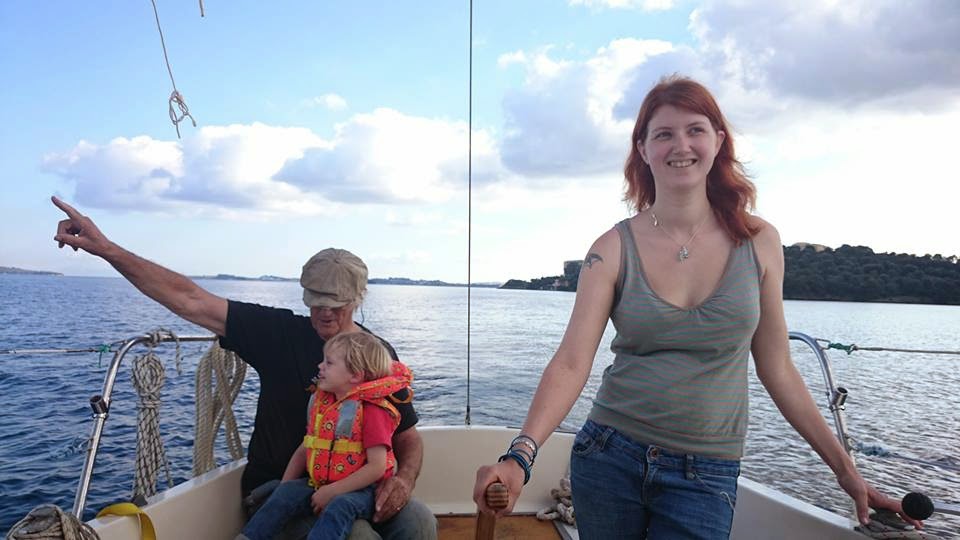
In no time we'd returned aboard, cast off, and were heading home, Oliver at the tiller steering with the foresail up before a gentle breeze. Quiet. Ripples and small splashes against the hull.


Dave, Guy and Oliver sailing on Summersong

I found a souvenir - a thole-pin in a block of wood broken from the gunwale of one of the pirate's sally boats; rusted spiky nails sticking from it. Dave banged them flat against the stone work of the jetty. I drew out the pin and put it in the other way round.
"A boat!"
The boat I found on the island
In my childhood there was a lot of time without grown-ups. I don't recall missing them when I wandered in gardens. Perhaps they were there watching, but a lot of the time I think I got to be on my own. I have early memories of walking along the banks of the Itchen, peering into deeper fast running water, finding it and knowing it could end my existence. I don't recall being told the dangers. I just knew them. In London I was taking the bus and the tube on my own from 10 years old. When I learned to cycle - late at 10 years old - I roamed widely through narrow streets and across Hamstead Heath. We had horses. I rode out on my own. The countryside was my oyster. In later years I started sailing making my own adventures. My rules were strict; less for my safety than the strict duty to attend to the seaworthiness of my 'small ship'. I was never a fan of 'Swallows and Amazons'. Why read a grown-up's fantasy about the private adventures of childhood? How I have wanted my children to have their own adventures; suppressing anxiety, being what some would consider an irresponsible parent. I'm so glad they walk the city. Brought up in the inner-city; witnessing and judging its hazards; street-wise, but also country-wise, knowing stock, alert to the seldom-dangers, knowing the riskiest thing is to get near a cow and her calf. That they've cycled and walked in wild places on their own and walked the city at night; unfazed by rain and wind and the insanely exaggerated fears of 'stranger danger'. 

Friday, 31 October 2014

Late October in the village

Dawn over the mainland - an October morning in Ano Korakiana

As the time to leave the village and return to the distant city grows closer I find myself playing down here; playing up there. It’s the same for those long departed swallows. As they assembled on village power lines beside their fledglings, emptied nests growing stale under tiled eaves of a village in Greece, twitching for the flight south; reversing the excitement of Easter’s arrival, fretting for a village in Africa.
 “You’ll like it”
 “Are we there yet?”
I’m balancing regret and anticipation; a slight time vacuum that matches this weather; poised between late summer and gentle autumn; sounds and smells evoking life as a planet in a universe of parents, their story my sun, sensations and images evoked by wood smoke, slight chill, misty evenings, lit windows into glimpsed interiors; the quiet of this village strewn along a mile of mountainside with its wide precise focus on the scrubbed mainland hills of Epirus. Here is a warmed space in which to be absorbed uninterrupted by clues to the present; so the click of burning wood in the stove is both now, and long ago, a reminder to feed the fire. I roam in time, occupied by beloved presences long gone from the earth, places past, still ineffaceable. So will we be for our children I hope - an indelible frieze. I’ve been employing my imagination on the recovery of Rock Cottage, assisted by Martin’s regularly forwarded pictures from Gloucestershire. He and Sandra and Adam have been travelling down to the Forest of Dean at weekends from their home near Worcester - equipped with first aid for our first second home, plus Jack and other helpers – ‘Team Ward’ Martin calls them. I’m nearly ready to imagine us being able to stay again in the Forest of Dean – but there’s tiling, painting, carpeting yet, and the hope that the problem of upstairs damp will be solved, by adding gutters, burning logs, clearing drains, living there…
Hi Simon. Paul examined the heating system today, re-filled and charged the system, and got it all up-and-running. The boiler has withstood the ravages of time and lack of use quite well. There is only one issue and this is some corrosion on the diverter valve and pipework.
He estimates the boiler is ten years old, and has a lifespan of 15 years. He estimates this corrosion will last the life of the boiler, and messing about with it at this stage in its life would only cause more problems.
I have been discussing the damp problems with Paul, and he has had similar problems with a cottage in Wales. After many surveys and so-call expert advice - most of the problems turned out to be condensation. I note the new windows have no trickle vents, and other than the chimney flue upstairs - there is no ventilation at all. When we got there this morning, the windows were steamed up on the inside !
I've opened all the windows one tiny gap, and left the heating on for the week, turned down to 15°C - so it will only come on at night. I'll see how it goes for just this week, and note any improvements. Talk more about this when I see you both next. Regards, Martin X
Adam mending the guttering
Sandra on the windows 
Martin's lit the fire to help dry the house ~ 'Team Ward' at work
There’s the allotment, plot 14 on the Victoria Jubilee, from which I’ve pledged these last years, I’ll supply vegetables for our next Christmas lunch. Winnie’s been sending reassuring pictures of well prepared soil, sprouting winter onions…
Plot 14 England (photo: Winnie Hall)


There’s walking and cycling on the canals with dog Oscar, who, while we’ve been away, has been shared between our neighbours and Amy. There’s a host of work to be done on the house in Handsworth; continuing work on the Jack Hargreaves archive sat in that slatternly lock-up on the Tyburn Road; see what Francis in London has done by way of further digitising film and tape, synchronising sound and image. Second day home – Monday after next – I’m giving an evening talk about the history of Handsworth Park to Barr and Aston Local History Society in Great Barr Memorial Hall. And there’ll be seeing the grandchildren again; familiar after an interval of just a fortnight since they were with us in Corfu...
Lin, Hannah, Amy, Oliver at Ipsos

... a fortnight since Guy and I went out on Summer Song; Dave our guardian.
“Let’s go to Lazaretto Λαζαρέτο
“Where?”
“Gouvinon Island”
He was still puzzled.
“Execution Island”
I’m averse to the name. A cloud shadowed the mountains. We motored out of Ipsos into a calm sunlight sea. No chance to sail…
”Unless those two big clouds come together, then we might need Gouvia as a bolt hole” said Dave as we passed close by Cape Kommeno.
But the sun shone on us between them. The island came closer.

We slowed near the old jetty, took a second pass to avoid shallows, and went in nose first, Dave mooring us with a knot shoved into a slot between a pair of rough stones, our bow covered in fenders touching the water. The clouds moved across the sun.

I’d been here a over four years ago, expecting now to see the museum announced in 2007 completed; a place to tell the story behind the walls scarred by the impact of many bullets; serried ranks of crosses a few yards up a slope from the jetty; memorials for young men and women shot during the Civil War - bearing dates between 1947 and 1949.
A Museum of Medical History and National Reconciliation is to be built on the historic islet of Lazaretto, Corfu. The old leprosy hospital, which has been listed for preservation, is set for restoration and the surrounding area will be refurbished and made fully accessible to the public, according to a Corfu Municipality architectural study that has the approval of Deputy Environment Minister Stavros Kaloyiannis.[Long history of Corfu isle honoured with a Museum February 24, 2007]
But someone and something doesn’t want the history yet. Can’t tell it. Won't tell it. The Occupation executions perhaps yes, but not the fratricidal killings that came after. When I was here in May 2009, the new building looked smart, ready to be used for visits, lectures, exhibitions. The older buildings including the old and perfectly shaped small church, were readied for restoration, scaffolding erected, walls being stripped, some re-plastered. Now the whole place lay besmirched with neglect, mossed, mildewed, rusting, streaked with gutter dripping. In a clearing was a large stack of hardened sacks of cement, paper peeled.


“There’s a €1000 of cement gone to waste there” said Dave.
"It could have been stored under cover surely?"
The notice I’d seen before showed the starred Euro-symbol and the amount dedicated to creating this memorial - €314,000
“That’s gone somewhere else” we muttered.
 “There’s some rain” I said, feeling speckles between the pines. Someone had been strimming and lopping recently or all would have been disappearing into the shrubs, saplings and trees decorating the rest of the island. There were also roughly squared boards bearing more names, listed without dates or other identification. We'd been going to sit and eat our sandwiches. Instead we headed back to Summer Song, passing another notice, the only one that speaks a little of what happened here.

“What a great place for a taverna!” said Dave “A proper jetty. You could have a to-and-fro ferryboat from Gouvia”
“Yes. An open air grill. Souvlaki  lamb, pork, kokoretsi, chicken breasts and legs and beer and wine” “It would be a cracker of a place”
"Singing, dancing..."
Remembering. Someone told us an old man they knew saw soldiers with rifles bringing prisoners to the harbour.
“Young men and women from the prison marched to the old port to board a boat to the island. They were shouting and singing as they walked!”
We got back on Summer Song and motored around the island before heading back to Gouvia Bay. Guy had phoned Amy.
“They’ll meet us at the jetty there in an hour”
The clouds passed as we closed the shore by the old Venetian shipyard, tied up beside the caïque moored there and strolled ashore as Lin drove up with Amy, Liz, Sophia, Hannah and Oliver. Dave had brought small life jackets, and fitted one to Oliver.
“We’ll meet you at Ipsos” said Amy.
Liz and Oliver came with us on Summer Song, clambering over the decks of the caïque to board the old yacht.
Summer Song leaving Gouvia Pier (photo: Linda Baddeley)


Oliver with his dad "What's that noise?"
With Oliver aboard the 'Boyhood of Raleigh' flashed in my mind...an image nursed in imagination since I was a boy, lived in my youth...the model ship, the arm pointing to the Spanish Main, so so long before I was - with thousands of others who need to know their history - grappling with post-colonialism.

A breeze got up off Kommeno again. For a quiet half hour, before calm returned, we sailed under the foresail, Liz at the helm. Moored again in Ipsos, tidying the boat, turning the handle that pumps grease into the stern gland, I thanked Dave
 “That was such good outing. Your reassurance made it so”
Oliver had spent most of our return journey exploring inside the cabin, observing as we approached Ipsos “Look at the lovely water” A boy's memory of the sea.
Meeting up at the harbour in Ipsos

*** *** ***
The Co-op is gearing up for this winter's olives. On a walk with the family, we dropped in on Sebastiano Metallinos, and his helper Harry, overseeing the oil processing machinery. Sebastiano gave Amy and Liz a tour of the plant from the delivery of olives, twigs and leaves, to the cleaning washing hopper, to the oil tap at the other end
One of the two olive oil centrifuges in the village co-op

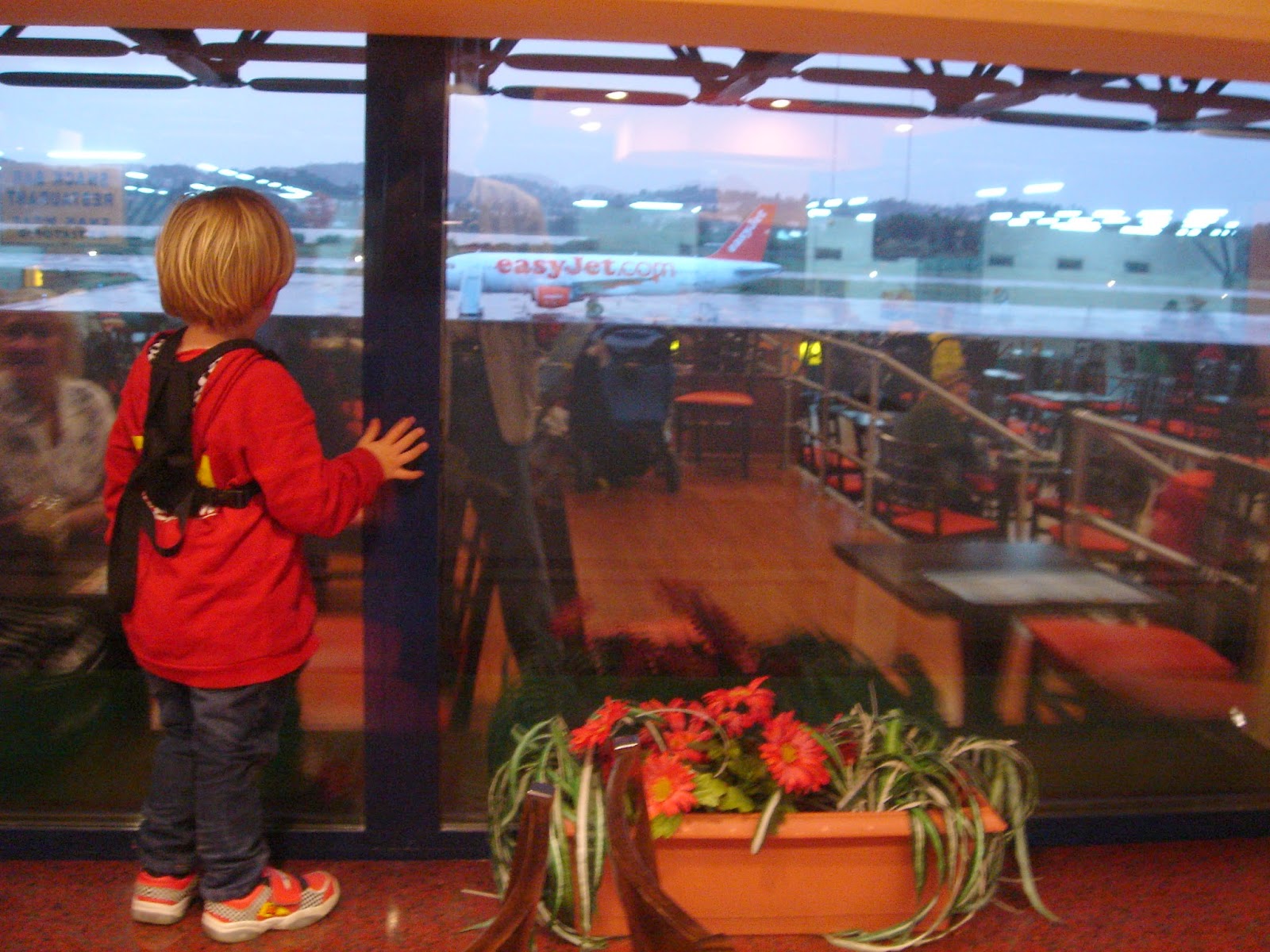
Douglas Adams would have used the name of a town, Roget might have a clue for me, and the Germans, a suitable compound adjective to describe the bitter-sweet experience of having the house to ourselves, now Liz, Sophia, Guy, Amy, Oliver and little Hannah have flown back to England. They left - eventually - in wet grey weather, which is always better, except the plane that should have taken them home was struck by lightning somewhere on its approach to Kapodistria. It landed with everyone safe, but sat on the runway effectively unusable, while Easyjet announced they were sending a replacement jet, which would mean everyone waiting in the airport for the rest of the day. (Other travellers fared worse). I was grandpa childminder helping with the children until at last they trooped into security just before nine in the evening and I headed back to Ano Korakiana in the dark.

"I don't see how they can get any compensation" said Lin later, reading the cancellation and delay leaflet everyone had been been given at the airport "It's hardly Easyjet's fault if they get struck by lightning"
“When we get home…”
“Home?” I’m of two minds on this, at least two, thinking of a way to return in January when the internet – outside the popular months for travel - becomes useless and Lin and I rely on local knowledge.
“Do you know anyone who knows about travelling to and from Albania?” I asked Pastor Miltiades at the Lighthouse.
I do”
“Wow! We’d like to go to Dubrovnik, perhaps Split and on to Albania without having to go back to Italy first”
The crow flight from the bottom of Croatia to the top of Albania is hardly 100 kilometres. No coach or ferry is promoted between the countries…
“Not that we can see”
“From Dubrovnik there is a coach or ferry to Durrës. From Durrës - in Greek we call it Dyrrhachion Δυρράχιον - you take a coach to Saranda” said Pastor Militiades
“Right opposite us!”
“From Saranda you take a ferry direct to Corfu. I will give you some places to stay in Albania next Saturday”
So then I’m trying to work out how to get to Dubrovnik for under the ridiculous £1000 price three change 12 hour flights thrown up by flightscanners.
“They’re useless for economy flights in Europe.” says Lin “They’re for cheap tickets to Thailand, Hawaii, Australia…I’ll do some searching on Ryanair, Easyjet, Whizzair
Meantime I’m phoning Viamare in London for their access to winter ferry routes to Croatia from Italy.
Says Alina “Bari-Dubrovnik? Wait a mo’…checks her computer...they start in April”
“Anything in January?”
“Wait a mo’…Ancona-Split. I’ll email details”
Dear Mr Baddeley. Further to our telephone conversation with regards to a ferry crossing from Italy to Croatia or Albania. Please note that I can offer a ferry crossing from Ancona – Split , Jan 2015 however time table is still not available, it should be available in mid/end November 2014. At the moment I can offer: Bari-Durrës – 10 Jan 15 – 23:00 arrives 08:00
2 passengers in seats = €116
2 passengers in 2 bed inside cabin with shower and wc = €168
Please note the ferry runs every day at 23.00
Best regards. Alina. Viamare Ltd. Reservations Dept.
***** *****
Kobanê...Just when the politicians and military of the West have learned about fighting assymetric war they find themselves confronting a force claiming aspirations to fighting symmetrically in the style of the warrior prophet. Kobani  an undoubted place, a concept avoided in asymmetric conflict, is being fought over these last weeks. I suspect the 'West', working the old military option of patience - if only they'd done this after 9/11 - will, with the learning of the last 10 years, out-manoeuvre this unwieldy occupation of ravaged middle eastern deserts. As for the Kurdish diaspora - this must be a moment in history.
*** ***
By incomparable Tolstoy’s first line in Anna Karenina, his response to Madame Bovary perhaps, we ought, in order to be interesting, to be less than fully happy. Yet to avoid too much derivative plotting, clichés even, I wouldn’t want to paint a picture of enviable harmony masking an emerging tale of depravity…(from the prompt box – frantic rotations of fingers and a finger slashing the throat)
No no, seriously tho’, don’t bloody do those fake gaping yawns, you know how real writers can compress time; painters define foliage with hardly two deft strokes or composers hit a three note phrase that says it all…
The trouble with all this is that I try to agree with my stepfather, a master of the television anecdote. He didn’t think you should ever take your audience behind the proscenium; “Don’t share the tricks of the trade”…
I suspect that these last few weeks will show up on our tree rings, or whatever Lysenko projected was the physiological medium by which experience attached itself to genes, as a time of richly harvested joys. Yet didn’t Tolstoy also show that his hero Levin – same novel – in even his happiest moments contemplated suicide. It’s something about mixing; an alchemy in which grown-up joy is the more real through being spiced with homoeopathic dilutions of misery, depravity, despair, extinction and failure. These are dreams I have, waking to find myself among my children, beside my wife, in my home bed. Koestler implied it with the image of a walled cottage garden orchestrating an array of gentle perfumes and colours, sounds and lovely things to touch and taste, surrounded, if you lift your gaze, by a panorama of barbed wire, where Homer’s rosy fingered dawn is become a blood streamed firmament.  Wasn’t I right to cry out with revulsion when Uncle Mac on Children’s Hour sang about the bells with that finale...
Here comes a chopper to chop off your head
Chip chop chip chop - the last man's dead.
...or Strewwelpeter’s to little Conrad suck-a-thumb … ‘he comes he comes’ –  the big red scissor man.
Snip! Snap! Snip! the scissors go;
And Conrad cries out - Oh! Oh! Oh!
Snip! Snap! Snip! They go so fast;
That both his thumbs are off at last.


...just little red stumps - in that famous cautionary children’s book.
“Oh! The crying and the wailing of children!” I smiled in mock despair to our neighbours Vasiliki and Lefteri and family around their table for Sunday lunch. Foti smiled at me
“You need King Herod” he muttered with a grin.
I missed his meaning for a moment
“Massacre of the Innocents!” said Natasha to cries of horrified laughter. Ah yes indeed.
The children in Corfu 
*** ***
A new shop - for goods, coffee and drinks - has opened in the village's last kafeneon καφενείου Κεφαλλωνίτη. Crescendo run by Spiro and his brother Dimitri Vlachos, opened with the blessing of Pappa Kostas last week...
Εγκαίνια στο "Κρεσεντο" - 26/10/14
Χθες, παραμονή του Αγίου Δημητρίου, το σούρουπο, πραγματοποιήθηκαν τα εγκαίνια ενός νέου καταστήματος στο χωριό, από δύο νέους ανθρώπους, τα αδέλφια Σπύρο και Δημήτρη Βλάχο. Το κατάστημα άνοιξε στο χώρο του πρώην «καφενείου Κεφαλλωνίτη» επί του κεντρικού δρόμου, έναντι του Δημοτικού Σχολείου του χωριού και είναι πλέον πανέτοιμο να προσφέρει τρόφιμα, καφέ και γλυκά, στον ειδικά διαρρυθμισμένο χώρο του.
crecendo102014a.jpg

Τα εγκαίνια έγιναν με τον συνηθισμένο για την περίσταση αγιασμό από τον παπα-Κώστα, με την παρουσία της οικογένειας των ιδιοκτητών, φιλικών τους προσώπων και αρκετών χωριανών, ενώ μπροστά από την είσοδο υπήρχε μπουφές με κεράσματα.

Ευχόμαστε καλές δουλειές…και προπάντων με «κρεσέντο»!!!

Wednesday, 28 May 2014

Lunch with Richard Pine - pondering Ballybeg

 Avignon © Bert Smith

A woman in Perithia, seeing my car with a hire company badge on the driver's door, wandered over to peer in my window and saw Richard sat beside me.
"Oh! It's you. I thought you might be lost"
"We are, We are!" said Richard
"Aren't we all?" she called over her shoulder
Richard P

I drove over the mountains behind Ano Korakiana down to the north coast. We ascended then, from Perithia, where Richard had been waiting for me near the post office, to Loutses and on up the bumpy winding road to Old Perithia, parking on the rough gravel beside other cars and a coach; treading carefully down the steep cobbled slope into the village, until we were below the village's view towards a patch of sea below the high Albanian mountains. We sat at a wooden table covered with a red and white gingham table cloth, dappled with sunlight through an awning vine that brushed my shoulder. 
Two fizzy waters served us for drinks; along with a basket of fresh bread to whet our appetites. Half an hour into our conversation Tomas served us our order, grilled livers in their own gravy topped with fried onions surrounded by richly browned chips and a rationed garnish of chopped tomatoes. We dipped our forks into a wooden bowl - a shared salad of rocket and lettuce dressed with olive oil, sprinkled with grated pecorino. Our conversation as we enjoyed this lunch touched on Richard’s about-to-be-published book, The Disappointed Bridge
“Don’t buy it! It’s going to cost £70”
But I will. Richard’s writing is a struggle I welcome. Sometimes more than half the time I don’t understand what he’s getting at, but then a grasp of an original and unfamiliar understanding emerges. Of Brian Friel it was how a village - Ballybeg - could contain everything; how an artist can make the ordinary heroic; weaving plots from the threads of routine. It was Richard who told me that Chekov’s stories came from what he saw through his window. Where I see a fascinating view with sounds and colour and movement, he – as with all genius - could create a proscenium for the rest of us and raise a curtain on the unforgettable doings of eternal personalities – who are yet us; me even. I’m intrigued by the colonial story and how it reads into the present. The preoccupying issue of the current local and European elections is bound up intimately with the implosion of the continent’s separate empires. Enoch Powell in his brilliant, sad and ugly speech in 1968 had called allowing a total of 50,000 immigrants into the UK ‘literally mad’. It’s well agreed that current figures are unreliable - according to the final chapter of Andrew Marr's excellent History of Modern England...
...but the annual net arrivals from other countries to the UK in the 2000s has been closer to 165,000 a year, while more than one in ten of those with British nationality – five and a half million – live abroad, joined in that British diaspora by over a thousand more emigrants every day – some in despair at here, hoping their choice of there will be better. What an astounding rejigging of old ideas and experience of place, identity, and the meaning of life!
Humans have always moved about but this mêlée involves a vaster mélange of humans across  a land mass mapped to the centimetre whose outlines alter with the melting of ancient ice, rising seas and dying bees. I want to read what Richard has to say about ‘what happens to an emerging nation after it has emerged’ and what is understood by the ideas of ‘independence’ and ‘freedom’. 
Lin will insist “You can order it from the university library”
This original study is the first major critical appraisal of Ireland’s post-colonial experience in relation to that of other emergent nations. The parallels between Ireland, India, Latin America, Africa and Europe establish bridges in literary and musical contexts which offer a unique insight into independence and freedom, and the ways in which they are articulated by emergent nations. They explore the master-servant relationship, the functions of  narrative, and the concepts of nationalism, map-making, exile, schizophrenia, hybridity, magical realism and disillusion. The author offers many incisive answers to the question: What happens to an emerging nation after it has emerged?
It was Stephen Dedalus - James Joyce's disguise - who used the term 'disappointed bridge' of a seaside pier - the south arm of the harbour at Dún Laoghaire;  not really a pier in my book. Richard's book cover bears a picture of a slightly different 'disappointed' bridge at Avignon, a small silhouette placed at the broken end that must have fallen into the swift snow-melt waters of the Rhône, which for a few seconds we looked up to from Danica as Chris and I swept by on our way to the Mediterranean - in the company of a surly pilot who we'd been required to pay to join us at Lyons, where we'd arrived via the gentler Saône on our inland voyage through France. A pier is intentional, but the famous Pont D'Avignon is a truer disappointment; that no stone bridge could long survive the force of the Rhône in winter flood; rebuilt several times men finally gave up on it.

From Richard's preface to his latest book
...When freedom comes, men and women explore each other in a new light, as citizens and as lovers, but above all they explore freedom itself. Attitudes to land, society and sexuality take on new perspectives and are subject to new descriptions. Narratives alter both subtly and violently.Many emergent countries continue to live in the shadow of their history. But with autonomy comes an unfolding of a range of attendant freedoms and responsibilities which engage the imagination in acts of cultural, sexual and spatial emancipation...The interstitial space between colonisation and full autonomy is a very dangerous place, as relationships are redefined and new forces, previously impossible or inconceivable, become visible, articulate and active....All the lines must be redrawn, all the characters redefinedThe moments immediately following freedom are the most dangerous....
He and I discussed the Greek political landscape; the possibility of a General Election if Samaras’ coalition with PASOK becomes too weakened in the light of SYRIZA’s successes in the latest local elections. We touched on the research on Golden Dawn’s infiltration of the country's army, church, police and judiciary. 
“I was chatting to an Englishman the other day" said Richard "He scoffed at the idea of Golden Dawn as a threat to him. I said ‘Look if they become powerful you are one of the foreigners who’ll have to leave Greece. Your property here forfeit” 
But it was like trying to imagine something too far outside experience. 
“We never think it’ll happen to us!” 
We spoke about Ano Korakiana’s laic sculptor, Aristides Metallinos; what happened to his dream of making a gift of his work to the village. 
“You must write a book about him. It’s a fascinating story.” 
We mused on bad writing about sex. 
“Well it’s just as bad for many people even talking about it” I said “I don’t mean prudery. Rather the opposite.” 
“Hm” 
“One thing. The young get embarrassed even a little disgusted by their elders, particularly parents talking about coition, affairs, passion. Goodness! My mum drew my attention to Donne’s The Ecstasy when I was about 16 - pointed up favourite lines in the poem. 
...So must pure lovers' souls descend
         T' affections, and to faculties,
Which sense may reach and apprehend,
         Else a great prince in prison lies.
To'our bodies turn we then, that so
         Weak men on love reveal'd may look;
Love's mysteries in souls do grow,
         But yet the body is his book.
And if some lover, such as we,
         Have heard this dialogue of one,
Let him still mark us, he shall see
         Small change, when we'are to bodies gone.
I was almost repelled by her delight in these. Now I celebrate his line ‘else a great prince in prison lies'  Then it was ‘Yuk!’ I suspect a reflex working of the incest taboo. I also think that writing about sex is so often gross, unlike Donne's; why I like the Bad Sex in Fiction Awards drawing 'attention to the crude, tasteless, often perfunctory use of redundant passages of sexual description in the modern novel, and to discourage it.'
“I want " I added "to be able to show how Ano Korakiana's self-taught sculptor – taking up hammer and chisels in his old age - expressed the theme in stone and marble, but English, failing an improvement in my prose, is too medical or too brash, so that the words that do at first seem right turn out sheepish euphemisms. Aristedes Metallinos* is - when depicting his wife, oblique, yet more assured, more laic; their wedding memorialised in traditional finery, full of love...a marriage to Angeliki who bore him a son and a daughter. 
How they gaze into each other's eyes. How he swaggers with cane and turn of knee in princely plumage and she, with her white mountain flower, face unveiled, now dotes upon him; touching each other's hands with intimate promise, both hearts leaping. 
'Love's mysteries in souls do grow'...'and yes I said yes I will Yes'.
.A Lord of the Ionian Islands. Aristides Metallinos 1981 - shown with respect and gratitude to Andrea (sculptor's son) and Anna (daughter-in-law) Metallinos. 
The tree of life - Aristides Metallinos
'The tree of life' - Το Δέντρο της Ζωής - brought to mind L'Origine du monde - the title rather than than Courbet's image and the surrounding gender politics; the action of Deborah de Robertis on 29 May at the d'Orsay Museum in Paris. Something according to Aristedes brought detached ascetic Diogenes almost leaping from his ceramic pithos!
Diogenes came out of his pot - Aristides Metallinos 1981
I believe 1981, when the sculptor was 73 - old as his Diogenes - might have been an especially important year for his' work; some confident juncture of his life and the universal at which every artist aims - even unconsciously. Aristides rejoices, with every chip of his chisel, at the memory of his second marriage in the 1950s, his children and ageless Angeliki - bride, mother, lover.
Aristides Metallinos - relief carved in 1981 
St Stylianos is famed for curing childhood illness, hence the reference in the Papas' book to 'γιατρός - doctor' - Aristides Metallinos 1981  
We talked on, over Tomas’ complimentary apple pie and cinnamon cake, about ageing; about losing dear friends; missing them terribly; on trying to stave off senility. We ordered Greek coffee – a skirto and a metrio. I added a Metaxa. 
“My mother” said Richard “speaks of holding on until she’s a hundred in 3 months time, and then she’s ready to go.” 
“My great grandmother died in 1969. In her 90’s she complained 'I’m losing my mind. It takes me over half-an-hour to do the Times crossword’”
"Where did you get the picture on the cover of your latest book?"
"In brief...Bert Smith is a prof at the Baltimore School of Design, which is associated with the Lawrence Durrell Society in the USA. When the LDS held its conference in Avignon, he designed a poster - the diminutive figure is Lawrence Durrell...the muffler in the wind is the giveaway, but he has captured the man's essence perfectly in such a tiny image. I asked for permission to use it since the bridge is, well... disappointed."
Richard’s next book – writing to keep the brain at work he said – will explore the odd sensibilities that in some people’s minds separates high literature – the canon – from popular writing. We both had a go at Leavis. Not our favourite person. Richard enjoys stories to be read in winter beside a log fire “in a panelled room…” 
“..with Mrs Hudson preparing toasted muffins” 
Of course! Sherlock Holmes, but also John Buchan and – what – anything about an adventure that moves from the dark rainy streets of a British capital – though probably not Cardiff - to somewhere east of Prague, a small almost unknown principality with a castle and a railway that began from the edge of the channel. 
"A quest"
"And a maiden in distress"
I mentioned Alan Furst. Richard mentioned Ian Fleming. He enjoys James Bond, which except for the earliest films – especially From Russia With Love - I don’t enjoy. Richard didn’t like the lugubriousness of Henning Mankell’s Kurt Wallander (“He eats so much junk food”), whereas Lin and I enjoy the dyspeptic policeman. We discussed other Scandinavian successors. 
“What about Italian – Aurelio Zen – and Donna Leon’s Brunetti?” 
“Definitely. And Camillarri in Sicily, and the Greek one – can’t remember his name.” 
“Inspector Haritos. Petros Markaris"
"I wish his latest was translated into English, the one about the murders of millionaires in Athens. Anyway, Richard, I’m still struggling to get you a Wikipedia entry. It’s a matter of your notability”
“What about Seamus Heaney?” He’d shown me a quote from a personal letter whose pronouns the poet, before his death, had permitted Pine’s publisher to rejig  as a recommendation 
‘Your (Pine’s) strength as a commentator comes from your (his) meditative, associative, habit of mind. Your (His) readings constantly deepen our sense of complexity and modernity.” 
Try googling my name plus ‘Irish literature’ or ‘Brian Friel’ and see how many hits you get. “I’ll persevere” I promised “If Conchita Wurst can be in Wiki…”
I’d driven to Perithia over the mountains – up the bends to Sokraki, down to Zygos; round the hairpin in the centre of that village, and a climb to the T-junction just north of Sgourades –  enjoying the lively verges of flowers, waving in the breeze, with, behind them, the shade of olive groves, and glimpses, in the villages, of red and purple Bougainvillaea, mauve Wisteria, white and red roses, the early flowering of Oleander. I was watching too the gradients and thinking of the next time I cycle this way. The road from Sgourades north to Episkepsi is downhill more or less all the way to Acharavi, from where there’s a 5 miles run on a wide road to Perithia. That’s probably the best way to cycle to the north coast - but how to return? From Roda to Troumpetta via Livadakia and Kalimanatika?
From the house we hear the cuckoo and, a few days ago, a crescendo of buzzing as a swarm of bees approached over the rooftops, descending towards the bottom of the village. The caged dog, some houses away, moans and barks day and night. Now and then we hear the eagles that hunt from the warm air that rises up the greened crags behind us. With hot weather, planes come and go, rumbling off the runway in town; passing overhead and climbing before disappearing over the ridge behind the village. Aircraft about to land are more relaxed, seeming to wander south – high for a northward turn back to the runway or lower if the wind is in the south. The silence between their passage – not so frequent as to vex – is punctuated in the day by the sound of strimming, digging, hammering, cats defending their patches, chickens in the back garden a few houses away, chat between the houses beside us, occasional cars along Democracy Street, the loud-speakers of the grocer and fishmonger as, in their vans, they work their way through the village, and the lament of the hopeless dog. Holidaying visitors to the island  come and go, though there are few in Ano Korakiana. We note them on the beach at Ipsos or wandering along the pavements through Dassia, on dune buggies on the Sidari Road or cyclists working their way up the hill to Agios Markos from the sea. Their time here is brief compared to our sojourns. Though even now, as our latest stay nears its end, I can feel my senses turning to England and all the things to do there, regretting departure yet knowing that this to-and-fro life - πέρα δόθε - suits us, for the pleasure of arrival, and re-arrival, and the sadness of leaving over and over. 

On Sunday we sat chatting with Mark at Piatsa an hour, enjoying wine and cold beer and souvlaki grilled just across the narrow road along which cars backed up...
Polling jam on Democracy Street
...on the way to and from the polling station for the European elections and to settle the race – under proportional voting -  for the Mayoralty of Corfu** (which was won by SYRIZA's Kostantinos Nikolouzos - of whose success a friend commented "...so that means ND have been ousted here. I'm delighted that the malaka Trepeklis has gone, he was an A1 shit. This new guy at least has to pretend that he cares about people, even if he turns out to be just a politician. Trepeklis never cared, and showed it."

Yesterday I went out again on Summer Song. Dave and his dog came too. There was too little wind to fill a sail, so we motored across Dassia Bay to Dafnilia Bay and practised testing depth and anchoring.
“I want to be able to take the family on short day-trips, bringing a picnic, visiting a beach” 
On the way back we skirted the shore of Dassia beach where the sea is shallow, commenting on the hotels and their beaches full of loungers and umbrellas and moored pedalos as we slowly passed. In the last half hour the jib was unfurled. We enjoyed the quiet of sailing back to Ipsos. 
I made a list of things  and jobs for the boat – a better pump for the dinghy, a plug for the auto-steer, a bucket for the anchor chain at the bows, a lead line, a stern anchor, life jackets and a life belt, a repair to the connection between stove and gas (“So we can make a cup of tea”), a water container, another coat of varnish for the cockpit woodwork, tidying and whipping the jib sheets where they connect to the clew, depth marks on the anchor chain, tidying the stern mooring, a compass if one become available second hand, repair to the bimini, and of course the new arrangement that will let me roller reef the main from the cockpit. The 'new' engine performed well, using hardly 3 litres of fuel an hour. The motor started instantly whenever needed, was quieter and more powerful. 
“Blimey! This has taken a while” I said “Near three years from when the idea of a replacement engine was muted”

On the jetty at Ipsos, Russell was working on organizing the rigging and spas on his and Shauna's Westerly, readying it for setting her up to sail. I’d sent him a photo of my gunter rig from 1965. 
Leaving for America. Young Tiger in the Solent

He’d studied that. 
“We had to start this from scratch” he said. “The spas were in the hedge. Bare. No running rigging.” 
Locals unfamiliar with the gunter rig had told him he needed a back stay. I’d reassured him on that score “so long as you don’t let the sail put over much pressure on the aft shroud, but even then they're more than adequate.” 
To my chagrin though I didn’t know exactly how the lazy-jacks fixed to the mast. Did they stay divided all the way to the mast or was it right to have them joining a foot or two short of the mast. I couldn’t see how the the gaff could be raised high enough with them like that but I could not remember. 
“Even so” I said “I doubt there’s another gunter rig on a boat this size, within hundreds of miles.” 
Russell’s concerned that the ropes in the luff and foot of his mainsail will not easily slide into the grooves on the gaff and boom” ... even using silicone spray to ease the process.
Hi Russell and Shauna. My overview - I will ask someone in England just where the running rigging should go to ensure the gunter works. I know the gaff relies on two halliards – one, the peak, that hauls from a pulley at the mast head and is used first when raising the main and which attaches to, and slides up and down a braided steel wire running almost the whole length of the gaff, attached to it by stainless steel straps at either end…(sorry you know this but I’m thinking aloud)...and another halliard, the throat, running from a pulley three quarters of the way up the mast, which is used once the first halliard is secured, and fixed to the gaff next to its jaws. This throat halliard allows the gaff, once the parrel beads are tied round the mast to hold the gaff jaws in place, to be hauled up and above the top of the mast. The gaff is held close to the mast by the peak halliard which has a slide where it attaches to the steel wire on the gaff. Hauled upwards by the throat halliard the gaff slides upwards on the steel wire to set the full main. When reefing the main you do not touch the peak halliard, which fixes to a cleat at the foot of the mast. You slack the throat halliard – which I’m almost certain should lead back to the cockpit. You use a smaller rope wound round the drum at the boom’s gooseneck to reef the main as many times round the boom as you decide. Only for a last reef – lowering the main completely - do you release the peak halliard. That job can be done without climbing on deck in a sea. You poke yourself through the forward hatch and release it from there.  “Once you get this rig going you’ll love it” I promise, but I can see why some people find it initially complicated and apparently unwieldy, compared to a Bermudan rig. The advantage of the gunter is that it's so easy to reef the main from the cockpit, with the gunter spa aiding the lowering of the sail. Thus you reef both main and roller jib without clambering around on deck. I’m confused though as to where the reefing cord for the jib runs. I wonder if Sue (my transatlantic crew) and Phil’s W22 called Vicky is gunter-rigged. They can tell the details if so and I’ll pass them on. All the best (hope to catch you before we leave) (Do you have a phone number I could keep?). Simon
And an email from Wales:
hello Simon and Lin - yes Vickie is gunter rigged and I simply could not for the life of me explain how she rigs, especially since she's down in Neyland as we speak having a bit of a refit as after 50 years and us not getting younger it would be nice to have heads that worked again, portholes that didnt leak and so forth - but when I can get hold of Phil (who is out and about just now) will ask, and also I think we just may have the original brochure with drawings etc, so can copy and post if so. So this is just a 'coming shortly'reply email to yours, and how lovely to be in Corfu not in wet chilly Wales where we have had a bit of a fine Spring but in only 3 weeks the nights will start to draw in again and summer has definitely not yet come! hey ho! Love xxxxx S
Vickie - Sue and Phil's Westerly 22
*** ***
*The sculptor Aristedes Zacharias Metallinos (Άριστείδη Μεταλληνοῦ), brother to Spiros and Xthoforos, one of three sons of Zacharias and Eleni Metallinos, was born in 1908 (no official record of birth date) and died at 79 on 19 May 1987. He spent the greatest part of his life working as a general craftsman in the village of Ano Korakiana on the island of Corfu in Greece. Despite early evidence of his imaginative talent as a carver of stone, Metallinos was prevented by poverty from artistic training. He did not begin his work as a self-taught sculptor until 1973, when at the age of 67 until his death in 1987, he fulfilled a long held intention of creating, in local stone and marble, a unique record of the fast changing social life of the village’s pastoral economy, emphasising the role of the family and traditional customs. To this the sculptor carved, as his work evolved, a commentary on human nature and the world - one that was often pungent, erotic and at times ribald. His work of over 250 pieces, nearly all completed in the last 12 years of his life, is kept together in a family museum in Ano Korakiana - a museum he built himself, intending it as a gift to the village. Aristedes' first wife, Eleni, died childless. The sculptor was married again, late in life, to Angeliki, who bore him two children, Andreas and Maria. Andreas and his wife Anna continue to live in Ano Korakiana in the museum that houses a unique collection of work largely unknown outside the village in which it was created.
**Αλλαγή σκυτάλης τόσο στο Δήμο Κέρκυρας, όσο και στην Περιφέρεια Ιονίων Νήσων. Νέος Δήμαρχος Κέρκυρας ο Κώστας Νικολούζος και νέος Περιφερειάρχης Ιονίων Νήσων ο Θόδωρος Γαλιατσάτος, με ποσοστά που κυμαίνονται στο 60% περίπου.
Το κλίμα αυτό αποτυπώθηκε και στο χωριό, όπου σύμφωνα με τα τελικά αποτελέσματα:

Α. για το Δήμο Κέρκυρας

Ψήφισαν: 744, εκ των οποίων 47 «Άκυρο-Λευκό»

Έγκυρα: 697
ΝΙΚΟΛΟΥΖΟΣ: 466 (66,9%) και
ΥΔΡΑΙΟΥ:         231 (33,1%)

Β. για την Περιφέρεια Ιονίων Νήσων
Ψήφισαν: 744, εκ των οποίων 78 «Άκυρο-Λευκό»
Έγκυρα: 663
ΓΑΛΙΑΤΣΑΤΟΣ: 399 (60,2%) και
ΣΠΥΡΟΥ:          264  (39,8%)


Back numbers

Simon Baddeley