Total Pageviews

Showing posts with label Soho Road. Show all posts

Monday, 3 March 2014

"Unrecognisable"

Royal navy postcard - written on the back 'Smyrna in Flames Sept 1922'
 I got the train the other night, it was rush hour, from Charing Cross, it was the stopper going out. We stopped at London Bridge, New Cross, Hither Green. It wasn't until after we got past Grove Park that I could actually hear English being audibly spoken in the carriage. Does that make me feel slightly awkward? Yes.                                                Nigel Farage, London Evening Standard 28 Feb'14
Nigel Farage isn’t a nasty man. He's popular in sections. Married to a German, parent of two children, cricketer, no thug, not racist, born in a Kent village near Canterbury with a metropolitan career, before politics, in banking, he speaks of his idea of how England, perhaps ‘Britain’, its cities and market towns, have become....What did he say in Torquay last week?
“...this country in a short space of time has frankly become unrecognisable” (18.40-18.43 on video)
He might have described something similarly 'foreign' in the, once, rich cosmopolitan cities of Constantinople, Cairo, Alexandria, Smyrna, Thessaloniki; spoken - "frankly" - in worried ways about their messy hybridity; their polyglot incomprehensibility, a slight vexation that that they too had become “unrecognisable”. Over the twentieth century similar apprehensions, even hopes, in the minds of others, have laundered the diversity of those great cities; the population exchange of 1922 under the Treaty of Lausanne removed Greeks from Istanbul, victims of the 'Great Idea Μεγάλη Ιδέα' and popularly nurtured fears of irredentism, parallel dynamics to those Farage described to UKIP's Spring Conference. In 1922 the bloody catastrophe of Smyrna cleansed that city of its Greeks; renamed it Izmir. Nazi’s murdered the Jews of the great trading port of Thessaloniki. A new kind of Islamisation has dispersed those an Arab empire once harboured. Sephardic refugees found haven under in Istanbul from Christian persecution in Spain;  so the high politics of the Middle East, drives Jews from Cairo; Coptic Christians too. Modern Alexandria and Cairo may be teeming with people, but for their tourists, their diversity is blighted. The remaining Orthodox Christians of Istanbul cluster defensively in Karaköy - once Galata.
“It’s so depressing to see these great cosmopolitan places spoiled by contemporary yearning for homogeneity” I muttered to Wesley a few weeks ago, at lunch in his and Stefie's home in Ano Korakiana.
He replied “Hold on, Simon! You enjoy diversity, things cosmopolitan?”
“Of course”
“Yes Istanbul and Cairo may have changed in ways you regret, but look at London, most of the cities of Northern Europe, and your Birmingham, and Leeds, Manchester, Liverpool. What about New York, Seattle, Melbourne, Sydney? Things change. They shift.”
I perked up thinking of my own streets in Handsworth. What Farage calls ‘unrecognisable’ is where I’m at home. I once wrote of this - about the internal heterogeneity that enjoys it in the world - internal polity...
International Supermarket recognises Kosovo despite Serbian residents' refusal to recognise its 2008 Independence Declaration 

Soho Road, Handsworth, Birmingham - one of my homes
The provinces of his body revolted,
The squares of his mind were empty,
Silence invaded the suburbs,...
Moldovans meet Oscar in New Street

Some links that aid my thinking...more about mocking of the poor, fear of the other, rejection of multiplicity...
The Spirit of Haida Gwaii

The Spirit of Haida Gwaii, creation, in 1986, of Bill Reid, comes as near as any piece of art to describing my world. I embrace this work. enjoy the idea of a boat, but the much used image of the 'Ship of Fools' projects our private ugliness - looks and behaviour - as images of shared foolishness, but in the process enjoins mockery of the ugly, the poor, the maimed, the underclasses....

...the present model of a highly centralised state “will not see us through for very much longer”...'


...and this recent piece from the Inlogov blog Migration, citizenship and diversity: questioning the boundaries, in particular research described by Sarah Neal Living Multiculture...
the new geographies of ethnicity and the changing formations of multiculture in England is a two-year research project that explores the changing social and geographic dimensions of contemporary multiculture in urban England....With a focus on the ordinary encounters of increasingly diverse populations in everyday locations the project asks two key questions: how do people live cultural difference, and what role does place play in this process? It is examines the way in which ethnically complex populations routinely interact in convivial and competent ways. Exploring the dynamics and limits of this competency - and its relationship to places that have long and short histories of multiculture - is at the heart of the research
*** *** *** ***
 "What can I put into soil as wet as this?"
"Rice?"
"I can't plant potatoes can I?"
"Best thing is to put them in the fridge until May"
At Hirons where I've bought a selection of chatting potatoes and two kilos of variegated onion sets.

I've been around to my allotment hoping to start planting, but even though well drained, sloping gently down to the park, the ground is spongy damp. I'd be putting the spuds in what's damn near a swamp. As for onions...
Perhaps we'll get a few more weeks of less wet weather. Meantime Taj has cleared a mound of couch grass and removed more of the many stones. If the soil dries out a little we might be good to go. There's no sign of work on my immediate neighbours' plots, nor indeed on too many others. It's not a good time for allotments. I circulated a caution #allotments...
Dear All. Because of the zeal to cut local government bureaucracy, Section 23 of the 1908 Smallholdings and Allotments Act, which requires councils to provide allotments to local residents where there is demand, is on a hit list of ‘burdensome’ regulations.
City Farmer NewsThe Independent
This move is not unexpected. Allotment land has high value - but is currently protected. But it is urban development land where there is intense demand for new housing, promoted by the building industry and the expectations of many citizens expecting easier access to the housing market. It only needs a succession of bad seasons, a few ill-managed allotment sites with many unworked or vacant plots. The temptation to begin a process of selling part, or all, of an allotment site will, if these ‘burdensome’ regulations are removed, become even more inviting, even more feasible. In Birmingham more and more green field sites are being located by satellite and earmarked for future building. Satellite pictures also include images of allotment sites, including the means of calculating their degree of cultivation. I predict that we will see a very strong reaction to these propositions from allotment holders, petitions will be signed, but the demand for development land is relentless.
One of the greatest problems is that many allotments are no longer a means for a working man to feed his family. They are more for the leisure and recreation of the middle classes.
A friend, Dr Richard Wiltshire, who has long advised government on urban allotments and city farms, began a chat with me on one of our periodic meetings
“Does your home have a garden, Simon?”
“Yes”
“So why do you bother with an allotment? if you really needed to grow vegetables you’d use your garden. It’d be closer and more convenient and you needn’t pay rent”
He went on to say that governments have noted many people are either concreting their gardens for parking, reducing the capacity of urban land to absorb rainwater, or using them as playgrounds for their children. It would be easy to start a green movement encouraging people through grants or council tax concessions to get people growing their own food in their gardens.
“If” he pointed out “there really was a need, as in wartime, for people to grow more food themselves...for a few in government it's insane that we subsidise the middle classes by letting them have very valuable urban land for leisure and recreation at rents that hardly pay for the cost of maintaining allotment sites”
I find these views uncomfortable but they exist. Richard Wiltshire is not against allotments, has visited them all over the world, but he’s also an economist. Best wishes, Simon
Clive Birch from the Birmingham and Districts Allotments Association, replies. I hear nothing from the VJA committee...
Simon. I've read this and similar viewpoints. We tried to involve NHS in agreeing allotment gardening was beneficial for patients with depression, stress and other related problems - they stated in writing that "allotment gardening was considered to be a middle class activity!" The quest for land suitable for development is ever with us [Victoria Jubilee!]. We are always vigilant and associations contact us immediately if they see strangers with theodolites or other surveying instruments. Regards Clive
Grayson Perry might regard our allotment as a penance. Richard and I went to see Perry's wonderfully woven tapestries in the Birmingham Art Gallery on Sunday. Last year, Lin and I had delighted in the sequence of TV films in which the artist visited the people and places that inspired his Rakewell's Progress from working class Sunderland via 'Eden Close' in Tunbridge Wells to new-rich Cotswolds via the anxious self-consciousness of the various gradations of middle class - All In The Best Possible Taste with Grayson Perry. The tapestries are threaded through with another dimension of art reference - as well as Hogarth's progresses - Harlot's and Rake's - Perry draws on Mantegna, Bellini, Grünewald, Masaccio, Crivelli, Jan Van Eyck, the Master of Flémalle, Gainsborough, Van der Weyden, and many images of the Vision of St Hubert and I bet there are others. Talk about layering - literal and figurative.
Richard reads about the tapestries


"I didn't see a single bicycle"
"One in the background by the canal in The Agony in the Car Park?"
"That's someone's who can't afford a car" I said
The Agony in the Car Park


Another driver of taste that I noticed amongst the upper middle class was the desire to show the world that one was an upright moral citizen. In the past, a good burgher might have regularly attended church or done voluntary work; today they buy organic, recycle, drive an electric car or deny their child television. This need to pay inconvenient penance to society seems to come partly from guilt. The liberal, educated middle class have done well, but they must pay with hard labour on their allotment, or by cycling to work...extract from the artist's introduction to the catalogue
I don't recognise myself. Perhaps my motives are hidden from my self-consciousness. A penitent can rejoice in penance, be masochistic even. I enjoy cycling far too much. I haven't commuted since my first job in the 1960s. For me a truer self-punishment would be to have to drive a car everywhere. And my penitential plot? I don't enjoy it enough. Ha gotcha! Seriously though, I know my driving wish is to prove to myself I can get food from the ground in which I've planted its seeds. To do that under my own steam. To prove something to my stepfather perhaps? Not that he ever sought any proof from me. Not his way. But if I succeeded he'd be discreetly proud.
'The Vanity of Small Differences' by Grayson Perry - Freud's word 'narcissism'

 *** *** *** ***
Carnival 2014 in Ano Korakiana  - Sunday 2 March - we missed it again
karnav2014c.jpg
Democracy Street
karnav2014i.jpg
Luna D'Argento
karnav2014e.jpg


Εκεί, ανέκαθεν διαβάζεται η Διαθήκη του Βασιλέα προς τους υπηκόους του, που συμπυκνώνει αρκετά από τα προσωπικά και συλλογικά συμβάντα της χρονιάς. Παρότι η εκδήλωση αυτή είχε προγραμματιστεί να γίνει σε εσωτερικό χώρο, τελικά καιρού επιτρέποντος, πραγματοποιήθηκε από το μπαλκόνι παρακείμενου σπιτιού.
Το Κορακιανίτικο Καρναβάλι για μια ακόμη χρονιά, έδωσε το παρόν, παρά τις «απειλές» του καιρού έως την τελευταία στιγμή και τη σύντομη περίοδο που μεσολαβεί μετά τις γιορτές. Έτσι, μέσα σε τρεις μόλις βδομάδες, ολοκληρώθηκαν οι προετοιμασίες όλων εκείνων των στοιχείων, που το έχουν καθιερώσει τα τελευταία χρόνια στην κορακιανίτικη και όχι μόνο, συνείδηση.

Το πρωί ακόμη της Κυριακής, αρκετές λεπτομέρειες έμελε ακόμη να ρυθμιστούν και κυρίως να προβλεφθεί η εξέλιξη του καιρού, προκειμένου να προσαρμοστεί ανάλογα το πρόγραμμα.Τελικά, όλα κύλησαν ευνοϊκά και έτσι, νωρίς το απόγευμα, ξεκίνησε η καθιερωμένη πομπή από το κτίριο του Συνεταιρισμού.
karnav2014d.jpg
Δύο καλοφτιαγμένα άρματα (ένα των νεαρότερων καρναβαλιστών), το ομοίωμα του Καρνάβαλου, στο «δρόμο» τη φορά αυτή, μεταφερόμενο στα χέρια και ο κόσμος που ακολουθούσε μασκαρεμένος και μη.
Η πομπή, με δυνατή μουσική ανηφόρισε και έφθασε έως την άλλη άκρη του χωριού στην πλατεία, όπου έλαβε χώρα το πρώτο μικρό δρώμενο, για να πάρει το δρόμο της επιστροφής έως την Πλάστιγγα.
karnav2014a.jpg
Όμως η βραδιά, τη φορά αυτή ήταν ιδιαίτερα μεγάλη, αφού ο αποκριάτικος χορός πραγματοποιήθηκε στο Luna d’Argento με τη συμμετοχή τετρακοσίων και πλέον ανθρώπων, που διασκέδασαν με τις…προχωρημένες πρωινές ώρες. Και λίγο πριν από τα μεσάνυχτα, παρουσιάστηκε το όμορφο σκετς που είχαν προετοιμάσει σε πολύ σύντομο διάστημα παλιοί και νέοι Καρναβαλιστές και η βραδιά κύλησε με κέφι, μουσική και προπάντων χορό!!!

Tuesday, 9 August 2011

In a place far far away...

After the misery comes humour
Strife. Strewth. Getting jugged by spouse, daughter, son-in-law, mum's carer, for saying though looting is double plus depressingly stupid, there might be a link between contagious urban pillage and the most severe cutbacks in public services since WW2 beside global recession. They believe I condoned this, caused it and would like to take part. There's no arguing with these mindless thugs - I mean - beloved family and friends (:)) Simon in Scotland - not planning to torch the village shop!
"A cautious thumbs up for the Big Society?"
Just after midnight GMT from Connecticut:
Dear Simon. I heard tonight on the BBC television news that the rioting in UK has spread to Birmingham.  Are you and Lin OK?  Aside from the shooting by police last Saturday (I thought the London police didn't carry guns unlike the US police) which seems a trigger not enough to account for this extraordinary outburst except that the Conservative austerity plan is finally driving people to the breaking point.  I can't make out the cause from the BBC whose coverage seems poor for once. But most important are you OK? ...anxiously, Tony & Helen
Dear Tony & Helen. I’ve been sat at my laptop in the Highlands of Scotland – 10 miles from the town – with my daughter Amy (in the West Midlands Police) and her husband Guy as they watch events on BBC 24 Hours rolling news on the widescreen TV, she on her mobile, and he on his laptop, discussing events as they emerge - Tolystoyan style - across the country and from different parts of London and Birmingham, from whence come messages – questions, observations, exclamations - by email, twitter and facebook from strangers and relatives and friends. Now you’ve just  emailed to ask after us and I’ve just come off the phone to Linda at home in in Handsworth who’s also on her computer and watching the TV, while my son, Richard, in the house with her has just come back from taking photographs in Soho Road a mile away. 
I know this place...
and this...
...too
We are getting sounds, images, film and interconnection on various channels with the rest of the world including you. It’s sweet of you to be concerned. I appreciate it. We’ve been through a succession of urban riots here over the years each bringing months if not years of post-mortems, analyses, enquiries and ever contested narratives. Have a glance at some of the links in the second paragraph of yesterday's blog entry. I’ve also been having a lively socio-political debate on-line about cause and effect with a couple of academic friends in other parts of the the country, agreeing, disagreeing.... Here the weather by the seaside has been sublime with brisk winds blowing a short surf onto an iron grey sea skirting the long shallow pebble and sand beaches of the Moray Firth as we stroll with the world to ourselves, dogs romping joyfully around us. Love Simon
In the Highlands ~ Amy and her grandma with dogs
From America:
Whisked through the link you sent me. Seems much like the Arab Spring. See Casey Rain's entry (and here). Hopeless youth. Having been through a period of unemployment myself I know that there is nothing more emasculating than being unemployed even if one's food is not is question. This is the best explanation I have seen of the cause of the rioting. Still inexcusable - on both sides - and no solution either. Cameron's austerity program will lead to more of this. It will happen here too if the #'s get larger enough or if it goes on long enough while the fat cats are siphoning Midas's gold through the tax system and bailouts. But wasn't there some moral about Midas where the gold turned molten when he tried to eat it and he was killed by his avarice? fill me in. Perhaps an apt metaphor for our times. Regardless of the lessons, so glad to hear you both are ok. Tony
Quotes from one line of chat -
Sarah Jane West · Wallington High School for Girls: Mike, I'm sorry, but I live in Croydon, I live with these people, have worked with these people.We had riots in our town centre last night. I promise you, the kids taking part in this are not engaged with the things you are talking about, they don't read papers, they don't watch the news and they won't read this. They tweet each other about where the next riot is taking place, dress up in their "costumes" and bus themselves over to where the looting is going on. They won't have heard of Mark Duggan, they won't have heard of Rupert Murdoch and they don't care about student loans because they won't be going to college.They just like wrecking stuff.
Susie Brain · Manchester, United Kingdom: The kind of rights they clearly feel have been taken away from them or have never been given. A small handful may understand the reason behind it, but most of them have just jumped in to get some easily acquired freebies - the way they already probably spend most of their life anyway. They're not worth even spending any time thinking about. In fact I don't even want to spend any more time on a reply about why they may be doing it. They 'simply' shouldn't be doing it and that's that.
Steven Keyser · Owner at PC Fix-IT Shop: Burning of buildings and cars is a sign of ignorance. If your protest is with the police why destroy your neighbors lives. I suspect the people who burned and looted had no idea why the original protest started. I understand the events in photo's like 4, 5 and 11. But, 9, 13 and 23
Me: ‘Depravity in the oppressed is no apology for the oppressor; but rather an additional stigma to him, as being in large degree, the effect, and not the cause and justification of oppression’ Herman Melville, Chap 14 White Jacket
...and (back to the future - 23 Oct '11 - on BBC R4  Today Programme's organised public debate on the riots in Birmingham Town Hall, hearing Martin Nairy, ex-Prison Service and Barnados, during the last hour rough quote (at 05.41) the vexed shepherd's words from Scene 3 of Winter's Tale:
I would there were no age between sixteen and
three-and-twenty, or that youth would sleep out the
rest; for there is nothing in the between but
getting wenches with child, wronging the ancientry,
stealing, fighting...
In Ovid's Metamorphoses XI Dionysus found his old schoolmaster, the satyr Silenus, missing. Silenus had wandered away drunk. Found by some Phrygian peasants, he was brought to Midas, Μίδας, their king. The king's guest for ten days and nights, Silenus entertained Midas and his court with stories and songs. On the eleventh day, Midas brought Silenus back to Dionysius. In gratitude Dionysius offered Midas whatever he wished. Midas asked that whatever he touched be turned to gold. His wish granted, he turned a holm-oak twig and a stone to gold. Utterly delighted he ordered his servants to prepare a feast. Everything he touched became gold; but when on trying to eat he found his food grow rigid and his drink harden into molten gold. By mistake he touched his daughter, transforming her into a golden statue.

Horrified, grief stricken he prayed to Dionysus.
"Father Dionysus (Ovid called him Bacchus), forgive me! I have sinned. But have pity on me, I beg you, and save me from this costly evil!"
Bacchus restored him, kindly taking back what he had granted.
"So you do not remain coated with the gold you wished for so foolishly go to the river by great Sardis, make your way up the bright ridge against the falling waters, till you come to the source of the stream, and plunge your head and body at the same moment into the foaming fountain, where it gushes out, and at the same time wash away your sin."
The king did as he was told. His hated gift flowed into the river and its sands turned to gold, which explains why the river Pactolus is still so rich in gold. Midas was freed, his daughter restored. Hating wealth and splendour, he moved to the country and became a worshipper of Pan, the god of the fields - my favourite god.
***** **** *****
A Facebook exchange with my friend Jonathan Davies last night and next morning:


Jonathan Stephen Davies According to Nina Power, the only things getting smashed up on Walworth Road are 'bastions of economic misery - loan shops, bookies and banks'. But, inchoate rage is by definition unfocused, so inevitably people who should not get caught up in it. That is regrettable and sometimes has tragic consequences. But, that just makes naming the enemy and providing grounds for hope - politicization - so much more important.
    • John Moore The Gordon Rioters had the Bank of England at their mercy but decided to prioritise the release of the prisoners at Newgate. Having burnt down Newgate they returned to the Bank of England only to find troops defending it. Random targets?
    • Simon Baddeley The Gordon Rioters like Enoch Powell's dockers had a nasty agenda.
    • Jonathan Stephen Davies Enoch's dockers became Heath's nemesis four years later.
    • Simon Baddeley Because he was one nation where Thatcher wasn't
    • John Moore Gordon, the marchers and the petition had a very nasty agenda but the subsequent rioters had were far more than a tool for the protestant associations and had a number of their own agendas.
    • Jonathan Stephen Davies In other words, there can be many outcomes to tinderbox situations like this and movements that start with reactionary agendas, like the Powellite dockers, sometimes develop authentically emancipatory ideas.
    • Simon Baddeley If Heath had been prepared to use the police as Thatcher did he might not have been replaced by her. He'd a vein of common decency that comes from being in war.
    • Jonathan Stephen Davies @Simon - they did use Thatcherite tactics and Heath considered worse (he showed no decency in Ireland). Remember Saltley Gates? The police were actually defeated by force of numbers and the very real threat of a general strike in 1972, th...
    • Simon Baddeley The history of those times is as contested as the present. It teaches me that in the last resort Heath blinked - and some saw that as weakness other's as decency. At what point to maintain the Queen's Peace do you call on water cannon, plas...
    • Jonathan Stephen Davies Absolutely - but he may also have blinked because he thought he would lose. As we're seeing in various parts of the world right now, sending in the army does not translate into automatic victory for the state. It is not the bottom line and...
    • Simon Baddeley 
      We are in conjecture land. Tolstoy was so right about how events that are later called history unfold. I think you are right about Cameron's direction but recall that it was Willie Whitelaw who challenged Thatcher's view that 1985 in Handsworth was just criminal. i was at one of the many meetings where one of the brightest civil servants I've met came up to listen to small groups of Handsworth people saying they deplored the riots but that the rioters were not criminals. There was, whatever you think, some listening. More optimistically I think there will be a great pulling together of the Handsworth community - in fact even in Scotland where I am, I'm engaged in the rebuild - material and psychological.
Linda to me: People with your condescending, 'it's not their fault, we need to do something for them, laisser-faire attitude' are the reason for things like this. It is their fault, they should be getting off their butts and doing something for themselves and they shouldn't be able to do as they please! I'm fed up with people thinking they're 'entitled' and can just do as they please. You're seeing the results of not practising 'tough love' in a big way!
But my friend Susan Green, long term Handsworth resident,living up Antrobus Road defends me: Of course their is a link. Kids in places like Chipping Norton aren't out looting. Poverty in all it's manifestations provides a rich breeding ground for resentment, envy and frustration. So many young people around here are boxed in by lack of options that when a bunch of criminals decide to go on the rampage they drag along a lot of disaffected youth. In fact I think last night they counted on it in order to ensure there was enough diversionary activity allowing them to concentrate on high end stuff like the jewellery shop. My local shop keepers are really upset and afraid as are local residents I've spoken to this morning.
*** ***
I just streamed another of Jack's films. The Falcon pipe he lays down - still smoking - on the table beside him stands on a shelf in our kitchen with another he never used. The bowl of the Falcon still has a whiff of that Gallagher's Rich Dark Honeydew I remember from childhood and all the later years.

"I have no doubt that in about 200 years time the people who occupy my patch will find one of these - one of my pipes lying around the place and no doubt they'll take it to the local museum and ask them what it is.'"
An episode - or rather half an episode - of one my stepfather's 30 minute 'Old Country' broadcasts made in the early 1980s. Many thanks as usual to the viewer who recorded this at the time and took the trouble to find me so I could stream it on YouTube. As usual off-air copies on '80s video recorders are seldom of the best quality, so apologies for fuzziness.
*** ***
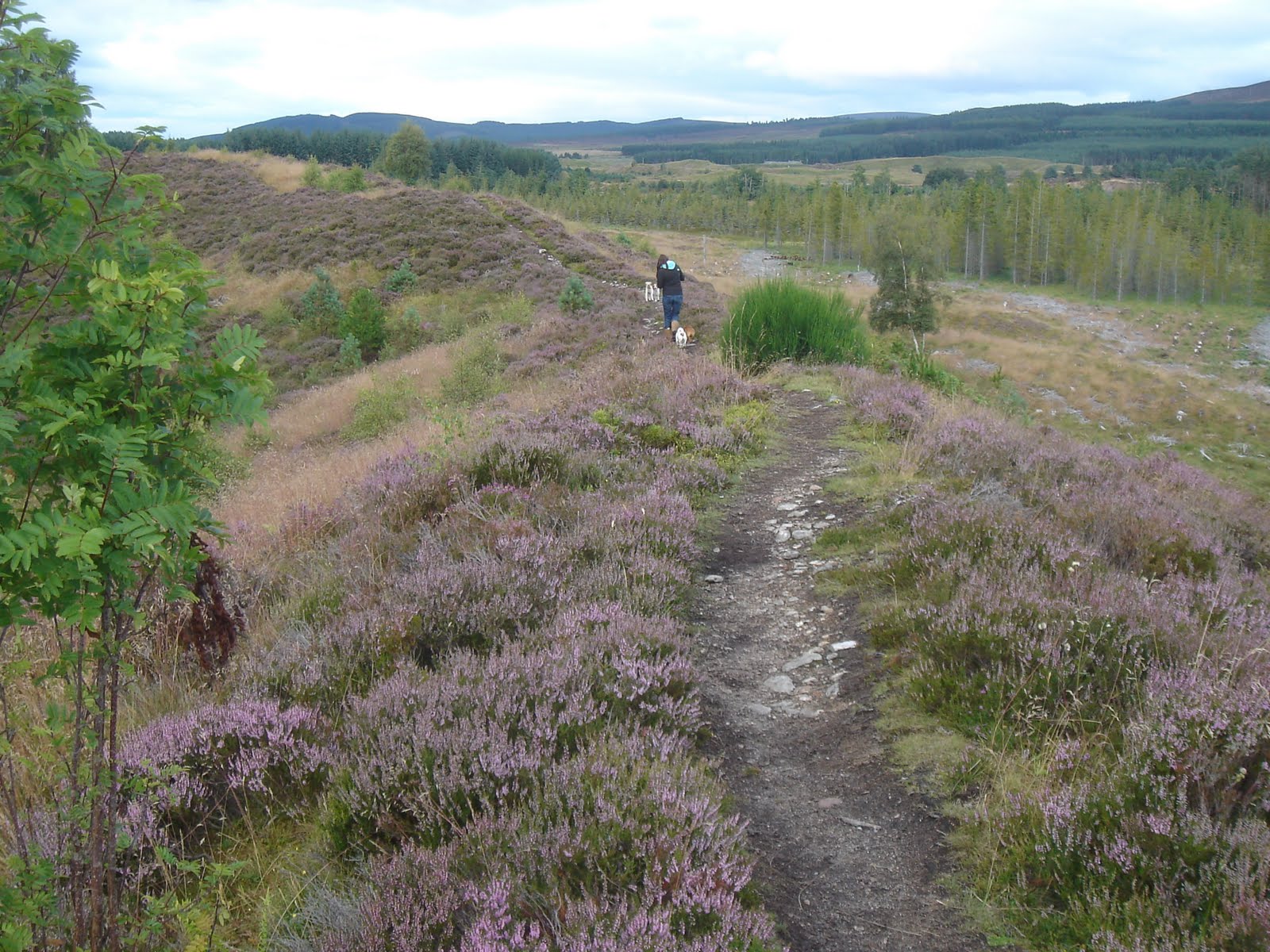
In the late afternoon Amy and I walked the dogs along the heathered esker above the house. Two buzzards, their territory invaded circled mewing. "Sending them to prison won't do any good. What will they learn there? We need some restorative justice despite the popularity of harsh retributive justice" "Make parents account for their children?" "Confiscate goods that were stolen" "Get rioters to clear up the mess." So we chatted over the esker laid down before men walked here when ice stood five miles above the ground. You can't steal a walk I thought but then I thought of those respectable men who steal landscapes.

Dammit! There was a S106 Agreement -  the same that after four year's delay brought us the hard won Victoria Jubilee Allotments, but which has still not brought us the cricket pitch and two playing fields and sports pavilion that were part of the same agreement. When we got back to Brin Croft we had supper, after which wrote to our new councillor, Waseem Zaffar:
Dear Cllr Zaffar 
I may be 400 miles away for a few more days but Handsworth is in my mind every moment. In Oct 2009 as part of lobbying over more than a decade we were getting closer to having the 80 allotments many people now enjoy next to Handsworth Park as part of a S106A deal with Persimmon Homes. But there was meant to be more to come. Instead there has been a continued delay in providing sporting facilities next to the allotments. The significance of that delay in the light of current events you will immediately grasp.
For context, this was my letter to Cllr Martin Mullaney after Basil Hylton, many years Secretary of the cricket club in Handsworth Park and the promoter of sports for local young people in our area, had again asked me if I knew anything about the delay in the implementation of the S106A on application N/01514/03/FUL:
Dear Martin. I’ve been pushing the allotments, but as background to Basil’s enquiry, the S106A of May 2004 included the following:D. Planning Application No. N/01514/03/FUL – Victoria Jubilee Allotments ... approved under a Section 106 agreement to provide the following:• Eighty new municipal allotments plus an index linked payment of £21,000 towards their maintenance.• An index linked sum of £27,000 towards the maintenance of a play area and £25,000 in lieu of a second play area.• An index linked sum of £15,000 towards the regeneration of neighbouring Handsworth Park.• Two playing pitches and a cricket square plus a pavilion and car parking to the Council design.• The inclusion of twenty four affordable homes.Yours sincerely. Simon
Can I suggest you try your hand at accelerating the play area and most especially the two playing pitches and cricket square plus pavilion and car parking? At present all we see from the allotments is a vast and inviting flat green space on which hundreds of young people should be involved in sport.
There appear to be three reasons for the delay which may well make the problem seem to you intractable, though the log jam might be loosened by current events.
1. Local residents on the new Parklands estate (Secretary: Marcellus Lindsay have objected to the planned locations of the play areas included in the S106A. Marcellus is a sensible and intelligent man and very ready to discuss this matter and share residents' concerns. marcellus@catalystsforcommunity.com

2. The developer Persimmon Homes, project manager Cliff Nixon at last report, claim the recession affects their ability to pay for the work which, when completed, like the allotments, are supposed to be transferred to Birmingham City Council and indeed should have been transferred 4 years ago. Planning officer Alan Orr, presuming he is still our constituency planning officer, (or his successor) is the best informed on the status of the S106A. alan.orr@birmingham.gov.uk (Note: in fact it's now: Stuart.Morgans@birmingham.gov.uk, Stuart Morgans, 
 Principal Planning Officer)

3. Unlike the allotments on which the plot holders themselves have been dealing pretty well with debris strewn top-soil spread by the developer (we said to city allotments officer Adrian Stagg "Let's just get gardening" despite his dissatisfaction with the preparatory work of the developer, so the site was opened in June 2010), the City Education department which has taken responsibility for implementing schools use of the playing fields is unwilling to receive the site until it is in a fit state to be played on, fearing, very understandably, the possibility of having to spend city money rather than the developer's money, to get the ground fit for soccer and cricket.

Whenever I raised this matter at Ward Committee - many times over the last 4 years - I said officers could do nothing without robust political action by elected members. The problem was constantly referred back to officers by ward councillors. My point that they might need to lobby politically to get movement on the delay in getting those playing fields was not grasped. Local people campaigned for over ten years for that S106A with crowded public meetings, petitions, letters and regular stories in the media. We thought that the conclusion of the S106A marked the end of the need to campaign.

I really hope you may be able to achieve progress where we have failed.

Kindest regards

Simon Baddeley
Handsworth Allotments Information Group (HAIG)
mobile 07548 820658

Monday, 10 May 2010

May in Corfu

A jocund day. May in Kerkyra. To escape the roar of wall-busting Lin has her morning coffee round the corner of the house. Cats are unfazed, but flies, wasps, swallows stay away as he applies a kango hammer to reopening the original space for the balcony doors. The house vibrates. Alan complains “Instead of just bricking up where the doors used to be he’s concreted. Put breeze blocks in between. Hope it’s not the same inside.” Visions of dust invasion.
** ** **
This could be a moment for The Queen; what she does or - equally important - avoids doing, with her one constitutional prerogative. The especial conundrum of a hung assembly is that it’s not that helpful to look at what happened ‘last time’ – a coalition of talents against a powerful enemy threatening invasion – or indeed the hapless and more recent Lib-Lab pact. There are so many different ways of being hung, each unique in implication, history’s unhelpful, as we’re well aware from extensive local government experience of that condition over at least the last thirty years. Much turns on personalities, who, tied by party loyalties, must balance the consequences of reneging, during negotiation with other parties, on promises that delivered them their vote with the value they, and their supporters and indeed the voters, place on their being part of government. What many see as confusion – “The King is dead, long live the …er…um” – I can see this situation as good if it gets us PR in line with the majority of democracies across the world. [memo to study AV+ - the type of PR now being considered] I can see it as good if the civil service can line up sufficiently effectively alongside the different parties to act as honest brokers – some call that an oxymoron – between them when it comes to formulating policies the elected can agree, and which do not bear the impression that clever men and women, without a mandate, have been insinuating their own agenda into negotiating messages borne between the separate parties. Reply to Graham:
Now we must start reading up on PR in all its complex variety. MoJ oversee electoral procedure including project managing the implementation of any new system so they must fielding lots of practical questions about the implications including costs of PR. Civil servants, bar the Cabinet Office, can't now speak to Labour Secretaries of State – bar ‘Good morning’ - even if a Lib-Lab agreement is being negotiated, nor to Con Shadow Ministers re a Lib-Con one. What they can do is provide costings to different party reps of the effects of their decisions - such as implementing AV+. All approaches to any one ministry by any party are being referred to the Cabinet office who can pass them on undistorted to the negotiating teams. People assume that, as in Scotland, and indeed many other democracies where NOC, minority admins and coalitions are normal, once an agreement is reached, a protocol will be formulated defining relations between civil service and political leadership - and its "back to the day job".
Side thought on PR. Nearly everyone understands majoritarian voting systems. Few including those who administer it, understand PR, but it was found in Scotland that although most people didn't understand it compared to ‘first past the post’, they still thought PR was fairer (even though there were 1000s of spoiled ballots first time round) and of course PR has a way of delivering NOC, (see an exploration of the implications of NOC in Hertfordshire in 1994) and the need for rainbow coalitions (until the voting public learn to use it other ways. The wisdom of crowds etc...). Best, Simon

** ** **
James Carroll to whom I was pointed by Corfucius has interesting things to say about the 'illusion of control' – the essence, indeed the ideology, of managerialism (other ways of thought, especially the political, the religious and the professional, accept in different ways the capriciousness of life, have rituals for the constancy of fate, live with luck, with ‘sod’s law’ and have argot for its inevitability. Managerialism has instruments for clambering around the unknowable - ventures to offer nostrums for managing time, managing chaos, managing fate, and will, to paraphrase Douglas Adams, ‘in the endeavour to fly, hurl themselves at the ground striving to miss.’ Thus Carroll, whose column appears regularly in The Boston Globe, on Powerpoint:
Anyone who has ever sat through a PowerPoint presentation has seen how the speaker surrenders initiative to the machine, and how the prepared breakdown of information inhibits actual thinking. Because the speaker is not thinking, neither is the audience. …The degradation of rhetoric throughout contemporary culture, epitomized by PowerPoint, means that essential capacities for thought and communication are being lost. The sound-bite reduces experience to episodes shorn of context, when understanding what matters requires a honed feel precisely for the connection between episodes.
Instead of focusing on ‘causality’ there’s a symbol in the tool bar whose regular use corrodes connection between events transforming sequences and consequences into discrete - and manageable - ‘bullet points’. 'The moral imagination', writes Carroll,
is defined by awareness of how choice leads to consequence, which leads to a new and graver choice, which in turn leads to a larger and more fateful consequence.
As an occasional user of PowerPoint who came to it late, I’ve found it quite useful to kick off discussion about a proposition or a sequence of images – “among these pairs I’ve filmed which is the politician, which the officer?” – or an explanatory diagram - the overlapping zones of politics, professionalism or management – or a choice quote, ‘The English seldom draw a line without blurring it - Churchill’ - infrequently using more than three slides at a time but being able to jump round and select from a much larger repertoire of slides as discussion proceeds on just those things Carroll accuses the method of blighting. It's true, the schools of sophistry would have embraced PowerPoint. How Socrates would have teased them on ‘bullet points’.
***
A man's coming over tomorrow to measure up for the new set of doors that will open onto the balcony at the top of the external stairway. I've just grasped the intention, conscious or otherwise, of the previous owners of this house and their builder. It was to switch its orientation - the one being reconstructed by the steps and balcony Alan's rebuilding - from a certain neighbourliness that came with the house's sideways connection, via steps, a door and balcony overlooking Democracy Street to a private space looking south; from a public frontage looking west, from which to hold conversation with others, to a private one from which to enjoy 'a view'. Now we'll have both - but there's no question that Alan's work restores our connection to the village street, as well as doing at least two other things - joining up the originally separate houses that make up our property, and bringing more light through the recovered doorway to the interior stairs. Our house has recovered its 'face'.
Neighbours over the way, tell us we can have a load of old wood they want cleared from their garden. They've also carted an old boiler, radiator and oven to the edge of the street for disposal. I drag the wood - roof timbers, broken furniture, branches - over their garden wall, pile it on the path, then we barrow and carry it round to our garden to stack ready for sawing into logs for winter heating.
** ** **
In the garden Lin has been working on laying plaka, using a mix of tile cement that we found abandoned by bins and mortar she mixes. The stones are uneven in thickness and have to be separately bedded in the wet mix over the wire grid she's laid over a bed of gravel dug out of the apothiki. The idea includes a ramp from the back gate, tidying the space between apothiki and plaka, so it's easy to get a barrow in and out. Soil beds line the edges of the plaka and the wild orange tree in the centre cut down by the previous owners to make space for a satellite dish, is now thriving. Leftheris suggests grafting a sweeter orange to it next year. Meantime the vine that was also cut back to the soil has recovered well and is working its way up to our veranda and from there up to the balcony above. Leftheris has been pinching out the shoots without grapes, pointing to those we'll have by September.
It is still slightly beyond my comprehension that I have a share in a space where an olive tree grows and thrives; where I can collect lemons by shaking the trunk of the tree that grows from a flower bed outside our back door; that blood oranges fall on the shed roof in December rolling down the path beside the house; that vines bearing grapes are working their way towards the upper floor; that lizards sun themselves on the stones of our garden; gekko's stick to the walls of the house; that eagles circle from the crags above 'our' village; that bugs the size of olives - rose chafers - share our spaces; that hornets, big mosquitoes and scorpions are here (I saw my first a few days ago scurrying from my shadow) that bees are working everywhere on sunny days; that fireflies twinkle in the dark. Strangely it's not so foreign. Much of the flora and fauna we see here survives and thrives in hardier form further north and when it comes to the population my neighbours in Birmingham are signally more diverse than our neighbours in Ano Korakiana
No mean city: Soho Road in Handsworth, Birmingham where we've lived for 30 years

Friday, 7 November 2008

Written stuff

Here are various papers and handouts with links to downloads. If there's a problem accessing any of these, contact me at simon@baddeley.be and I'll email requested copies. 

PAPERS
Baddeley, S & Martin, J (2008) Negotiating the Overlap, Local Government Managers Australia, Oct/Nov, pp.18-19
Baddeley, S (2008) Political-management leadership, in James, K & Collins, J (eds.)(2008) Leadership Perspectives: Knowledge into Action (Palgrave Macmillan) p.177-192 (See a version of the this paper with added links to film illustrating its argument)
Baddeley, S (1998) Constructing trust at the top of local government, in Andrew Coulson (ed.) (1998) Trust & Contracts: relationships in local government, health & public services (Policy Press:Bristol) (4) 55-78
Baddeley, S & Wall, A (1998) Chair-chief executive relations in the NHS, Chap. 5 in Andrew Coulson (ed.)(1998) Trust & Contracts: relationships in local government, health & public services (Policy Press:Bristol) (5) 79-93 (references omitted)
Baddeley, S (1995) Internal Polity, Human Relations, 48 (9) pp.1073-1103
Baddeley, S (1993) Internal Polity, Invited paper for the Canadian Association of School Administrators, Second Annual Leadership Conference, St.Andrews-by-the Sea, Nova Scotia
12-16 July (brief version of the above)
Baddeley, S & James, K (1987) Owl, Fox, Donkey, Sheep: Political Skills for Managers, Management Education & Development, 18 (1) Spring, pp. 3-19
Baddeley, S (1997) 'Governmentality' in Brian Loader (ed.) (1997) The Governance of Cyberspace (London:Routledge) (5) 64-96
HANDOUTS
Leadership at the Apex ~ politician/administration relations TABLE
Converging zones - politics, management, professionalism IMAGE
Role-tension between members and officers IMAGE
Types of officers ~ types of members
DRAFTS

Baddeley, S & Martin, J (unpublished), Probing the heart of democracy with video (draft).
Abstract: In the context of evolving video technology since the 1980s, Simon Baddeley has been refining methods of accessing the way politicians and managers work together. Since 2007 the latter has continued this research in collaboration with Martin, using film to investigate the interpersonal dynamics built in to political-management ‘conversations’. As well as contributing to theories about the leadership in government, this research has produced stimulating training material, used in UK and Australia, to increase skills, and explore values, among local government practitioners negotiating the overlap of political and managerial responsibilities.

The linked papers can be downloaded via Google docs. E-mail about any problems with downloading at simon@baddeley.be
 * * *
A while ago I had a chat with Professor Tony Bovaird about ways of making the subject in which I've been so interested for so long - constructing trust in government - easier to follow; more accessible. Could I combine text and illustrative video on the web to share, as we've taken for granted we can share writing and graphics? It seems easy enough these days - so long as those involved allow it and those interested find it useful. Government and companies are using YouTube, Schools on campus have been webstreaming lectures for a few years, local councils are filming their meetings. This isn't new.
So here's a transcript of a short extract from a longer conversations between Sue Smith when she was Leader of Woking Council talking to Ray Morgan, its Chief Executive. Below that are some references, and some thoughts on political-management - howgovernment is made in that conversation - and on reading, followed by film from an in-house workshop on constructing trust:
Ray: The strange thing for me is that that if if you take – depending on how far away from me somebody is, the further they are away, when they meet me first time, about how that discussion’s going - Sue: Hm R: - if I haven’t said who I am and exactly what my role is they’re not sure whether I’m actually a paid official or a politician, and that’s been a fascinating kind of - S: Well I think that’s only because you’re more overtly like that. Actually when I think talking to chief executives that I know now they’re all extremely politically astute, and I don’t see how they could fail to be other than that - em - in order to function properly. R: But - what I would call the dinosaur regime – officers are in this box and members in that box. The reality is - S: It doesn’t actually work like that. R: - the leadership is in this trading zone. I won’t call it grey zone. I call it trading zone because that’s exactly what we’re doing. We’re trading off what’s possible administratively. S: Yes R: What’s desired politically - S: - ically R: - and how are we going to get a balance where we’re both going to survive. S: That’s right. And se - R: Sorry to describe it that way. S: - selling it back down the line both ways as well. R: Yes


[...and here's a link to further extracts from films made over the last 25 years of politicians and managers in local government discussing their working relationships]
* * * *
Ordinary things
Cycled up the Soho Road to tick boxes - get printer ink, look in shiny shop windows, post a letter, see Hector at the Library
and shake hands, then into town to buy a rail ticket to the Highlands over New Year, but found I was still outside the concession zone ("£130, with a senior railcard, return to Inverness on a journey that usually costs £75 - dearer than flying!"), then gave blood (a process so simple I wonder we suffer shortages), then, after a call from Rajinder, took a Metro to Handsworth Booth Street for a late lunch turning into high tea then supper at Sangams, with him, Natasha and her mum, Darshan (got laughing about marriage - "three rings - engagement, wedding and suff!" "Marriages are made in heaven - so are thunder and lightning"; Elizabeth Bennett's anger at Darcy's condescension, inventing the subversive idea that love and marriage should go together. Rajinder, an artist "to make my living", spoke of 'bang bang' painting vs. cool painting, Francis Bacon and Jack the Dripper vs. Mark Rothko and, because Rothko had said art needs gods and monsters to speak to us we compared Hindu and Christian views of good's relationship to evil - a long marriage or a protracted battle - "no, both!" - which got us on to the Mahābhārata and the taxi driver in Rajasthan who ran Lin and me through the mighty story while dodging traffic between Tikli and Kesroli a few years ago) then on to Soho Foundry Pub in Smethwick for a meeting of The Friends of Black Patch Park, where I chaired an inconclusive discussion with Phil, Harjinder, Stacey, Andrew, Barbara and Sue - old comrade troublemakers. Unsurprising, given Sandwell's funding famine. Park's saved but but now what? As for the VJA. I'll give it a week and see what transpires. Cycled home and there arrived Amy and Guy and Liz and Mark with fireworks - rockets, bangers, roman candles - which Amy, being police, took charge of lighting in the garden. We watched a few pounds of explosives brightening the sky of Handsworth. Oscar dog, far from being fearful of the noise, has to be restrained from hunting and attacking its cause, so was kept indoors for the show.

Back numbers

Simon Baddeley