 |
| South wind on the west coast of Corfu |
Sat either side of the aisle we saw lozenges of perfect blue as our plane ascended, banking in a wide circle that brought us over Pantokrator, then the high coast of Albania, before sea and land receded below bright white clouds. On the flight from Corfu we enjoyed prosciutto and cream cheese sandwiches in a round loaf from the village bakery made up for a picnic before we left.
We landed around one-o-clock at Luton with a slight bump that made someone exclaim. After an hour waiting by a carousel for our bags, a timorous tannoy voice apologised for the delay, "caused" - with fudged syntax - "by operational reasons".
A resigned British crowd, but for a tearful mother with a toddler, awaited belongings from Riga, Malaga, Faro, Palma, Corfu and somewhere else - luggage unloaded in no special order.
"Sunday lunchtime's always diabolical" said a slightly harassed women fielding mild grumbles at a service desk. Thirteen flights had landed at the same time causing a "massive back-up"
 |
| Luton luggage jam |
"I don't recall such recurrent inefficiency in Corfu" I said to Lin "Yet people are wont to to throw up their hands at Greek confusions. When have we encountered that?"
The crowd was a lively metaphor for British acceptance of our economic mess. Jan wrote just now:
Hi Simon...when are you returning to Blighty? I would stay longer if I were you. The weather here is simply foul. I am interested to read your outline for Member-Officer courses. Do you think it's possible to weave in some of the issues we have exchanged views on in the last few months? I suspect it's a matter of it evolving and bringing authorities on board based on their own experiences and requirements, but there is no doubt in my mind that fundamental (irreversible ) changes are taking place and given local authoritys' relative powerless position vis-à-vis government, they frequently spend much of their energies on 'chasing and adjusting' to government requirements which are going to become even more challenging over the next few years; to such an extent that LAs, as we have known them, will cease to exist (SB note: news item - 7 June 2013*) and be replaced by something else yet to emerge.
The government’s approach is crude but becoming clear - 'delegate' (dump) difficult and unpopular (toxic) tasks to LAs (e.g. housing and welfare) then top slice (cut back) the monies available to carry out these tasks, thus achieving both financial and political objectives in one swoop. We are going to see more of this during the next Spending Review where I fear LAs will receive another hammering bordering on a coup de grace.
The scenario is obviously a bit more sophisticated than that and there are still 'hooks' for LAs to hang their issues on (e.g. City Deals, Community Budgets) but the general direction of travel is fairly clear and I believe beyond the tipping point because even the 'hooks' are in place by government decree and would not be there but for the government. This is the reality and the starting point for all those who want to see Localism become meaningful.
I have mentioned before the need to recalibrate the relationship between LAs and government and for LAs to have their own 'narrative' for this. Whilst this remain important, I am coming more and more to the conclusion that it is the relationship between LAs, their population and local community, which requires more attention and recalibration. The traditional models are becoming increasingly irrelevant; no longer fit for purpose. The old saying that “all politics are local” remains true, but a narrative (and practice) based on delegated democracy, selective engagement and top-down consultations is not going to promote Localism...more likely it will be used to drive the current policy objectives. Perhaps the time has come to phase out this narrative or reconstruct it within an overall narrative of 'mobilisation and support'; for LAs to make this focus a priority because if (when) successful this would impact significantly on the LA-government relationship, simply because the political foundations of LAs would strengthen. No government could ignore that for long.
This will take courage and persistence. The starting point is to ditch the parent-child relationship of local to centre; 'cleanse' local government of its Stockholm syndrome with Whitehall...a tall order; to get hundreds of LAs to 'sign up' is near impossible, but what is the alternative?
What I find frustrating is that no such narrative, backed up by analysis, leading to a Localism Agenda has even started to emerge. This may be unfair but it seems that the mind-set is stuck in the past and past methods are being rolled out to deal with the new agenda when in reality something very different is called for. We are talking about culture and behaviour change more than anything else. A new skills set is desperately needed but I can’t see one emerging yet. I am mindful of the saying that all generals fight the last war instead of the current one. Any thoughts on this?
The main news at this end is around the horrific terrorist attack on a soldier in Woolwich in London. This has some very challenging implications for Localism. The other big story is around is the tax affairs of large international corporations[ the way they avoid tax (legally) by moving monies around the world and manipulating the tax regimes of various countries. If they paid according to the spirit of the legislation, or on the same basis as the rest of us, then the public financial deficit would largely be resolved. Tthe sums are staggering. What is even more striking is the government’s total impotence in dealing with this. They are simply unable (unwilling) to act. We have plenty of moralistic shroud waving but total paralysis as far as actions are concerned. I think this demonstrates the power (and arrogance) of the 'new feudal elite'. They are not in the slightest bit apologetic and have no plans to change. They operate totally outside any democratic accountability. Their financial muscle is greater than most countries and beyond meaningful scrutiny. At the same time we are becoming more and more dependent on them for jobs and services. LAs are often desperate to attract them into their localities and you can see why.
Perhaps the time is right to start to talk about local taxation in a meaningful way - local taxation without which Localism cannot exist. The implications for the rest of society are quite staggering in terms of living standards and well–being especially for vulnerable and disabled people (the precariat)*. We are all paying more taxes than we should and enduring more welfare cut-backs than we should (more about ideology than anything else). These circumstances are manifesting themselves at local level in communities all over Britain; albeit very differently in poor areas compared to wealthy areas. Here you have an issue upon which 'mobilisation and support' could begin to emerge, but the silence is deafening. Why has this not yet filtered into the political-managerial agenda. Is ethics the missing link in the reading/carrying model, or is this a matter of hard-nosed politics?
The ramifications of the local council elections are rumbling on. The Tories are tearing themselves apart on Europe and gay marriages. If anything it is becoming worse; quite a spectacle; clearly now impacting on local politics. Many authorities are having to adjust to having significant numbers of UKIP councillors on the council. These are new and inexperienced people but with strong views on a narrow range of issues. It’ll be interesting to see how this plays out. It could shake things up or, more worryingly, it could lead to a strengthening of the worst underlying forces in many local communities (prejudice, xenophobia, insularity, nimby-ism, cronyism, and similar ugly forces). We have to recognise that there are - potentially - some very nasty downsides to localism. There needs to be a counter-balance to this. That is why I am talking about a recalibration of the relationship and a re-alignment of the power relationship. Not a divorce. It is difficult to envisage Civil Rights in the USA developing the way it has through a reliance on Localism on its own. Therein lies the challenge and pitfall of localism. What about a chat in June when you are back? Best Jan
*07 June 2013 Watchdog warns cuts could lead to collapse of councils....Local authorities must come clean in explaining to residents what services they might have to cut in the next Spending Review period, a parliamentary spending watchdog has reported. A Public Accounts Committee report into the National Audit Office’s (NAO) study, published in January, into the financial stability of local authorities, finds Whitehall doesn’t properly understand the overall impact of the 28% budget cuts taking place over the existing spending round. The MPs expressed fears those councils more reliant on government grants - which serve poorer and more vulnerable communities with higher demands on services - are experiencing the greatest spending reductions. Whitehall does not fully understand how budgets cuts are affecting vulnerable groups, the PAC said. ‘This raises the spectre of the worst-affected councils being unable to meet their statutory obligations,’ Ms Hodge added. She urged the Department for Communities for Local Government (DCLG) to get a better understanding of how cuts affect vulnerable groups and demanded to know how Eland House would respond in the event of multiple financial failures of local authorities....We left Ano Korakiana at 1030 after a rush of tidying. Vasiliki and Effi came out to kiss and hug us. I dropped in on Katerina to say 'goodbye'. All said the customary "Kalo taxidi, Καλό ταξίδι" as we loaded our bags into the car and I stood beside Adoni to say bye-bye to our house, our other beloved home.
 |
| With Adoni at the top of our steps onto Democracy Street |
 |
| Greeting Oscar in the garden at Handsworth |
*** ***
What of Summersong, now floating again at her fore and aft mooring in Ipsos?

Dave has done great work on her exterior. Now, he sets to on the interior!
 |
| Summersong's cabin roof |


......Running and standing rigging are fine. The engine's working well but I'll only be confident after sea trials - for me as much as the boat - with wind and wave. 'I must go down to the sea again, to the lonely sea and the sky'...and as Spike wrote 'I left my shoes and socks there, I wonder if they're dry?' Lin even said "I\d like to visit the Mani" Is that possible? Could we really?

“There’s the Sea of Tranquility”
Martin was gazing up at a gibbous moon, recalling how his Dad had built a reflecting telescope with which he’d shown his son places on the moon from their garden in Birmingham.
“I haven’t got my glasses or I could make out the crater of Copernicus”
“Over there, that one bright light, with darkness to the left, marks the border with Albania. The line of twinkling lights further south. That’s Sayada and then even further there’s Igoumenitsa”
We looked at the Plough overhead and subtended the angle of the last two stars on its front to see the North Star just above the edge of the crags above the village, dimly underlit by our street lights.
“The moon’s too bright to see the Milky Way”
We recalled wondering, on childhood nights, at the sight of the full starred heavens, the edge of our galaxy strewn from horizon to horizon, across the abyss of black space.
“There’s too much light pollution too”
Along the closer horizon of the island lay the glow of the city. I called to Lin and to Martin’s wife, Sandra, chatting downstairs, to come and join us on the balcony. A few days before we returned to Birmingham they, our best friends in England, were our guests in Ano Korakiana.
We listened to the sounds inside this space, stood on our balcony together; people talking below the village, a lot further off than the Skops owl calling to another among trees beyond the houses edging Democracy Street. There was a dog complaining in the distance.
“That’ll set off all the others” I said as barking spread closer. Cockerels do the same but they were quiet at midnight.
The blinking lights of a plane appeared silently over the hills between us and the city, turned towards us and became a sound droning swiftly over Trompetta.
 |
| Sandra and Linda at Piattsa on Democracy Street |


“So why didn’t you do that?” says Lin.
“I tried but I didn’t know how and it sort of worked with the chain and the hooks”
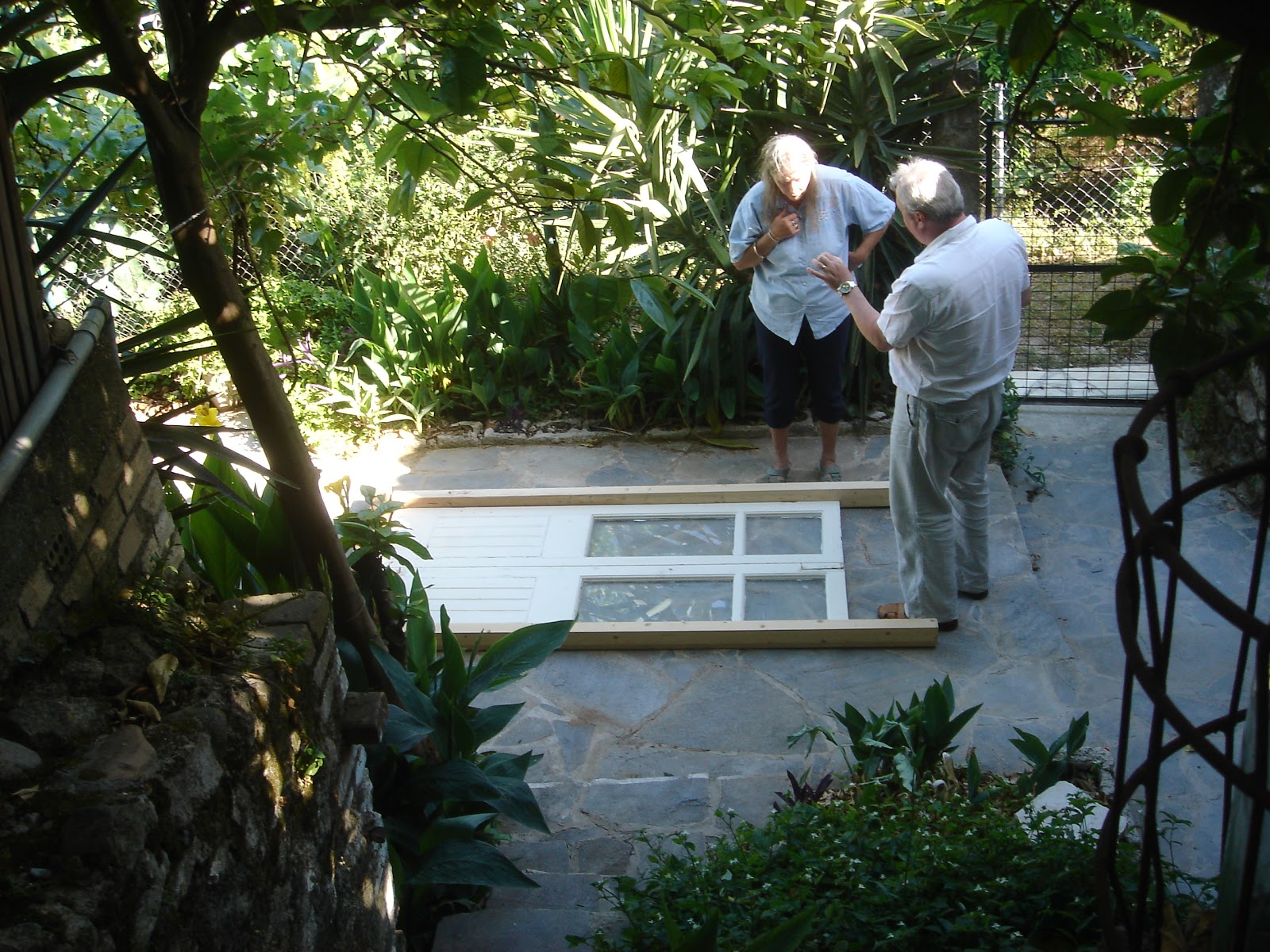
We’ve been go-betweens for house improvement for Steve in England who wanted the walls of his house, next to the café, rendered. All work had stopped after his regular builder had to go to Ioannina for heart surgery. We’ve got a local builder to start rendering, sending Steve pictures as the work proceeds.
Dear Steve. Before talking to A, our friend Martin, a builder/architect, currently staying with us, inspected your rear wall. He noticed that your wall ends in an uncovered section that is part of X’s property. In Martin’s opinion, X's strip of wall, if not rendered at the same time as yours, would let damp into any new render on your property. X, as you'd expect, says he’s no money to make this strip good…We tend to agree with Martin that this extra cost would represent a saving for you in the long run….Do you want the short iron bars sticking out of the wall, that were used to support a vine, removed? Let us know what you think. Best, Simon
Well I'm like a spoilt kid at Christmas, I can't stop getting the picture up and looking at it… After so many years of neglect the little house is finally getting some TLC, which its deserved after standing so many years. Wish you could see the smile on my face. many thanks for organising and overseeing the work on my behalf. SteveWhile they were here we showed a little of the island to Martin and Sandra, walking, driving, swimming, eating out and eating in, enjoying drinks at Stamatti's café Piattsa, seeing the city and the country, ascending to the top of Pantokrator and down to the sea at Paleokastritsa.
 |
| Our friend Sandra on Angelokastro |
Picnicing below the oak tree on the top of Angelokastro we saw, at first cleverly camouflaged in its deep serrated bark, a host of moth caterpillars - indeed several colonies attached to different parts of the tree.

*** *** ***
From the Ano Korakiana website - our neighbour's daughter Dimitra, flutist, is first left:
Λιτανεία στην Αλεπού

Λιτανεία της εικόνας της Αναστάσεως σήμερα το απόγευμα (Κυριακή 26 Μαΐου 2013), στην Αλεπού. Από τις Κουλίνες, βήμα-βήμα τον επαρχιακό δρόμο, στους ήχους της Μπάντας και με τις «φωνές» της Χορωδίας της Φιλαρμονικής Κορακιάνας, ίσαμε δύο χιλιόμετρα απόσταση. Ανά διαστήματα «συστάδες» κόσμου στο δρόμο, για να παρακολουθήσουν την πομπή να περνάει. Κάθε τόσο και κάποιος ιερέας πύκνωνε τις τάξεις του ψαλτηρίου, μέχρι και τα τελευταία μέτρα της πορείας. Στην άλλη λωρίδα του δρόμου η κυκλοφορία των οχημάτων συνεχιζόταν περίπου ανενόχλητη, συνθέτοντας ένα περίεργο ηχητικό κράμα θορύβου, μελωδίας και ψαλμών. Στην εκκλησία της Θεοτόκου, στο στενό της ενορίας, όπου κατέληξε η πομπή, ευλογήθηκαν και μοιράστηκαν άρτοι. Είχε πια νυχτώσει, όταν χορωδοί και μουσικοί πήραν το δρόμο της επιστροφής για το χωριό…

Υ.Γ.: Απαραίτητος συντελεστής της Λιτανείας, αποδείχτηκε το Ι.Χ. φορτηγάκι, που, αφού μετέφερε τα «έπιπλα», κουβάλησε και αρκετούς Χορωδούς, από το χώρο στάθμευσης μέχρι το σημείο εκκίνησης.
*** *** *** *My colleague Chris Game has written in the Birmingham Post about the recent ESRC report on poverty in Britain. 'This is the fifth scientifically conducted independent study of poverty since 1983' he says 'and the situation is worse today than it has been for the past 30 years.' He summarises findings from the report titled The Impoverishment of the UK - officially published tomorrow: * Over 30 million people (almost half the population) are suffering to some degree from financial insecurity[...and in America] *** *** Involved early in the development of Aftab Rahman's Lozells and East Handsworth Heritage Trail I was still in Ano Korakiana when the trail had its launch on 25 May.  Dear Sir/Madam Launch of Lozells and Handsworth Heritage Trail – 25th May 10am – 1pm We would like to invite you to the launch of our heritage trail for Lozells and Handsworth. This has been a very exciting journey for us, we have learned so much about this amazing area and its heritage and we would like to share it with you. The area is home to Soho House which is Matthew Boulton’s former home, St Mary’s Convent designed by Pugin, St Mary’s Church where Matthew Boulton, James Watts and William Murdoch are buried and there are several other historically significant buildings and places. The registration will start at 9:30am at Soho House (Soho Avenue – off Soho Road, B18 5LB) and the tour will commence at 10am. It is likely to take two hours approximately. We have a reception at 1pm at South and City College – Soho Campus, on the Soho Road. You will be able to hear from key note speakers and our tour guides – this will include a networking lunch.We have been working with South and City College to train 20 passionate people to become ‘tour guides’. They will be your guides on the tour and will share their knowledge of the area with you on the walk. Yours sincerely, Aftab Rahman, Director, Legacy WM Aftab circulated the trail guide with maps and photos and profiles of guides.   |


 |
| Handsworth Park on a Saturday afternoon in early summer |
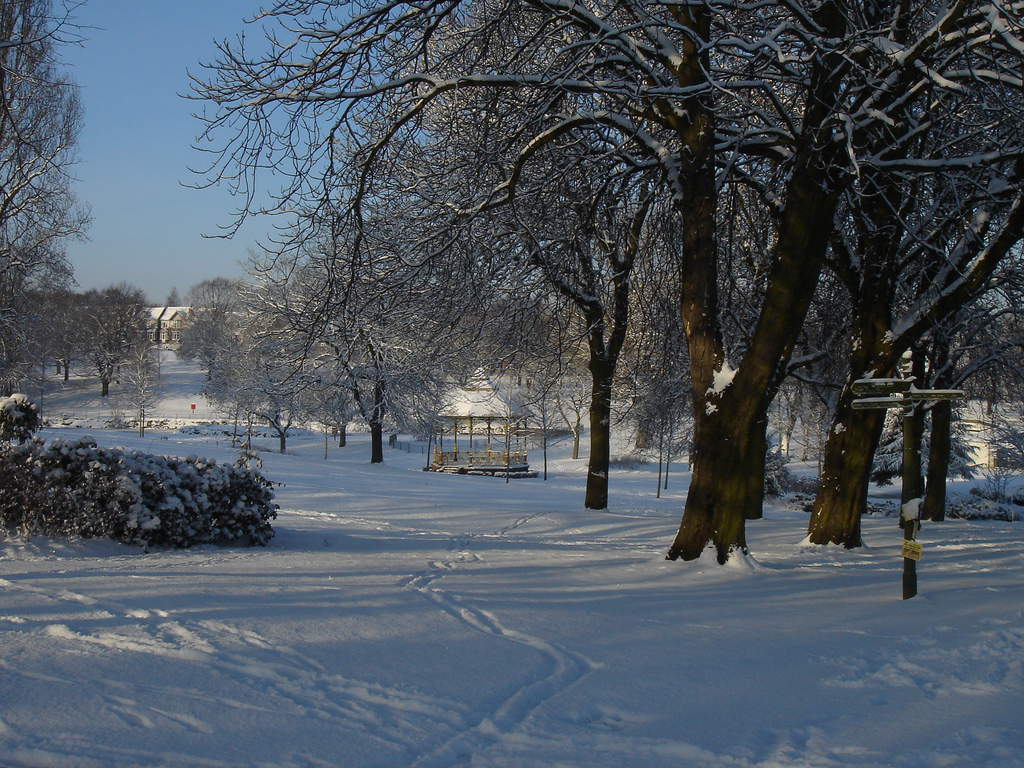 |
| Our park at Christmas |


