Total Pageviews

Showing posts with label Macedonia. Show all posts

Friday, 3 June 2011

Macedon

Vergina, Βεργίνα - ancient Aigai, Αιγαί. So many beautiful things brought from the tombs of the kings of Macedonia, the dynasty of Alexander the Great to England. I shall go to Oxford for the day to see them.
Heracles To Alexander The Great: Treasures from the Royal Capital of Macedon, A Hellenic Kingdom in the Age of Democracy, The Ashmolean Museum, Oxford, 7 April -29 August 2011.
Macedonia, Greece
It's confusing, and nothing if not controversial in some circles, that there's a land-locked country in the central Balkans that's claimed the name of Macedonia, with a southern border on Greece - a border that marches with the Greek province of that same ancient name.
The land-locked Republic of Macedonia - capital Skopje

And I'd be playing Candide, if I did not recognise that this is a subject to be held in the tongs you'd use to pick up a glowing coal. Haven't I read any history? Don't I know of the 201 villages, 12,400 houses burned, 4,694 people killed by the Ottomans, 30,000 refugees fleeing to Bulgaria after the Ilinden Uprising, Илинденско востание, Ilindensko vostanie, of August 1903? Don't I know of the significance for Greeks of the Vergina Sun unearthed in 1977 during excavations in Vergina, in the northern Greek region of Macedonia, by archaeologist Manolis Andronikos - an artefact that between 1992-95 was a prominent part of the national flag of FYROM - sitting in the UN Assembly under 'T' as the EU entity 'The Former Yugoslav Republic of Macedonia' - subsequently muted but still a political symbol used to express a link with Alexander the Great and a claim to be as Greek as the Greeks? Have I not studied the ancient migrations, invasions, dispersions of DNA and the idea of Sklavinia and its borderless maps laced with the fuzziest of boundaries, focus of unending debate about identity?
The newish country of Macedonia contends with Greek Macedonia and indeed with the Hellenic Republic, its geographical association with that most famous of Macedonians, Philip II of Macedon, father of Alexander the Great.
The Kingdom of Macedon in 336BC
Where the confusion of names becomes more sinister, taking on the character of a frozen conflict, is the existence of a notorious Balkan phenomenon - a big idea. [Back to the future - 8 Jun'11: Skopje-Macedonian snap general election results. On-line guide to the political environment in the Macedonian Republic. A global diaspora has electoral significance in a country of many parties, with significant ethnic divisions. The social web contributes to the connectivity of political debate ]
There has been a Croatian big idea - Red Croatia Crvena Hrvatska. There's been an Albanian big idea, which also includes Chameria. The Greek big idea, Μεγάλη Ιδέα ended in bloody tears.
The Greek Big Idea - recovering Constantinople, capital of Byzantium
There was a Serbian big idea - Greater Serbia, Velika Srbija, whose chief agents stand in the dock at the Hague.
A Serbian big idea - from the Adriatic to the Black Sea
Although it is not supported by anyone in the national government of the country of Macedonia - there is a Macedonian big idea looking like a blood splat - involving the circulation of maps titled Autonomous, Greater and United Macedonia - Obedineta Makedonija.
A big idea from Skopje - expand into Bulgaria, Greece, Albania and Serbia
** ** **
I've been returning meter readings to power suppliers. A letter came from Siemens asking for my electric meter reading even though I already record this on a website for Scottish Power. The letter asks for my name, my MPAN (electricity) and my MPRN (gas) and the date of the reading. I can find out the meaning of these acronyms easily enough, but they might confuse some. The easiest way to get these readings, given that the gas meter which is outside is tricky to read in direct sunlight while the electric meter in the garage is rather high up, is to take a photo of each dial.
The website address given me to report the reading returns an 'error' message...

...without direction as to where to go to provide a reading I've already recorded with Scottish Power's quite efficient website. I take a lazy moment to send an email to Siemen's Customer Business Manager:
Dear Mr Alan Fletcher. I'm sure you won't read this but in a Panglossian spirit of optimism I'm taking a couple of minutes to email you to say that this is now the second time you have sent me a letter asking me to record my meter readings via the website:  The website with the URL supplied in your letter yet again reports an error with no clear directions as to where to go to record my gas and electricity meter readings. Any chance I could earn a discount on my energy bills for going to the trouble as a customer of Scottish Power of letting you know about the error in your letter asking me to contact you with my meter readings? Ha ha. I have recorded my current meter readings on the Scottish Power website where I have account - MPAN 1413713321000. Yours etc.
The reply is is instant:
Thank you for contacting Siemens Metering Services. Your e-mail has been received and will be passed on to the relevant department for their attention. This is an automatic e-mail; please do not reply. SIEMENS Siemens Metering Services, Woodyard Lane, Wollaton NG8 1GB
Meantime I received another email:
IMPORTANT INFORMATION ABOUT YOUR UNIVERSITY ACCOUNT. This email has been sent by IT Services at The University of Birmingham and is intended for the member of the staff who's University ID ends in ******. IT Services have been informed that the password associated with your Active Directory account ****** has not been changed since *****. In accordance with current University policy, you are required to change the password associated with your personal Active Directory account every six months at least. This email is intended to remind you that unless you change the password associated with the Active Directory account ***** before ***** it will be forcibly changed on your behalf. If this should happen, you will no longer be able to login to your Active Directory account or read your email until the password associated with the account has been reset.  You can change your password yourself - from the login page for the IT Service Desk website - from the login page for my.bham username and password or which contain links to web pages asking for your username and password. IT Services never sends such messages. (of course I've excised phone numbers and IDs)
Birmingham Identity Integration Services (BIIS) is a service of exemplary efficiency; a pleasure to use. I phone a number I know to confirm the email's not a phish and get through almost at once. It's 24/7 service. I'm reassured. I go smoothly to the relevant site and change my password, knowing if I have problems I can talk almost immediately to a human being anytime of the day or night, and if I'm struggling go in the week to the IT Service Desk and meet and even touch a real human being.  In this case I follow clear instructions and get an instant auto email reply 'The password for the Active Directory account "*****" has been changed at ****.'  This is an ace service, well protected (as it ought to be), to be coveted given that it gives me access not just to email and information about the university, but, and this is the real gift, access via Athens and Shibboleth to every university or affiliated library in the world allowing me to read and often download almost every academic journal paper and publication that exists.

*** ***
For inefficiency surpassing the call of normal bureaucratic hebetude there's the challenge Linda and I, and other designated members of the working committee for Central Handsworth Practical Care Project (CHPCP), face trying to alter the signatories on the project's Business Account with Barclay's Bank.
In Feb '11 I'd been approached by Edmund Branch (see him in the film) following the resignation of the Project Manager Mr Ali, who'd taken over, in vague circumstances, after the death of the project's founder Glynis Foley in 2010. Could Linda and I help? We were asked the same by Mahmood Hussain, co-founder of the project, though he is now no longer a councillor. We recruited friends; called an emergency meeting on 31 March. A paragraph in the minutes of that meeting mentioned the bank account:
In order to cash cheques two signatures are required. Currently the only signatories are Mr A and CB. Theoretically no cheques can be signed because Mr Ali is no longer a member. At least three signatories need to be appointed to avoid this situation happening again. It was agreed that, as an interim measure, these would be MT, CB and EB, and appropriate forms have been completed. An appointment with the business manager at Barclay’s Bank, Perry Barr, needs to be arranged in order to submit the forms. In the meantime we have asked Mr A to continue to sign cheques. 
Prior to the meeting we'd picked up Mandate forms from Barclays' Perry Barr. Once the meeting had approved the 'interim measure' three of us took our completed Mandate forms with names, addresses and proofs of identity for each signatory into the bank. We were told by someone - didn't think to take their name - on the customer side of the counter that no-one could help. We needed to see the Branch Business Manager, Selina Cooppen, who, owing to reorganisation, divided her time between several branches. She was available at Perry Barr on particular days at certain times. The person who told us this photocopied our IDs and attached them to the completed forms, promising they'd be given to Selina, who would switch the account to the new signatories on the Mandate forms. The whole process "takes about a week" we were told.
In the meantime we were acutely aware that though cheques could be paid into the project account by clients for whom Edmund and Krzysztof were working, no money could be withdrawn to pay wages, insurance or tax or materials for jobs. Edmund would have to continue taking some payments for work in cash - all receipted - out of which he could glean what he and Krzysztof  needed to keep the project going. They'd have in the interval to do without their normal monthly wages. The interim committee managed at least to get hold of Mr Ali - unobtainable since his resignation - long enough to have him and Charles sign three holding cheques to reassure the Inland Revenue and pay partial wages to Edmund and Krzysztof. Three more cheques to cover similar outgoings were signed with just CB's name, assuming these could be co-signed by one of the new signatories, on our assumption that by the time they were needed the account would be active. Thereafter further cheques could be drawn on the account as and when.
With that, as we believed, in hand, Lin and I left for Corfu on 1 April, feeling we had moved forward from insolvency, with agreements in place for the payment of insurance, MOT, the next month's wages and further sums to the inland revenue, and a second emergency meeting agreed for 19 May'11.
While we were in Corfu Edmund sent us messages reporting new work, client cheques paid into the project's bank account and agreed jobs done. We assumed things were going smoothly. The second emergency meeting was at our house on 19 May'11.
Lin, Leslie, Edmund, Krzysztof and Mike - second emergency meeting
An extract from the Minutes of that meeting, completed with a supplementary note the next day:
The bank has not yet approved the new signatories for the cheque book, though the mandate forms were taken in 2/3 weeks ago. E & M will contact the bank to check progress. Update following phone calls to the bank: The bank has ‘lost’ both the mandate forms for adding (new names) to the list of signatories, even though they were taken in at different times. They are sending new forms, but this will delay the process considerably and perpetuate difficulties in gaining access to funds. Linda Baddeley complained by phone to Barclay’s (the main number, not the local branch). They will speak to Selina Cooppen (Business Manager, Perry Barr branch) and contact Charles Bate (as the only remaining official signatory) after investigation.
Over the next week Mike and I completed a new set of Mandate forms, and resubmitted them to the branch with the same IDs. We were  told the Bank would phone as soon as these had been processed. Edmund and Krzysztof  were getting more and more frustrated and worried - for obvious reasons. Three days ago Mike, who'd been making regular phone calls to the Perry Barr Branch of Barclays was told, a fortnight after the new Mandate forms had been submitted that the branch had no record of them. He phoned us.
"Guess what. The bank has lost the second lot of forms. We've got to fill in another set and bring them in with ID again."
Later Mike came to our house with another new form for me that he'd collected from the Perry Barr branch. I filled this in, planning to go to the Perry Branch branch the next morning.
Mike phoned again.
"I think I've found a way forward. I've taken my form to Barclays' Birmingham HQ on the Hagley Road. They've promised to give it to their Mandate team on the third floor. They can't process the new arrangement until they have your form, Simon. You go to Barclays HQ tomorrow. Ask for Andrew on the Mandate team and he'll deal with you"
Yesterday - 3 June - Lin and I, after she'd found a lucky parking place, went into Barclays on Hagley Road with my completed form and ID.
"Hullo" says Lin to Zahir Khan behind a counter. She introduced us; explained our errand. He looked puzzled
"We've come to see Andrew in the Mandate Team."
"Do you have his surname?"
"No just 'Andrew'. On the third floor, with the Mandate team"
"There are lots of Andrews up there."
"I don't believe you," said Lin
"They don't come down anyway. It's not in their remit" He turned to a thin young fellow employee. "They want to see someone in the Mandate Team." The beardless youth curled his lip and shrugged. I glared at him. I'd asked Lin to do the talking because I didn't trust my manners.
"Look" said Lin, "you have over £3000 of this project's money. We can't pay wages. One of our staff has been given notice for non-payment of rent at his flat. He and his mate haven't been paid in three months. We owe money to the inland revenue. We can't buy essential materials...and Barclays, who we approached about this at the end of March, have now mislaid two sets of Mandate forms. Do you understand the urgency?"
He apologised with formal profuseness.
"Wait a moment I'll see what I can do." He wandered off across the bank's immaculate concourse.
"He's probably gone round the corner to wait for a few minutes," muttered Lin "He'll be back to tell us 'computer says no'. Did you hear him when he said 'there are lots of Andrews up there'?"
If I'd been a kettle I'd have boiled dry after a long whistle. After a few minutes Mr Khan did return.
"Someone from upstairs will speak to you on the phone in one of our private booths."
He took us to a desk in a booth, dialed a number and handed the phone to Lin who found herself listening to a recorded message with options - as if she'd phoned from outside. Having pressed the right buttons she got through to Sophie in the Mandate Team and explained the situation.
"I'll come down." she said
"So they can break their remit?" observed Lin.
In a few seconds we were chatting to Sophie, a nice young woman, who copied my passport and other ID - a utility bill with my address -  and assured us the matter would be dealt with by the end of the banking day or by Monday.
"Monday the 6th? Are you sure?" asked Lin
"Yes. Promise."
We headed home.
"I don't think I've experienced quite such a sequence of inefficiencies," I said to Lin "God I hope Sophie-without-surname gets things done by Monday. At least we'll be up to a starting line for the project."
We've our next CHPCP meeting on 16 June. We've been circulating letters to the old committee members to attend and join in, send apologies or resign. One was in India, another had just disappeared, but slowly we are getting in the signed slips with names and addresses that will legitimate declaring a new committee with the approval, or at least acceptance, of the old. On 23 June we have a meeting with Yvonne Wager and her colleague Jessie Gerald to explain what's been happening, to show that the project is up and running, legitimate, able to take work from the City.
2. Dissolution of the current Board. There were no members of the old Board present, despite Edmund having advised those he managed to see of the date and time of the meeting. No communication by letter, phone or email had been received from any of them. Consequently, it remained impossible to dissolve the current board. It was agreed at the meeting to continue the meeting with the voluntary advisory group set up at the previous meeting (agenda item 2 – 31/3/11). In these circumstances it was agreed to defer discussion of agenda items 2, 3, 4, 5 and 6 until the new committee is established.
In order to resolve the continuing problem of how to dissolve the old Board so that a new committee for the CHPCP can be properly constituted, it was agreed that a special general meeting will be held on June 16th. In line with the present constitution, all Board members will be sent a formal written invitation giving at least 21 days notice. This letter will be delivered by hand and a receipt obtained. If any Board member cannot be contacted, the same letter will be sent to their address by recorded delivery. They will be informed that, if they do not attend the special meeting or send apologies, it will be assumed that they do not wish to continue participating in the activities of the project. In the meantime the present group will continue, on a purely voluntary advisory basis, to attempt to resolve the project’s current difficulties.
Recognising the difficulty created in the meantime for the reputation and standing of the project, it was agreed that a meeting will be arranged with a senior manager of the Perry Barr Constituency as soon as possible. 
Update regarding the proposed meeting
This meeting has now been arranged with Yvonne Wager, Neighbourhood Manager, Lozells and East Handsworth Ward and Jesse Gerald, Perry Barr Constituency Support Officer on 21 June ’11
5 June '11: I've drawn the attention of Barclays' Complaints site to my account of our experiences and received this instant computer generated response:
Thank you for taking the time and trouble to let us know of your disappointment on this subject. We value your feedback and we are sorry that you have experienced dissatisfaction on this occasion. Your complaint has been forwarded to the Customer Relations Team who will provide you with an update within the next five working days. Please note that for security reasons they will respond to you in writing rather than email. We want to reassure you that we are dealing with your complaint as quickly as possible and will investigate all aspects fully. Please see our website for further information on how we deal with complaints, Regards, Barclays Bank PLC
***** *** *****
European authorities and the IMF say Greece will receive the next instalment of its bail-out funding -  €110 billion to be paid before August 2011. She is the hesitant beneficiary of another big idea - the EU
** * ** * ** * **
I read many texts on the internet, I buy most of my books off the internet, but I do like the heft of a book, the smell and touch of paper. I don't think I'll buy an e-book reader. I had a chat on Facebook about the future of books and book-selling with my niece after she'd written a piece in the Spectator
...Anna, I agree with you, but I strive to build evidence based arguments that demonstrate the market failure of turbo-charged capitalism where it pushes the 'logic' of terminator seeds, 8000 cow dairy parlours, and the rationale of intensified food production. Next time you write throw in a seed of hope that some trends aren't inevitable, and I don't mean wishing for a new ice age. Uncle S XXX
01 June at 08:04 ·  · 

    • Anna Baddeley haha yes it was a little pessimistic. Sadly though I do think this one is inevitable, in the longer term at least. Waterstone's may survive in some shape or form but not without closing a lot of shops — there just isn't a big enough market for full-price literary fiction & non-fiction.
      01 June at 11:53 · 

    • Simon Baddeley http://www.wired.com/epicenter/2011/06/ebooks-not-there-yet/2/ ..doesn't mean the way is clear for e-books tho' S X
      Yesterday at 01:26 · 

    • Anna Baddeley thanks Simon that's interesting. He makes some good points among the silly ones, eg would def make sense to get an e-book with your print edition. They are about to take off in a big way though, the new kindle is really good.
      21 hours ago · 

    • Simon Baddeley ‎"About to take off " but we're still on the apron. Kindle's good for book business, critics and judges. I'm less sure about readers. A bound book, sentiment aside, is nothing if not ergonomic. See archivists too on anxieties about long term digital storage. Paper even parchment seems to last better than rejigged ways of story zeros and ones (e.g. binary) - or do you know something I don't...as someone who's enjoyed reading handwriting in archives I suspect we lose something with the loss of pen to paper, as we do with digital drawing and painting. I'm saying William Morris has a point.
      20 hours ago · 
    • Anna Baddeley Yes definitely, although whether a 608 page hardback is more ergonomic than an ebook is debatable! Don't think books are in danger of dying out anytime soon, but I am seeing more and more people with kindles & ebook sales have now outstripped hardbacks on amazon. Interesting times! x
      14 hours ago · 
      Simon: I'm also impressed with a piece in the NYRB Publishing: The Revolutionary Future by Jason Epstein who while confessing to inhabiting a study of loved wall-to-wall books writes: The transition within the book publishing industry from physical inventory stored in a warehouse and trucked to retailers to digital files stored in cyberspace and delivered almost anywhere on earth as quickly and cheaply as e-mail is now underway and irreversible. This historic shift will radically transform worldwide book publishing, the cultures it affects and on which it depends. Meanwhile, for quite different reasons, the genteel book business that I joined more than a half-century ago is already on edge, suffering from a gambler’s unbreakable addiction to risky, seasonal best sellers, many of which don’t recoup their costs, and the simultaneous deterioration of backlist, the vital annuity on which book publishers had in better days relied for year-to-year stability through bad times and good. The crisis of confidence reflects these intersecting shocks, an overspecialized marketplace dominated by high-risk ephemera and a technological shift orders of magnitude greater than the momentous evolution from monkish scriptoria to movable type launched in Gutenberg’s German city of Mainz six centuries ago.....

So will I get my paper books via an Espresso machine? Will I come to reading books out of sentiment as I might refuse to use the engine on my sailing boat, or cycle rather than climb into a car, or dig ground for my vegetables rather than buying them over the counter, will I prefer wood joinery to cheaper synthetic construction? What are the questions here? My great grandmother, Lucy Halkett, who died at 99 in 1969 taught me to read when I was very young and taught me too to look after a book... “never turn down a page to keep your place; never turn back the spines on themselves; never write in a book.” I've disobeyed her, but even now as I jot in a margin, underline a phrase, fold the tip of a page, stain a book with jam or gravy or wine, leave it in the sand on a beach, push it doubled up into a baggy jacket pocket, I note her advice, prepare my excuses. I think she'd have been fascinated by an e-book, as she wondered at and used the phone and taught me about listening to her valve-powered radio in the 1940s that used to take a minute to warm up, as she flew -  in her 80s - to see her family stationed in Hong Kong, and enjoyed watching the television...and got worried, in her 90s, her mind was going because it was taking her nearly an hour to do the Times Crossword.
** ** **
Last night I led a scrutiny course for Forest Heath District Council deep into the flatlands of East Anglia. Council offices at Mildenhall, without a station so I took a taxi to and from Ely, an amiable Pole, demonstrating his skills as a taxi driver, told me his reasons for coming to England without telling me, and his thoughts about England without sharing them - or rather I can't recall a thing he said.

SCRUTINY BASICS: WHAT A MEMBER NEEDS TO KNOW
2 June 2011
This programme will assist members in understanding:
· what scrutiny is, the existing and new legislation, and how they can make it work well and engage local communities, and the public, in the scrutiny process;
· what goes on beneath the surface. How the process in managed, by the leading councillors working with the officers, and, and how all the councillors can be involved in interesting activities which assist the council;
· The challenges and opportunities opened up by scrutinizing organisations outside the council.

PROGRAMME
6.00 Welcome, Introductions

6.10 Making a Success of Overview and Scrutiny: What it is, and what have we learnt about how to make it work well. Including the 2000 Act, new legislation, call-ins, calls-for-action, and the procedures in Forest Heath Council

6.45 Issues facing Scrutiny in the Current Context (work in small groups, with feedback and discussion)

7.10 Managing the scrutiny process Engaging with local communities, involving the public, monitoring the process and ensuring effective action

7.40 External scrutiny: Developing an interesting and relevant programme (with work in small groups, and feedback)

8.00 Comments and Conclusions*

8.15 Seminar concludes
* Andrew C had drawn my attention to a report that came out this February with implications for scrutiny ‘Taking the Lead - Self-regulation and improvement in local government’. With the ending of the Audit Commission, Public Service Agreements (PSAs) and Comprehensive Area Assessments (CAAs) and other external performance inspections and measurements, it's a report offering practical advice on greater self-regulation and improvement by local authorities. Implicit in this is the contribution of overview and scrutiny, which many feared would be an easy target amid public sector cuts.

Ely: waiting for my train back to Birmingham

Tuesday, 10 May 2011

Orange pie

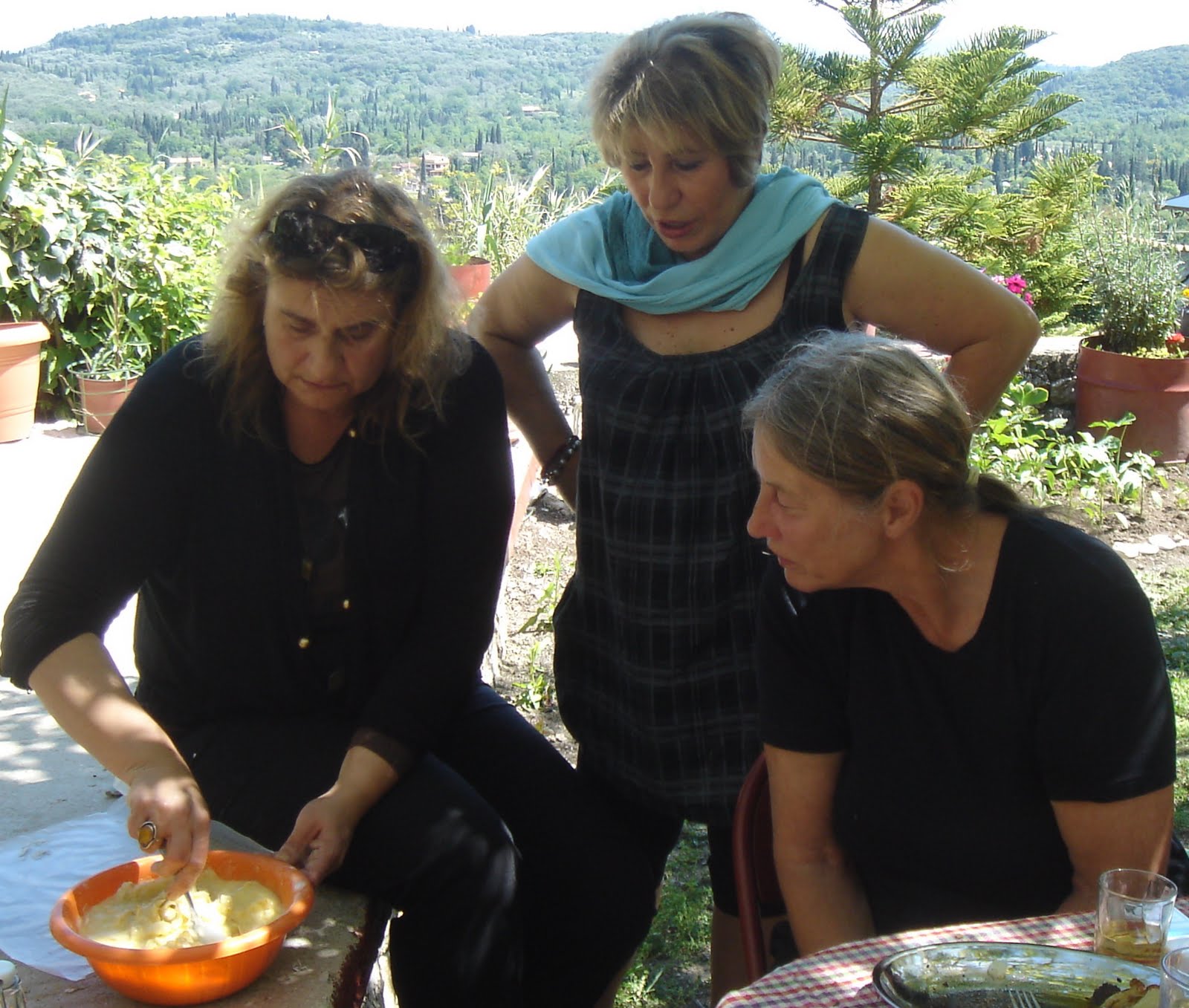
On Sunday Adonis’ and Effie’s friend Katerina Papas, who used to live in the village, came for lunch with them. We were invited, in part so Katerina could show us how to make a sweet called Orange Pie, πορτοκαλόπιτα, that she’d brought along on Easter Monday. I took notes as Lin observed. This is also a happy way to improve one's Greek:

Open out ½ kilo of filo pastry and leave it in the sun (or put in a low oven) until it’s dry and crumbles easily.
In a mixing bowl put the grated zest from two oranges, one tumblerful of sunflower oil, one tumblerful of orange juice and one tumblerful of sugar and mix.
Add a small packet (about 2 teaspoons) of baking powder and one small carton of Total yoghurt (the container carries slightly more than other brands) and mix in well.
Crumble the filo pastry into the mix a bit at a time. Fold in gently, making sure that the filo pastry is all coated with the mix.
Grease a large shallow baking tin. Pour in the mix and spread to cover the base of the tin, making sure to break up any filo still in large pieces or stuck together.
Cook in a preheated oven at 180°C (Gas mark 5) for half an hour.
Make a syrup with a tumblerful of sugar, a tumbler and a half of water, zest from one or two oranges and a few drops of vanilla essence (or two teaspoons. of vanilla powder). Mix and boil for 3 minutes.
Remove cake from the oven. Allow to cool. Spoon over the syrup, making sure that the cake is covered all over.
Serve on its own, with cream or with ice cream.
We had the pie – more a cake – after lots of other tasty things in company with Effie's and Adonis' other guests, Gerasimos, Anna, Michael, Yianni, Katerina and – my memory fails me. To my content we soon broke the rules about talking politics (I find people have enough faith in shared food and wine around the same table to treat politics as an acceptable subject even among new acquaintances). Talk turned on ‘Macedonia’. I couldn’t figure different shades of pessimism and optimism, but one at the table muttered to me of another that ‘they believe’ incorrigibly ‘history as it is written in school texts.’ I ventured there’s a history of the head and a history of the heart. The truth of the former is always a debate, of the latter a conviction.
I asked Michael what he thought of the current crisis. I’d first mistaken him for a Greek but he’s German long in Corfu, a language teacher. He said many people had lost their work, their businesses, their hopes. He saw no clear end to the problems “and not only here.” We agreed. It brings ‘a move to the right’ he said quietly, fuelled by humiliation. Pessimism turns to bitterness. "Foreign workers are less welcome on Corfu" he said "They get a negative response" (see news of recent violence in Athens and - back to the future 21 May'11 The Politics of Insecurity)
A shared hiatus drew us both to the history of the 1930s.
“Ordinary people don’t want to go to war. They get led when they are ready to be led” said another. Yianni told us of two old men relaxed over coffee on the bank of the Contrafossa - the short channel that separates the Old Fort from the city. One was Italian, spoke some Greek; the other Greek spoke some Italian. So they conversed – sat together talking about everything enjoying the long afternoon, when the Greek noticed his companion had tears in his eyes.
“Why are you crying?”
“We were soldiers here”
We spoke of living with less money, of allotments, of sun and wind energy. How easily these could become normal across the world.
In the background I could hear the continued talk of Macedonia.
“Surely” I said to Yianni “this couldn’t lead to war?”
“I hope not”
I saw Michael was telling a joke in his perfect Greek ending with the evil salute.
“What’s that in English?”
“There was a little boy sitting with his father looking at a family photo album. The boy saw one snap of his grandpa making the sieg heil and started to ask questions. His dad hurried on to other pictures in the album. The boy was insistent. His dad took a deep breath
‘Once there was a very bad man called Hitler. He was making a speech asking German people if they wanted to kill the Jews (everyone cheers), make total war (more cheers), rule the world (even more cheers)' but your grandfather replied ‘kill the Jews?’ - stretching his arm out level - ‘make total war?’ - raising it higher - “rule the world?” - raising it nearly over his head he shouted at Hitler 'enough! I’m up to here with all this!'”
*** ***
By the bins were two kapok-filled mattresses, covered with sturdy striped cotton fabric and held together by tasselled buttons. We took these home, from where they’d lain on the road. Beneath them was a gathering of leaf mould, twigs and seedlings, harbouring centipedes, scattering ants and wood lice, some flecked with yellow, others with a brown skirt edging a shell covered with light blue spots.
Dried out from the morning showers, the mattresses were almost pristine, though plainly of some age.
“How could someone have thrown those away?”
Off Democracy Street, in one of its narrowest parts, we came upon a man painting the doors and windows of an old abandoned shop, still with its fittings – shelves, glass-fronted cupboard and counters, all with finely moulded edges and on the floor encaustic tiles – chequered oxblood and white. He allowed us in to look around.
“We hanker for these things because they were made by craftsmen in whom the balance of the mechanical – joinery tools including moulding planes, saw and set square, screws and nails, kiln and paints – favoured the carpenter over the predominance of mechanised manufacture, synthetic pre-moulded standard and universal products."
A distant relative by marriage was a very successful games machine salesman. By way of compensation for a job that didn't inspire him he was devoted to restoring old buildings. He's dead now, husked out by drink and a succession of temporary partners more interested in his money than him. The only conversation I had with Freddie he was working on a vast oak purling for a medieval Welsh farmhouse, gently adzing it square.
"I could have had this work done at the timber yard in half an hour and still met the heritage specifications. Here I've been working on it for three weeks. I know this piece of wood. I know it in the way the original carpenter knew the decayed timbers I'm replacing."
I don't believe in hauntings, but I guess this is how a place acquires its spirit; the unique imperfection that comes only with time, small blemishes, careful repairs made long ago, the process of ageing, signs of daily use by people no longer living; wabi-sabi - 'nothing lasts, nothing is finished, and nothing is perfect' -  侘寂
Lines, proportions and angles are the creation of particular eyes and hands so that, even when precise, they lack the uniformity and symmetry that can be achieved with machines. When peoples unfamiliar with the products of mass production first encountered a discarded pop bottle – detritus of the US army in the Pacific - they were impressed. Containers are valuable, not to be thrown away so casually, let alone one made of glass. When people saw another exactly matching bottle and then another and another and another they were at first overwhelmed. When such objects were chucked off the back of a jeep they were impressed that people could part so easily with something so magically similar - something impossible for men to make prior to mass production. In some pre-industrial societies, twins are sacred and risky, fraught with mystery, even taboo. Yet here were numberless twin glass bottles, and a thousand other objects, all exactly the same, yet taken almost for granted, fecklessly thrown away, replaced, thrown away, replaced...tipped, dumped, discarded. No wonder we, among whom mechanisation has such command, covet asymmetry, dissimilarity and uniqueness. On that score we take pleasure and pride in completing the latest set of shutters for our bedroom window.
Louvered shutters converted to village style shutters
...and ones we made earlier
*****
If I get gloomy about the prospects of our species achieving a sustainable relationship with the Earth it's not because I cannot see the poor giving up having children or surrendering the possibility of having white goods and cars or the products of mechanised farming - though that seems unlikely - but because I cannot see we who already enjoy the benefits of those things being ready or able to give them up or vote for governments who will encourage or even make us. Can I deny myself access to a tenfold increase in chances that if injured or sick contemporary medicine, hard pressed though it seems, can save my bacon? What about the joys of travelling the world, enjoying unprecedented choices of food, unlicensed diversity of sensations for mind and body, the entertainments of sensuality, owning several spacious homes supplied with water, power and the means of communicating with the rest of the world? "It is easier for a camel to go through the eye of a needle, than for a rich man to enter into the kingdom of God" I find that retort as telling as, my favourite "this night, before the cock crow, thou shalt deny me thrice."
Mark showed me an article last week about a book by Prince Charles, Harmony: A New Way of Looking at our World. Its strength – I’ve only read a favourable review in Mark's January copy of The Shooting Times – is that it strives to digest the whole dish, climate change, town planning, medicine, advertising, deforestation, gardening, farming, transport, globalisation, attempting to reason the dire consequences of our detachment from nature, trying to navigate between good science and bad science, to enrich public debate between faith and reason, provide marriage guidance for the awkward partnership of empiricism and spirituality. He's a penitent rich man, who like many of us is trying. His arguments are supported by opinions formed in the conversations he's had and the the places he's visited. Reading it I expect to hear some of the HRH phrasing- the gnomic wisdom Private Eye enjoys parodying - 'If people are encouraged to immerse themselves in Nature's grammar and geometry they are often led to acquire some remarkably deep philosophical insights.' Well yes, but I value his use of the word 'grammar' in this setting.

The Prince may be criticising Cartesian detachment, but his polemics have never sought to deny sweet reason. I'm also less than impressed with the critiques especially some comments on the internet by keyboard warriors gripped by ad hominem ire - strewn with capital letters; venomous judgements from mean imaginations looking at the royal finger instead of where it points. When did an heir to the throne or indeed any member of our royal family write a book so steeped in understanding of the world's great problem? This is the 'king's writing'; Lionel Logue's role shared by Tony Juniper and Ian Skelly. I shall get the book.
Goya - The Sleep of Reason brings forth monsters
Meantime I'm engrossed – as I didn’t expect to be – reading Mark Twain’s late book A Connecticut Yankee in King Arthur’s Court. I had expected it to be simply a long funny essay in which Hartford meets Camelot, Hank Morgan takes on Merlin. It’s all that and the humour of Yankee English full of Great Scotts, ain’ts and corkers, encountering Malory’s wists, wonts and prithees. As I should have expected of Mark Twain it's a deal more of that exploring - with great humour and passion - the encounter of a late 19th century industrial entrepreneur republican with feudal superstitious 6th century Camelot, getting darker as it goes along. Twain is prescient about the American military fascination with 'rapid dominance' - shock and awe. In this book he may have invented the first ugly American.
** ** **

We are now officially included in the Hellenic Census. Angeliki  and Marie-Elena who have volunteered to carry out the census for Ano Korakiana and who live in the village knocked on our door today and noted details of our names. education, jobs, parents and...
"Why did you come here?"
"Love" I said. Marie-Elena wrote on the form.
"You mean you can put that in?"
"Of course"
"Not because we loved each other" Lin hastened to correct "but because we  love Corfu."
"Li-in!"
Thanassis on the village website reminds us that the population of the village needs to be above a certain number - 1000 residents - to avoid our village losing influence in the new local government of the island,
*** ***
Onions were 69 cents a kilo this February, and this isn't just Lidl
A circuitous and counter-intuitive position on the Greek economic crisis is taken by the BBC's economics correspondent Stephanie Flanders. 'Everyone says that heightened talk of a Greek default is proof that last year's bail-out has "failed". But you could make a strong case for the opposite.' The BBC tend to hire rather clever people - in this case Balliol, Harvard, US Treasury - so I note what she says even though I understand hardly a third of her argument, but would like to agree with it even so - not least because she likes cycling in sensible clothes.  Her view is that the bailout has worked for the Eurozone but hasn't been much help to Greece. That's so unlike 'a strong case for the opposite', I find her her piece tendentious and insensitive.
*** ***
Since dominant Bubble died, there's been renegotiation between cats around the house - a valued pitch with so many of us putting out food for them. A new Tom has made his appearance, testing out more familiar males, each challenge, avoiding actual fights, has enhanced his place in the feline pecking order. He's not a prepossessing beast - matted and mangy - 'of feature by dissembling nature' - seemingly composed, fore and aft, of separate animals, we've called him 'devil-cat'.

Saturday, 19 September 2009

'...the ravages of bitter civil strife...'

John Koliopoulos’ book Plundered Loyalties needs to be ingested in doses. Other than Thucydides, no historian attracts my respect so much, for being able to be so involved, so human and yet so scholarly, writing soberly of events associated with the Axis Occupation and civil strife between 1941-1949, but like the Inferno the awfulness of what’s described takes on the impetus of a depression shifting one’s mood like a gradual but relentless shift in the weather. I made a vow never ever again to pretend I understood or think casually about the matter of Macedonia and its northern neighbour.
Our route last winter from Igoumenitsa, via Ioannina, on the Via Ignatia, towards Thessaloniki passed well south of the West Macedonian towns of Grevena, Florina, Kastoria, Kozani, where Mark and Sally visited over Christmas, including Lia on Grammus. ‘People’ writes Koliopoulos, Professor of Modern European History at the Aristotelian University of Thessaloniki in 1998, ‘are made to slip into thinking of Macedonia or notions about the region as something with an unchanging identity …
the result of superficial knowledge of both the history of Macedonia and attitudes towards the place and its vanishing variety of cultural and linguistic communities, as well as of refusal to come to terms with that history when it is known…the uninformed visitor … can hardly imagine the fierce passions that tore the land to pieces and drove a sizeable part of the population to the four corners of the earth as refugees or emigrants…one has to travel higher up the mountain slopes and visit half-deserted mountain villages like Ano and Kato Melas, Kotas, Antartikon, Ano and Kato Kraniona, Mavrokampos, Chalara and Old Gavros to see the marks of war on the walls of abandoned houses, their windows like empty eyesockets and their roofs fallen. They are ghost houses, their bare red mud-brick walls still standing to remind visitors of the ravages of bitter civil strife in these well-watered and verdant valleys between high mountains, some of the most beautiful in Northern Greece…A visitor is given to understand that he is an unwelcome intruder in a world brought to a standstill by so much grief.’
* * *
Watering the plants on the veranda I disturbed a wolf spider - as big as any I’ve seen here or in England - a clutch of her young spiders covering her back. We were intrigued. Mrs L came to see and suggested swiping it. “No no” we said “The spiders control the flies.” I nudged it back into the shade of the garden, some of her young jumping ship on the way.
After a morning bickering about small things we set about some odd jobs; painting the frames for the shutters we’re putting on the balcony doors; varnishing wooden coving for the small bedroom and starting to fix it up…much later we went for a walk – about three miles - west through the village’s small spaces, fruitful in evening greetings, leaving its lights clustered below the crags. The wind fluttered the olive leaves gusting to stir their branches until darkness turned them into sounds for the imagination.
A construction challenging the surrounding landscape, more Las Vegas than Ano Korakiana, nears completion on the outskirts - an imposing villa with an array of balconies and porticoes; yellow, pink and orange walls, columns and pilasters to attract the envy of people passing through the olive groves either side of the road from Agios Markos. An arrow, painted on a steep concrete drive, invites guests to park their cars below heraldic lions in golden bas-relief.
** ** **
As well as Calligas’ thesis which I took over to Richard Pine the other day so that he could have it on record at the Durrell School, wanting to invite her to a conference in 2010 on Ionian politics, I’m reading Rebecca Morris’ draft of her research on the meaning of giving blood via donation. It’s rather pleasurable reading about myself, even with all the ‘erms’ ‘um’s’ and sporadicity of recorded chat typical of the messy rawness of the data used to assemble contemporary understanding of the world. Fancy putting this in a dissertation – interesting to me but the kind of thing you’d leave out in the old days:
Simon is the only male participant I have in my study. He is also the oldest. At 65 (when I met him), I’d say that he is probably the wisest too! It also struck me when I first met him, that he is also very tall! I think I have a thing for being drawn to tall academics (given that all of my supervisors tower above me) as he is also one of ‘those’. …Educated at Cambridge University, Simon also knows about anthropology because he studied it there. This puts him finely attuned to the ethnographic endeavour, albeit one that is slightly different and ‘less (post)modern’ than mine. Simon is one of the chattiest people I have ever met. He’s like the older, male, academic version of me: loquacious! I immediately liked him and I was gutted when my Dictaphone ran out of battery power only 45 minutes into the first of our marathon conversations…. When I first met him, I was struck by not only his height, but also that he was carrying a fold-up bicycle in his hand…
I quite like this. Lin reading notes ‘loquacious’ and looks at me with a rueful grin. I’m thinking she’s thinking ‘prolix’. And while sunning myself in flattering biography I got an mail from Owen Sinclair who writes a blog called ’70.8%’ being the amount of the earth’s surface covered by sea. A self-confessed armchair sailor, Owen had asked to post my 40 year old account of sailing to the Americas. I’m proud of that, finding it tricky to imagine how we did it when we did and in so small a craft.
* * *
Richard Pine has pointed me towards a Greek police detective Inspector Costas Haritos, trained in the time of the junta, a creation of Petros Markaris. Haritos may be as much or even more to my liking than the British author Anne Zaroudi’s ‘fatman’ – mysterious nemesis of wrongdoers on imagined Greek islands.
Visiting Richard in town up narrow stairs off narrower Philhellinon off Spiridon off The Liston; coming to an old door with a brass plaque and being invited upstairs to find books shelved around a spacious room with annexe above the bustle a floor below – home of Richard’s creation, The Durrell School of Corfu. To my delight he asked if I’d like to chat to one of the monthly gatherings – with wine - for subscribing members of the School. I suggested a discussion of how successive High Commissioners, from Maitland to Storks, had got on with the Corfiots.” “Good idea, but keep it short. They enjoy the wine and the company.” “I could have, thumbnail sketches, stories, mention of statues around the town, plus pictures of Ionian politicians and their opinions of the British and how they danced with their ‘protectors’”. “Ah! ‘Call it dancing with wolves’?”
** ** **
I was asked for this newsletter item in the September Newsletter of Birmingham Friends of the Earth (FoE):
Planning Application No. N/01514/03/FUL – Victoria Jubilee Allotments
In May 2004 Birmingham’s Development Control Committee approved - by one vote - an application to build homes on the Victoria Jubilee Allotments (VJA) next to Handsworth Park – a private site surrendered by a cabal keen to profit from the development value of their plots. Supported by FoE, people in Handsworth and across the city had campaigned for ten years against this loss of urban farmland. Government guidance discouraged building on allotments, and we presented sound evidence of local demand for plots on the whole site. Bitter disappointment at the committee’s vote was partly allayed by firm promises that the successful applicant would – under a Section 106 Agreement – hand over part of the land to the city to create:
- 80 new municipal allotments with a gardeners’ meeting room
- 3 playing pitches and a cricket square and a sports pavilion with parking
In May 2008, at a site meeting attended by councillors, allotments campaigners and people concerned with local sport, constituency planning officer - Alan Orr - gave assurances that the ‘trigger point’ – number of homes sold – had arrived; that the S106A would be implemented by Persimmon Homes that summer.
Summer passed. In February 2009 the city council’s allotments team opened a short-listing process in anticipation of allotments being available by this summer. Applications came in swiftly, but, as numbers went over 50%, we heard that undefined problems in the legal arrangements the land’s acquisition by the city meant no allotments this summer and indefinite delay on the rest of the agreement.
Council staff understand and sympathise with local frustration at yet further delay in honouring a contract concluded 5 years ago. Burdened by recession, the Council has born down heavily on its allotments budget – making cuts, according to the Birmingham Post, of 65%. Front line staff who provide excellent service to plot holders are under great pressure, yet here we have a legal agreement in place, at no cost to council taxpayers, to open the largest new allotment site in the UK since WW2. The problem is demonstrably at the highest level in the city.
Simon Baddeley, Handsworth Allotments Information Group (HAIG) TO GET ON THE SHORT LIST FOR A PLOT ON THE VJA WHEN THEY BECOME AVAILABLE PHONE 0121 303 3038, e-mail: allotments@birmingham.gov.uk or complete a form on-line.

Back numbers

Simon Baddeley