Total Pageviews

Showing posts with label Anna Baddeley. Show all posts

Saturday, 19 May 2012

Cycling to the top of Mount Pantocrator

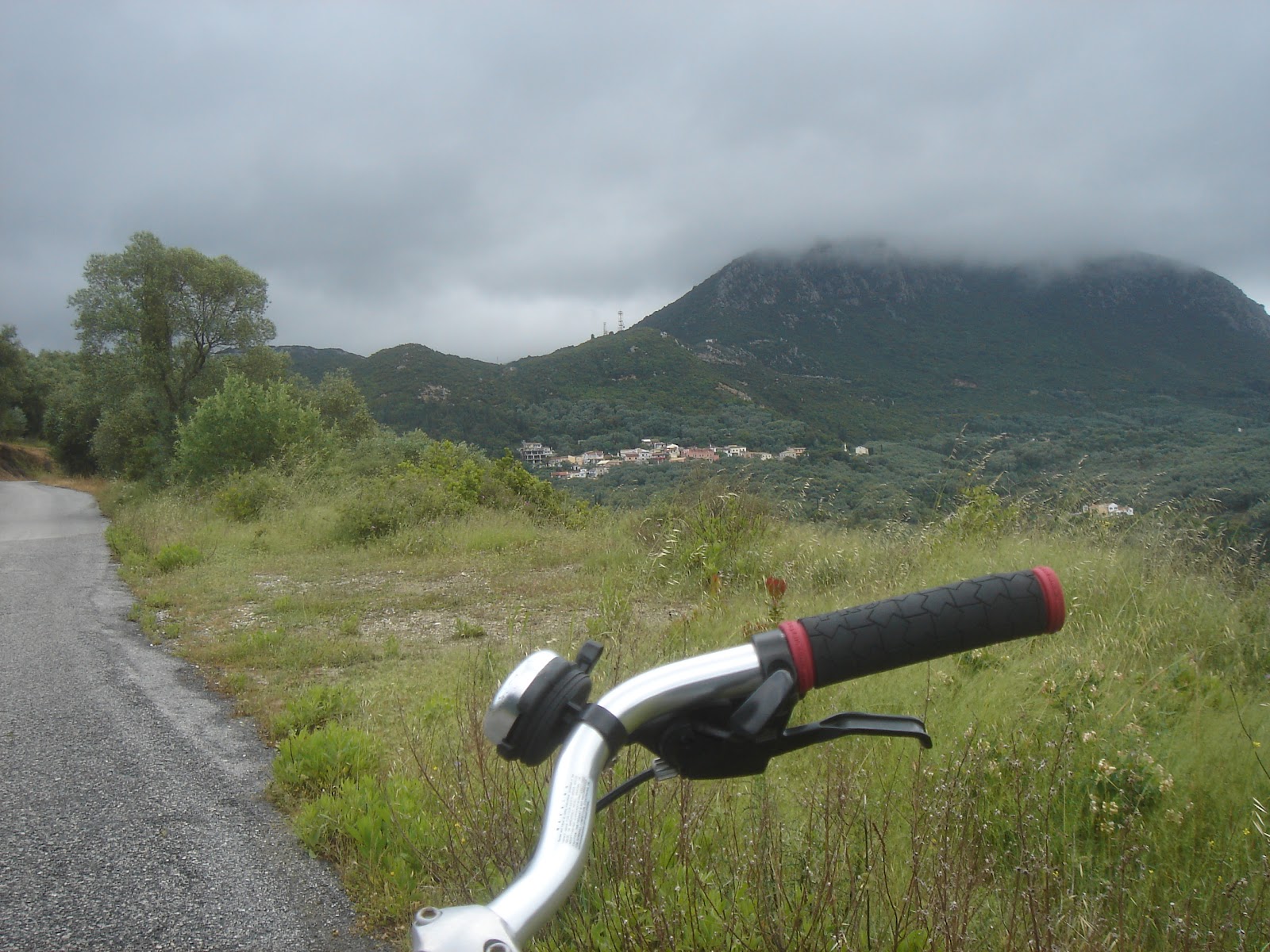
I cycled from our house up to the top of Mount Pantokrator on Thursday. The first stretch, the 29 hairpin bend ascent to Sokraki was done in an hour – at the seventh bend is Ag Isadoras where I rested a moment, the step by the verge helping me mount my big bicycle for which I feel affection.
The road to Sokraki
On the twelfth or the fourteenth bend of the ascent I glimpsed a V-shaped patch of grey sea on the other side of the island. I took the gravel bypass round Sokraki, runnelled by rain, passing chickens who were chukkling from their coop above a bank
“The Prussians are on the ridge!” as a French aide said at Waterloo
“No, it was ‘in the woods’”
“Yes but those chickens were definitely on a ridge.”
I passed the petrol station, wound through to where the descent began, free-wheeled down past the small church of Peter and Paul, to the corner where at a corner before the bridge last spring Mark strolled off the road and saw a blackbird’s nest with eggs. We were driving in a convoy of three to have Sunday lunch at Palia Taverna in Strinilas. All about in this small plateau below Zygos are fields of vegetables. In Zygos there’s a tight turn off the road to Episkepsi, that winds up through the village on a gentler hill toward Sgourades. Here resting by an olive tree I could see mount Mikhalakadhes – 852 metres, 2700 feet – its flat top hidden in mist.
Mikhalakadhes over Sgourades
“Am I really going higher than that?"
"Yes you are”
Another kilometre, gently rising to meet the road between Ipsos, via Spartillas to Episkepsi, on the edge of Sgourades. I turned right into the village, passed through it and on even more gently rising to the junction where a small bus waits to transfer passengers from the bus between Corfu town and Acharavi and bring them to Zygos and Sokraki. Here a sign said 12 kilometres more to Pantokrator, 6 to Strinilas.  I’d imagined myself turning back here if the weather got too fierce or my strength was giving out after the climbs from Sokraki and Zygos but I was doing fine. Sensible about my pauses, drinks and snacks. This steady climb to Strinilas was the hardest of the journey; goal not in sight to give me encouragement. The free-wheel back via Spartillas with the small climb to Ag Markos almost tempting me. Cars passed with ease, their passengers stopping at a view point above, their passengers dawdling, filming and on their way before I came by. Stopped looking back at where I’d come, Zygos and in the distance Sokraki and the long green Trompetta ridge.
“That’s where I’ve been”
Vanley on digging the plot on the Victoria Jubilee said
“You’ve left a bit of a mess. Dig so you can see where you’ve been. It encourages.”
I sipped water, sucked a chunk of dark chocolate; heard a cuckoo call about twelve times. I’ve not heard one for years. This road to Strinilas goes on to Petalia and Lafki where it divides for Acharavi and New Perithia. It’s the last north-south route before the corniche that circles the jutting north east coast of Corfu. Pantocrator fills the space between. 
The next three kilometres I travelled steadily upwards, seeing, far away, the Old Fort’s two prongs, Corfu town, and the airport runway and the island winding south, until I turn a corner round the northern edge of Mikhalakadhes, by radio masts beside the road, and, like crossing a watershed, the island’s north coast fills the horizon, the Diapontian islands north westward, hidden, now and then, in mist.
So to Strinilas by 1045. Just beyond the village where a downward hill begins, I stopped for water and cut a thick slice off my dried sausage. Round the walled corner behind me walked a tall man with a walking stick and umbrella, in a black gown with long white hair and curling beard.
- Hullo.
- Hullo. Good food?
He laughed in welcome
- Yes. I’m going to Pantocrator (I think I said this right in Greek)
- I to Episkepsi
- I am 70
- I am 80
- You look good (feenise se kala - φαίνεσαι σε καλά – did I get that right?)
- Wait until I am 120
He bent at the waist, switched his brolly to his stick hand, pressed the other to his back, coughed and mimicked a trudge and smiled
- Goodbye
- Goodbye
He waved and walked on briskly, soon out of sight round a bend, and I, freewheeling down, thinking I’d catch him up, was surprised to see the road empty ahead. It doesn’t go to Episkepsi either but at 80 he knows the island from long before the motorcar spread. I guess he’d turned off on a clever track that crosses the valleys and ridges separating the divergent roads
“Probably a ghost” said Lin later
“He left me feeling very happy”
I turned sharp right below Strinilas, in sight of Petalia, for the last stretch of my journey. The wind was chillier. Over a hill, the rocky cone shape summit of Pantokrator loomed ahead then disappeared. At the foot of the cone the road turns too steep for me to pedal. I walked the final kilometre of zigs and zags, unworried by the effort now my goal was so close. A friendly couple in a hire car who’d passed me earlier, must have stopped for a meal in a village, saw me again and waved. I grinned back broadly. I had not been sure I could do this ride. I had places in mind for turning back but once started it was a pleasing mix of pain and anticipated pleasure – the thought of arrival and the thought of coming down. Close to the summit I wheeled past parked cars and strolling visitors, and up to the shop to greet Spiro. He reached to my hand. We shook. I felt delightfully proud of myself.
“How long did you take?”
“Three and half hours, but I’m 70. Have a drink?”
“No”
“Yes. What?”
“Metaxas”
I ordered two 5-star measures from the café and brought the brandy back into the warmth of the shop. Spilled them, cursed cheerily and at once bought two more - €16 (“Lin’ll love that”). Spiro pressed a box of Kum-Quat loukoumi from the shop on me refusing payment
“Yes”
”No”
“Yes. I insist”
“Not!”
We drank a toast and sucked the sweets.
“You shouldn’t have come in this weather”
“It’s only like this near the top”
The wind was moaning among the girders of the big radio mast in the centre of the monastery; the usual panorama – all the island’s compass points, Albania deep into her mountains and the Adriatic horizon appeared in sun brightened flashes between thick grey cloud carried on a cold gusting wind.
“I’ll light a candle, then head back”
I was under the bad weather as soon as I was below the summit again. On impulse I took a right down a gravel track and freewheeled gingerly on my road tyres down the east side of the mountain until I came to deserted Palea Sinies, burgeoning with brambles and ivy and wild flowers and paused for a picnic. I had the ruins of the old village and half the mountain to myself but for a herd of goat, bells tinkling, and an eagle heading south, and everywhere blackbirds and swallows. The track became smoother then abruptly metalled and I was in Vinglatoura where I changed an inner-tube with a slow puncture; a thorn inside the tyre; no visible point of entry. Back on the mainroad I pedalled through Barbati, Pyrgi and up to Agios Markos, Two glasses of village rosé, fresh bread, olives and oil at the Panorama Bar. Home by 6.


*** *** ***
From Tony in America:
Dear Simon, I think of you often as I listen to the BBC TV news every evening and hear about the political paralysis of Greece. Are you at Democracy Street now? An appropriate place to be at this moment!
What's it like? What is your bet that Athens will leave the Euro Zone? I'll bet they do.  I just don't see how Greece can become competitive again until they can devalue their currency to match their output. While Greece clearly needs reforming, I don't feel very sorry for all those European banks (especially German) who fed the Greeks with high price loans (like the subprime and credit card lending here) and now have to take a hit. (Very similar to the mortgage foreclosure problem here). but in both cases until the market can clear by writing off mortgage principal or devaluing the Greek currency, the economies will stagnate (in our case) or go spiraling down in the case of Greece. In the meantime the Germans are benefiting mightily by the depressed Euro in their exports. Merkel's arguments about austerity are so self-serving. The situation is very dangerous with the emergence of strong right-wing parties in many European nations.
Τhe basic problem is that Europe doesn't have the will to really integrate itself politically and economically - which is a pre-requisite for a unified currency.  Europe now is like the US under the Articles of Confederation. And we know that didn't work!  They have no equivalent of our Federal Reserve which can expand and contract demand without running up real debt. Even here, only a few such as Paul Krugman, see the real nature of this situation - that the function of a currency (is) to express demand and the ability to meet it; it is not the size of one's stock of gold.
Enough of my sermonizing. I am really writing this to find out how you and Greece are doing.
Last Saturday in our living room we had a glorious concert consisting of one of Ravel's Miroir, the Liszt piano sonata in B minor and the Rachmaninoff cello and piano sonata. Audience of about 40. It was amazing. H and I have been in a trance ever since. A young Canadian pianist and US 'cellist playing. If you ever see a concert with Cicely Parnas (cello) go to it. In a few years (she is 19 now) she will be the YoYo Ma of her generation.
How does it feel to be a grandfather?
Cheers to you and Lin,
Dear Tony. So good to hear from you. 'Listening' to the BBC in Connecticut! As though tuning to what you can trust in an occupied country. True enough. I wonder why I can’t buy radios set to BBC, specially in cars where you have to search through pop and cheer first. The concert sounds sublime. I think of you as a sage aristocratic family in a belovedly constructed estate in the heart of Britannia observing tradition, now and then hosting friends and family, some with rumours from Rome. I agree with all your thinking aloud - because you don’t lace conjecture with oughts. I get as irritated with remote imperatives as with religious tracts passed out and littering the street, or essays on forums with upper case words, snake-oil prescription - sic "I am always asked to lay out my proposals for moving out of the financial crisis. Well here it is - three simple things I would do from my book ‘Bank To The Future: Protect Your Future Before Governments Go Bust’. If I was appointed to advise the new Greek parliament tomorrow, here is what I would advise them"... So simple. Now grace us with instruction, since neither Lin nor I could follow the implication of your para on the Eurozone and I need to understand this: 
They have no equivalent of our Federal Reserve which can expand and contract demand without running up real debt. Even here, only a few such as Paul Krugman, see the real nature of this situation - that the function of a currency (is) to express demand and the ability to meet it; it is not the size of one's stock of gold.*
I get miserable feelings, gut apprehension, even as I cycle by flowered verges and gaze on blue green landscapes or chat to friends over good food and wine, watch sails wandering on the strip of ruffled blue and listen to swallows gossipping in the eaves about real estate... 
...and of course get daily news of Oliver, our grandson from tired Amy (O sleeps in the day, cries in the night). The unspoken. Half the seed of Europe. Mark Mazower’s history of Europe’s 20th century – Dark Continent – tells how the European Community and hence the Eurozone grew out of the now imaginable effects of two world wars. The memory of these things infuses not just the old. We run our heart of darkness multi-media past pupils under 15. Isn’t global sport – whose noisy popularity can be tedious – soaking up what was once the enthusiasm of men to rush to arms. Aren’t the dogs of war skulking and mangy now? So is the bad future one of spreading poverty, crime, immiseration – but not except locally attached to ethnic scapegoats because no-one with any power will do more than pay lip-service with small publicity seeking persecutions at election time to the kind of thing we fear. Aren’t minorities far more alert to such dangers, unprepared to be languorous about xenophobia, fighting back even when unnecessary. Reading, hearing, chatting about the situation, nothing presents itself as so impregnable to comprehension as the present. I have decided – arrogantly of course – that Job was written by an old pagan, an atheist, also wise and attractive. I embrace the author of the verses from 38 on ‘Then the Lord answered Job out of the whirlwind, and said, Who is this that darkeneth counsel by words without knowledge?’
[ΙΩΒ ΚΕΦ. λή.1,2] ΤΟΤΕ άπεκπίθη ά ΚΥΡΙΟΣ πρὸς τὸν Ἰὼβ ἐκ τοῦ ἀνεμοστροβίλου, καὶ εἶπε˙ Τίς αὖτος ὂστις σκοτίζει τὴν βουλήν μου διὰ λόγων ἀσυνέτον; 
This is only an invocation to others to pipe down so's I can hear what you are saying. So much that is written and spoken about the 'crisis' – I almost forgive journeymen journo-academics writing to a deadline – is written by people dyslexic about history, Job's helpers. This is how 761 with some blank ballots, polled out of the 1252 eligible to vote in Ano Korakiana… Votes cast: 761 SIRIZA: 147 19,3% PASOK: 112 14,7% Communist: 111 14,6% New Democracy 87 11,4% Independent Greeks: 84 11,0% Golden Dawn 44 5,8% Democratic Left 44 5,8% Greens: 31 4,1% Popular Orthodox Rally: 23 3,0% Other: 78 10,2% So what now? New election in mid-June. I think people will vote in even greater numbers for SIRIZA. X Simon
*To explain - received from Tony 23/5/12:
When our Federal Reserve Bank wishes to stimulate our economy it buys US Treasury bonds and other assets, it pays for them by issuing a zero percent note of indebtedness called a Federal Reserve Note a.k.a. the dollar bill (look at them closely some time).  And what backs these bills? What is the indebtedness? Not a promise of the FED to  give you gold, or any other specific object or service on a particular schedule. Look rather at the words 'This note is legal tender for all debts public and private' on each dollar bill. They mean that you can present that bill to any other person or company in exchange for $1 worth of the goods and services the person is selling. The exact quantity of the seller's good and services that you receive is determined by mutual negotiation between you and the seller. That negotiated quantity is the 'value' of the dollar.  (Occasionally the amount is determined by a court if the buyer or seller tries to reneg. That is the 'legal tender' part.)  In other words the sum total of all dollars corresponds to the sum total of the productive capacity of our economy at any time and, equivalently, the sum total of all the actual demand plus the potential demand corresponding to the dollars held in reserve by the note holders as 'savings' (the latter bit is the Keynes part). When the FED wants to contract demand it simply reverses the process and sells some of its holdings of bonds and other assets in exchange for dollar bills held by individuals, thus reducing the amount of goods and services that individuals can 'spend' to obtain other goods. In this process the FED simply 'prints' dollar bills and gives them to individuals or takes them from individuals and 'burns' them up. The important point is that only the FED, not even the US Treasury, can create or destroy these 'dollar bills (notes)' according to what it - the FED - perceives as the desired level of production and purchases in the economy. The total stock of dollars represents the total production and demand capacity of the entire US economy, not that of any individual state even including the Federal government. Because these notes are 0% notes they have no 'cost'. They are not a debt to someone else (except in the case of foreign creditors). They are debt to ourselves promising our ability to produce or demand goods and services when requested. Europe, even through its European Central Bank, does not have such a unified financial system because Europe is legally just a confederation of states not a unified federation of states governed by a central government which has supreme power for the powers enumerated in our constitution. So Europe is hog-tied in the current situation and views the problem of Greek indebtedness as one of Germany 'bailing out' Greece which, naturally, the Germans are reluctant to do. Of course the Germans have been gaining; all the while stimulating their export economy by cramming instalment debt down the throats of 'sub-prime' nations like Greece who ultimately couldn't afford to pay. We have a similar problem with sub-prime mortgages taken out by homeowners who ultimately couldn't afford to own a home, or at least couldn't afford to own a home under the terms conned on them by predatory lenders. [My footnote to Tony's; an unmissable dramatization of 'predatory lending' is in Sidney Mamet's 1984 play, 1990's film, Glengarry Glen Ross - some brilliantly ugly quotes; the kind of desperate hard selling that launched the sub-prime crisis on the world. Ed Harris said that on set his fellow actors would call it Death of a F*cking Salesman.]
*** ***
If given the choice of the north face of the Eiger in winter and three minutes doing stand-up comedy I'd seriously consider the mountain, so respect to my brother - half-brother - George Pericles Baddeley (50% Greek) who's walked the walk on stage and manages Silver Comedy. he keeps asking me to go on one of their training events, but I'm terrified.
George's eldest daughter, Anna Baddeley, runs The Omnivore website and blog, writes for the Spectator now and then and for the Observer. She writes in the old media about the new - ebooks and self-publishing.

Friday, 3 June 2011

Macedon

Vergina, Βεργίνα - ancient Aigai, Αιγαί. So many beautiful things brought from the tombs of the kings of Macedonia, the dynasty of Alexander the Great to England. I shall go to Oxford for the day to see them.
Heracles To Alexander The Great: Treasures from the Royal Capital of Macedon, A Hellenic Kingdom in the Age of Democracy, The Ashmolean Museum, Oxford, 7 April -29 August 2011.
Macedonia, Greece
It's confusing, and nothing if not controversial in some circles, that there's a land-locked country in the central Balkans that's claimed the name of Macedonia, with a southern border on Greece - a border that marches with the Greek province of that same ancient name.
The land-locked Republic of Macedonia - capital Skopje

And I'd be playing Candide, if I did not recognise that this is a subject to be held in the tongs you'd use to pick up a glowing coal. Haven't I read any history? Don't I know of the 201 villages, 12,400 houses burned, 4,694 people killed by the Ottomans, 30,000 refugees fleeing to Bulgaria after the Ilinden Uprising, Илинденско востание, Ilindensko vostanie, of August 1903? Don't I know of the significance for Greeks of the Vergina Sun unearthed in 1977 during excavations in Vergina, in the northern Greek region of Macedonia, by archaeologist Manolis Andronikos - an artefact that between 1992-95 was a prominent part of the national flag of FYROM - sitting in the UN Assembly under 'T' as the EU entity 'The Former Yugoslav Republic of Macedonia' - subsequently muted but still a political symbol used to express a link with Alexander the Great and a claim to be as Greek as the Greeks? Have I not studied the ancient migrations, invasions, dispersions of DNA and the idea of Sklavinia and its borderless maps laced with the fuzziest of boundaries, focus of unending debate about identity?
The newish country of Macedonia contends with Greek Macedonia and indeed with the Hellenic Republic, its geographical association with that most famous of Macedonians, Philip II of Macedon, father of Alexander the Great.
The Kingdom of Macedon in 336BC
Where the confusion of names becomes more sinister, taking on the character of a frozen conflict, is the existence of a notorious Balkan phenomenon - a big idea. [Back to the future - 8 Jun'11: Skopje-Macedonian snap general election results. On-line guide to the political environment in the Macedonian Republic. A global diaspora has electoral significance in a country of many parties, with significant ethnic divisions. The social web contributes to the connectivity of political debate ]
There has been a Croatian big idea - Red Croatia Crvena Hrvatska. There's been an Albanian big idea, which also includes Chameria. The Greek big idea, Μεγάλη Ιδέα ended in bloody tears.
The Greek Big Idea - recovering Constantinople, capital of Byzantium
There was a Serbian big idea - Greater Serbia, Velika Srbija, whose chief agents stand in the dock at the Hague.
A Serbian big idea - from the Adriatic to the Black Sea
Although it is not supported by anyone in the national government of the country of Macedonia - there is a Macedonian big idea looking like a blood splat - involving the circulation of maps titled Autonomous, Greater and United Macedonia - Obedineta Makedonija.
A big idea from Skopje - expand into Bulgaria, Greece, Albania and Serbia
** ** **
I've been returning meter readings to power suppliers. A letter came from Siemens asking for my electric meter reading even though I already record this on a website for Scottish Power. The letter asks for my name, my MPAN (electricity) and my MPRN (gas) and the date of the reading. I can find out the meaning of these acronyms easily enough, but they might confuse some. The easiest way to get these readings, given that the gas meter which is outside is tricky to read in direct sunlight while the electric meter in the garage is rather high up, is to take a photo of each dial.
The website address given me to report the reading returns an 'error' message...

...without direction as to where to go to provide a reading I've already recorded with Scottish Power's quite efficient website. I take a lazy moment to send an email to Siemen's Customer Business Manager:
Dear Mr Alan Fletcher. I'm sure you won't read this but in a Panglossian spirit of optimism I'm taking a couple of minutes to email you to say that this is now the second time you have sent me a letter asking me to record my meter readings via the website:  The website with the URL supplied in your letter yet again reports an error with no clear directions as to where to go to record my gas and electricity meter readings. Any chance I could earn a discount on my energy bills for going to the trouble as a customer of Scottish Power of letting you know about the error in your letter asking me to contact you with my meter readings? Ha ha. I have recorded my current meter readings on the Scottish Power website where I have account - MPAN 1413713321000. Yours etc.
The reply is is instant:
Thank you for contacting Siemens Metering Services. Your e-mail has been received and will be passed on to the relevant department for their attention. This is an automatic e-mail; please do not reply. SIEMENS Siemens Metering Services, Woodyard Lane, Wollaton NG8 1GB
Meantime I received another email:
IMPORTANT INFORMATION ABOUT YOUR UNIVERSITY ACCOUNT. This email has been sent by IT Services at The University of Birmingham and is intended for the member of the staff who's University ID ends in ******. IT Services have been informed that the password associated with your Active Directory account ****** has not been changed since *****. In accordance with current University policy, you are required to change the password associated with your personal Active Directory account every six months at least. This email is intended to remind you that unless you change the password associated with the Active Directory account ***** before ***** it will be forcibly changed on your behalf. If this should happen, you will no longer be able to login to your Active Directory account or read your email until the password associated with the account has been reset.  You can change your password yourself - from the login page for the IT Service Desk website - from the login page for my.bham username and password or which contain links to web pages asking for your username and password. IT Services never sends such messages. (of course I've excised phone numbers and IDs)
Birmingham Identity Integration Services (BIIS) is a service of exemplary efficiency; a pleasure to use. I phone a number I know to confirm the email's not a phish and get through almost at once. It's 24/7 service. I'm reassured. I go smoothly to the relevant site and change my password, knowing if I have problems I can talk almost immediately to a human being anytime of the day or night, and if I'm struggling go in the week to the IT Service Desk and meet and even touch a real human being.  In this case I follow clear instructions and get an instant auto email reply 'The password for the Active Directory account "*****" has been changed at ****.'  This is an ace service, well protected (as it ought to be), to be coveted given that it gives me access not just to email and information about the university, but, and this is the real gift, access via Athens and Shibboleth to every university or affiliated library in the world allowing me to read and often download almost every academic journal paper and publication that exists.

*** ***
For inefficiency surpassing the call of normal bureaucratic hebetude there's the challenge Linda and I, and other designated members of the working committee for Central Handsworth Practical Care Project (CHPCP), face trying to alter the signatories on the project's Business Account with Barclay's Bank.
In Feb '11 I'd been approached by Edmund Branch (see him in the film) following the resignation of the Project Manager Mr Ali, who'd taken over, in vague circumstances, after the death of the project's founder Glynis Foley in 2010. Could Linda and I help? We were asked the same by Mahmood Hussain, co-founder of the project, though he is now no longer a councillor. We recruited friends; called an emergency meeting on 31 March. A paragraph in the minutes of that meeting mentioned the bank account:
In order to cash cheques two signatures are required. Currently the only signatories are Mr A and CB. Theoretically no cheques can be signed because Mr Ali is no longer a member. At least three signatories need to be appointed to avoid this situation happening again. It was agreed that, as an interim measure, these would be MT, CB and EB, and appropriate forms have been completed. An appointment with the business manager at Barclay’s Bank, Perry Barr, needs to be arranged in order to submit the forms. In the meantime we have asked Mr A to continue to sign cheques. 
Prior to the meeting we'd picked up Mandate forms from Barclays' Perry Barr. Once the meeting had approved the 'interim measure' three of us took our completed Mandate forms with names, addresses and proofs of identity for each signatory into the bank. We were told by someone - didn't think to take their name - on the customer side of the counter that no-one could help. We needed to see the Branch Business Manager, Selina Cooppen, who, owing to reorganisation, divided her time between several branches. She was available at Perry Barr on particular days at certain times. The person who told us this photocopied our IDs and attached them to the completed forms, promising they'd be given to Selina, who would switch the account to the new signatories on the Mandate forms. The whole process "takes about a week" we were told.
In the meantime we were acutely aware that though cheques could be paid into the project account by clients for whom Edmund and Krzysztof were working, no money could be withdrawn to pay wages, insurance or tax or materials for jobs. Edmund would have to continue taking some payments for work in cash - all receipted - out of which he could glean what he and Krzysztof  needed to keep the project going. They'd have in the interval to do without their normal monthly wages. The interim committee managed at least to get hold of Mr Ali - unobtainable since his resignation - long enough to have him and Charles sign three holding cheques to reassure the Inland Revenue and pay partial wages to Edmund and Krzysztof. Three more cheques to cover similar outgoings were signed with just CB's name, assuming these could be co-signed by one of the new signatories, on our assumption that by the time they were needed the account would be active. Thereafter further cheques could be drawn on the account as and when.
With that, as we believed, in hand, Lin and I left for Corfu on 1 April, feeling we had moved forward from insolvency, with agreements in place for the payment of insurance, MOT, the next month's wages and further sums to the inland revenue, and a second emergency meeting agreed for 19 May'11.
While we were in Corfu Edmund sent us messages reporting new work, client cheques paid into the project's bank account and agreed jobs done. We assumed things were going smoothly. The second emergency meeting was at our house on 19 May'11.
Lin, Leslie, Edmund, Krzysztof and Mike - second emergency meeting
An extract from the Minutes of that meeting, completed with a supplementary note the next day:
The bank has not yet approved the new signatories for the cheque book, though the mandate forms were taken in 2/3 weeks ago. E & M will contact the bank to check progress. Update following phone calls to the bank: The bank has ‘lost’ both the mandate forms for adding (new names) to the list of signatories, even though they were taken in at different times. They are sending new forms, but this will delay the process considerably and perpetuate difficulties in gaining access to funds. Linda Baddeley complained by phone to Barclay’s (the main number, not the local branch). They will speak to Selina Cooppen (Business Manager, Perry Barr branch) and contact Charles Bate (as the only remaining official signatory) after investigation.
Over the next week Mike and I completed a new set of Mandate forms, and resubmitted them to the branch with the same IDs. We were  told the Bank would phone as soon as these had been processed. Edmund and Krzysztof  were getting more and more frustrated and worried - for obvious reasons. Three days ago Mike, who'd been making regular phone calls to the Perry Barr Branch of Barclays was told, a fortnight after the new Mandate forms had been submitted that the branch had no record of them. He phoned us.
"Guess what. The bank has lost the second lot of forms. We've got to fill in another set and bring them in with ID again."
Later Mike came to our house with another new form for me that he'd collected from the Perry Barr branch. I filled this in, planning to go to the Perry Branch branch the next morning.
Mike phoned again.
"I think I've found a way forward. I've taken my form to Barclays' Birmingham HQ on the Hagley Road. They've promised to give it to their Mandate team on the third floor. They can't process the new arrangement until they have your form, Simon. You go to Barclays HQ tomorrow. Ask for Andrew on the Mandate team and he'll deal with you"
Yesterday - 3 June - Lin and I, after she'd found a lucky parking place, went into Barclays on Hagley Road with my completed form and ID.
"Hullo" says Lin to Zahir Khan behind a counter. She introduced us; explained our errand. He looked puzzled
"We've come to see Andrew in the Mandate Team."
"Do you have his surname?"
"No just 'Andrew'. On the third floor, with the Mandate team"
"There are lots of Andrews up there."
"I don't believe you," said Lin
"They don't come down anyway. It's not in their remit" He turned to a thin young fellow employee. "They want to see someone in the Mandate Team." The beardless youth curled his lip and shrugged. I glared at him. I'd asked Lin to do the talking because I didn't trust my manners.
"Look" said Lin, "you have over £3000 of this project's money. We can't pay wages. One of our staff has been given notice for non-payment of rent at his flat. He and his mate haven't been paid in three months. We owe money to the inland revenue. We can't buy essential materials...and Barclays, who we approached about this at the end of March, have now mislaid two sets of Mandate forms. Do you understand the urgency?"
He apologised with formal profuseness.
"Wait a moment I'll see what I can do." He wandered off across the bank's immaculate concourse.
"He's probably gone round the corner to wait for a few minutes," muttered Lin "He'll be back to tell us 'computer says no'. Did you hear him when he said 'there are lots of Andrews up there'?"
If I'd been a kettle I'd have boiled dry after a long whistle. After a few minutes Mr Khan did return.
"Someone from upstairs will speak to you on the phone in one of our private booths."
He took us to a desk in a booth, dialed a number and handed the phone to Lin who found herself listening to a recorded message with options - as if she'd phoned from outside. Having pressed the right buttons she got through to Sophie in the Mandate Team and explained the situation.
"I'll come down." she said
"So they can break their remit?" observed Lin.
In a few seconds we were chatting to Sophie, a nice young woman, who copied my passport and other ID - a utility bill with my address -  and assured us the matter would be dealt with by the end of the banking day or by Monday.
"Monday the 6th? Are you sure?" asked Lin
"Yes. Promise."
We headed home.
"I don't think I've experienced quite such a sequence of inefficiencies," I said to Lin "God I hope Sophie-without-surname gets things done by Monday. At least we'll be up to a starting line for the project."
We've our next CHPCP meeting on 16 June. We've been circulating letters to the old committee members to attend and join in, send apologies or resign. One was in India, another had just disappeared, but slowly we are getting in the signed slips with names and addresses that will legitimate declaring a new committee with the approval, or at least acceptance, of the old. On 23 June we have a meeting with Yvonne Wager and her colleague Jessie Gerald to explain what's been happening, to show that the project is up and running, legitimate, able to take work from the City.
2. Dissolution of the current Board. There were no members of the old Board present, despite Edmund having advised those he managed to see of the date and time of the meeting. No communication by letter, phone or email had been received from any of them. Consequently, it remained impossible to dissolve the current board. It was agreed at the meeting to continue the meeting with the voluntary advisory group set up at the previous meeting (agenda item 2 – 31/3/11). In these circumstances it was agreed to defer discussion of agenda items 2, 3, 4, 5 and 6 until the new committee is established.
In order to resolve the continuing problem of how to dissolve the old Board so that a new committee for the CHPCP can be properly constituted, it was agreed that a special general meeting will be held on June 16th. In line with the present constitution, all Board members will be sent a formal written invitation giving at least 21 days notice. This letter will be delivered by hand and a receipt obtained. If any Board member cannot be contacted, the same letter will be sent to their address by recorded delivery. They will be informed that, if they do not attend the special meeting or send apologies, it will be assumed that they do not wish to continue participating in the activities of the project. In the meantime the present group will continue, on a purely voluntary advisory basis, to attempt to resolve the project’s current difficulties.
Recognising the difficulty created in the meantime for the reputation and standing of the project, it was agreed that a meeting will be arranged with a senior manager of the Perry Barr Constituency as soon as possible. 
Update regarding the proposed meeting
This meeting has now been arranged with Yvonne Wager, Neighbourhood Manager, Lozells and East Handsworth Ward and Jesse Gerald, Perry Barr Constituency Support Officer on 21 June ’11
5 June '11: I've drawn the attention of Barclays' Complaints site to my account of our experiences and received this instant computer generated response:
Thank you for taking the time and trouble to let us know of your disappointment on this subject. We value your feedback and we are sorry that you have experienced dissatisfaction on this occasion. Your complaint has been forwarded to the Customer Relations Team who will provide you with an update within the next five working days. Please note that for security reasons they will respond to you in writing rather than email. We want to reassure you that we are dealing with your complaint as quickly as possible and will investigate all aspects fully. Please see our website for further information on how we deal with complaints, Regards, Barclays Bank PLC
***** *** *****
European authorities and the IMF say Greece will receive the next instalment of its bail-out funding -  €110 billion to be paid before August 2011. She is the hesitant beneficiary of another big idea - the EU
** * ** * ** * **
I read many texts on the internet, I buy most of my books off the internet, but I do like the heft of a book, the smell and touch of paper. I don't think I'll buy an e-book reader. I had a chat on Facebook about the future of books and book-selling with my niece after she'd written a piece in the Spectator
...Anna, I agree with you, but I strive to build evidence based arguments that demonstrate the market failure of turbo-charged capitalism where it pushes the 'logic' of terminator seeds, 8000 cow dairy parlours, and the rationale of intensified food production. Next time you write throw in a seed of hope that some trends aren't inevitable, and I don't mean wishing for a new ice age. Uncle S XXX
01 June at 08:04 ·  · 

    • Anna Baddeley haha yes it was a little pessimistic. Sadly though I do think this one is inevitable, in the longer term at least. Waterstone's may survive in some shape or form but not without closing a lot of shops — there just isn't a big enough market for full-price literary fiction & non-fiction.
      01 June at 11:53 · 

    • Simon Baddeley http://www.wired.com/epicenter/2011/06/ebooks-not-there-yet/2/ ..doesn't mean the way is clear for e-books tho' S X
      Yesterday at 01:26 · 

    • Anna Baddeley thanks Simon that's interesting. He makes some good points among the silly ones, eg would def make sense to get an e-book with your print edition. They are about to take off in a big way though, the new kindle is really good.
      21 hours ago · 

    • Simon Baddeley ‎"About to take off " but we're still on the apron. Kindle's good for book business, critics and judges. I'm less sure about readers. A bound book, sentiment aside, is nothing if not ergonomic. See archivists too on anxieties about long term digital storage. Paper even parchment seems to last better than rejigged ways of story zeros and ones (e.g. binary) - or do you know something I don't...as someone who's enjoyed reading handwriting in archives I suspect we lose something with the loss of pen to paper, as we do with digital drawing and painting. I'm saying William Morris has a point.
      20 hours ago · 
    • Anna Baddeley Yes definitely, although whether a 608 page hardback is more ergonomic than an ebook is debatable! Don't think books are in danger of dying out anytime soon, but I am seeing more and more people with kindles & ebook sales have now outstripped hardbacks on amazon. Interesting times! x
      14 hours ago · 
      Simon: I'm also impressed with a piece in the NYRB Publishing: The Revolutionary Future by Jason Epstein who while confessing to inhabiting a study of loved wall-to-wall books writes: The transition within the book publishing industry from physical inventory stored in a warehouse and trucked to retailers to digital files stored in cyberspace and delivered almost anywhere on earth as quickly and cheaply as e-mail is now underway and irreversible. This historic shift will radically transform worldwide book publishing, the cultures it affects and on which it depends. Meanwhile, for quite different reasons, the genteel book business that I joined more than a half-century ago is already on edge, suffering from a gambler’s unbreakable addiction to risky, seasonal best sellers, many of which don’t recoup their costs, and the simultaneous deterioration of backlist, the vital annuity on which book publishers had in better days relied for year-to-year stability through bad times and good. The crisis of confidence reflects these intersecting shocks, an overspecialized marketplace dominated by high-risk ephemera and a technological shift orders of magnitude greater than the momentous evolution from monkish scriptoria to movable type launched in Gutenberg’s German city of Mainz six centuries ago.....

So will I get my paper books via an Espresso machine? Will I come to reading books out of sentiment as I might refuse to use the engine on my sailing boat, or cycle rather than climb into a car, or dig ground for my vegetables rather than buying them over the counter, will I prefer wood joinery to cheaper synthetic construction? What are the questions here? My great grandmother, Lucy Halkett, who died at 99 in 1969 taught me to read when I was very young and taught me too to look after a book... “never turn down a page to keep your place; never turn back the spines on themselves; never write in a book.” I've disobeyed her, but even now as I jot in a margin, underline a phrase, fold the tip of a page, stain a book with jam or gravy or wine, leave it in the sand on a beach, push it doubled up into a baggy jacket pocket, I note her advice, prepare my excuses. I think she'd have been fascinated by an e-book, as she wondered at and used the phone and taught me about listening to her valve-powered radio in the 1940s that used to take a minute to warm up, as she flew -  in her 80s - to see her family stationed in Hong Kong, and enjoyed watching the television...and got worried, in her 90s, her mind was going because it was taking her nearly an hour to do the Times Crossword.
** ** **
Last night I led a scrutiny course for Forest Heath District Council deep into the flatlands of East Anglia. Council offices at Mildenhall, without a station so I took a taxi to and from Ely, an amiable Pole, demonstrating his skills as a taxi driver, told me his reasons for coming to England without telling me, and his thoughts about England without sharing them - or rather I can't recall a thing he said.

SCRUTINY BASICS: WHAT A MEMBER NEEDS TO KNOW
2 June 2011
This programme will assist members in understanding:
· what scrutiny is, the existing and new legislation, and how they can make it work well and engage local communities, and the public, in the scrutiny process;
· what goes on beneath the surface. How the process in managed, by the leading councillors working with the officers, and, and how all the councillors can be involved in interesting activities which assist the council;
· The challenges and opportunities opened up by scrutinizing organisations outside the council.

PROGRAMME
6.00 Welcome, Introductions

6.10 Making a Success of Overview and Scrutiny: What it is, and what have we learnt about how to make it work well. Including the 2000 Act, new legislation, call-ins, calls-for-action, and the procedures in Forest Heath Council

6.45 Issues facing Scrutiny in the Current Context (work in small groups, with feedback and discussion)

7.10 Managing the scrutiny process Engaging with local communities, involving the public, monitoring the process and ensuring effective action

7.40 External scrutiny: Developing an interesting and relevant programme (with work in small groups, and feedback)

8.00 Comments and Conclusions*

8.15 Seminar concludes
* Andrew C had drawn my attention to a report that came out this February with implications for scrutiny ‘Taking the Lead - Self-regulation and improvement in local government’. With the ending of the Audit Commission, Public Service Agreements (PSAs) and Comprehensive Area Assessments (CAAs) and other external performance inspections and measurements, it's a report offering practical advice on greater self-regulation and improvement by local authorities. Implicit in this is the contribution of overview and scrutiny, which many feared would be an easy target amid public sector cuts.

Ely: waiting for my train back to Birmingham

Back numbers

Simon Baddeley