Total Pageviews

Showing posts with label Localism. Show all posts

Wednesday, 22 January 2014

Mimosa

Mimosa - the tree that knows you're there

I feel this place fixing in memory, filling up those parts of my head that store happiness, edging out others once in fuller occupation – places now so changed they would, if revisited, only beget despondency – blighted by golf courses, executive estates, urban kerbed and straightened country roads, dual carriageways with out of scale EU signage. It happens almost everywhere. Yet even as I grouse, I know little’s worse than a place fixed in the amber of nostalgia. Better take it as it comes since what matters in any landscape, however drab or sublime, is its people. A dose of psychogeography has taught me the gems to be discovered walking through a littered car park under pylons to where some break in the chain-link leads to the remains of an unmarked path ending in a deserted junkie space of cans, plastic bottles, shards, shredded sleeping bags given over to vigorous proliferating weeds and their flowers – a reminder of what rust and moth corrupts, fecund nature recovers.
The western outskirts of Ano Korakiana

So laced is this village and its outskirts with paths, tracks and roads, the permutations available for our walks, are, if not numberless, unexhausted after six years of almost daily strolls in all seasons and weathers.  Private space and public space mingle to exclude severing walls or gates with a minimum of cul-de-sacs – matching unself-consciously, and without their intervention, urban planners’ recommendations for ‘livability’. This is not because there is no crime or its notorious equivalent ‘fear of crime’. There are plenty of spiked fences and locked gates and notices warning of guardian dogs. Somehow the need for domestic security has not blighted our village’s delightful permeability. 
“Is that a path we’ve not been along before?” Lin wonders as she inserts herself into a alleyway between high walls. I wait while she reconnoitres.
“Yes! It goes on through” 
I follow, skirting porches, shutters, window boxes, perhaps a parked scooter, chairs at a table and other personal belongings before our way opens into more shared space.  
“Let’s try this way?” I suggest as we see an untried track between fences off a road running below the village
“Where does it go?”
“Not sure. Let’s see”
Paths lead to small pastures off which run other paths which turn into dirt tracks then a road we recognise off which run other tracks in a general direction that more or less matches our wish to return at some stage to Democracy Street.
“Shall we try it?”
“But of course. I suspect it may comes out or go by Eklisia Paraskevi”

Sure enough. It’s the church just beyond the abandoned car that a few years ago looked quite run-down, now with a bell tower designed and built by our neighbour Lefteri and relatives; the whole joined together with a finely finished matte paint, many mitred wooden doors glistening Corfu green. Just over the track that runs beside the church is its cemetery where we expect to see the grave of Lefteris’ brother who died in 2011.
“This is also where we’ll find Arestides Metallinos and his wife Angeliki” 
Angeliki, their grand-daughter, had told us they were laid there. 
“That is our church”
It sits amid olive and cypress trees about half a mile on the flatter slopes below the village. 
“I’ve never really liked graves with photos and plastic or withered flowers and dead candles” I said to Lin “but I’m coming round to the idea that it might be comforting to visit an actual place where bones are interred below a memorial bearing a friendly gently smiling photo of the person who’s gone.”
Lin said nothing. I wondered if I could imagine such a place for my mum. I thought not, but wasn’t sure.


But Arestides Metallinos was someone who lived all his life in this village and is, like our neighbour
Lefteri, inalienably linked to Ano Korakiana.
The sculptor and his wife, Angeliki


Ήλθες στην πρόσκαιρη ζωή
κι έφυγες όπως όλοι
το γέρικοσου το κόρμι
ελύγιζαν οι πόνοι
---
Κι αν απ’τον τόποσου
έφυγες λιγάκι πικραμένος
ας ειν’το χώμα ελαφρύ
που είσαι σκεπασμένος*
My mother made the many and varied spaces we lived as children into our places. She was the place where she was with us.
Theodora Barbara - mum in 1917
I cannot associate her with any one place – rather with many special places where we were happy long ago -, in the heart of London, along the chalk streams of Hampshire and Berkshire, on the heathered moors and peaty waters of Inverness-shire, of the aching beauty of Ross and Cromarty; the places we went on childhood holidays, Exmoor, the dark jag-rocked white sanded Pembrokeshire coast, and later, when went together with her - Lin and I - to Istanbul, Cairo, Alexandria, Rajasthan, Crete, Venice. Like me and countless others who left the village centuries ago I have no ‘place’ where I’d wish, or even feel entitled, to have my remains interred - no place I can claim as especially mine. This is not a matter for regret. Being geographically unplaced means my places are ones of imagination, of many many memories. Perhaps that’s why people in my circumstances prefer cremation – illegal in Greece – so that if our relatives are so inclined our remains, as ash, may be spread among reminiscences, born on wind or water. Ironic that all my professional life I’ve been preoccupied with local government, and the elusive challenge of what’s now called ‘localism’. Lin is more determined than I. 
“I want no funeral’ she asserts “The refuse men can remove my corpse. Take it to the dump”
“Yeah well not my problem” I say “since I shall make a point of dying before you, and anyway I’ve donated my body to the NHS”
On the way home to Democracy Street, as we walk along National Opposition Street a woman sees us gazing up and murmuring admiration at her swirling flowering mimosa that hangs from her garden over half the road.
“Perimeni wait a moment” she says through her garden fence, then hands down to Lin two generous twigs of the yellow flowers and their delicate leaves.
** ** **
After the visit to the Metallinos Museum with Irini Savvani the Saturday before last I wrote:
Dear Irini. I’m so pleased we met. Lin too. That stone shoe seems a ‘transition’ between craft and art. Lin suggested Arestides might  have copied it from a real shoe that he had made.
Is there a Greek word for a man who has many crafts? Metallinos was good at shoemaking, building, furniture making, carving olive-oil millstones. Then in his last years - sculpting in stone and marble.
I think we are agreed that there is unlikely to be an expert or ‘authority' out there who can give any ‘certificate of value’ for this work.
I say - as one rather dependent on the opinion of others for my opinions about art - that the point at which a carved object becomes art has always been for those who see it to decide.
In the case of Arestides Metallinos there are still so few who have had the opportunity to make up their minds about him. We are nearly on our own, which makes me nervous amid my enthusiasm. My ‘qualification’ is that my interest was invited by the sculptor’s family; that Lin and I live in Ano Korakiana for many months of the year; that we love the village and Greece in ways that are far more than romantic or sentimental. (I know quite a lot of the history of modern Greece and of Corfu in particular).
Your qualifications? You are an art historian, critic and curator. You were born in the village. You are Greek, Corfiot and you met the artist when a child, and I’m sure there are other qualifications…One other thing we share; we are both ‘qualified’ by happy coincidence, in that in going to buy bread in the village we met in the centre of Democracy Street a few days ago. Had you or I left home a few minutes earlier or later this would not have happened. So. I treat luck in this matter as an asset.
I’m assuming you will write something about Aristedes Metallinos. I will be happy to get anything you draft sent to me to be translated (tho’ I know your English is very good). I imagine the challenge is to find the words and phrases to capture and convey to others something of the essence of this man’s art.
Thanks for the things you pointed out - especially the similarity of many of the faces to the artist’s own…I cannot get over the resonances of this ‘uneducated’ man’s talent. He understood Pygmalion - in that relief of him carving a woman and those words incised below  “Do not trouble your old bones…”. Also that 1984 sculpture of the ram which appears unfinished, but intentionally so. It’s a lesson in carving stone – ‘pitching’ (with that large chunk of rock left with point-chisel marks on the animal’s back)....
...‘roughing out’ with a claw chisel (I believe) and the process of ‘rasping’. That piece remains unpolished - the final stage. It makes me wonder if Arestides, like the great Italian sculptor, sought to release a form trapped inside his raw material…Kindest regards, Simon
Continuing with the project I contacted John Petsalis, so far only an internet acquaintance. Since the prospect of finding exhibition space remains for the time-being remote despite enquiries I felt that John’s ‘virtual museum’ would be a way of widening the audience for the work, providing links to an inventory that can evolve into a catalogue, and as a means of at least making images of the work accessible even if though its essence exists in dimensions and weight that can only be experienced directly. 
On Thursday Lin and I met John for coffee and cakes on the Liston – bathed in shade and bright sun. I showed him some pictures of the sculptures. The upshot was a meeting this Tuesday morning at the museum in Ano Korakiana. Angeliki arranged for her and her parents to be joined by her cousin Tassos. John Petsalis arrived with his wife Tina and an assistant Effie Stathia a photographer, studying for a history Phd.
John, Angeliki, Tina, Effie, Simon and Linda outside the Arestides Metallinos Museum in Ano Korakiana

As we assembled in Anna’s sitting room, I sitting between Linda on one side to nudge me if I talked out of turn and her husband Andrea. I could not have been more delighted as introductions were made. Tassos, John and Effie slipped easily between Greek and English. We had almost enough Greek to avoid being obtuse.
Angeliki and her cousin Tassos with one of their grandfather's works
Enthusiastic debate – some of which I could follow – as we enjoyed Anna’s coffee and cake, then we went out of one side of the house and back in through the door reserved for the display of sculptures. I don’t think I could ever become jaded by this rich collection, augmented on this occasion by the pleasure of seeing others looking at it for the first time.
"I did not know this man existed" said Effie as she strolled the collection planning a photographic record.
We wandered about the small room full of carved marble and stone - the Greeks helping me understand even more of Arestides’ art.
Mark said over a beer at the bar in the village last night
“I bet you never thought when you came here a few years back you’d be in this position”
“I know I know. This man has made a record of a world that's disappeared. He lived amid change from a pastoral society to the modern world, fuelled by mass tourism. And that’s just part of his work. There’s all the other things I’ve yet to understand! God, in whom I don’t believe (as if that would worry him in the slightest) works in mysterious ways sending such marvellous unanticipated gifts to me who loves this country and will never cease wanting to learn more about it”
I didn’t voice that last sentence but I sensed he agreed and sympathized. 
Before we left the museum after two hours continuous and excited conversation John thanked me for arranging for his meeting with the sculptor’s family and the opportunity to visit the museum. I and Effie exchanged emails so that we can stay in touch from England. I was almost glad to leave as I could see Lin getting gently frustrated at my impulsive effusiveness, exactly the un-English thing in me that I needed her to keep in check.
“You must stop saying ‘sorry’” said Angeliki at one point, as I apologized again for arranging the meeting at such short notice
“Sorry” I said “It’s an English habit”
“I know” she replied.
I have been entrusted with several papers from Tassos and Angeliki, two academic articles in Greek, one a chapter from a book, written in the late 1970s when the sculptor still had years more carving to do, and an inventory, one in Greek and one in English, twenty pages, listing – not in chronological order - all 252 pieces in the museum.

I confirmed that the stone shoe we’d seen on our first visit back in November last year, the first thing – so far as we know - Arestides carved; dated by the artist ‘25 September 1928’ when he was 20 years old, nearly 50 years before, as an old man of 67, he would invent himself as the sculptor of Ano Korakiana.
Irini remembered encountering this lion as a child when visiting the museum with her parents
*Last four lines - my translation: 'And if you leave this world a little embittered let the earth lie lightly on the place where you are buried'
*** ***
Google maps team sent me a message after I’d said the two main roads through the village had names different from those on the actual street signs...
Your report near Eparchiaki Odos Agiou Vasiliou in Ionian Islands
Hi Simon. We've reviewed your problem and you were right! The default view in Google Maps has already been updated to reflect your suggested change, as shown below.
The road was called Eparchiaki Odos Agiou Vasiliou because the village of Agiou Vasiliou lies on what used to be the main route to Corfu from Ano Korakiana. The lower road - National Opposition Street Οδός Εθνικής Αντίστασης - was unnamed on Google and previously called the district road from Pyrgi to Ano Korakiana Eparchiaki Odos Pirgiou-Korakiana.

Saturday, 3 December 2011

«Αποφασίζουμε»

At the end of October, in the run-up to the G20 meeting in Cannes on 3/4 November'11, President Sarkozi and Chancellor Merkel - Σαρκοζί και Μέρκελ - pressed George Papandreou, who was then still Prime Minister of Greece, to decide whether his country planned to remain in the Eurozone....: “Εμείς αποφασίζουμε για την Ελλάδα”. To many their words came out as "We decide for Greece"

On 1 December 2011 on the Ano Korakiana website:

ΑΝΑΚΟΙΝΩΣΗ
Στις 28/11/2011 πραγματοποιήθηκε η 2η Λαϊκή Συνέλευση των κατοίκων της Άνω Κορακιάνας για το χαράτσι της ΔΕΗ. Δηλώνουμε ότι θα αντισταθούμε οργανωμένα και συλλογικά στη ληστεία και την υποβάθμιση της ζωής μας και αρνούμαστε την πληρωμή του χαρατσιού για τα ακίνητα.

Α π ο φ α σ ί ζ ο υ μ ε:

- Κανένας εργολάβος με εντολές διακοπής δεν θα πατήσει το πόδι του στο χωριό μας
- Αναρτούμε πανό στις εισόδους του χωριού, μαζεύουμε τα χαράτσια και  δημιουργούμε δίκτυο επικοινωνίας και άμεσης παρέμβασης για να εμποδίσουμε τη διακοπή του ρεύματος
- Κανένα σπίτι χωρίς ρεύμα. Είμαστε αποφασισμένοι να επανασυνδέσουμε το κομμένο ρεύμα.
- Συγκροτούμε Λαϊκή Επιτροπή για τον καλύτερο συντονισμό της δράσης μας

ΚΑΝΕΝΑ ΣΠΙΤΙ ΧΩΡΙΣ ΡΕΥΜΑ
ΚΑΝΕΝΑΣ ΜΟΝΟΣ ΤΟΥ ΣΤΗΝ ΚΡΙΣΗ

ΣΗΜ.: έχει ξεκινήσει και στο χωριό μας και δυναμώνει από βδομάδα σε βδομάδα, η κίνηση-αντίδραση που εξελίσσεται και σε άλλα χωριά της Κέρκυρας κ.ά., ενάντια στους έκτακτους φόρους στα ακίνητα, που εισπράττονται μέσω των λογαριασμών της ΔΕΗ, αλλά και της απειλής για διακοπή της ηλεκτροδότησης σε όσους δεν πληρώσουν.

"No to the poll tax"

NOTICE
On 28/11/2011 the second People's Assembly of the residents of Ano Korakiana debated the property tax charged through bills from the Public Power Company. We declare that we will offer organised and collective resistance to this robbery and degradation of our lives and we refuse to pay the increased property tax.

W e  d e c i d e :

- No contractor with disconnection orders sets foot in our village
- We post banners at the entrances of the village, gathering to ensure we are in touch with one another to organise collective interventions to stop disconnections
- No home will be be without electricity. We are determined to reconnect homes whose power supply is cut off.
- We form a Popular committee for the better co-ordination of our activities.

NO HOME WILL BE WITHOUT ELECTRICITY
NO-ONE WILL FACE THIS CRISIS ALONE

What has begun in our village grows stronger from week to week, spreading to other villages of Corfu, against the extraordinary taxes on property collected by the Public Power Company using the threat of disconnection of power against those who do not pay.
*** ***
Linda and I, now in England, were discussing how we should conduct ourselves.
"I'm not sure" said Lin "whether we, as foreigners, should join in."
"I know. I'm unsure" I thought for a while "We've already paid the first of the two bills containing the tax increase" We left the money with friends. "We've still another property tax bill to pay."
Lin was silent.
"You know what?"
"?"
"I think it's right we should pay, but I would, if someone was about to have their electricity disconnected for non-payment, stand in any peaceful crowd that sought to intervene by gathering between someone's home and the contractor's workmen."
"I'd do that" said Lin.
Πρέπει να αποφασίσουμε...
*** ***
Athens News on 2 December reports the new Prime Minister Lucas Papademos saying to Parliament at his first session of PM's questions: "I do not think it is correct to cut off the power supply to households that cannot afford to pay..." Indeed something has to give as yet another instalment of the mighty bail-out, the 6th tranche, money on unimaginable scale, is agreed. Nick Malkoutzis, deputy editor of Kathimerini's English Edition, points out in his blog Inside Greece that...
...the impression is often created that Greece is being unfairly rewarded with 'cheap money despite failing to get its act together. The country is continuing to spend much more than it earns in revenues but its large deficit is not just down to the slow pace of public sector reforms, the worsening recession has deeply affected the revenues side of the equation as well....Greece’s inability, for whatever reason, to get its public finances on track does not change the fact that the bulk of the money Athens is borrowing from its eurozone partners is going toward repaying foreign banks, investors and institutions and only about a fifth is being spent on public sector salaries and pensions....the Greek bailout is by and large a recycling of money from eurozone taxpayers to European banks, which also helps buy everyone time ahead of a possible default by Greece. This theory is only emphasized by the fact that just days after Greece is due to receive its €8-billion loan tranche this month, it has to meet two major bond maturities: one for €1.2 billion on December 19 and another for €4.6 billion on December 29. In other words, Greece will pay out a total of €5.8 billion to its lenders this month, which is exactly the same amount that it is borrowing from the eurozone. As self-serving as that may appear on the part of its eurozone partners, Greece is in a position where it cannot survive without these loans until a better solution is adopted. At least for now, the two sides are bound together as they hurtle through the current uncertainty. 
*** ***
After teaching in Dumfries and Galloway on Tuesday I went south west of London to brief members and councillors on the implications for them of the Localism Act, just passed - and the wisdom of persuading scrutiny members to identify and focus on these for the rest of the authority. I enjoy cycling through London, strolling through the concourses of capital stations, crossing the Thames...
On Waterloo Bridge
...waiting in a shelter on a wet platform at the outer edge of London as through-trains dash by.
"The next train will not be stopping at ..."

My nurturing narratives of government at school were almost invariably - Boadicea, the English Civil War, Robin Hood, Hereward the Wake, Rob Roy notwithstanding - about the accrual of authority to the monarch, the centralisation of royal power - the Domesday Survey and Norman hegemony, before that the Romans and their roads and walls, later Henry VII and his use of the Star Chamber to gain control of a powerful royal exchequer, the Act of Union, and these, despite the spilling of blood, were stories of governments able to maintain and widen the rule of law, bringing greater opportunities for justice against the wolves of localism - predatory tribes, war lords, robber barons, raiding Picts, lawlessness along the marches, plunder and civil strife. I asked people what positive stories they knew from their history books - their early education in history - about devolution; about the giving up of power by larger governments to smaller. No-one could raise a hand.* Localism's heroes are rebels, outlaws (even criminals like the psychopath Dick Turpin), protestors, petitioners, and martyrs. There are no great narratives of localism triumphant. This is why it is so difficult to renegotiate relations between centre and locality in the United Kingdom. That it is happening is undoubted. Few do not believe it should not - so 'wicked' and intractable are the problems faced by a central government that attempts to control our unwieldy polity ("Try to control everything; you end up controlling nothing"). Do you now hear anyone at the centre calling for greater power there, unless it is to demand it from the larger government of Europe? Who now celebrates strengthening the control of Whitehall? There are struggling nations like Iraq where honourable and effective central government is yearned for; but not in Britain. Everyone thinks localism is an idea whose time has come (see The Welsh Assembly, The Scottish Parliament, even a faltering Northern Ireland Assembly) but do not be surprised if this happens slowly, cautiously, laboriously, vexingly and frustratingly slowly. There has never in the history of this 'United Kingdom' been a great story of successful devolution. It's being written as we speak. The Localism Act is not as significant for all the hoo-haa surrounding Big Society as the Local Government Act 2000, but it is not to be ignored. It offers further choices and possibilities. It needs to be scrutinised in detail - all 497 pages.
THE LOCALISM ACT  2011
Of special interest are those elements of the Act that relate to Overview and Scrutiny in local government. Three amendments relating to Scrutiny were made in the report stage,
1. The deletion of the prescription about matters non-scrutiny committee members may refer to a scrutiny committee. Councillors who are not members of scrutiny committees will no longer be restricted to referring only local government matters to scrutiny committees. This means that any members of an authority may refer any matter to scrutiny committees for consideration.
2. The removal of the link between the scrutiny committee’s powers to scrutinise partner authorities and improvement targets in local area agreements, widening the partners’ activities that overview scrutiny committees can scrutinise
3. The removal of the distinctions in the scrutiny provisions between district councils in county councils’ areas and other partners authorities. This gives scrutiny committees of non-unitary district councils an equivalent position to scrutiny in other authorities, allowing them to hold partner bodies to account.
...but the Localism Act introduces a demarcation line according to whether a local authority opts for Executive arrangements or Committee arrangements. It has that choice. If an Authority settles on Executive arrangements these must include provision for the appointment of at least one scrutiny committee. The rest of the provisions concerning scrutiny will then apply. But if an Authority settles on a committee system it may have one or more scrutiny committees - or none.
The Act contains provision for local authorities to continue to have a role in scrutinising the work of health authorities. In the consultation stage leading up to the bill there were proposals to merge local authority scrutiny functions into Health and Wellbeing Boards…Bodies like the Centre for Public Scrutiny, the Unitary and County Scrutiny Network as well as INLOGOV pointed out that, given that it was almost certain that senior Executive Members and Officers would be appointed to these Boards, the scope for scrutiny would be limited with the scope for conflict of interests increased. It would also be very difficult for the proverbial person on the Clapham omnibus to see such a Board being independent and impartial. Bluntly, the proposals were flawed…these representations were listened to …so now there’s continuing opportunity for scrutiny to contribute to the work of the NHS.... 
The role of a Designated Scrutiny Officer involves (see p.252)
- Promoting the role of authorities’ of O&S committee(s)
- Providing support to O&S committee(s)
- Providing support and guidance to ‘Members, Members of the Executive and Officers of the Authority’
Furthermore, in stating that this Officer should not be the Head of Paid Service, Monitoring Officer, or Section 151 Officer and placing it in this category suggests that it is envisaged that this role should be at a senior level.
An Inlogov view: Whether or not a Council chooses to conduct its affairs through committees; it should properly resource a capacity to undertake scrutiny. For committees, or for that matter cabinets (and cabinets are, in the last resort, just single party committees, dealing with detailed and complex agendas) there is no substitute for the analysis of an issue or service in depth which scrutiny is properly placed to do and where an input from non-executive Members can bring out choices and alternatives that otherwise might never see the light of day…
Using the Scrutiny function to make sense of the Localism Act 2011
_________
*There may be few if any striking narratives of locality and devolution but there are some increasingly prominent stories - fulminations where the story and its style make the narrative - against forms of sovereignty that no longer lie with nations. Of these one of the most prominent is Greg Palast's recent Vultures' Picnic: In Pursuit of Petroleum Pigs, Power Pirates, and High-Finance Carnivores. I must thank this journalist for introducing me to the 'vulture fund' - 'a private equity or hedge fund that invests in debt issued by an entity that is considered to be very weak or dying, or whose debt is in imminent default.' Hear Palast on the phone to the US libertarian part-time gonzo historian, anti-globalist Alex Jones Show - especially when speaking of Greece as a 'crime scene' between 06.30-08.09 - more elaborately and soberly outlined in the film Debtocracy Χρεοκρατία, made earlier this year by Katerina Kitidi and Aris Hatzistefanou, mentioned in Democracy Street on 17 June'11.
*** *** ***
I took the train to Stourbridge on Saturday morning to meet Simon Winter and sit in on part of the Kaleidoscope Christmas Event in The Talbot Hotel.
If anyone can dig up old copies of my step-father's TV programmes - especially Out of Town -  it's likely to be via people who belong to or are associated with Kaleidoscope.

Sunday, 16 January 2011

A visit to Sheffield

Me and my friend
What a happy 24 hours! I caught a train and went straight to the stage door of the Crucible. And there after forty five years was my university friend, famous, bringing enjoyment to so many people including me. Miriam* had invited me see her in Me and My Girl in which she plays the Duchess and to have lunch. It seemed to me that she'd not changed in all this time, but then perhaps that's because she's hardly ever been out of public sight. I'm accustomed to her face as she's not to mine, yet we slipped into conversation as easy as it had always been with her when we were at university. "As I was saying..." when a near lifetime intervened. In the evening I sat in the stalls and was as happy watching the musical as at the party after carnival last February in Ano Korakiana. Me and My Girl is a tale that works in England especially; class divisions surmounted by love, a high point being the end of the first act when toffs, at first aghast, then hesitantly enthused, are drawn into the Lambeth Walk. Of course I knew the tune - everyone does - but I'd never seen it in its original setting, a musical which played from 1937-1942 (the year I was born) - bearer of the most resonant of class mixing narratives - including ours. My programme reminded me
...that it was seen three times by the King, George VI, and its tunes went round the world...Me and My Girl is about the clash between culture and class, love versus duty and of course, being true to one's roots, as well as having catchy tunes. At the heart of it is the song and dance number which Lupino Lane -  music hall character over a century, archetypal cockney costermonger - created, entitled The Lambeth Walk. The dance acts as a social mixer...becoming so popular in Berlin that a leading member of the Nazi Party apparently denounced it as 'Jewish mischief and animalistic hopping'.
I remembered a film clip I'd seen years ago referred to in my programme. In 1942 Charles Ridley of our Ministry of Information, purloined extracts from Leni Riefenstahl's grandiose celebration of Nazism and edited her ridiculous and hideous pictures of goose stepping stormtroopers so that they seemed to taking two steps forward, one step back, three steps forward, to the, by then, famous tune from Me and My Girl - rather good propaganda, especially as The Lambeth Walk was already popular in Germany, though officially condemned.

In the Crucible the audience was enraptured - prolonged clapping, cheers and whistling, as the number ended - and then after a crafty pause - was encored into our applause. There were other famous tunes - The sun has got his hat on, Leaning on a lamppost; lots in between; the cast working brilliantly together; entertaining us with songs, dances and jokes - verbal and visual - to an ever-enthusiastic audience. It was silly, sweet, innocent and good, and people, including me, had a happy evening.
After the show Miriam and I had a light supper, shared memories and promised to stay in touch. On Saturday morning, still in Sheffield, I strolled the town, chilly and windy; enjoyed a favourite treat, a tray of chips in curry sauce eaten outside the chippy. As time for my train approached I wheeled my bicycle down High Street. There was a demo outside Barclays, chanting against bonus payments for their rogue CEO with handheld posters - 'Rage Against the Bankers'. Further down the street, just opposite Boots, I was drawn to a violinist playing beautifully to the street. I listened, pretending it was age and the chill wind that made my eyes water so, until she gathered her things, including a deserved pile of small change and immeasurable pleasure. I felt light headed and light footed as I headed gently down to the railway station.
*Miriam's captured - in so far as that's possible - rather well in this extract from an Australian blog commenting on her performances there a few years back. I notice that her brave - far braver given her standing and the fact of being Jewish - stand against the expropriation of Palestinian land for Jewish-only communities. The idea of Miriam having to defend herself against even the imputation of anti-semitism (a vice deserving the seventh circle of hell) is a sign of the knot apologists for Israel's present actions have tied themselves in trying to fend off those who oppose her policies in Gaza. It's like accusing me of paedophilia for loving Richard and Amy.
** ** **
Monday I cycled into campus to sit in on a talk by my colleague Tony Bovaird on trends in co-production - ideas about public service provision drawing on the work of Elinor Ostrom on the government of common pool resources. The day was arranged for members of the Japan Local Government Centre on a two day visit from London. Tony made a point of signalling a greater sense among people in business that were things the public sector can do better, and a greater recognition within the public sector that there are things business can do better, and that if both long opposing sides could work together....he gave Emma Harrison's A4e as an example of public-private mutuality, pointing out that Harrison was child of a piratical capitalist that had cut swathes through the UK steel industry.
Prof Tony Bovaird at Priorsfield
...and here's LGIU's briefing on the Localism Bill.
In Ano Korakiana's there a meeting on Tuesday evening to discuss the future of education in Greece, Corfu and the village with implications for the future of the village's kindergarten and primary school, hardly fifty yards from our house on Democracy Street.
Σύσκεψη πραγματοποιήθηκε σήμερα το απόγευμα στα γραφεία της Δημοτικής Κοινότητας Άνω Κορακιάνας, με πρωτοβουλία του Τοπικού Συμβουλίου και τη συμμετοχή του Διοικητικού Συμβουλίου του Συλλόγου Γονέων του Δημοτικού Σχολείου και του Νηπιαγωγείου του χωριού και κατοίκων. Η συζήτηση αφορούσε το Δημοτικό Σχολείο και τις προοπτικές του στο προσεχές μέλλον. Σύμφωνα με τις δηλώσεις του Αντιπροέδρου και των μελών του, το Τοπικό Συμβούλιο εγκαινιάζει έτσι, ένα νέο τρόπο «ανοικτής» λειτουργίας, προσέγγισης και συνεργασίας με τους κατοίκους. 
There was a meeting on 15 January at the offices of Ano Korakiana's local council of the school parent's association and other residents to discuss prospects for the school. The vice president and council colleagues supported a new way of  'open' operation, involving collaboration with residents.(Excuse my translation)
I am so aware of the vital role of a school in the sustainability of a village and before that the importance of young families being able to afford to live in the village when house prices have become so high because people like us buy homes there.

30 January 2011 - apprehensions about the future of the school in Ano Korakiana
The school in 1939 with 130 pupils

Tuesday, 14 December 2010

The Localism Bill - power to the people?

Maria wrote 'δυνατά και ντύσου. Βάλε τα καλά σου. Δεν μπορείς να διαβάζεις αυτό το συγκεκριμένο ποίημα με τις πιτζάμες ' ... basically, 'don't recite this particular poem in pyjamas' to which she sweetly adds 'Ωραίος είσαι και έτσι'.
** ** **
I got up this morning from a restless sleep and started to try to make sense of the Coalition Government's Localism Bill which we'd discussed at Inlogov's departmental meeting yesterday morning. The official guide from CLG is the kind of thing I used to find so helpful when assembling a flatpack from a furniture superstore.

But here's the flensing - courtesy of posting on the LGiU site. Although the Minister, Eric Pickles, says no cuts will be greater than 8.9%, I suspect actual cuts are considerably deeper. Complaints will be treated as 'shroud-waving'. LGiU provide excellent useful information - as it emerges. Our take on the Bill will come with more narrative, though this is LGiU CEO Andy Sawford's take. (See also Ref: Professors George Jones' and John Stewart's oral evidence on localism to the Communities and Local Government Committee on November 15).
For the moment I'm reeling with the long term effects of the government's policies on Handsworth and the rest of our area; the implications for the breaking up of decades of messy incremental investment in our fragmented and fluid inner-city population...and this is from someone deeply involved in voluntarism and community activism since I arrived in Birmingham.
To make an inventory: ....starting, with Lin, The Reservoir Roads Residents' Association feistily engaged in resisting the renewal of the licence of the neighbouring Tower Ballroom to pay for an overflow car-park so late night revellers didn't invade our narrow streets; participating in the content of an S106A to get a local playground; succeeding via a survey of traffic in denying permission for a detour road that would have sent commuters in and out of the city centre past a local school and through residential streets;  acting as key witnesses in a case of racial discrimination in a local 'white's only' Working Men's Club and numerous local activities involving care of the elderly, street cleaning and a great street party to celebrate the Queen's Silver Jubilee in 1977
Street Party in Daisy Road for the 1977 Silver Jubilee
When we moved to Handsworth it wasn't long before we'd started a residents' association for new street, and become involved in challenging our rating valuations in front of the local rating tribunal. We had limited success but got to know more of our neighbours. The two main community activities that have taken up the last decades of mine and many other's time have been campaigns to save Handsworth Park
 and to recover and restore the Victoria Jubilee Allotments, resisting robust attempts to encroach on a limited pool of inner city urban green space. Our successes here were palpable; the stories lengthy and well documented in film and text, attracting interest way beyond our local focus.
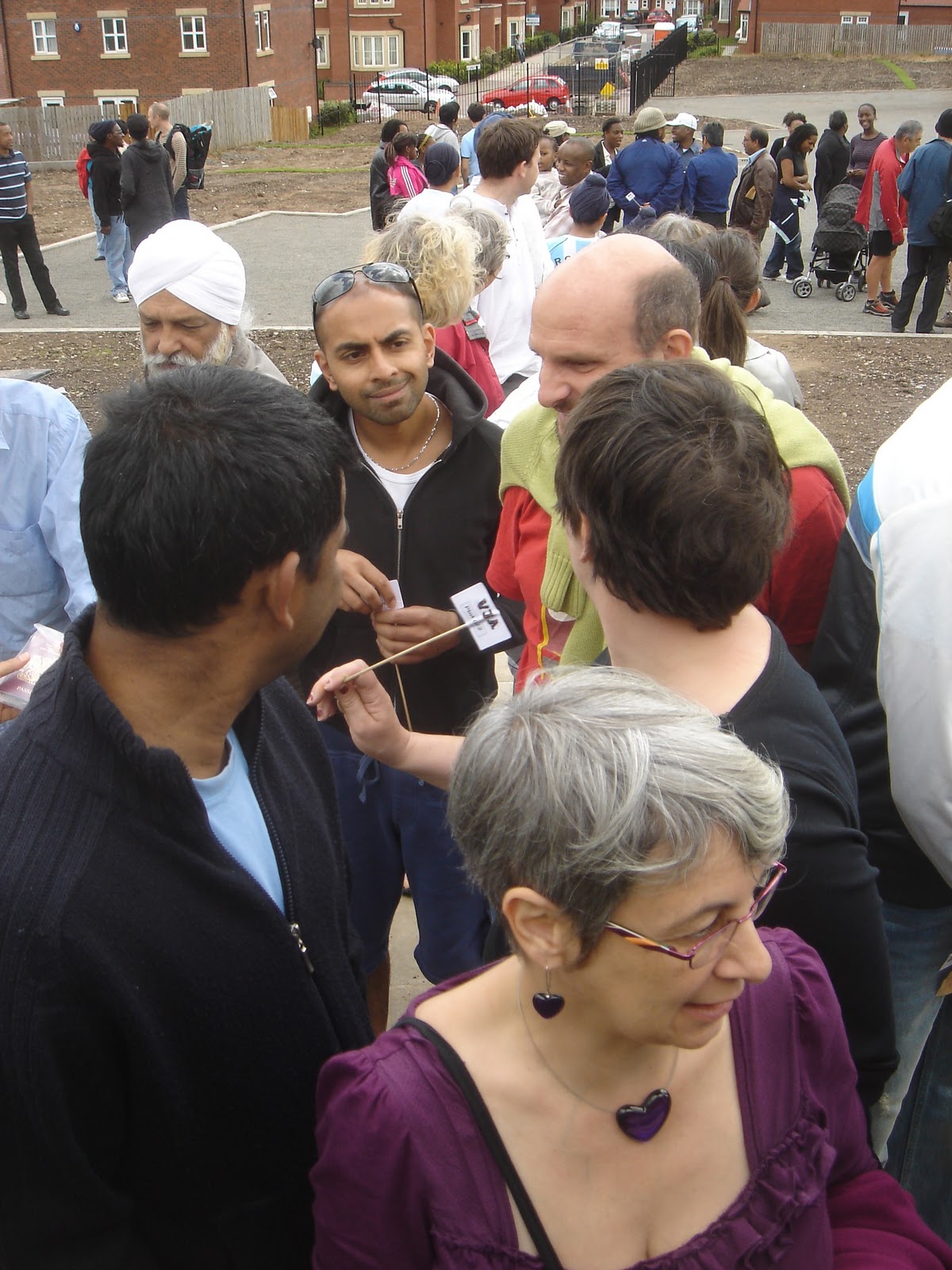
10 June 2010: queueing for plots on the restored VJA (ph: Richard Baddeley)
Other activity has involved work on restoring the churchyard of St Mary's Handsworth and the successful campaign to get Sandwell Council to alter the local plan for the area that includes Black Patch Park so that it is no longer available for industrial development. That's a continuing story amid as funds dry up for maintaining let alone restoring an urban park.

 What's been unique about this is the connection with the descendants of the Gypsies who were originally evicted from the Black Patch long ago. Some of them are shown in the YouTube of Bryn Phillips' song about Queen Henty's curse.
** * ** * **
 1400 Tuesday: Ah here's a reaction from Inlogov, from Philip Whiteman
....there remain a number of elephants in the room that Government has failed to fully answer.
Local authorities are being encouraged or subjected to the ideology of mergers and shared services are arguably good ideas in terms of economics but goes against the very concept of local control. In essence councils are becoming ever more distant from those they seek to serve. This is counter to the idea of connecting government to communities.
The move to de-ring fence funding is to be welcomed as it will allow greater local discretion over funding priority services. However, if Government is sincere in terms of allowing greater local autonomy in terms of funding, the balance of funding between central grants and local taxation needs to be addressed. Instead of central funding accounting for 75% to 25% local funding, this ratio should be reversed. Central government should only provide funding to ensure equalisation of funding between the richest and poorest communities.
The Big Society proposals could inevitably be depicted as little more than a mask for local authority spending reductions also announced yesterday. This means that funding community groups, the third sector and others to provide the Big Society capital will be difficult to achieve. The big hope comes from these groups being able to provide quick and cost effective alternative solutions.
The Localism Bill needs to ensure that principal councils can let go of services and hand them over to the parish and town level. Equally, local and parish councils need to build their own capacity and ensure that they are advocates for the Big Society. However, this tier of councils is very rural centric and greater thought will need to be given towards building the Big Society in urban conurbations.
The move towards increasing the number of mayors is journalistically and politically popular. However, government should not assume that all of the twelve cities will jump at the opportunity. Evidence in favour is patchy.
The role of councillors has largely been ignored. At a time of the Big Society, greater effort could be given towards the role in supporting and enhancing community influence and provision of local services.
INLOGOV will be researching, evaluating and monitoring how the Bill is enacted into reality. We will also be engaging our postgraduate students on the impact of Localism and the Big Society with their communities and employers. We welcome discussions with local authorities or any other organisation on how they seek to address the implications of new and current thinking within this arena. In the New Year, INLOGOV will publish a full and detail response to the Bill drawing upon expert opinion within the field.
** **
Καλά Χριστούγεννα και Ευτυχισμένος ο Νέος Χρόνος
I've posted quite a few Christmas cards this year including one to our neighbours - which might just make sense despite my Greek writing. We're always putting snow into our Christmas cards despite its rarity in English December. This year our local weather richly matches the theme. There was a prediction of snow in Ano Korakiana the other day - για έναρξη χιονόπτωσης στο χωριό. A celebration and vigil in the church of Savvani Arkoudena - εκκλησία των Σαββανήδων στην Αρκούδενα - ended early as a result. I see a photo of our neighbour - the Papas - Κωνσταντίνος Φαϊτάς - second from left - in Alice Stergiou-Savvani's dining room.
This year her family provides the traditional dinner of fish and wine for a vigil which, if I understand rightly, takes note of an ancient dispute that was to sever Eastern and Western christians. In the local church of Savvani Arkoudena there's a picture of St.Arius at the great Council of Nicea - first ecumenical council - Α’ Οικουμενική Σύνοδο - in the year 325AD. He is arguing his belief that Christ, though the most perfect of creations, is a creation of God the Father, in opposition to the belief of St.Alexander who held that Christ is of the same substance as the Father and co-eternal with him (my italics). This debate became so heated that Nicholas of Myra - one day to be known as 'Santa Claus' - slapped Bishop Arius for, as he saw it, belittling Christ.
The slap: 'Behold, how great a matter a little fire kindleth!' James 3:5-6
The insertion of Alexander's argument - the filioque (and from the son) into the Western creed 260 years after the arguments at Nicea (words on this in Democracy Street some years ago, and again in Feb 2008),
Aghios Panteleimonas attended by the President of Greece and the Archbishop of Athens - reported by Malcolm Brabant - to advance conciliation in the present...

** ** **
The other day I dropped into our local GP to get my flu jab - which covers swine flu - and have a routine blood test. I like this process of trying to stop people getting ill, rather than waiting until they do. That of course is the trouble with a lot of what government does - stops bad things happening via road safety, food and drug testing, with building regulations - inside and out - with child protection; all kinds of risk assessment - things that can make government look like party poopers, do-gooders and interferers - and with the additional problem that it's so tricky to measure performance in stopping things happening. You can measure how many people you've arrested. How do you measure how many crimes you've prevented; how many fires didn't have to be put out because of the work you've done to ensure they never started? As a recipient of the flu jab over six years I've no scientific proof it works just because I've not had flue more than once in that time.
Preventive medicine: old gits at the docs
** ** **
I'm flattered at seeing my face on the front page of the Ano Korakiana website - with a fair précis in Greek of what I wrote in 2007 about Ano Korakiana avoiding becoming a 'non-community'
I find my rough re-translation rather pleasing, so leave it as is, since the meaning's all there (go to the village website and click on my face to read it in Greek) - Ο  Simon Baddeley είναι λέκτορας στο Ινστιτούτο Τοπικής Διακυβέρνησης του Πανεπιστημίου του Birmingham στην Αγγλία, μα πάνω από όλα λάτρης της Ελλάδας. Εδώ και αρκετούς μήνες έχει αποκτήσει μαζί με τη σύζυγό του μια άμεση σχέση με το χωριό μας, αφού εδώ περνάει αρκετό διάστημα του χρόνου, στο σπίτι που αγόρασε  στην περιοχή που είναι το πηγάδι της «Γραμματινής», κοντά στην εκκλησία του Εσταυρωμένου. Μέσω δε της ιστοσελίδας μας προσπαθεί να έχει μιαν εικόνα για τη ζωή του χωριού μας και αρκετές φορές γράφει σχετικά στο δικό του χώρο στο διαδίκτυο, ανταλλάσσοντας μάλιστα απόψεις και με άλλους συμπατριώτες του που έχουν κάνει την ίδια επιλογή με τον ίδιο, να αποκτήσουν δηλαδή ένα «καταφύγιο», μια δεύτερη κατοικία στο χωριό μας...
Do not make Korakiana "non-community"
Written by Kvk
13.12.07
Simon Baddeley is a lecturer at the Institute for Local Government at the University of Birmingham in England, but above all a lover of Greece. He's acquired with his wife, a direct link to our village, after passing some time here last year, buying the house by the well of Grammatinis near the church of the Crucified. Through our website he strives to gain an idea about the life of our village and sometimes writes on his own site on the Internet, exchanging views with other compatriots who have chosen like him to have a second home in our village ... He indicates a developing problem in a recent memo to the village about our future, in response to some reports on our website, a small part of which has already been translated into English and French. 
"What I'm trying to figure out is why the village (Ano Korakiana) has such a great style of architecture. It resembles a village that might have benefited from one or two large public buildings gifted by a rich Greek Diaspora. It seems there are so many elegantly crafted buildings, lovingly prepared with the additions to the lintels and doors and arches and other decorative features, suggesting a prosperous time ...
Referring to comments on the site  - korakiana.gr - hat today, a reduction in the population of the village is evident, despite the installation of either temporary or permanent foreign families. Many years ago in my childhood, my parents bought and converted an old house in the village of Bagnor near Newbury in Berkshire. When we went there in 1949 we were re the first among some 20 houses in the village to install interior plumbing. Others went to a small stream - the Winterbourne - running at one point under the village street, bringing water home in buckets. When we left there in 1962, the village had changed a lot. The villagers had mostly moved to the municipal housing on the edge of Newbury, and more professionals from the city had moved into the village . Of course we now know this phenomenon well. It happens in villages throughout Europe - and no doubt elsewhere.
I remember my father said that although we loved the place we'd come to live we were also part of what some saw as the destruction of the rural economy. In the 90s I re-visited Bagnor. I could hardly recognize it. We were there to protest along with thousands of others against the highway that would pass through the meadows of my childhood. My father wrote in his old age, that the invasion against which we were protesting so vigorously (but peacefully), was part of a change that affected all of us and for which we were partly responsible.
Do you think that some of us are putting at risk what might be called the 'integrity' of Ano Korakiana? Can any of us (trying to avoid the term 'we' because you and I and our relatives are unique and I don't want to characterize us all together as 'foreigners') be criticized for our choices in life? Will Ano Korakiana become as much a non-community as Barbati, with newly built houses and wonderful views of the sea, but inhabited exclusively by seasonal visitors. I hope that young Greeks born in Ano Korakiana will be able to stay, or leave, and return to contribute to village life. There are villages in England which despite having been transformed have gained a new equilibrium, with significant involvement of relative newcomers, who've found harmony with the remaining former residents,  pressed for the building of 'affordable housing' so younger people can remain in the village.
It is truly a touching reflection of Simon Baddeley, thinking that might not have been experienced by many of us locals, a reflection of a 'foreigner' who seems to feel as 'native' as many of us. We believe that such examples are useful and beneficial for our region, now and for the future in an ever-changing world. Moreover, the history of Korakiana for centuries, has been largely written by family relocation ...
In a Greek nutshell I guess!
** ** **
At a suburban BBQ, a  man slaps a child who's not his own
My current reading. The Slap* by Christos Tsiolkas.  I read earlier work by him while in Australia. Tsiolkas' writes of the lives of successfully settled emigrants from the Balkans, especially Greeks, living in Australia. He reports the dire existences of a materially comfortable, social and psychological diaspora. This is the Balkans transferred to the suburbs of Melbourne; eastern Europeans escaped, or dislocated by globalisation, from the hold of blue-collar solidarity, faith and ritual, tight family, close neighbours, organic community. Tsiolkas is an enragé on the arid rewards of embourgeoisement. A third generation emigrant, he looks back at a prosperous dystopia in the way a young 'gentleman' sent to private school by his nouveau riche parents might be ashamed of them, looking upon talk of self-made success with ignorant disdain. I'm over 150 years away from that process worked out in the mills of Oldham and Bolton, distanced from its feelings and dynamic, but I've been lucky with my friends, relatives and reading.

*The link here is to The Omnivore, a website developed by my niece, Anna Baddeley
***
Oral evidence on Localism from John Stewart and George Jones, [George to the committee: "John and I are old men in a hurry. After all, we’ve been doing this for 40 years. We want to see it now."] taken before the Communities and Local Government Committee chaired by Clive Betts on 15 November 2010. Both have given a professional lifetime's academic attention to local government.

Q49 Chair : Good, we can make a start on our second evidence session of our inquiry into localism. Welcome, George and John; it almost seems like yesterday when you were before us on our previous inquiry into the balance of power, so welcome once again. Henry Peterson, welcome as well; it’s the first time you’ve come before the Committee. Somebody asked me the other day at a talk I was doing, after I’d finished, whether you could really prove that localism was going to make services more efficient, whether in the current climate it was actually going to be more cost effective and, if it wasn’t, whether there was any point in doing it. What would your response be if you were asked that question?
Professor George Jones: Yes, certainly localism will make services more effective, more efficient and more economical, because decisions will be taken close to the communities that are being dealt with. If we, for example, build on the work of the participatory budgeting experiments and exercises, we saw there, in an era of growth, that local citizens could take decisions sensibly and effectively about how to spend local money. Now we move into the era of cuts, and I’d have thought localism is even more significant, because, after all, it’s local people who will know where the cuts really bite, and they will know where to make sensible cuts far better than any central Government Department or regional office, and they will be able to be sensitive to any of the big problems that will arise-the social consequences, for instance, of cuts. Yes, it’ll be more economical, more efficient and more effective, because one hopes that they will be able to take an overview of all public service spending in the locality, building on the total budget experiments, so that it won’t just be local government expenditure that’s within their remit; it will be all public service expenditure. I’m a great champion of localism. You have yet to get me to define what I mean by that, but we’ll leave that to one side. My answer is wholeheartedly yes.
Professor John Stewart: I would also say wholeheartedly yes. You can fit expenditure more closely to two things: you can fit it more closely to local circumstances, which will vary from area to area; and you can also fit it more closely to what local people want. National Government tends inevitably to seek uniformity, because it hasn’t the machinery and the means to discriminate between the circumstances in one area and the circumstances in another, or to take full account of local wishes. That is why we actually have local councils; they can take account of local circumstances. The argument for localism is that maybe we are not giving the local councillors enough power.
In late November the Institute for Public Policy Research North - ippr north - sets out ‘five foundations’ upon which localism must be built:


  • A framework for decision-making which is efficient and effective – with powers being devolved down to the appropriate level of government.
  • Arrangements which give powers for much greater local financial autonomy. The target should be that local councils raise 50% of funds locally through a reformed local taxation system which combines local income and property taxes.
  • A set of national minimum outcomes which mean that every citizen is guaranteed a level of service within a system of greater de-centralization and local flexibility.
  • An increase in the transparency and accountability of local decision-making through more powerful and democratic local government.
  • A formal constitutional settlement between central and local government enshrining the key principles of central-local relations for years to come.

Back numbers

Simon Baddeley