Total Pageviews

Showing posts with label Irish Times. Show all posts

Tuesday, 29 December 2015

"It wasn't a merry Christmas in Greece..."

Τέβε - Insurance & Pensions Fund ~ Aristeidis Metallinos 1981 (cat.112 marble relief)

Greece faces into yet another unhappy year

Another general election is almost inevitable within the next three months

Clientelism and plutocracy are so embedded in the Greek political system that to change it would require heart and brain in the corridors of power. Photograph: Orestis Panagiotou
Clientelism and plutocracy are so embedded in the Greek political system that to change it would require heart and brain in the corridors of power. Photograph: Orestis Panagiotou 
It wasn’t a merry Christmas in Greece and it won’t be a happy new year. Not for the 26 per cent unemployed (many of whom will be long-term unemployed), in a system where the dole stops after one year. Not for the 50 per cent of unemployed and unemployable school-leavers and university graduates. Not for the 25 per cent of small businesses that are more than likely to go bust. Not for the thousands of migrants herded in near-animal conditions on islands which are unable to sustain them alive or bury them dead.
Yet despite the misery caused by the major players – the International Monetary Fund and the EU – Greeks continue to support a government which is unable to deliver on its election promises, which cannot reverse the downward spiral of recession or rescue those 30 per cent living below the poverty line.
The left has always been on the margin of Greek public life. That is why the rise of Syriza, from its formation in 2004 with just over 3 per cent of the national vote, to victory with 36 per cent in 2015, has been so phenomenal. It is as unthinkable as an all-Labour government in Ireland, yet it happened for three reasons.
First, voters were utterly disenchanted with the two major parties, New Democracy and Pasok. Second, Syriza offered a radical answer to austerity: rescind the bailout. Third, PM Alexis Tsipras is a charismatic figure – young, handsome, casual, and, like all successful politicians, looks as if he almost cares.
Tsipras thought one year ago that he was in a win-win situation. He could not only give Greece a voice but he could transform European politics by the power of argument. He may still hold the moral high ground, but his compromises on reform and capitulation to austerity show how naive he was when it came to playing politics.
Over the past year we have learned that good intentions, especially if politically incorrect, carry as much weight as a puff of wind in the real world.
The Syriza election slogan a year ago was “Hope is on the Way”. That’s all the Greeks are left with – hope. But what use is hope if there is nothing to hope for? Even so, Greeks have not abandoned the spirit of resistance, the capacity for argument and the determination to survive in conditions that all but the most destitute in Ireland would find unlivable.
Greek politics since independence has been remarkably like Ireland’s. The redistribution of land, the opening up of the professional classes and the opportunities for commercial exploitation bred a bourgeois mentality anxious to achieve social and economic respectability and to educate the young in orthodox conformity. Syriza came on the scene to change all that.
But clientelism and plutocracy are so embedded in the system that to change it would require heart and brain transplants – not for the man in the street or the olive grove but in the corridors of power. Greek people are the servants of the 1 per cent owning 90 per cent of the wealth, controlling most of the media and occupying seats in Tsipras’s cabinet.
Greeks are rapidly discovering that not all conspiracy theories are wishful thinking. They now know that German finance minister Wolfgang Schäuble set out to crush Tsipras, Syriza and Greece itself if necessary. They know that refusal to contemplate a “Grexit” was an elaborately choreographed charade. They know that the IMF admits it was wrong in setting up the austerity programme.
It is a cruel fact that small countries have little choice in international affairs. Greeks are now openly saying what had been unacceptable before: that Germany is responsible for many of Greece’s difficulties.
In 1833 foreign powers imposed a German king. The last queen in Greece (deposed in 1974) was German and a Nazi sympathiser. Greece is still pursuing war reparations from Germany, but even more serious is the fact that old people today still carry memories of their pregnant mothers bayoneted by German soldiers.
German companies – including Siemens – bribed Greek officials in some of the biggest corruption scandals of recent years. One government minister was jailed, but the Siemens trial, due to start in 2014, has yet to get under way because at least 14 of the 64 defendants are being sheltered in Germany, which has refused to extradite the former chief executive of Siemens Hellas.
German banks benefit from the Greek debt crisis and German companies are the biggest earners from Greek imports. Is it any wonder that Greeks get angry when a German tabloid tells them they should sell off the Acropolis and some of the islands? Is it any wonder that street posters show Angela Merkel wearing a swastika and an Iron Cross? Is it any wonder that Greeks are incensed because the Greek fascist party openly venerates Hitler, burns synagogues and mosques and beats up immigrants while all of its 17 MPs are on trial for murder or associated crimes?
One hundred years ago, while the Easter Rising was being planned in Dublin, the humiliated Serbian army of 150,000 men women and children and their government in exile, arrived in Corfu, where the Greek government gave them asylum after their defeat by Germany. They were a broken people. The mausoleum of those who died here is a chilling place. But they carried the same hope in their hearts that Greeks continue to cherish. And the Serbs regrouped and went back to fight the Germans who had precipitated the world crisis.
In 1916, the Serbs brought with them love of country and a deep faith in its survival. This gelled at the time with the Greek spirit and could offer some hope to modern day Greece, where yet another general election is almost inevitable within the next three months.
Richard Pine’s Greece Through Irish Eyes is published by Liffey Press
*** *** ***
Dora Metallinou writes on 26th December on the Ano Korakiana website 'In celebration of love' Στη γιορτή της Αγάπης:
"Καθώς οι μέρες περνούν ο προβληματισμός μου εντείνεται.. Όλο και πλησιάζουμε στη γιορτή της ''αγάπης''. Ποιας αγάπης; Ποιο το νόημα σήμερα; Στολισμοί στα σπίτια και στους δρόμους! Λαμπιόνια να φωτίσουν τα σκοτάδια... Μια φενάκη να κρυφτεί η αλήθεια...Μα πάλι ,να αλλάξουμε κάτι..να ξεφύγουμε.....κι ας είναι το ΄΄φαίνεσθαι'' Το ''είναι '' το καταχωνιάσαμε, το τυλίξαμε σε σελοφάν γιορτής...Μια βιτρίνα για να κρύψουμε τη ζοφερή πραγματικότητα... Βαυκαλιζόμαστε πως όλα θα αλλάξουν, με ευχές, διακοσμήσεις και κατ επίφαση εορταστική ατμόσφαιρα...Και το γνωρίζουμε πως δεν θα αλλάξει κατι... Άνθρωποι πεινάνε,κρυώνουν,πνίγονται! Τι να γίνει; θα πείτε; Δεν ξέρω ! Απλά λέω δυνατά τις σκέψεις μου!Μια διαφορετική γεύση πήρα χθες το βράδυ,σε μια γιορτή που πραγματοποιήθηκε σε ίδρυμα με άτομα νοητικής στέρησης...Συγκινήθηκα πολύ...προβληματίστηκα... Ένοιωσα όμως όμορφα! Αληθινα! Υπήρχε αγάπη! Αληθινή! Αυτά τα πλάσματα αγαπούν ανιδιοτελώς! Κοιτάζουν στα μάτια τους ανθρώπους που είναι κοντά τους και τους αγαπούν!!!!!! Ίσως είναι η ομορφότερη εικόνα που θα πάρω από τη φετινή χρονιά...... [και σε ένα όμορφα στολισμένο σκηνικό!!!!!!!!! Μπράβο στους ανθρώπους που είναι κοντά τους και τους προσφέρουν ,εκτός των υπηρεσιών τους, και την αγάπη και το νοιαξιμο! Το είδα!!!!!]"   ΔΩΡΑ ΣΠ. ΜΕΤΑΛΛΗΝΟΥ

Tuesday, 2 June 2015

An hour


The whole job – tidying up the piece of wood from the shed; cleaning up three old coat hooks; centring and spacing them and fixing them to the wall in Amy’s bedroom, took an hour. Those brash and useless diagrammed and illustrated DIY books! Never a chapter on creating even holes in an old wall which, behind render and plaster, is made of undressed stones and old mortar. For the first two holes the masonry drill entered fairly sound mortar, but two and half inch screws through countersunk holes in the wood into rawlplugs, left the hooks insecure. I could feel the give. I made two extra holes in the wood, offered it to the wall with a spirit level, making small marks on the plaster to start the hammer drill, which first hit and pierced a stone. Making the next hole, the drill crumbled the mortar, slipped and made a crater of broken render and plaster. I filled the cavity, and the better holes, with a dollop of quick drying glue from a gun; tapped in larger rawlplugs flush with surrounding plaster; wiped excess glue from the wall; presented the tips of four longer screws to the prepared rawlplugs; tapped the wood slightly home; tightened the screws. Three pulled firm. Where, as expected, a screw went on turning despite being home, I relied on its glue filled hole to do the holding. Half an hour later the hooks were fit for use.
*** *** ***
Nico and Sophia Zervopolou, neighbours, invited us to a celebration at their family church on Monday...
Στην Αγία Τριάδα
Γράφει ο/η Κβκ   
02.06.15
ag_triada01062015c.jpg
The Church of the Trinity - a kilometre south of Ano Korakiana
Πρωτομηνιά χθες, εορτή του Αγίου Πνεύματος και η εκκλησία των Ζερβοπουλαίων, λίγο έξω από το χωριό, εόρτασε όπως κάθε χρόνο. Ο κόσμος όπως πάντα αρκετός, ανηφόρισε από τον κεντρικό δρόμο στο μικρό ύψωμα, όπου η μικρή εκκλησία στέκει εδώ και μερικούς αιώνες περιτριγυρισμένη από παμπάλαιες ελιές και μερικά αμπέλια. Την επιμέλεια της φετινής εορτής  είχε η οικογένεια Νίκου Ζερβόπουλου, που με τους γιούς του Χρήστο και Αλέκο, είχαν φροντίσει για το καθετί, με τον εσωτερικό διάκοσμο του ναού να έχει ανατεθεί στον Ιωάννη Κοντοστάνο. Την λειτουργία ετέλεσαν ο παπα-Κώστας και ο παπα-Ιωσήφ Γεωργουλάς, που έχει συγκενέψει με κορακιανίτες Ζερβόπουλους. Ανάμεσα στους πολλούς γνωστους, το παρόν έδωσαν και ο Σάϊμον με τη Λίντα, λίγο πριν επιστρέψουν στην Αγγλία για τις καλοκαιρινές τους διακοπές.
ag_triada01062015a.jpg 
 ag_triada01062015b.jpg
Simon and Thanassis at the Church of Holy Trinity ~ Αγία Τριάδα


Outside the church as we enjoyed cake and coffee, Dr Savannis gave Linda a posy
Lin said later "It's made up of a carnation, myrtle leaves and something else whose name I didn't catch"
"The Trinity" he'd said, smiling "All are sweet smelling"
"I've never understood the Trinity" I'd said
"Nor I"
*** *** ***
Richard Pine's 11th May letter from Greece in The Irish Times:
Oscar Wilde said every American bride is taken to see Niagara Falls on her honeymoon. “It is the second, if not the first, disappointment of married life.” Alexis Tsipras took his bride – Hellas – to Brussels. The bride contracted Brusselosis and the honeymoon ended abruptly.
The reality of married life kicked in – or up – sooner than either had expected. There were so many factors militating against the marriage. When the engagement was announced, Hellas had been warned by other jealous suitors that the union was doomed, that her meagre dowry would be spent irresponsibly and that her reputation for reckless spending and handing out tips to her worthless relatives did not bode well for a prosperous union. Her bottom drawer, and all the other drawers, was bare, and the unhappy couple would be condemned to live beyond their means, ending their days in the workhouse before the year was out.
Even the groom’s unruly family had doubted that the marriage would work, if Hellas’s relatives living abroad had anything to do with it. Each of Tsipras’s brothers had a different view of how the marriage should be conducted. They urged that the family that prays together, stays together, but the family that thinks alone sinks alone. The worst insult they could throw at Tsipras was that he would not be master in his own house – that Hellas was a shrew as well as a spendthrift, eager only to get jobs for her family at the expense of others.
Only his best man, Yanis Varoufakis, stood by him and fought off the creditors and the naysayers as best he could.
Hellas came from a poor family. Ever since her birth, she had been in debt. Twice before she had been bankrupt through no fault of her own, and her foreign relatives had taken control of her finances. Too late, it seemed, for all this time, her wicked stepmother in Berlin was threatening retribution. Hellas was marrying purely for love, because her beloved had seemed a knight in shining armour. Now the armour was tarnished, badly in need of a Silvo polish, but they couldn’t even afford Brasso.
When the debt collectors assembled at the door, Hellas knew that she and Tsipras had only the wit of the loyal Varoufakis, and the tiny savings she had managed to hide away behind the central heating, to save them temporarily from penury.
They had heard of a wise counsellor, the Krugman, who came to Athens and gave them what encouragement he could. He would explain to their creditors that to call in all the debts would totally blight the young couple, who were completely inexperienced in household management. All he could get from the creditors was hollow laughter.
Tsipras had married with nothing in his pocket but hope and honesty. He had run out of one and was fast losing his grip on the other. His were the actions of a brave but foolish man. He was discovering the ruinous power of love. In his heart he knew that Hellas loved him unreservedly; in his head he knew that she would desert him if she got a better offer.
Eventually the day came when they fought bitterly over their mistake. “You brought me no dowry, how do you expect me to pay your bills?” he yelled. “Can we not compromise on my virtue? Wouldn’t a bit of cuckolding get us out of this mess?” she retorted tearfully.
Spoiled goods
Somewhat ungentlemanly, he snapped: “When I met you, you had already been interfered with. You were spoiled goods. I thought I could make an honest woman of you. Make you see the error of your ways. You could have been a reformed character, proud to hold your head high again.”
“You were so glamorous,” she screamed. “When you raced into the Field of Politics and went from nought to 100 in a few months, how could I resist you? And now look at you, and that ne’er-do-well Varoufakis!”
He responded:“You have been on a spending spree, and now we are both up a dark backwater with no means of propulsion.”
Closeted with Varoufakis, the only man he knew he could trust, Tsipras wondered how much longer they could hold out before the situation became intolerable; they would capitulate, compromise Hellas even further, and to the snarls of the debt collectors would be added the outrage of his own family. He would be disowned by both sides.
There may be a trial separation. Certainly a trial. They may be able to renew their vows, but both families will be breathing down their necks. If the marriage, and Tsipras’s career as a boy racer, does come to a miserable end, we may hear the word “Hellas!” on his dying lips. And some French joker will quip “Did someone just say “Hélas”?

Thursday, 28 November 2013

'…setting the scene...'

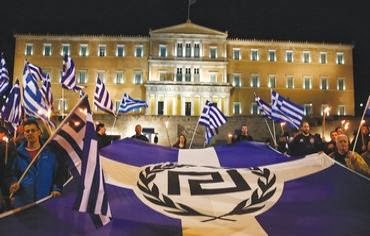
Eggvolk and their party symbol in front of the Hellenic Parliament building

Richard Pine loves Greece, lives in Corfu, and is someone whose friendship is a source of pride. His conversation is sparse, amusing, educated and to the point. This article, one of his regular 'Letters from Greece' to The Irish Times, chills me, piercing through my reflexive optimism about the capacity of Greek democracy and the Greeks to weather this relentless unending crisis. Now the experience of relative tranquillity looks more and more like that eerie peacefulness to be found in the eye of a storm. Comments on his article criticise Richard for lack of balance, for not providing evidence (in a short essay he actually refers to much evidence for his despondency) - but neither do those who comment, failing to offer any robust rebuttal of reflections based on Richard's acute knowledge and direct experience of Greece and its history as well as the sequence of events by which Weimar Germany, one of the most civilised states in Europe, popularly elected the demise of its own democracy…because these things are unthinkable they are not thought about, and for those who do not remember they are unimaginable…

'Many Greeks would prefer stability to democracy'
Under the present regime, the country as a whole is unsustainable


Protesters from the Communist-affiliated trade union PAME shout slogans during a rally yesterday against the government’s plans for cutbacks in medical staff and hospitals in Athens. Photograph: John Kolesidis/Reuters
Protesters from the Communist-affiliated trade union PAME shout slogans during a rally yesterday against the government’s plans for cutbacks in medical staff and hospitals in Athens. Photo John Kolesidis/Reuters
I would not be surprised or even shocked to see tanks rolling into Athens to signal the advent of a military junta. Apprehensive, but not surprised. It will almost certainly not reach that point, but citizen apathy at the poverty of political life, and despair at the continuing economic decline, are setting the scene for a potential takeover by forces including the military, police and far- right political parties such as the fascist Golden Dawn (GD).
A coalition of such forces would offer not only stability – a one-party state or even a no-party state – but no-nonsense determination to deal with the conditions of a country which sees no way forward under present dispensations.
A judicial investigator, attempting to assess the culpability of Golden Dawn MPs in relation to a recent murder and membership of what is in effect an illegal organisation, has stated that the party’s aim is “the dissolution of the democratic system of government”. That system has been abused by successive governments to such an extent that its suspension would be welcome to many disillusioned Greeks.
Meanwhile, the call by the union of reserve military personnel, for abolition of the government, repudiation of the bailout programme, the expulsion of illegal immigrants and the establishment of a government of national unity, chimes chillingly with GD’s policies.
A coup in 1967 led to a military junta for seven years. Greece became a police state. One of its leaders declared categorically, “whoever is interested in human rights in Greece is a communist”. So much for democracy. Its anti-democratic behaviour included disappearances and torturings, as reported in gruesome detail by this newspaper’s Peter Murtagh in his book The Rape of Greece.
But that was several years before Greece joined the EU in 1981. If it happened today, the EU would most likely expel Greece, which would certainly exit the euro zone, a step which would upset few Greeks. The bailout was (as the IMF admits) a mistaken panic measure to save the euro rather than saving Greece. Today, the people among whom I live don’t give a damn about the euro, and they look enviously at the likely end to the Irish bailout.
Today, the passivity of citizens, already exhausted by successive waves of austerity and degradation led by Brussels and Berlin, would reduce the likelihood of any meaningful opposition to military rule. Many Greeks, quite apart from the fascists, would agree that the prospect of stability and a dependable vision of the life to come is more important than democracy, and better than the life they currently lead.
It would, nevertheless, be a police state. It is widely believed that the police have been infiltrated by GD (this is under investigation), thus creating a strong ideology and a threatening presence on the streets. A police state would be Europhobe, xenophobic, and brutally harsh on its opponents.
A government spokesman recently said, “We have used up all the fat in the economy” – referring to Greece’s inability to reduce public finances any further to meet troika demands. With the fat has gone the elasticity and resilience of the man in the street in both financial and intellectual terms.
It is unrealistic and unfair to compare Greek statistics with the EU norm, even with the similar Irish financial mess. Unemployment, the banking crisis, tax evasion and corruption are specifically Greek problems. Under the present regime (or lack of it) the country as a whole is unsustainable – politically, economically, socially, culturally and morally. A hardline government could be achieved by the expulsion of the existing middle-of-the-road cosy coalition of New Democracy and Pasok, the so-called socialists. The chief alternative is a coalition of the left (Syriza), the possibility of which has increased the rightist vote.
Public opinion has moved slightly away from GD. Parliament has voted to remove immunity from nine of its 18 members, and suspend state financial support for GD as a political party. But current opinion polls still place GD with 7% of the national vote, down from 12% at its highest. This would still leave it with three more seats in parliament than it already holds.
And it is not only politicians who are decrying the status of Greece. At a London conference in mid-October speakers referred to the risk Greece runs of becoming “a failed state” unless it addresses “ineffective governance and lack of public confidence”. It was argued that “targeted constitutional correction and an internationally-sponsored programme of economic reform” is the only way to save Greece and the euro zone. Whether an attempted, failed coup would give the government a sufficient wake-up call is unlikely. Greece is a tragedy waiting to happen.
A relief by Aristeidis Metallinos, sculptor of Ano Korakiana

Plato said "One of the penalties for refusing to participate in politics is that you end up being governed by your inferiors" - an elitist observation unless you subtract any implication of class and insert some gauge of the inclination to treat one's fellows with decency; as germane, the words of George Santayana, 'Those who cannot remember the past are condemned to repeat it'
My good wife with paint in Ano Korakiana
…and see the article by Michael Theødosiadis at Eagainst.com 24/10/2013 The Fascist threat beyond Golden Dawn
The Serpent's Greek Lair by Yanis Varoufakis - In this, the fourth article that vitalspace.org and I have contributed to the Witte Centre for Contemporary Art, I offer a short history of the Greek Nazi party...In this piece on Golden Dawn, I begin with an encounter with an old, poor Peloponnesean farmer, some time in the 1990s, whose life revealed much about Greece’s Dark Side...
...The question now is: Why has contemporary Greece seen a Nazi revival? Spaniards, the Irish, the Portuguese, the Italians have also felt the ill-effects of the Eurozone crisis in their bones. But why is it that only in Greece has a Nazi party, Golden Dawn, managed to enter parliament in large numbers, while its storm troopers are terrorizing the streets? Kapnias’ story offers useful clues. It throws light on the significance of the Nazis’ attempts to create a local SS-like body of marginalized men disaffected by the local bourgeoisie, by the Left, and living under a permanent cloud of collective disgrace brought on by a previous national humiliation....
*** ***
On Tuesday Handsworth Helping Hands (HHH) had a good day's work in Wilson Road…


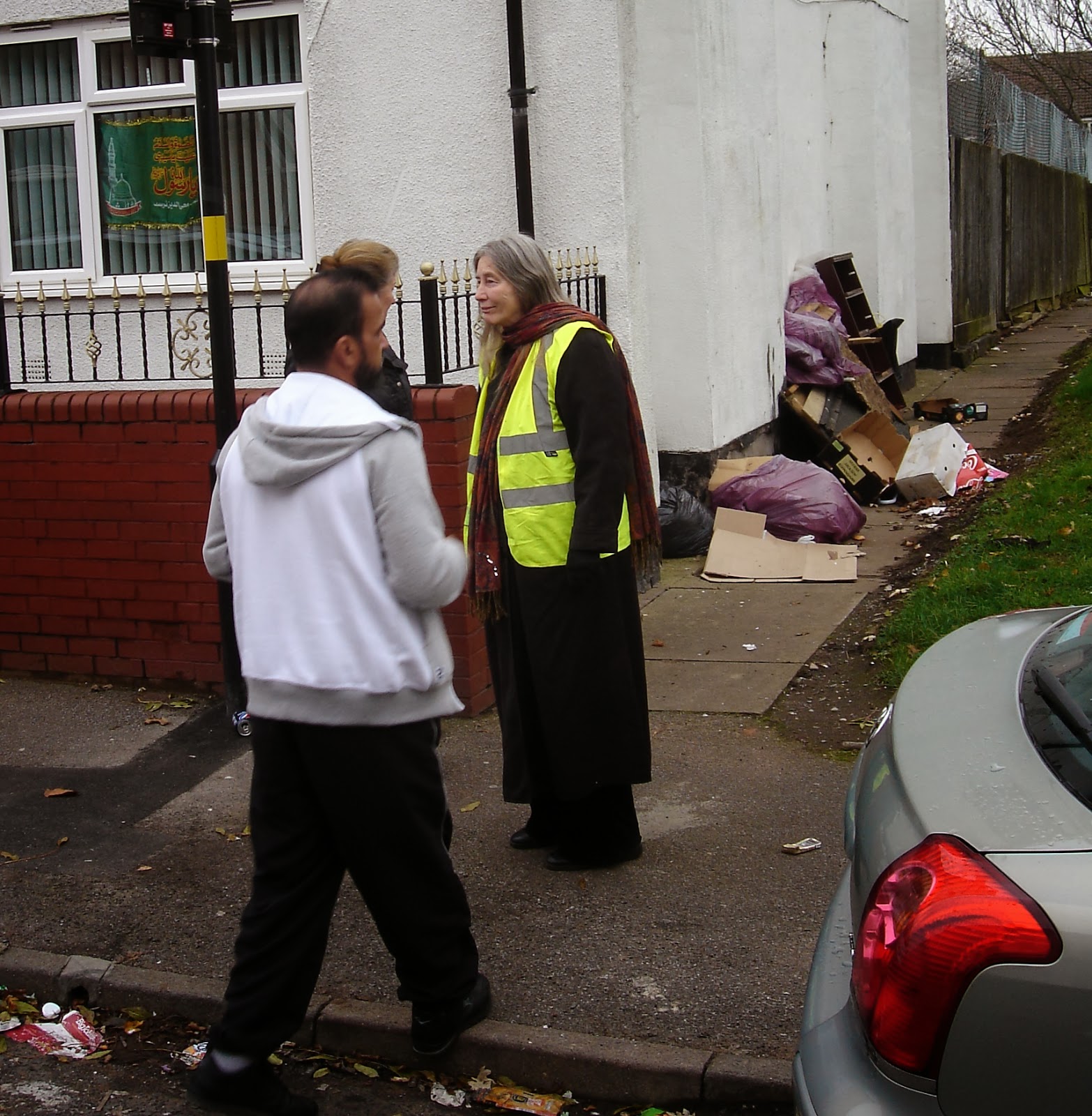
HHH volunteers enjoy a lunch break of local chips discussing progress with Ward Officer Ken Brown visiting to check progress on our skip-it don't tip it day. There are some typical rubbish collection challenges around Wilson Road. 1. A pile of detritus gathering further rubbish in the alley between New Inns Road and Wilson Road that council workers struggle to keep cleared, [Some say we should copy those countries that serve strict penalties on those who litter but it is almost impossible to collect evidence acceptable to the Crown Prosecution Service (CPS). You must catch people in the act. That requires street wardens, police, PCSOs. All in shorter and shorter supply as the government erodes commitment to the public domain in favour of privatisation. On the whole citizens are reluctant to take photos and report (less apathy than an aspect of UK culture I quite like) and the police, unhappy about the paperwork involved, will seldom charge someone with littering in what they already view as a rough part of town with more serious policing priorities. The people who contribute most to this are social casualties - in this case from a local hostel for recovering alcoholics. Would the courts be able to change their habits? It's most intractable. This is why we must labour the links between social cohesion and the environment. This kind of thing makes people dislike, have contempt for, and over time even develop hate for particular categories of vulnerable people who are their neighbours. This constantly renewed heap of rubbish erodes social altruism.]
I feel the animosity I refer to in myself.  I question it and wonder what my mirror says. That term of abuse - 'bleeding heart liberals' - coined in the US, is such a clever turn of phrase. Cruel but so effective in drying up civility towards neighbours and even making some feel guilty for caring for their fellows. I'm not saying this problem is not always with us, nor that more government would solve it. I think some challenges are Sisyphean*. A good citizen acknowledges that and goes on rolling the stone up the hill.

2. A broken notice warning of £20K fines for fly-tipping, 
3. The end terrace fly-tip site where we found a dismantled garden shed stuffed in Solihull Council plastic bags, 
4. A fridge, which should have been disposed of separately, dumped in one of the skips while HHH volunteers were clearing rubbish further up the street, 

5. An HHH volunteer chats with a neighbour feeding pigeons showing them a Birchfield Action Group circular asking people not to do this 'because food on the ground causes more rats'. 
All these issues demonstrate the connection between our environment and local social cohesion.
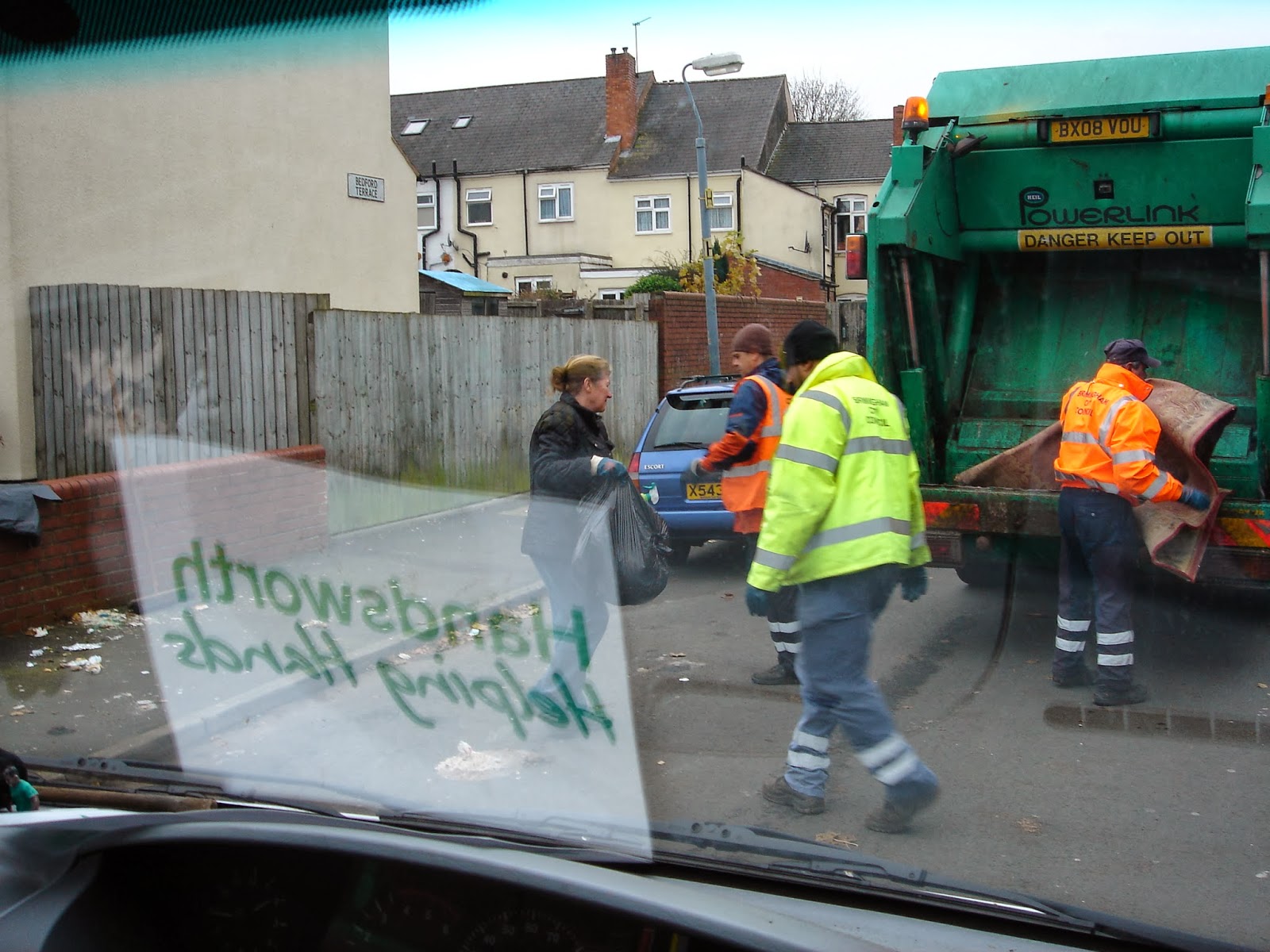
Filling the crusher truck in New Inns Road - HHH working in partnership with Council workers


*** *** ***
On Wednesday afternoon Linda and I were at an awards lunch at Aston Villa Football Ground for people who've given 75 or a 100 blood or platelet donations…
It was enjoyable and I felt proud being officially thanked and having my photo taken and getting an entirely impractical glass trophy.
"You'll fall on that" said Lin "and need a blood donation"
Before lunch we were offered a tour of the Aston Villa stadium, getting a stroll, with spine-tingling sound effects, of coming out of the tunnel to the pitch…
In the tunnel at Aston Villa
After the meal all 175 of us listened as Nadine Simpson, who was to present us with our trophies, spoke, entirely without self-pity, of the pain caused by sickle cell anaemia for which she had been receiving transfusions most of her life. She thanked us all. We applauded and were called up for photos. I found myself next to Adrian who'd remembered me from our 75th donation presentation event at the Hyatt Hotel.
The Gift Relationship

*Sisyphus Σίσυφος was a king in Corinth punished for chronic deceitfulness by being compelled to roll an immense boulder up a hill, only to watch it roll back down, and to repeat this action forever.

Thursday, 19 September 2013

'Austerity takes toll on cradle of democracy'

Richard Pine has circulated his latest 'Greek letter' in The Irish Times but writes:
I have been unable to create a link to my column in yesterday's Irish Times (Wednesday 18 September). I am therefore sending it in the body of this email. The brutal killing (by stabbing) of an anti-Nazi rap artist, Pavlos Fyssas, by a member of Golden Dawn last night has raised the 'hate' and the 'fear' stakes even further. If you do not wish to receive copies of my future columns, please notify me and I will remove your name from the distribution list. Sincerely Richard Pine

'Extremism is fast becoming a political default in this humiliated country' Photo: Yannis Behrakis/Reuters


Given the low opinion held by most citizens of their political leaders, and of international institutions such as the EU and IMF, it’s astonishing that we seem to cling to the concept of democracy – especially in Greece, where the word was invented – to describe government of the people by the people. Today it’s all up for questioning, including the composition of the nation state.
There is a significant gap between our faith in the concept of democracy and our suspicion of the democratic process which produces people we cannot trust. A mismatch between the ideal and the real, including the operation of the civil service, the clientelist system and the passing of parliamentary seats from father to son – or daughter – a not unknown phenomenon in Ireland.
Do we distrust our fellow citizens because we fear that, as soon as elected, they will turn into powermongers, the political equivalent of werewolves or Frankenstein’s monster? In Greece we have a democratically elected parliament and a government appointed under the terms of the constitution, rejected and abhorred by the vast majority of voters.
Pavlos Fyssas Παύλος Φύσσας ~ April 1979 – 18 September 2013
Extremism
Plutocracy, oligarchy, autocracy, monarchy (all words with Greek roots) have their supporters, and even fascism (definitely not of Greek origin) has a hold in modern Greece (as reported in last month’s letter) although, as the third largest political party in the opinion polls, Golden Dawn is still not yet the overwhelming popular choice, but may have a very significant stake in the next parliament, with 14 per cent of the vote in current opinion polls.
But there is another Greek term gathering momentum today: anarchism. Many citizens, disenchanted with the political system which they regard as having failed the state, have turned their backs on politics and, instead, advocate lawlessness and, at its most extreme, tearing down political and social structures by terrorist means. The group Conspiracy of the Cells of Fire (one of the most successful) describes its mission as 'urban guerrilla warfare'.
I am surprised that the Greek indignados (who made such a dignified, peaceful process in Athens’ Constitution Square for many weeks in 2011) have not re-emerged during the latest crisis; some of them are merely disenchanted with all forms of protest, but I expect that many, more aggressive types, are actively pursuing the anarchist option.
At one end of the spectrum is the fascist Golden Dawn, burning synagogues and mosques and beating up migrants and gays; at the other are the various terrorist groups, the latest of which calls itself Untamed Desires, which sounds more like the title of a porno movie than a bunch of arsonists and bombers attacking civil servants, lawmakers and judges.
Richard Pine


Back to the future - 23 Sep'13 Nightmare on Democracy Street by Nick Malkoutzis on Macropolis
***
Just driving dully along I catch people on the beach at Ipsos enjoying their holiday in the sun.

Κι εγώ. In readiness for the wind vane removed from the roof of Brin Croft and due here by carrier at the start of next month, I've attached the iron bracket made for me by Steve Lee to a corner of the house. I bought five 9 inch coach bolts and the largest rawlplugs I could buy; dug out a metre length chunk of wood recovered from the beach and rejected as too good for the firewood in the apothiki, and drilled five holes in it. On a stepladder I offered the beam to the wall and, through the holes in the wood, drilled five marker holes on the mortar, then using my SDS drill followed these with five deeper holes in the stonework of the house. I filled these with a dollop of strong glue and then, with the coach bolts through the beam, and the rawlplugs lightly screwed on the end of each, offered the whole to the wall and tapped it home, until I could place a bottle spanner on each coach bolt and tighten.

I painted the wood, now tight on the wall, to match, and with a spirit-level positioned Steve's bracket, its end just beyond the gutter, pointing as vertical as I could make it. I gave it a couple of coats of rust resistant black gloss before using four four inch coach bolts to fix it firmly ready for the vane. I shall need a compass to find the north, or perhaps use the north star, or the wind vane on the church a few yards down Democracy Street.

Back numbers

Simon Baddeley