Total Pageviews

Showing posts sorted by relevance for query empty quarter. Sort by date Show all posts

Monday, 6 October 2014

A universe of children

(Photo: Lin Baddeley)

Once upon a time in a universe of children, we direct their sagas; stories full of half-human noises – a script of monosyllables, mingled with wailing and laughing. Late evening, the stars at last in their trailers, cossetted, coaxed, fitfully dreaming tomorrow’s lines, the crew eat, drink, talk and play cards, tired from another long day on set.

Another morning. Our stars don’t, like Achilles, sulk in their tents. They rise early to stir their staff, invade their beds, prise open their eyelids. The canteen is fired up. The house creaks. Shooting recommences at dawn. Nappies, potties, bottles, toast and cereal on plastic plates and dishes. Breasts pressed into service; sacred objects clutched. Somewhere in the long morning the scene shifters, grips and gaffers; take a breather, a smoke and a chat about their encounters with particular actors – a mix of bemoaning, boasting and largely unheeded advice. 
“But she’s always sweet with me!”
 “You’re joking. I get it like this every morning” 
“Just don’t let him get away with it.” 
“I don’t but I think he had a bad night” 
“Yes but you’ve got to let them know the limits” 
I’m an assistant, of little importance on set, with fantasies of how I’d direct the situation; a roadie goffer making cheese toasties, tea and coffee for colleagues, washing up, carrying trays, bagging the extra rubbish, wiping surfaces, straining at my traces, longing for my own place in the sun between the shadows cast by this trio of stars. The work is constant, prolonged, detailed and tedious with much standing around, much sentry duty. To get these children from the house into the car takes several hours. There’s the complicated business of assembling clothes, shoes, beachwear, sun cream – factor 50, hats, picnic things. For days until now the weather has been sublime, the far mountains hazed above a gently ruffled sea – scuffed blue velvet. In the foreground, green lemons, green oranges just above the balcony, with wisteria and bougainvillea; with silver and green of olives and cypress stretching to the near horizon. I’m assembling things for others, things that have little to do with me. It’s a lesson in humility; a lesson in what is for me the ill-practised art of caring for others.

I could be off walking, cycling, sailing, reading, even writing. It takes this family, this household – four grown-ups, my wife, my daughter – mother to Oliver in his third year, and Hannah two months – Liz, Amy’s best friend and mother to one year old Sophia, all morning and into the early afternoon, to be ready for “what we’ll do today” – go to the grassy beach at Dassia....
....have a swim in the lovely empty - end of season - pool at Dominoes in Analipsi, 

walk on the cricket ground opposite the Liston...
Oliver, Sophia. Liz and Hannah on the cricket pitch in Corfu
...stroll in the evening by the pebbled shore below Faliraki in the city...
Gazing towards Mother Greece from Faliraki
...find this early October and almost empty beach near Canal D’Amour at Sidari. 


The actual shoot is hardly a quarter of the day. I want to start my story, my once upon a time at dawn and let it run until I sleep, waited on as I wait now, my grandchildren’s sentry. 
(Photo: Lin Baddeley)

Did Hitler ever rise early to make someone’s breakfast? I know Heracles, followed by paparazzi, diverted a river to clear the Augean stables but did he ever just bag domestic rubbish and take it daily to the wheelie bins – unsung – or ever change a nappy? Did Voltaire ever have to oversee the assembling of the shoes needed by four adults and a toddler planning a couple of hours on the beach? 

Robespierre. Did he empty a potty and clean it? "Great Alexander! Hold this baby. Can you calm her as you did Bucephalus?" Shakespeare knew what I’m going on about; knew about mewling and puking. I’d trust him above Rousseau for all his influential theories about raising children.

Monday, 14 July 2008

The family come to the village

On Thursday - in Athens - some of us left the hotel in a small coach with a guide to visit Poseidon’s temple at Sounion on the southernmost tip of the mainland, marking the entry to the Saronic Gulf, with safety for wind blown sailors both north or south of the Cape. I’d read, as a child, how King Aegeus had waited on this headland for his son’s return from challenging the Minotaur in the maze at Knossus. His ship stopped at Naxos where he abandoned Ariadne who'd helped him overcome the Minotaur, then on to neighbouring Delos where, amid celebrations for his victory, Theseus forgot to change his black sail to the prearranged white one to signal his safe return. From beside the temple, I gazed south and thought how, waiting for my son, I might have seen many vessels with white sails heading north and hoped, but then, at about the expected time for the annual return of the tribute vessel from Crete, glimpsed or pretended not to see, slowly rounding a hazy island headland from within the cyclades, a sail of undoubted blackness on course for Athens, and known the boy lost and a sheer drop close to hand. The temple occupies less land than nearby hotels – slender-scaled to the human physique - despite, as Anna, our guide, said, the craft being available to build on the scale of the pyramids. ‘Harmony between man and the earth - the thing we’ve lost … have always been losing and finding again,’ she said. While I toured, Lin read by the hotel pool, later taking the train with Richard and Amy to Monastiriki to stroll the Agora museum while Richard took his camera up to the Acropolis – his first visit. * * * On Friday afternoon we got back from the birthday party in Athens and were in Ano Korakiana – this time with Richard and Amy. Richard, especially, was fidgety “We’re stuck here in the middle of nowhere”. Hurt, I almost but didn’t reply that he’d said that as tho’ it was something bad. Later in the day Lin drove us by flowering oleander to our pebbly beach inside Cape Kephalopsos – entered via a small track through the growing rubble at the south edge of Ipsos harbour. In no time Richard was off to hire a scooter. Amy and I swam leisurely in the warm sea while Lin read in the shade of the myrtle, wavelets slapping the shore by her toes in this blighted Eden. Before she and Amy had arrived I’d filled a bin bag with rubbish washed up on our tiny strand alone, while reverberating across the grand vista stretching between the Albanian shore, Epirus’ haze and the villa'd slopes of Pantokrator the engine noise of cars, motor boats and aircraft. The serenity of this place, before we learned the art of capturing energy from exploding oil, can still be glimpsed at sunrise in winter. Slower economies make the poor picturesque, donkey-born poverty invisible. The sail strewn past is history. And still my jaded metropolitan eye notes the travel pimps' descriptions ‘unspoilt’ (over 2000000 hits on Google!) above italicised details on ‘how to get there’. Always, said JH, to avoid disappointment, go and live somewhere ‘already ruined’. In 1993, the year before he died, Jack wrote, for our reading: ‘Love of the Country - Ode to a book I never wrote’:
Did they think about the skylarks when they built Mayfair on the grazings that ran down to the Shepherd’s Market? Did they worry about the snipe when they drained the marshes behind St.James’s Palace to build Belgravia? Where did the kite go when they dug the London sewers? Do the piles they drove down through the beaver’s dam hold firm the supermarket in Newbury High Street? Who cooked the big trout that lay under the village bridge at Wandsworth? Who feasted on the last salmon that was netted at Tower Hamlets? Now they come to put central heating in the ploughman’s hovel. They claim the sun that used to bake the hay. And breathe the breeze in which the pointing dog caught a hundred scents. They walk out in trainers and T-shirts that say “Save the Rain Forest”. “Stand back!” they say. “We have a right to walk where we please!” But we look where they trod before and shudder for what follows in their footsteps. I said I must write a warning. But I was angry and - as the Japanese say - to be angry is only to make yourself ridiculous. So we will live out our days in the cracks between the concrete. And then they will pour cement on top of us.
I note the reproach, knowing ‘us’ excluded no-one. J wanted to write, I think, a final book about how to live without vexed dissimulation, arrogance or isolation. One element was a modern transhumance – the old pastoral seasonal journeys aimed at getting the best for their stock from different but familiar places, observing the migratory cues of flocks and herds. This included mental travel, moving at mind-speed across the patchwork eiderdown of his learning about the past and curiosity about the future. I wonder if J read The Songlines. It was published in 1987, hardly a year before Bruce Chatwin died in January 1989, when Chatwin must have known his future. I read it just now, after my short adventure in Australia. Chatwin wanted to learn ‘not from other men’s books, what a songline was – and how it worked’. His exploration, guided by a selection of unique and richly self-educated people, is deep referenced to insights from earlier travels…‘the more I read, the more convinced I became that nomads had been the crankhandle of history…’ (p.19). Chatwin followed my reading of a concise history of Australia, in particular a chapter about the catastrophic two century encounter of European and pre-neolithic peoples in Australia. History, to quote Durrell (in Prospero’s Cell 1945) ‘with her painful and unexpected changes cannot be made to pity or remember: that is our function’. This function Chatwin fulfils with engaging wit, finding just the tone for the mess strewn across the commonwealth by that collision – not ‘the fatal shore’, no ‘black armbands’, even an open-eyed optimism (given Chatwin’s closeness to death). Of another group of destitute outcasts in the Saharan Empty Quarter - the Nemadi - Chatwin told his chief Australian guide, Arkady Volchok (I don’t want to know where he is now, or not at once) a story of a greeting, ‘a few warbled notes’ and a three minute smile - over a chasm of separate experiences - from a woman of ‘more than a hundred’ called Lemina. That smile, C told A, was something he lived with:
‘...like a message from the Golden Age. It had taught me to reject out of hand all arguments for the nastiness of human nature. The idea of returning to an ‘original simplicity’ was not naïve or unscientific or out of touch with reality. “Renunciation”, I said, “even at this late date, can work.” “I’d agree with that,” said A. “The world, if it has a future, has an ascetic future.”’ (p.133)
* * * On Thursday evening the family and friends sat in a restaurant in Kifissia overlooking the vastly scattered lights of greater Athens. A breeze blew across Attica, ruffling hair – almost cool. My sister-in-law Kate was enjoying a barney across the white table cloth, beneath plentiful food, water, wine and Diet Pepsi, about the virtues of a hybrid car – she and G having bought one - the boon of supermarkets, railing at sentimentalist dreams among the prosperous about the mulish drudge of local shopping for sweated food, while arguing for global unions to regulate food prices. I’d started the evening by saying, jokingly, “hurray, we can talk about allotments”, a matter on which my assumptions are muddied, especially amid the joy of family table talk. I faltered and Lin entered the debate. Later I smiled quits to Kate as we headed back to our hotel. “Did you respect the way I deployed my relentless logic to demolish your case?”. “Yeah yeah. I love a good debate” she smiled her quits. * * * R, me, Lin and A went out for supper in Ipsos at the Bonita. Lots of scooters, strollers and boom boys passing pell mell – though word is that Ipsos is ‘dead’, lacking the spending numbers it needs to thrive. A & R stayed on to seek a nightclub, finding one place with the critical mass to make an evening. Lin and I were home by 11.00 and found the neighbour’s family and friends spread across the steps outside their house celebrating young Leftheri’s 7th birthday. Wending our way through the path to 208 we were beckoned to their table; served meat and cakes and wine from grandpa L’s garden. Young L’s sister, Dimitra and her friend Maria, - about 11 and 12 I think - spoke lots of English, taught by Katya S, wife of Thanassis. We shared favourites: school subjects, composers, musical instruments, football teams (we weren’t much good there. “Football – then katalaveno!” we grinned sheepishly), while everyone chatted to and fro and young L’s friends played in the alley and spilled onto Democracy Street, to be called back into the light around their table. * * * On out first evening back in the village – Friday late – we strolled, my family, up the gentle slope beyond the bandstand and towards the narrowing street that goes through little Venice. Some dogs barked, others sought stroking. A hedgehog scampered across our path. Another played dead to avoid confronting two waiting kittens. Cats chased grasshoppers skipping between light and shadow. We saw glow worms in the verges; a large cricket sat squat on a wall where Democracy Street narrowed; geckos hugged warm lintels scuttling away if any of us approached. Richard found a shed snake skin in a wall drain; hefted it gently out with Mark’s gift stick. In the house we saw and left cobwebs - a wasp trussed and husked in one. Later in Corfu in the afternoon we saw lizards, irridescent beetles, a cicada, a hornet, fishermen watching another preparing a fish he’d caught and in our garden the shed husk of a grasshopper.

Friday, 10 August 2012

Out of Town

'Here, long after I'd left home, is my stepfather on set, relaxed in the 'shed' he invented for the programme, a yoke of studio lights reflected in his glasses...
Jack Hargreaves ~ Out of Town 
...Growing up with Jack I spent a lot of the time we weren't out of doors, in a shed - watching him, sometimes helping him, always listening. It was a comfortable space suffused with the aroma of Gallaghers Honeydew and a bench rather than a desk next to tool racks and an accumulating plethora of useful odds and ends that would have cluttered a studio.'
I've just prepared this paragraph as a comment on a Southern Television studio photo in family files taken, I suspect, in 1980 when Jack must have been touching 70, about to leave the company, knowing it was almost certain to lose its franchise in the latest round of ITV bidding. I'm working with Ian Gilcrist at Delta who are preparing some images and texts to go with their release of 34 original Out of Town broadcasts.
These are as far as we know the only complete episodes of Jack's Out of Town programme that survive. The set that Charles Webster of Delta, who I've been working with over the last three years, plans to release later in the year. His 'box' will include an account from me of the search for this material and one from Simon Winter of Kaleidoscope of the extraordinary mix of luck and wisdom that unearthed them, with a short accompanying website, in which my stepfather's portrait will feature.
1951 ~ Gallagher's Golden Honeydew
I probably know as well as anyone how accurately Out of Town transferred my childhood to the tele’. In that posed studio photo he sits at a desk with the Falcon pipe he’d draw on through count-down - a concession to indoor smoking that even as early as 1980 had to be negotiated. He’d rest the pipe gently on the desk as he went on air, relighting it with the credits.  There was in the end surprisingly little difference between Jack’s carefully devised set and the shed next to our house; little difference between Jack Hargreaves as a natural on TV and Jack in a real shed being a dad to die for. He chatted as he worked. I was endlessly entertained, understanding, years later, why he sub-titled his book - Out of Town - ‘a life relived on television’. I'm sure that was because of, rather than despite, the artifice. Never am I so reminded of the fancy that we invent our lives, or at least our biographies.
*** ***
I don't wish recession on anyone but this is nectar:
ATHENS, Aug 8 (Reuters) - Greece's dire economic plight has forced thousands of businesses to close, thrown one in five out of work and eroded the living standards of millions. But for bicycle-maker Giorgos Vogiatzis, it's not all bad news. The crisis has put cash-strapped Greeks on their bikes - once snubbed as a sign of poverty or just plain risky - and Greek manufacturers are shifting into fast gear. The high cost of road tax, fuel and repairs is forcing Greeks to ditch their cars in huge numbers. According to the government's statistics office, the number of cars on Greek roads declined by more than 40 percent in each of the last two years. Meanwhile, more than 200,000 bikes were sold in 2011, up about a quarter from the previous year. Shops selling bicycles, and equipment ranging from helmets to knee pads, are spreading fast across the capital, popping up even between souvenir shops on the cobbled pedestrian streets of the touristy Plaka district. "They're sprouting up like mushrooms," said Vogiatzis, who designs and builds tailor-made bicycles in his workshop on the Aegean island of Rhodes....

*** *** ***
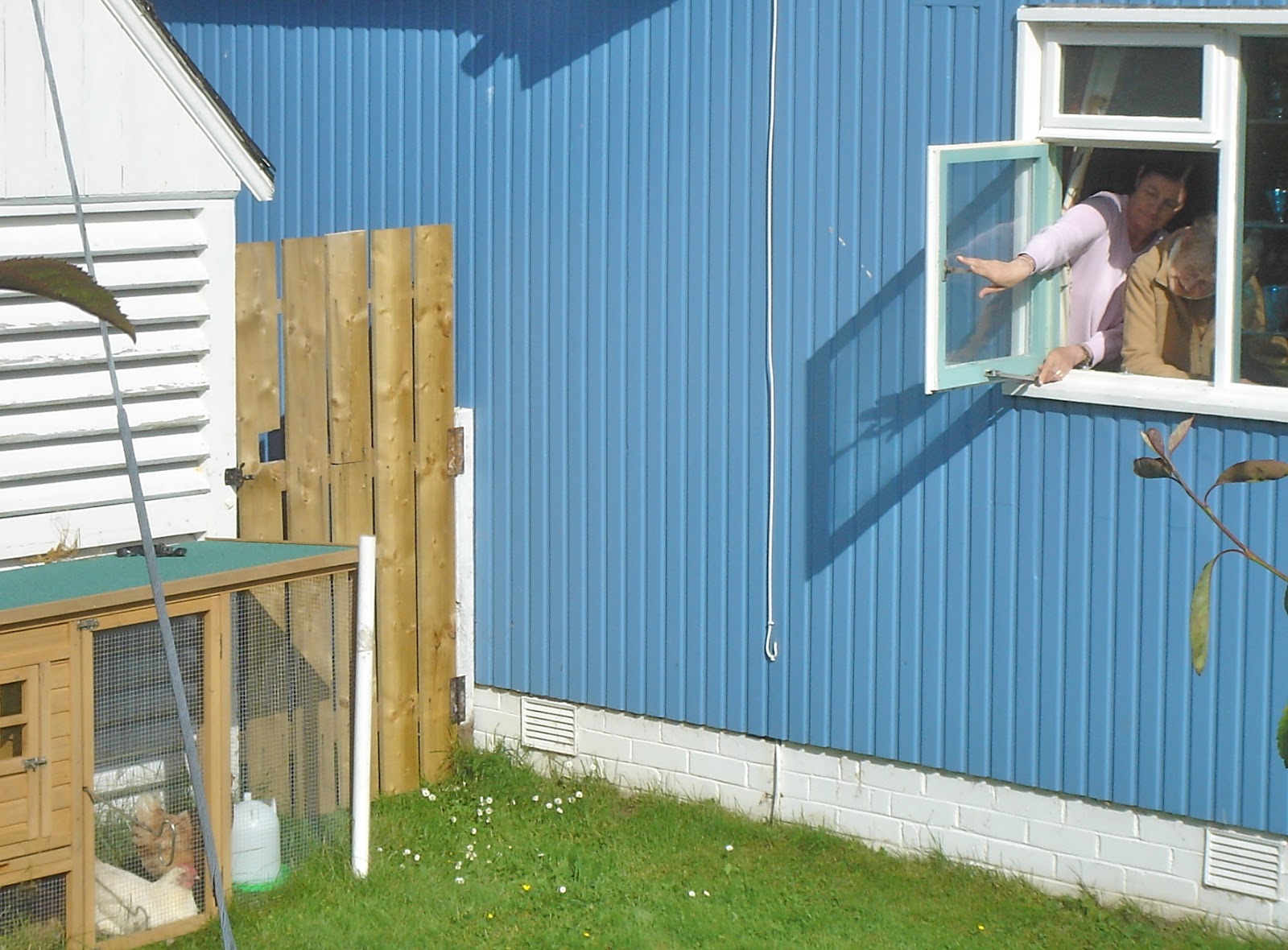
To my delight the chickens have arrived. Four healthy looking two year old hens. Two Suffolk Lights and two Rhode Island Reds. They were delivered to their run and coop on one side of Brin Croft at 7.45 Wednesday morning...

...kept in there for 24 hours. Friday afternoon three are out on the grass basking in  unaccustomed sun, wings outstretched, and Blanche seems to be broody in the laying box. "I doubt we'll have any eggs for a while. They need to settle in" said my mother, who sees them first on my computer...
...and names them, Blanche, Edith, Rhoda and Gladys - Edith the Suffolk with black speckles on her cape, and Rhoda, the Rhode Island with darker feathers on her back. I bought back a large bag of laying pellets and a water feeder from Harbros on Harbour Road in Inverness.The doctor and nurses have been dropping in, courtesy of the NHS to check on Mum who's not feeling so good. The arrival of hens and relatives cheering her up a little. Her grandson, my sister Bay's son, Antony, has taken a house in Tomatin for a week and is there with that side of the family. I've been ferrying Bay over the 14 miles to Inverarnie to check on our mum and confer with Sharon, her wonderful carer, and calm collected Doctor Sweeney who's mother's also in her 90s. Bay got our mother to a window to have a first gaze at her new chckens...
...and  my great niece came round with her mum keen to try feeding them...
Sydney with her grandma and the chickens
** ** ** **
I've been taking walks in jocund grazings playground for hundreds of small butterflies - Scotch Argus - myriad small insects, bees large and small, tiny moths fluttering between storks amid the rich greenery along the silvery Farnack...
The Farnack
...heading above this pleasant Highland bocage, on above the forestry line to scan the Strath in all its beauty - a panorama on these clear days to Ben Wyvis in Easter Ross beyond the Moray Firth winding away to Cromarty until it disappears beyond my middle ground, eastern slopes of serried pine, leading south to my point of reference - Brin Rock.


Time travel, like riding a bicycle the first time or skipping, is a mix of chance and craft. My daily biography runs to random slides amid the sounds of the moment; no track for smell. Dipping my nose into a flower, a patch of greenest sphagnum, rotting leaves, an errant pine branch, a handful of long wet grass to hold a living fish going back where it came, broken earth; I flick through a worm hole - momentarily effulgent with joy; sometimes its opposite stench, equally evocative. Possession is immeasurably brief, far outside conscious attention, an elusive sense animating the images and sounds, even the tastes, of lost times - του χαμένου χρόνου. How we mock noses, the part that resists all but teasing poetry. Yet the terriers, all dogs, share an environment of smells and taste. With their wet noses and little lolling tongues they survey and map the walks we take.

*** *** ***
À la recherche ... in Ano Korakiana
A swimming expedition of Korakianers to Dassia - before the they built the big road along the shore

"Η μυρωδιά της τηγανητής μελιτζάνας και πιπεριάς καθώς και η φρέσκια σάλτσα ντομάτας μου θυμίζουν έντονα τα καλοκαιρινά μας μπάνια όταν ήμασταν παιδιά! Από τα χαράματα με ξύπναγαν οι μυρωδιές που προανέφερα. Ήταν η μέρα που θα οδεύαμε προς Δασιά μεριά. Αρκετή η απόσταση όταν την κάνεις πεζή. Όσοι είχαν γαϊδουράκι ήταν τυχεροί. Εμείς δεν είχαμε! Ξεκίναγε η συντροφιά με τα φαγώσιμα κρεμασμένα στα ''σκαρβέκια ''του γαϊδάρου...
The smell of fried aubergines and peppers as well as the smell of fresh tomato sauce reminds me intensely of our summer bathing when we were children. These smells awoke us from daybreak. It was the day we were going to travel to the seashore at Dasia - a considerable distance on foot. Those who had a donkey were lucky. We didn't. Our group set off with the picnic food hanging from the wooden parts - σκαρβέκια - of the Jenny's saddle..."
*** ***
I thought this interesting - from John and Alistair cycling across Canada right now. Looking at what makes a community work -
John and Alistair in Tatamagouche
Sustainability and the Entrepreneurial Spirit: It is the most obvious thing that is missing in communities that are stagnant or in decline. In these places no one is able to refer to any one individual or a group of passionate and committed citizens who are taking action....Business entrepreneurs are the cornerstone of successful small communities. It may not take many, just a handful working on their own business. Together they recognise the efforts of others who also take this risk and they form an important cohort in the community around which others will follow to build a sense of place...
...and another cycle odyssey with a purpose - described in The Carbon Cycle. In 2006 Kate Rawles cycled 4500 miles from Texas to Alaska, following the spine of the Rocky Mountains conversing with people she met about climate change – from truck drivers to the Mayor of Albuquerque – to find out what they knew about it, whether they cared, and if they did, what they thought they could do. I've bought the book...and extract from Kate's blog. I like the fine grain, the small things, the ubiquity of unique individuals, talents I'll never encounter, the amount I miss in the wider world:
25th june '06...wonderful couple of days. great evening at neighbours' yesterday. when we arrived at john and anne's, just us and them. i was imagining a sit-down formal dinner. then another couple arrived, then a car-load, then another. cars kept arriving. soon the house was full of three generations, wandering inside and out, drinking beers, cokes and margheritas. i spoke with a geologist specialising in hazardous waste retraining as a nurse specialising in anaesthesia. (an anaesthetist with a geological time-frame, what a thought! let me put you to sleep for a hundred thousand years....).   his view on global warming was a) climates have always been in flux and this is just another flux and b) in any case talking about global warming isn't a good way to get people to act differently. it's too big and distant. focussing on the geo-political situation and the desirability of energy independance would be much more effective. i spoke with a solar astrophysicist who'd been studying the sun's output since 1970. we can't blame the sun's output for global warming anymore, he said. it's now certain that the output has been constant for the last 30 odd years. and yes, i certainly believe global warming is happening. i spoke with anne who showed me her little black and white cat panda's two kittens and told me a bear had eaten all their chickens bar one last night - and had a go at the hummingbird feeder. (bears? already? goodness!). best of all i spoke with heidi. small and slender, skin tight jeans, beautiful boots, pink and white shirt and white cowboy hat over a long pale plait, large blue eyes with a calm, grounded sort of look. heidi has a very large ranch in utah. in the summer she rides the ranch checking on cattle and fences, sleeping out for five or six nights at a time and then coming back for an occasional bath before setting out again. a real cowgirl (cowperson?!) - and a grandma! what an inspiration. (being a cowgirl is a long-standing fantasy of mine, tho its never sat entirely easily with being a vegetarian). we talked about arabs versus quarter horses (she uses quarter horses), how travelling in an rv cuts you off from so much of what you are travelling through, and how useful dogs are. "they make for lazy cowboys but take the pressure off the horses. they're about 5% useful: most of the time the cattle are chasing the dogs rather than the other way around." tom and rosalind told me later how heidi on form was an extraordinary dancer, known, amongst other things, for tap-dancing on tables and throwing truly wild parties which people would cross states to get to. and she invited me to come and visit! oh my. somehow i must find a way to make that happen.
****** ** ******
I've only just read Richard Pine's latest Letter from Greece in the Irish Times of 3 August 'Living with bribery and tax evasion as normal as the azure sky'...
I plead guilty. Last month I colluded in tax evasion and paid a bribe. I was buying stationery costing €105. The shopkeeper asked if I wanted a receipt. No thanks. “Then that will be €90 – cash, of course.” Of course. I saved €15 and he avoided paying VAT. Collusion. Everyone does it...Meanwhile, the coalition government in place since late June appears to be doing nothing except mouthing empty rhetoric about the need for reform and renegotiation of the bailout. There are reportedly 110 bailout conditions on which no progress has been made, thus imperilling payment of the next tranche of the loan. Government prevarication has registered with the voters: a recent opinion poll indicated that 50 per cent of voters are dissatisfied with the inaction of people who have the power – but not the motivation – to effect change. This is the same percentage that voted for the anti-austerity, anti-bailout parties on June 17th. A house divided, indeed. A visitor, looking at an aquamarine sky, asked: “Where else would you see a sky like that?” To which the answer is: Portugal, Spain, Italy – all the “bad boys” of southern Europe. It isn’t simply a matter of doing business in these countries in a quite different way to those of the north, but a cultural difference. A country in which clingfilm is called “diaphanous membrane”, and where boys are still named Aristotle, Hercules and Perikles, and girls Aphrodite, Urania (sky) and Agape (love), isn’t quite the same as one in which children are called Nigel and Ingrid, and where clingfilm is, well, clingfilm.
The other evening I asked my nephew, who's senior enough in knowledge of economics and finance, to have an opinion I value, about Greece
"You know how I feel. What of the future?"
"Greece will leave - will have to leave the Euro" he said very quietly; a little reluctantly.
"And Spain, and Italy and Portugal and...?" I asked amid a crowd of chatting relatives in my mother's sitting room. He looked at me eyebrows raised knowing I was seeking reassurance.
"Well?"
"They'll pull through"
Olympic debt race - Sophia Mamalinga 2 Aug'12

"What's the difference?" He shrugged and made a small spread of his arms. It was like pulling small teeth.
"Is it corruption?"
"Hm"
"Why Greece? Why not the others? You know how bad things are in Athens" I ran through my present list of harm and spreading misery.
"There's no capital left" He paused and looked away then back at me "Nothing there" Another pause "A dreadful mess."
He wanted to talk and think about something else. I didn't pursue, just felt a small ache in the pit of my stomach. (Telegraph 7 Aug'12: Greek exit from euro is 'manageable’ says Jean-Claude Juncker)
The family came to say 'Goodbye"

Friday, 21 June 2013

Tidying and clearing the house in the Highlands

Tidying Brin Croft

I would, while she was alive, think of how it would be, sleeping and eating in her empty home, going through her things, sorting, allocating, disposing. I knew the day would one day come when she would be gone, Indeed it was an ever present understanding, once I was a grown-up, that intensified the joy of all the days we were together. Lin and I have spent nine days in Brin Croft, sprucing up the house, inside and out, deciding a ranking of the many things that must go - some, depending on what they offer, to antique dealers, some to auction, some to be sold on ebay or Gumtree, some to the family, some to charities, some, that can't be sold or donated, to house clearance. I've had a word with Sandy, the regular postie, who'll halt the flow of catalogues mum used for her bedside shopping. I've taken sacks of junk mail to be recycled in the bins by Inverarnie Stores. As I heaved handfuls of unread glossy catalogues into the recycling bin by the shop, I spied a slip of paper with typical scribbles in mum's hand...
'On the divan are piled (at night her bed) stockings, slippers, camisoles, and stays…'

I didn't throw it out thinking of the only context I've come across the word 'carbuncular', known those resonant lines since I was taught about them at school. I recognise Watson and the Gaelic place names reference, but what's that 'Sister Theresa' and 'Hullo Hullo Hullo'? How mum shrank from 'apathy'. The Wiesel quote in Against Silence 'The opposite of love is not hate, it's indifference...' She and Jack, between them, taught me, entirely indirectly and by example, that being 'bored' is nearly a crime, something to be scorned.
The house will be cleared, but for a few things left on the estate agent's advice - "so the house is not entirely empty" - in mid-July. All valuable items removed, we've reduced the contents insurance; given the place a short back and sides - washing, scrubbing, vacuuming, dusting, weeding, pruning; taken photos for the agent's website, lined up auctioneers, dealers and other potential buyers; made dates for van hire and moving; kept detailed lists of everything...demonstrated some of mum's disability gear...

Apart from those the family wanted, we've sold or given away what remains of mum's books - a good number bought by Leakey's in Inverness and Logie Steading Bookshop in Forres - both places where mum was a customer. Roger from Auldearn Antiques, often visited by mum...

...came to Brin Croft and made offers for us to review and compare with other valuations.

The house goes on sale in mid-July


I've got to find someone who'll climb the roof to recover the wind vane I've known for sixty years. It's followed mum around since it was first designed by my stepfather, put together by our blacksmith, showing a lurcher, whose name I've forgotten, and a Jack Russell called Sukie.

I've had times to go walking with Oscar, following familiar paths through the woods that march along the edge of Strathnairn along the Farnack...


Brin Rock

Brin Croft from the south
*** *** ***
For two days of our time at Brin Croft the once winding narrow road with passing places - the B851 that runs two and a half miles to a T-junction with the busy A9 to Inverness, was closed for the completion of 'improvement' works - in this case at the bridge over the river Nairn near Mid-Lairgs. To transport the big turbines for Dunmaglass Windfarm, just beyond Croachy, to be sited four miles down the strath from Inverarnie, the only route there has to be widened.
1. Littlemill Bridge
RES aims to commence construction work for the new bridge at Littlemill in early 2013 to replace the existing double arched stone bridge with a new, wider clear-span bridge. This bridge will require minor re-routing of the B851 to link in with the new bridge and provide approaching traffic with a clear view.
The new bridge works will take approximately six months to complete. No road closures are anticipated. However, temporary traffic lights and speed restrictions will be used for a limited time when the bridge is connected to the existing road network. There will be a brief interruption to broadband and phone services over one night. Residents likely to be affected will be given advance notice.
2. Inverarnie Bends
RES will be widening a 400 metre stretch of single track road near Tombreck to create a twin track carriageway. The works will include replacement of an existing culvert and diversion of existing BT cables, which will cause minor disruption to broadband and phone services over one day. Residents likely to be affected will be given advance notice. The road widening scheme requires the section of road to be closed to traffic. Diversions will be put in place for general road users but local properties will continue to have access. The works are likely to take two months to complete. Temporary traffic lights and speed restrictions will be used for the duration of the road improvement programme to minimise the road closure period and to protect the workforce and the public.
3& 4 Croachy North and Croachy South
Works at Croachy North will extend the twin track carriageway from its current extent near Brinmore School Bridge for more than one kilometre to the entrance to Croachy village. At Croachy South an upgrade of the B851 from single track to twin track will be undertaken on a short stretch of road between Blarachar Bridge and the existing twin track carriageway near the Aberarder Estate.
The improvements will include diverting existing BT cables and water mains to allow construction to begin, extending the road and embankment and creating new drainage. Residents will be given advance notice of minor disruption to water, broadband and phone services. Interruption to each utility should last no longer than one day. RES will work with The Highland Council to maintain access to fields and properties for adjacent landowners affected by these road improvements....

I approve renewable energy but this scheme deprives the route down the strath of a marker, the old humped bridge with traffic lights that pinched the road to Tombreck; always noted near the end of a long journey. It's gone; sidelined to a farm road and footpath beside a steel fendered clearway for the necessary trucks, incentive for speeding motorists. The building of a new parapet of 'old' stone where the river runs under the flattened crossing is an unconsoling excuse. Seeing the wide straight tarmac that's replaced the familiar delay I felt almost relieved to be ending my connections here.  I remembered something my stepfather had written a year before his death...lines from an ode to a book he never wrote...
...I said I must write a warning. But I was angry and - as the
Japanese say - to be angry is only to make yourself ridiculous.
So we will live out our days in the cracks between the
concrete. And then they will pour cement on top of us.
Road 'improvement' at Littlemill in Strathnairn
*** *** ***
Jan comments on our letter to Highland Council:
Subject: Some thoughts
Date: 18 June 2013

Simon. I have read with a mixture of bemusement and despair your experience with the Highland Council. It is beyond me how councils get themselves into this mind set but I suspect it is an accumulation  of trying to cover every eventuality and solve ‘problems’ by drawing up more and more elaborate rules and regulations and double/triple checks on everything, combined with a dilution in decision making and a defensive mind-set. Instead a system of delegated decision-making based on some simple but effective principles and procedures would improve the situation. We had a similar experience when we cleared out my mother-law’s council flat in Middlesbrough. The person on the phone informed us they could only deal with the tenant. As she was dead this was rather difficult and we had a bizarre ‘Pythonesque’ dialogue for over 20 mins, reminding me of the dead parrot joke, before it was resolved by us informing them that we were just leaving the keys in the door and driving away. This, not surprisingly, jolted them into action. There are times when it is difficult to defend councils.
On a more positive note it is pleasing to see that some councils are now trying to co-ordinate their actions in respect of all the welfare changes. Manchester City Council is taking a lead on this. I think developments in and around the Greater Manchester area are worth a bit of study. They offer some models of ‘recalibration’ with government, albeit on the latter’s terms, but it think they have been rather astute at exploiting what is on offer whilst also being robust in defence of their own communities.
Did you see the letter in the Observer from a large number of Council Leaders across the country pleading with the government not to be too harsh in the next spending review. I think this will fall on deaf ears and is a lost cause but it was interesting to read that they all now claim to be in or close to ‘insolvency’ in terms of not being able to fund their core statutory responsibilities. I believe most councils are beyond that ‘tipping’ point already. I think district councils in particular are very vulnerable to becoming ‘redundant.’ What was depressing was the tone and focus of the letter. It read like a drowning person without a lifejacket  crying for help and rescue to an imaginary rescuer on the beach (The Child believes the Parent will come to its rescue but the Parent believes the Child has to either sink or swim and this will make it stronger). 
It is frustrating that there is a lack of real meaningful strategy and narrative being developed by councils themselves other than the now rather old ‘innovation and transformation’ mantra, or a straight forward ‘help us’ message to government. As I have said before I think councils are hoist by their own success. They are by far the most competent and best performing sector across the whole public sector and this combination of Competence and Compliance is being ruthlessly exploited by Government and we’ll see this even more clearly in the next spending review. The most acute part of this is Adult Social Care, where numerous hospital, care homes, domiciliary reports, not to say scandals, point to a collapsing service for a very large proportion of elderly people. We are talking about basics such as not feeding and watering people, leaving people unattended and worst of all treating vulnerable people with contempt. Yes I know that there are examples of good service and committed people but when according to published figures between a quarter and a third of older people receive sub-standard services, then we have a national scandal which nobody is getting a real grip on other than by voicing rhetoric and platitudes; very depressing. Sadly, it can only get worse, especially for the most vulnerable. If you are old, ill and poor, then your end of life is likely to be a very distressing experience indeed.
There are no quick fixes but anybody who says “throwing money at the problem is not the solution” is either a fool or incompetent (or worse, driven by politically motivated ideologies). The key to it is to throw the money at the right things at the right time, but I can think of numerous examples where this approach has worked very well and often paradoxically (but not surprisingly) been more cost effective in the long run. 
It is disappointing that the various organisations representing LAs and its various professions have not developed more robust strategies and alternative narratives around such an approach although in fairness I see the occasional ‘green shoot’. The dialogue is dominated by Government around ‘cutting bureaucracy’, ‘efficiency’, ‘being creative’ etc.; in themselves OK, but in an ideological context, merely a smoke screen and hardly a substitute for proper strategies and investments. It is strange (or perhaps not) that concepts the government is keen to apply elsewhere (as long it’s not public investments) hardly feature in this debate, where it is absolutely vital. 
We can see the way the Welfare State is being phased out. The first stage is being completed; the removal of all universal benefits and services. This is being replaced by discretionary services across the board. The big prize here is the State Pension. We are being ‘softened up’ for its replacement by a means-tested state pension after the next election. The final stage is the emergence of a new form of ‘poor law’ heavily dependent on ‘voluntary’ contributions. Just look at Food Banks and Wonga Loans to see a glimpse of the future. Zero hours employment contracts are also a pointer to the future allowing government to claim employment is rising; but income is actually falling (15% since 2008) and growth stagnant. There is psychology at play here. Actively manage people’s expectations downwards. The new feudal elite (neo-feudalism) will use certain localities, mainly the financial centres of the world, as their docking stations; their connection to any locality merely guided by investment potential eagerly sought by Local Enterprise Boards, probably adopting a race to the bottom approach (e.g. as in Ireland). I am trying to put this and much of our previous correspondence into the context of Localism and the managerial-political arena, but I can’t get it to gel yet. Best, Jan. 
***********
Until just after Easter - the Orthodox that, this year, wasn't until the start of May - a collection of potholes on the country road between Ipsos, Ag.Markos and Ano Korakiana, endangered cyclists and people on motorbikes, and did little for any vehicle's suspension. Linda, adept at driving around them even at night, took pictures and showed them to a friend at Sally's Bar, her son Rob Groove. He's half in love with inventing impossible images.
"Rob! Can you make it look as if I'm stuck in one of those big pot holes?"
"No problem. Take a pictures for me of you looking as if you're holding on to the edge of one"
The Demos had sent a crew round and filled all the holes by the second week of May but Rob has just sent me a clever image.
Στο δρόμο προς την Αγίου Μάρκου - eίναι το ποδήλατο μου, ανησυχώ για!

*** ***
And in The Irish Times, Richard Pine writes from Corfu on the closure and reopening of Greece's public TV and radio:

Dispute over Greek broadcaster illustrates how essential public broadcasting is

Protesters demonstrate outside Greek state television ERT headquarters in Athens last week. Prime minister Antonis Samaras was forced to climb down over his decision to close the state broadcaster. Photograph: Reuters 
Imagine waking one morning to find that RTÉ radio and television services had been taken off the air by an overnight government decree. Many, it is true, might say “good riddance”, while others would scarcely notice. But the social and political repercussions of such a decree would be far-reaching. That is precisely what happened in Greece last week when ERT (the Greek equivalent of RTÉ) was suspended by a ministerial ruling of New Democracy prime ministerAntonis Samaras without reference to his junior coalition partners Pasok and Democratic Left. Samaras claimed that ERT was responsible for “incredible waste” and suffered from a “unique lack of transparency”. 
In the face of huge international criticism and opposition from his partners in government which might have broken the coalition and provoked a general election, the prime minister was forced into a climbdown, while Greece’s supreme court declared his actions beyond his power. ERT is now back on the air.
The episode is crucial to Greek society because it calls into question whether the country actually wants public service broadcasting.
Even more importantly, perhaps, it highlights the government’s announcement that ERT would be replaced within three months by a new organisation, “a state company owned by the public sector and regulated by the state”
“Regulated by the state” should alert all proponents of public service broadcasting to the dangers of too close an association between a public broadcaster and a government. It was Seán Lemass, as taoiseach, presiding over the formation of RTÉ in the 1960s, who saw the station as merely “an arm of government”.
Conversely, the European Commission, which denied it had any part in the Greek decision, has supported the role of public service broadcasting as “an integral part of European democracy”. 
National airlines in recent decades have largely succumbed to market forces, but public service broadcasting is a different kind of entity: the need for public channels which are not profit-motivated, which are supported by the state but not subject to government interference, is generally accepted as a necessary means of ensuring that information, as well as entertainment, is available free of market forces.
It also provides a common reference point in this case not only for Greek residents but also (as for Irish people via the RTÉ Player channel) for an enormous diaspora.
To give Greeks a sense of Greekness at such a crucial time for the country could be seen as one of the principal justifications for public service broadcasting. Given my background as a former RTÉ employee I might be expected to have an affiliation to the concept of public service broadcasting. But there is no room for either sentimentality or complacency. In the 1980s I wrote RTÉ’s mission statement “to commission, produce and transmit cost-effective programmes of excellence”. When the public broadcaster falls short of those standards it deserves a reprimand. In Ireland we have seen RTÉ putting its house in order by internal revisions in budget, structures and staffing, not least in the light of the Prime Time Investigates debacle in regard to Fr Kevin Reynolds. Yet it can also provide programmes, such as the recent Breach of Trust expose of Irish creches, which are of national importance and 100 per cent in the public interest.
In Greece a review of ERT’s performance and market share, on an already reduced budget, had been signalled for some time.
This is amid general agreement that the organisation was overfunded and overstaffed, and that its current affairs programming sometimes tended to follow the government line rather than conducting its own investigations.
However, on the basis of my knowledge of RTÉ’s budgets and staffing levels, it seems clear to me that in the case of ERT the proposed reduction of the workforce from 2,650 to a third of that, and a comparable budget reduction, is untenable if responsible quality programming is to be maintained on three TV channels and a nationwide network of local radio when Greece also has seven nationwide private TV channels and literally dozens of regional ones.
ERT channels may not necessarily be the viewing and listening options of first choice – they have only a 15 per cent audience share while private channels are thriving due to the popularity of their mindless diet of foreign soaps and “spin-the-wheel” programmes.
But that is not the point. At a crucial period for Greek society, with issues of identity and national self-confidence at the centre of public debate, the existence of a public broadcaster, even a faulty one, is of paramount importance.
Richard Pine is a former public affairs editor at RTÉ. He now lives and works in Greece

Barbara Burnett Stuart 1917-2012: 'a life of favourite days'


Back numbers

Simon Baddeley