Total Pageviews

Showing posts sorted by relevance for query "clear trout". Sort by date Show all posts

Monday, 29 October 2007

An amicable divorce

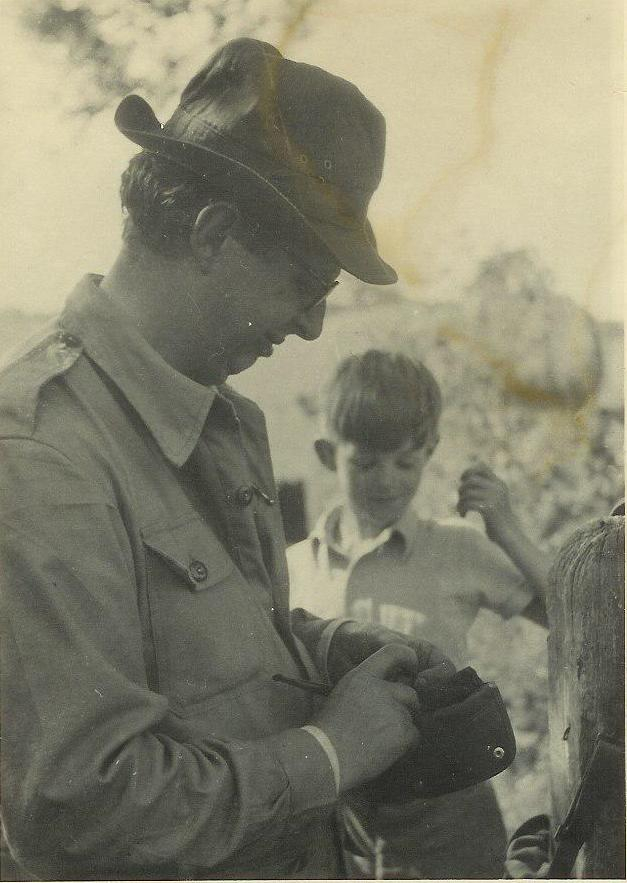
I have just seen my car driven away by a friend who's got it for free. I've been 'deciding' for 5 years - maybe longer. But the final decision to be rid of it came a week ago, since when it's sat in our drive, insurance cancelled. It helped that the cost of repairing its transmission was assessed as more than its worth. I have not been without a car since the 1960s. This evening is a moment long anticipated, regularly postponed. My family seem to have had cars since they were toys. I recovered an old photo of Barbara Maine, my maternal grandmother Bar, in her Peugeot smoking a cheroot. I recall having some of my happiest childhood times in cars, with my family. What I best remember (something written about and filmed at the time) is the accessibility to places all over Britain we got from having a car in the 1950s. I realise we drove - 50 years ago - on roads that most people now see in absurd advertisements - filmed on locations in Croatia or Albania. My mother and step-father were writers and journalists through the late 1940s and '50s. Cars were part of their salaries. We had the means to drive. We would arrive at places where there would be no cars for miles - or very few. We could park next to beaches, cliff tops, and high ridges with mighty views (see what I mean about advertising?). We reconnoitred long, lightly-paved rural lanes ending in cul-de-sacs where, after a word with a the farmer, we set up tent and fished in clear trout streams. We ate our catch fried in butter. I was often very happy - innocent of being in a vanguard of social change. My step-father remarked once, when I was going on once about the 'beauties of the countryside' (I was a literary youth) that this sort of thing wouldn't last. 'We're doing things the very rich could do. Now we are doing it. Soon everyone will be doing it! We're part of the rot.' In later years he observed that the central dilemma of socialism (quoting Bertrand Russell) was that 'you can ruin anything by making it available to everybody.' From the mid '60s, life on the open road, new motorways notwithstanding, became increasingly closed. The freeway became unfree as more and more people, understandably, sought access to a possession we'd enjoyed more exclusively. The freedoms promised by the advertisers of cars became more and more conditional. Friends of friends were killed in them and by them. I started travelling abroad to get away from the crowds in my own country - often walking and relying on trains and buses when going to lonelier places that were still places. Travelling with my wife, we seldom returned more than twice because we could always see material prosperity spreading - as it rightly should - but in the process blighting the quietness and slowness of more self-sufficient economies we'd visited as guests rather than an important part of the new local economy. We saw fishing boats laid up and replaced by marinas and yachts. We saw heritage signage spreading, as places became consumer items and we became harvest. We too had been consuming but we'd usually enjoyed the only table in the house.
In old age, my father said
'The only places left to live will be the cracks between the concrete. I advise you to to live in places already ruined. Maybe you will find the wisdom to make them better in some new way none of us understand."
Photo from Richard Risemberg's 'Bicycle Fixation'
I did not revisit my childhood experiences of motor touring until 1995, when with my young children we toured the Peloponnese in a hired car. We had had help from the Greek half of my family identifying still isolated areas of the peninsula. The motorway southwest from Athens was under construction. We drove en famille from Athens via Corinth and Leonidi, Sparta, Kalamata and Messini to Pylos on almost empty roads, stopping when we wanted and having picnics, strolling together through ancient ruins. Stopping high in the Taygetos mountains in Lakonia (the point from where this summer's conflagration spread) one Sunday evening and hearing silence under a black sky pierced by a million stars (normally hidden above the yellowing pall of light polluted England), with no sound except the cooling cracking of the car, hot from ascending a narrow zigzag road where we encountered no other vehicle for half-hours at a time. I took joy seeing my little daughter and wife who, unlike me, had never been to Greece, walking among the remains of a civilisation I associate with my roots as well as my present family. The car took us to the edge of beaches and right up to tavernas where we could park and walk to a table. Only once an ill-judged detour 'to see the sea' at Koroni jammed us into the narrow walking streets of an ex-fishing village grid-locked by visiting motorists - foreign, and the new expanding Greek middle classes, and us. Back in England I saw this holiday as an anachronistic replay of my motoring childhood and realised I could not keep trying to stay ahead of people with the same aspirations as myself but slightly further back in the rat race. I had to start thinking about my step-father's old age advice. I kept my car but reduced my annual mileage below 3000. My favoured way of getting about became my feet, my bicycle, train or bus, while car ownership just went on increasing. I have indeed found contentment and interest in the cracks in the concrete. I have watched wild fowl, inland seagulls, herons, urban rats, and foxes along canal towpaths, passing beneath the pillars of raised motorway junctions as I've cycled and walked the city, threading its congested roads and alleys free of worries about gridlock and parking. I have enjoyed picnics in the shadow of dilapidated industrial ruins. I've campaigned for more urban green space, for education for sustainable living. I've chatted across the rich world in cyberspace to like-minded people about ways to solve that central dilemma of making the riches of the world available to everyone without destroying it.
I've tried to imagine cities where more people will want to stay and make them into real places again instead of dismal, narrow economies where they can earn enough 'to get away.' I have found the roots of such cities in my own home town, as I walk and cycle about. Anyone hearing moralising in these reflections, should know that we fly to places still, that there's still a car in the drive (my wife's). My daughter has just bought her own. We are profligate with energy. This is more about about ending my long taken-for-granted relationship with the car - my auto-dependency. It's been a gentle separation, then an amicable divorce from a long and increasingly jaded marriage of convenience.
[A piece I wrote 7 years ago about 'cutting my car use']

[Back to the future 14/01/08 Alex Taylor, Fortune senior editor: DETROIT (2008 Detroit Motor Show number) -- If you are looking for some insight into what the automobile of the future will look like you could do worse than talk with Tom Lane. An American, he runs all of Nissan's Product Strategy and Product Planning from his office in Tokyo. Unlike most executives, he welcomes the imposition of new U.S. fuel regulations that mandate 35 miles per gallon by 2020. "It is not an issue" for Nissan (NSANY) he says. He expects the new regs to drive more small cars, improved technology, and a broader variety of shapes and sizes, as designers try to get more variety out of similarly-sized vehicles. But he points to some discouraging global trends that don't bode well for the industry. He notes that consumers in Japan are losing their mojo when it comes to cars. The population is aging, and younger drivers would rather spend their money on new cellphones and Internet access." Japan is increasingly not interested in new cars," he says. The population in Europe is aging too, and Lane sees similar ennui spreading there. As car ownership becomes more expensive and cities increasingly impose congestion pricing on car usage in center cities, he sees car owners switching to mass transit for their daily commute, and then renting cars for longer trips. "The U.S. is headed that way," he says. "The challenge for us, going forward, is a more interesting offer. Doing a better Sentra or an Altima isn't going to do it." [Review article 'Reducing our dependence on the car', Local Government Studies (2000) 20:1, pp.101-110]
['Cutting car use' Bicycle Fixation 2000]
[Back to the future. AlterNet piece on driving cars in July 2008]
[Back to the future 11 Oct 2009: The auto industry frets over young people's lack of interest in driving]
[Back to the future 14 Oct 2009: Oil ~ From extraction to consumption: an exhibition by Edward Burtynsky]
[Back to the future: 14/06/10 Lament for today's cars]
[Back to the future: 28/03/12: Edward Burtynsky ~ Automotive detritus, Oil ]

Sunday, 21 August 2011

Starting anew

Friday saw the Project's tipper truck securely stored at last. This gives the Voluntary Advisory Group, delegated responsibilities by the remains of the old project's management committee, time to formally clear any outstanding sums owed -  reduced over preceding months to a manageable sum - and get on with setting up a proper legal entity - probably a Company Limited by Guarantee or a Community Interest Company - so that a new enterprise can be up and running before December, using the vehicle and machinery of the dissolved project. It's been a slog. The truck's ready for re-use but we still have to recover a rich variety of machinery including a chipper, chain saw, strimmers, mowers, picks, stepladder, spades, shovels and crowbars. Some of the trickiest part of winding up the project, drawing a line under the past is now behind us. Now we have the challenge, in tough times, of restarting it as a transparent accountable enterprise fit to earn money where that's appropriate, and apply for grants - increasingly rare - to help do an endless range of odd-jobs - garden clearing, window and lock repairs, house clearance, removals - to name a few - for the most vulnerable people in Handsworth, as well as communal tasks like litter picks, clearing those urban dead zones beloved of fly-tippers and cutting overgrown foliage by footpaths and alleyways.
*** ***
An old lady, Rodo Metallinou, Ρόδω Μεταλληνού, sits at her window in the narrowest part of Democracy Street - if you ignore the stretch where it runs through Venetia half a mile further up the village. When we pass she smiles and waves, crying out - γειά σου, often adding further blessings we still don't always understand. I admit to peering through her open window at the dark varnished dresser with its shiny decorations, gleaming cosily on dark winter evenings. 
Ο Μάρκου και η κυρά Ρόδω
An entry in the Ano Korakiana website shows Rodo sitting beside our neighbour and friend Mark Jacks, showing her an old black and white photo - η παλιά φωτογραφία - a gathering of her fellow pupils at the village school in the 1930s, an image that might have been thrown away or simply allowed to decay in some abandoned room. Here they sit together as she happily recalls names, nicknames - τα παρατσούκλια τους - and old faces. Mark wrote:...she was sitting on the step with the photo when I happened by and she was talking to a man with a beard who took the photo , I  asked her which schoolgirl she was in the photo and she pointed herself out to me and then burst into fits of laughter ,1930 she reckons , great stuff.  loved the 15 minutes with her and her neighbours,
** ** **
Mark Taylor, a members of my informal JH committee, helping me search for Jack Hargreaves' programmes between the 1950s up to his death in 1994, sent me an old VHS tape of a broadcast in which Jack speaks a commentary written by his colleague and friend Colin Willock over a film about another friend, James Robertson Justice. Tony Herbert took Mark's old tape and transferred it to DVD so's I could float it on Vimeo. The Angler and The Trout appeared in Anglia Television's Survival series, invented by Aubrey Buxtonand broadcast  13 February 1974. Comparing it with one of Jack's films about fishing, made in the early 1980s, it is ever so slightly bothering to hear the shift in rhythm and flow as my stepfather recites someone else's words while different hands and eyes stand behind the camera, sit at the edit desk and insert background music and sound effects. I guess it's a reminder of how much more familiar I've become with JH's material in the last couple of years.

Monday, 24 January 2011

Streaming videos of Jack Hargreaves

About two years ago I persuaded my mother to give one of my stepfather's fishing rods to Paul Peacock, his biographer. He produced this film in which Charles Jardine, who's father fished with Jack, compares the old rod with a contemporary one.

This goes well with the old episode that I posted on 4 January in which JH describes the evolution of fishing rods - from the 'famous London roach pole' to carbon-fibre and beyond. "Hullo. In the Camden Town murder trial at the turn of the century a man was asked what he was doing on the street at 2.30 in the morning."

I've spent the day checking through my list of 87 clips, sent to Paul Peacock by a fan a couple of years ago, comparing it with the list from SWFTA of 262 ¼" sound tapes and about 440 clips on 16mm film from Out of Town and Old Country made up by Roger Charlesworth at the archive.
Selecting a pilot episode from these lists turned out less straightforward than I'd hoped. Films on my two lists - archive and fan's clips have titles that vary from, but may match, titles in the archive at Plymouth. Thus 'barrel-making' for 'coopering' is easy but others are less clear. To be sure we're going to need to view all those that are ambiguous. So this afternoon I made up five DVDs containing copies of all the 87 clips I hold to post to Roger so that he has them to hand when searching for the ingredients of a suitable pilot episode - made we hope from two outdoor films from the original 16mm linked by the shed scenes among the fan clips. Mark Smith on Facebook commented:
I'm sure that someone, somewhere will eventually find a piece of film made in Jack's shed... These things have a habit of turning-up in the most unexpected places...look at all those TV programmes from the early days of ITV that where thought to be lost for ever until the death of Bob Monkhouse who had recorded thousands & thousands of hours worth of TV throughout his life; so you never know, someone may have video recorded some of the original Out of Town programmes.
***  *** ***
I've just uploaded BW nymphs - a film from Old Country in which JH quotes Bertrand Russell on a central dilemma of socialism 'that you can ruin almost anything if you make it available to everybody', in this case hooking fat farmed trout on gaudy flies from the murky water of artificial ponds:

****  ** ****
ΤΕΤΑΡΤΗ 26 ΓΕΝΑΡΗ 7 μ.μ. στην αίθουσα του Συνεταιρισμού Ανω Κορακιάνας, θα πραγματοποιηθεί η πρώτη  συνάντηση για την οργάνωση του φετινού Καρναβαλιού...Όσοι και όσες μπορείτε, ελάτε...Wed 26 Jan 7 p.m. in the Cooperative, Ano Korakianas, there will be the first  meeting for organising this year's Carnival…Those who can, do come…
** ** ** **
Homework - Niko's mum's ill - very ill. He's had to go swiftly to Athens, postponing our lessons....
       
WANT
θέλω     I want
θέλεις     you want
θέλει     he, she, it wants
θέλουμε     we want
θέλετε     you want
θέλουν     they want

                  GO
πάω, πηγαίνω    I go
πας, πηγαίνεις    you go
πάει, πηγαίνει    he, she, it goes
πάμε, πηγαίνουμε    we go
πάτε, πηγαίνετε    you go
πάνε, πηγαίνουν    they go

BE
Εγώ  είμαι
I am
Εσύ είσαι
you are
Αυτός,Αυτή,Αυτό είναι
he, she, it is
Εμείς  είμαστε
we are
Εσείς είσαστε
you are
Αυτοί είναι
they are

DO
Κάνο
I do
Κάνεις
you do
Κάνει, κάνει, κάνει
he, she, it does
Κάνουμε
we do
Κάνετε
you do
Κάνουν
they do

HAVE
Έχω
I have
Έχεις
you have
Έχει, Έχει, Έχει
he, she, it has
Έχουμε
we have
Έχετε
you have
Έχουν
they have

Saturday, 17 July 2010

Just one more 'Out of Town'

A programme compered by his friend and colleague Fred Dinenage was coincidentally broadcast the evening that my stepfather Jack Hargreaves died on 15 March 1994. Fred when I met him at Jack's funeral in Salisbury and who knew Jack was ill at the time the programme was made, said it was typical of his professionalism that whether by luck or some magical intention it should have gone out the same night. Jack had a preference for the dangers of live TV, but this evening had been pre-recorded. Isobel, his wife of thirty years, who died in 1998, told me that though Fred had kindly sent her a tape shortly after the broadcast, she couldn't bring herself to watch it. I have not been able to find a recording - until now.
A week ago Ian Wegg, who'd traced me through the internet, kindly sent me a DVD containing the whole programme, along with other films he'd recorded off air, including an Out of Town episode from 1980 and a tribute assembled by Fred Dinenage that aired on 28 March '94.
I’ve edited Ian's recording to show the 'special' of Out of Town that JH agreed to make for the broadcast, though the series had ended 13 years earlier, just before Southern Television lost its franchise. In this film, mentioned in one of Jack's obituaries, his shed is not the usual studio rig, but the real shed at his last home, Raven Cottage, near Belchalwell in Dorset. Who was behind the camera then? I don't know. The broadcast includes a reunion between Jack and his companion entertainers on ‘How!’ - the children’s series he invented.
I was on a train when the programme went out. A few hours earlier I'd been beside Jack’s hospital bed with Bay, my sister. He was in a coma; had been far away since he'd arrived at the Hospital a few days earlier; already becoming part of everything, even though he seemed so palpably there and just in heavy sleep. At moments I’d wanted to raise my voice and shake him awake but he was a long way off. All the same we spoke to him in case he might have heard us somewhere in some last liminal space. Perhaps our voices hovered on a riverbank as he gazed at a rise or heard us by the edge of some wintry wood in the evening or imagined all of us, Bay and me and Mum, in the suspended time of dreams, strolling up Regent Street together after seeing a film in Leicester Square long ago, feeling it was now. Perhaps our murmurs by his bed fused with our childhood chatter in one river - Lambourn, Winterbourne, Kennet, Enborne, Itchen and Stour flowing together. Perhaps I’d imagined him a little boy again remembering his mother and father and brothers and the bullnose Morris days long before he knew us; long before the war and its intensities, Fleet Street, television studios, advertising agencies, cities of the plain and their dangerous women.
Perhaps all these were fleeting together to drift on the surface like the sun's reflection on a cold chalk stream hiding for a moment the clean gravel, crayfish, caddis tubes and mayfly larvae, miller’s thumbs and brown trout suspended in the invisible current, with water crowfoot and emerald starwort stroking their golden scales.
Bay and me had eaten in Dorchester, then caught the train together and talked about Jack and Mum and our own children and us. It was the longest we’d been together for ages. I left Bay at Southampton so she could go on to London, phoning her husband Gabe to say she was on her way. “I think we’ll be back quite soon“ she’d said. Isobel rang me just after I’d got home to Birmingham saying Jack slipped away as the nurses turned him in the bed at 8-o-clock that evening when my train was somewhere between Banbury and Leamington Spa.Jack & Simon 1951
** ** ** This Thursday Paul Peacock, who wrote Jack's biography, drove down from Waterfoot in Yorkshire, collected me from Handsworth, and we drove on to Gloucestershire to Rock Cottage in Lydbrook, our small house in the Forest of Dean beside a path that curves up the side of Bell Hill away from the road and car access. It needs tender loving care after thirty years. We're hoping Paul and his family will take this on in return for the time they spend there. Rock Cottage from Simon Baddeley on Vimeo.
*** *** Teacherdude's Grill & BBQ posts an irritated commentary ...
What we see is yet another example of how 'access journalism' reduces reporters to little more than stenographers and cheer leaders for those in power and that by making so many compromises to gain access to their subject the whole point of a newspaper interview is subverted...
...on a syndicated Guardian piece by Helen Smith from the island of Poros about George Papandreou on the irony of a Socialist PM dismantling the Hellenic welfare state:
"As long as I feel I am doing what I think is right and just for my country, for the Greek people, that is enough for me. Saving Greece from this crisis was the first thing on the agenda. We are now on a much more normalised road." But he also concedes that the path ahead is strewn with difficulties. After months of angry protests and bloody violence, culminating in the deaths of three bank employees in May, it is clear that the Greek people are not prepared to take austerity lying down. For many, the recent respite is the lull before the storm – with worsening recession, galloping unemployment and mounting dissent within Papandreou's own party looming on the horizon. He accepts that in a nation where almost a quarter of the population lives under the poverty line, communication could be better. In the months ahead, as measures really begin to bite, there will, he says, be greater urgency to "get out more into the neighbourhoods and countryside" to convey the message that Greeks must bite the bullet of austerity in return for seeing their country emerge reinvigorated out of the crisis.
More about the drastic Hellenic Pensions Bill from Athens News 8 July 2011 - a piece by Dimitris Yannopoulos about the extent and range of this legislation driven by Andreas Loverdos - Ανδρέας Λοβέρδος - and on YouTube a strong speech to the Hellenic Parliament on 6 July 2010, with signing, received with applause and with five reminders from the President of the House, Philippos Petsalnikos, I think, on time limits....and from Athens News Agency 19 July 2010:
Employment minister Andreas Loverdos on Friday tabled a draft bill on reforming Greece's pension system for the public sector in Parliament. Among the key features of the new bill is that it equalises retirement age for men and women, gradually abolishing rights previously held by women to retire at an earlier age if they had at least one child under 18 or had three or more children. For a brief transitional period between 2011-2013, both men and women will have the right to retire at a younger age based on these rules, increasing from 50 years to 52 in 2011 and 55 in 2012, while from 2013 onward the age of retirement for both groups will be 65, regardless of other factors. Age of retirement will also equalised for men and women with adult or no children based on the new bill. Women in the public sector currently have the right to retire at 60 years, compared to 65 for men. Under the new rules, both men and women will be able to retire at 61 in 2011, at 63 in 2012 and at 65 from 2013 onward. The exception will be men and women with handicapped children, where from 2011 the age of retirement will remain at 50 years for women, while it will be lowered from 65 to 50 years for men. Apart from the above, for pensions above 1,400 euros per month, the bill brings back the LAFKA fee and introduces the new "Pensioners Solidarity Contribution' ranging from 3-10 percent. It also places those hired in the public sector from 2011 in the unified IKA pension system and equates the status of public-sector pensioners with those of the private sector in other ways, establishing the same system of a 'welfare' and contributions-based pension for the public sector from 2015, while it abolishes the right to pension for unwed adult daughters with the exception of those that are judged incompetent or are still students.
... and more details of the depth and range of austerity measures from Athens News - 12 July 2010:

Benefits for public sector workers not already scrapped will be reduced by 8%, while wages for state enterprises employees will be cut by 3%
Annual holiday bonuses only for civil servants earning up to €3000 per month are capped at €1000 (250 for Christmas, 250 for Easter and 500 for summer holiday)
Annual holiday bonuses for public sector pensioners capped at €800 (200 for Christmas, 200 for Easter and 400 for summer holiday)
Holiday bonuses axed for civil servants and public sector pensioners earning more than €3000 per month
Current public sector salaries and pensions frozen for at least 3 years
The second installment of a handout to low-income workers is scrapped
All 'high-pension earners' of €1400 euros or more will experience reductions (LAFKA) of 5-10%, depending on pension brackets, which range from €1400 to €3000 or more
Pensions calculated on the basis of full-career earnings and eventually capped at €2500
Drastic revision in private sector labour relations, impacting minimum salaries, mass layoff limits, collective bargaining arbitration and severance pay cuts
VAT increases from 21% to 23% for all commercial goods, and from 10% to 11% on basic goods and public utilities
Special excise taxes on fuel, alcohol and tobacco taxes raised by 10%
lllegal construction and open-space penalty taxes
Special annual levy on very profitable enterprises
Increased taxes and licence fees for electronic and gambling games
Increases in the objective valuation of buildings
The Public Investment Programme will be reduced by €1.5 billion over the next year

Sunday, 8 April 2012

Working late

Up the Soho Road for various errands. The weather's wet, windy and chilly. I think of Giles. No cartoonist could better evoke a dreich British day. Spring has receded, but rain is welcome on the allotment...
Cabbages protected by sticks and netting
...where I've planted four rows of potatoes, five fruit trees, a row of cabbages, a rhubarb, and runner beans, and five rows of onions...
The soil still puzzles me. Should it be a perfect homogenous medium like branded compost in plastic bags from garden centres? It's far from that, far more interesting, far stranger.  I keep picking out larger stones, couch roots, miscellaneous human-made debris like bricks, glass, bits of plastic and metal fragments and other weeds. I lay the small onions about four inches apart roots down and water the trench after sprinkling them with bone meal and chicken manure. Have I planted too deep or too shallow? Is it  enough? Too much? I rake heaped soil back over the trenches picking out more large pebbles and couch roots. I'm only slightly confident these plants will survive and grow. The trees - yes. The other crops I've yet to see. All the time the soil's becoming easier to work, more couch grass removed and larger stones set aside. Everything tells me you can't really leave an allotment to itself. If it's not me someone else must work it daily.
Rhubarb and runners
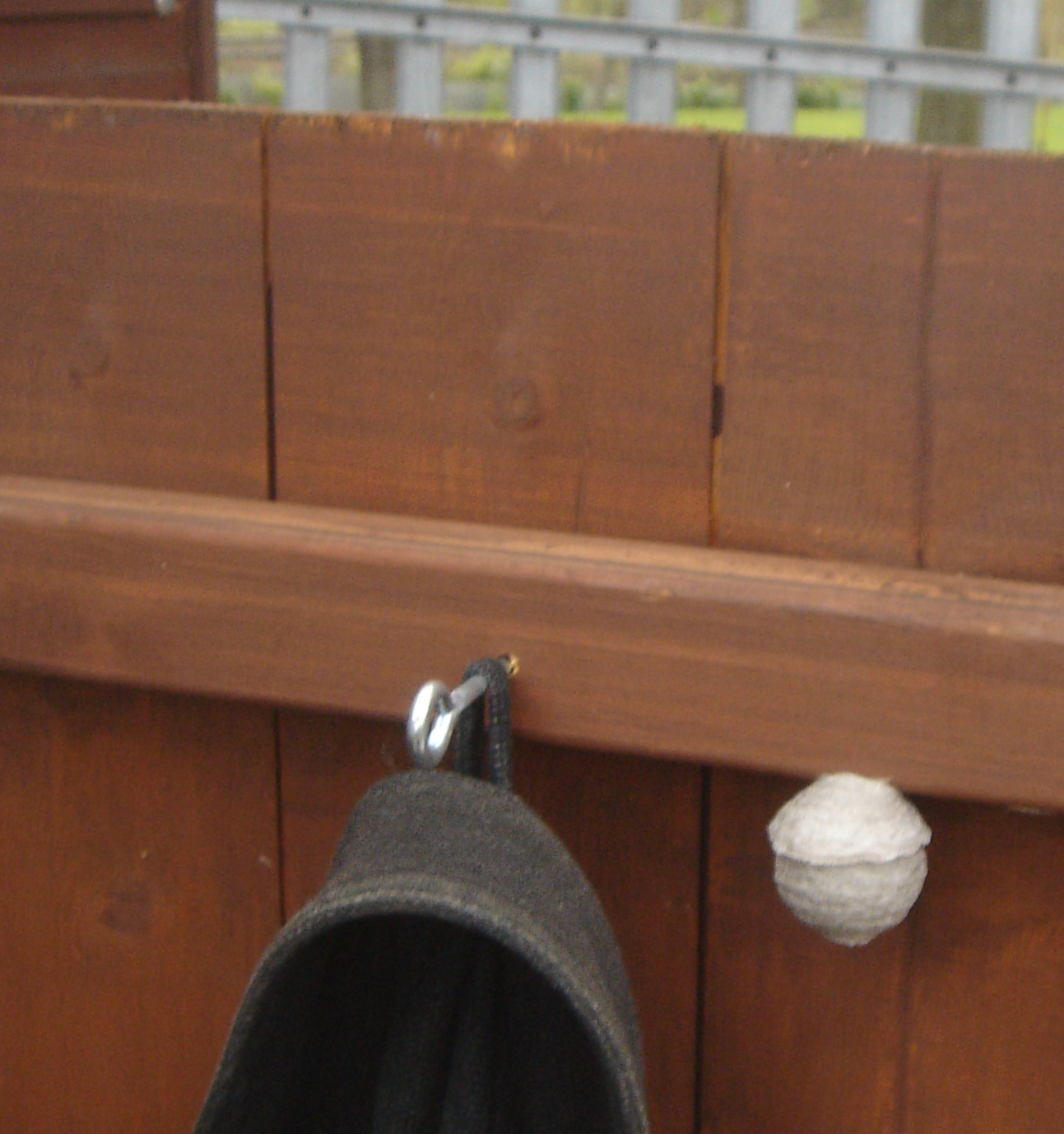
What else? I've started composting in a set of heavy duty builder's bags, made two more slab paths, arranged with my neighbour Gill to place her bees on the plot next month, and of course there's the shed with its veranda - my base - inside whose door I've just noticed a wasp nest. Going in and out of the shed is going to present a lot of opportunities for us being seen as a threat, so despite all the benefits of wasps as insect predators, pollinators and recyclers, I'm going to need to move this nest to a more mutually satisfactory place.
Wasp nest in the shed
How the wasp nest was removed without killing its sole inhabitant.
*** *** ***
I had a go at giving advice to someone who sent me a first chapter of the book on which they're working. I am of course addressing myself:
Thanks so much for entrusting your authorship to my judgement.
I enjoyed what you’ve written and will come back to it. I am not an editor and, apart from academic papers, have never published anything other than my blog - read by a nice minority that would never get me a book deal!
So much for my qualifications to say anything about your history of xxx - which might languish on a shelf or in a hard drive or enter the world - after the typical procession of rejections - as a best seller, crowding the modern outlets (of which bookshops are an increasingly small part) and spreading via e-publication across the universe of cyberspace. You know, I’m sure, that self-publication gets easier every day; that what used to be called - demeaningly – ‘vanity press’ is a recourse of many authors prior to discovery by the larger market. Changes in methods of getting the word out to the world is altering in the way it did with the arrival of the Gutenberg printing press, so all’s to play.
My niece - Anna Baddeley - runs a website called the Omnivore. She’s gained much experience in publishing though hardly 24 years old. Her plan is to e-publish very short books by good writers she’s been lining up. There’s going to be more and more space for short essays, stories, manuals and histories on the web.
Where does this put you, given that actually getting published in the 21st century is not a serious problem? The depressing side of this is the deluge of superficial, short attention span self-indulgent tat that has spread. The human ego unharnessed is not a pretty sight. On the other hand we associate the Renaissance and the Enlightenment with the spread of reading and writing. Slaves were forbidden books as indeed were young woman from such subversive writing as Pride and Prejudice with its crazy implication that a man and a woman should marry for love.
Where does this leave you? Publication and diffusion are less important than the quality of your book and the style of your writing. I know my stepfather who wrote three short books spent his life on this; not least studying other writers and being fascinated by first lines - many of which he would enjoy quoting 'It was the best of times, it was the worst of times…’  Take your first paragraph
 (I quoted an opening para’; suggested minor changes)
OK so that’s just a few comments. Imagine if we sat together with the whole manuscript, what a drag I’d become!
I know of writers who get sick - literally - before they start writing. it’s as hard as any manual labour. Martin Amis says it’s a physical process. See Seamus Heaney on his dad: '...Through living roots awaken in my head. But I've no spade to follow men like them. Between my finger and my thumb The squat pen rests. I'll dig with it.' (I've printed out this poem, had it laminated and stuck it up inside the shed on my allotment)
I think you’ve done brilliantly. You’ve started. I wanted to read on. You’ve done research and you love the subject. Let that shine through. It comes with time and effort - both of which you have. Don’t write to publish. Write as though you were writing for an unborn child or indeed one already here but who may not really understand your drift until you are gone. I feel this about Jack’s writing. ‘It is one of the most excellent provisions of Nature that chub are to be angled for on hot summer afternoons ... When the grass is high and full of hum and rustle, when the comfrey blooms along the edge of the water and the air shivers in the heat, the chub lie just under the surface in slacks and corners and eddies all along the bank. You will see them and you will think they have not seen you.’  I saw this book of Jack’s in the 1950s. I didn’t get to read it properly until last year. Writing is as near, in this secular age, as you may get to praying. It’s hard and yet, as Proust said, it’s not about trying too hard, more like dreaming the words without waking yourself up. Keep a jotter. A good phrase can make a sentence and that can make a chapter. Riddle the adverbs and adjectives! Look: (I quote another paragraph, shorten it by taking out unneeded intensifiers, repetitions - 'save them for when they seem essential or suit the flow) That’s a poor example (by me) and I apologise for interfering with your words but don’t they read better - silent and aloud?  And they're still yours....
Someone said don’t wipe out something you’ve just written but, on re-reading, dislike. Prose can be like wine or a sauce. Leave it for a while and you may find it’s mellowed and you like it more than you thought at first. Don’t buy all criticism and certainly not rejections. They come so plentifully to good and bad writers alike.  Most of all; the best advice I’ve had (much good it does me); whether you’re writing a novel. a manual, a dictionary or a history you’re not in the first instance writing about those things. You are writing about yourself. That’s what makes your book unique. You.  Don’t fret too much about punctuation, spelling and typos. These can be cleaned up in moments. Indeed software may do it for you! Don’t worry about length or structure. Just write.
If you need help with an overall approach have you tried a mind-map? Putting down messy but connected ideas on one sheet of paper ignoring sequence - as in a map (we read books - linear - but we also ‘read’ maps - non-linear). I mentioned jotting down choice words and phrases  - wherever you are - or having a mini-recorder to speak into when an idea or a sentence springs unbidden to your mind - when on a bus, driving, cycling, walking, gardening, cooking, in the loo, just as you wake, just before sleeping. Cherish these, as also something someone says to you that strikes a chord. These jotted sketches are more likely to be you than the chunks of other people’s writing you may need to collect for your research.
A sheet of paper on which you propose to write is scary. I’ve heard painters say this of a blank canvas; musicians of silence. If a pen doesn’t work try a pencil. On paper if lines are better, try them instead of blank pages - but try hand-writing instead of keyboard. Neither is better than the other. It’s just worth trying - like using a different spade. Good luck and keep writing! Best wishes, Simon
***** *****
At Plymouth on Tuesday John Rose and I will be collecting the Jack Hargreaves collection from South West Film and Television Archive (SWFTA) and bringing it back to temperature controlled storage in central Birmingham, minus the tapes of Old Country which will go with David Knowles to his home. David will meet us at the archive on Tuesday to help with the loading and, most of all, cast his experienced eye over the contents of the collection with a view to helping with the work we are planning to make this material accessible. The Facebook page for Out of Town is getting busier:

  • Simon Baddeley At last - someone who was there at the time! Thanks David.
    Friday at 08:54 ·  ·  1

  • Mark Smith As you say Simon, it great to hear from someone actually involved with the programmes when they were being broadcast. This is certainly a step in the right direction! Now, dare I ask Dave, is there anything you can do to help Simon with the restoration of these films? If not directly, do you have any contacts that might be interested in this project?
    Friday at 10:04 ·  ·  1

  • Dave Knowles Hi Mark.
    Firstly thank you for your comments and offer of help. There are two things I think needs to happen first one is see what we have and as although I think I know what will be there without checking them it is impossible to tell. I suppose the good thing is I did edit a lot of the Out of Town and was directly involved in its production so should be able to help Simon find out what is there and what can be done with it. Secondly and maybe more important is the rights to this material needs to be established and I know that this is top of Simon's list of things to sort out. Until this is established it will be very hard to get anyone to invest in the project. I do have some contacts in Abu Dhabi who may be interested (I have not spoken to them) but like everything to do with the television and film industry they will probably want a return on their investment which could be quite high.
    Therefore lets do things one step at a time and if we do I feel sure that we will get there eventually but it is a long term project.

    Friday at 10:41 ·  ·  3

  • Paul Eades Excellent stuff Dave. So glad you are on board with Simon on this.
    Friday at 15:11 ·  ·  2

  • Simon Baddeley I'm confident there's a book to be written on this project - it has many twists and turns involving technical, legal, personal complications plus all the different characters involved and the value of new media in giving momentum to the recovery of older media, in the context of Jack's powerfully and entertainingly presented theme - our loss of connection to the the countryside and the land.

  • Paul Eades I think the last sentence says it all!
    Friday at 15:40 via Mobile ·  ·  2

  • Teal Jacks great to hear that JH OOT and OC has come back to its roots and now has some original people back and involved , can only mean good news
    Friday at 19:43 ·  ·  3

  • Neil Maidment I hope this really gets the support it deserves. And Dave, thank you for all your work with Jack, I was riveted to the TV set every time he came on. Jack influenced my fishing world and extended it to include all things "country". I had the privilege of meeting him twice on my local Dorset Stour, memorable days indeed!
    Friday at 20:26 ·  ·  4

  • Paul Eades Lucky man!!
    Friday at 20:28 via Mobile ·  ·  2

  • Mark Smith Paul beat me to it...I too, was going to say 'lucky man'! So few of us ever get to meet the people we admire and look up to.

  • Simon Baddeley I am learning - late in life - more about what I owe my stepfather from the thoughts of people who never met him but still know him, sometimes better than I. My sense of responsibility to him as reflected in these films grows stronger with this enthusiasm, experience and respect.

  • Mark Smith During life, we often find ourselves in positions we did not expect. Circumstances put you in just such a position, a position that none of us could ever begin to imagine! Now you have the opportunity to help save a large portion of Jack's life's work for posterity. Quite an undertaking but a project that is so worthwhile as this material may well contain the only record of crafts and skills that have long ago disappeared, denying future generations to learn about them without Jack's films and narrations. Most of us on this forum are powerless to assist you in this task in any practical way and can only offer you moral support but we are all behind you!
    Yesterday at 11:00 ·  ·  2

  • Paul Eades Spot on!!
    23 hours ago via Mobile ·  ·  1

  • Simon Baddeley I’m going to need some pricing - on 16mm to digital, full quality and ¼” reel to reel sound tape to digital full quality. I David is right and it's unsafe to try the matching using original material, then only once this is done we can begin the matching process - sound to image. Any ideas or information most welcome. I recognise that a more precise specification within the media types I've mentioned will be needed. Many thanks Mark. The quote 'this material may well contain the only record of crafts and skills that have long ago disappeared, denying future generations to learn about them without Jack's films and narrations' is what I'm looking for and it will help when we have a clearer inventory of content. This is the best we have so far thanks to Roger Charlesworth at SWFTA where I should be on Tuesday
    17 hours ago ·  ·  2

  • Mark Smith Wow! What a great wealth of material in those lists. I do recognise some of the films as they appear in the DVD set and some of the others ring a distant bell from the TV days. Alas, I never watched any of the Channel 4 series 'Old Country' and was not even aware of it's existence before joining this forum. It is a sad thing, but Channel 4 run some excellent and informative programmes in between the crap. The problem has always been...finding them! I am not one for pawing over the Radio Times or other such publications so must miss a lot. Mind you, one advantage of the new digital TV age is that it is easier to find these programmes if you happen to fall on them at the right time. Are there any complete episodes of Old Country in the Channel 4 archive do you know?
    16 hours ago · 

  • Paul Peacock This is one of those must do projects. David, I am going to re release muy bio of Jack, but with extra material in it, can we chat sometime?
    16 hours ago ·  ·  1

  • Dave Knowles Paul - No problem...
    15 hours ago ·  ·  1

  • Dave Knowles Mark - We made a total of 60 programmes of Old Country over the period of three years and the viewing figures reached just over 1,000,000. Then when we talked to Channel 4 about a fourth series they said they were not interested in continuing.
    15 hours ago ·  ·  1

  • Mark Smith What a shame Dave! As I said earlier, I had been unaware of Old Country until joining this forum. However, I never missed an episode of Out of Town. It was a great favourite of my late father and I and was broadcast in the London area on a Sunday lunchtime. Are you aware if Channel 4 did have / keep master copies of the Old Country programmes it did broadcast?
    15 hours ago ·  ·  1

  • Paul Eades Also, have you ever heard what happened to the Country Boy tapes?
    15 hours ago ·  ·  1

  • Simon Baddeley Those have disappeared - so far!


  • Dave Knowles Mark, Simon and I are hoping that some of the tapes in Plymouth are Old Country programmes. As soon as we know we will let everyone know.
    15 hours ago ·  ·  1

  • Simon Baddeley David or should I say Mr D! When are you going to give me a chance to give attention to your knowledge of thermal cooking 

  • Dave Knowles Paul...watch this space.
    14 hours ago ·  ·  1

  • Dave Knowles Simon Goodness knows I will try and get you some details for Wiki one day...Maybe when you get back from Greece.
    14 hours ago ·  ·  1

  • Simon Baddeley It doesn't matter where I am. In cyberspace no-one but the security services knows or often cares where you are (:)) Just get me something to kick off with by way of a CV that includes eco-friendly food prep...
    14 hours ago · 

  • Paul Peacock We have been making films for the Mirror and I have been trying to emulate Jack and the ways he made his films. I'm making some films for a number of sources and have to say Jacks is the most logical for this type of filming, He
    Was a genius - and the people around him too!

    14 hours ago via Mobile ·  ·  2

  • Ian Wegg Mark, there is no such thing as the Channel 4 archive. Channel 4 only commissions programmes, it has never made any so doesn’t hold any masters. The SWFTA catalogue lists ALL the Old Country episodes on Beta (including the rare episode 28) so with luck those are the masters. Hopefully Dave will find out this weekend.
    2 hours ago ·  ·  1

  • Ian Wegg Dave, thanks very much for that fascinating insight. I hadn’t realised that the sound effects had been put onto the films, I’ve just watched an original OoT and the corresponding DVD version to check it out! How bad is the reversal stock then? I understand that good quality 16mm is HD standard but it sounds like this reversal film isn’t. Why was it used anyway, was it to make editing easier?
    2 hours ago · 

  • Mark Smith Thanks for the information Ian, I did not know that Channel 4 does not actually make programmes.

      • Mark Smith It is wonderful how the SWFTA tapes have got us all talking and really brought this forum to life! Good luck to Simon and all of you working so hard to rescue these films. I am sure that this will become a long term project due to cost / time etc but it will be so worthwhile, even if only a small portion of the collection makes it to public viewing again. Keep up the good work chaps!
        about an hour ago ·  ·  2

      • Dave Knowles
        Hi Ian, Each bird, each splash of the fish I laid individually from sound effects from the library. Jack did not really want any sound and would then turn it right down. He said it was a dream and people would imagine the effects which to an extent was true. To hear them you may need to listen with headphones.....you may be surprised what you don't normally hear.
        With regards to 16mm and HD video this is a huge subject and I am no expert. You must however remember that in those days there was no wide screen and that NTSC (the American standard) was different to PAL (our standard). The other thing was that 16mm film was 4:3 and had to go through a telecine before appearing on your screens so this has to be added to the equation. I for one loved and still love film but it was not so sharp as video partly due to the grain. I was always told however that 16mm resolution was less that BVU U-Matic which I think was around 280 lines. This of course was the way resolution was measured then and not pixels. Betacam SP then came with 330 line resolution and this was a great jump forward. With 16mm a lot came down to the physical size of a frame. Super 16mm on the other hand was much better as the frame size was that much larger.
        Southern Television was almost unique (I know that does not make sense) in shooting a lot on reversal stock. This did save money as you did not have to make prints of the negative. But of course as an editor you were handling the original not a cutting copy so any damage it received in the cutting room was for good...Hope this helps a little. Must go to cook my Beef Bourguignon in the thermal cooker for our 11 lunchtime guests. Dave
        11 minutes ago · 

      • Ian Wegg Hi Dave, Thanks for that explanation. I did listen yesterday with headphones and I can tell a lot of work went into the effects (just for once I was wishing Jack would keep quiet so I could hear them properly!) Enjoy your Beef ... Lamb for us! Cheers, Ian.
        3 minutes ago · 
    • *** ***
I was down at the Rag Market yesterday. Had one of my favourite snacks from the stall just inside the covered part, a marfona, or is it an estima, baked spud with plenty of butter and a cup of tea. People recognised and greeted Oscar sat in the basket on my Brompton just outside the big glass doors. Roaming I bought a 1970s Ladybird Book on Transport through the ages, held together with sellotape, remaindered from St Chad's Roman Catholic Primary School...
...a book published in 1970 just after the landing on the Moon when people were intoxicated by roads and cars. Bicycles, once so liberating, had become mere toys or things some dads were  still forced to ride because they had no 'better' choice. My photo (top) of Soho Road, taken only the day before yesterday, exemplifies that bleak 1970s vision of 'improvement', but how things have changed in 40 years of long campaigning against the ravages of autodependency. I wrote in 2007:
I have just seen my car driven away by a friend who's got it for free. I've been 'deciding' for 5 years - maybe longer. But the final decision to be rid of it came a week ago, since when it's sat in our drive, insurance cancelled. It helped that the cost of repairing its transmission was assessed as more than its worth. I have not been without a car since the 1960s. This evening is a moment long anticipated, regularly postponed. My family seem to have had cars since they were toys. I recovered an old photo of Barbara Maine, my maternal grandmother Bar, in her Peugeot smoking a cheroot. I recall having some of my happiest childhood times in cars, with my family. What I best remember (something written about and filmed at the time) is the accessibility to places all over Britain we got from having a car in the 1950s. I realise we drove - 50 years ago - on roads that most people now see in absurd advertisements - filmed on locations in Croatia or Albania. My mother and step-father were writers and journalists through the late 1940s and '50s. Cars were part of their salaries. We had the means to drive. We would arrive at places where there would be no cars for miles - or very few. We could park next to beaches, cliff tops, and high ridges with mighty views (see what I mean about advertising?). We reconnoitred long, lightly-paved rural lanes ending in cul-de-sacs where, after a word with a the farmer, we set up tent and fished in clear trout streams. We ate our catch fried in butter. I was often very happy - innocent of being in a vanguard of social change. My step-father remarked once, when I was going on once about the 'beauties of the countryside' (I was a literary youth) that this sort of thing wouldn't last. 'We're doing things the very rich could do... Soon everyone will be doing it! We're part of the rot.' ...."
*** ***
I have so many good and interesting things on my British plate. Even so I long to be in Greece, to touch her ground and see our friends.
Ἀγαπητέ, περὶ πάντων εὔχομαί σε εὐοδοῦσθαι καὶ ὑγιαίνειν, 
καθὼς εὐοδοῦταί σου ἡ ψυχή.  ΙΩΑΝΝΟΥ Γ΄ 1
About this time last year Katerina shows Linda how to make orange pie πορτοκαλόπιτα.

Back numbers

Simon Baddeley