Total Pageviews

Showing posts with label heritage. Show all posts

Saturday, 7 July 2007

UNESCO counters the Greek Lopakhins


Lin took this photo in April 2007. She didn't tell me to tuck in my shirt. The Liston is what some, trying to emulate its character, would call 'shared space' or a 'living street'. It's a kind of perfection - old but not a museum, grand but not big. When crowded it's full of intimacy. No cars endanger children, or pollute it with smell, noise or impatience, yet the Liston's easy to get to by sea, road and air. The Liston is a place for walking and sitting and talking and gazing around. It connects to the sokaki - Corfu's intricate back streets - and to the grand square, the cricket ground and the sea. It's open to the Ionian sky but has ready shelter from its generous rain. It is private space where people have homes as well as offices - full of thriving interesting business - and it is a public space that takes civility for granted without pompous notices; an agora for all and an avenue for secular and religious celebrations of joy and solemn gatherings at times of sadness. It stands on its own connected to everywhere. Even the pigeons like it but, unlike similar spaces in other lands, don't seem to mess it up. Dogs enjoy it similarly, sharing it with their brethren cats. Good men (like one you can see in the middle ground of Lin's picture) do its housekeeping.

It's just one part of Corfu’s Old Town which has just been named a World Heritage Centre (WHC) by UNESCO's ICOMOS, who've described it as a special architectural landmark. What's so significant about this - apart from the fact that the global competition to be a WHC is intense - is that this is a recognition of Corfu's contribution to modern rather than classical Greece. Few would question listing such ancient places as Bassae, Delphi, Mycenae, Epidaurus, Olympia (places Dad sent me to see on a mini-bus tour in 1957) and the Acropolis (which I first viewed through the loo window of Yia-yia's tiny flat in Koloniki the same year) or the early Christian sites at Meteora and in Thessaloniki, or even medieaval Rhodes (which I've not seen), but they were famous long before Corfu's Old Town which really began to flourish in the 17th century as Greeks began their struggle for independence.

There's a risk of pickling a place in 'heritage' [UNESCO declares the town as having 'high integrity and authenticity'] but it's not as if modern Greeks or British aren't used to commodifying their past to import new world dollars into post-modern economies. Tourists are harvest. But this long sought recognition might reverse a balance tipped towards Greek Lopakhin's in their work of chopping down Greek cherry orchards to make dachas for people like us in favour of other Greeks striving to be more creative and kind to their land while still welcoming visitors.

I read in Kathimerini that what impressed the judges in New Zealand was the Minister's of Culture, Giorgos Voulagarkis' management plan. Amid loose canons such schema may seem dry and wordy - the work of teams - but they can be a charter for sustaining a place's locus genii counterbalancing the corrupting charm of the Lopakhins - what we are beginning to refer to as 'place-shaping'.

Speaking as one who first glimpsed Corfu through a tiny window across a crowded plane, this is an island without insularity, while its capital, no larger than an English market town, feels like a city - part of a polis, inseparable from the island that shares its name. Corfu's position and conformation makes it strategic, attracting invaders - some, like the Ottomans, repeatedly repelled, some occupied, some embraced and some survived. Its beauty seduces visitors - scholars in love with old marble, rich birds of passage, coach class holiday makers common as muck - some passing through stay longer than intended, some keep returning, some never leave and Lawrence Durrell exiled by war wrote of 'an amputation' [e-mail/n*m*s*) for which 'all Epictetus' could give no consolation.

* * *

From latest edition of Kathimerini
Parnitha protest rallies
The fire that devastated Mount Parnitha last week has sparked a response from the public. Those who want to add their voice to the chorus of protest can join a walk this Sunday on Parnitha, organized by the Pan-Attica Network of City Movements. The group held a rally outside the National Technical University of Athens on Tuesday to protest the actions of successive governments which they say have paved the way for unprecedented ecological damage. Fires, they say, are typically followed by land-grabbing, the redesignation of forest areas as farmland, and house construction, both legal and illegal. They urge the public to take action and demand legal protection for forests, reforestation and fire protection, as well as a stop to construction in forests and public open spaces. The meeting point is in Aghia Triada, and the walk starts at the Mont Parnes teleferique at 9 a.m. A coach will leave from outside the Hondos department store in Omonia Square at 8 a.m. (For information: tel 6974.775.279, 210.995.4362). And there’s another protest to take place on Sunday at 7 p.m. in Syntagma Square.

[Back from the future ERT-gr 18/7/07 and Greek News Agenda: Georgios Souflias, minister of Environment released to the public the tragic numbers of the burnt land of Parnytha. 56.000 out of 300.000 square meters of the mountain part ot Attiki and Viotia were burnt. Mr. Souflias stated that reforestation is going to be declared next week for the burnt land. A Presidential Decree was submitted according to which the State Park is going to triple.The park will be enlarged and monitored to prevent encroachment. “We are aiming to organise Parnitha in exactly the same way a national park should be organised: With observatories, roads, capable personnel, adequate equipment, with all the means necessary to confront fires or land-grabbers,“ Souflias stressed. The minister added that an amendment to the existing law would allow authorities to demolish swiftly any illegal buildings found in the fire-charred area as well as any new constructions that may spring up in the future.]


* * *

"I want an olive grove!" said Lin "Have you seen all these olive presses for sale?" She was scanning the copious Corfu property pages. The old ways are up for sale. "Who's going to work it?" I said. Modern olive cultivation involves syndicates, distribution centres, mechanised bottling and packaging techniques and a pair of jaws on the back of a tractor that clasps and vibrates the trunk to shake the olives into a big upside facing umbrella - while the children of the black garbed farmers are at university studying to be scientists, doctors, engineers and lawyers and agronomists who'll be inventing further mechanisation for the industry, genetically modified futures for the olive and wondering where to buy their second home, and buy organic food from a farmers' market.

I see Katherina, who helped demolish one of ugly breezeblock walls beside 208 Democracy Street in April has her maisonette on the opposite side of the road for sale for €75000. She'd told us as much when we made a second visit with a mind to purchase 208 last November."if you don't want that one, buy mine!" she'd said showing her cosy room opening straight onto the road. Where will she go if she sells. Who will feed the cats?

* * *

I remembered something about that room onto the road, so full of things on floor and wall. 'Greeks decorate their rooms so you don't look at the ceiling'. Who told me that? I know the same person who told me the statues on the Parthenon were painted flesh coloured, red lips, eye-liner - the lot. Nooooooo! I've got to get it out of my system that everything Greek's got to be 'distressed'.

A youthful tourist is gazing towards the horizon where smoke rises from a hundred forest fires. The camera pans and zooms to close up. We see he was waiting for a recalcitrant autocash machine in Skiathos - a Mediterranean Island near Greece in Europe. The machine refuses to disgorge his cash. He curses; pounds the screen; gestures to the long queue behind him offering unintelligible advice in Greek - clearly foreigners. The same happens to a visiting couple in Zakinthos - also linked to Greece. A family on holiday in Rhodes, near Turkey, are left with nothing but English small change. Will Dan Brown's next blockbuster be a secret conspiracy by millionaire Oxbridge philosophy dons to show that the ancient Greek philosopher Socrates from Athens, Greece, wasn't required to take poison by the Democrats (largely digitised) but was murdered. The brilliant genius's dying words "Crito, we owe a cock to Asclepius. Do pay it. Don't forget!" contained a hidden formula for the machine code of the world's first analogue computer, designed by Socrates for Philip of Macedon (Macedonia - but let's not go into that), from whom it was stolen by his assassins, who gave it to one of his son's henchmen who used it after Alexander's death (in suspicious circumstances) to construct the incredible machine using a local Persian craftsman (bit-part for Sean Connery) so that he and his soldiers could make their way back to the sea from Afghanistan (epic journey) where it disappeared to be stolen, centuries later, from the beautiful but reclusive Ada Lovelace, by the secretive Democrati clan, who observe ancient psephological rituals celebrating their original plan to use Socrates' invention for its 'true purpose' - a computerized voting system that could have prevented the Peloponnesian War and saved Greek Democracy from destruction. That noble goal has been diverted over centuries by envy and ambition into a mission to develop a super computer with which they can subvert the global circulation of credit, in order, in their own perverted minds, 'save the world'. The film will have the 21st century hero Professor Derek de Sola of Yale played by Tom Cruise (Harrison's not Greek enough and he's getting wrinkly and we need bedroom scenes) who is approached with the story of the Democratis' perfidy by Ada's beautiful great great grand-daughter - also Ada - who discovered a coded diary in a box of her ancestor's papers. Together they set about unravelling the truth of De Sola's Greek ancestry and the incredible secret that lies at the heart of the disassembled Antikythera Device to show that though it was designed by Socrates it was stolen by his pupil Plato (played by Gary Oldman - wait, we need him for Alcibiades) who poisoned him (bugger, there goes the plot) so he could use it in the creation of his 'True Republic'. Socrates had realised that Plato was programming the AntiKythera Mechanism to reject the ballots of 'wrong voters' who threatened the integrity of his perfect system of government. .. (continues) To find out more about the terrifying connections between ancient Greece and threats to democracy that reach into the Oval Office and 10 Downing Street see "The Phaedra Option". Buy the book of this year's blockbuster and its prequel - 'Phaedra' - where the original secrets of the universe have lain unrecognised for thousands of years, until the author discovered a moth eaten copy 'in an old Jewish (another celebrity bit-part - but does Schwarzenegger look Jewish enough? ) bookshop on the banks (sic) of the Seine'. "Believe me said Brown to a packed audience of his fans 'It's beautiful. it's bright and it's very shiny!'"

Wednesday, 30 May 2007

Visiting Soho Foundry

The Soho Manufactory (etched) and the Soho Foundry (Ted Rudge's photo) were part of a Silicon Valley of the 18th century, drawing people from over the world to work and live.
Matthew Boulton and James Watt needed the foundry to build the steam engines to power the engines of mass production of buttons, buckles,toys, silverware, ormolu and the minting of coins and medals at their Manufactory. Yesterday morning the Friends of Black Patch Park visited Soho Foundry and the private weights and measures museum of Avery Weigh-Tronix, guided by John Doran, archivist. Ted Rudge, the local historian came along with Andrew Simon, our secretary and about six others of us, curious to learn about this neighbour of Black Patch Park.
Now that Sandwell Council has backed off plans to build on the park, its future is tied to theirs and their partners' plans for the remains of the foundry. John is optimistic about the creation of a site of industrial archaeology, with new housing and infrastructure.
"Whether we will see it is another matter."
I knew something of the Manufactory - long demolished - via Soho House Museum - but none of us knew much about its associated foundry, despite our many meetings at the pub opposite. Its brick shell is next to the old Birmingham canal that served it - visible through an iron bridge colonised by Buddleia. The canal basin that served the foundry was filled in long ago.
Warned to stand back for fear of falling masonry we peered in at its dappled spaciousness - the grumble of metal recycling in an adjacent yard resonated in the background. We took pictures, asked questions and strolled the surrounding dereliction, glancing south to the tree tops of the Black Patch.
The working site of Avery Weigh-Tronix, HQ in America, has been hollowed out as manufacture has moved to China. It's primarily a site for packaging and transport of goods amid the surrounding industrial wasteland. I imagined a cinematic 'cut' to this area 177 years ago:
'By day and by night the country is glowing with fire ... the smoke of the ironworks hovers over it. There is a rumbling and clanking of iron forges and rolling mills. Workmen covered with smut, and with fierce white eyes, are seen moving about amongst the glowing iron and the dull thud of forge-hammers ... The grass had been parched and killed by the vapours of sulphurous acid thrown out by the chimneys ... every herbaceous object was of a ghastly gray – the emblem of vegetable death...' James Nasmyth 1830
The next day Andrew asked for comments on a draft memo from the Friends' response to the agency leading on plans for the Soho Foundry:
DRAFT - Historic Soho Foundry – Response from Friends of Black Patch Park to questions from ABL Cultural Consulting
1. Industrial heritage of world significance – possible World Heritage Site. For example in addition to Watt, Boulton and Murdock also Muntz, GKN, Tangyes, Averys, Raleigh bicycles, Metropolitan Carriage Works. Also canal history e.g. Telford and Brindley. As a Friends group we would argue that ‘Industrial Heritage Site” include, in the environs of the Foundry, Black Patch Park through which flow the Hockley and Boundary Brooks – used for water power but also marking ancient pre-industrial boundaries. Romany Gypsy history also connected with the park – a traditional site in late nineteenth and early twentieth century’s.
2. Its part in the industrial revolution especially the manufacture of steam engines which were exported all over the world. Industrial pioneers such as Watt, Boulton and Murdock. Murdock lived in one of the cottages that still exist on the site. The Avery Weigh-Tronix museum with weights and measures going back to the Egyptians. Lunar Society – the 18th century equivalent of a think tank which debated social as well as scientific issues e.g. slavery. The Foundry’s links to the wider world e.g. export of steam engines to the Caribbean for sugar production and how this related to Watt and Boulton’s attitude toward the slave trade and slavery.
3. Welcome the proposals provided they are sympathetic to the history of the site and surroundings. Also the facilities should be accessible and affordable by all - compare, for example, Millennium Point which is expensive for families to visit, whereas the old Science Museum was free. How do these plans link to Carl Chinn’s idea of creating an industrial museum?
4. Working exhibits – hands on including working steam engines. Possibility of opening up access from the canal e.g. opening up the original canal basin so that people can approach the Foundry by canal. Exhibits that demonstrate the whole process involved in the production of steam engines and how the Foundry worked – including the working conditions of Foundry workers etc. Something about the general social history of the area including the other industries in Smethwick and also the history of the adjoining park – e.g. the Romany Gypsy connection – perhaps a Gypsy Varda – photographs of the families and their genealogy – see Ted Rudge. Exhibits about the Foundry’s connections with the rest of the World and the implications of this. Also presentations that are forward thinking – perhaps a reflection on the impact of science and technology on society and the process of innovation.
5. Multi-media presentations. Programmes that look at the history of the area as well as the Foundry. Outreach programmes for schools – there are many Primary and Secondary Schools in the immediate area. Oral history – an urgent need to record the memories of people who have lived in the area while this is still possible. For example, people’s memories of the Second World War, memories of the surviving family members of former Romany Gypsies and also the memories of those who have moved into the area over the last 50 or so years – opportunity for an inclusive history. Also Soho Foundry’s global links and the issues that this raises.
Programmes that are accessible to all e.g. ATHAC – Access to Heritage, Arts and Culture – 0121 558 6334
7. Representation on the project steering group
- Possibly an advisory role re development of the interpretation and outreach/community programmes
- Helping make contacts
-Participation in an oral history project
8. A place that stimulates thinking and challenges people. Hands-on. Something that encourages people to examine evidence and come to their own conclusions. Realistic displays about the Foundry what went on their – the manufacturing process – what it was like to work in the Foundry and the surrounding area – what was it like to live there and how has it changed. Working steam engines and examples of their applications. The Foundry’s links to the rest of the world – and its global significance – for example where did the steam engines go – what were they used for – and the possible implications of this. Also something about the park and its historical significance.
9. Bill boards
-Website
-Radio/TV
-Community events and open days
-Libraries
-Leaflets to households, schools, colleges and other organisations
-Local media e.g. papers, radio – Express and star, Evening Mail and Birmingham Mail
10. Heritage of the Foundry and Park should be a significant part of the development
Don’t want to lose the community centre within the park as part of the development
How do the plans relate to the future plans of Avery Weigh-Tronix?
Will there be a transport plan as part of the development? – so that people are encouraged to use public transport where possible e.g. Metro, canal, bus, cycle routes. Also are there ways in which transport systems can be better integrated to make the Foundry more accessible by public transport.
Sustainability in general – how can the development demonstrate best practice in terms of minimising environmental impact e.g. energy use, carbon footprint, use of sustainable materials, water conservation, biodiversity etc.
Soho Foundry in the 19th century probably by John Phillip (provided 18/6/17, by Andrew Simons, Hon Sec. FoBPP)

Sunday, 27 May 2007

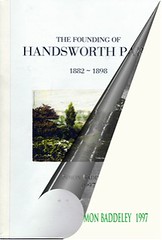
My history of the founding of Handsworth Park

The Earl of Dartmouth opens the Victoria Park Extension on 30 March 1898
This afternoon, I did another history tour of Handsworth Park - initially titled Victoria Park - but the chilly wet weather was too much for all but my friend Zarina, so we strolled round the pond in the wind and the rain for over an hour, meeting one of the rangers and the boatman and some people measuring the Canada Geese population ("There are too many" said one, while another wrestled a bird to the ground to ring it), sheltering under trees, gazing at the views, and chatting about lots of things - geese and whether its cruel to pierce their eggs, Guantanamo, that 'heavenly body' and the uses of sheep according to Lawrence Durrell in Prospero's Cell, the Sisters of Mercy Convent in Hunters Road, Mr Smiley's houses, plans for Aston and Lozells, the gate the developers want removed from the masterplan linking the park and the new houses on the Victoria Jubilee Allotments, the workings of the Serious Organised Crime Agency, discarded gum and cigarette butts, details of Austin Line's and Charles Palmer's lovingly restored fountains ("You know Palmer was a keen cyclist"), what to do about dog mess, the boats which were out again yesterday, the hoped for return of fish to the pond, the unmarked pauper's graves in St.Mary's Churchyard and the thinking of the people who created Handsworth Park - "so people like us could talk in a public place on a rainy day?" Strolled home to tea and coffee with Lin. Had a good afternoon yesterday attending a friend’s wedding where the pastor has been for 50 years and is struggling a bit with rituals - checking stage directions sotto voce. My friend M, arrived 50 minutes late, having struggled, she told me later, to get the clingiest of pale pink wedding dresses around her slender figure. She's now married twice - well actually thrice if you count yesterday. She divorced a while ago. Yesterday, having plighted their troths and sworn the vows the pastor started over “Do you – sorry remind me of your name – yes, right – OK - do you M take ... ?“ and so we went round again, everyone, including bride and groom, smiling and laughing at a joyful and hilarious piece of double knot-tying to the music of ‘Greensleeves’, through Handel’s ‘Behold the Lamb of God’ and the singing of ‘Amazing Grace’ and ‘When Jesus Washed – Oh happy day’, a Lesson from Ephesians 5, 20-33, some vibrant preaching with the tale of Paul shipwrecked on Malta surviving a snake bite - ‘for his destiny was Rome’ - and a convivial blend of black and white. Someone whispered to me later that the ‘pastor was past his best’ - yet he founded this church and saw its congregation through hard years of settling in England – years about which the Anglican communion in Birmingham has reproached itself for being less than welcoming to Christians from the Caribbean. It will be decades or more before a faltering secularist like me can compete with this sort of thing. Around 4.30 I was at The Village Cafe over from the Arcadian Centre with Richard and Amy enjoying noodle soup with roast duck. R took the car to work in Broad Street. Amy and I walked home via Bennetts Hill, the Jewellery Quarter into Hylton Street where a shoulder-width alley between workshops leads to Key Hill and the closed post office on Hockley Hill. By a bus stop among broken bottles lay the glossy cardboard packaging of a legless headless torso branded 'Heavenly Body'. We threaded the low tunnels and non-agora under Hockley flyover, up the sidewalk, past flytipping, past the nearly completed Gurdwara Babe-Ke - "Hey the fibreglass dome is rotating!" - down Naden Street (more an alley) where we were asked to a boombox enhanced block BBQ in the car park behind the redbrick flats overlooking Soho Hill. Along Hunter's Road, with the exception of the Catholic church and St.Mary’s Convent with their flowered frontages, a street of fine buildings has suffered low-budget private renovation. We walked on to the top of the hill and the tripartite junction of Weston Road, Hunters Road and Barker Street, wondering why some roads are called 'streets' and v.v., passing The Observatory Pub in the bow of one junction, and walking up Barker Street to the acutely angled Villa Cross, its identity mishapened by the disorder of the 1980s, losing us a cinema (already a bingo hall), pub (a drug market), shops (uninsurable) and gaining us a carpark, boarded up buildings and grant-funded offices with frontages attracting fly-posting as a cul-de-sac attracts flytipping, prompting traffic to pass rather than arrive. How titanic a task to draw in the involvement of its present and future population in reshaping this place and its surroundings. It can be done. People are working at it. We do meet and strive to get our minds around many tasks. It helps to have lots of cups of tea and biscuits. Promise exists - despite the acronyms of planning - in the Aston, Newtown and Lozells Area Action Plan (AAP) Issues and Options Report handed out at the Ward Area Committee last week. Comments need to go by 15 June 07 or phone 0800 694 3100. This plan will be part of the Local Development Framework (LDF) replacing the Unitary Development Plan (UDP). It's about the interconnection of housing, jobs, architecture, green space, health, education, transport, sustainability. It's about the circuitry of the area – IT, lighting, energy and water. It's about places to buy and sell, to worship, to play, to grow, to sit and talk, to listen, to eat, to associate, to read and view. It's about museums, gardens, smallholdings and trees and all with an eye to the broader changes that transform the practices and objects of one era so they become incomprehensible or impractical in another. Coming down Heathfield Road we came across three quite new brick houses in this dystopian place. They’d been built with such care and skill I wanted to clasp the hand of their builder. Amy took a picture she hasn't given me yet of a carved plaque in the wall of one house, saying it was built and designed by a man called Anthony E. Smile in 1998. Of course I’ve seen these many times but never asked about them. We strolled down Heathfield Avenue under trees and peered at the backs of the houses through iron gates. With a 'peep' of its horn an estate drove up. A lady introduced herself as Mrs.Smile. I shook her hand. "When you see your son please pass to him my deepest respect. He is a craftsman!" Smiley's houses are hope in brick. Mrs Smiley said "See the Lodge at the top of North Drive. My son worked on that." We did. This was the Lodge at an entrance to James Watt's Heathfield Estate, the original house demolished and what would now be called executive homes built in eclectic styles in the 1930s and now made more eclectic by prosperous newcomers who instead of flying to the suburbs on making their wealth have stayed in wicked Handsworth. The rawness of some renovations, such as the giant rampant gilt lions on one frontage, has not yet been moderated by the patina with which time can moderate the flamboyant impulses of new money. We walked on down North Drive, turning left along Gibson Road cursing the non-planning that had permitted the placing of several ill-proportioned new houses, still fenced off with paling and barbed wire, much too close to the pavement with diminutive back yards taken from gardens in North Drive. "It's someone in North Drive who's built them" said Amy. Greed in brick. So we came home, having enjoyed several little adventures. (see this entry 13 Dec'11 on a proposed Heritage Trail for Handsworth and Lozells)

Saturday, 19 May 2007

Free cycling

Errands day. Mowed lawns, fed fish, put out nuts for birds. Saw a Greater Spotted Woodpecker in the garden. Great Tits are nesting in the bird box Amy made. The sun's shining between showers. I'm spending too much time on the computer still entranced by the window it offers to hop and skip about the world in tune with my jackdaw temperament. Lin's using freecycle to clear the house of a plethora of things we don't need.
She sells things through eBay and now Ebid "eBay's got too dear". I haven't been in the University Library since they installed turnstiles a decade or more ago. All the reading I need for keeping up I can get from the papers and books I identify from web references, the remarks of colleagues and the people I meet when teaching round the country and some specialist websites, as well as the on-line library now better set up for being accessed by computer than by humans searching stacks - with the exception of the rare books and manuscripts section. Yet I love books and resent the lack of quiet public space to enjoy them. I see the Evening Mail published my letter this Tuesday:

'Sir. I’m vexed to learn that the Council is seeking an application to extend the presence of the BBC screen in Chamberlain Square – especially now the Town Hall has been renovated and is looking so good. Because no-one makes a public fuss about it I wonder if those asking for it to stay have any sense of how some resent its presence and were looking forward to its removal. This massive TV screen, with its constant sound track, blights an area meant for rendezvous, debates or strolling through, turning it into an open-air domestic space encouraging passivity and blemishing the Town Hall’s façade.
The prospect of an urban beach with deck chairs from which some can watch the tennis this summer is a further example of the way a civic square that is part of Birmingham’s identity has been confiscated from the rest of us to allow part of the population to accumulate yet more hours in front of the television. Yours'

[Harumph. The screen overlooking Chamberlain Square will go in October but from June to September the Council is supporting a £50,000 beach for the public paid for by a cheap flights airline. 'Visitors to Birmingham will be able to relax in deck chairs under palm trees, play volleyball and watch live entertainment on the BBC TV Big Screen' was a recent news item. One councillor says this is fine "because it worked in Paris", but there Mayor Bernard Delanoe's 'Paris-plage' runs along the banks of the Seine reclaiming it from a busy dual carriageway for the summer]

Cycled to campus via the canal yesterday Oscar trotting beside me and in a courier bag when on the roads at either end. It was a colleague's last day at work after 30 years. We signed a card, made a donation and had a chat, bringing Oscar to be stroked. Also half an hour with another colleague, off to a conference in America on leadership. He's helped with my thinking and teaching. The day before I went to a meeting in Llandrindod Wells and my train broke down at Wolverhampton. To get to the meeting I paid £107 for an 80 mile taxi ride with a fast nice driver from India [he told me when we parted with a wave and an exchange of first names, having arrived on time]. Later I sent a letter of complaint to the train operator plus copies of tickets and expenses (all takes ages which is why some don't bother). The most I'll receive for my trouble will be an ill-phrased apology and a futile explanation.
'The ship sank as a result of coming into contact with an iceberg. We are very sorry for any inconvenience this has caused to your journey. We hope you will continue to travel with White Star Line.'
This has happened three times with the same rail operating company since January 2006. Yet I enjoy travelling in trains far more than in cars.

Back numbers

Simon Baddeley