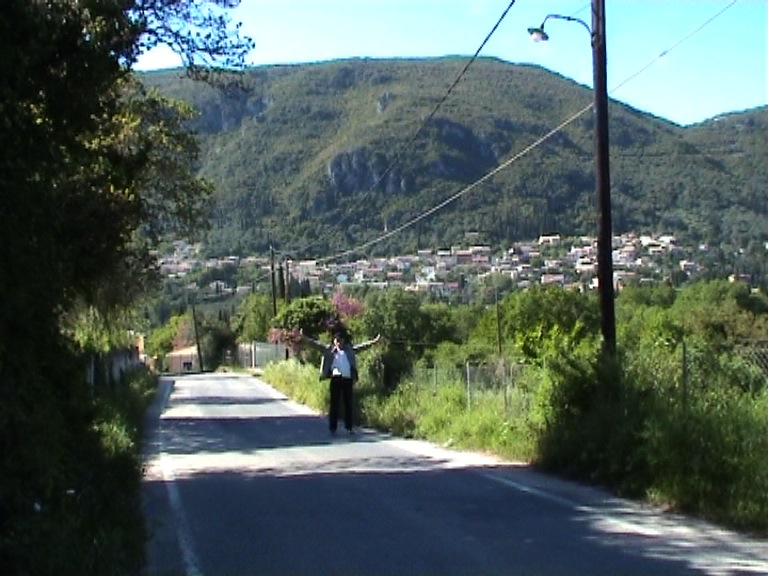
Our son turned up at Democracy Street, unannounced as he prefers. I’m always half expecting such surprises; wondering if it was I or he or she who left the key in the door. When anyone’s here, sleeping below, I, in the morning, put on my slippers and, in dressing gown, go up and down the outside balcony stairs for morning tea, brushing wisteria leaves and honeysuckle, exciting the suitor cats that wait outside; and in passing I check the citrus leaves for scale insects. I’m more confident, though more proof awaits, that there’s a relationship between the ants that live around the house and the orange and lemon trees that grow so close to it.

Around trunks and branches I’ve bound sticky paper, strips of flypaper stuck together, bound with garden string; duct tape back to front. But yesterday I found that a young Dahl’s whipsnake (Σαïτα), in stalking a cricket already stuck, had glued itself to one of my ant barriers. I’d hoped it might have been an Aesculapian snake (Λαφίτης του Ασκλληπιού); that this rare sight of the healing snake, which looks similar, might have been a good omen for the citrus trees. I tenderly eased the little olive hued snake’s slender body from the sticky paper, so it could escape into a crack in the terrace wall. The cricket with its long legs leapt free of its own accord.
Where I’ve found a stream of ants walking back and forth I’ve searched their base and poured on boiling water. In one less accessible space, some poison. In a few days I’ll apply bait (“I’ll have some next week”, says the man at the garden shop in Kontokali). The ants can collect the sweet poison I lay down, take it home and share it with their children.
Every few days in the evening cool I spray the underneath of leaves with Lin’s olive oil soap bars dissolved into a milky solution. Leaf growth is now vigorous; scale insects are now far fewer - two or three on a rare leaf. I pray for blossom. Early in April I wanted to save myself the work of pumping our manual spray whose pressure lasts all of 30 seconds. I added the olive soap solution to the tank in a pressure washer, thinking to speed the job. Such folly! The powerful spray drenched the trees but in the process I blew away emerging blossoms. I feel animosity towards these insects whose innate habits have prevented our trees fruiting, and could kill them by blocking them from the sun. I'm mortified by this conspiracy of ants and scale insects. Instead of detached wonder at how ants corral scale-insects to the underside of citrus leaves, stroking them into extruding the honeydew, which attracts black mould to the upper surface of leaves, I cultivate chagrin.
“Do you have to strangle trees to get your honeydew?”
“We’re harvesting honeydew” sing the ants
“We love being stroked” sing the scale insects
“Yes, but don’t any of you bloody understand, you’re preventing photosynthesis?”
“What’s that?”
“Black mould!”
“What’s that?”
“It stops the sun getting to the leaves”
“Hunh?”

I wander off muttering curses. If I come to a fuller understanding of this leaf invasion and its consequences; if I come to know that our attempts at prevention and recovery have worked; that we again enjoy our pleasing harvest of oranges and lemons; I’ll become objective. For the moment there’s no peace. That confession made, I hear Gerald Durrell’s warnings, so eloquently repeated by so many, about the feckless way we humans are treating our environment and the catastrophe that awaits us if we don’t change our rash ways, and take more care of the earth.
 ** ** **
I have seen a difficult film – not surreal, not a thriller, nor vicarious ‘horror’; Son of Saul by László Nemes, set in the Auschwitz II-Birkenau in 1944. I’d been bracing myself to watch it, knowing it was about Death camp victims used by the Nazis to work as Sonderkommandos - able bodied inmates allowed to live slightly longer as forced labour, ushering new arrivals into the ‘showers’, collecting bodies, feeding ovens, shovelling ash into a slow moving river. The main character recovers a dying boy, who for a fluke moment survived the gas chamber, and seeks a Rabbi among the arrivals to give him a proper burial, fantasising this is his own son. His efforts are dangerous and futile. The violence, but for blows of the Kapos’ whips, is in the wings, as in Greek Tragedy. It is terrifying, on the cusp of being watchable only for the art of the film-maker, coming in and out of focus, just enough to stay looking and listening - sounds are critical to the screenplay, including the gentle rain on tall trees behind the final credits - and the acting of Röhrig Géza as Saul, and the rest of the cast. That same night I got what I had earned. I dreamt our son had died in some unknown circumstance. I was to meet his body on its way to New York – as is the way with dreams there’s a lonely journey or mission, usually frustrated. In real life. Richard had indeed been to New York a few weeks back for work. At last I sighted the coffin parked on a JFK carousel.
“May I see him?”
It was oval, like a dog basket; rather too short for his tall slim body. What’s been done to him? A lid was raised. I saw him lying like a flaked icon long gone away - two dimensional. My feelings in the dream were contained, not detached; aching in my bowels on a note no strings of mine could sound. Lin might have rightly cried out, like Job’s wife, ‘Curse God and die” (Job 2:9). Later it occurred to me only The Burning Babe, poem of the martyr Robert Southwell, came close to containing such sorrow in words.
*** *** ***
On the first grey day Richard drove north – a long gentle descent from Sokraki, through Zigos, Klimatia, Episkopi, Mili and Platonas – to Roda. Shallow trenches of still water led to a grey sea bordering a grey shore on which ranks of hopeful sunbeds lay empty. Some holiday makers sat on their balconies looking at a tractor with a shovel lifting piles of dry flaky seaweed into a truck. The mountains of Albania were hidden by a damp haze. That evening we ate at 60 Needles in Kato Korakiana, and heard Alex, co-owner and chef, talking to two visitors
"The weather is unfortunate, but the rain is good as we’ve had none for over a month.”
On the second grey day Richard and I walked down a gravel track between thick wooded slopes and the meadows of the Ropa Valley, where sheep drifted between reed-lined waterways and willow wind brakes.

A half gale fretted at the tall trees lining our way – high venerable oaks, eucalyptus, cypress. As he does, my son walked far ahead, peering into hedges and verges, now and then, with bent knees, squatting to touch a leaf or push aside a stalk. Rain came in waves from the south. The full leafed trees kept us dry.

We came to a Theotoki Estate barn where we bought a red wine to have with the spaghetti Richard was going to cook that evening. Driving towards Giannades we’d turned sharply onto a narrow metalled road that ran down the middle of the Ropa plain, tufts of grass growing from fissures in its neglected surface. Richard braked abruptly and got out of the car to look at a terrapin on the verge. He eased it gently towards one of the long ditches running beside our road. We returned on the winding road through Temploni, stopping at Kaizani at Tzavros to buy salad.
I had had no more nightmares. We drove to the Nature Reserve by Ag Spyridon. As the holiday season picks up people drive cars along the gravel tracks here, but at this time people showed respect.
Only walking like us. I deviated down a grassier track into olive groves with the sound of innumerable insects, Richard again discovering things for us – a bush where many bright iridescent beetles were feeding on pollen, spiders with webs spread between trees, waiting. He teased one out with a blade of grass just touching its alarm strand. We walked an avenue of colour, scents and sounds. Sand bees turning up tiny mounds in our way. Bee flies whining like small machines. A big insect, yellow and white, buzzed us. On his mobile Richard called up photos of bees, wasps and hornets. I was sure it was one of the latter.
“It was a mammoth wasp. Apparently they don’t sting.”
Abruptly he reached out and grabbed a passing rose beetle, holding it long enough for us to look at it before it was away on its errand.
“How did you know that wasn’t a ‘flying olive’ - a carpenter bee?”
“I wouldn’t have grabbed it if it were”
We wandered down a narrower path that went by a ruined monastery - 'Ag Katerini' it said on Richard’s sat-nav. An empty beach appeared. White pebbles and tiny gravel merging into sand and, 19 miles beyond the bluest sea, the grand mountains of Albania.
“In less than a month there’ll be cars parked here, radios playing. Let them have their fun, but it’s good to have this place to ourselves.”
A ring had formed around the sun.
 We enjoyed lunches with friends.
“Would you ever want to live here. Richard”
“I need the city”
Kazantzakis’ view was that Corfu’s pleasant land makes men lazy, finally sucking out their energy. Dylan Thomas, invited to Corfu by Lawrence Durrell, wrote back something similar. He needed the sodden chill of Wales to write. Kazantzakis needed the dry crags of Crete. Richard Pine said that except for visiting their father, his daughters couldn’t wait to get back to Ireland.
“Next time you come we should go to Albania, or Zagori. Corfu is one part of Greece.”
** ** **
We went to the British Cemetery and wandered among old and new graves. George Psillas came to his door at the sound of the iron gate bell, and waved and smiled. He’s getting old now – as am I. One of the tortoises that roam here was covered in ticks. It was helpful in letting us remove two from its neck and head. We left the rest at the back.
“My goodness” I said squashing them with my thumb “they’re lively little bugs. I’m more used to getting them whole off dogs in the Highlands. How do they even get through a tortoise’s scaly skin?”
We walked in the dusk from Ano Korakiana to Panorama Bar at Ag Markos for mezes. On arrival as in other places I know well even though it may embarrass him I like saying “This is my son – Ios mou”..
In the dark, striding home, a torch to show ourselves to drivers on the narrow road, Richard stopped and shone it up on two edible dormice in a high olive branch. He’d heard their chatter. A minute later he sharpened the beam and pointed out two tiny bright spots further up the hill. Reflections.
“Probably a cat” he said
“Might be a Stone Marten”
On Richard’s last day here I took him to Pontikonisi on the five minute ferry. Several planes came in and out of Kapodistria, roaring enormously overhead. At the car-hire compound Yianni took over and drove Richard to departures (“Bye then. Kala Taxidi.”) I caught the 16.00 Paleo bus which dropped me at Doctor’s Bridge, 4 kilometres from the village. Only walked 5 minutes and Dimitri came by, stopped and offered me a ride to Ano.
I think I saw Richard’s flight pass over the mountains behind the village. When he was home that evening he posted me a picture I’d asked him to take after we’d walked up to the Church of the Prophet Elias to gaze towards Ano Korakiana, whose parish boundary it marks.
With my son home, I float again between being solitary and lonely. The one is good. The other, as Lin said before she left for England to look after her mum, less so.
“You’ll have to rely on DIY” Glue, filler and rough sanding for carpentry; butt joints for dovetails; at night 'no music in the nightingale'.
***** ***** *****
Sandwell MBC Planners are responding to a steer from their leading politicians. I begin to get hints of the future of Black Patch Park in the stolid, but reassuring, jargon of ‘implementation’. Time scales are being mentioned. From correspondence copied to a member of the Friends of Black Patch Park from Sandwell’s senior planning officer, I conjecture that Sandwell MBC Planning Department are formally ‘reviewing land in the Black Patch area to assess its potential for housing'. Nothing visionary, just ‘potential for housing’. Of course local government Planning officers are bound to a statutory planning process and to Sandwell's protocols on this kind of thing, meaning that initially planners, observing planning law, will present to Sandwell Cabinet, a ‘Planning Statement’ that outlines rough plans for new houses around Black Patch Park - Kitchener Street? Merry Hill Allotments? What we call Coppice Corner?
Sandwell’s Cabinet, who meet mid-afternoon on Wed 13th June 2018, will consider their officers’ planning statement and issue authority to their planners to consult the public and other agencies, on what Cllr Steve Eling at his meeting with the FoBPP last year referred to as a ‘schemata’. Public consultation could run through the summer of 2018, barring slips ‘twixt cup and lip, that I’m always inclined to anticipate. FoBPP will be expected to play an informed role in that consultation. It would follow, if normal planning process applies (and why shouldn’t it?), that a Master Plan and Interim Planning Statement, modified by comments received during the consultation, will be presented to Sandwell Cabinet for approval at their meeting in November 2018. That approval, if given, will be considered for ratification by full Council in January 2019.
As soon as rezoning for housing is politically approved, if it is, we will see another part of the council - Sandwell’s Strategic Assets and Land Service - advising members and officers on a statutory process of rezoning the areas defined in the modified Master Plan. The local structure plan will at last be changed to favour housing over, as at present, light industry, on land around Black Patch Park. Values will be placed on selected parcels of land for sale to housing developers. We can’t expect a result for this process in under 4 years. So at best we are looking to Spring 2022 – the year the Commonwealth games come to the West Midlands - before the way is clear for ground breaking around the Patch. Much can happen over this period. Much can be done by way of influencing the prime movers in this lengthy and uncertain process.
Right now, various small and very welcome improvements are happening in Black Patch Park - enthusiastically followed by FoBPP. Professional grounds maintenance is happening, where for the last two decades – at least - most council work focused, generally unsuccessfully, on the expensive work of preventing trespass and clearing up flytipping around the park, and flytipping inside the park, following illegal incursions by travellers using it as a caravan park, work space and dumping ground for every imaginable waste. The laying out of a temporary transit site for travellers on the edge of Foundry Lane in 2017 put a legal stop to that, allowing our ravaged and blighted Patch to have a good ‘wash and brush up’ and its first ‘back and sides’ in years; setting the scene for the return of a significant number of people to the area - pre-requisite for the success of a public park, as public green space is for the prospering of a community.
I’ve been wondering what would need to be touched on in any draft response to consultation on the forthcoming ‘Master Plan’ - given Sandwell Cabinet give approval to proceed. My own thoughts, which include issues Sandwell planners will, under their version of ultra vires, be unable to include or refer to in their forthcoming – we hope - Planning Statement…
*** ***
I am embarrassed, no, frustrated, that I have managed no further serious progress on making Aristeidis Metallinos, the laic self-taught sculptor of Ano Korakiana (Αριστείδης Μεταλληνός - 1908-19 May 1987), whose work for complicated reasons is unavailable. The sculptor lies with his wives and now his son, Andrea, who died in 2016, in the cemetery of Paraskevi Church at the foot of the village, which can be seen through the trees from down there.

The sculptor’s house from which he intended to make his work available to fellow villagers and visitors belongs, under Andrea’s will to one of his grand-daughters, Aristea, though Anna, his widow can live there for life. Andrea and Anna's other daughter, Angeliki, lives just outside the village, in a house built by Andrea. Aristeidis also had a daughter. Maria, who lives on the edge of Dassia with her family. Her son Tassos has paid for the website name that our son Richard has started to design to be a ‘virtual museum’ of the sculptor’s work.
Lin and I and Richard, honoured to be trusted by the family, have only made the village sculptor’s name and work as public as the family wants. No words or photos or pictures have been published without approval. As well as the website – that can expand as we add more pictures and information – I have ensured that Aristeidis Metallinos has an entry in Greek and English wikipedia. On my blog I have shown more of his work and given accounts of how our family came into contact with the sculptor’s descendants, and shown a picture of the epitaph on his gravestone. The artist, about whom the village maintains a certain silence, has been praised on the village blog by Thanassis Spiggos who has visited the collection.
In 2017, not long after Andrea, died the notices in stone and on a couple of road signs indicating that the house of the sculptor was a ‘Museum’ were removed. The collection sits in three darkened rooms, unseen. Angeliki, Lin and I, with Andrea’s and Anna’s permission, in April and May 2015, made a full inventory of each of the 255 works. Each sculpture bears a small number, and in the ‘catalogue’ has a name, dimensions and whether in local stone from the quarry at Sinies or Kozani marble. Tassos had earlier made a draft catalogue recording the date and words his grandfather had carved on many, translating them into English. Some but not all of these are to be transposed to the catalogue and added to the Aristeidis Metallinos website.
Tassos, much earlier, took small photos of each work. These are an invaluable record, but we all agreed that no sculpture would be portrayed on the internet unless photographed to highest standard against a neutral background. In 2016, Richard, with professional lighting and a white screen, made photos of several pieces...
 ...but there remains the challenge of how to move the heavier or more delicate pieces and friezes – whose present frames cover words on margins - to where they can be properly recorded for ‘virtual’ display. The website also contains an academic paper about the sculptor by Eurydice Antzoulatou-Retsila, retired professor at the School of Cultural Studies at the University of Peloponnese in Kalamata. There’s also an earlier short biography in a published record of Greek folk sculptors. There was a local radio programme, broadcast while Aristeidis Metallinos was alive. That is recorded and can be listened to in Greek on the website. As well as a photograph portrait of the sculptor on the website, I was able to get a sketch made from a photo of Aristeidis Metallinos at work by the artist Jan Bowman. She did this gratis - a favour for a recommendation I made about her work in UK. Jan’s signed original sketch I gave as a present to Angeliki. Richard and I presented a framed photo of one of my favourite pieces to Maria when she and her family invited us to her home.
 I shall never surrender my interest in this man. I rejoice in the friendship of his descendants – and their trust. When opportunities have arisen I have spoken about Aristeidis Metallinos to writers, artists, local historians and people of craft that I’ve encountered – so that his persona and art can perhaps be more widely known. Richard Pine included a photo of one of the artist’s sardonic comments in the form of a marble frieze recording the scandalous behaviour of ‘The Saint of Preveza’, in his recent book ‘Greece through Irish Eyes’. I have described his work to Katherine Wise, the artist sculpture who lives on the island; to the novelist Maria Strani-Potts and her husband Jim Potts author of a history of the Ionian Islands. I mention the man to strangers I think might be interested such as Alexander, with whom I have conversations at his bookbinding shop on Maniarizi Street just before it meets Filellinon Street, an narrow way off N Theotoki in town. I have had intriguing hints from people in Ano Korakiana who recalled the artist when they were children in the village. There is far more to be known. Perhaps paradoxically this does not worry me. There’s a pace to this. I have no interest nor does anyone else, including the sculptor himself, in fame or cash. I have great interest in learning – and Aristeidis has brought me that.
*** ***.
Mark, Stamatti and I in Piatsa, Ano Korakiana were looking over a poster showing pictures and giving brief descriptions and names in Greek of all the snakes and slow worms of Corfu.
This poster comes with Bo and Marie Stilles' brilliant book The Herpetofauna of Corfu and Adjacent Islands. It aims to add to knowledge and respect for the snakes. lizards, frogs, slow worms, tortoises and terrapins of the island. The Stilles are making a slightly smaller poster. all in Greek, that island teachers might like to use in the classroom. We tested customer's in Piatsa yesterday evening and nearly everyone recognised that the only venomous snake of the 13 species is the v easily recognised and timid Horned Viper. Good start. But we heard someone else who'd overheard our conversations dismissing 'all snakes with a hand wave' - his implication, all snakes should be killed on sight! Some of Galileo's detractors refused to look at his evidence through the telescope he'd invented with which it was possible to examine the moons of Jupiter - planetary dynamics that lay behind the new theory that the earth (and therefore Man) was not the centre of the solar system. Mark and I thought that a good classroom exercise would be to hide the key to the photos and issue the children (could be adults) with red and green post-it stickers and tell them to mark which species are dangerous and which harmless, with perhaps a yellow post-it for 'don't know'. It was an interesting exercise. I'd love to think that many Corfiots are actively proud of their wildlife and in this case the beauty of their almost entirely harmless snake population.
**** ****
Cycling on my hybrid on Ioulias Andreadi, on the way to SaRocco Square I was knocked off my bike by a driver in a utility truck pushing out of one-way Ipoliti Street. Drivers tend to edge their way into the main flow of two way traffic on I. Andreadi. He was no exception. I, with right of way, decided not to stop. He had the same idea - without right of way. Had I given way he could still have cut me up in turning left, so I thought to get past. I and bike lay for a second or two on our sides in the middle of the road. Stop-frame. He jumped out of his van; cried out he’d not seen me. Other drivers and pedestrians witnessed and looked concerned but I was up, unhurt, in seconds. “Look where you’re going” I said uselessly. I remembered the first time I had a proper fall off a pony, one summer when I was about 9 years old. “Get back on at once” was the rule. My head was bleeding a little. My hard hat had fallen off and the muddy ground was sun-hardened into sharp ruts from tractor tyres. Later the doctor inserted a stitch in a cut on top of my head. I recall being quite proud of my first fall. Being right by my favourite bike shop – George’s Bikeworks (Γιώργος Γκαβαρδίνας, ΠΟΔΗΛΑΤΑ ΑΝΤΑΛΛΑΚΤΙΚΑ ΕΠΙΣΚΕΥΕΣ) – I had him put my bike on the stand and check spokes, wheels, brakes and pedal crank. All fine. Meantime, arrived in a week by parcel post, to be collected from PO at Tzavros, a new front wheel for my Brompton, along with two Marathon Plus tyres – bloody expensive at £40 each, but supposedly the most resilient there are. Once again I can increase my range of travel on the island, by combining my folding bike with the Green and Blue Bus Schedules – except that across all Greece today and perhaps tomorrow there’s a General Strike. No planes, buses, trains, civil services or harbour workers – so also no ferries. Mark suggested that there’s so much and so many that depend on the arrival of tourists that cruise liners and private coaches and perhaps private workers in other places will keep some things going. I just heard a jet passing over low enough to have come from Corfu Airport.

Around trunks and branches I’ve bound sticky paper, strips of flypaper stuck together, bound with garden string; duct tape back to front. But yesterday I found that a young Dahl’s whipsnake (Σαïτα), in stalking a cricket already stuck, had glued itself to one of my ant barriers. I’d hoped it might have been an Aesculapian snake (Λαφίτης του Ασκλληπιού); that this rare sight of the healing snake, which looks similar, might have been a good omen for the citrus trees. I tenderly eased the little olive hued snake’s slender body from the sticky paper, so it could escape into a crack in the terrace wall. The cricket with its long legs leapt free of its own accord.
Where I’ve found a stream of ants walking back and forth I’ve searched their base and poured on boiling water. In one less accessible space, some poison. In a few days I’ll apply bait (“I’ll have some next week”, says the man at the garden shop in Kontokali). The ants can collect the sweet poison I lay down, take it home and share it with their children.
Every few days in the evening cool I spray the underneath of leaves with Lin’s olive oil soap bars dissolved into a milky solution. Leaf growth is now vigorous; scale insects are now far fewer - two or three on a rare leaf. I pray for blossom. Early in April I wanted to save myself the work of pumping our manual spray whose pressure lasts all of 30 seconds. I added the olive soap solution to the tank in a pressure washer, thinking to speed the job. Such folly! The powerful spray drenched the trees but in the process I blew away emerging blossoms. I feel animosity towards these insects whose innate habits have prevented our trees fruiting, and could kill them by blocking them from the sun. I'm mortified by this conspiracy of ants and scale insects. Instead of detached wonder at how ants corral scale-insects to the underside of citrus leaves, stroking them into extruding the honeydew, which attracts black mould to the upper surface of leaves, I cultivate chagrin.
“Do you have to strangle trees to get your honeydew?”
“We’re harvesting honeydew” sing the ants
“We love being stroked” sing the scale insects
“Yes, but don’t any of you bloody understand, you’re preventing photosynthesis?”
“What’s that?”
“Black mould!”
“What’s that?”
“It stops the sun getting to the leaves”
“Hunh?”

I wander off muttering curses. If I come to a fuller understanding of this leaf invasion and its consequences; if I come to know that our attempts at prevention and recovery have worked; that we again enjoy our pleasing harvest of oranges and lemons; I’ll become objective. For the moment there’s no peace. That confession made, I hear Gerald Durrell’s warnings, so eloquently repeated by so many, about the feckless way we humans are treating our environment and the catastrophe that awaits us if we don’t change our rash ways, and take more care of the earth.
Many people think that conservation is just about saving fluffy animals – what they don’t realise is that we’re trying to prevent the human race from committing suicide … We have declared war on the biological world, the world that supports us … At the moment the human race is in the position of a man sawing off the tree branch he is sitting on. GDI cut away the dead wood from a grape vine, yards long, that had seemed healthily spreading along one side of the apothiki. From the foot of the main stem I’d thought lost, a fledgling sprout rises beside a stack of thigh tiles. I gently pulled up, by its roots, a climbing pelargonium that seemed to be competing for nourishment from the same niche.

I have seen a difficult film – not surreal, not a thriller, nor vicarious ‘horror’; Son of Saul by László Nemes, set in the Auschwitz II-Birkenau in 1944. I’d been bracing myself to watch it, knowing it was about Death camp victims used by the Nazis to work as Sonderkommandos - able bodied inmates allowed to live slightly longer as forced labour, ushering new arrivals into the ‘showers’, collecting bodies, feeding ovens, shovelling ash into a slow moving river. The main character recovers a dying boy, who for a fluke moment survived the gas chamber, and seeks a Rabbi among the arrivals to give him a proper burial, fantasising this is his own son. His efforts are dangerous and futile. The violence, but for blows of the Kapos’ whips, is in the wings, as in Greek Tragedy. It is terrifying, on the cusp of being watchable only for the art of the film-maker, coming in and out of focus, just enough to stay looking and listening - sounds are critical to the screenplay, including the gentle rain on tall trees behind the final credits - and the acting of Röhrig Géza as Saul, and the rest of the cast. That same night I got what I had earned. I dreamt our son had died in some unknown circumstance. I was to meet his body on its way to New York – as is the way with dreams there’s a lonely journey or mission, usually frustrated. In real life. Richard had indeed been to New York a few weeks back for work. At last I sighted the coffin parked on a JFK carousel.
“May I see him?”
It was oval, like a dog basket; rather too short for his tall slim body. What’s been done to him? A lid was raised. I saw him lying like a flaked icon long gone away - two dimensional. My feelings in the dream were contained, not detached; aching in my bowels on a note no strings of mine could sound. Lin might have rightly cried out, like Job’s wife, ‘Curse God and die” (Job 2:9). Later it occurred to me only The Burning Babe, poem of the martyr Robert Southwell, came close to containing such sorrow in words.
*** *** ***
On the first grey day Richard drove north – a long gentle descent from Sokraki, through Zigos, Klimatia, Episkopi, Mili and Platonas – to Roda. Shallow trenches of still water led to a grey sea bordering a grey shore on which ranks of hopeful sunbeds lay empty. Some holiday makers sat on their balconies looking at a tractor with a shovel lifting piles of dry flaky seaweed into a truck. The mountains of Albania were hidden by a damp haze. That evening we ate at 60 Needles in Kato Korakiana, and heard Alex, co-owner and chef, talking to two visitors
"The weather is unfortunate, but the rain is good as we’ve had none for over a month.”
On the second grey day Richard and I walked down a gravel track between thick wooded slopes and the meadows of the Ropa Valley, where sheep drifted between reed-lined waterways and willow wind brakes.

A half gale fretted at the tall trees lining our way – high venerable oaks, eucalyptus, cypress. As he does, my son walked far ahead, peering into hedges and verges, now and then, with bent knees, squatting to touch a leaf or push aside a stalk. Rain came in waves from the south. The full leafed trees kept us dry.

We came to a Theotoki Estate barn where we bought a red wine to have with the spaghetti Richard was going to cook that evening. Driving towards Giannades we’d turned sharply onto a narrow metalled road that ran down the middle of the Ropa plain, tufts of grass growing from fissures in its neglected surface. Richard braked abruptly and got out of the car to look at a terrapin on the verge. He eased it gently towards one of the long ditches running beside our road. We returned on the winding road through Temploni, stopping at Kaizani at Tzavros to buy salad.
I had had no more nightmares. We drove to the Nature Reserve by Ag Spyridon. As the holiday season picks up people drive cars along the gravel tracks here, but at this time people showed respect.
 |
| Before the holiday season picks up |
Only walking like us. I deviated down a grassier track into olive groves with the sound of innumerable insects, Richard again discovering things for us – a bush where many bright iridescent beetles were feeding on pollen, spiders with webs spread between trees, waiting. He teased one out with a blade of grass just touching its alarm strand. We walked an avenue of colour, scents and sounds. Sand bees turning up tiny mounds in our way. Bee flies whining like small machines. A big insect, yellow and white, buzzed us. On his mobile Richard called up photos of bees, wasps and hornets. I was sure it was one of the latter.
“It was a mammoth wasp. Apparently they don’t sting.”
Abruptly he reached out and grabbed a passing rose beetle, holding it long enough for us to look at it before it was away on its errand.
“How did you know that wasn’t a ‘flying olive’ - a carpenter bee?”
“I wouldn’t have grabbed it if it were”
We wandered down a narrower path that went by a ruined monastery - 'Ag Katerini' it said on Richard’s sat-nav. An empty beach appeared. White pebbles and tiny gravel merging into sand and, 19 miles beyond the bluest sea, the grand mountains of Albania.
“In less than a month there’ll be cars parked here, radios playing. Let them have their fun, but it’s good to have this place to ourselves.”
A ring had formed around the sun.

“Would you ever want to live here. Richard”
“I need the city”
Kazantzakis’ view was that Corfu’s pleasant land makes men lazy, finally sucking out their energy. Dylan Thomas, invited to Corfu by Lawrence Durrell, wrote back something similar. He needed the sodden chill of Wales to write. Kazantzakis needed the dry crags of Crete. Richard Pine said that except for visiting their father, his daughters couldn’t wait to get back to Ireland.
“Next time you come we should go to Albania, or Zagori. Corfu is one part of Greece.”
** ** **
We went to the British Cemetery and wandered among old and new graves. George Psillas came to his door at the sound of the iron gate bell, and waved and smiled. He’s getting old now – as am I. One of the tortoises that roam here was covered in ticks. It was helpful in letting us remove two from its neck and head. We left the rest at the back.
“My goodness” I said squashing them with my thumb “they’re lively little bugs. I’m more used to getting them whole off dogs in the Highlands. How do they even get through a tortoise’s scaly skin?”
We walked in the dusk from Ano Korakiana to Panorama Bar at Ag Markos for mezes. On arrival as in other places I know well even though it may embarrass him I like saying “This is my son – Ios mou”..
In the dark, striding home, a torch to show ourselves to drivers on the narrow road, Richard stopped and shone it up on two edible dormice in a high olive branch. He’d heard their chatter. A minute later he sharpened the beam and pointed out two tiny bright spots further up the hill. Reflections.
“Probably a cat” he said
“Might be a Stone Marten”
On Richard’s last day here I took him to Pontikonisi on the five minute ferry. Several planes came in and out of Kapodistria, roaring enormously overhead. At the car-hire compound Yianni took over and drove Richard to departures (“Bye then. Kala Taxidi.”) I caught the 16.00 Paleo bus which dropped me at Doctor’s Bridge, 4 kilometres from the village. Only walked 5 minutes and Dimitri came by, stopped and offered me a ride to Ano.
I think I saw Richard’s flight pass over the mountains behind the village. When he was home that evening he posted me a picture I’d asked him to take after we’d walked up to the Church of the Prophet Elias to gaze towards Ano Korakiana, whose parish boundary it marks.
 |
| From the wall before Prophet Elias looking over towards Ano Korakiana (photo: Richard Baddeley) |
With my son home, I float again between being solitary and lonely. The one is good. The other, as Lin said before she left for England to look after her mum, less so.
“You’ll have to rely on DIY” Glue, filler and rough sanding for carpentry; butt joints for dovetails; at night 'no music in the nightingale'.
***** ***** *****
Sandwell MBC Planners are responding to a steer from their leading politicians. I begin to get hints of the future of Black Patch Park in the stolid, but reassuring, jargon of ‘implementation’. Time scales are being mentioned. From correspondence copied to a member of the Friends of Black Patch Park from Sandwell’s senior planning officer, I conjecture that Sandwell MBC Planning Department are formally ‘reviewing land in the Black Patch area to assess its potential for housing'. Nothing visionary, just ‘potential for housing’. Of course local government Planning officers are bound to a statutory planning process and to Sandwell's protocols on this kind of thing, meaning that initially planners, observing planning law, will present to Sandwell Cabinet, a ‘Planning Statement’ that outlines rough plans for new houses around Black Patch Park - Kitchener Street? Merry Hill Allotments? What we call Coppice Corner?
Sandwell’s Cabinet, who meet mid-afternoon on Wed 13th June 2018, will consider their officers’ planning statement and issue authority to their planners to consult the public and other agencies, on what Cllr Steve Eling at his meeting with the FoBPP last year referred to as a ‘schemata’. Public consultation could run through the summer of 2018, barring slips ‘twixt cup and lip, that I’m always inclined to anticipate. FoBPP will be expected to play an informed role in that consultation. It would follow, if normal planning process applies (and why shouldn’t it?), that a Master Plan and Interim Planning Statement, modified by comments received during the consultation, will be presented to Sandwell Cabinet for approval at their meeting in November 2018. That approval, if given, will be considered for ratification by full Council in January 2019.
As soon as rezoning for housing is politically approved, if it is, we will see another part of the council - Sandwell’s Strategic Assets and Land Service - advising members and officers on a statutory process of rezoning the areas defined in the modified Master Plan. The local structure plan will at last be changed to favour housing over, as at present, light industry, on land around Black Patch Park. Values will be placed on selected parcels of land for sale to housing developers. We can’t expect a result for this process in under 4 years. So at best we are looking to Spring 2022 – the year the Commonwealth games come to the West Midlands - before the way is clear for ground breaking around the Patch. Much can happen over this period. Much can be done by way of influencing the prime movers in this lengthy and uncertain process.
Right now, various small and very welcome improvements are happening in Black Patch Park - enthusiastically followed by FoBPP. Professional grounds maintenance is happening, where for the last two decades – at least - most council work focused, generally unsuccessfully, on the expensive work of preventing trespass and clearing up flytipping around the park, and flytipping inside the park, following illegal incursions by travellers using it as a caravan park, work space and dumping ground for every imaginable waste. The laying out of a temporary transit site for travellers on the edge of Foundry Lane in 2017 put a legal stop to that, allowing our ravaged and blighted Patch to have a good ‘wash and brush up’ and its first ‘back and sides’ in years; setting the scene for the return of a significant number of people to the area - pre-requisite for the success of a public park, as public green space is for the prospering of a community.
I’ve been wondering what would need to be touched on in any draft response to consultation on the forthcoming ‘Master Plan’ - given Sandwell Cabinet give approval to proceed. My own thoughts, which include issues Sandwell planners will, under their version of ultra vires, be unable to include or refer to in their forthcoming – we hope - Planning Statement…
1. Where would new housing go? The areas where there’d probably be new housing, include the vexed issue of the actual space that would, in Cllr Steve Eling’s view, allow for ‘a sustainable community’ around the Patch, what he has referred to as a ‘break out’ from the enclosing embankments of the ‘triangle’ - housing and roads (walkways, cycleways) between Perrott Street and the Metro stop (Winson Green Outer Circle) on Handsworth New Road - right at the end of the Sandwell apex.I suspect that the document presented for public consultation this coming month will preclude nearly all of these matters, as a Judge in court can prohibit use in evidence of all sorts of things the naïve plaintiff or defendant assumes crucial to their case. There’ll be stuff on central government planning guidance, the West Midlands Combined Authority regional strategy, revenue streams for housing as defined by Treasury restrictions on local authority spending over successive years. Local government’s room for manoeuvre is far more restricted in the UK than most of us realise.
2. How far will a proportion of new homes, as in the days – long ago now - before demolition and dispersal of the old Black Patch community, back onto or face the park without an intervening public road?
3. What will be the character of new housing in the area - as the Rev Ash Barker, vicar of the local parish of Winson Green, has put it, 'neither gentrified nor ghettoised’. What mix of single, semi-detached homes, apartments, courtyards, walkways, and of course how much space for car parking? People need and cherish their cars, despite government efforts to get more people walking, cycling and using public transport.
4. For what proportion of affordable homes will planners aim?
5. What commitment exists in Sandwell MBC (or Birmingham CC) to work in partnership with neighbouring Birmingham in the sharing of services (revisiting our analysis of the capacity of the local infrastructure - transport, schools, health facilities, care homes, community centres, places of worship)?
6. What measures will be introduced to ensure traffic calming and traffic reduction – especially along busy Foundry Lane - via diversion and filtering where road traffic presents hazards to residents and other park users?
7. What might be more original as ideas to plant, e.g. keeping a small proportion of allotments, opening up the Hockley Brook, enabling an element of co-operative self-build, a new or diverted bus route through the area, and the provision of local small shops and other businesses? What is planned to replace the current temporary transit site, and if it is replaced what is the legal situation with regard to its role in preventing destructive trespassing on Black Patch Park?
8. What possibilities are there for raising the standard of the piecemeal small business frontages along Woodburn Road - sole sad product of Sandwell’s rezoning of the area for light industry?
9. What steps will be taken to spark an interest in the regeneration project from the board of the multi-national corporation based in Chicago that owns the Avery-Weightronix site containing the moth-balled remains of James Watt’s Soho Foundry?
10. Given the need for central government approval for any major change of policy towards the area known as the Black Patch, what steps are being taken to get local MPs on board to lobby on behalf of the council for the ‘return of people to the Black Patch’?
11. Is there the possibility of capitalising on the much publicised rumour that Charlie Chaplin was born in a Gypsy caravan on the Black Patch more than two decades before it became a public park?
*** ***
I am embarrassed, no, frustrated, that I have managed no further serious progress on making Aristeidis Metallinos, the laic self-taught sculptor of Ano Korakiana (Αριστείδης Μεταλληνός - 1908-19 May 1987), whose work for complicated reasons is unavailable. The sculptor lies with his wives and now his son, Andrea, who died in 2016, in the cemetery of Paraskevi Church at the foot of the village, which can be seen through the trees from down there.

The sculptor’s house from which he intended to make his work available to fellow villagers and visitors belongs, under Andrea’s will to one of his grand-daughters, Aristea, though Anna, his widow can live there for life. Andrea and Anna's other daughter, Angeliki, lives just outside the village, in a house built by Andrea. Aristeidis also had a daughter. Maria, who lives on the edge of Dassia with her family. Her son Tassos has paid for the website name that our son Richard has started to design to be a ‘virtual museum’ of the sculptor’s work.
 |
| At Piatsa in Ano Korakiana, Angeliki and Linda looking at Richard's website |
Lin and I and Richard, honoured to be trusted by the family, have only made the village sculptor’s name and work as public as the family wants. No words or photos or pictures have been published without approval. As well as the website – that can expand as we add more pictures and information – I have ensured that Aristeidis Metallinos has an entry in Greek and English wikipedia. On my blog I have shown more of his work and given accounts of how our family came into contact with the sculptor’s descendants, and shown a picture of the epitaph on his gravestone. The artist, about whom the village maintains a certain silence, has been praised on the village blog by Thanassis Spiggos who has visited the collection.
 |
| Right to left - progress of woman sequence by Aristeidis Metallinos |
 |
| Aristeidis Metallinos carved this shoe in local stone 1928 when he was 20 and made no more sculptures until his old age |
Tassos, much earlier, took small photos of each work. These are an invaluable record, but we all agreed that no sculpture would be portrayed on the internet unless photographed to highest standard against a neutral background. In 2016, Richard, with professional lighting and a white screen, made photos of several pieces...


 |
| Aristeidis Metallinos, laic sculptor of Ano Korakiana (picture: Jan Bowman) |
*** ***.
Mark, Stamatti and I in Piatsa, Ano Korakiana were looking over a poster showing pictures and giving brief descriptions and names in Greek of all the snakes and slow worms of Corfu.
 |
| Mark and Stamatti in Piatsa, Ano Korakiana |
This poster comes with Bo and Marie Stilles' brilliant book The Herpetofauna of Corfu and Adjacent Islands. It aims to add to knowledge and respect for the snakes. lizards, frogs, slow worms, tortoises and terrapins of the island. The Stilles are making a slightly smaller poster. all in Greek, that island teachers might like to use in the classroom. We tested customer's in Piatsa yesterday evening and nearly everyone recognised that the only venomous snake of the 13 species is the v easily recognised and timid Horned Viper. Good start. But we heard someone else who'd overheard our conversations dismissing 'all snakes with a hand wave' - his implication, all snakes should be killed on sight! Some of Galileo's detractors refused to look at his evidence through the telescope he'd invented with which it was possible to examine the moons of Jupiter - planetary dynamics that lay behind the new theory that the earth (and therefore Man) was not the centre of the solar system. Mark and I thought that a good classroom exercise would be to hide the key to the photos and issue the children (could be adults) with red and green post-it stickers and tell them to mark which species are dangerous and which harmless, with perhaps a yellow post-it for 'don't know'. It was an interesting exercise. I'd love to think that many Corfiots are actively proud of their wildlife and in this case the beauty of their almost entirely harmless snake population.
**** ****
Cycling on my hybrid on Ioulias Andreadi, on the way to SaRocco Square I was knocked off my bike by a driver in a utility truck pushing out of one-way Ipoliti Street. Drivers tend to edge their way into the main flow of two way traffic on I. Andreadi. He was no exception. I, with right of way, decided not to stop. He had the same idea - without right of way. Had I given way he could still have cut me up in turning left, so I thought to get past. I and bike lay for a second or two on our sides in the middle of the road. Stop-frame. He jumped out of his van; cried out he’d not seen me. Other drivers and pedestrians witnessed and looked concerned but I was up, unhurt, in seconds. “Look where you’re going” I said uselessly. I remembered the first time I had a proper fall off a pony, one summer when I was about 9 years old. “Get back on at once” was the rule. My head was bleeding a little. My hard hat had fallen off and the muddy ground was sun-hardened into sharp ruts from tractor tyres. Later the doctor inserted a stitch in a cut on top of my head. I recall being quite proud of my first fall. Being right by my favourite bike shop – George’s Bikeworks (Γιώργος Γκαβαρδίνας, ΠΟΔΗΛΑΤΑ ΑΝΤΑΛΛΑΚΤΙΚΑ ΕΠΙΣΚΕΥΕΣ) – I had him put my bike on the stand and check spokes, wheels, brakes and pedal crank. All fine. Meantime, arrived in a week by parcel post, to be collected from PO at Tzavros, a new front wheel for my Brompton, along with two Marathon Plus tyres – bloody expensive at £40 each, but supposedly the most resilient there are. Once again I can increase my range of travel on the island, by combining my folding bike with the Green and Blue Bus Schedules – except that across all Greece today and perhaps tomorrow there’s a General Strike. No planes, buses, trains, civil services or harbour workers – so also no ferries. Mark suggested that there’s so much and so many that depend on the arrival of tourists that cruise liners and private coaches and perhaps private workers in other places will keep some things going. I just heard a jet passing over low enough to have come from Corfu Airport.