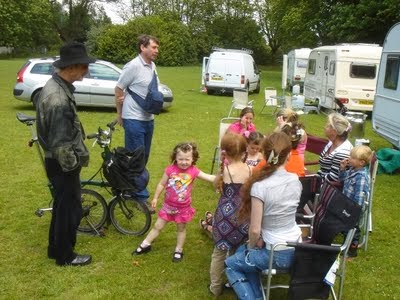
The Friends of Black Patch Park meet in the Soho Foundry Pub. Ron Collins, our Chair, on the left.
Stacey takes us through a CAD-CAM plan for Black Patch Park
A few days before Christmas I met up with my friends Andrew Simons and Phil Crumpton to design a tour of Black Patch Park. They, I and others have campaigned to save and restore this park for over ten years. A mix of protest, with lobbying by letter and meetings - plus the economic crisis - saved the place from ill-judged plans to designate this small green space for industrial building. Vital to the campaign has been the historical research and involvement of the Birmingham and Black Country historian, Ted Rudge. As well as collecting many messages and images from people in different parts of the world who recall childhood on the Black Patch, Ted has documented the enduring link between the Black Patch and the Gypsies...
The Loveridges, descendants of those evicted in 1910, campaigning in 2004, to save Black Patch Park.
...forcibly evicted from the area in the early 20th century to create a park, Gypsies whose descendants a century later joined with the Friends to campaign against building on the Black Patch.
This was from the first Wikipedia piece I wrote about the park in 2006. Black Patch Park and the adjoining Merry Hill allotments are 2.5 miles north-west of the centre of Birmingham on the Sandwell side of the city boundary, surrounded north, east and south by railway embankments. One of these carries the West Coast main line that with the A41 and Birmingham Mainline canal are the arteries, old and new, of what is now known as the city’s 'North West Corridor of Regeneration'. In the centre of Black Patch Park, Boundary Brook, which for centuries marked the boundary between Staffordshire and Warwickshire, meets Hockley Brook, which once separated the country towns of Handsworth and Smethwick.
Black Patch is a green pentagonal edged by Foundry Lane to the west and south, Woodburn Road to the north, and Perrott Street and Kitchener Street to the east beyond which, as far as Handsworth New Road, stretches the fertile triangle of Merry Hill Allotments.
Lying amid intersections, boundaries and important routes, Black Patch Park’s twenty plus acres have a special aura. Sometimes this place can be sunny and convivial, at others times, shaded, misty – especially at first light – and a little eerie; one moment a serene and peaceful place full of birdsong and the sound of breeze in the trees, another moment full of human activity and passing trains seemingly on every side.
Of course revisions removed all those unreferenced 'opinions' - quite rightly. I have not mentioned Kitchener Street which marches along the south west border of the Black Patch. It was once lined by terraced houses. These were demolished in 1980. Kitchener Street was gated in January 2009 under Section 129A of the Highways Act 1980 - a measure intended by Sandwell MBC to prevent fly-tipping along its length.
Kitchener Street in 2008
Phil and Andrew met me near the bridge in the centre of the park. I followed them with pencil and notebook as we discussed suitable places to stop and talk about an aspect of the park...
Philip and Andrew by the bridge at the junction of Boundary and Hockley Brooks - 22 Dec 2013
A WALK AROUND THE BLACK PATCH (first draft)
Notes prepared by Simon Baddeley, Phil Crumpton and Andrew Simon - for the Friends of Black Patch Park on a meeting in the park on Sunday 22 December 2013 to plan a visitors’ tour of the park
1. “Where we stand”, 52° 29.899', -1° 56.650' The bridge. Our tour starts at the ancient boundaries of Anglo-Saxon lands, where two streams meet...
...Hockley Brook and Boundary Brook. Bridged now; once a ford...in an area where a hundred and fifty years ago 'the earth seems to have been turned inside out.'*
The Black CountryKaulo = a Romany word referring to a common or heath, a term which is said to have originated with the large black waste lands about Birmingham and Staffordshire...in 1830 James Nasmyth, a pioneer of the machine tool industry, walking across the area, wrote...'The earth seems to have been turned inside out. Its entrails are strewn about; nearly the entire surface of the ground is covered with cinder heaps and mounds of scoriae. The coal which has been drawn from below ground is blazing on the surface. The district is crowded with iron furnaces, puddling furnaces, and coal-pit engine furnaces. By day and by night the country is glowing with fire, and the smoke of the ironworks hovers over it. There is a rumbling and clanking of iron forges and rolling mills. Workmen covered with smut, and with fierce white eyes, are seen moving about amongst the glowing iron and the dull thud of forge-hammers. Amidst these flaming, smoky, clanging works, I beheld the remains of what had once been happy farmhouses, now ruined and deserted.'
Boundary Brook in summer
2. Black Patch and the Gypsies - "magic hanging in the air"52° 29.950', -1° 56.673' On the rough path into the park just off Woodburn Road and opposite Anne Road. Here we speak of the Industrial terrain of the Black Country – high undulating banks of slag, foundry waste. Detritus and oily trickling waterways – and learn about the Gypsies with Black Patch Park and how they were violently evicted from here in order to found Black Patch Park in 1905.
We chat with Michelle and Bridget and families on the Black Patch in June 2011
The story, as told by Ted Rudge, of Queen Henty and her husband. Her curse on anyone who builds on the Black Patch. (Her ghost - scroll down this 2011 blog entry to read an account)
Queen Henty
Bryn Phillips "Queen Henty might put a curse on you"
3. From a place to a limbo,52° 29.929', -1° 56.821' Standing on the pavement next to the park just where the Hockley Brook passes under Woodburn Road. What was once a ‘place’ before the industrial revolution and continued as a space between factories for dumping waste and as a Gypsy settlement has, post-industrialisation, become almost a non-place, its surrounding factories mostly derelict and the surrounding population, once its users, decanted from the area. This is the challenge for the future of the Black Patch, on the boundary of two local councils, to be better recognised as a stewarded public space. recalled with nostalgia by people who once lived by, and played in the park.
4. The Old Main Entrance to the Black Patch, 52° 29.916', -1° 56.848' From a position just inside a corner of the park where Woodburn Road meets a bend in Foundry Road. An avenue of mature London Plane trees runs south-east against a background of Grey Poplars lining the Boundary Brook on the other side of the main playing field. This is one of the finest views of a typical late Victorian Park, snowy black and white in winter; a feast of greenery in summer. and...
...if you gaze slightly right from the tree-lined avenue, you glimpse a long mound, intended over a decade ago, to be a BMX track. Just before that, covered by greenery is all that remains of the small cottage that was the home of Mrs.Hill. Before the cottage was built, this was a camp-site - parking for a vardo in which Hannah Chaplin, née Hill, gave birth, in 1889, to a baby boy.
Charlie Chaplin by Peter Ackroyd, Chatto & Windus: London 2014, p.4
Transcript of a particular letter that Chaplin, who received millions of letters, kept on its own in a locked drawer
Charles Chaplin had his upbringing - a difficult one - in south London, but unless there's credible rebuttal, Smethwick's Black Patch, rather than London's Southwalk, has become the great comedian's strongly rumoured birthplace - 52°29'53.3"N 1°56'49.6"W
Hannah Chaplin, née Hill
The Chaplin birthplace conjecture was artfully fuelled in the TV series Peaky Blinders, series 2, episode 5 (2013) - creator and writer Steven Knight:
"...I was a bookie in Birmingham, then he went to Los Angeles.
You see, Wag is also a Romany Gypsy, as is Chaplin.
But he keeps it a secret. Chaplin was born on the Black Patch, a Gypsy camp in Birmingham..."
Back to the future 2/8/15: I made a video recording on Sunday 26th July 2015. It shows Ted Rudge, author of Brum Roamin' and Charlie Chaplin's son, Michael Chaplin, visiting Black Patch Park. The clip records a gathering of Gypsies and friends at the bridge in the centre of Black Patch park, where a memorial has been set up, recording the association of Romany with the Black Patch. Michael Chaplin speaks of his belief that his father was born here....
5. The Coppice, 52° 29.811', -1° 56.726' Having strolled down the SE avenue, we stop where the path divides, to meet an exit into Foundry Lane just before the Soho Triangle of the old LNW Railway or north east along the edge of Boundary Brook. This was a confluence of local population, industrial buildings and parkland; the park ill-tended; the population dispersed; the industry departed. There are views to be restored, easy to see with a selective cutback of shrubbery and windfall saplings, of the Victorian railway viaduct and embankment to the south, old industrial roof tops to the north west and, due east, the distinctive square redbrick tower of Bishop Latimer Community Church.
The coppice
6. Warwickshire triangle52° 29.879', -1° 56.625'. We stroll north east along the west bank of the Hockley Brook the main playing field on our left, cross the bridge, and enter the overgrown area of the Black Patch bounded by Perrott Street and Kitchener Street where there was a Primary School whose playground markings and concrete turtles still show through brambles and brush, the space so overgrown it is near impossible to see the older tree lines. There’s an entrance to the park off Perrott Street which brings you to a small undulating green sward, isolated from the rest of the Black Patch.
Warwickshire Triangle
7. The Main Playing Field, 52° 29.875', -1° 56.728' Walk back across the bridge and head south west to the centre of the main playing field. Here is an opportunity to gaze about at the original space that was created by John Nettlefold's Birmingham Playgrounds, Open Spaces and Playing Fields Society to meet the needs of the new industrial population that surrounded the Black Patch. It is an area that is still much used by footballers of the Warley League.
8. Soho Foundry, 52°29'50.46", -1°56'50.94" Stand beneath the imposing gateway of the Soho Foundry, opposite its eponymous pub where the tour can end with a drink and snack. This place is a prime target on the 1940s German air reconnaissance maps - some of them which we saw in the Avery Historical Museum entered below this gateway – the centre of an industrial hive.
Black Patch Park is closely NW of the 3 parallel roads - Wills, Markby and Preston - at the lower right hand corner of the 1940s Luftwaffe reconnaissance photo
It is also where our tour might continue - exploring the remains of the Soho Foundry and, still standing and part-used, the 19th century houses, first to be lit by gas.
Andrew and Phil
Black Patch Park was saved from building, but it remains a blighted and derelict space
*E-mail from Phil Crumpton on 15 Feb 2014 re that place in Black Patch Park:
Hi, Simon...Mercia before William Conqueror, Kingdom of Mercia was almost the monopoly of England outside Essex, Wessex, East Anglia and Kent with Sussex. Western area was mostly Welsh border and still to be tribally fought over.
WHERE BLACK PATCH ( then Handsworth Plain and Pre-'Smithwick' ) ended up as a camping site for Roma was to form a later eastern boundary to pre-date the convergence of Staffordshire; Worcestershire and Warkwickshire. That's where we (3) stood on the bridge as the brooks joined up in the park. We have to work on County Boundaries that also differentiate the site from the Norsk Invasion period that saw so much pre-industrial fallowness. People were more welcome to 'live' at the Patch in those times than they are accommodated, today...!
Let me know what you think. Watching (videoes) and brushing up on my Smith Wick knowledge over this weekend. See you on tuesday night at the AGM where I think there's likely to be many hours of lively discussion. Phil.
If I was adding to points on this tour I'd include the way in and out of the area that brings a visitor to Black Patch Park via the Birmingham Mainline Canal towpath, up Avery Road to meet Foundry Road - a hedged path almost a tunnel - 52.495691, -1.947895 - at the bottom of the Avery Road cul-de-sac. It leads about 100 yards via a couple of kinks to and from the waters of the canal and its towpath back two miles or so eastward into Birmingham or six or seven miles westward to Wolverhampton.
The path to Black Patch Park from the canal
Cycle and walking path from Avery Road to the canal towpath - a Sustrans route
*** *** ***
My longing for Greece is palpable. In days from the cold Adriatic I shall touch the concrete at ugly Igoumenitsa Port. We'll walk a kilometre to the ferries for Corfu.
A view from Ano Korakiana - the ferry from Venice to Igoumenitsa in the centre of the Kerkyra Sea
The Philharmonic Christmas Concert on Sunday, December 29, 2013, is in the church of St. George, in our village στο χωριό μας.... Χριστουγεννιάτικη Συναυλία Η Χριστουγεννιάτικη συναυλία της Φιλαρμονικής την Κυριακή 29 Δεκεμβρίου 2013, στην εκκλησία του Άη-Γιώργη, στο χωριό μας.
*** *** ***
These last few months have been spent working on the soil of my allotment. I've invested in manure and topsoil and paid someone younger and stronger than I to spread and dig it in. My neighbouring plots seem neglected, even for winter, after small bursts of enthusiasm earlier in the year...
These allotments are sketches of achievement and shortcoming; aspiration and lethargy. How appropriate that the word ‘plot’ also means 'story'; in mine and my heighbours' cases. biographies - more complicated than the original purpose, which was an allotted piece of ground off which a working man, often an émigré driven from the countryside, could feed his city family. These allotments test more than our craft as gardeners. Standing on my rented ground I gaze hopefully at a mirror.
The shed came free. We got it for the cost of transport via Freecycle. I repainted it, re-roofed it and added a veranda. Inside it's neat. I keep only hand tools there, most hung neatly on hooks. My neighbour's bees, to the west of the shed, are surviving the winter so far. We continue to take out couch grass, removing the spreading white roots and their rhizomes. Some of the plot is covered in black polythene - bringing the couch roots to the surface for elimination. Just to the east of the shed, four builder's bags are composting green waste. There's a water tank beside the shed door - a gift from a neighbour. The whole plot has been deep dug over several times. The collection of middle sized stones is getting larger as these are sifted out and separated from the soil. They're flattish and round, a reminder of how millions of years ago a wide warm river ran through this part of the world, Our five fruit trees have survived another year. We are half through the fourth year of the tenure for which I signed on the Victoria Jubilee Allotments. My plot is just acceptable; just satisfactory; clearly being worked. Having campaigned ten years to prevent the whole area being used for building, this is a small island in which I rejoice.
June 2010 - Adrian Stagg welcomes new gardeners on the opening days of the VJA
Yesterday evening after various morose chats at Sally’s Taverna in Ipsos, while I did email, having again bailed Summersong’s cover and checked her mooring lines, I treated myself to several euro’s worth of prosciutto at AB and bought a bottle of Tequila to make the puddings I’ll serve my guests next Wednesday.
Christopher at the bar in Sally’s said he hoped Greece would revert to the drachma, that indeed the whole Eurozone project should dissolve and everyone go back to their own currencies. I disagreed, though that could well be the succession of events if Greece defaults.
“Angela Merkel’s tied her place in history to Germany saving the eurozone” I said
“And she’ll be out soon along with Sarkozy” replied Christopher "and then things’ll start to happen”
“And what will happen to the poor and dispossessed of Europe?”
“They’ll go to the wall” muttered Scot George, sat next to Christopher at the bar.
“The family will return to its own, and the villages” said Christopher
“They’ll go to the wall” repeated George, who’d been complaining how the UK government keeps extending his pension date.
In the dark I began the ascent from Pirgi to Ano Korakiana, a route I've come to know by signs, shrines, buildings, particular stretches of fence and bends, dividing up my journey in my head to spread my pedalling energy. The Kandylakia which mark halfway and completion of the main hill to Ag Markos are, Sophia told me last Sunday, not shrines for road victims, but mark churches at the end of steep paths. Up and up I went, until the road became black, lit by the dim light of my cycle dynamo’s headlamp.
Panorama Bar
In Ag. Markos I stopped at the Panorama Bar, a small warm oasis. I greeted three men in there, ordered a glass of wine and sat on a sturdy dark varnished bench close to a wood stove. We stared up at a TV screen over the door, relaying pictures of a seriously concerned news announcer, ribbon titles running across the bottom of the screen as clips came from the European Parliament, from the Bundestag, and the chamber of the Hellenic Parliament, earnest Greek, German and Italian politicians sub-titled in Greek, interspersed with serious groups of men holding folders walking in bunches in and out of glass foyers, a shot of Venizelos speaking over a bouquet of logoed sponges on sticks...
...with cut-backs to studio conversation, with repeated shots of Athens police in riot gear dashing about Syntagma targeted with missiles, fireman hosing smoking burning buildings, glass strewn streets and a shopkeeper wringing her hands over the wreck of her shop. Now and again one of the men in the Panorama would make a laconic comment on what we were viewing. The others would smile and shrug resignedly, observing shared dismay. A long-haired terrier wandered out from behind the bar, its coat matching the tawny floor. I stroked and scratched its back as it sniffed my feet. Someone spoke to it in a friendly way. It settled by the fire as a woman came out, the owner’s wife, to join the taciturn company. The owner wandered over, hefted the round stove lid with a neat tool, peered into the glowing fire and added a log. The TV switched to a weather report on deep snow in Macedonia, pictures of snow ploughs in narrow streets, sheep and goats herded into byres, a well scarfed woman telling us it was cold and snowy, with subtitles saying it was cold and snowy. I said 'goodnight' and headed on up the darker road to the village..
The road to Ano Korakiana
..glad to see the street lights that start around the road up to Venetia. At the shop I asked Stammatis about 'the news'.
“The football?”
“No no. Greece!”
“I only get football on this set”
"Goodnight Stammati"
"Goodnight Simon"
*** ***
Jim Potts on Corfu Blues has had a go - quoting some telling passages in Greek and English, in support and refutation - at answering my first 'exam' question to him and Maria when we were lunching at Rouvas the other day:
1. Is the architectural, environmental and spiritual desecration of Corfu offset by the alleviation of the material and mental poverty of its population?
This is one from Augustus Sordinas on The Corfiot Peasant:
*** ***
Our ward councillor Waseem Zaffar in Birmingham Handsworth, has asked as many of as can to contact as many others about the second conference for the ward on 3 March:
Dear Colleague. You are cordially invited to attend the second annual Lozells & East Handsworth Ward People's Conference 2012. The Conference will be held at 10.00 - 1.00 pm on Saturday March 3 2012 at City College Birmingham (Soho Road Handsworth Campus B21 9DP).
The Conference continues the theme 'communities coming together' - how, with fewer resources, residents, third sector and public sector organisations can work together to make Lozells, Handsworth and Birchfield better places in which to live and work.
People's Conference 2011 succeeded in raising key themes and putting forward recommendations for addressing them. We have been acting on those recommendations and are organising this Conference as a way of sharing with you what we have been doing as well as illustrating some of the exciting initiatives occurring across the ward.
On behalf of the Conference planning group, I would like to express our genuine enthusiasm for this Conference. As a community we have so much to celebrate and yet so much more to achieve. I hope you will be able to join us for the Conference and help us continue the momentum that has developed.I hope you will also be able to pass this information to family, friends and colleagues who might not have been included in the mail-shot. It would be helpful for catering purposes if you could indicate the likelihood of your attendance. For any further information, please do not hesitate to contact me or Michael Brown of the North West Birmingham Development Agency on 0844 870 7982 or by email Michael Brown michael.brown@nwbda.org.ukYours truly, Waseem Zaffar Councillor for Lozells & East Handsworth Ward
Lin's copied me her letter to members of the voluntary advisory group for Handsworth Helping Hands (HHH), previously Central Handsworth Practical Care Project (CHPCP)
Dear All, I've renewed our free tipping permit, though it won't be for long. Attachment is description of our status and intended activities that I sent Bridget Kearney, Birmingham City Council, Fleet & Waste Management, for their records.I've advertised the chipper on the Prelovedwebsite. I'll put it on more sites when I have time. I'm hoping to get to the meeting at Mayfield on Thursday re. Heathfield Neighbourhood Forum. Might see some of you there. Lin
And again Waseem has sent this round to kick off a new forum more specific to our area within his ward:
The launch of Heathfield Neighbourhood Forum is taking place on Thursday 16th February, 6.30pm start at Mayfield Special School, Heathfield Road Entrance, Heathfield Road, Birmingham B19 1HJ. Are you concerned about the issues affecting your area including: environment, health, transport, leisure facilities, education, housing, jobs and training, community safety & crime. Then join the HEATHFIELD NEIGHBOURHOOD FORUM. A community meeting has been organised for local residents who are interested in tackling issues affecting the Heathfield area including all roads within the perimeter of Lozells Road, Birchfield Road, Church Hill Road (not including Church Hill Road) and Hamstead Road. Do you care about where you live and want to play a more active role within your community, then come along to Mayfield Special School to find out more information about the steering group launch for the Heathfield Neighbourhood Forum. Ongoing training and support will be available to all the volunteers. Free energy saving items will be given to all those participating. For further information and clarification of the neighbourhood forum area, please contact Rajinder Rattu of Neighbourhood Consultancy on 0121 448 8187 or email rajinder@neighbourhoodconsultancy.co.uk - please forward information across your networks. Yours truly, Waseem Zaffar, Councillor for Lozells & East Handsworth
Telephone/Fax: 01215513300 Mobile: 07790 161889
Email: waseem@waseemzaffar.co.uk
Mail: 16 Heathfield Road, Birmingham B19 1HB
Website: www.waseemzaffar.com
Twitter: @WaseemZaffar
Facebook: Waseem.Zaffar
Skype: Waseem.Zaffar1
LinkedIn: Waseem Zaffar
BBM: 272EE8CA
We've also got messages about new localised refuse collection arrangements happening soon:
Dear Colleague. Following the pilot of ward-based refuse collections in the South East of the City, Birmingham City Council have decided to introduce this form of refuse collection across a number of wards across the city including our ward, Lozells & East Handsworth, with an introduction date of Monday, 6th February 2012. In brief this will result in all refuse collection and recycling rounds being changed so that each ward will have a dedicated refuse collection and recycling crews. According to Birmingham City Council, as well as improving accountability this approach allows for greater synergy between the refuse/recycling crews and the dedicated street cleansing teams already working in the ward. However, as the existing collection rounds are not co-terminus with wards, implementation of ward based collections means that there will be changes in the day of collection for many residents. The time of day collections are made may also be changed, but will be between 6.00am and 3.30pm. Birmingham City Council state that as with the pilot, there will inevitably be some teething problems as residents and crews adjust to the new arrangements. However, to keep this to a minimum, each household in the ward will receive a post card outlining the new arrangements and days of collection. A hotline has been established by the Council for enquiries from residents. Please telephone 0121 675 7454 to report any issues with the new service or visit the website www.birmingham.gov.uk/collections.
I also enclose a map that has been provided to me illustrating the collection day for different areas of the ward. Please try to convey this information to local residents to ensure a smooth transition to the new system. Please forward this email across your networks. For any further information, please do not hesitate to contact me. Thank you. Yours truly, Waseem Zaffar, Councillor for Lozells & East Handsworth Ward
*** ***
Email purporting to come from my friend Ted Rudge. My server thought it was spam, but it used his normal e-mail address.
From: <his email> Subject: ?spam? Terrible Trip....Ted Rudge Date: 16 February 2012 12:37:45 EET Reply-To: <same name different e-dress>
Sally looking over my shoulder said 'delete at once', but I hesitated. I know Ted so well and 'if he's in trouble' I thought, yet spelling, grammar and style! Woeful. But then he might be distraught, injured, whatever:
I really hope you get this fast. I could not inform anyone about our trip, because it was impromptu. we had to be in Madrid , Spain for a program. The program was successful, but our journey has turned sour. we misplaced our wallet and cell phone on our way back to the hotel we lodge in after we went for sight seeing. The wallet contained all the valuables we had. Now, our passport is in custody of the hotel management pending when we make payment. I am sorry if i am inconveniencing you, but i have only very few people to run to now. i will be indeed very grateful if i can get a loan of 2,720 Euro from you. this will enable me sort our hotel bills and get my sorry self back home. I will really appreciate whatever you can afford in assisting me with. I promise to refund it in full as soon as I return. let me know if you can be of any assistance. Please, let me know soonest. Thanks so much..Ted and Maureen Rudge
Swift e-mail from Linda "I can't think why you would 'pause and ask'. It's classic scam material. Ted's email has been hijacked. I've emailed to tell him" and a mutual friend, Andrew Simons, in Birmingham, also one of the Friends of Black Patch Park, has checked. It's already amazing to me that I could have, even for an instant, not immediately agreed with Sally. The hustler plays on the mark's feelings, sometimes greed, but in this case, compassion for a friend. Even tho' I'm well alert to multiple web scams, keeping myself informed about them through all the channels, this one stopped me for a moment. It's an example of the influence and power of emotion over common sense:
Hi Simon. I rang Ted just to check and spoke to Maureen. Ted is out buying bricks in Earlswood and definitely not in Spain. Like you the way the email was written didn't sound like Ted and I'm sure if stuck in such a predicament he would contact family first, but I was taken aback when I first received it because usually scams like this involve some anonymous person who claims to have come into unexpected money which they wish to launder through a UK bank account and for which you will receive a generous percentage. Best Wishes, Andrew
Martin and Annie Howard run a guest house - Tikli Bottom a Lutyens-style four bedroom Indian haveli - and a farm just south of Delhi down a lane just beyond the village of Tikli. We stayed there a few years ago when visiting Rajasthan. Over the last few years Martin and Annie have started a primary school on village common land. They come to England to stay with relatives and raise funds for the school.
Martin: ... those who wish to help the developing world to slow their growth rates, and those who wish to leave their grand-children a less over-populated and less fractious world, must focus on educating the poor. This will enable us to enjoy the benefits of their affluence. BET (Bass Educational Trust) is doing this in its locality. We have set out to give every child in the three villages where we live, an education similar to that which the politicians and bureaucrats insist upon for their children....
I had morning tea with John and Annie and talked ten to the dozen while they dutifully listened. I told them about Minoti Chakravarti-Kaul and her long involvement in making the case for the commons and her meeting with my mum and the role of Henry Maine in charting the sophisticated complexity of self-governing communities in east and west. Wouldn't it be good if living so close to Delhi they and Minoti might meet. They agreed and I said I would pass this thought on. Annie fed me chocolate cakes between cups of Earl Grey and I collected two jerkins they'd bought me from fabindia - with which they keep me annually supplied. I could try getting these over the internet but their site don't show the type I like. Collecting them is a pretext for seeing Martin and Annie when they're in London.
** **
The three pound hoe head I ordered - after seeing several people using such tools on the allotment - has arrived. Trouble has been finding a handle. It was "sorry sir you can't get them anymore" all over, until Lin found a gem of a site called Get-Digging based in Norfolk and in no time had identified what I'd bought as a type that comes in many forms in use across the world, often called an azada. I phoned them, spoke to Simon there, and using my debit card ensured a handle was on its way. I should have gone there in the first place. I'm an old man returned to school.
A farmer at work with an azada
I met three men on a plot near the site gate on Sunday - Joe, Mugabe, and Mahen - experienced gardeners working on behalf of a voluntary body - Family Care Direct - preparing a plot for people with learning disabilities. Mugabe gave me a banana. We talked about different kinds of garden tools and how to use them. Mugabe had a hoe like the one I've bought but he keeps its handle quite short - hardly 42". "It's easier to swiftly flick away weeds in the African sun" he said. The others are from Mauritius "Farming is in our blood" said Mahen. "My family left the land at the time of our Industrial Revolution. We've been city people for two hundred years" I thought of my grandmother tho' and her bottle deciding just before WW2 to start the small dairy farm at Mill End in Clavering where I was born in 1942.
Joe, Mugabe and Mahen on the VJA
My relationship with the countryside has been an urban one. I was born on a farm which I visited many times during my grandmother's life; spent many happy months at my great grandmother's home - a cottage near the river in Itchen Abbas; grew up moving between homes in London and a home in Bagnor near Newbury between water meadows and lynchets in Berkshire; went to prep school in Sussex near Handcross with a panorama to the South Downs and in the last forty years my mother has been our family's host in Strathnairn in the Highlands. But for pocket money earned helping with the harvest in my teens, all my living has come from the city. As well as living in London - Chelsea, Hamstead, Regents Park and visiting relatives in their London homes (my grandmother as well as her farm had a small place in Walton Street where I delighted in hearing the underground trains between Sloane Square and South Kensington) I went to my second school under Big Ben, Westminster Abbey my parish church for 5 years. I was proud to be a Londoner. Later after a sojourn in America I came back to work at university in Birmingham, a place whose name would once have curled my lip, but which is where I've made my life - a citizen of Handsworth, Soho and Lozells.
I have never made a living off the land. My uncalloused easily blistered hands are vulnerable to stinging nettles; the hands of an office worker; hands that in the days of Pol Pot would, on being inspected, have sent me to the killing fields.
** ** **
From Annie and Martin's home I cycled back to Victoria for a late lunch at Seafresh with Charles Webster of Delta to review progress on what we'd learned about Jack's films since we'd met just after Christmas. I've learned a great deal, in part through my own research and in part through the research and advice of the informal JH Committee.
** ** **
I left Victoria as the clouds lowered and the predicted rain began to spot making my way towards Euston to have supper with Ziggi at Pasta Plus on seedy Eversholt Street. We caught up, not having seen each other since last July, soon swapping accounts of our allotments - hers in Haringey, and Lin's and mine in Handsworth. She being an experienced gardener might have made me envious describing an overflowing cornucopia of carefully timed harvests, but being a dear friend she could only fill me with joyful enthusiasm about what I might achieve. We waving our arms so much as we talked our waitress wondered whether we were Italian. I caught a late train north, half asleep, half awake, arriving in almost empty New Street just before midnight, cycling wearily home through light rain.
*** ***
Last Saturday around noon I went down to Black Patch Park for a meeting with our group and found many camper vans parked in line. It was the centenary of the founding of the park - a space laid out as a municipal leisure ground after Gypsies who'd regularly settled there were forcibly removed by police and bailiffs at the behest of the local authority.
Black Patch Park: Saturday 18 June 2011
Before going on to the sandwich lunch we'd arranged at the Soho Foundry Pub to give time to planning the celebration of the centenary that we'd had to postpone through lack of funds, I wheeled my bicycle over to one of the vans, children playing around, and introduced myself to Michelle and Bridget.
"I'm Simon, one of the Friends of the Black Patch....did you know this was Black Patch Park?"
"No we didn't" Irish brogue "We'd three places in mind. We came here last night"
"Did you know it was the hundredth anniversary of the Black Patch?"
"No"
"So you didn't know about the connection between this place and the Gypsies? Is it OK if I say Gypsies?"
"Sure. No. Who were they?"
"The Gypsies were forcible removed from here a hundred years ago to make it into a park"
"Oh right. Could we have some of it back do you think?"
"Not mine to give. It's an idea"
"We'd look after the place"
"Do you know about Queen Henty and King Esau?"
"No. Who were they?"
"Their names are on the plaque over by the bridge and I added...
...Queen Henty's ghost is still haunting this park they say"
"My my my! That was what Robbie was on about. He seen a lady last night"
"Where?"
"Robbie, Robbie" The call was taken up between the vans - in a line below the trees beside the sunken brook that divides the park in two "Robbie! Robbie!" She looked around "He was going on about this lady he saw and I thought he was being daft."
After five minutes a trio of youngsters answered the call, one taller than the others, about thirteen years old with an elfin face. "
Robbie. Tell the gentleman what you saw last night"
"A lady" Pause.
"What was she like?" I asked, intrigued, a non-believer in ghosts, but thinking he sounded innocently truthful
"She had a big hat. She was wearing a cover on her face like the Muslim ladies wear"
"Yes?"
"She was looking up. She had white eyes. She was wearing green. Looking up."
"Where did you see her?"
He pointed towards the bridge over the river
"She moved" he said "She went from there" pointing to a place under the trees this side of the brook "to over the other side. She went through to there"
"Over the bridge? Were you scared?"
"Yes"
"How long did you see her?"
"Five minutes"
"Anyone else?"
"The other two with me"
Gypsies on the Black Patch ~ circa 1890 ~ before it was a park
I said I'd come back in the evening when I could get permission from Robbie's dad to make a film. I told the Friends at the pub who stopped complaining I was late for their meeting when I told them what I'd heard. They'd kept me some salad and sandwiches. Discussing the situation, we divided between Sue, our secretary, who took strong exception to the way she'd observed the Gypsies breaking into the park the previous evening, and Ron Collins, our Chair who, intrigued by my story of Robbie's "lady", was entertaining conciliatory moves, especially given the history. After lunch Ron and Phil Crumpton and I strolled over to chat with Bridget and Michelle. Sue said "Not me!" I understood both points of view.
Ron and Phil chatting to Michelle and Bridget, friends and children
I cycled over to the Black Patch again at 7.00pm and asked around for Michelle. I was invited into another camper. Michelle was nowhere around. Margaret and Barbara asked me to come in and have a cup of tea. By then I'd bought back Ted Rudge's book Brum Roamin' with lots of black and white photos of Gypsies on the Black Patch in the early 20th century, and newspaper stories reporting the Gypsies' eviction. I thought to myself if there was ever a chance of getting an undistorted account of what Robbie saw on Friday evening it was now diluted. We continued chatting as they looked through the book. I was offered a tasty plate of baked potatoes, broccoli and fried chicken with gravy. Later I tried phoning again but I couldn't arrange another visit to talk to Robbie. I don't believe in ghosts but I do believe people see things that can't be explained. It struck me that it was quite a coincidence these people should have arrived in the park on its 100th anniversary and one should tell me he'd seen "a lady". Much later I saw there'd been an exceptional number of hits on my photos on flickr of Black Patch Park
Queen Henty
From Bryn Phillips' Ballad of Black Patch Park: You better think before you touch her park You really don't want to break her heart You'd better stop before you start To develop Black Patch Park The name of the Gypsy is Queen Henty A well respected Romany She still cherishes her memories As her ghost walks Black Patch Park...
Dear Simon. Many, many thanks for the account of Saturday 18 June at Black Patch Park. I have made a copy and placed it among the collection of archive material we intend using when we get the go ahead from the Heritage Lottery Fund. What a shame the Friends of BP open day did not take place however our next one is on the 10 July may see you there. Kind Regards, Ted Rudge MA
**** ****
Tuesday evening I did two hours more digging on the plot - mattock work, bashing and levering and dragging; fighting the earth rather than working with it. Lifting stubborn clusters of yellow nettle roots clinging to the ground, chipping old bricks used by the previous gardeners on the Victoria Jubilee, clanging against hard fist-sized oval stones smoothed by the Paleogenic river that flowed across the Midlands millions of years ago, bits of plastic, glass, wire, pieces of cut wood, shapeless pieces of oxidising iron, chunks of mingled tar and gravel from a broken road, working up the good earth. sparing wild poppies at Lin's request.
Oscar watched and wandered around as I worked my way down almost to the shed foundation on one side of the plot. I can imagine being asked why I don't use the fork for this work. That's what my reading recommends when preparing ground. The trouble is that frequently I can't sink the fork into the ground. It gets blocked by stones or bricks. If I try to make the forking easier by using a small fork - again this is suggested in more than one of my books - it doesn't go deep enough to get under the weed root clusters. The grubbing mattock does, and even though it jars my wrist now and then, this ancient tool can cope with stones, has served us since Mesolithic times and will be around for long into our future.
Άλλο ένα σχετικό με το όργωμα εργαλείο ήταν η μάκελλα, η αξίνα δηλαδή για την κάλυψη των σπόρων, το άνοιγμα αρδευτικών αυλακιών, το σκάψιμο και το σκάλισμα των δέντρων. Η μάκελλα είχε τη μία λεπίδα πλατιά και την άλλη κάθετη με αιχμηρή απόληξη.
The trouble for me is that its blade weighs about six pounds, twice as much as the azada blade that I'm hoping to try out soon, and so tires me. After an hour with the mattock, μάκελλα, I need to rest after every seven or eight blows. Furthermore on this plot I hardly even need to use the axe end of the mattock, something that would be very useful if I were trying to grub out tree roots.
** ** ** **
Good news from the village: Having been anxious that work on restoring the old Band Room in Ano Korakiana, might, amid the crisis, be delayed indefinitely, it was good to read, on the village website, about a meeting in the present bandroom to discuss not only the renewal of work but details of the building's interior layout.
....Σήμερα το πρωί (Τετάρτη) επισκέφθηκε το χώρο του ανακατασκευαζόμενου παλαιού κτιρίου της Φιλαρμονικής μας, η Επιμελήτρια του παραρτήματος Κέρκυρας της Εθνικής Πινακοθήκης (Κάτω Κορακιάνα) Μαρίνα Παπασωτηρίου, δίδοντας χρήσιμες συμβουλές όσον αφορά στην οργάνωση των εσωτερικών χώρων του κτιρίου. Επίσης, το αμέσως προηγούμενο διάστημα ήταν γεμάτο από συναντήσεις και συζητήσεις για το ανακατασκευαζόμενο παλαιό κτίριο, οι εργασίες στο οποίο είχαν εδώ και 3 περίπου μήνες σταματήσει. Έτσι, σε επιτόπια σύσκεψη των αρμόδιων υπηρεσιακών παραγόντων και εκπροσώπων της Φιλαρμονικής την περασμένη Παρασκευή, έγινε μια ανακεφαλαίωση των εκκρεμοτήτων και έγινε γνωστό πως οι εργασίες ξεκινούν εκ νέου.