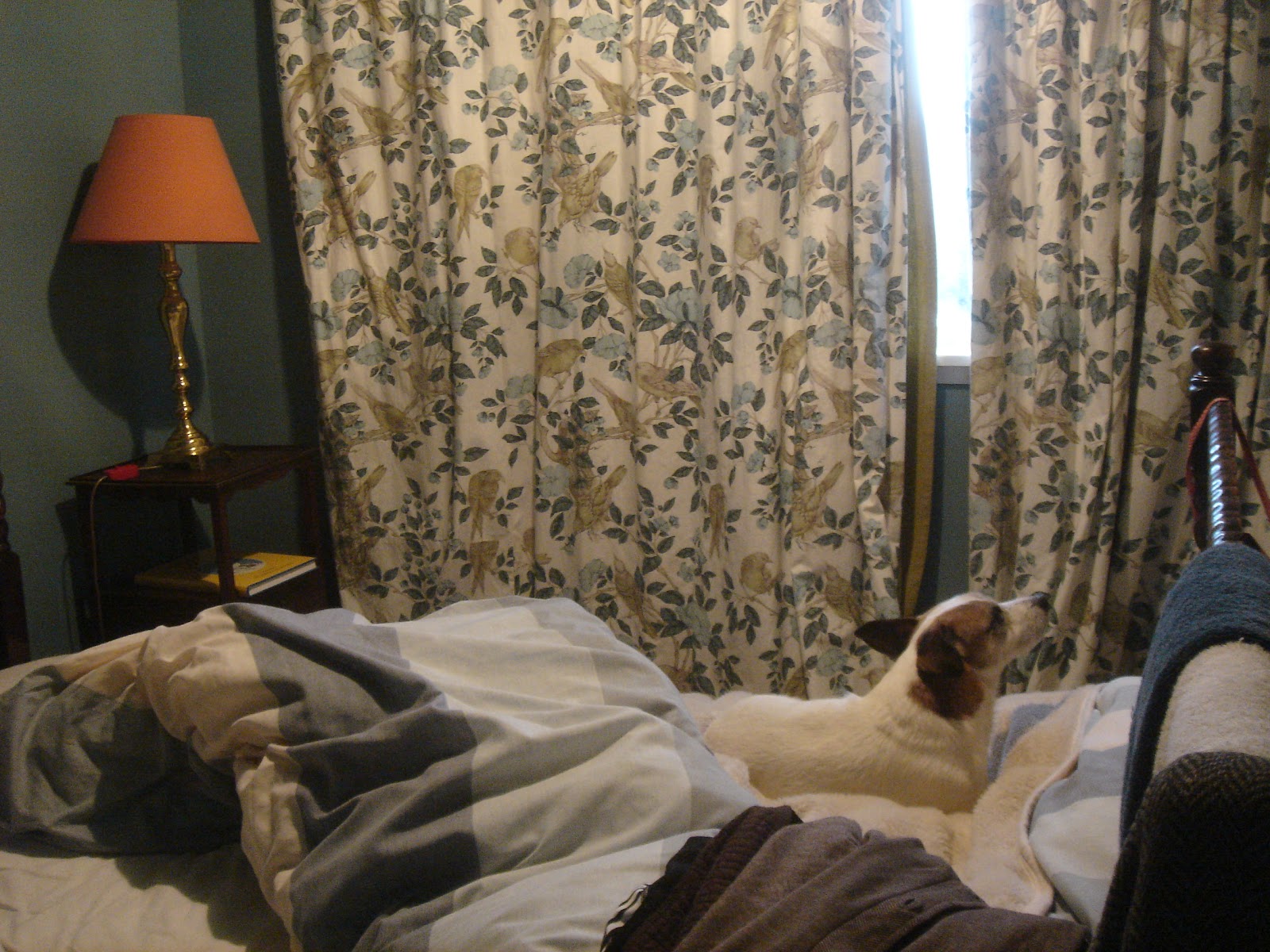
Mum and I and the terriers walked along the remains of an abandoned road beside the Moray Firth looking over to towards
Kessock Bridge and the Black Isle. I’m in the Highlands for a week.

It’s calm with clear moments; other times
dreich - tho' Isobel at the
Inverarnie shop put me right on the
pronunciation she said it was one of those words from down Aberdeen way, and remember 'it's
i before
e except after
c!' [
back to the future: It's definitely
dreich]
* * *
On Friday evening, I arrived in Glasgow after working with Fire and Rescue in
Rhyl. How I like arriving at Central Station! Trundled my suitcase contentedly through cold wet streets sparkling with Christmas lights to the
Millenium Hotel where I got a cosy room backing onto the great glass fan of Queens Street Station.

On the Friday afternoon - next day - Jan and I enjoyed an audience of practitioners discussing Charlie’s list of problems of government as they appear from the points of view of politicians and officers – ones described at the workshop she and I did in East Anglia.
• Scope creep: Councillors set clear objectives. Officers develop a project plan that is signed off through proper process. Then members start adding things. The expectation is that additional elements can be added to the scope of a project during its course without consequence. Officers are just expected to manage those additions.
• Making grey even greyer: Members are uncertain or confused about objectives and plans. Members and, accordingly, officers seemingly add to the confusion or uncertainty. Sometimes this can appear to be a deliberate fudging. Other times it is accidental.
• Pick on someone your own size: An attempt by a member to get what is wanted by going to an officer who may be least able to say ‘no’ or caution against a course of action.
• Stand by your…: For no apparent reason a decision agreed and on which action has begun is overturned or not supported.
• Fudge the steer: Officers are given a really clear objective. They proceed to implement an action or policy, only to be told the proposal has not been well received or, for some other reason, they need to proceed less quickly or deliberately with it.
• Member or manager: Sometimes officers feel that councillors are getting too involved. It’s not clear who decides who’s doing what.
• Advice or something else: Councillors sometimes feel officers may be a bit blinkered in giving advice, partial or overly impartial. Tension arises because officers seem uncaring about real issues, escalate issues or insist this is ‘just the way we do it around here’.
• ‘You can’t do that….’: Councillors sometimes feel that officers are intent upon thwarting their intentions, often not understanding or frustrating the bigger picture. Councillors do not understand why officers cannot just find a way to do what is wanted.
• Let us take the risks: Councillors sometimes feel officers are being overly risk averse. Instead of managing risks they prevent any action that involves any level of risk.
• Stop flogging dead horses: Councillors report that sometimes officers won’t admit when they’ve got it wrong.
• Lack of corporacy: Members perceive officers undermining other officers - the left hand not knowing what the right hand is doing.
• Don’t all say the same things: Officers unite on issues about which members want a range of their views.
• Don’t talk to him or her: Some senior officers have instructed councillors not to talk to specific members of staff.
• Role blindness: Some officers cannot see the person beyond their role as councillor. A councillor may have skills and competence in other areas that could useful to the Council.
• ‘We are human you know’: Some officers forget that - sometimes treating councillors differently because they are councillors.
• Hiding behind conflict of interest rules: Councillors felt that sometimes officers construed this rule narrowly to preclude legitimate views being presented.
• Use your PAs: Sometimes it is not recognised that a good PA can make or break a relationship between officers and members.
* * *
Liana's translation of a part of the
Ano Korakiana website teaches me things to know and observations to ponder. The mountains whose crags tower above Democracy Street, seeming ‘to embrace’ the village, are
Korakiana and
Korendi.
'Today, the decrease in the village population is evident, despite the settlement, either temporary or permanent, of foreign families. As a result, a village that has got a dynamic presence, is within easy reach of Corfu town and other areas, is near the developed tourist resort of Dassia-Ipsos, starts getting affected by the modern trend of urbanization. The only hope that remains is the activation of some clubs and organizations such as the historic Music Association, Spiros Samaras, as well as the new generation of youths who choose to settle down here, thus going against the grain.'
Knowing Corfu never fell to the Ottomans, I note that
Ano Korakiana’s people and buildings suffered severely from
Turkish assaults in 1537 and 1716; that her population has been renewed many times. After
1204 – I’m, for the moment, ignorant of the particularity of that year - people came to the village from the coastal towns of Asia Minor and Thrace. During Venetian rule of the Adriatic and Ionian seas, settlers came from neighbouring
Epirus, from the Peloponnese, from Crete and islands in the Aegean under Ottoman occupation. The oldest families in
Ano Korakiana are the
Savvanis - since 1473,
Vradis,
Mandilas,
Ionas, Markos,
Metallinos,
Laskaris,
Kaloudis,
Linosporis, Reggis,
Balatsinos, and finally,
Kendarchos and
Kefallonitis during the first half of the 16
th century.
Even in translation the diplomacy of the account from which I’
ve gleaned this information is sophisticated. I wrote Venetian ‘rule’. The preferred term is ‘occupation’. This applies also to the Ottomans. Invaders ‘occupy’; only Greeks ‘rule’ their country. Pleasingly the British, according to the website did not ‘occupy’ but maintained an English
‘protectorate’ – the latter descriptor made negotiable, for better or worse, by the addition of single parentheses.
[
Back to the future: How embarrassing is my ignorance! That date 1204 referred to on the
Ano Korakiana website, which I didn't recognise but which must be notorious among Greek children
and indeed all in the Byzantine parish! 1204 marks the sack of Constantinople, not by Islam, but by Latin Christians on that dismal project that goes by the title '
The Fourth Crusade'
 QUOTE: The Crusaders gathered at Venice, Italy, but they could not raise enough money to sail to the Holy Land. They made an arrangement with the Venetians. For Venice, the Crusaders would conquer the Christian city of Zara; then the Venetians would take them on to Jerusalem. Pope Innocent III ordered the army not to proceed and even excommunicated them, but he could not stop them. After conquering Zara, the Crusaders diverted to Constantinople rather than sail on to the Holy Land. They and the Venetians attacked Constantinople, the richest Christian city in the world. They plundered the city and took its wealth, including the treasures of the great church Hagia Sophia. They battled against other Christian men and they raped Christian women. The conquering of the great Christian city in 1204 ended the Fourth Crusade and had significant religious and political consequences. A number of Latin states were established in Greece and the Aegean; the communion between Roman Catholic and Orthodox Churches ended. The Byzantine government moved to Nicea. Likewise most of the Greek bishops abandoned their sees and took refuge at Nicea, leaving their churches to the Latin bishops; Greek convents were replaced by Cistercian monasteries.
 I
must have been taught this at school but I had forgotten.

Note: Athens News Agency - 4 Dec 07: A delegation from the Vatican headed by Cardinal Walter Kasper was in Turkey to attend celebrations being held at the Ecumenical Patriarchate in Fanar to mark the feast day of St. Andrew, the Patriarchate's patron saint. To improve relations between the two churches, Patriarch Athinagoras and Pope Paul VI agreed that Fanar and the Vatican attend the feasts of their respective patron saints. Pope Benedict XVI has written to Ecumenical Patriarch Vartholomeos: ‘We wish to reassure once again the adherence of the Catholic Church to the creation of a fraternal ecclesiastical relation and the preservation of dialogue…our work during these first years of the 21st century is urgent due to the many challenges being faced by all Christians and to which we must reply with a united voice and faith.’
Exploring the subject I've learned the origin of the term
Phanariot, and the location of Fanar (lantern) on the outskirts of Istanbul. [
Back to the future: See
Turkish Daily News piece about the dilapidation of the
Dolapdere neighbourhood of Istanbul]