This is the kind of thing I dislike reading - from Kathemerini:
Remarks by EU Regional Policy Commissioner DanutaHubner that Greece ranks at the bottom of EU tables regarding the absorption of community funds spent on road, railway and port projects say a lot about the incompetence of Greece’s political officials and the state apparatus in general. Her words shatter the impression cultivated by Greece’s idle politicians that progress on public works is stymied by a lack of money. The money is there, it’s just that the ministries have not hammered out any plans for how to use it.
I've spent my professional life studying and working with local government in the UK. Birmingham's transformation during the 1980s from a derelict late industrial wreck to a post-industrial European city was vitally dependent on the competence with which the City Council and its partners tapped into EU Regional Structural Funds. Of course that narrative's more complex. How do you rate a city's successful weathering of a 20th century crisis - the almost total loss to the East of its founding identity as the 'city of a 1000 trades' - the source of manufacturing wealth in a map that my school books covered pink to mark an empire?
I have watched our local councils go through compulsory competitive tendering, running intense annual evaluative audit - the Comprehensive Performance Assessment - the development of endless Performance Measurement, shifting from emphasis on inputs to outputs, submitting to efficiency reviews, continually meeting demands to deliver more for less. Now we see central government departments submitting themselves to Capability Reviews. There's still miles to go but that changes over the last 25 years have been dramatic.
The comments in Kathimerini would be supplemented by the curled lip contempt for Greek politicians and government that I encounter from my Greek family when trying to speak up for local democracy. In the flesh they are such fun to be with. They are all - over three generations - daunting in intelligence and talent. Phds, Firsts or nothing less than a 2:1 at Oxford, Cambridge or LSE; papers in journals so prestigious they are read only by a few people a year but last like oaks - Cambridge Journal of Economics; multi-lingual as toddlers; sisters as bright and successful as brothers.
So why am I reading about 'the incompetence of Greece’s political officials and the state apparatus in general'. The brightest star on the Greek side of my family is the son of a genius who started life in a Peloponnesian fishing village who worked as a deck hand.
The Greek students I encounter at my University work hard and are above average in intelligence. So why does someone unwire (if they did) the safety alarms on the gas-fired water boilers and why did police in Corfu accuse six individuals and one or more companies of negligence leading to manslaughter, negligence leading to serious bodily harm and negligence leading to endangering human lives in an apparently successful Corfu hotel (now re-opened) so that two kids died of carbon monoxide poisoning last October half-term holiday? Why do I get jokes like the one about the queue to get into Greek Hell where the devils are too lazy to bother tormenting sinners?
I've never met a lazy Greek, nor a stupid one. Where are they all? Why the jokes? What's with not only being unable to 'absorb' EU money for infrastructure, but 'ranking at the bottom of the table' for this capacity. You have to work to do so badly. Were the last Olympic Games secretly more of a mess than our Dome! Didn't look like it to me. What is this?
* * *
Of course I'm not being rational. How do you feel if someone's rude about someone you love. How dare they criticise Greece in their own bloody newspaper. I don't want to read this.
Yes yes I know. But you have to admit that Greek local government isn't as good as it could be. It is Greeks criticising Greeks.
Papsipapsi! I'm not listening!
* * *
Professor John Stewart - my colleague, Director for 17 years and original recruiter to Birmingham University in 1973 - told me when I bumped into him last Wednesday that one of his books - 'Modernising British Local Government' - had been translated into Greek. (details at www.epikentro.gr - and search for 'John Stewart; but on 16 nov 2007 I can see his name but not the book) John said he'd lend me his copy "I can't read Greek" he said, "Nor me" I said "but please, yes".
Prime Minister CostasKaramanlis on Thursday had successive meetings with the leadership of Greece's main local authority unions, the Central Union of Municipalities and Communities of Greece (KEDKE) and the Union of Prefecture Authorities of Greece (ENAE), in order to discuss legislation for reforming the administrative structure of local government ... meeting was also attended by Interior Minister ProkopisPavlopoulos, who afterwards stressed that the new framework would not be imposed on municipalities ... the new municipalities and communities code, would be tabled in Parliament in December this year. ... Also due for completion by the end of the year was a new code for prefectures, Pavlopoulos added ... the government's goal was to create stronger local government that would receive more funding, in line with the changes also taking place within the European Union. Under the plan, which has been dubbed 'Kapodistrias 2', local authorities are expected to join together and redraw their administrative boundaries - which will also increase the funds at their disposal - along the lines of the original and controversial 'Kapodistrias' plan passed by PASOK in 1998, which forced smaller municipalities and communities to merge with larger ones.
Coal, much of it shipped to fuel China's industrial revolution is being extracted from the Bowen Basin in great quantity replacing sugar cane as the mainstay of Mackay's economy, with more and more attention to tourism.
What's became of the blokes?
On our way to the inland highlands, an horizon of blue mountains, we diverted to visit a sugar mill - Sarina Sugar Shed - learning yet again the familiar story of how the sweat and heroism of the cane cutters has been disenchanted by mechanisation - saurian machines surging through the fields, doing the work of a hundred blokes, incapable of inspiring a line of the drama - Summer of the Seventeenth Doll - a landmark play of the 1950s exploring the erosion of cherished Australian ideals of manhood. "Have you read it?" asked John "No" I said, vaguely recalling a Hollywood film starring Ernest Borgnine and John Mills, with an altogether different title.
Instead of cane-cutting feats we now have GT Chargers and occupational status, instead of Kewpie dolls we have dream homes and the latest deciduous mod-cons.... the replacement of the Colgardie safe by the fridge, the drover by the commuting executive. Summer of the Seventeenth Doll presages an Australia with a new face and a new set of clothes, yet one whose physiology is principally and depressingly the same. (Jack Hibberd, dramatist and critic writing about Ray Lawler's play in 1977)
An indulgence as we left was candy floss - something I've not enjoyed for sixty years, and as John discovered, not to be tried with a beard. So it goes, change upon change, and then...
...wonderful, exciting, memorable, yet at the same time utterly ordinary. Everyone knows about the bizarre animal, the Platypus, which, when first described by European explorers, was thought a hoax, like the composite grotesque exhibited as a feejee merman by P T Barnum. Yet far from being odd this little brown creature, hardly larger than a water vole, was going about its daily existence, living in a stretch of slightly murky water on the Broken River high in the hills of Mackay, 60 miles from the Coral Sea, in Eungella National Park.
Five seconds on the surface the little animal appeared, paddling, then tail-flipped to the shallow river bottom rooting with its beak for crayfish and other fare as it has since primordial times. Twenty seconds later it surfaces again, and we tourists gaze rapt, pointing our cameras to take silly snaps of a little shape as vague as a tabloid picture of the fabled 'bigfoot'. We had to wait a while, but once strolling along the well laid path beside the river bank, John, I and Lin saw a Platypus three times in three places, along with a Brown Snake, a large freshwater eel twisting with slow grace almost at our feet, many birds, including a jewel like kingfisher darting up and down the river, and slow moving turtles, their backs so mud-mossy they seemed fashioned of weathered bronze. High above the sugar cane fields between us and the coast at Mackay we gazed through, what the Park's service signed as a 'sky window' - a landscape suddenly appearing through the sub-tropical forest; no less magnificent for making all the brochures. Some places can cope with people. This was one of them, in part because the Australians know how to do national parks, affording them federal protection, husbanding them with consummate professionalism.
"There it is!" Lin on the Broken River (photo: John Martin)
** ** **
The second seminar of our tour, held in Mackay Regional Offices, went excellently. John and I complement each other as well as in any collaboration I've experienced, which is why I shall miss him while I'm in New Zealand. On Thursday's seminar we used film from Marion (Mayor Felicity Ann Lewis & CEO Mark Searle) and Wyndham (Mayor Shane Bourke and CEO Ian Robins) in Australia and from the UK - Birmingham (CEO Sir Michael Lyons and the then Leader - Cllr Theresa Stewart) and Woking (CEO Ray Morgan and then Leader - Cllr Sue Smith).
Professor John Martin and Simon Baddeley in Longreach (photo: Lin Baddeley)
I'm missing dear Greece. We'll be there again in February. Sailing down the Adriatic from Venice, making landfall at dawn on the Acroceraunian Peninsular, past the snow capped peaks south of Kadare's town of Gjirokastër, through the Corfu Channel, over to Epirus south to Igoumenitsa from where we'll catch another ferry to the island, thence to Ano Korakiana.
*******
Item sent to Caroline Rance for our weekly Inlogov Newsletter:
I’m back from nine excellently received one day local government seminars for Mayors, Deputy Mayors and Chief Executives – seven in Australia with Professor John Martin of La Trobe University in Northern Queensland, New South Wales and Tasmania (see photo) and two in New Zealand for the SOLGM (Society of Local Government Managers New Zealand) in Wellington and an in-house event for Rangitikei Council. This is Simon’s third teaching tour in Australia, his first in New Zealand – focusing on the theory and practice of negotiating the overlapping responsibilities of councillors and managers at the top of local government. John Martin has replicated, in Australia, Simon’s film research into the joint leadership of lead councillors and officers. (The photo shows John and Simon at a workshop in Tasmania in front of a filmed conversation of Mayor Felicity Ann Lewis and CEO Mark Searle of Marion Council, Australia).
E-mail from my colleague Andrew Coulson
Simon - welcome back to cold and snowy UK! We got these comments a few days ago. Many of them refer to your part of the paper - interesting! I should have passed then on straight away. I think you should reply to George! All the best - Andrew
I find the three spaces confused. The figure is fine – I agree there are three types of leadership, but the text uses in the bottom para the word “technical” as if it is the same as “professional”. I dislike the way “administrative” is diminished into minor tasks, like record keeping. There are (i) political leadership, as with English directly-elected mayors/leaders; (ii) administrative leadership which involves coordinating in a generalist way the more specialised units below, as with chief executives/directors of finance; and (iii) these units are headed by specialised chief officers, with their specialised professional expertise. The last two comprise the appointed permanent officials, as distinct from the elected impermanent political leaders.
p.14*. para 1. In the USA the mayor/manager system makes a clear division between political and managerial, with the mayor being of the “weak mayor” variety, and the manager appointed by the council. But “strong mayors” usually need the support of an appointed chief administrative officer, appointed by the mayor. There seems to be a convergence of the two types in practice. (*p.18 in PDF file)
p.14. para.4. I miss from the chief executive’s role coordinating the other officers and their units, and advising the political leadership even about political aspects. Perhaps that is subsumed in the word “situation” NEVER WRITE A WEAK WORD LIKE “SITUATION”. Be specific about what you mean.
p. 14. para 5. I agree about the moveability of boundaries – all of them. So I worry in para 6 about “a blend of political and administrative contributions” without mention of “professional” too. I like the phrase “combined dynamics” (and ‘bridge’ and ‘exchange’, but if your threefold distinctions of figure 1 are to be maintained then you need to add the other (‘professional’) to your twofold blend. Another niggle: chief executives and treasurers giving “administrative leadership” are usually “professionals” in their own right, but they are more generalists than specialists.
p. 15*. para 2. Here you recognise the three-fold distinctions I mentioned above at (*p.19 in PDF file)
pp.13-15. You refer to them now as (i) “technical”; (ii) “managerial or administrative”, and (iii) “political or strategic”. You should at the start of the chapter have given a clearer picture of the three leaderships, and their interactions.
My reply:
Dear George...To respond to some of your very helpful points, I’ve found it useful following Churchill’s maxim ( “The English never draw a line without blurring it”) to imagine a tense and dynamic interaction of managerial, professional and political activity in the making of government. The topographical approach and the idea of overlapping zones offer rich metaphors, e.g. centrifugal or centrifocal forces mediated by interpersonal negotiation among people spending more time in one space than the other.
Good local government is made by people who are part manager, part politician, part professional. My simplified terms are at the tip of several icebergs of definition about differences between managerialism (changed in the paper to ‘administrative leadership’), professionalism (changed to 'technical leadership') and politics and the tension between them. I’m an anthropologist seeking to explain structurally determined conflict and a psychologist seeing how interpersonal skills and values can reduce or amplify those conflicts – with the proviso that conflict isn’t of itself bad, nor its opposite good. Some of what I’ve written can be found here.
I’ve tried to make this material more accessible by putting links to Google.docs files on a page of my blog Democracy Street. Not all servers permit access to Google.docs, so if you’d like to see any of these papers, email me at s.j.baddeley@bham.ac.uk and I’ll send one or more as an email attachment.
I write, but my enthusiasm has revolved around making films of senior politicians and managers in conversation about their working relationships. I use this to explore political-management leadership on seminars for practitioners. Elaborate ethical procedures apply to the use of this material, but I’ve had permissions from those involved, or their estates, to stream some film on the Internet. Extracts with transcripts and comments can be seen by clicking on the links distributed through my paper on Political-Management Leadership - links the editor was unable to include in the text version of my chapter in the 2008 book - Leadership Learning.
Some of the clips referenced in the paper can also be seen with others plus comments and, in some cases, transcripts, here and here.
The difference between the text and the filmed conversation showing para-linguistic
I’ve ploughed an esoteric furrow in my time at inlogov – a freedom to roam for which I shall be eternally grateful to John Stewart and the culture he created there. This doesn’t mean I’ve not been a keen contributor to inlogov’s mission. A lot of my work has been in-house – here and in other countries.
John Martin & Simon Baddeley: using video in Australia (ph: Pamela Crawford)
Recent films are for reasons of their political sensitivity less available, which is why most of the films streamed via my blog on the Internet were made over two years ago, but I’m confident that the generic features of the political-management relationship have a permanence that ensures their value for both practitioners and on campus.
This vital working relationship in government holds fascination for me...As the technology improves, along with my understanding of methodology for accessing these conversations at the heart of democracy, I hope to be able to add to the interest and usefulness of this focus.
Your point about the CEO’s role ‘coordinating the other officers and their units’ applies also to the work of senior politicians' in the political sphere. You put your finger on the methodological challenge posed by the limitations of a camera lens (wiring more than three people for sound gets expensive and intrusively complicated). I've focused on the dyad, with occasional widening of focus in hung/balanced/NOC situations, e.g.Herts No Overall Control
You see the problem! The NOC situation here was filmed in our campus TV studio with a director deciding where to point two cameras. It makes better TV but less good research. As the method has developed I’ve excluded myself from the films, so that instead of being told about the relationships we've a chance to see the people involved having a working relationship.
Another weakness (which you’ve picked up) is that as I’ve come to understand the significance of the dynamic relationship between managers and professionals (core skills and values directly or indirectly involved in the delivery of government) as well as between managers and politicians (bringing a contrasting skills and values) I’ve focused on a dyad and not a triad. This is not necessarily a problem since it is the political-management relationship that operates ‘at the apex’. I use this diagram to open up my argument along with film from an research base collected over thirty years - a sample streamed here.
Political and professional spaces are straddled by political-management space - a hybrid zone where values created in political space encounter the legal, technical and financial parameters of government, and where professional values encounter the rationing of management working to an agenda forged in negotiation between politicians and managers. Managers connect with politicians while building alliances in professional space, and politicians while maintaining their political support, work with managers to monitor implementation. Between them, they create government.
This and other diagrams are images for exploring the issue of how a political-management dyad relates to the larger society of government. Have you a few sentences that would help combine greater clarity with our paper’s necessary brevity? I’d be delighted to acknowledge your help if were allowed to include them in any revision. In the meantime thanks again for taking the time to make comments on the paper. Kindest regards, Simon
****** **
Nice email from Scylla Parkyn, Hon.Sec. of the Victoria Jubilee Allotments Association about discussion at a meeting while we were out of the country:
Hello Simon...Just to let you know, the topic of beekeeping on the allotment was discussed at the last VJA meeting, and Anna , the person who is allergic bees (& who is also on the committee), said although she would prefer that bees were not right next to her plot, she has no objection to a hive being some elsewhere on site, provided that they are kept by a qualified apiarist, and that whoever keeps them goes through the proper channels, i.e. runs it by the other allotment members first. With best wishes, Scylla
Maria wrote 'δυνατά και ντύσου. Βάλε τα καλά σου. Δεν μπορείς να διαβάζεις αυτό το συγκεκριμένο ποίημα με τις πιτζάμες ' ... basically, 'don't recite this particular poem in pyjamas' to which she sweetly adds 'Ωραίος είσαι και έτσι'.
** ** **
I got up this morning from a restless sleep and started to try to make sense of the Coalition Government's Localism Bill which we'd discussed at Inlogov's departmental meeting yesterday morning. The official guide from CLG is the kind of thing I used to find so helpful when assembling a flatpack from a furniture superstore.
But here's the flensing - courtesy of posting on the LGiU site. Although the Minister, Eric Pickles, says no cuts will be greater than 8.9%, I suspect actual cuts are considerably deeper. Complaints will be treated as 'shroud-waving'. LGiU provide excellent useful information - as it emerges. Our take on the Bill will come with more narrative, though this is LGiU CEO Andy Sawford's take. (See also Ref: Professors George Jones' and John Stewart's oral evidence on localism to the Communities and Local Government Committee on November 15).
For the moment I'm reeling with the long term effects of the government's policies on Handsworth and the rest of our area; the implications for the breaking up of decades of messy incremental investment in our fragmented and fluid inner-city population...and this is from someone deeply involved in voluntarism and community activism since I arrived in Birmingham.
To make an inventory: ....starting, with Lin, The Reservoir Roads Residents' Association feistily engaged in resisting the renewal of the licence of the neighbouring Tower Ballroom to pay for an overflow car-park so late night revellers didn't invade our narrow streets; participating in the content of an S106A to get a local playground; succeeding via a survey of traffic in denying permission for a detour road that would have sent commuters in and out of the city centre past a local school and through residential streets; acting as key witnesses in a case of racial discrimination in a local 'white's only' Working Men's Club and numerous local activities involving care of the elderly, street cleaning and a great street party to celebrate the Queen's Silver Jubilee in 1977
Street Party in Daisy Road for the 1977 Silver Jubilee
When we moved to Handsworth it wasn't long before we'd started a residents' association for new street, and become involved in challenging our rating valuations in front of the local rating tribunal. We had limited success but got to know more of our neighbours. The two main community activities that have taken up the last decades of mine and many other's time have been campaigns to save Handsworth Park
and to recover and restore the Victoria Jubilee Allotments, resisting robust attempts to encroach on a limited pool of inner city urban green space. Our successes here were palpable; the stories lengthy and well documented in film and text, attracting interest way beyond our local focus.
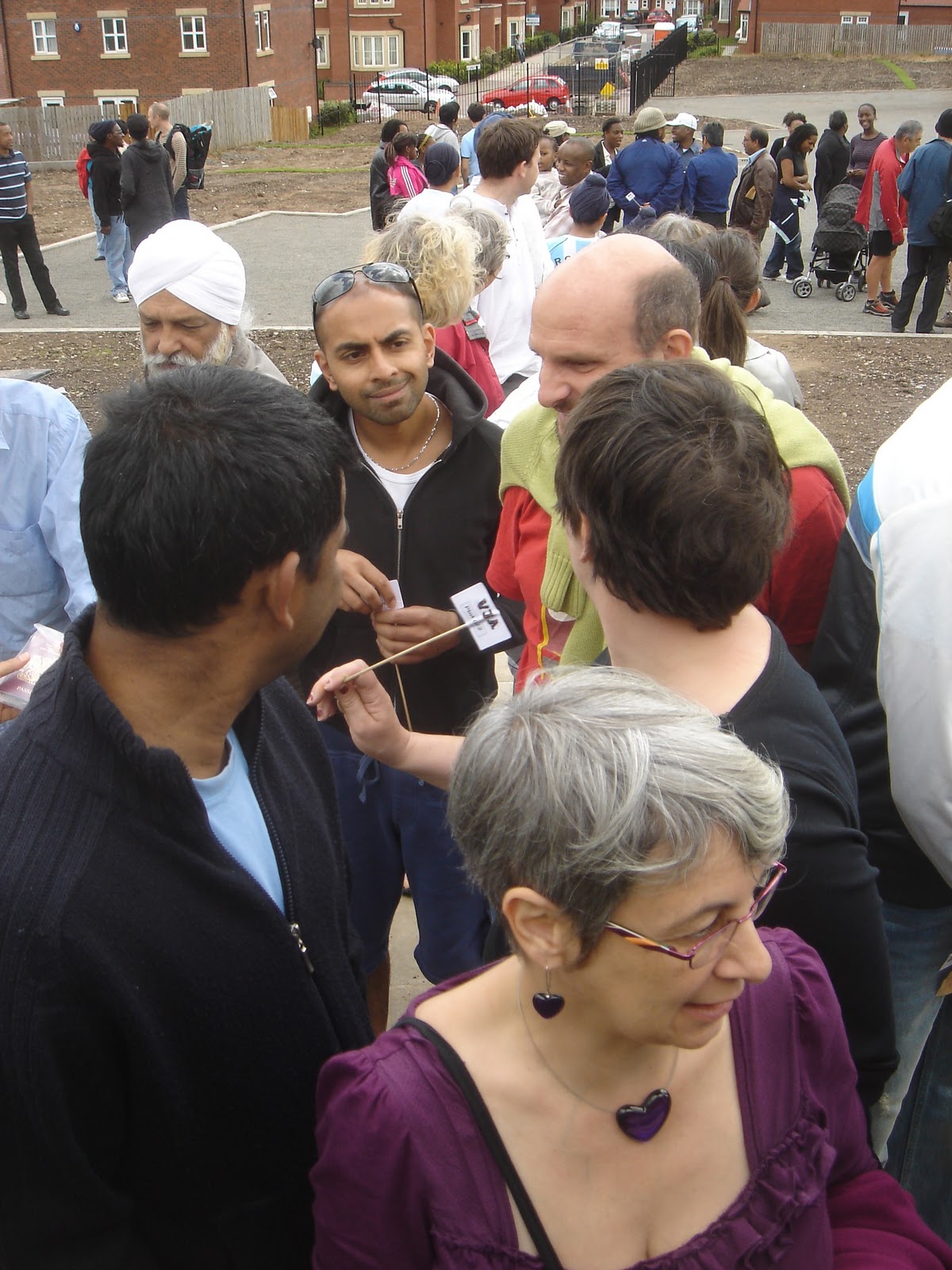
10 June 2010: queueing for plots on the restored VJA (ph: Richard Baddeley)
Other activity has involved work on restoring the churchyard of St Mary's Handsworth and the successful campaign to get Sandwell Council to alter the local plan for the area that includes Black Patch Park so that it is no longer available for industrial development. That's a continuing story amid as funds dry up for maintaining let alone restoring an urban park.
What's been unique about this is the connection with the descendants of the Gypsies who were originally evicted from the Black Patch long ago. Some of them are shown in the YouTube of Bryn Phillips' song about Queen Henty's curse. ** * ** * ** 1400 Tuesday: Ah here's a reaction from Inlogov, from Philip Whiteman
....there remain a number of elephants in the room that Government has failed to fully answer.
Local authorities are being encouraged or subjected to the ideology of mergers and shared services are arguably good ideas in terms of economics but goes against the very concept of local control. In essence councils are becoming ever more distant from those they seek to serve. This is counter to the idea of connecting government to communities.
The move to de-ring fence funding is to be welcomed as it will allow greater local discretion over funding priority services. However, if Government is sincere in terms of allowing greater local autonomy in terms of funding, the balance of funding between central grants and local taxation needs to be addressed. Instead of central funding accounting for 75% to 25% local funding, this ratio should be reversed. Central government should only provide funding to ensure equalisation of funding between the richest and poorest communities.
The Big Society proposals could inevitably be depicted as little more than a mask for local authority spending reductions also announced yesterday. This means that funding community groups, the third sector and others to provide the Big Societycapital will be difficult to achieve. The big hope comes from these groups being able to provide quick and cost effective alternative solutions.
The Localism Bill needs to ensure that principal councils can let go of services and hand them over to the parish and town level. Equally, local and parish councils need to build their own capacity and ensure that they are advocates for the Big Society. However, this tier of councils is very rural centric and greater thought will need to be given towards building the Big Society in urban conurbations.
The move towards increasing the number of mayors is journalistically and politically popular. However, government should not assume that all of the twelve cities will jump at the opportunity. Evidence in favour is patchy.
The role of councillors has largely been ignored. At a time of the Big Society, greater effort could be given towards the role in supporting and enhancing community influence and provision of local services.
INLOGOV will be researching, evaluating and monitoring how the Bill is enacted into reality. We will also be engaging our postgraduate students on the impact of Localism and the Big Society with their communities and employers. We welcome discussions with local authorities or any other organisation on how they seek to address the implications of new and current thinking within this arena. In the New Year, INLOGOV will publish a full and detail response to the Bill drawing upon expert opinion within the field.
** ** Καλά Χριστούγεννα και Ευτυχισμένος ο Νέος Χρόνος
I've posted quite a few Christmas cards this year including one to our neighbours - which might just make sense despite my Greek writing. We're always putting snow into our Christmas cards despite its rarity in English December. This year our local weather richly matches the theme. There was a prediction of snow in Ano Korakiana the other day - για έναρξη χιονόπτωσης στο χωριό. A celebration and vigil in the church of Savvani Arkoudena - εκκλησία των Σαββανήδων στην Αρκούδενα - ended early as a result. I see a photo of our neighbour - the Papas - Κωνσταντίνος Φαϊτάς - second from left - in Alice Stergiou-Savvani's dining room.
This year her family provides the traditional dinner of fish and wine for a vigil which, if I understand rightly, takes note of an ancient dispute that was to sever Eastern and Western christians. In the local church of Savvani Arkoudena there's a picture of St.Arius at the great Council of Nicea - first ecumenical council - Α’ Οικουμενική Σύνοδο - in the year 325AD. He is arguing his belief that Christ, though the most perfect of creations, is a creation of God the Father, in opposition to the belief of St.Alexander who held that Christ is of the same substance as the Father and co-eternal with him (my italics). This debate became so heated that Nicholas of Myra - one day to be known as 'Santa Claus' - slapped Bishop Arius for, as he saw it, belittling Christ.
The slap: 'Behold, how great a matter a little fire kindleth!' James 3:5-6
The insertion of Alexander's argument - the filioque (and from the son) into the Western creed 260 years after the arguments at Nicea (words on this in Democracy Street some years ago, and again in Feb 2008), Aghios Panteleimonas attended by the President of Greece and the Archbishop of Athens - reported by Malcolm Brabant - to advance conciliation in the present...
** ** **
The other day I dropped into our local GP to get my flu jab - which covers swine flu - and have a routine blood test. I like this process of trying to stop people getting ill, rather than waiting until they do. That of course is the trouble with a lot of what government does - stops bad things happening via road safety, food and drug testing, with building regulations - inside and out - with child protection; all kinds of risk assessment - things that can make government look like party poopers, do-gooders and interferers - and with the additional problem that it's so tricky to measure performance in stopping things happening. You can measure how many people you've arrested. How do you measure how many crimes you've prevented; how many fires didn't have to be put out because of the work you've done to ensure they never started? As a recipient of the flu jab over six years I've no scientific proof it works just because I've not had flue more than once in that time.
** ** **
I'm flattered at seeing my face on the front page of the Ano Korakiana website - with a fair précis in Greek of what I wrote in 2007 about Ano Korakiana avoiding becoming a 'non-community'
I find my rough re-translation rather pleasing, so leave it as is, since the meaning's all there (go to the village website and click on my face to read it in Greek) - Ο Simon Baddeley είναι λέκτορας στο Ινστιτούτο Τοπικής Διακυβέρνησης του Πανεπιστημίου του Birmingham στην Αγγλία, μα πάνω από όλα λάτρης της Ελλάδας. Εδώ και αρκετούς μήνες έχει αποκτήσει μαζί με τη σύζυγό του μια άμεση σχέση με το χωριό μας, αφού εδώ περνάει αρκετό διάστημα του χρόνου, στο σπίτι που αγόρασε στην περιοχή που είναι το πηγάδι της «Γραμματινής», κοντά στην εκκλησία του Εσταυρωμένου. Μέσω δε της ιστοσελίδας μας προσπαθεί να έχει μιαν εικόνα για τη ζωή του χωριού μας και αρκετές φορές γράφει σχετικά στο δικό του χώρο στο διαδίκτυο, ανταλλάσσοντας μάλιστα απόψεις και με άλλους συμπατριώτες του που έχουν κάνει την ίδια επιλογή με τον ίδιο, να αποκτήσουν δηλαδή ένα «καταφύγιο», μια δεύτερη κατοικία στο χωριό μας...
Do not make Korakiana "non-community"
Written by Kvk
13.12.07
Simon Baddeley is a lecturer at the Institute for Local Government at the University of Birmingham in England, but above all a lover of Greece. He's acquired with his wife, a direct link to our village, after passing some time here last year, buying the house by the well of Grammatinis near the church of the Crucified. Through our website he strives to gain an idea about the life of our village and sometimes writes on his own site on the Internet, exchanging views with other compatriots who have chosen like him to have a second home in our village ... He indicates a developing problem in a recent memo to the village about our future, in response to some reports on our website, a small part of which has already been translated into English and French.
"What I'm trying to figure out is why the village (Ano Korakiana) has such a great style of architecture. It resembles a village that might have benefited from one or two large public buildings gifted by a rich Greek Diaspora. It seems there are so many elegantly crafted buildings, lovingly prepared with the additions to the lintels and doors and arches and other decorative features, suggesting a prosperous time ...
Referring to comments on the site - korakiana.gr - hat today, a reduction in the population of the village is evident, despite the installation of either temporary or permanent foreign families. Many years ago in my childhood, my parents bought and converted an old house in the village of Bagnor near Newbury in Berkshire. When we went there in 1949 we were re the first among some 20 houses in the village to install interior plumbing. Others went to a small stream - the Winterbourne - running at one point under the village street, bringing water home in buckets. When we left there in 1962, the village had changed a lot. The villagers had mostly moved to the municipal housing on the edge of Newbury, and more professionals from the city had moved into the village . Of course we now know this phenomenon well. It happens in villages throughout Europe - and no doubt elsewhere.
I remember my father said that although we loved the place we'd come to live we were also part of what some saw as the destruction of the rural economy. In the 90s I re-visited Bagnor. I could hardly recognize it. We were there to protest along with thousands of others against the highway that would pass through the meadows of my childhood. My father wrote in his old age, that the invasion against which we were protesting so vigorously (but peacefully), was part of a change that affected all of us and for which we were partly responsible.
Do you think that some of us are putting at risk what might be called the 'integrity' of Ano Korakiana? Can any of us (trying to avoid the term 'we' because you and I and our relatives are unique and I don't want to characterize us all together as 'foreigners') be criticized for our choices in life? Will Ano Korakiana become as much a non-community as Barbati, with newly built houses and wonderful views of the sea, but inhabited exclusively by seasonal visitors. I hope that young Greeks born in Ano Korakiana will be able to stay, or leave, and return to contribute to village life. There are villages in England which despite having been transformed have gained a new equilibrium, with significant involvement of relative newcomers, who've found harmony with the remaining former residents, pressed for the building of 'affordable housing' so younger people can remain in the village.
It is truly a touching reflection of Simon Baddeley, thinking that might not have been experienced by many of us locals, a reflection of a 'foreigner' who seems to feel as 'native' as many of us. We believe that such examples are useful and beneficial for our region, now and for the future in an ever-changing world. Moreover, the history of Korakiana for centuries, has been largely written by family relocation ...
In a Greek nutshell I guess!
** ** **
At a suburban BBQ, a man slaps a child who's not his own
My current reading. The Slap* by Christos Tsiolkas. I read earlier work by him while in Australia. Tsiolkas' writes of the lives of successfully settled emigrants from the Balkans, especially Greeks, living in Australia. He reports the dire existences of a materially comfortable, social and psychological diaspora. This is the Balkans transferred to the suburbs of Melbourne; eastern Europeans escaped, or dislocated by globalisation, from the hold of blue-collar solidarity, faith and ritual, tight family, close neighbours, organic community. Tsiolkas is an enragé on the arid rewards of embourgeoisement. A third generation emigrant, he looks back at a prosperous dystopia in the way a young 'gentleman' sent to private school by his nouveau riche parents might be ashamed of them, looking upon talk of self-made success with ignorant disdain. I'm over 150 years away from that process worked out in the mills of Oldham and Bolton, distanced from its feelings and dynamic, but I've been lucky with my friends, relatives and reading.
*The link here is to The Omnivore, a website developed by my niece, Anna Baddeley
*** Oral evidence on Localism from John Stewart and George Jones, [George to the committee: "John and I are old men in a hurry. After all, we’ve been doing this for 40 years. We want to see it now."] taken before the Communities and Local Government Committeechaired by Clive Betts on 15 November 2010. Both have given a professional lifetime's academic attention to local government.
Q49 Chair : Good, we can make a start on our second evidence session of our inquiry into localism. Welcome, George and John; it almost seems like yesterday when you were before us on our previous inquiry into the balance of power, so welcome once again. Henry Peterson, welcome as well; it’s the first time you’ve come before the Committee. Somebody asked me the other day at a talk I was doing, after I’d finished, whether you could really prove that localism was going to make services more efficient, whether in the current climate it was actually going to be more cost effective and, if it wasn’t, whether there was any point in doing it. What would your response be if you were asked that question?
Professor George Jones: Yes, certainly localism will make services more effective, more efficient and more economical, because decisions will be taken close to the communities that are being dealt with. If we, for example, build on the work of the participatory budgeting experiments and exercises, we saw there, in an era of growth, that local citizens could take decisions sensibly and effectively about how to spend local money. Now we move into the era of cuts, and I’d have thought localism is even more significant, because, after all, it’s local people who will know where the cuts really bite, and they will know where to make sensible cuts far better than any central Government Department or regional office, and they will be able to be sensitive to any of the big problems that will arise-the social consequences, for instance, of cuts. Yes, it’ll be more economical, more efficient and more effective, because one hopes that they will be able to take an overview of all public service spending in the locality, building on the total budget experiments, so that it won’t just be local government expenditure that’s within their remit; it will be all public service expenditure. I’m a great champion of localism. You have yet to get me to define what I mean by that, but we’ll leave that to one side. My answer is wholeheartedly yes.
Professor John Stewart: I would also say wholeheartedly yes. You can fit expenditure more closely to two things: you can fit it more closely to local circumstances, which will vary from area to area; and you can also fit it more closely to what local people want. National Government tends inevitably to seek uniformity, because it hasn’t the machinery and the means to discriminate between the circumstances in one area and the circumstances in another, or to take full account of local wishes. That is why we actually have local councils; they can take account of local circumstances. The argument for localism is that maybe we are not giving the local councillors enough power.
In late November the Institute for Public Policy Research North - ippr north - sets out ‘five foundations’ upon which localism must be built:
A framework for decision-making which is efficient and effective – with powers being devolved down to the appropriate level of government.
Arrangements which give powers for much greater local financial autonomy. The target should be that local councils raise 50% of funds locally through a reformed local taxation system which combines local income and property taxes.
A set of national minimum outcomes which mean that every citizen is guaranteed a level of service within a system of greater de-centralization and local flexibility.
An increase in the transparency and accountability of local decision-making through more powerful and democratic local government.
A formal constitutional settlement between central and local government enshrining the key principles of central-local relations for years to come.
We think we've allowed for the €3.50 for each square metre of the assessed floor space of our home in Democracy Street which we will be required to pay when we get our next electricity bill, but November 9th's Kathimerini reports problems across the country as the new property tax increment appears on this month's round of domestic bills:
Public Power Corporation (ΔΕΗ) on Tuesday announced that it has set up a special hotline to deal with hundreds of complaints from consumers around the country who have received larger-than-expected bills for an emergency property tax levied through their electricity bill. According to the majority of complaints received by PPC representatives across Greece, the square meterage of hundreds of properties -- which is one of the factors in the complex formula used to assess property tax, together with the location and age of the property, and the so-called objective value, a bracket set by the Finance Ministry to control real estate prices -- was inflated. It is the job of each individual municipality to submit to PPC the details of every declared property in its domain, with which it levies the municipal tax that is also charged through PPC bills. A spokesperson for PPC on Tuesday said that the discrepancies in the new emergency property tax are the responsibility of the municipal authorities rather than the electricity provider, though it added that consumers who have any questions regarding the tax they are being asked to pay can call the toll-free hotline on 214.214.1000 for advice. In the case of sensitive social groups, like pensioners and disabled people, the General Secretariat for Information Systems of the Finance Ministry - Γενική Γραμματεία Πληροφοριακών Συστημάτων - has set up an SMS (on tel 54160) and web (http://www.gsis.gr/faq/faq_eta.html) service to deal with claims of over-charging. Other consumers who believe that they are being asked to pay more than their proper dues are required to pay their property tax and PPC in full and to then apply for a refund via their next electricity bill. PPC has been ordered to cut the electricity supply of anyone who refuses to pay the property tax.
[Back to the future - 15 Nov': Kathimerini reports:
It is unlikely that the state coffers will see anywhere near as much money as expected by the George Papandreou government from the Special Property Tax, levied on citizens via electricity bills, as the first signs have been rather disappointing.]
*** *** Channel 4 is showing a programme Go Greek for a Week . In the first episode three British citizens - a bus driver, hair dresser and a doctor, advised by a fake accountant - Mr U.Kostas (ha ha) - learn how much they would get by way of earnings and pensions in Greece, and how much they would need to pay by way of fakelaki - Φακελάκι - for an MOT and a planning application to build on greenbelt land. It's all done archly tongue in cheek. It's also depressing and one-sided implying Greek corruption - undeniable (see 'Tragic Flaw: Graft Feeds Greek Crisis' Wall Street Journal, 10 April 2010) caused the Eurozone crisis, leading to the collapse of capitalism. One responses from Radio Arvyla - Ράδιο Αρβύλα - is a parody show hosted by ANT1 from Thessaloniki.
"Go Greek for a Week" is sub-Ladybook One analysis of a complex crisis. Yes of course Greece sustains a horrid amount of corruption, but this alone excludes as much learning about causes and solutions to the problem as the medical treatment of an epidemic is helped by looking at someone's life style. It's almost certainly relevant but considered on its own becomes more useful for moralising, stereotyping and caricaturing than finding answers what happened and how we are all - and we are in it together - going to recover from the mess we're in.
**** ****
Negotiations continue for the formation of a possible government of unity in the Republic. Tony Scoville e-mailed me this afternoon with an account of his and Helen's tour of Greece, including their stay with us in Ano Korakiana, during October. I shall settle down to read it tomorrow. He ends his letter...
...Poor Greece. In the last three weeks since we left, things seem to have gone from bad to much, much worse. I read a heart-rending article today in the NYT portraying how the entire Greek economy seems to be grinding to halt - literally. Businesses and shops, even in the affluent districts are shuttering because they haven't had a buying customer in weeks and those who do come in are seeking to pawn family valuables rather than buy anything! Deposits are fleeing Greek banks and sent abroad before it loses its value from enforced conversion to a new drachma. Will be interesting to see whether the new coalition government can handle the situation. I have my doubts. All parliamentarians, according to the article, have to be accompanied by armed guards. Do you think the military will try to take over as in the 1970's if the situation becomes chaotic and the government simply cannot enforce the measures it passes? Though no one has mentioned the possibility yet, Greece may be close to this possibility. I have no sense as to how all these turns are affecting the countryside but the paralysis has got to hit the rural areas and smaller cities sooner or later if things continue along their present trajectory. How stupid and, as Paul Krugman points out in the NYT so much unnecessary suffering all because the ECB, France and Germany won't get together to form a truly continental economy with greater not less unity. Hell, we learned that lesson (during America's critical period) in the 1780's under the Articles of Confederation!
*** *** ***
Just another day and a half in my mother's house in the Highlands and then south to Birmingham. I'm ensconced as in a closed order here, warm, secure, remote - yet in touch through phone to laptop, with little need for TV or newspapers...
Brin Croft
...organising a lecture on campus on 11 November on 'managing in a political environment', planning an in-house event on performance scrutiny for Dumfries and Galloway later in the month, sending an outline of my interest to the new Director of Inlogov, Catherine Staite, in readiness for a meeting next week about further work:
Dear C...For 30 years or more, while teaching on campus and in-house at InlogovYes Minister crystallised that interest, both because it was so well received, so funny on an unpromising subject - the relationship between a senior administrator and senior politician - and because it was about the minutiae of what went on between two people, with their various foils, but primarily two named human beings - two players. In real life this relationship between a politician and an administrator is not meant to be a friendship, tho' often friendly and usually courteous. It's a public relationship of government - yet at the same time drawing on the energies, feelings, motives and passions of a private relationship. By and large this aspect of leadership in government is left to gossip, reminiscence, fiction and historical biography because methods for exploring personal relations at the core of democracy are so unattainable.
I’ve always had an interest in photography and then television (my step-father was on it and I spent some of my youth in studios as he broadcast). With a mix of help from Chris Game and John Stewart and people at the campus TV studios we started creating short films of political leaders in local government to use on courses - as spice. I became more and more fascinated by the idea of filming the working relationship between a lead manager and a lead politician in making government...there were subtleties here that merited the attention of the video camera, which while not guaranteeing authenticity, could show both verbal and non-verbal exchanges in conversations at a ‘political-management interface’.
I wrote about this in a number of papers that are on my CV - especially my thinking on ‘the construction of trust at the top of local government’ and ‘political-management leadership’. As time went by I detached myself from the increasingly expensive services of campus TV service and acquired my own filming and editing equipment; developing the skills need to use equipment that in time became more and more ‘user-friendly'.
There is a method and a craft to making these films of CEO’s (sometimes Chief Officers) and their significant opposite number in the political sphere. I don't just ask them to talk to me about their working relationship. I have found a way of getting them to have that relationship on camera while I say nothing though of course they know I’m filming.
In 2011 I have an archive comprising many hours of material collected over a lengthy period from which with very clearly agreed permission from participants I've extracted key episodes which I use for graduate teaching, one-off lectures, conference presentations and in-house teaching and consultancy aimed at enhancing the quality of a council's political-management working relationships. An important step forward was having participants trust me sufficiently to permit me to stream extracts of films I’d made of them on the web (clearing this also with campus legal services.).
Although these films are unique - both as a record and as teaching material about leadership in local government - they are by no means the only material I use. There’s the conceptual and cognitive material based on far wider writing on leadership in government and the tension between political, managerial and political processes concentrated at the point where unique figures meet in specific organisations - hence my strong preference for closely prepared in-house work based on local context. I use mini-case studies - critical incidents of which I have 100s on file - told to me, and then rendered anonymous, by the key actors. I use carefully prepared exercises in political mapping to help less experienced officers enhance their skills at ‘reading' a political environment, and similarly I have developed techniques that mirror these ‘reading' exercise to assist members read the bureaucracy they are expected to understand and lead.
With the great diffusion of agencies that has come with localisation such exercises are valued at all levels of local councils, but I continue to hold that the working relationship of a lead manager and politician is key to understanding the wider interaction of politics and management. I believe this entails a process of skilled negotiation. Teaching this subject in Australia with a colleague there we titled our seminars, run jointly across the continent, ‘Negotiating the Overlap’ (the attached programme flier may be of interest). I enjoy working with other trainers, indeed prefer it, whether colleagues from inlogov, other institutions or in-house managers.
With Professor John Martin in Tasmania
When I meet M I hope to win her interest (and the prospect of future work in this area) by running quickly through the contents of a one-day event for a specific local council and the planning that precedes such an event as well as what follows it by way of managerial and organisational development. Every encounter varies since every council’s unique. I’m a tourist in my own land. People speak of cloned town centres. One of the reasons I like walking and cycling is that when I visit a particular council I get to see a few of its byways and highways and of course, if it has one, its railway station. I see its houses, offices, public buildings and green spaces and the drivers of the local economy as I pedal about. As you know I’ve also been involved in community activism in Birmingham and have been able to learn from these experiences without compromising my capacity for an appropriate detachment when it comes to working with local members and officers across the UK....
*** ***
Yesterday under a clear sky I cycled first north to Wester Lairgs Farm, just sold to a new owner as yet unknown, then took the broad gravel forestry track that leads along the treeline on the eastern slopes of Strathnairn, turning downhill and back before Farr Loch, where the track ends...
...and joining a narrower one that runs beside the river beside fields and through tall plantations - about five miles, with Scotland to myself, but for the signs of seasonal heather burning and a few cars once I'd joined the road at Farr School half a mile from Inverarnie.
Later I drove with my mum to Tomatin Distillery to smell the oats and see a little of the process of making single malt...
'...curious treasures of their stock-in-trade'
... a small sight of another's craft. We got to see the copper distillation stills, a warehouse full of vaporous oak barrels...
... coopered on site and a sip of 12 year old Tomatin and learning that most Scots distilleries are owned by the Japanese - in this case Takara Shuzo - that the bottling's done far south in Dumbarton, the barrels emptied into a tanker; the oats made into mash-tun elsewhere and brought for distillation to Tomatin. Later I took Mum to the Snow Goose on the edge of town for supper - veg soup, local beer and sausages and mash, though Mum fiddled with an aubergine curry - and a chance to discuss a video we're planning to make tomorrow about memories of Bagnor - though I'm not sure mum has the plot on that wonderful 13 years of my childhood. There's so much happened, with so many separate intertwined strands, that I can't quite imagine how she'll weave a narrative, compared to other memories of her's that we've filmed.
 Professor John Stewart - my colleague, Director for 17 years and original recruiter to Birmingham University in 1973 - told me when I bumped into him last Wednesday that one of his books - 'Modernising British Local Government' - had been translated into Greek. (details at www.epikentro.gr - and search for 'John Stewart; but on 16 nov 2007 I can see his name but not the book) John said he'd lend me his copy "I can't read Greek" he said, "Nor me" I said "but please, yes".