Total Pageviews

Showing posts sorted by relevance for query "questioning for overview". Sort by date Show all posts

Tuesday, 16 December 2008

York - my first train

My mother says I was hardly two years old. How I could remember? This is a recent picture, I think, on sale in the shop at the National Railway Museum, but it's my first memory - from a pushchair on the platform in early 1944, gazing up at a great dark sloping shape, steam rising to the curving roof of York station. My dad was stationed at Helmsley with the Guards Armoured Division in training on the Yorkshire moors for the opening of a second front in June '44. This Tuesday, sixty four years later, I went to York for a meeting with Jan D, and dropped into the Museum next to the station. I'd never been there. The first engine I saw was this one. I roamed around it, touching its polished streamlined valances and massive drive shafts; climbed onto the footplate amid the copper brightwork, steam gauges and red painted valves, where with three others, all railway men, we chatted - about the Mallard, about Dr Beeching - "only obeying orders", about the railways and hope for their future. And so south again, via Doncaster, Sheffield and Derby, to Birmingham on a X-Country train. Is it possible that in some way my feeling for trains partakes of the phenomenon of imprinting - so that I treat them instinctively as though they were family, and tubby Richard Beeching, for the sundering axe he used in the early 60s on 5000 of Britain's 18000 miles of railways during a formative period of my growing up, is the object of irrational loathing far beyond my dislike for the policies of the government he served? [See overview of the Tornado - first new steam train in Britain to be working from 2009] * * * *
Back from York at 8.30pm I cycled down to the Warehouse at Digbeth for the Friends of the Earth Christmas party and had some mulled wine while I talked to Karen Leach and Ben Mabbett about how FoE might support our group over the delayed S106A on the VJA. Joe Holyoak spoke to me the other day about a piece he was preparing on the place of growing space in the urban land-use mix. On Tuesday I'm seeing Paul Peacock and Paul Aitken who are visiting us in Handsworth and on Wednesday I'm seeing Richard Wiltshire - at our back, concerns about food supplies in cities. * * * *
Questioning for Overview and Scrutiny
I have come near to refining, not perfecting, a training session on Questioning for Overview and Scrutiny that fits busy councillors' diaries. I tutor this, but it could, as easily, be included in a briefing for new councillors by a scrutiny support officer. People who cross-examine - barristers - or interrogate - police, can spend a career refining their skills. They get lengthy apprenticeships. Councillors appointed to overview and scrutiny committees have little time to learn what may be involved. Even if some local politicians have professional backgrounds that make them familiar with questioning, the powers of scrutiny and its resources are limited compared to those on which a court can rely. Parliamentary Select Committees, upon which scrutiny is partly modelled, have far more generous staff support than their local government equivalent. I've suggested four questions: closed, open, probing and reflective, to which I've added two more; rhetorical questions that get people settled in, "May I say how pleased we are that...May I introduce you to an expert witness who...." (Hansard omits a '?' on these); and second, comes silence, a non-verbal interrogative, possibly with raised eyebrows and pursed lips, supplementing a verbal - tricky because a group can find holding silence for more than a few seconds uncomfortable. The characteristic of each question is explained. Closed seeks 'yes' or 'no' answers. it is similar to a leading question, which is useful if it's to save time while getting to the point where evidence is needed (e.g. a judge may permit counsel to lead a witness to the point where their evidence needs to be brought out by open questions). A closed question also provides brief confirmation of the answer to an open that has drawn out the witness's understanding, but can also lead to drawing out more than needed, unless there's guidance on what's wanted by way of depth and range of answer. Probing is when, having worked gracefully through a preliminary mix of open and closed questions, you start pursuing detail. How well these probing questions are phrased depends on how well the ground has been prepared - especially how well members have refined and shared their terms of reference. From time to time, a reflective question summarises what has been understood so far, allowing a witness to agree or correct. It also helps clarify everyone else's understanding of where the questioning has taken things so far; "So what we've learned is....? You've described how, this, this and this happened...Have I got that right?" I take people through transcripts from Select Committees - asking them what seems to be happening in the exchanges transcribed and whether particular questions or combinations of questions have been effective in throwing light on areas of doubt, and where more probing is needed. I explain that scrutiny should avoid getting a reputation for wrong-footing witnesses; that whoever is chairing the scrutiny should give witnesses notice of lines of questioning and the committee's areas of interest. A follow-up letter asking if being a witness has been positive or not, and whether there were relevant matters the questioning had missed. I also share this assessment, by a group of members, in one council where I was working, of where they were falling short on questioning:
1. Members make comments rather than ask direct questions 2. Members will often ask an irrelevant question or one that is not directly connected with the issue under discussion 3. When members do ask questions the questioning does not get to the heart of the matter 4. Members don’t pursue a line of questioning with supplementary questions 5. The way that the Chair allows each member to ask a question makes supplementary questions difficult as the discussion becomes disjointed. 6.Members may pursue a line of questioning but abandon it if the officer appears defensive or gives vague answers – they get thrown off course easily 7. In the past we have had planning meetings for all members prior to the meeting taking place to agree lines of questioning but this is often ignored in the meeting itself.
We explore these, recalling examples from direct experience. Then we practise questioning that will make the best use of everyone's time, finding out things, avoiding ill-manners, balancing courtesy and inquisitiveness, being a 'critical friend'.

Saturday, 10 November 2012

Πλήρης ημερών

Darling Mum, Grandma, and Great Grandma. All our love always...
Letter to my son-in-law:
Dear Guy
Amy asked me to send you a picture of the flowers for Barbara yesterday - the ones we're throwing into the rivers she loved. Also the music* we chose and my words in the small chapel at Inverness Crematorium where I was with Bay, Amy, Richard, Sharon and Elizabeth, while Lin stayed at Brin to take care of Oliver.
Our mother left us with extremely imprecise – actually no instructions.
We’re making this up as we go along and I want to thank the staff here and William Fraser and his family for the craft and professionalism they’ve contributed to this quick farewell.
This is not mum, or grandma
These small fragile remains on which we repose our care – and grief – are neither mum nor grandma
She’s already left us – and is becoming part of everything
We here need her remains for a little while, but she is not her remains, any more than she is her possessions – treasure them though we may; a talisman here, a memorial there.
Even mum – for all the precious care and love bestowed on her in these last months – had little time for what lies here.
Don’t remember this as mum, or grandma or Poppet or Theodora or Baba.
Progeny: a picnics by Dell Loch in 1987

What we now say farewell to is a symbol, a means – time-worn, traditional, valued - for lament, for grief and tears – all things that in time should not be any great part (for all our present feelings) of the vast treasure chest of memories we carry with us – some in our DNA – for the rest of our lives
Let’s say goodbye to her now; and be as brave as her; as brave as you know she'd insist we be. It’s not her death that matters in the end.It’s her life that we’ll take away from here.
Love
Simon
*Ω! γλυκύ μου έαρ, γλυκλύτατον μου Τέκνον, πού έδυ σου το κάλλος;
"Oh! my sweet Spring, My sweetest child, where has your beauty set?" - and deep thanks to Chris Holmes and Aleko Damaskinos in beloved Kerkyra for refining the translation and pointing me to where I could buy the music we wanted and to our tutor Nikos Mytikiotis in Birmingham for first pointing me to 'Ω γλυκύ μου έαρ'
Richard and I walked by the Nairn today
My mum was born 11 February 1917 in Hereford Square in Kensington. North of the Ancre the British took about 600 yards of enemy trenches near the Beaucourt-Puisieux road.
1918: Great grandma Jackson, my mum - Theodora Barbara - and her mother Bar Maine

Mum - Poppet - with Motley at Mill End in 1931
Barbara at Mains of Faillie in 2005
Now we're at Brin Croft - Lin, who drove up to the Highlands with me on Thursday night, Richard who flew up on Thursday evening, Amy who flew up with Oliver on Monday, and our dear friend Liz who's been here four months. Bay's flown back to New York to be with her husband after five weeks at Brin Croft helping care for mum. Sharon, her carer for five years, has driven south to be with her son in Nottingham and to rest.
Supper at Brin Croft this Saturday evening
**** ****
From: Andrew Coulson
Sent: 31 October 2012
To: Deepa Patel
Cc: Simon Baddeley; John Cade; Sue Platt
Subject:: Request for Quotation: Coaching Support for Scrutiny Chairs in Hounslow
Dear Deepa. Here is our proposal for delivery of your coaching sessions for scrutiny chairs. We have done our best to make clear how we would deliver what you need.  We appreciate that you will do your best to assist us to carry out the sessions with a reasonable number of visits, and are more than happy to clarify anything in the bid if that will assist.
Best regards. Andrew Coulson. Scrutiny Lead, Institute of Local Government Studies
One to One Coaching for Scrutiny Chairs - Hounslow LB
Proposal from the Institute of Local Government Studies

We have unique experience of scrutiny training – having been involved since 2000 when the legislation first made it mandatory. This training will be delivered by the following team:

Dr Andrew Coulson - former councillor, cabinet member and scrutiny committee member in Birmingham, has been a staff member of the Institute since 1984, written extensively on scrutiny and its position in local government, and been instrumental in creating the first assessed training course on scrutiny.

Simon Baddeley - a Tavistock Institute trained psychologist and counsellor, with special interest in relationships within organisations. He has conducted many one-to-one or one-to-two interviews with scrutiny chairs and scrutiny officers, and explored the relationships which are needed for scrutiny to succeed.

John Cade - former Head of Scrutiny at Birmingham City Council, with special interests in scrutiny at times of financial pressure and retrenchment, in topic selection, in managing the scrutiny processes, preparing high quality reports, and ensuring that they have maximum constructive impact.

Identification of Needs
If this is to be done effectively, and to deal with some of the sensitive issues which may arise, we do not see any alternative to undertaking it face to face. It would also be worth having a check-list to hand of some possible topics or issues, see below.

Our preference would be for the four sessions to be undertaken on the same day, e.g. a day when three or four of the councillors are present. The 27 November full council day is a possibility for this – and would still allow time for one coaching session for each of the four chairs to be held in December. The discussion of tailored sessions which follows shows that we understand that there is a great range of possible needs and opportunities for developing skills.  The task here will be to make the task manageable.

Delivery of Tailored Sessions
Good scrutiny depends on good chairing, and there are many different facets to this. Thus scrutiny chairing involves providing leadership and direction, ensuring the work is member-led, that other scrutiny members have the necessary skills for questioning, evaluating evidence and understanding the stages of a scrutiny project;  engaging all committee members in the process; ensuring adequate resources are provided or knowing how to work effectively within limited resources; acting as a ‘gatekeeper’; prioritising work, minimising some of the  common pitfalls of scrutiny; co-ordinating work with other scrutiny committees; sharing learning; developing constructive relations with the executive and relevant portfolio holders, with chief officers in the departments the committee scrutinises and with external witnesses.
For those who have doubts about their chairing skills, the best initial approach may be for the trainer to attend a scrutiny panel chaired by that member, and then meet either after the meeting or the next day to discuss conclusions and lessons that can be learnt from what happened, and other relevant issues.
More specifically, the chair will also need to ensure that the committee contributes actively to the scrutiny of the authority's policies, budget, strategies and service delivery, as well as evaluating and monitoring the performance of the authority and other agencies with whom the council works in partnership. It may also entail creative and inventive approaches to one-off investigations that contribute to the work of the council and the needs of the communities it serves.

Thus scrutiny chairs need to be confident, and able to:
·      chair the overview and scrutiny panels (already mentioned)
·      present the findings of the committee to the council, executive, the press and public where appropriate
·      promote the work of scrutiny and organise its work programme
-      work effectively with the officer or officers who serve scrutiny, constructing trust across the council and its departments
-      develop good working relations across parties so as to be able to work outside the party political framework
-      be able to engage with senior officers across the council to strengthen their respect for and involvement in the scrutiny process
-      work well with key figures in outside organisations, e.g. in health, housing, transport, etc etc

The practical one-to-one tutoring would, where possible, entail close observation of actual scrutiny sessions, with pre-meeting briefing and reflection and post-meeting feedback and preparation for the next meeting on the basis of what has been learned via this process of observation, reflection, feedback, and planning. There could also be sessions in which the tutor sat in on working meetings between the scrutiny chair and the relevant scrutiny officer. The feedback and reflection sessions following these observed meetings could involve both member and officer and could be enriched with video demonstrations from Inlogov research on members and officer working together on the scrutiny process. The initial session or sessions for each councillor would be conducted by our experienced counsellor, Simon Baddeley.
If these sessions identify needs for practical discussion, of matters such as selecting topics for investigations, scoping investigations, working with officers to manage the scrutiny process, drafting recommendations, or working with external agencies, then these sessions would be delivered by Andrew Coulson or John Cade.

Costings...etc
Reply - 8 Nov'12:
Dear Andrew
Many thanks to you and colleagues for taking the time to answer the questions in the quote documentation. I am pleased to say that Councillors have decided they would very much like to accept your quote! In particular they felt your quote showed a very thorough understanding of the wider role of the scrutiny chair both in and outside of meetings.
I need to get a formal letter out to you confirming acceptance of your quote. I shall do this early next week. If you can contact me next week we can start discussing next steps and get some dates fixed in the diary as soon as possible. I really look forward to supporting you with this project. Best wishes and have a good weekend. Deepa 
*** *** ***
As Richard and I strolled at sunset along the river, with the terriers, Mum's Lulu demanded her usual play in the cold clean water taking mum's flowers down to the sea.
Lulu in the Nairn

Γλυκό παιδί μου - once upon a time
*** *** ***
Dear Niko. Thanks you so much for the epitafio lament you showed me when we last met.
We played it at my mother’s funeral on Friday.
Everyone loved the music and the lament. It is of course sung at Easter in Ano Korakiana. Lovely as it is sung by the women’s choir in Ano Korakiana, we did not at first recognise it enhanced by Vangelis and Irene Papas.
Once again you and Greece support me at an important  moment in our lives. I know my mother would have loved this music. I will remember it for ever.
Much love to Christina. We have seen a few photos of your wonderful wedding but we want more…and perhaps to hear more of the music at the church and at the reception.
I am in Scotland now at my mother’s house but Linda and I will return to Birmingham in about a week. Much love and respect. Simon 
Dear Simon, Linda and Family. I was looking to my emails, who actually pointed me to Facebook that I do not follow that closely, and I've learned about your loss. Please accept from me and Christina our Sincere Condolences - Τα Θερμά μας Συλλυπητήρια και τις Προσευχές μας Υπέρ Ανάπαυσης της Εκλειπούσας. We know that her loving memory and personality will live in you and your family. Looking forward meeting you soon to express the above to you in person.
Deeply Saddened. Nikos

Saturday, 26 May 2007

The most pleasant place

From: Linda Baddeley Date: Sat, 26 May 2007 10:21:03 +0100 (BST) Hi George, Thanks for lending money till we get there. We owe you a drink or two! Thank Ben for sorting out the electrics. We owe him a drink too. Yes, we would like the window please. Good idea about the temporary plaka on the drain, but only if it's not going to cost much extra. Really can't afford to do things to be undone later. We're not rich like that lady you garden for! LOL Enjoyed seeing pics of arch jig. Shape looks good. It's looking so much better with that wall gone. I'll see if I can get any more info on sealing wood floors. Must admit that when we did one years ago in our previous house we just used normal satin finish polyurethane. Seemed to work OK, but don't know how long it lasted before it needed redoing. Could you give an estimate of how much we're going to owe you, so we can make sure we have enough to pay you when we come. You'd better add on the price of a saw blade! Thanks for keeping up the updates and pics. Regards to all. Lin
Big Pond Originally uploaded by lindabaddeley1.
As mid summer approaches and we are time richer the garden's looking good. Quite a lot of animals are living in or visiting. A young rat passes through on the scavenge driving the dog potty with its scent. Grey squirrels try to filch nuts from the birds. The occasional city cat passes along the gardens. The fish - orfe, koi, goldfish, tench - are stuck here, so we net their ponds against herons. The list of birds we've seen - Parakeets, Great Spotted Woodpeckers, (can't be bothered with more caps), jackdaws, rooks, magpies, great, blue and coal tits, hedge and city sparrows, an occasional thrush, a chattering jay, a wagtail, nuthatches, jenny wren, robins, starlings, blackbirds, fat wood pigeons, ring doves and - passing overhead now and then - Canada geese from the pond in the park. Our pond gives us dragonflies (but no frogs) and skaters and many other little beasts we don't see. The garden's full of insects, spiders and worms and snails and soon there'll be more butterflies to complement the bees. This weekend feels busy with a meeting later this morning of the Friends of St.Mary's Churchyard, followed by a wedding at Bethel United and one of my history tours around Handsworth Park - 'meet at the Park Lodge off Hamstead Road at 1300 on Sunday afternoon'. Yesterday I was doing a workshop for members of a Police Authority and some of its senior officers. Issues I suggested they consider: 1.Following the Police & Justice Act 2006 can Police Authorities develop a broader ‘conversation’ about service delivery with the public? 2.Central targets have created an Authority geared to delivering its performance figures to the centre. Can that process be about-faced? 3.By advancing their capacity for scrutiny, could Authority members have greater influence on the direction and nature of policing in the area? 4.How may Crime and Disorder overview, the spread of a habit of scrutiny among partners and ‘community calls for action’ influence relations between the Authority and the Service? 5.Can Authority members adopt techniques pioneered in Overview and Scrutiny, e.g. chairing, scoping, questioning and weighing evidence? Could scrutiny uncover the unknown unknowns? We noted a paragraph sent me by the person who'd invited me. It was in Mike Bichard's 2004 Inquiry into the murders of two children in an English village: '2.135 Nonetheless, the Police Authority appears at the time to have monitored police performance primarily by reacting to matters raised by the police themselves. Unless difficult or probing questions are asked about matters beyond those that the police choose to raise, no problem will be uncovered. There was, in my view, sufficient in the HMIC (Her Majesty's Inspectorate of Constabulary) reports to have caused the Police Authority to start asking more difficult questions. There is no indication that this happened.' These people - a mix of men and women between 30 and 60 (I'd say) were bright and conscientious sharing a wealth of experience. What a pleasure to work for such a group. I had a gentle row the evening before with a friend - a professor at Cranfield. She reflected perhaps no-one was to blame but the murderer; that Mike's remarks were perhaps untoward. I mentioned this on Friday morning. The most senior officer said "A difficult decision was made about what to do with information. What followed was consequent upon that judgement." As always I enjoyed cycling through London between rail stations on my way to this work. Being part brought up there I can't get lost in the capital. On my bicycle I travel almost as the crow flies, passing through static traffic like a butterfly, respecting those on foot, acknowledging the courtesy and skill of those who still drive in London, helped by the new cycle lanes. Lin's Mum just phoned to remind me to wake her for her Saturday visit to Cannock. The book I ordered has arrived. Lawrence Durrell's 'Prospero's Cell'. I've not read him since University ('The Alexandria Quartet' - spellbinding introduction to the same overlapping events told by different narrators; Justine, Balthazar, Mountolive, Clea). At the start of this 'Guide to the landscape and manners of the island of Corfu' written in 1945 Durrell quotes Anthony Sherley, His Persian Adventure 1601 'A Greekish isle, and the most pleasant place that ever our eyes beheld for the exercise of a solitary and contemplative life ... In our travels many times, falling into dangers and unpleasant places, this only island would be the place where we would wish ourselves to end our lives.' [Flickr news: 439 images and 117 members in the group I'm administering on 'International flytipping'.]

Monday, 30 November 2009

In Jersey

Arriving over Jersey in a gale
So after getting home on Friday with the joy of seeing Lin - in the flesh - since we'd been chatting on Skype all the time I was away, and also Richard and Amy and Oscar dog, I've flown south to Jersey for two days, descending through driven clouds across a south westerly gale joyously stirring white caps in the distinctive blue of the English Channel below;
that dreaded tide rip harrying the rocks beween Alderney and France, as our medium size prop plane descended for a brief stop in rain and wind swept Guernsey.
Last time I made that journey was in Two Pearls - and it was summer, but she was a sweet sea boat. One advantage of so-called jetlag is that there's a whiff of an antipodean afternoon in my time clock even though I'm sitting preparing for tomorrow's seminars for members and officers of the States of Jersey at 2.00am in my hotel room in the Pomme D'Or. Tomorrow - well - later this Monday morning, I'm leading two seminars on Chairing Scrutiny. I'm not to say 'Chair'. Members, including women, will remind me they aren't 'furniture'. Trickier is members' animus against the idea of scrutiny as a 'critical friend' to the executive.
CHAIRING SKILLS FOR SCRUTINY
Seminars for the States Assembly of Jersey
30 November 2009, 0900-1300 and 1330-1730
The effectiveness of scrutiny depends on refining the skills and knowledge needed to raise the profile of a process still relatively novel. Scrutiny chairmen, and those who work with them, are usually the first to recognise that steering scrutiny differs from more traditional chairmanship tasks in government. These workshops offer an opportunity to rehearse the competencies involved. There will be brief presentations with discussion to guide analysis and reflection with a refreshment break during each seminar.
AIMS:
• to identify and review the responsibilities of scrutiny chairmen in the government of Jersey,
• to explore and clarify the skills and knowledge required by those chairing the scrutiny function, including scoping, questioning and weighing evidence,
• to consider how chairmen, members and officers can plan to develop and maintain these skills.
PROGRAMME
Introductions and overview of the seminar
The roles of scrutiny chairmen
Challenges of chairing scrutiny
Skills and knowledge before, during and after meetings
Future learning
Summary and final observations
What is it about that term 'critical friend'? It's an issue on the horizon of nearly every chair/chairman of scrutiny I encounter. The political context in Jersey is of course unique to the history and personalities involved and despite studying their impressive website - 'Scrutiny: ensuring transparency and citizen involvement in our government' - I am strong in my ignorance of its traditions, but the matter of scrutiny's relationship to the executive has generic qualities existing in the relationship between the government and select committees at Westminster, where scrutiny has a 30 year start - at least - on its equivalent in sub-national government in the UK. In our Parliament there've been recurrent attempts to whip chairmen, resisted with increasing success after many more years of select committee existence than constitutionally established scrutiny in Jersey and similar functions across English local government. It's an inevitable constitution conundrum; one of the more recent of the stream of attempts to tweak that cumbersome system we call 'democracy' into better working order. It would be foolish of me not to anticipate opinions on this, if for no other reason that if I try to ignore it, the concerns I've been cautioned about will rear up anyway, because anyone seeking to make headway with scrutiny will have encountered this tension. If they do not give it thought, they'll be reminded of it by their colleagues. Understanding and handling relations with the executive is part of effective chairing of scrutiny, which doesn't mean there shouldn't be reciprocity, and readiness among executive members to agree quid pro quos, and indeed an understanding that ineffectual scrutiny can mean ineffectual executive. Is there a problem that being a 'critical friend' runs counter to the long tradition in law and government of adversarial debate, so that being 'a friend' - critical or otherwise - suggests collusion, collaboration and weakness. I was first introduced to the important principle that opposing the government of England was not treason when I was about 12 - when introduced to the term 'Her Majesty's Opposition', an idea that enshrined the notion that it was for certain subjects of the sovereign their duty to oppose.
* * *
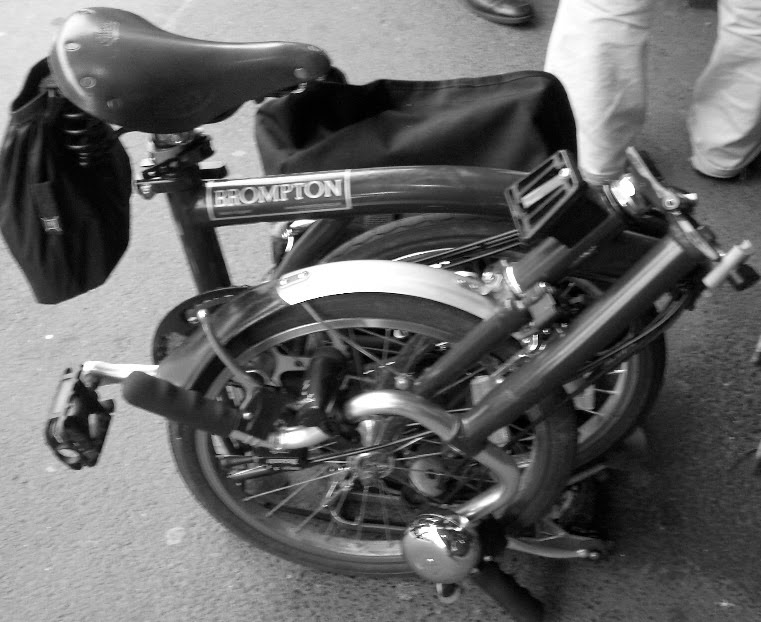
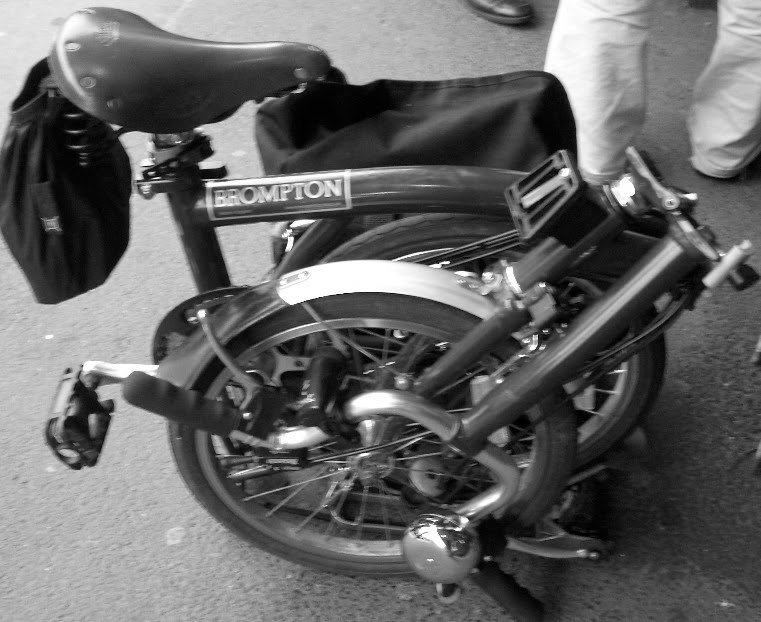
In Birmingham before going to Jersey I had Saturday clear. From the bike kennel in our cluttered garage I chose - not my usual Brompton - but my full sized bicycle. The habit of using my folder has been interrupted by the cycling in Australia. Feeling slightly disloyal I took out the Eco Real to enjoy the extra speed of a full sized bicycle. The contrast is marked. The wind rushed, chilly, despite my warm clothes, into unguarded crannies around my neck as I swept over the Hockley flyover, enjoying the choice of 16 rather than 6 gears. But the bigger bike can't be taken inside places. I have to keep locking it. I can't take it on buses or trams. On the inter-city trains I have to buy a ticket to have it with me and put it a special compartment and worry whether there'll be space on trains back if I take it to other cities. For work I'll be sticking to my Brompton but I'm exhilarated by the novel sensations of the larger bicycle as I was on Geoff's Orbea in Melbourne and John's MTB in Bendigo. The additional pleasure here is being free from the Australian compulsion to wear a helmet.
At the city centre I worked my way into the cheerful crowd enjoying the German Market, sipped a mug of mulled wine and savoured a plate of fresh fried mushrooms and diced potatoes mingling with a generous covering of creamy garlic sauce. Then out again to Handsworth for an excellent haircut at a little barber in Nineveh Road. I'll go there again, especially as I can see the large bicycle through the window, where it's locked to a lamp-post. I was reading something I wrote about 9 years ago about the trend towards urban utility cycling - wondering how things would be in ten years time. There are more people relying on bicycles but the car continues to proliferate - still the preferred way to get from A to B. Is there any acceleration of change?
I doubt it, though in London increases in cycle commuting are evident. Lin drives. Richard drives. Amy drives, though she's been experimenting with cycle commuting "but not now it's turned cold and dark" she admitted to me slightly ruefully on Friday. So while I have fun, my hopes that many more would share it, seem confounded. I console myself by enjoying the benefits of escaping the inconveniences of autodependency, while little by little people of vision lower the profile of the car in plans for the city.
* * * * *
The Agiot Newsletter for December '09 has used an old piece of mine on the Parthenon Marbles - pages 8-10. Written in November 2007 when New Democracy are still in power it looks odd, but the argument survives - more or less. And to show my hopelessness as a predictor of political fortunes, Dora Bakoyannis lost a fight with Antonis Samaras for the Leadership of New Democracy, in opposition since PASOK won a General Election in October '09. Op-Ed from Kathimerini

Friday, 19 December 2008

I entered the home of a woman...

From: Iason Athanasiadis Date: Fri, 19 Dec 2008 13:58:27 +0330 To: Simon Baddeley Subject: The tragedy of Greek apathy Dear Simon. In the end, I gave the piece to Guardian Comment and, as you can see, it's attracting a fairly lively debate! Thanks so much for the fascinating insight and historical background I couldn't hope to be able to provide on my own. Looking forward to hearing your comments. Warmly, Iason Guardian.co.uk 18/12/08: Moving back to Athens in 2003, I found a society living in denial. Greeks were skimming the cream off the last rounds of EU subsidies oblivious to the tidal wave of globalisation looming over them. I had been living in Qatar, the very definition of a globalised city-state. The return home was a welcome respite from the Arab peninsula's identikit steel-and-glass cities, where city centres had been abolished in favour of income-appropriate super-malls and the pursuit of business was supreme. On my first night in Athens, I sat in a leafy square and watched young couples enjoy ouzo and mezze as children played under the lemon trees. Some of those same children may have been torching the municipality's Christmas tree last week or chucking petrol bombs at its parliament. Greece's student intifada erupted over the shooting by a policeman of a 15-year-old student, but the anger and lasting power of the riots imply a deeper malaise. The violence and nihilism with which banks, government buildings and private cars were burned down wrong-footed the older generation. But after the smoke cleared, there was a self-conscious pause as both sides waited for lucid demands to be made. "Who if anyone is emerging?" asked Simon Baddeley, an honorary lecturer at Birmingham University's School of Government and Society in the UK, who offers coverage of the crisis through his Democracy Street blog. "The ideological stuff I've heard so far seems juvenile. Any new ideas would have surely to come linked to a set of workable economic and social ideas that don't look like the ones I'm hearing,"....

Dear Iason. You quote me correctly. My thoughts were shared with a Greek citizen I admire, about a land that has furnished my life. Omit that and my interrogatives make me sound like yet another keyboard colonel aching for tanks on the streets - something that anyone but a dunce can see is not going to happen. Indeed your piece in the Toronto Star, on 16 December, quotes columnist Alexandros Papahellas writing that 'Our problem today is not whether tanks might roll in the streets, but that even if they did they would likely collide into each other.' I'm very grateful for your thoughts, for the comments it's encouraged, and especially for MilesSmiles' reflections on a 'Western condition' - reminding me that this crisis in Greece is only momentarily Greek:

We now have pretty good reason to think that neoliberal capitalist democracy is a failed ideology, incapable of dealing with the real problems societies face. Part of the problem is that neoliberalism is a bit like Ingsoc – an ideology that is paradoxically set up to destroy the possibility of ideology. Neoliberalism atomizes social discourse so that talk of a common good becomes almost incomprehensible, since nobody is supposed to criticize anyone else's values and all that rubbish.

I hope to be saying I was wrong to comment on lack of leadership in Greece, because I was unable to recognise original thought - because I'm locked, with the rest of us (including most of the rioters, with their multilingual posters), into looking at the present in the mirror of history. It's an old forgivable error. The future may be being worked on in a beer cellar; inhabiting some 'rough beast'; a sapling indistinguishable from surrounding annuals. What may be unfold may be good and bad and will have been developing in ways that are initially parasitic, sucking meaning and agency from familiar events and institutions. I'm more puzzled about what is happening than I ought to be. I am also rather excited and optimistic. I do not feel apathetic - a Greek invention describing stoic withdrawal from the affairs of the world - and I do not think what is happening will lead to the inevitable disaster that is the essence of that misused term tragedy. I wait on the moment, embracing conversation.

* * * * This situation posted to YouTube on 16 December has had nearly 57000 hits - the banner held up so awkwardly - well, a bit 'shuffly' after a while - invites viewers to stop watching television and go on the streets. The rather longer statement by the manager of the TV station deploring the invasion - not, he insists, a 'take-over' - has had less than a 1000 hits so far - not least I suspect because he's less aware that for those for and against a cause, situationism is, outside the psychotic obscenities of Mumbai, the only game in town. Even Dubya had the wit to make a point about the size of the shoe thrown at him by a Iraqi TV journalist last Sunday. I'm reading of Robert Shoemaker on The London Mob and George Rudé on The Crowd in History.[Ref: Adam Shatz in London Review] And this piece posted 17 December by Andrew Lamm plus the conversation/comments that follow illuminates changing perspectives in the hall of mirrors within which news is created
Editor’s Note: While nearly 500 journalists and media developers met in a five-star hotel in Athens to discuss the state of the media, the city smoldered from riots organized by young people using new forms of communication. [Reminder:"Karamanlis or tanks" - the choice that Konstantinos Karamanlis, uncle of the present PM, posed to Greeks in 1974]
* * * On Thursday I took the ferry from Portsmouth Harbour Station across the estuary to Gosport - about 8 minutes - to run a workshop on Questioning, passing through London via Waterloo Bridge, dropping off for an hour with Richard Wiltshire, co-author with Deborah Burn, of Growing in the Community, published by the Local Government Association with a foreward by Baroness Andrews - "Everyone benefits from allotments and we are conscious that there is rising demand..." This is the first time government has gone beyond saying allotments are good and acknowledged that more people want them. Richard gave me an overview of his current reading of the prospects for allotments and food growing in cities which I'll summarise shortly. I wasn't home until just after one on Friday morning but was immersed in reading Obama's memoir Dreams from my Father. I watch this man with such hope and interest as he assembles his cabinet. It was fascinating to follow his mind at work, parsing his growing up and emerging identity, as the offspring of black and white - the relief of encountering a mind that can struggle with and navigate dilemmas and contradictions is almost palpable. I see my face in the window of the train, hurrying through the dark, smiling at his prose. * * * *
A political-management disconnect
Councillor Margaret Eaton (video ~ October 2008), Chair of the Local Government Association and Paul Coen, its Chief Executive who, on 12 December, via the LGA website, wrote:
Since September it has become increasingly difficult to have confidence that the political leadership and the managerial leadership of the LGA are at one on both the direction of travel and the day-to-day leadership of the Association. On Wednesday I was asked to take leave, which I have done. The LGA and I will now seek to agree a way forward. We do not believe that this will be aided by further publicity and speculation. Therefore we shall be making no further comment or answering questions until it becomes necessary.

Back numbers

Simon Baddeley