A strong wind blows; nothing to what's happening in the Highlands, but enough to blow even more glass out of a rickety greenhouse on Plot 66 on the Victoria Jubilee Allotments. Being there, I picked it up, piece by piece, and put it in the back of the HHH van. Later I wrote a note to the site secretary:
Dear G. Don’t read this until after Christmas, but I popped up to the VJA to check that these high winds hadn’t blown away the polythene sheet we spread on Plot 78, and found yet further panes of glass shattered and thrown over the ground from the frail greenhouse on the neighbouring plot. Shards had been blown almost as far as the entry gates (see attached photo). This structure is a hazard. I ask the VJA committee to let me and Winnie remove its glass, ideally with the permission of the plotholder, but otherwise without. I collected the shattered glass ... glad no-one was around when this glass went flying. I could do this work - removing the glass from the greenhouse - on the same basis as we are doing other work with Committee approval. It would hardly take 10 minutes ... anytime after Christmas day. Happy Christmas. S
At last I have a brief to start tidying abandoned plots on the VJA. Phil, our Hon.Treasurer, agreed to let Winnie and I clean up Plot 78 opposite the site gates. A week ago we set to with a will.
Plot 78 Victoria Jubilee Allotments - before tidying
The plot had been abandoned after its tenant was evicted for leaving his tap running overnight in the middle of the summer, a breach of rules that brings penalties at any time of the year. I'm pretty sure this tenant was glad to see the last of the plot anyway. They left owing a year's rent.
I was ranting away to Vanley about why 'some people' treat their plots as tips.
As I recall, the person working plot 78 was working happily away some two years ago, building terraces to accommodate the gradient of their 200 square metres. Something went wrong. They lost interest. Not just like that; rather a gradual decline of enthusiasm, during which the site accumulated the detritus of waning intention; a mess, whose detail became more unpleasantly clear as we began tidying the vacated plot. Soft drink, beer and cider cans, plastic and glass bottles, sacks of domestic rubbish, broken glass mainly from discarded window panes brought in to build a glass house that didn't happen; spare off-cuts of wood, brought in for a purpose, allowed to rot; pointless levees of soggy plastic sacks filled with clay-mud and roots, entwined with lugs of couch grass from which extend rhizomes fatter than spaghetti, beneath which, embedded, we find more rubbish, flattened seams of black polythene that have to be scraped up to get closer to the earth.
"You know" I said to Vanley, who stays calm on these things, but listens attentively, as I stoke pious frustration at other people's errancy, their downright feckless lack of talent as gardeners
"You could donate someone a studio, give them paints, brushes, linseed oil, palette knives, canvases, size. Everything a painter needs. Come back in a year and all you have, instead of a parade, as you hoped, of creative work, of art - chaos! The materials not just abandoned, but squashed, mingled, smeared, with unrecognisable pieces of rubbish that might have been easels, chairs, frames...."
Vanley, who's famous, said to me ages ago "Allotments are a metaphor for life".
Embedded black sacks overlapping the plot boundaries
Odd-and-ends to no purpose
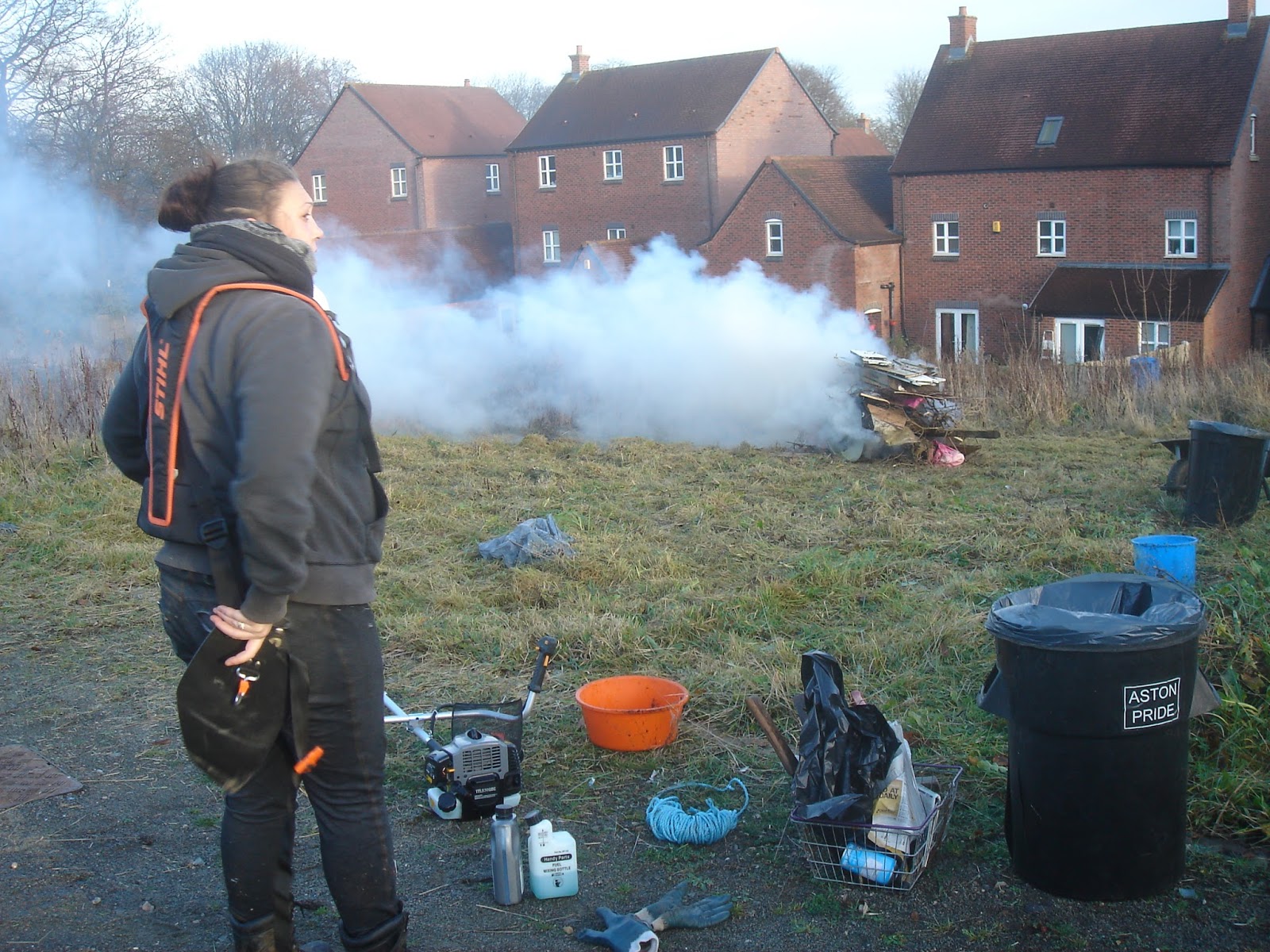
A cleansing fire for combustibles
Half a ton of rubbish to go to the tip
Well how did someone manage to leave an original plot in such a mess? It's not just fallow. It's a tip. Instead of being cultivated, it's been used. With the worst and most of the waste removed Winnie could strim the plot to about 6" all over and then I spread 200 square metres of black polythene held down with bricks and stones. The uneven ground, caused by the terracing and the original intention of divided-up beds, made it tricky to keep our footing.
There had been an attractive small oak tree at one corner of the plot; killed after a heap of fresh manure was dropped on a corner of the plot. I left the manure uncovered, so other plot holders could help themselves. The trunk of the oak made a good stake. Someone will use it.
Plot 78 Victoria Jubilee Allotments - after tidying
Phil and the VJA Committee were pleased with our work on Plot 78 and have now asked us to tidy 11 more vacant plots.
On Friday we began on four of these - 54 to 57.
Tidy all the plots that have a tick on them
By midday the van was half full of cleared waste. There's more to come - a large pile of red bricks and over twenty five sheets of double glazing stacked at the bottom of the slope between the allotments and the houses.
Starting on the tidying of plots 54 to 57
The most visible rubbish was consigned to cleansing flames - the smoke blown north by a steady breeze. Later the wind changed direction, blowing smoke towards one of the houses. I knocked on the door, apologised and found it was someone I knew and was 'forgiven'. The wind changed again. As the fire heated up, the flames grew stronger, the smoke lessened. Winnie strimmed, I carted rubbish, again having to work through a blanket of couch grass to ease out layers of plastic sacks, lino, carpet and chipboard, in one area a layer of broken glass...
...to be picked up shard by shard by hand and dumped in the van...
The four plots are already looking better ...
Plots 54-57 strimmed
...but there's more to be done, before we can finish ...
...by laying the weed suppressing fabric which Phil has managed to buy in volume on ebay.
The trickiest stuff to clear as there's so often more plastic sacks beneath, usually falling apart
I suspect those bricks were collected to help terrace the plot's slope.
Glass intended for a home-made greenhouse
Later that evening I dropped by to make sure the fire had died down to embers. In the morning I picked out metal parts and raked the ashes flat, while Winnie with the brush-cutter cleared all four plots down to 5 inches, leaving a few fruit trees and a line of broom between two plots.
"We've got a lot of work done today" she said.
"And we've done lots on Plot 14!"
Meanwhile Plot 14 is being prepared for 2017
Last year and a few months we'd made the plot manageable by making more, and wider, paths between smaller beds that could be dug from all sides without need to tread on the working soil. Now I'm reclaiming some of the walking space for beds at the top of the plot.
We needed a mattock to break up boulder-clay soil in an area of our allotment that had been used for parking cars and a van. On the rest of the plot - except the paths - I can get a spit's depth with even a spade. Getting closer to the original soil back in 2010 when I signed up to rent this plot, even a fork wouldn't go down more than inches. Winnie and I, with Dennis helping, used the mattock to get some depth, removing a familiar collection of glacier-smoothed stone embedded in clay. Picking up a fist sized piece, it squeezes together and stays that way. After we'd got the depth - about 18" - we mixed the soil with 'black gold' compost making the beds a little higher, and loamier. I sprinkled and raked in several handfuls of garden lime. Worms aplenty in the compost continued our work.
Bed E0 - planned for main crop potatoes
In two beds I planted garlic in early November - breaking into cloves garlic bought at a local grocers. They've benefited from frost, and should be ready to harvest when their beds are needed for broad or runner beans.
The shed veranda has been leaking. I repaired it on top with a patch of felt over a thick coat of bitumen...
My grandson was wondering where I'd got to
... cutting a rectangle of plywood to sit underneath, held between the supports with brackets.
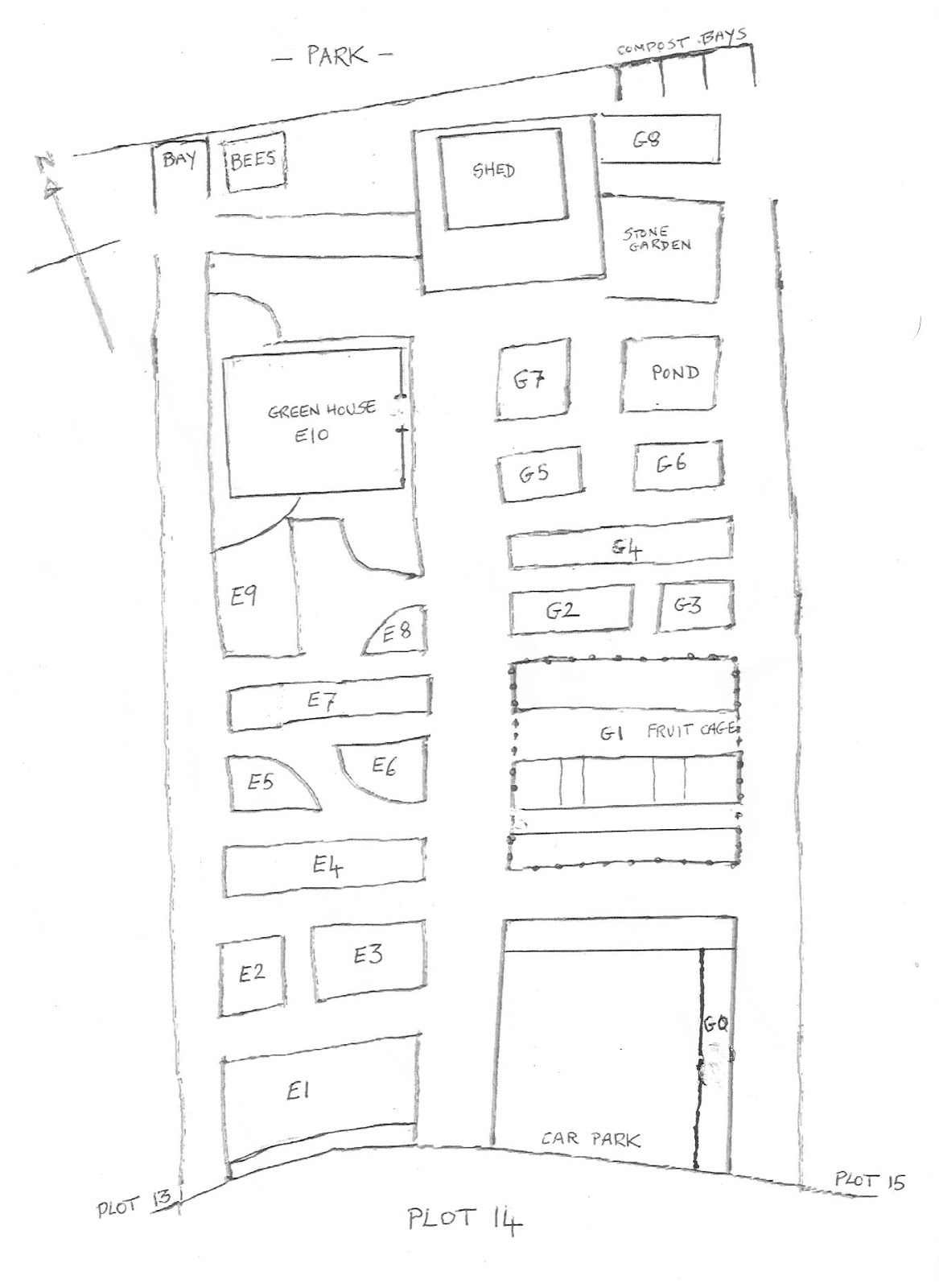
Redrafted bed plan. 'E' stands for 'English side', 'G' for 'Greek side'.
*** *** ***
Christmas day in Ano Korakiana....Χριστούγεννα! ... την ηρεμία του πρωινού, the tranquility of the morning...
Χριστούγεννα με ολίγη συννεφιά...Αρκετός ο κόσμος στη Λειτουργία στον Άη Θανάση. Η συνέχεια ανήκει στα παιδιά της Μπαντίνας που θα περιδιαβούν τις γειτονιές για να παιανίσουν τα Κάλαντα, ενώ την ίδια ώρα τα μέλη της Διοίκησης θα αναζητήσουν την οικονομική ενίσχυση του Συλλόγου στις οικογένειες του χωριού. Τα εορταστικά γεύματα μεταξύ συγγενών και φίλων θα ακολουθήσουν...Και οι κάπως μεγαλύτεροι σε ηλικία απολάμβαναν την ηρεμία του πρωινού.
*** *** ***
27th December - work continues. Was someone planning to build a house on one of these plots?
...and another load of rubbish. On the weighbridge at Holford Depot it was 3/4 of a ton
...and to finish off four more plots, two large rolls of ground cover...
The laic sculptor of Ano Korakiana at work by Jan Bowman
A catalogue on the internet for Aristeidis Metallinos` Ο Αριστείδης Μεταλληνός I left Ano Korakiana in June telling Angeliki, his grand-daughter, that by September I would bring her a rough draft - on paper.
Back in England, talking to several curators of art galleries, I came away convinced that what was needed was not a hard copy - yet. I asked my son, Richard, to design a website. Yesterday he showed me his draft for a front page...
...but to get it right "You have to have high quality photo's of each sculpture.
"Can you come to Corfu?"
"Yeah"
Richard will bring his camera to the museum in October. I hope he can work through the works not already photographed by Rob Groove who may be able to do more.
The artist creating his work - 1984, cat 190, stone 74 x 69cm (photo: Rob Groove)
"I need speed lights and a roll of white paper"
"Hm? Can you bring your own lights?"
"Maybe. Can't you find some in Corfu?"
"Maybe. I can let you know."
"I guess we'll need to photograph about 50 to 60 pieces a day. Can they be moved?"
I imagine doing this vital process the same way Angeliki, Lin and I with help from her parents worked up the draft catalogue we made in May, listing and numbering each piece with measurements and whether it's stone or marble.
Lin and Angeliki working on the catalogue
Every on of Aristeidis' pieces has been photographed by the artist's nephew Anastasios Nikolouzos, Tassos - an invaluable record, basic to the project.
A sample of Tassos' images of the carvings
There are the lists made 10 years ago by Angeliki M, in Greek and English, recording the inscriptions on each work. Now all pieces in the collection are renumbered - chronologically - these words need to be digitised and linked to each new picture, bot for their explanatory value and to ensure identification.
Letter to Angeliki M: Αγαπητοί Αγγελική. Linda and I send love and best wishes to your family and hope you are all well. I have attached letters to me from Eurydice Antzoulatou-Retsila who knows as much as anyone outside Ano Korakiana about your grandfather. She is happy to write another article for the ‘catalogue’ we are working on about Aristeidis Metallinos. She retires from her university in the Peloponnese this month and she will be coming to Corfu, where she also worked, to visit friends and, she hopes, to visit you, your family and the museum when she is here. My son Richard Baddeley is working on a website about the sculptor. This website will record all the works with photographs of each carving. My son says that he needs high quality photographs like those created by our friend Rob Groove from Ipsos who visited the museum this May to make an image of ‘The Saint of Preveza’ for Richard Pine’s book about Greece which will be published in October. Our son will be coming to Corfu for a week in order - with yours and your family’s permission - to take high quality photographs for the Aristeidis Metallinos catalogue which he will be putting on the website catalogue he has started to design. After we returned to England in June I asked several museum and art gallery curators about our plan to publish a catalogue. They confidently advised me that it would be far better to have a web-based catalogue containing the artist’s work and articles about him. The advantage of this is that we can have swift free access across the world to Aristeidis’ works. The website can include texts including ones by Eurydice Antzοulatοu-Retsila, by your father and by me and you. We can also include video clips and sound recordings in English and Greek that can be accessed with a click of a computer key. People with smart phones can find out about the sculptor. A web-based catalogue has the additional advantage that it can be easily re-edited as new knowledge about your grandfather or more detailed images become available. I hope you will not be disappointed that I am not coming back to Corfu with a ‘book’, but I am now convinced that an Aristeidis Metallinos website is the best way forward in bringing the artist to a larger audience, and certainly does not preclude a book type catalogue. If a ‘hard-copy’ catalogue is wanted for a particular exhibition of the sculptor’s work at some time in the future, this can be constructed from data in pictures and words from the internet. We are looking forward so much to being back in the village and to seeing our friends again. I don’t know exactly when Eurydice arrives on the island but as you see – in the attached letters - I have given her details of how to contact you. I hope she will be welcome in Ano Korakiana. The work I am currently involved with is writing the English and Greek words on each of the sculptures....
First page of 15 pages - spaces await recording of transcriptions and, where needed, explanatory notes
The Scops owl Metallinos carved on a stone plaque fixed to the front of his house, displaying his initials, and holding a builder's trowel and a sculptor's hammer, is dated the year he made the transition from builder to sculptor, depicting in stone and marble a unique record of a fast changing pastoral economy, emphasising the primacy of the family, village institutions and traditional customs, yet mingling with this account of Greek folklore, works that are στοιχεία ερωτικά, σκωπτικά και πολιτικά ανατρεπτικά...erotic, ribald and subversively political.
*** *** ***
I planted parsnip seedlings, germinated in March on a wet kitchen towel at home then planted them out on the plot inside cardboard tubes to help them stay straight and not divide. Since July I've been enjoying them as soup, roasted and boiled. Late August, my friend Winnie gets my grandson's help pulling up another crop for the pot.
One of the most robust sources of happiness these last 9 months has been the fecundity of our allotment. Various actions define a turning point. For s start I did what just about anyone living in Handsworth starting with raw soil has to do - one way or another. I invested in several builders bags of black gold compost which I gradually mixed with the 'messy' soil I've been trying to work since mid-2010.
Andy of Valley Contractors delivering black gold compost to Plot 14 - July 2014
What is 'messy' soil? There's a question. This plot and others on the Victoria Jubilee are confusing in this respect. It presented itself to my spade, fork and mattock, as neither sandy, nor peat, nor clay nor chalky.
The soil as it presented itself in December 2013
This kind of rubble still being dug out of the plot in 2014
It might have the character of silt soil. Where compost has been mixed in, it might be loam. Loam and silt contain elements of the others. Why is it tricky to define?
To go way back; in Triassic times all Britain was in the tropics, our area a vast shallow lake. Far more recently - between 100,000 and 12,000 years ago...
Birmingham is about where ''e' is at the end of 'Northern Ice'
... the land was buried beneath 3000 metres of ice. The climate was like that at the North Pole now. Slow-moving sheets of ice ground the tops from the Welsh Mountains. Glaciers pushed great masses of earth and broken stone south eastwards across the clay plain.
...huge glaciers pushed millions of tonnes of sand, gravel and pebbles from Wales and from the north of Britain to the Midlands. Glacial drifts with different mixtures of sand and gravel, pebbles and clay are found in many places on top of other rocks...
Across great lakes, blocked in by mile high ice barriers, gales blew the water into mighty waves, which, breaking, pounded fallen rocks into smooth rounded gravel. When the great thaw came, glacial drift had left rubble strewn over the landscape forming an uneven layer of water-worn pebbles mixed with sand, clay with a few larger boulders...
Winnie's stone garden - 'water-worn pebbles' ground by glacial drift
So Handsworth and its surroundings was 'covered by glacial drift deposits 150 feet thick'. Glaciers ground the high peaks of Wales and drifted their stones all over the Midlands. The ground stones are attractive, but they're mixed with recent remains from activity on private allotments that were here up to the start of this century
A typical collection of glacier and water-worn stones mixed with more recent rubble dug from the plot
The account of local geology goes on to say that the local 'topsoil is porous and acidic, unsuitable for agriculture...its natural cover was light woodland and heath.'
This suggests that anyone who's used this land for growing vegetables has needed to improve their soil. I'm confident that the soil on the original Victoria Jubilee Allotments (VJA) - private land - had been undergoing steady improvement for near a century, from the time working men started using land given them by the church at the end of the 19th century. Much of the VJA had been thoroughly dug, manured and composted for decades.
The Victoria Jubilee Allotments, sold by their owners to a developer, who got planning permission to build in 2004
The old Victoria Jubilee Allotments were accessed by country lanes (photo: Luke Unsworth 2004)
Would that those of us who took up plots on the 'new' Victoria Jubilee Allotments - 80 plots on a third of the original site - in June 2010 had inherited this well prepared soil. What actually happened was that the whole site...
Google map now - the unfinished playing fields and the new housing around Victoriana Way were once all allotments
...from which Birmingham City Council eventually won the new plots and space for playing fields - still not delivered after eleven years - was first graded and built on and driven over with heavy machinery during the housebuilding that went on between 2004-2009. There were major man-made ground upheavals. First, old sheds, shrubs, trees, hedges and anything remaining on the old plots was bulldozed into several big heaps...
In 2005 the old VJA was being prepared for new allotments, playing fields and houses (photo: Luke Unsworth)
...then a large cavity was dug in the ground beneath the smaller area reserved under a S106A. It was deep enough to almost hide the diggers involved...
Landscaping on the VJA in 2005 reveals glacial drift - pebbles, sand, clay and occasional boulders...
...and show the start of the deep sandy muddy glacial drift deposit that runs so close to the surface. Why such a large hole? Why did the developer need to create such a space? Was some of the excavated earth trucked from the site? I suspect this was all about major re-landscaping of the whole site with earth from one part being moved to other part - including the laying out of level playing fields to the south where the land had sloped gently down to the park. The original geology is confused. I didn't see it happen but my guess is that this cavity - under my present plot - was refilled from gradings elsewhere on the VJA site over which earth mixed with all left on the surface of the original VJA site was re-spread across the new site...
The new plots being laid out on the VJA
...with, as I understand, a few inches of topsoil brought in from elsewhere. I'm unclear why this was necessary and most gardeners tell me it's not especially rich and may have brought in such perennial weeds as horsetail.
On 10th June applicants signed up for their plots. Linda and I chose one overlooking Handsworth Park.
Signing up for our plot (photo: Richard Baddeley)
I started work - innocent and ignorant - on preparing our new cherished hard-won plot.
Summer 2010
The earth was dry, dusty, full of weeds, pebbles, stones and odds-and-ends that had been part of the furnishings of the previous plots that had been here - worked wood, plastic, metal brackets, wire, fragments of fabric, many coloured pieces of broken glass, bricks, rubble...
It was a start. I was carried forward, as I am now, by interest, enthusiasm for learning, excitement at the prospect of growing things, getting a shed, making Plot 14 into a place.
July 2015 ((photo: Richard Baddeley)
*** *** ***
1. Making sense of the soil - from figuring the local geology; investing in topsoil and compost; knowing the history of the site to explain some of the objects brought up by the spade. Studying the book recommended by Barry Luckhurst - Gardener's Earth by Stanley B. Whitehead and beginning to learn the art of composting.
Palette composting bays laid out in March 2015
2. Making the improved soil accessible...by laying and widening paths to create beds I can get at without treading on worked soil.
My rough plan of Plot 14 in 2015
I used the HHH van (with a donation for time and fuel - all logged and transparent) to deliver hundreds of bricks recovered from skips and front yards, with permission. These are easily moved to change the shape of a bed as carpet tiles, collected in a discarded batch while clearing a Handsworth garden, can quickly create temporary paths as well as holding down the hem of netting. All paths on the plot have been covered with permeable weed control membrane fixed with staples...
I've stocked up with plastic tubing to use as frames for nets, investing in veggiemesh and, for winter, bubble wrap to protect from frost. I now set up a netted framework swiftly; a crowbar to make the holes, Each end of a cut-to-length plastic tube inserted in the holes; the hoops strengthened with bamboo fixed with plastic ties to the hoops. Then the mesh spread over the frame, staples inserted to hold it down and carpet tiles to cover any excess spreading on the surrounding path.
3. Winnie. She is my steward and farm hand and friend as interested in the plot as I and with a dad who also has an allotment, and a young son who works with her on the plot and plays with Oliver, my grandson, when he's here.
Winnie and Simon on 'our' plot this January
Cutting out cabbage buttterfly eggs and damaged leaves on Brussels Sprouts


 The four plots are already looking better ...