Pietro Lorenzetti Christ's entry into Jerusalem on Palm Sunday
It’s Good Friday. What a waste it would be, if people like me, without faith in resurrection, miracles or virgin birth, might be tempted to throw out such an accurate demonstration of human nature; even turning away from witnessing the same population who provided a cheering procession last Sunday as Jesus arrived in Jerusalem on a peaceful donkey, but became, within a week, victim of a blood drenched lynching, incited by a religious hierarchy panicked, in their high offices, by the breach of small regulations; an uneasy imperial governor who for political expediency makes the killing of an innocent man official, ignoring his wife's pleas, and lending wood, nails and executioners; of a dear friend whose uncomprehending disappointment turns to anger and impulsive betrayal, and another, who’s resolution faltered when faced with torchlit darkness, armed soldiery and the dreadful smells and sounds of torture. Caiaphas, Pilate, Judas, Peter. There are many bit parts. Simon of Cyrene who carried the cross part of the way up to Golgotha; Veronica who lent her veil to wipe Jesus’ face; two thieves walking to the same death. Many witnesses.
Andrea di Bartolo Way to Calvary
** ** ** **
It's not that I take Greece for granted now we've been regularly at home here these ten years. Not for a moment. It's that some of the fervent, and to Lin, I suspect, feelings that would overtake me when I touched on Greek ground and heard Greek spoken and saw it written, are not so impulsively expressed. I was in love - am still in love - with this place, but now it's more like an extended friendship. Companionship. I'm at ease here.
Hannah and Oliver on the walls of Kassiopi castle
I hoover the floor. I know the details of dust, the mould on the plaka, the dry shed leaves I sweep from our small garden. I love hanging washing that dries in hours, seeing it blowing in the warm breezes that waft between the village and the mountains; remembering to feed the cats where they've left their shit - after I've washed it away - so we won't tread in it as we go up and down the steps to Democracy Street, whose blemishes I know in my sleep. I change the broken bulb in the municipal light that hangs off a bracket on the side of the house, helping us in and out at night. In the morning the piss-pots emptied on the compost of greenery and dried weeds along with peelings from potatoes and carrots. In the grandchildren's case I enjoy reminding Oliver, as I empty his, that only male wee works on compost. One day Hannah will challenge me on this. Oliver's learning the difference between 'bitch' as a rude word and the description of a 'lady dog'. I don't want him getting into trouble with teachers, but nor do I want him town-ignorant. Five days ago swallows began returning to Ano Korakiana.
There was a problem with our water supply. Strong as usual outside; a dribble indoors. I needed to replace the pressure regulator that moderated the high pressure supply to the village. Bought from a plumber by Sgombou, the new kit wasn't too tricky to fit in place of the old one, blocked and rusted, unwilling to loosen up when tapped with a hammer.
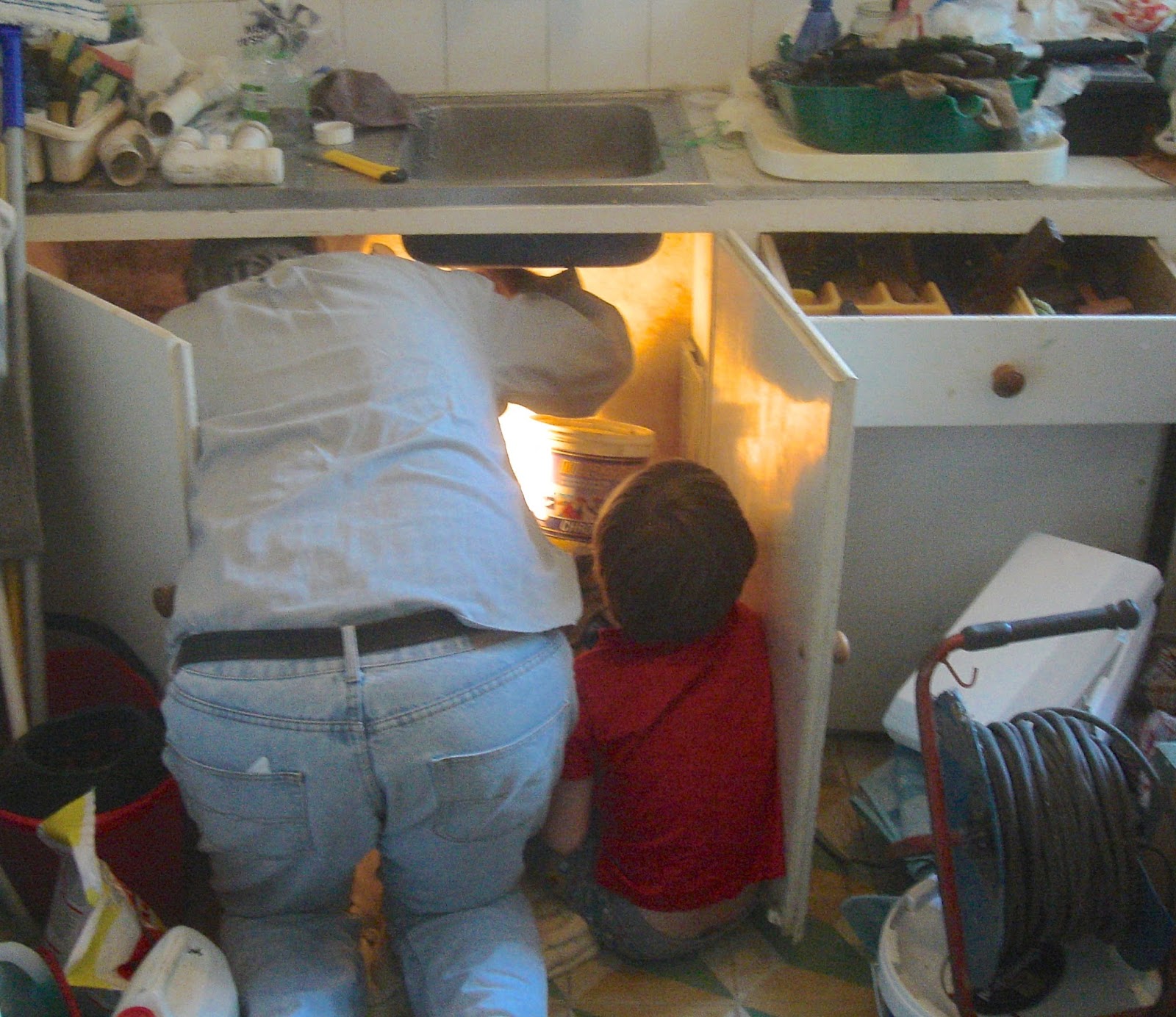
Fiddlier was mending the sink drain inside a cupboard in the utility room. Woeking on bended knees is harder work these days, as I explain to Oliver, watching with pleasing interest.
"Turn on the tap....wili it leak? Yes? No! It's OK. I'll tidy things up later"
Mending the sink drain u-bend in the utility room
...nnd Lin's already resealed a gap that's opened up between the stove and its lid, using thermal filler and sealing rope.
On Good Friday afternoon we drove to a stretch of empty shore at Sidari, treading on warm cushions of dry seaweed, sat on the jetty.
From the littered overbuilt shores of Corfu lots of people still reap perfect images of the island landscape that so enchanted those who passed through before mass tourism – the monastery of Panagia Vlacherna and Pontikonissi omitting the roar of the airport and the multistoried hotel on Kanoni, the pretty sight of Gouvina Cove where you can park by the road a few hundred metres from the end of the dual carriageway at Tzavros, and a small crop with photoshop can easily disappear the cloned boxes and concrete skeletons that disfigure Barbati, and from a distance even the jutting hull of the Nissaki Beach Hotel can be blended into the towering cliffs of Pantocrator, though ignoring 'Seashore Villas' plonked on what was once the village of Ag Spiridon near the car-blocked streets of Kassiopi is a little trickier, but removing the endless plastic detritus from the beaches needs no army of earnest litter-pickers - just a tiny upward shift of the lens records the sublime landscape of archetypal Greece above the sparkling blue of the Kerkyra Sea, as from the dizzy heights of Angelokastro the cliffs of Capes Iliodoros and Plaka facing the Adriatic horizon distract from the disastrous shamble of Paleocastritsa.
It was the better-off who recorded their memories of Corfu’s charms; incubating their future commodification. For peasants, fishermen, small shopkeepers, beauty lay in health and harvest; the two connected. Once upon a time, when people gazed longingly at the green island from the rocky mainland of Epirus they saw its wealth not in its landscape but its fecundity, as a family judging a prospective daughter-in-law might rate child-bearing hips, above a pretty face [Of these observations Jim Potts remarks: 'Succinctly stated. But I sincerely believe that even the poorest peasants appreciated Corfu's natural beauty and recorded it in their own ways, through orally-transmitted tales, folksongs and proverbs, for instance. Is it not possible to feel a sense of profound regret, even while cutting down olive trees to build a better house or to make some money to pay to educate one's children? The sense of regret increases with time.']
Only in the last fifty years has Corfu’s harvest changed from what grew here to what disembarked from ships and planes. The shift in wealth that followed – from the grand farm estates of the nobility - the signorini - thriving and then just surviving on the close cropping of tenant labour - needed and got little help from government. Oil in Arabia and Texas turned arid scrubland into gold. Tourism in Corfu made hard-worked seaside estancias into cornucopias. Sea, sand and gravel were already here. Cement made new byres, the digger and the dozer swiftly cleared the island curtilage of unnecessary trees. An olive grove or a vineyard anywhere on the island sprouting concrete in place of roots could send your children to university and show a way, other than emigration, to escape a life of sweated labour, as a fibreglass boat with a glass bottom over one busy summer could replace the hazards and uncertainty of fishing round the year. Landscape enjoyed by those with the means to gaze upon it, that had inspired painting and poetry became publicity and copy to attract the new wealth of millions.
I hear myself muttering “You make all this sound like a bad thing”
“Well yes and no” I reply “Yes and no”
The noble leftwinger Lord Bertrand Russell remarked that ‘the central dilemma of socialism is that you can ruin anything by making it available to everybody’.
“If only governments instead of being bought by the Lopachin's so excited about laying an axe to Corfu’s cherry orchards had pursued a research based policy that had regulated the massive changes brought by mass tourism; created an infrastructure that was less piecemeal and opportunistic”
A broad smile grows on my face at my naïve pomposity.
“Έλα τώρα! Surely you jest?” I exclaim “Weren’t these messy changes always going to be irresistible, any attempt at planning overwhelmed not just by greased palms and brown envelopes but by human yearning. Try testing your commitment to properly regulated planned development of tourist infrastructure against another lifetime of horizon-less poverty heaped on the deprivation of centuries”
Linda and our friend Jill on the Kato road to Ano Korakiana
The challenge of Ano Korakiana; a few years back – three or four at most – there was a discussion, probably one of those animated debates in which I’ve sat in the back nodding sagely as though my Greek is good enough to follow the arguments, in which villagers, in large numbers explored whether they should have a taverna or indeed any other commercial establishment in the village that catered for and attracted foreign visitors. I first heard of this meeting from two British neighbours in the crowd awaiting midnight the Easter Saturday before last
“They decided, on balance” said Wesley “that they would not.”
This confirmed the presumption I heard a few years earlier when we were planning to buy a house in the village that “Ano Korakiana doesn’t welcome tourists.”
To suggest that Ano Korakianas do not welcome strangers – for all those 44 voting last Sunday for Golden Dawn to keep foreigners out of Greece – would be slander.
Apart from the fact that an overwhelming majority of eligible voters here voted for the left including the KKE (third in the poll here), this village is nothing if not hospitable, not just to people who have made their lives here but to passing tourists on foot, on cycles and in cars, who stop to look about, sometimes puzzled as to where to buy a drink or a meal. Such people are sometimes treated to these; as guests, not customers.
So? So what makes this village? What makes any village? It’s a question elaborated across the world. I have urgent thoughts on this, I feel a need to know and understand. This village has a website, as with all Greek villages - a global diaspora, an historian, a documented history that goes back over a 1000 years...
Kostas Apergis' history of Ano Korakiana
...and a permanent population that qualifies it as a working village in the eyes of government. It has a medical centre staffed at different times through the week, and of course it has the Spyros Samaras Philharmonic Society of Korakiana, including its superlative band that performs here, in Corfu Town and across Greece, with practise rooms (a new finely restored band-room higher in the village will probably be ready next year), instruments, uniforms and regular rehearsals – an institution linked to a choir and dancers – who rehearse and learn in both the band-room on Democracy Street and in the Agricultural Co-op which also processes olive oil; providing space for meetings and village celebrations like Carnival through the year. It has 35 churches – the one’s most used Ag Georgios, Ag.Spiridon, Ag. Athannasios, Ag. Isadorus. I can’t list all their names though they are described in Kostas Apergis' history – but also the semi-ruined Prophet Elias...
Church of the Prophet Elias before mother Greece
...marking the ancient village boundary on the hill a mile away and Ag.Paraskevi, a church below the village. There’s a taxi service on Democracy Street - almost opposite us, and buses to and from the city. There’s a second olive processing factory below the village, a furniture making workshop, a carpentry shop, a thriving bakery serving other villages and two grocery shops on Democracy Street and a kindergarten and nursery and a kafenion - του καφενείου Κεφαλλονίτη - regularly attended, where even Linda and I have enjoyed a coffee and beer, tho' there's still a mainly male attendance there overseen by Maria, its proprietor. Another kafeneon - John Laschari's, Γιάννη Λάσκαρη, ceased in 2007.
The village primary school closed last year and is to be replaced by a special school serving the whole island. Ano Korakiana appears to have a museum for an exceptionally gifted village sculptor who worked in the first part of the 20th century – but disappointingly, this though full of invisible sculpture, with parking spaces displaying signs saying it’s a museum, is, I’m authoritatively assured, never open (but see this - in early 2014 also this about the village sculptor Aristeidis Metallinos). There is another business – Luna D’Argento – a kilometre below the village, a venue for weddings and dances, also occasionally for the whole village as at the cutting of the New Year Cake, Vassilopita, and next to that a stable for horse trekking and riding lessons run by our friend Sally.
I couldn’t attest to how many other skills and talents are exercised in Ano Korakiana. There are people who in repairing or rebuilding parts of their houses are conscientious about maintaining its architectural character – what experts sometimes call 'vernacular'. (Example 1 ~ Nick and Sophia's house. Example 2: George Poplis's work and Sally and Mark's house - scroll down. Example 3: The restored Music School). Our house lost some of this vernacular at the hands of an English builder hired by the previous English owners who destroyed its balcony and steps, replaced by us via the admired skills and taste of Alan Barrett of Ag Markos.
There are doctors, pharmacists, house-painters, plasterers, carpenters, artists, probably writers preferring anonymity, many wine makers, woodcutters preparing a delivering fuel, gardeners cultivating vines and vegetables, gardeners growing a festival of flowers – geranium, roses, honeysuckle, jasmine, bourgainvillea, wisteria, cana and arum lilies; a few farmers tending larger fields, small vineyards, keeping sheep and goats, chicken, turkey, guinea fowl, ducks and geese and of course harvesting olive oil from their olive groves - the island’s most distinctive crop; plumbers and mechanics and builders, roofers, private tutors teaching English and other skills; engineers, accountants working in the city. Kostas is the village priest. Ano Korakiana fields a football team that triumphs across Corfu and beyond, but hopes of having a local football field - one a quarter completed that has sat fallow below the village for over a decade - seem to have expired. This is made less problematic by the existence of two pitches finely maintained that Ano Korakiana can share with its neighbour Skripero, sited close to the T-junction between the winding south-westward lane out of Ano Korakiana where it meets the road to Sidari.
Ano Korakiana has organization. It has committees for the band, shareholders for the Co-op. It has government. It debates and makes decisions – με δημοκρατικό τρόπο - about events and direction. Some say it has the best water on the island. Does all this make ‘a village’; in modern parlance – a sustainable community?
[A cautionary essay on the village in England, Bagnor, where I grew up between 1949-1960 - translated. and posted on Ano Korakiana's website..Νομίζεις, ότι κάποιοι από εμάς θέτουμε σε κίνδυνο αυτό που αποκαλείται «ακεραιότητα» της Άνω Κορακιάνας; Είναι δυνατόν οποιοιδήποτε από μας (προσπαθώ να αποφύγω το «εμείς» επειδή εσείς και εγώ και οι συγγενείς μας είναι μοναδικοί και δεν θέλω να μας χαρακτηρίσω όλους μαζί ως «αλλοδαπούς») να επικριθούμε για τις επιλογές μας στη ζωή; Δεν θα επιθυμούσα η Άνω Κορακιάνα να γίνει όπως η μη-κοινότητα του Μπαρμπάτι, με τα νεόκτιστα σπίτια και τη θαυμάσια θέα προς τη θάλασσα, που κατοικείται όμως αποκλειστικά από εποχιακούς επισκέπτες. Ελπίζω ότι νέοι Έλληνες γεννημένοι στην Άνω Κορακιάνα θα είναι σε θέση να μείνουν, ή εάν φύγουν, θα επιστρέψουν για να συμβάλουν στη ζωή του χωριού. Υπάρχουν χωριά στην Αγγλία που παρότι έχουν μετασχηματιστεί, εν τούτοις έχουν οδηγηθεί σε μια νέα ισορροπία, με σημαντική συμμετοχή σε αυτό, των σχετικά νεοφερμένων, που έχουν βρει την αρμονία τους με τους εναπομείναντες παλαιούς κατοίκους και πίεσαν για το κτίσιμο «φτηνής στέγης» ώστε νεότεροι άνθρωποι να μπορούν να παραμείνουν στο χωριό...]
Ano Korakiana
...and some thoughts from an earlier entry inDemocracy Streetwhich draw on the experiences of Geert Mak in Jorwert - reported beautifully but without the 'aren't they quaint and eccentric and charming' tropes of some commentators on villages
(from a review)...The point is made, and reinforced by research carried out by others around the world that villages divided by space and time have more in common with each other, than they do with their nearest urban neighbour. Villagers are proud of the small differences. Jorwert is very special to Jorwerters. They are proud of tradition, and cling on to the facets of it that survive the changes in technology and bureaucracy as best they can. They believe in the future and in the family. And that is what the country, and therefore the village, life is all about. It is not about being an individual. It is not about making money or acquiring stuff . It is all about survival. Making sure that what is outlives you, and that your children are there to take it on and take it forward and protect it as you have done. This is true of every village, everywhere. What is also true of every village in northern Europe is that since the end of the second world war, the local people have had to cope with the Europisation of regulation. The disaster of the Common Agricultural Policy played out with the best of intentions and the worst of results. This is as true for the dairy farmers around Jorwert as it is for the sheep farmers of Wales. The lure of education, of easy money, of city life and hedonism affected the children of Jorwert, just as it did those of the French mountain youngsters or those in the Spanish plains. Schools struggled and then closed. Shops followed them. Churches remained the focus, but in protestant northern Europe they didn't have the hold they had in the catholic south – which isn't to say the whole Jorwert didn't put aside their personal faiths the day the church tower collapsed and set about figuring out how to rebuild it! Mak examines all of the issues in true journalistic fashion, supporting his arguments with academic study and local example...
*** *** ***
Our bathroom washbasin had a mixer tap with a spout coming out so far it splashed the floor. I assembled the new tap I’d bought from Niko at Tzavros, fixing flexible pipes to hot and cold, inserting the spout into the base. With new found skills I removed the old tap, groping below the drips with a bottle spanner, and fitted the new. It leaked hot and cold unless you screwed the taps so tight Lin could hardly turn them on again. I took it back. Nico changed the tapwashers, clearly damaged by the tightened taps. He even added a new valve unit to the cold. Back in place the problem was worse. Hot water went on running however tight the tap. Cold water was a trickle with tap full on. Back to Nico. He was puzzled. Began to think about replacing both valve units, then, examining the unit more, he noticed I’d pushed the spout too far into the mixer unit. Removing one tap showed the spout base intruding into the core of the unit.
“So it was my fault”
“But an easy mistake” said Nico generously.
He tried to pull out the spout. We both tried to pull it out; he on one side of the counter, I on the other. Another customer came in and saw us struggling.
“Κράτει! Whoa! What’s the problem?”
“We can’t get these two apart!” I said offering him the spout. Another tug-of-war with he and I risking falling over had the parts separated. Then Nikos and his customer tried - younger men more powerfully leaning back - bracing and hauling at the unit. No movement.
“We must apply a flame” said Nikos and lit a blow lamp “OK?” he asked.
I nodded
“Στάσου. Just one more thing first” said Nico and unscrewed the second valve unit. Again we prepared to tug, but the spout came clear with ease.
“Bravo!” We raised our arms in shared triumph
“The problems of the world are sorted!”
Back home the reassembled taps worked perfectly. Nico would take nothing from me.