“I’ve just had a woman complain my compost is full of worms! She was all the way down towards Benitses. Asked me all sorts of details about the compost and then ordered one bag. I delivered it. Next thing I heard, she’d warned another customer not to buy the compost…”
“Because it was full of worms” we chorused.
“The worms for goodness sake show it’s not manure any more..that the compost is well on its way to being humus. I know, Mark, because when I handle it, there’s no discernible smell, it crumbles and mixes nicely with our present soil. It’s darker than the compost we’ve made with kitchen waste and green stuff from the garden.”
Fortunately the women complained to a another Greek who explained the function of earthworms to her”
I keep turning over in my head thoughts about the earth on our allotment in Handsworth. I’d been warned on Day One – back in June 2010 – when I, at last, signed up for a plot, full of excitement, and delight, that the one we wanted was available.
I’d been warned there was clay just below the surface; that the ground was full of large stones; that it would drain badly because new poor quality topsoil had been spread over earth compacted by the works vehicles used in building the neighbouring houses that had come with the S106A that had delivered the allotments to Birmingham City Council. The soul was also full of annual and, worse, perennial, weeds, mares-tail but especially couch grass whose rhizomes spread swiftly just below the surface of the soil leaching nutrients, spreading grass where it wasn't wanted. I knew all that. I've been dealing with the problem since – digging over and over, removing large stones, adding commercial compost, weeding constantly with the extra help of pegged down weed suppressing textile.
What I did not know, what I’ve just begun to understand is what good soil should be like; how it should be created; how maintained. It was not until I was pointed to the book I’ve mulling through for two months now, that I began to grasp the depth of my ignorance.
Gardener’s Earth it’s called by Stan Whitehead. Barry Luckhurst who knew and liked my stepfather’s programmes on TV, found me on Facebook, pointed me to this book; all the while mocking TV gardeners as entertainers feeding dreams rather than offering education.
The soil is a universe, alive, ever changing. It plays only a small part in the final success of what I grow – other factors being the plants or seeds I start with, the weather, insects and other predators, my skills in sowing and tending the growing plants. But that small percent on mainly the first seven inches of ground is a fascinating world, intriguing. Luckily Mark and I share this interest at the moment.
We’ve been discussing earth, manure, compost and humus, over drinks at Piatsa. How to get good tilth? He’s been digging into a couple of piles of three year rotted horse manure at Sally’s stables; distributing it via customers on the internet in 20kilo sacks of compost.
Organisms in the gut of the horse starts the decomposition as part of digestion. The process continues outside when dung meets air. When the manure has lain a while exposed to rain and sun, mixed with straw from the stables, worms start accelerating the composting, creating humus, that, spread on and mixed in with existing soil, enriches the earth, helping please the plants; creating conditions that enable other good things to happen in the soil.
There’s far more to it.
I’m only starting to understand the subject, aware that good farmers, good gardeners, have known about the earth intuitively; learned it from parents, from direct experience, not books. The vital thing about compost is that, applied properly – there’s the rub, it can improve and maintain the soil. To understand that I have had to grasp what is meant by good soil, gardener’s earth; what is meant by both the composition and the structure of the soil, and how it is constantly changing and how what is needed to arrive at the best growing medium – good tilth - requires an understanding of the kind of soil I’ve started with.
Colloids are particles of earth which do not dissolve in water but form, depending on whether soil is more sandy, loamy or clay, varying sized clumps, giving the earth greater capacity to hold moisture and plant food. Soil forms into clumps – sticky or less sticky, hard, soft, soggy – depending on whether it’s predominately clay or, at the other end of a spectrum of types of soil, sandy. Each type of soil needs different treatment to create colloids and so approach the composition and structure that suits what I want to grow in it. Another phenomenon I’ve yet to understand is flocculation – a process by which added lime creates greater aeration within the earth.
Even if the ideal tilth is approximated, growing things, even when successful, changes that approximate ideal, demanding continued work to keep the soil fecund. Growing things in it makes earth more acid. The balance of alkalinity-acidity (pH value) has to be created, restored – constantly.

The soil must also have holes in it, space between the particles - aeration - allowing roots to spread and gain nourishment, and – amazing – allow, in many cases, the growth of a fungus that attaches itself to those roots – mycorrhiza, which grows on humus – and in a mysterious symbiosis enters the roots of the plant, becoming a partner that makes other nutrients in the soil more available to the plant.
How far this seems from paying over the counter at garden shops for fertilizers in sterilised sacks and boxes and bottles, containing, if you examine the labels, the key ingredients – nitrogen, potassium and phosphorus plus small trace elements known to be important...

 ...These things, writes Whitehead, feed the plant, not the soil. Better he suggests to create the conditions for these to develop and remain in the soil mingling with myriad millions of micro-organisms nurtured by well mixed-in compost. He understands the power of artificial fertilization and the need for it by farmers who need to make their living from the land in the market, but better, he argues, to fertilize the soil rather than what grows in it; better to work on the soil’s native fertility rather than use artificial fertilizers which may, in promoting growth in one season, exhaust the soil the next of its natural capacity to produce the commercial nutrients you’ve added. Once reliant on artificial fertilizers for the growth you expect and need, you, or the plants you want to grown, can be hooked on them. Whitehead’s no faddist. Artificial fertilizers used with discretion can be good so long as you know the principles at work and can make appropriate adjustments, rather than head towards total dependence on products you have to buy.
I can see why one may be tempted to buy nutrients. There’s an art to creating the conditions under which the nutrients needed by what you want to grow will occur naturally and in the right balance in the earth. That’s how far I’ve got. Knowing far more about my ignorance; knowing, as I did not a year ago, things I didn’t even know I didn’t know.
I am not that keen to return to Birmingham – too much work on the untidy house and its delinquent plumbing, but then there’s babysitting duties – the pleasures and frustrations - work with Handsworth Helping Hands, even some paid work teaching, the need to help edit the recovered ‘Out of Town’ episodes for broadcast on Big Centre TV, drafting an Aristeidis Metallinos catalogue, getting back to the defence of Black Patch Park, tidying our neglected garden and the allotment – from which I’m expecting a better crop than before, a prospect that excites me but also reminds me that I am about to move from being delighted at managing to grow things to growing them in the right amount and sequence for cooking and eating, as well as observing the rotation of crops needed to keep the soil working for me. I’m also hoping that I am getting closer to making my own compost instead of buying it in. I shall make a plan that shows each bed and keep notes - a growing diary, and a reminder of how little I still know but how much I’ve learned in four or so years.
*** *** ***
I had speculated that there’d come a day when the subversive row of punk would become nostalgic “sing along a’ Sid”. Last night was so. A taverna near Ipsos, old English folk, a couple of holiday grandchildren – hardly out of toddling – pogoing round the pool at Dominoes to the harsh tones of punk tribute – a fiftieth birthday party and farewell to an ex-pat couple going home, a birthday cake iced in the Union stripes, “God Save The Queen”.
“An ethnic event” I muttered to Paul “It’s strange”
I doubt it applied to these x-pats either - never scrapped into the wasteland of post-industrial meltdown; not tuned to the desolation that made this droning clamour literally the rage. Paul generous and innovative had added the punk group from Maidstone to his Agiotfest menu, where, their dutiful ill-manners earned the ‘mixed reception’ intended. Now at Dominoes Paul politely pogoed a few seconds. I imitated him.
“Don’t be ridiculous” said Lin.
Yes indeed. How could I, under my unshaven silver hair, in my white jacket, my white easycare M & S shirt, my clean jeans and brogues, have a hope of being a headbanger?

Sleaford Mods - now there's something that even resonates with me....'Teacher faces Porn Charges' ...vocalist Jason Williamson and musician Andrew Fearn...'...one of those non-existent old blokes you see from time to time..." "I'm just saying things should be in order"..."From the window there's a great view of hell"...
** *** ***
I am still aware how life and its meaning hang by threads. How the universe of all matters can implode in an instant. What bloody contingency makes of all hopes and plans. That fiery New England preacher, Cotton Mather, put the fear of eternal damnation into his rapt congregations, reminding them that below their feet, an inch beneath the unreliable floorboards on which they stood, burned the vivid flames of hell. One lapse, one wrong thought or action, the wood could crack and...
Well who believes all that stuff. A parent? A grandparent?
When she flew into Corfu at the beginning of May, Amy pointed to Oliver’s head, showing me a bruise he’d received just a few hours earlier…I at the airport or on my way, excited and joyful, to meet my beloveds, might instead have had a phone call…Later she wrote a letter to the airline:
“Because it was full of worms” we chorused.
“The worms for goodness sake show it’s not manure any more..that the compost is well on its way to being humus. I know, Mark, because when I handle it, there’s no discernible smell, it crumbles and mixes nicely with our present soil. It’s darker than the compost we’ve made with kitchen waste and green stuff from the garden.”
Fortunately the women complained to a another Greek who explained the function of earthworms to her”
I keep turning over in my head thoughts about the earth on our allotment in Handsworth. I’d been warned on Day One – back in June 2010 – when I, at last, signed up for a plot, full of excitement, and delight, that the one we wanted was available.
 |
| Plot 14 on the Victoria Jubilee Allotments |
What I did not know, what I’ve just begun to understand is what good soil should be like; how it should be created; how maintained. It was not until I was pointed to the book I’ve mulling through for two months now, that I began to grasp the depth of my ignorance.
Gardener’s Earth it’s called by Stan Whitehead. Barry Luckhurst who knew and liked my stepfather’s programmes on TV, found me on Facebook, pointed me to this book; all the while mocking TV gardeners as entertainers feeding dreams rather than offering education.
The soil is a universe, alive, ever changing. It plays only a small part in the final success of what I grow – other factors being the plants or seeds I start with, the weather, insects and other predators, my skills in sowing and tending the growing plants. But that small percent on mainly the first seven inches of ground is a fascinating world, intriguing. Luckily Mark and I share this interest at the moment.
 |
| Greenery for our compost heap from Lin's gardening |
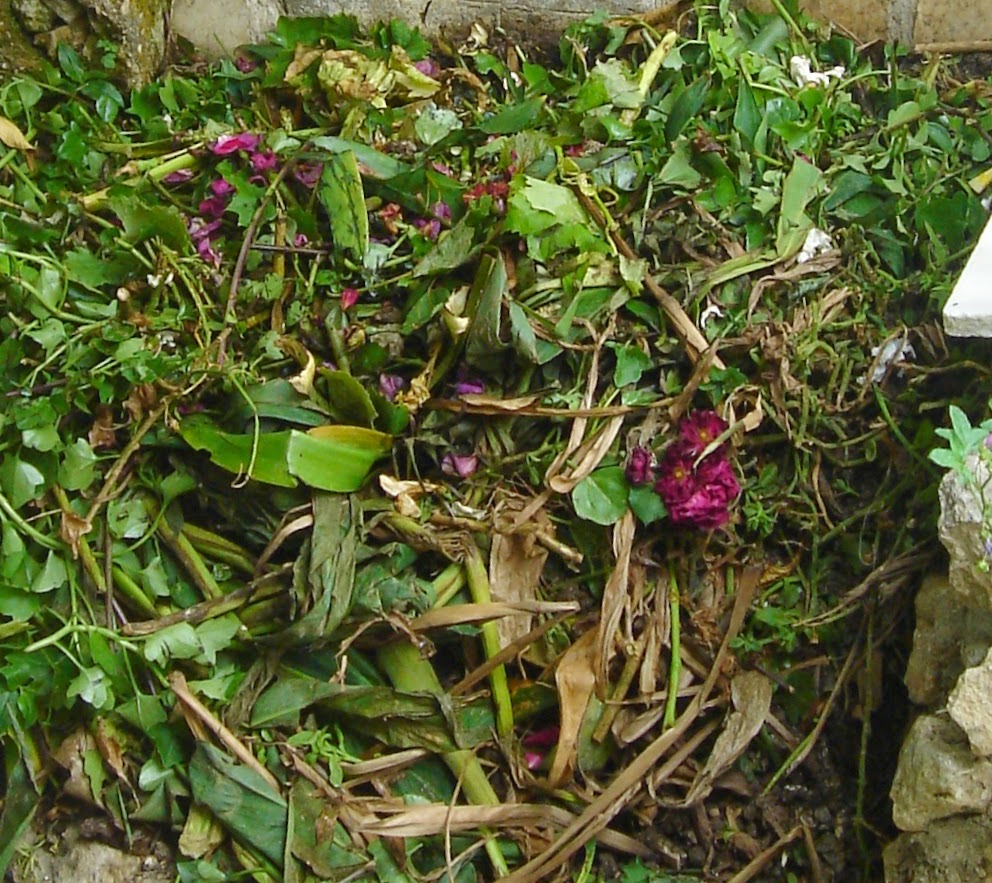 |
| Our compost heap - leaves, roots, vegetable peelings, egg shells, vacuum cleaner dust etc |
 |
| Our compost after just a few months |
 |
| The composted manure we had from Mark |
We’ve been discussing earth, manure, compost and humus, over drinks at Piatsa. How to get good tilth? He’s been digging into a couple of piles of three year rotted horse manure at Sally’s stables; distributing it via customers on the internet in 20kilo sacks of compost.
Organisms in the gut of the horse starts the decomposition as part of digestion. The process continues outside when dung meets air. When the manure has lain a while exposed to rain and sun, mixed with straw from the stables, worms start accelerating the composting, creating humus, that, spread on and mixed in with existing soil, enriches the earth, helping please the plants; creating conditions that enable other good things to happen in the soil.
 |
| Food for the soil rather than the plants |
I’m only starting to understand the subject, aware that good farmers, good gardeners, have known about the earth intuitively; learned it from parents, from direct experience, not books. The vital thing about compost is that, applied properly – there’s the rub, it can improve and maintain the soil. To understand that I have had to grasp what is meant by good soil, gardener’s earth; what is meant by both the composition and the structure of the soil, and how it is constantly changing and how what is needed to arrive at the best growing medium – good tilth - requires an understanding of the kind of soil I’ve started with.
Colloids are particles of earth which do not dissolve in water but form, depending on whether soil is more sandy, loamy or clay, varying sized clumps, giving the earth greater capacity to hold moisture and plant food. Soil forms into clumps – sticky or less sticky, hard, soft, soggy – depending on whether it’s predominately clay or, at the other end of a spectrum of types of soil, sandy. Each type of soil needs different treatment to create colloids and so approach the composition and structure that suits what I want to grow in it. Another phenomenon I’ve yet to understand is flocculation – a process by which added lime creates greater aeration within the earth.
Even if the ideal tilth is approximated, growing things, even when successful, changes that approximate ideal, demanding continued work to keep the soil fecund. Growing things in it makes earth more acid. The balance of alkalinity-acidity (pH value) has to be created, restored – constantly.

The soil must also have holes in it, space between the particles - aeration - allowing roots to spread and gain nourishment, and – amazing – allow, in many cases, the growth of a fungus that attaches itself to those roots – mycorrhiza, which grows on humus – and in a mysterious symbiosis enters the roots of the plant, becoming a partner that makes other nutrients in the soil more available to the plant.
How far this seems from paying over the counter at garden shops for fertilizers in sterilised sacks and boxes and bottles, containing, if you examine the labels, the key ingredients – nitrogen, potassium and phosphorus plus small trace elements known to be important...


I can see why one may be tempted to buy nutrients. There’s an art to creating the conditions under which the nutrients needed by what you want to grow will occur naturally and in the right balance in the earth. That’s how far I’ve got. Knowing far more about my ignorance; knowing, as I did not a year ago, things I didn’t even know I didn’t know.
I am not that keen to return to Birmingham – too much work on the untidy house and its delinquent plumbing, but then there’s babysitting duties – the pleasures and frustrations - work with Handsworth Helping Hands, even some paid work teaching, the need to help edit the recovered ‘Out of Town’ episodes for broadcast on Big Centre TV, drafting an Aristeidis Metallinos catalogue, getting back to the defence of Black Patch Park, tidying our neglected garden and the allotment – from which I’m expecting a better crop than before, a prospect that excites me but also reminds me that I am about to move from being delighted at managing to grow things to growing them in the right amount and sequence for cooking and eating, as well as observing the rotation of crops needed to keep the soil working for me. I’m also hoping that I am getting closer to making my own compost instead of buying it in. I shall make a plan that shows each bed and keep notes - a growing diary, and a reminder of how little I still know but how much I’ve learned in four or so years.
*** *** ***
I had speculated that there’d come a day when the subversive row of punk would become nostalgic “sing along a’ Sid”. Last night was so. A taverna near Ipsos, old English folk, a couple of holiday grandchildren – hardly out of toddling – pogoing round the pool at Dominoes to the harsh tones of punk tribute – a fiftieth birthday party and farewell to an ex-pat couple going home, a birthday cake iced in the Union stripes, “God Save The Queen”.
God save the queenThe hour and a half we stayed felt more exotic, than any Greek celebration. Stranger nation. Gnarled Brit men with shaven heads, tanned Anglo-Saxons, sun-dried ladies, having good fun, dancing and chanting to the frenetic noise of their youth.
The fascist regime
They made you a moron
Potential H-bomb
God save the queen
She ain't no human being
There is no future
In England's dreaming
Don't be told what you want
Don't be told what you need
There's no future, no future,
No future for you...
“An ethnic event” I muttered to Paul “It’s strange”
I doubt it applied to these x-pats either - never scrapped into the wasteland of post-industrial meltdown; not tuned to the desolation that made this droning clamour literally the rage. Paul generous and innovative had added the punk group from Maidstone to his Agiotfest menu, where, their dutiful ill-manners earned the ‘mixed reception’ intended. Now at Dominoes Paul politely pogoed a few seconds. I imitated him.
“Don’t be ridiculous” said Lin.
Yes indeed. How could I, under my unshaven silver hair, in my white jacket, my white easycare M & S shirt, my clean jeans and brogues, have a hope of being a headbanger?
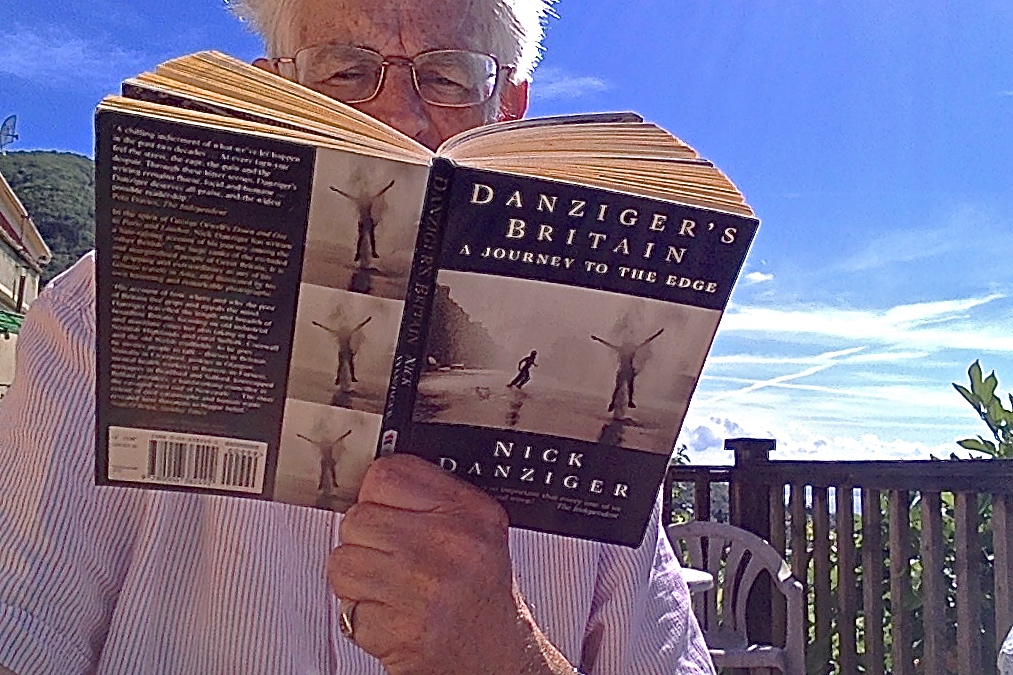
Sleaford Mods - now there's something that even resonates with me....'Teacher faces Porn Charges' ...vocalist Jason Williamson and musician Andrew Fearn...'...one of those non-existent old blokes you see from time to time..." "I'm just saying things should be in order"..."From the window there's a great view of hell"...
** *** ***
I am still aware how life and its meaning hang by threads. How the universe of all matters can implode in an instant. What bloody contingency makes of all hopes and plans. That fiery New England preacher, Cotton Mather, put the fear of eternal damnation into his rapt congregations, reminding them that below their feet, an inch beneath the unreliable floorboards on which they stood, burned the vivid flames of hell. One lapse, one wrong thought or action, the wood could crack and...
Well who believes all that stuff. A parent? A grandparent?
When she flew into Corfu at the beginning of May, Amy pointed to Oliver’s head, showing me a bruise he’d received just a few hours earlier…I at the airport or on my way, excited and joyful, to meet my beloveds, might instead have had a phone call…Later she wrote a letter to the airline:
Dear Ryanair Customer Services,
I am writing to bring to your attention a frightening and very worrying incident which occurred on Sunday 3rd May 2015, as I and my children were boarding Ryanair flight FR3854 from East Midlands to Corfu (Booking reference IDHIWB).
I was travelling with my three year old son and also my nine month old daughter, who I was carrying, along with the two bags containing items we needed during the flight.
As we got to about halfway up the metal steps to enter the plane, about six or seven feet above the ground, my three-year-old, Oliver, for whom both the handrails and the individual steps were very high, tripped and fell towards the left handrail.
There was nothing to stop Oliver going headfirst through the large gap between the steps and the handrail. The top half of his body was already through the gap, before I just managed to grab the back of his clothing and pull him back under, thereby averting what would have been a serious, or possibly even fatal, fall to the tarmac below.
Another passenger, who was still on the tarmac, saw the fall and, assuming a fall was inevitable, had started to run to try and catch Oliver below the steps (though it was unlikely he would have got there in time, had the fall actually occurred). The accident was also witnessed by ground staff and other passengers.
During the incident Oliver sustained a nasty blow to the side of his head and departure of the flight was delayed by about ten minutes, while airport paramedics were called to the plane and examined the bruising and swelling to Oliver’s left cheekbone and the area around his left eye. Fortunately the injury was not serious and could be dealt with by applying a cold compress, and we were allowed to fly.
I would like to commend one of the Ryanair flight attendants, a red-haired lady, whose name I unfortunately didn’t note, who was very helpful and efficient in dealing with the situation after the accident occurred
Both Oliver and I obviously found this incident quite traumatic, but luckily no permanent damage was done. However, I think that Ryanair should take a serious look at the health and safety implications of the occurrence, in case of any similar accidents which may occur in the future, and which might end less happily.....


