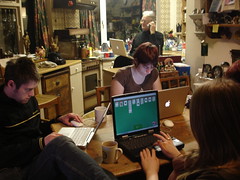
This is the home hub or broadband router that sits on our kitchen table at home. Because it occasionally stops working I want to say something about it. Paper and ink at some point remain significant artefacts for me. At school in the late 1940s we would be allocated pens from a dim human-high stationary cupboard behind a pannelled oak door - pencil-like bodies and nibs. I'd dip these in an inkwell at the top of my desk, or where there were just tables, into a small bottle of ink I kept with me. Blotting paper was a useful extra. These things are now seen mainly as props in period films. By the 1960s I wrote with a ballpoint pen or fountain pen with a rubber ink reservoir, replaced, at university with ink cartridges and felt tips of varying thickness. It was not until the 1980s that the QUERTY board, on which I'd learned years earlier to type while it was still part of a typewriter (my parents being journalists and writers), came into its own. By 1985, though I still wrote longhand in the diary I've kept since the 1970s, the computer keyboard was the main means of transcription.
At 0100 this morning our internet connection went down. We were off-line. That felt as mildly worrying in 2008 as knowing my car wouldn't start would have been in the 1980s. My marriage to my car soured in the early-1990s. I started an affair with cycling and concluded an amicable divorce from my car, following lengthier and lengthier separation, only a matter of weeks ago.
The car was once an essential means of getting to and from places where I could communicate with others. Now, I get physically from A to B by cycle, walking and public transport with the occasional borrowed car or taxi and - in the absence of trains, ships and time - airplanes. My electronic travel has expanded, via mobile phone and internet. If that or my net connection goes down I feel in a mess. As I once assumed having pen and paper to hand and depended on it, so now I depend on connection in cyberspace.
 While speaking to a friendly man in Chennai on the broadband helpline, he and I relied on a landline not connected to the router, while I could use my mobile phone to test the hub phone without breaking our conversation. The artefacts of net communication dissolve distance and time, so that I experience, while hardly thinking about it, a separation between the geographical space on which I travel by foot and bicycle with increasing efficiency and the expanded electronic space from which I was temporarily disconnected.
[A take from dominagraecia on the same sort of thing - what research was like before the internet. I find the internet, a gift for secondary sources, but for primary ones the old methods are good. At some point the archaeologist must pick up a spade. You do a general scan via Google (which also gets access to groups and blogs) or Wikipedia to find an expert in the field or someone who can point you to an expert (veteran, refugee, artist, relative, prisoner, etc) who 'was there' or 'is there'. You then find their e-mail or phone number or general whereabouts and try get to talk to or meet a human being. If you find them (which can be exciting) they can usually refer you to other people, to images, locations, reading and other websites. Some police officers, stalkers and good journalists still use this approach. It's worth remembering, without getting paranoid, that most police officers, doctors, certain grades of civil servants and copyright lawyers, have better access to the internet than many researchers - though we have JANET, a multiplicity of specialist journals and increasing interconnectivity via services like eduroam. I say most researchers because if you get a government grant, perhaps sign the official secrets act, you can get limited permission to access sources the average punter (me?) doesn't know even exist. The web is such a tease - giving out bewildering amounts of secondary information - good to satisfy dinner table curiosity, settle a wager between friends, dash off a newspaper article or do well in a pub-quiz and help write a blog.]* * *
Obama takes South Carolina. The turnout there and, we know, in New Hampshire has been unprecedently high, suggesting a message got through to those who might have stayed at home before the Florida mess that lost Al Gore the presidency to the present rogue. Obama honours rhetoric. He presses my worn buttons and he deploys the gravitas that's been so singularly absent in and around the incumbent. Despite my love of talent with language I can't relate to rap, but I can relate in my chest to Obama's US Southern Baptist style. Our friend Jill, at supper tonight, thought his victory might frighten off 'the whites'. Lin thinks not. Both would be happy to see Hilary Clinton succeed.
* * *
Via Busker - who dislikes being linked - I've stumbled on a vigorous Conservative voice commenting on the parlous state of the Greek body politic. Its author - under a pseudonym - purveys views intelligently written but hard for a lover to stomach.
Greek democracy is neither “robust” nor “healthy.” If anything, it is more in need of emergency care than ever before.The blog, skilfully formatted and linked, relays the spread in Hellas, in the name of modernisation and progress, of ailments and depravities familiar to us northerners - dispersing families, fragmenting communities, uglified town centres, transient displaced economic migrants, trafficked women, segmenting generations, vanishing respect for shared values and guidance from authority, sprawling settlements and hideous strip mall development created by the individuating tendencies of autodependency, lengthening food-miles in the name of choice and big box retailing blighting shopping streets, and commodification of hospitality. Who'll have - who has - the spittle for the work needed to resist these trends rather than being part of them.