Total Pageviews

Showing posts with label Minoti. Show all posts

Monday, 24 June 2013

Work


I cycled into town, Oscar running with me beside the canal, to get leaflets copied, buy some odds and ends including batteries for my cycle lights, marker pens, and a reliable steak bake from Greggs, and screws to mend the bottom hinge of our old garage door. In what was once the city of a 1000 trades I couldn't find a supplier; so instead of the 6" galvanised screws I wanted, I'll make do with half a dozen similar length coach bolts which at £5.50 cost far too much. Town was busy despite the chill with loads of people round the Birmingham Bull.


With my circulars printed at a shop on Colmore Row, I cycled back to Handsworth, headed down the Lozells Road and was called by name.
"Simon! Welcome back"
It was Aftab Rahman, with some people he was walking down the Villa Road, visitors to Handsworth
"I've been back a while, at least three days since Scotland"
We spoke of the success of the Heritage Trail and his plans for a Handsworth time capsule - local people to be trained as journalists to seek out older residents with memories of the area from their youth.
"You're ahead of your time, Aftab" I said, mindful of the view that few outsiders would want to visit Handsworth; that our MP, Khalid Mahmood, had called the trail a waste of money.
“We’re talking about the middle of Birmingham, I don’t think it is picturesque. We haven’t got the sort of sites they have in York, for example, but we’re not in that league. We’ve got to understand where we are. We’ve got better things to spend that money on than walking a group of Japanese tourists around.”
I headed a little north and...


...after fish and chips with curry sauce eaten in the street, I started the afternoon, trudging up and down Stamford Road, delivering leaflets. I detest British letter boxes - impossible to open, finger trapping, half-blocked with useless insulation, too often placed at the bottom of the door. Denise Forsyth came by, on her way to visiting a friend, and helped me for a while.
"Lin's gone to Sheffield hasn't she?"
"Taken her dad for a check-up"

 Handsworth
 Helping
 Hands…
      …working for the community
‘SKIP IT, DON’T TIP IT’ DAY

Handsworth Helping Hands are committed to cleaning up our area.
On Thursday June 27th a skip provided by HHH will be on the corner of Stamford Road and Putney Road from 8.30 a.m.
Residents are invited to use it to get rid of bulky rubbish & unwanted items.
Please do not put in household waste, green waste & recyclables usually collected by Birmingham City Council, building rubble or tyres.
HHH members will be there to help and advise.
HELP US TIDY UP ALONG YOUR STREET TOO - JOIN IN WITH OUR LITTER PICK!

"Putting these leaflets round, Simon, we're going to need more than one skip" she said. 
"Can we get a discount on a second one?"
"I'll give him a call. If we just have just one it'll overflow and we'll have a bigger mess than when we started. Oh and when you get home ask Nick Reid to send a scavenger truck round Friday morning to pick up anything left"
We saw several people in the street and told them there'd be a free skip in the street, may be two, on Thursday. The word's around and I can see us wishing we'd bought three.
"Let's just see what happens. It's a pilot after all. We can afford it"
"Lin's not going to like it. Another £120!"
"OK. I'll get a second skip and you deal with Lin and phone Nick Reid at the depot"
Dear Nick. Re: Handsworth Helping Hands skips in Stamford Road - scavenger truck follow-up...Can you arrange a scavenger vehicle to roam and pick up anything left over in Stamford Road (and Putney Road where it crosses Stamford) on the Friday morning 28 June after our skips have been removed? Best wishes, Simon 
Simon. I am concerned that you may be creating a bit of a monster here! Are you going to have somebody on site to supervise and turn people away once the skip is full?  I met Denise the other day and she did say you were going to do this and I have said that I will send the ward team across to clean up any spillage at the end of the day. Nic Reid, Principal Operations Manager, Fleet and Waste Management, Perry Barr Depot, Holford Drive B42 2TU.. 0121 303 1975 Mob: 07920 750 213
Follow us on Facebook  
Dear Nick. This was always a pilot and Denise and I have anticipated the thing that worries you. We’ve now invested in a second skip to go at the top of the road and of course we’ll be there - several of us - with the HHH van ready to speak to people and help pick up. But many thanks for your support and help and understanding. Best Simon, Handsworth Helping Hands
It's been an out-tray day. Checking with the removal company in Inverness, instructing surveyors to prepare a Home Report on Brin Croft; trying to get Highland Council to at least acknowledge my request to review their refusal to grant executors' exemption on Brin Croft ("We get 3000 emails a day we can't..." "OK OK, but has my letter arrived?" "It was passed for actioning on the 17th" "Thanks"). I have to complete an on-line questionnaire as part of it - but it only downloads on Internet Explorer which doesn't run on a Mac - as any ful kno. I've mowed the lawns here...

...and collected green waste and tidied and filed and prepared handouts and presentations for a seminar I'm running with Catherine in East Anglia - all done on line. It's mid-summer; the weather chilly even in the middle of the day. I'm putting off working on the allotment with a plethora of smaller jobs. The plumber, two doors down, has promised to fix the long standing slow leak below the bathroom tap, confident he can join old lead to new copper. X rang, anxious. Wanted to talk. His mother is over a 100 and he doesn't get on with the council carers. I could give little solace. The estate agent, Phiddy Robertson, emailed Brin Croft's particulars...

BRIN CROFT, INVERARNIE, INVERNESS IV2 6XA
Inverness about 8 miles.  Airport about 15.5 miles.

FOR SALE AS A WHOLE OR IN TWO LOTS.

Lot 1
An attractive single storey house on an elevated site with beautiful views over Strathnairn.

• The accommodation comprises:  Conservatory Porch.  Entrance Hall.  Open plan Sitting Room and Dining Room with wood burning stove.  2 en suite Bedrooms.  2 further bedrooms.  Kitchen.  Utility Room.  Generous Storage.

• Timber chalet, car port and game larder.

• Delightful wooded grounds overlooking the River Farnock.

• A peaceful and secluded setting on the edge of the village.

• Easy access to the A9 and Inverness.

About 0.27 hectares (about 0.669 acres) in all.

Lot 2
Littlemills Lochan

• Attractive lochan with boat shed located in Inverarnie Forest approximately one mile from Brin Croft.

Inverness Residential Department
Reay House
17 Old Edinburgh Road
Inverness
IV2 3HF

Tel: 01463 224343
Fax:   01463 243234
Email:   inverness@ckdgalbraith.co.uk
Website: www.ckdgalbraith.co.uk

Littlemills Lochan

*** *** ***
I emailed Minoti in Delhi
Dear Minoti. Linda and I have just come back from a melancholy week at Brin Croft getting the house ready for sale. Linda has been a great help as we go through the tedious details of disposing of things no-one in the family wants. We go up again in mid-July, also with Amy and Guy and our grandson Oliver, to do a final clearance and probably to spread mum’s ashes on the Findhorn. How are you and how’s your work? xxx Simon
Dear Simon. I was so stunned by what you wrote yesterday. But it was so good of you to remember me at a time like this. I also got the Memorial [you sent me] down from next to my own parents' photograph where I keep her and is the object of my worship when I do pray to all my ancestors.
I cannot imagine your melancholic visit but I can feel your pain as you have lost someone like Theodora who was the throbbing heart of Brin Croft. So much sadness.
I am in India since March as you may perhaps not remember in the midst of all that you have undergone since last year. I just keep praying for Peter to stay safe on his dialysis machine since he has been doing that at home for the last five months now! I also pray he stays that way till I am able to get back to Langford and be there to relieve him from all the house work at least which  he has to do despite his condition. Human beings need such support but he has to do it alone and I have never broken any rules of the UK. So here I remain for at least another 3 months before I go back.
I have just come back a week ago from Japan where I presented a paper at the International Association of the Study of Commons Conference at Kitifuji [northern Fuji Yama]  My panel was on Law and the Commons and I presented on Corruption in bureaucracy-political nexus  and land records in India and how the Law does not protect the commoners as a result of this. I can send my paper if you have the patience to read it.  Also two of my papers have got published just this month one as a chapter in a book which the Springer publishers brought out and the other in a journal called Global Environment.  When will you get back to England in case you go back to Greece or will you stay put till October or so when I might be able to get back. I might be trying to get to Germany too in case my daughter takes up a fellowship in Heidelberg.
Thank you again for writing to me - I am grateful. Love and all the best, Minoti   
Minoti and Mum at Brin Croft
*** ***
So there have been changes - prompted by the ERT closure and reopening  - in the government of Greece but the real news is that latest government reshuffle in Athens has not made news. Said Olli Rehn, EU economic and monetary affairs commissioner "I love Greece but I'm very much looking forward to a eurogroup press conference where Greece is not going to be discussed, and a summer where we don't have any Greek crisis.
In the village they've been leaping through fire:

Λάμπατα στην Κορακιάνα
Ανήμερα τ’ Αη Γιαννιού χθες, του «Λαμπατάρη» και στις γειτονιές του χωριού ζωντάνεψε για μια ακόμη φορά το έθιμο από τις «λαμπατίνες». Στο τρίστρατο του Κουκουκή (Μουργάδες) τα μαγιοστέφανα ρίχτηκαν στην πυρά, με την προσθήκη φρέσκιας ρίγανης και μικροί-μεγάλοι πήδαγαν πάνω από τις τρεις φωτιές…
labata2013c.jpg
Στον δε Άη-Γιώργη, το έθιμο έλαβε χώρα στο προαύλιο της εκκλησίας, με διοργανωτή το Συμβούλιο της Ενορίας και με την παρουσία κόσμου από όλο το χωριό. Η δε συμμετοχή του χορευτικού της Φιλαρμονικής έδωσε τόνο στο χορό που ακολούθησε, υπό τις μουσικές επιλογές του νεαρού Αη-γιωργίτη «D.J.» και τις ευωδίες της ψησταριάς που λειτουργούσε κάτω ακριβώς από το καμπαναριό…
labata2013a.jpg labata2013b.jpg 
Ψηλά, στον καλοκαιριάτικο ουρανό, η Μεγάλη Πανσέληνος αντιφέγγιζε από το Τριοκάτσουλο μέχρι του Κόρεντι, παρά το παροδικό πέρασμα από σκουρόχρωμα σύννεφα...
Υ.Γ. Από φίλους της ιστοσελίδας μας επισημάνθηκε ότι ο ένας εκ των κυρίων της ψησταριάς κατανάλωνε ασταμάτητα σουβλάκια!! Ποιος εκ των δύο άραγε??
I struggled translating this but when I asked him, Aleko D stepped in: 'Hello Simon and Linda. It was indeed a pleasure receiving your note. I thought that you would be here, this time of the year! I am now well again after my problem with the leg and I was looking forward to seeing you both over here or somewhere else! When you come in September please get in touch so that we can meet! Here is your translation':
On the day of 'St John of the Fire' the village once again revived the old tradition of lighting and jumping through the three fires. At the 'Koukoukis' cross-roads (Mourgades) the Mayday wreaths were thrown on the fire supplemented by fresh oregano.Everybody, children and grown-ups were jumping through the three fires. At the church of St.John this took place at the church forecourt and it was organised by the President of the Parish. The entire village attended this ceremony. The local Philharmonic gave the tone for the dance that followed under the direction of the young man from St.George who acted as the 'DJ'. This took place under the church belfry where the grill was set-up. High up in the sky on this summer night the very large Full Moon was shining from the 'Trikatsoulo' up to 'Korendi' even though at times dark clouds intervened!  P.S. It was noted by friends of our website that one of the two men grilling the 'souvlakia' was eating them non-stop!! We are wondering which one of the two it was??

Friday, 28 December 2012

Ἡ εἰρήνη τοῦ θεοῦ ἡ ὑπερέχουσα πάντα νοῦν


At my mother's memorial service her friend and neighbour, Christina Murray, read this from one of Barbara’s regular articles during her fourteen years as  the first women’s editor of Farmers Weekly. She was inspired by seeing Leonardo da Vinci’s Madonna of the Rocks in the National Gallery.

PEACE OF MIND
...When we were children, one of the excitements of Christmas was visiting the crib in our village church. And, like all things in a child’s memory, it’s the atmosphere and happenings which surround an event as much as the event itself which are important.
We always used to make this visit after tea and oh the excitement of going out of the house after dark and the little shivers of expectancy which murmured through my small frame as we entered the church door and tip-toed across the stone floor to where the crib was arranged in the corner. There it was, those little figures grouped around the inch high doll lying in its little match-box sized crib. This tiny figure representing the Man who was to make men and women of us all. Now, when I look at this picture, I recall the feeling of those after-tea visits, and though now I can express my thoughts a little more clearly the majesty and the magic of it still remain.
What emerges more clearly as one stands before this painting is the Mother’s peace of mind - strange that so nebulous a quality should shine out so distinctly. For her it was a peace of mind from having achieved so richly that for which she was chosen. For us it is strangely the same, for Peace of Mind is an achievement in itself. It is a philosophy of life born along the road to maturity. A state of mind achieved out of the guts of experience.
Then when you believe that you have found contentment in the way you live your life, a pride in your family and friends and no lasting envy of others, then peace of mind becomes the bridge over the gap between youthfulness and maturity which, when you cross it, makes you stronger and braver than the young.
The truth of this shines through the face of the Virgin in the picture and as one quietly gazes on this family group one begins to know the meaning of that Peace which Passeth all Understanding.
*** *** ***
The Rev William Mather, officiating, finished his tribute:
Barbara would not have called herself particularly religious but she was blessed with an open-heart towards life and people and with a spiritual awareness. It is perhaps worth reminding ourselves that when she refers to the 'Peace that passeth all understanding,' she is quoting from the famous verse in Philippians 4.4-7. In the words of the Authorised Version of the Bible, which she loved, it is as follows:  
4. Rejoice in the Lord alway: and
Again I say, Rejoice 
5. Let your moderation by known
Unto all men. The Lord is at hand. 
6. Be careful for nothing; but in
Every thing by prayer and supplication
With thanksgiving let your requests
Be made known unto God. 
7. And the peace of God, which
Passeth all understanding, shall keep
Your hearts and minds through
Christ Jesus. Amen
 **** ****
Barbara's step-daughter, Fiona, spoke most ex tempore, sweetly and with such fun, wit and timing. I pause at using her notes to capture her tribute, which like this seem to have something of the style of Pickwick's acquaintance Alfred Jingle. Fiona tho' was no charlatan and she never mangled a phrase:
Intro: difficult task so many aspects to her character. She was attractive, cultured, extremely intelligent, charming, great sense of style – feathered hats, plus fours, good sense of humour, great taste, always interesting, career woman, homemaker. A true country woman who was equally at home in the city, often infuriating and never, never wrong! She was interested in everything ranging from llamas and Jacob sheep to politics, religion, literature and the arts, always young at heart. Amusing and exasperating anecdotes: Supermarket trolley, plastic cutlery. Driving: excellent and very fast, to still very fast, but dangerous. A9 at 80mph, terrier. Crash with police car. “Not my fault, foggy”. Cooking: Excellent, unusual attitude to food hygiene, chicken, “Nonsense”. Food poisoning. Hols: far from incident free. Fire, insurance. Picnic chairs and table, picnic site. Lost passport, Wheelchair in road, furniture moving, slope, booking cockup, shared bedroom, smoking in café..End on serious note. Dad and particularly B gave us wonderful holidays with the children up at Faillie. Warm welcome, wonderful smell of woodsmoke, delicious meals, picnics. A relaxing outdoor holiday, fishing, swimming in the loch, walking the dogs. Hard to realise that a 40 year era has ended. I believe that B’s spirit is riding across the moors, whistling up the dogs or fishing down by her beloved Findhorn and that is how I’ll always remember her. Last paragraph from Wuthering Heights.
“I lingered round them, under that benign sky; watched the moths fluttering among the heath and harebells; listened to the soft wind breathing through the grass; and wondered how anyone could ever imagine unquiet slumbers for the sleepers in that quiet earth”.
Thank you Barbara for looking after Dad so well, for all that you did for our family, and for the privilege of knowing you. 
*** *** ***
Mum's friend Minoti could not join us but added her tribute in writing:
REMEMBERING THEODORA
"Theodora"! Slowly she lifted her head, a ray of sunshine stole in from the window wrapping around her hair like a halo as we came in beside her chair in the living room of Brin Croft that afternoon of the last day of June this year. It was as if a sunflower had turned its face to the East in the morning. Indeed so it was. For a moment time raced back two centuries. It was as if her great grandmother, Jane, Lady Maine, had stepped out of the pages of the researched volume on the life of Sir Henry Sumner Maine which lay open on the table where Theodora had been reading. But this was not the first time that our two worlds met, defying as it were Rudyard Kipling's famous prediction that they would not. Unlike her great grandmother, who had never seen India, Theodora had visited the country although she had not been familiar with her ancestor's famous books Ancient Law published in 1861 and his equally famous lectures in Oxford on Village Communities in the East and West which too had been published in 1871. It was well beyond the Kipling prediction that the "twain shall not meet". Sir Henry not only brought the East to the West but brought the study of Law into the formal teaching curriculum of Oxford University. I travelled the other way round to the West and so imbibed the scholarship initiated by Sir Henry which helped me to retrace my study of common lands in India to the Western Teutonic and Celtic communities of Europe. It was in this process of collecting Sir Henry's entire correspondence that I came across Simon's search on the internet for his Grandpa Henry who was Sir Henry Sumner Maine's grandson. This is like the silk route to Theodora Barbara Sumner Maine or TBSM - her encrypted DNA as I would like to think. Her great grandmother and grandmother belonged to families in Kelso - the Borderlands. I could discern a special attachment of Theodora to the Highlands and she listened with great interest to my work on common pastures in highlands both in Scotland and in the Himalayas. She called herself a shepherdess. To me our meeting has been a confluence of two cultures brought together by the onset of changes in the Twentieth century where women are no longer in 'tutelage' as they were in the times when Henry Sumner Maine wrote about it. She wanted to know so much about the tradition of commoning in both India and in Scotland and whilst I was able to explain the major findings of Sir Henry there was very little time to share his views on women in society. I never could tell her how Sir Henry had been in the society of educated authors of his time like George Eliot and had been espousing the talent of his wife's sister who wrote novels. I wonder what Maine would have thought of my finding his great-grand-daughter enthusiastically reading about the Voyager spacecraft on the edge of our solar system, on a 21st century iPad? [A note from the scholar, Professor Minoti Chakravarty-Kaul, December 8, 2012]

...and a few days ago came a card from friends in India, from Tikli
I studied E.M.Forster's A Passage to India for 'A' level 50 years ago. It was Mum's friendship with Minoti that made instant connection with that curtain falling conclusion, written when she was a 7 year old girl, to Forster's tour de force:
"But the horses didn't want it - they swerved apart; the earth didn't want it, sending up rocks through which riders must pass single file; the temples, the tank, the jail, the palace, the birds, the carrion, the Guest House, that came into view as they issued from the gap and saw Mau beneath: they didn't want it, they said in their hundred voices, 'No, not yet,' and the sky said, 'No, not there.'"  Ch. 37
*** *** *** ***
Clarinet Quartet in Ag.Georgiou
Μια πολύ ωραία συναυλία του "Κουαρτέτου Κλαρινέτων ΟΡΦΕΑΣ" πραγματοποιήθηκε απόψε  βράδυ, στην εκκλησία του Αγίου Γεωργίου, στο χωριό μας. Το συγκρότημα εκπροσώπησαν οι Αργυρός Δημήτρης, Κρητικός Γιάννης, Μάνδηλας Χρύσανθος και ο Βασιλάτος Ηλίας. Στο πρώτο μέρος του προγράμματος το κουαρτέτο πλαισιώθηκε από τις νεαρές μουσικούς της μπάντας του Μουσικού μας Συλλόγου  Νικολούζου Ευαγγελία, Στογιάννου Σπυριδούλα και Τσιριγώτη Ελευθερία. Το ποικίλο πρόγραμμα απέσπασε το χειροκρότημα του κοινού και τα θετικά σχόλια των μαέστρων των Φιλαρμονικών Σκριπερού και Κορακιάνας. Την εκδήλωση προλόγισε ο Πρόεδρος της Φιλαρμονικής Κορακιάνας Σπύρος Σαββανής. 
This evening a delightful concert was given by the 'ORPHEUS Clarinet Quartet' at the church of St. George - Αγίου Γεωργίου - in our village. The group comprised Dimitris Argyris, John Kritikos, Chrysanthos Madilas and Elias Vasilis, joined in the first part of the quartet by young musicians from our band's Musical Club, Evangelia Nikolouzos, Spyridoula Stogiannis, and Spyria and Eleftheria Tsirigoti. A varied programme won the audience's applause and compliments from the conductors of the Korakiana and Skripero Philharmonics. The event was introduced by the President of the Korakiana Philharmonic, Spyros Savvanis.
*** *** ***
I went shopping again on Christmas Eve and bought presents - chocolate boxes, champagne, marrons glacés, checked boys' toys at Maplins...
...before descending down the Birmingham slope to look for odds-and-ends from the Rag Market, treating myself to a well burned baked potato...
... dripping with melted butter, then half a dozen oysters...
... and later, when Richard joined me, a meal at Café Soya. A couple sat nearby. The male had entered on the phone, spoke on it while eating and left the same way, emitting muffled banalities, letting the woman open the exit door - a bulky figure, possibly an android, enabling its owner to enjoy the town alone. I peered to see a ring in its back, but she probably had a remote control in her handbag.
On Christmas day it continued grey. A part of my little constellation - Amy, Guy, now Oliver in his pushchair seeing it all for new, his first Christmas, Liz and Matt and Richard and dogs Jessie, Oscar and Cookie plus our neighbour's dog Deiter - we strolled through Handsworth Park, the familiar circuit of our park - Vertegan's promenades - by St Mary's Church, over the narrow rail bridge, past the cricket ground to the rose garden, children's playground and back along the avenue by the Son's of Rest and over the larger rail bridge, down the long slope that passes the pond, taking us back to busy Hamstead Road...


...and home for the happy chaos of Linda's and Dot's Christmas lunch in the early evening - and presents still to come. Oliver sits in the same high chair that served his great grandmother, his grandfather, and his mum.
Lin's mum Dorothy with Oscar and Oliver and Amy and Guy

Sunday, 9 September 2012

Private Property

Minoti pointed me towards Paolo Grossi’s book, An Alternative to Private Property (U of Chicago Press 1981). Grossi is or was at the University of Florence, director of the Institute of the Theory and History of Law, now, with familiar campus reorganisation The Centre for the Study of Modern Legal Thought. He first published the book in Italian in 1977, long before I became as curious and as earnest as I am now to learn about my great great grandfather Henry Sumner Maine. Minoti -  mine and my mother’s assiduous tutor on our ancestor - has spent her academic career in India with international visits, including the UK and US, studying land law and common rights in village communities, actively engaged with academics across the world in land use and the ideal of the Commons and their governance.
“Grossi” she said “has much to say about Maine.”
Minoti discovered us about two years ago and was delighted that a descendant of Henry Maine was still alive. She’s made several visits to see my mum in Scotland and helped me understand much more about Maine’s 19th century work, writing regularly about 'the commons'.
Her email this morning:
Dear Simon,
Thank you for your detailed memory of residence and if we have to search it may be in old books shops in the area but I will have to abandon that for the time being simply because I fly back tomorrow to Delhi.
    I just could not manage to go to Inverarnie and I just have to pray I can see Theodora when I get back in December...Only God keeps her here to enrich my life it would seem. She is two years older than my mother was. You are two years younger than me. My mother knew everything about my work on Sir Henry but alas she was very frail only my father was capable of keeping her in cotton wool as he did.
    Theodora is a gift of God to me and so are you. I declare I must have done something good in my last life to deserve this. May God grant me this Christmas with you all. I have tickets to return on the 2nd of December.
     I will give you a detailed response to this message when I settle down in Delhi. I begin then a very busy period of writing and presentations of what I hope will be the beginning of a workshop on archival material in history. My village maps will also be curated and put up in an exhibition. I am hoping all this to start in November by which time my paper on New Delhi's century must be completed for publication and I begin then the Maine book.
     I will discuss this on the email with you I promise just give me a few weeks.
    I will keep the details you have sent here for future reference.
yes press on with Grossi. He may be retired now from the judiciary in Rome. He was a judge in the High Court there. When I corresponded with him he was teaching in Florence and one of my friends in the Forest Department knows him well.
     If all goes well I will be trying to go to a conference in Tunisia in April next year and it occurred to me to visit Corfu in your den before I reach Tunisia.
Do keep well and running with our joint Maine trail - what a heritage!! No one, not even George caught on to the significance at the most significant level of Sir Henry's work. It compares with the Origin of Species in social evolution. More later. Love and regards to Linda. Minoti
I asked M if it was OK to put her letter on Democracy Street:
Not to worry. it is OK. The comparison with Darwin produces amazing conclusions about these two great scholars. Except that Darwin had inherited a large fortune from both his wife [the Wedgewoods] and his father [the Darwins]. Maine had earned it the hard way and had to worry about money and social connections, without which the nineteenth century was a hard time.  He rose by sheer brilliance - no social ladder for support. I admire the sheer grit. Minoti  
Grossi’s work strives for the seriousness of a judgment in the highest court on a matter that has worked its way through many lower courts, a judgement that seeks a credible conclusion on a subject that has been debated passionately in and out of those courts; a case that he suggests cannot be settled within existing understandings of the law, because informed by a vast array of controversial new evidence about the origins of law. It is as though an assembly of creationists engrossed in debate about the theology of Genesis has been asked to consider the implications for their discussions of findings made during the voyage of The Beagle.
Minoti says ‘The writing of Maine is not complicated”
Henry Maine
I think she’s right, but whereas the simple idea of evolution replacing the idea of Special Creation is obvious in its challenge to the authority of holy text, Maine’s account of how human law took over from human custom – a research-based discovery which explains why, as an undergraduate at Cambridge I was told by Edmund Leach, that my ancestor was a father of anthropology – lacks the dramatic social and psychological impact of Darwin’s discoveries.
Another comparison is the way Marx took Hegel’s idea of a dialectic in human reasoning and demonstrated – again with vast data -  that this was how human history unfolded. There is a comparable problem of popular comprehension. Marx’s association with the ideology of communism almost entirely obscures his ideas on dialectic, surplus value, immiseration, embourgeoisment  and commodification.
Maine having done something equivalent with existing explanation of the origin of law has never, for which I should probably by grateful, been a political icon. Minoti writes that Maine, about whom she’s preparing a book, showed how when law took over from custom, village communities – aboriginal human groupings – lost the means of taking their own decisions.
Maine studied village communities in east and west, documenting with vast comparative detail drawn from reports, diaries, journals, translations of local law books, personal interviews and the work of researchers with similar interests outside the borders of Empire, how the rules by which people lived had evolved from a situation where status dictated rules of conduct to one where rules are laid down by contract. His work was summarised in the phrase - from Status to Contract.
Maine’s analysis was written into the constitution  of India, linking its legal system to the codes not of British law with roots in English Common Law, but to deliberations based on the ancient custom of Scandinavian, Russian, Chinese, North American and Irish communities and, in India, of the panchayat – village government. Maine’s concerns were not with politics, but with scholarship, most especially with showing that what had for generations been regarded as a part of human nature, original rather than historical, was a human construction. Maine swept away myths surrounding the primacy of individual rights in property, a belief that was becoming, in the 19th century, a vehement counter to the spread of socialist ideas, but his case was always that of the scholar vexed by assumptions unsupported by research.
Grossi, p.46 ‘He avoided polemics: even though his argument is pitiless, one is rarely given to read pages that are more relaxed and less rancorous than those of Ancient Law…it was from a platform rigorously chosen and defined as scientific and with the calm certitude of a man of studies reorganising the papers on his desk that Maine launched the process of demolishing the edifice of individual property as an institution of natural law. But we must note that in demolishing it, he acted not as an enemy to private property, but as one who sought to confirm the antiscientific nature of its particular theoretical construction.’
*** ***
We'll take a 1300 bus into town next week to have a meal with Richard Pine. His latest in The Irish Times helps explain the deafening silence that seems to pervade the crisis here...he ends his article thus:
...Samaras had by this stage announced he would seek to renegotiate the bailout, but after the election he stated unequivocally that this was not the right time to do so. With so many U-turns, the electorate cannot understand what is going on. In fact nothing is going on.
We have had elections in May – inconclusive. We have had elections in June – inconclusive. In fact, absolutely nothing has happened in the past four months to indicate any resolution of the crisis, or Greece’s relations with the European superpowers. It’s as if the party leaders have taken a firm decision to be indecisive.
The reason is obvious: the reforms demanded by the troikato bring Greece into line with the economies of greater Europe would require a complete dismantling of Greek society. There are so many vested interests in Greece (protected professions being just the tip of the iceberg), there is no way that society can be reformed without a collective lobotomy.
The fact that the crisis is deepening rather than getting better suggests the remark in 1919 by David Ben-Gurion (later Israeli leader) about the emerging Arab-Jewish conflict: “Not everybody sees that there’s no solution to it. There is no solution!”
The crisis in Greece, followed by those in Ireland, Portugal, Spain and Italy, has been a huge learning curve for Europe, especially the architects and policemen of the euro zone.
There has been a gradual shift from the insistence that Greece could under no circumstances leave the euro zone, to today’s position where many member states are not only saying that a “Grexit” is likely, but are even considering strategies for survival in the event of the euro itself collapsing.
The Finnish minister for Europe, Alexander Stubb, has said that we must not build another Berlin Wall, this time between north and south, but that is precisely what seems to be in the offing.
and via Jim Potts I pick up another piece on Greece, in particular Corfu, and the European Union from Debora L Spar, President of Barnard College:
...In 1986, and again on a trip in 1993, my husband's relatives were reveling in a prosperity that only years ago would have seemed unimaginable. Nico, the son of a tailor and some-time olive farmer, parlayed an English-language tutoring business into a full-fledged school, then a grocery store, and one of the island's first new car dealerships. Spiros, once a small-time mechanical engineer, had become a master contractor, outfitting the McMansions springing up along the coast with rotisserie spits and Jacuzzi tubs. Yianni, the village baker, had a string of fancy shops and a factory outside of town. Lovingly, the nouveau riche of Corfu jostled my poor father-in-law, who had left the island in 1960 to work as an immigrant, underpaid tailor, and who lacked the foresight to see that his family's barren and sandy land would some day be a mecca for sun-starved European vacationers.
When we returned to Corfu in 1998, however, the riches had already started, subtly, to evaporate. Nico's store and dealership had gone bankrupt, victims to the larger, better capitalized businesses that flocked to Greece in the wake of 1992. Yianni's bakeries had shrunk, pushing him back to the original shop. Entangled by debt, Spiros and his wife had fled the country. By 2004, all of my family's friends had lost the trappings of wealth -- the houses, the cars, the pride -- they displayed on my first visits. Today, they are destitute. Nico's ex-wife sells decorated stones outside a monastery. Yianni painted houses in Toronto until his death last year. And my father-in-law is the wise one. The story of my friends is the tragedy of Greece, a tragedy, like many, based on faith and love and hubris...
She continues with an argument I've ever endorsed, that the dream of the EU was about never having another war in Europe. That intention shared by a few visionaries was sold to the larger population on the material prosperity that would accompany the idea of a Union; not the more important idea of how much work had to be done to maintain peace on a continent that had for centuries taken periodic and devastating war for granted. If only that idea could have been more publicly maintained, rather then the dreams of everyone getting richer, but the resident of a well maintained home, certainly its children, swiftly forget the intentions and attentions of the architect and builder, taking its stability so for granted. After a while they even forget the purpose of a home, and focus only on its decoration and the status it confers and its monetary value.
...Years ago, when I used to teach about the European Union (Spar continues) at Harvard Business School, I always began my classes with the same assertion. "The Europeans," I would state, "have embarked upon one of the greatest political experiments the world has ever known. They are trying, through peaceful means, to merge some of the most powerful nations on earth. This has never been done before." Then we would discuss the how's and why's of Europe, the ways in which the state-not-yet-a-state was governed; the economic hope that was blinding its inhabitants to the noble, messy, quixotic goal that sat still at its core. The European Union was a utopian ideal, forged from war with the goal of peace. It was sold as an economic program, though, and bought as such by millions of Europeans who saw their future in the little cluster of 12 gold stars on a band of blue. These fortunes, alas, have now evaporated, and Europe must decide whether to accept the political bargain that was always there -- the loss of national sovereignty implicit in union -- or whether, more dangerously again, to try to go it alone.
*** ***
Being without a car isn't the same for Linda as it is for me. I have my bicycles. Yesterday in the continuing heat of late afternoon I went for a ride to explore the country west of the Paleocastritsa Road at the turning opposite Sgombou - two kilometres north of Tzavros. I had a slow puncture, so stopped for a cold Corfu beer outside the small grocery shop there, while I changed inner tubes, always a satisfying procedure when time's unimportant. I asked the way to Poulades and was directed up a gentle winding ascent, past mainly deserted villas, some with enthusiastic barking dogs and deserted swimming pools - "yasoo skillo. Woof woof woof" I say as I pedal by. I turned north west at the first junction until on level ground on a road edged by dry shrubs and the remains of yellowing grass...

... I arrived at a farm after which the road became a track towards which I was directed by a boy on a bicycle - pointing towards το παλιό δρόμο - easy to negotiate and mainly downhill
I drank regularly from a large bottle of water. Enjoyed the quiet but for occasional planes ascending swiftly into the haze, carrying people back to northern Europe. I realised I was in the area of 'the ponds' to which Mark had referred a few days ago and so came to a building that had been used as a set for one of the Durrell homes in a BBC film made a few years ago. he'd shown me the distinctive Venetian arches of the building, now a barn of sorts, on Youtube with actors going to and fro from a horse and cart.
The building sat on a ridge looking down on the scrubby fields and hedgerows that edged into the Ropa Valley, one of those vantage places on the island where you can recognise the profile of higher ground at every point of the compass. I sat for a while. Ate a nectarine. The road became metalled and a moment later I was back on the busy Paleocastritsa  road opposite the small road that winds north to Skripero, where I went. On a bend near the village I came upon a sloping meadow covered in beehives
How ridiculous I thought that we'd had to go through such a  rigmarole to install one hive on my allotment in Birmingham including surrounding it with 8 foot nets to protect the public and submitting a risk assessment. I waved a greeting at the beekeeper who arrived in a van to check his hives, wandering among them at ease. I stopped longer to gaze back where a road-side fire hydrant was clustered with drinking bees.
I got good news about the beehive on Plot 14 from Gill Rose, who cares for them. She told me that when the old colony divided and she brought one half to the VJA this July, hers were the half without a Queen, but she writes 'the new colony have now grown their own', by that almost miraculous process of feeding one larva royal jelly so that it grows into a queen rather than just another bee. I pray that ‘our’ colony will have built up enough supply of honey from flowers on and around the VJA to survive their first winter here.
I cycled into Skripero, then a swift run downhill to the small turn that leads up into Ano Korakiana. We had melon with prosciutto for supper and finished off the trifle Lin made for our friends the other evening.
*** ***
Earlier a neighbour had printed out an insurance document we need to have completed for the Handsworth Helping Hands transit van. Lin will complete most of it and mail it to John R in Handsworth to complete. It can't be filled in on the web. While he was printing my document my neighbour said that driving earlier down the corniche road that looks over the straits he'd seen ten men walking along the road in carefully spaced pairs wearing colourful short trousers pretending, rather artlessly to anyone who looked, to be tourists, their shirts under their arms, wrapped to look like towels.
"They looked African, and Middle Eastern. Probably paid an enormous fare to traffickers in Albania thinking they were being shipped to Italy."

Saturday, 30 June 2012

Progress on Plot 14

June 2010 ~ Victoria Jubilee Allotments are opened
Plot 14 - September 2010
June 2011
This is a reminder from June last year of how much I had to learn about the craft of digging...
...Coming back to Ano Korakiana after a couple of days digging like that I could hardly move, my spine hurt so. In Venice - on the way - I was hobbling on a stick. For 24 hours I lay on the wood floor at 208 Democracy Street and read. It took me a minute to get up. I couldn't carry a cup of tea upstairs. Since then I've improved my skills greatly. My back hasn't given me such a problem since. 
June 2012 ~ a tractable mess
I'm not making excuses. I've found working an allotment - 200 square metres - hard work. I'm persevering. I'm pleased. Four rows of potatoes - 2 of Estima and 2 of Marfona - are coming along nicely, earthed up again this morning. There are rows of cabbages at the front and back of the plot. Lin's started flower beds that are getting rooted. A chunk of the plot is covered with black plastic to suppress weed. I'm starting to fold that back to plant seeds (parsnips, tomato and spinach) in the clearer earth left after 8 months of being covered.

There's a sturdy free-cycled shed on recovered slabs to which I've added a sturdy veranda. I share its use with two other gardeners. We've laid wood chip paths, and I've set out a composting area near the fence between me and the park. I'm growing four rows of onions from sets;..
Recovered builders' bags for composting
... my broad beans are coming along well, as are runner beans. Vanley gave me a few lettuce to plant last week. All the time I'm learning. Back in 2011 I dug over the whole plot and removed the larger weed roots. big stones, bricks and other detritus. I'm following Vanley's advice regarding the uncultivated parts of the plot. Let it grow weeds, just cutting them back with a sickle or scythe before they seed, but don't waste energy digging and clearing the ground unless you are ready to sow it. So. I'm working on looking after what's coming along at the moment and being relaxed about what's fallow. It's pleasant to see a large mallow thriving in the middle of the plot. I've planted a vine and five fruit trees close to the shed and just west of the shed I'm preparing a space for where a beehive can go surrounded by Buddleia and scented flowers, now we've been through the initial process of getting permissions from the Council and the site Association. My friend Mike Tye has taken over an area of about 9 square metres to grow potatoes and other greens, on a scale that suits him on a patch in the middle ground of the June 2012 photo. Judging Plot 14 against other plots on the Victoria Jubilee Allotments I would place myself well below the best. These are a pleasure to see. I would also place myself well above plots that are semi-abandoned, ill-worked -  effectively ready to be handed to someone else. I heard recently from the Hon Sec that there have been 28 plots given up; exceptionally high. People take these up as an idea, as a dream - having little idea of how much hard work is involved. I did know this would not be easy. There were times when I got to a point of not wanting to go out to work on the VJA, but since the major digging has been done and - perhaps most important - I've been tutored in gardening; learning how to be more efficient, and we've started to eat food grown on the allotment, I know that barring disability, I've turned that corner. This is going to work out.
Couch
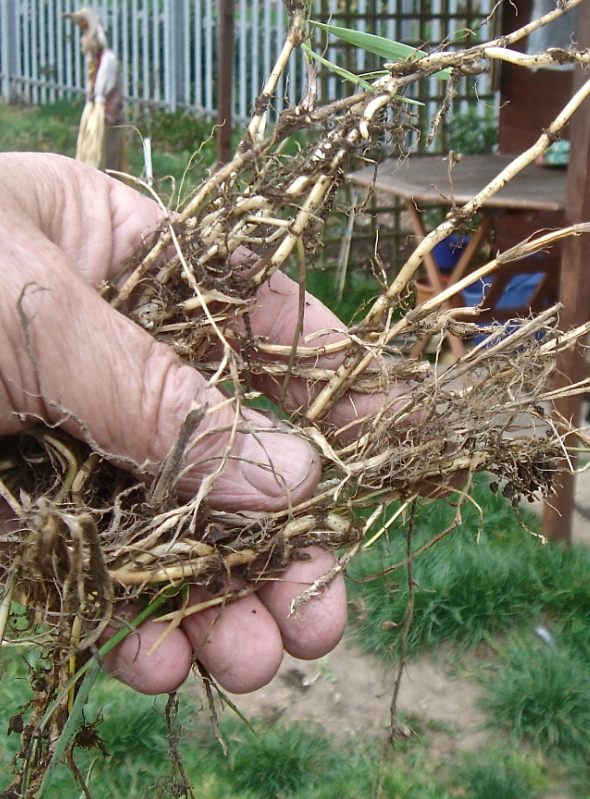
Pulling and digging couch grass up by the roots needs attention to detail, but every time I gently haul out another length of those shallow white roots with their keen little rhizomes I think how much work the next lot of couch will have to do to get that much hold again. One hour on hands and knees among my onions and I've teased out couch grass that will take weeks, maybe months to regrow. I've been told that if one keeps on removing it - widespread though it is and tedious though it may be - it will eventually cease to be such a problem. I can hoe it away when its seedlings appear, because its spreading roots once removed need time to re-establish themselves.
*** ***
My choice of Estima and Marfona arose from the pleasure I got from the baked spuds with a rich serving of butter sold from the Dinky Donuts stand in the Birmingham Rag Market for £1.50; £2 with a cup of tea. They know I like the skin nearly burned - firm almost crispy. I eat the lot.
Pretty sure this one's a Marfona

Amanda, there, told me their choice of potatoes for baking. These are the seed potatoes I found in Oldbury via the web and which should be ready to lift in another month.
*** *** ***
Tomorrow is the last day of Edward Burtynsky exhibition Oil at the Photographers Gallery in Ramillies Street London. Burtynsky has taken pictures of landscapes scarred by the extraction of oil, and the cities and suburban sprawl connected with its use. 'In no way' he writes 'can one encompass the influence and extended landscape of this thing we call oil.'
Breezewood, Pennsylvania - its name an eponym for such landscapes
Tom Clark's blog Beyond the Pale shows some more of Burtynky's powerful work, as does this record of an interview with him. (See also Marc Augé Non-Places: Introduction to an Anthropology of Supermodernity, The Axis of Hypermobility, and John Adams on the Social Consequences of Hypermobility)
*** *** ***
Minoti Chakravati-Kaur has emailed me from the Western Isles - places off the high west coast of Scotland I've never visited:

Dearest Simon. Early morning in Portree at the Isle of Skye and just getting ready to set out for Brin Croft and on the way to see the iconic castle of Eilean Donan. I am blessed with a desire and God has gone along with it and so a price has to be paid. See how you and Theodora have enriched my life.
    Yes I will leave the shirt in its fabIndia bag with Theodora. I will also give her a shepherd woven shawl which I thought she could throw over her shoulders when she watches TV. I will take as many pictures as I can in Brin Croft where we hope to reach at around 3 pm and will try to video record her for a little while if she allows us to do so.
Chicken coup? wow that is what I have wanted to do for a while.
I will certainly send you the photographs we have taken on Lewis and Harris - I have never seen such white sands in my life before and the colour of the sea around them in shades of turquoise and blue and green and a mixture of all three such that I cannot even describe adequately. We had to video record them as it was impossible to capture the sight on a camera in one shot.
Western Isles
   I also wanted to show you the Harris Tweed I have bought and some wool to knit waist coats to match with them. The herringbone design in charcoal grey. I literally tracked down weavers and saw them at work on their looms on Lewis and Harris and made friends with them all. One of them Donald Mackay will be receiving the MBE award on Monday. It is fascinating and I intend introducing the Gaddi shepherds to the idea as they too have looms but have not been able to continue against the competition they have against Australian merino and fluctuating wool prices in the world. That is why I would like you to see Theodora's shawl it has come from the loom of a Gaddi shepherd whom I befriended in Delhi when he comes down with those shawls.  Will write more after I reach home in Langford on Tuesday. See you then and stay happy and cheerful. Love from your friend Minoti 
*** ***
I'm over halfway through Vikram Seth's A Suitable Boy - begun in early May. I've just been sent my copy of Lawrence Durrell's - until now - unpublished novel Judith, edited and introduced by Richard Pine, who's been involved in helping organised celebrations of Durrell's Centenary in Corfu at the Durrell School.
It's set in 1945-48 in the final years of the British Administration of Palestine. Judith is a scientist refugee from Germany 'working on formulae vital to Jewish exploitation of oil reserves...' The other part of the plot has her Nazi ex-husband helping the Arab's to resist the arrival of the new state of Israel. Do I want to read this? I can't quite see how it's going to end.  In January 2009 Dhiaa and I had an exchange about Christians, Jews and Arabs...
'I think the three main world religions (Christianity, Islam and Judaism) can and must save the world' he wrote 'because they are also capable of destroying it.'
*******
How I miss dear Ano Korakiana for all my delight in what I'm doing in England. Thank goodness for the chance to glimpse the village website by Thanassis Spingos....
Βαφτίσια χθες, Κυριακή το απόγευμα, στον Άη-Θανάση...a baptism, Sunday evening in Ano Korakiana, in Ag.Thanasi, which among its 36 churches, is the 'cathedral', η «μητρόπολη», of the village, priest Kostas (who back in February promised a prayer for Oliver) baptises Αγγελική...
...Angela, daughter of Stamatis and Marcella, κόρη του Σταμάτη και της Μαρκέλλας. After the ceremony, through the summer dusk and late into the summer evening, a crowd of guests enjoyed a rich buffet in the courtyard of the church (my translation)
My note: In the Orthodox church baptism is the same as christening. A child has no formal or shared name until this event, being called 'the child' or 'baby' until it's immersed, unclothed, into the big bowl. The more the toddler screams the better. Devils are being driven out. In fact at all the Greek baptisms we've attended this ducking isn't anything like as traumatic as it sounds, with parents and godparents and sisters, brothers and cousins all about, plus lots of hugs and embraces in a big dry towel and the water tested to ensure it's the same temperature as a baby bath.
As far over the village as Ag.Thanasi is below, the view from Ag Isidoras
*** *** ***
When cars were fun ~ my grandma driving a a Renault type EU in the 1920s
12 years ago I wrote this in Local Government Studies
I see a new jargon phrase on the horizon - 'moral mobility' - as the Pharisee said in that salutory lesson, I have long known that as an urban cyclist I am not as other men are...Seriously tho' I reviewed a book and two policy reports over 10 years ago on reducing autodependency, and here I'm scanning a piece of research happy to refer to 'moral mobility'.
'...car-dominated mobility has been significantly fractured'
..for every one that exalteth himself shall be abased..

Back numbers

Simon Baddeley