Total Pageviews

Showing posts with label Jan Bowman. Show all posts

Saturday, 10 February 2018

Hannah's afternoon

Vertumnus by Giuseppe Arcimboldo
I spent a Good Sunday with our grand-daughter. Hannah stayed overnight with us, because our grandson was poorly. I've got to know Oliver quite well. We’ve been on expeditions. We talk. 
My stepfather long ago said “I don’t like children while they’re still small animals. I like conversation”
First Hannah and I and Oscar dog went up to the Soho Loop with my bicycle and, placing a cushion on the rear rack, carried her into town on the back – stopping now and then to look at things – she holding on the saddle stem; dismounting when going over a hump-back on the towpath.
“Are you OK, Hannah? Just shout if you want me to stop. OK? Hannah! OK?”
“Yes”
Things and things. Flowerless, leafless, winter-quiet shrubs. Trains rushing past, wheels at eye-level, seen through railings beside the towpath.
“Do you hear the rails singing before the train comes by?”
Litter in the brown canal.
"See how it floats so slowly. Look, here’s a narrow boat coming”
We watch its slow progress towards us.
“Wave, Hannah”
Passengers wave back.
"See the geese! Look there's a duck and a drake, the one with the shiny green neck"
Hannah watches and considers.
“Look at these bricks?" I say "Between them, mortar, so they stick together. Go on. Touch"
Hannah isn’t – yet - asking “Why?” all the time. 
How does she take in these things?
Under the bridge near Gas Street Basin we go ‘whoo’ to warn, but also to hear our voices echo.
On the slopes over feeder canals I ask Hannah to dismount, then get on again for the rush down the other side. Oscar runs ahead, and lingers behind – exploring with his nose. If we spy another dog in the distance I summon Oscar with my whistle, and lean my Brompton down, so he can jump in the pannier until the other dog has passed; much fierce growling from Oscar in his safe berth; tail wagging if it’s a bitch.
In town we work our way eastward. On Temple Row a road sweeper with spinning brushes drives slowly by capturing litter, sucking it in. We follow it awhile. Another manual trolley is pushed by a man with a broom, working niches. He points out the machine to Hannah 
"We call them beetles"
We stroll over to the St Philip's Cathedral where I take Hannah to gaze up at the Burne-Jones Last Judgment.
Outside again, we window-shop, talking about, exclaiming, at what we see, especially in the Great Western Arcade.
On Colmore Row at 200 Degrees we sit outside having chocolate and an apple drink and chocolate cake, Oscar in his pannier removed from the bike, cosy at our feet, blanketed with my tweed gilet.
“This is nice, Hannah”
No-one else was outside. Too chilly. I was warm with the happiness of my grand-daughter’s company.
We walked northward over Great Charles Street, Queensway, down Newhall Street on the bicycle, where we turned down dark steps to the canal towpath, to walk westwards up past Farmers Bridge Locks, where the path is often cobbled, the brick blue. Approaching the penultimate locks, I explained the way they worked, both of us peering down mud scummy walls into grey water.
“Let’s open a lock gate!’
After a while Hannah caught on to the difference between a gate that was impossible to open and ones that even she pushing and pulling on the big paddle beam can slowly open. Then, as easily, close.
“See! If the water’s the same level on either side the gate will open.”
After three locks, one half-full where the gate will not yield to her, I’m sure she’s got the idea.
From Gas Street we cycled back the way we’d come along the Birmingham Mainline, turn north at Soho Loop, now and then summoning old Oscar to catch up with us, and so back to the van on Clissold Street to drive to Victoria Jubilee Allotments to check the sleeping plot.
Hannah on Plot 14 on Sunday

Hannah's 3rd birthday on 25th July 2017 - Simon, Hannah, Oliver, Linda and Oscar (picture: Jan Bowman)

“Do you remember what it was like in Summer?”
Has she got her head around the four seasons, given how little time she’s been on the earth?


Wednesday, 27 September 2017

'...co-operation between the gardener and the cook...'

The top of Soho Hill, three miles north west of Birmingham city centre, is concealed by the terraced streets that run north-south across Handsworth to Soho Road, where the gentle topography of the old rural landscape is blurred, depicted in old pictures, difficult to match with present observation.
The topography of Handsworth. Plot 14 on the Victoria Jubilee Allotments is 420 feet above sea level

I didn’t notice the hill’s slow ascent from the Hockley flyover, two miles to Junction 2 M5 and Smethwick, until, 15 years ago, I took to cycling, sensing the artery’s steady north-westward incline in my pedaling. In places, green spaces remain, once pastures, or heathland, the area’s boulder clay unsuitable for cultivating crops.
Where buildings and streets stop, there lie, near us, precious green spaces, landscaped to oblige the town – St Mary’s Churchyard where the dead lie in their classes from family vaults to paupers' unmarked indentations, Handsworth Park, whose history I’ve written, and the Victoria Jubilee Allotments on the north side of Soho Hill, on a gentle slope that continues, beyond sturdy iron palings, to the Handsworth Park pond and St Mary’s Church, whose bells, hushed by trees, ring familiar changes.
In June 2010, when the new Victoria Jubilee allotments were at last opened, Lin and I chose a plot at the far end of a site for which I and others had campaigned over ten years helping the city to negotiate a S106 agreement that delivered eighty municipal allotments, gravel paths, drains and a portakabin club house. The allotment is 200 square metres. Plot 14. A new part of my life.
“I shall not join the site committee. I’ve done enough paper work and talking to win conditional rights to this ground. £30 annual rent for over 60s. I shall concentrate on cultivating my allotment!”
I began to break up the surface tufts of well rooted couch grass the day I signed the lease. So I started to learn just what we'd squeezed from a developer who’d planned to build over the whole site, but been allowed a third of what had once been private allotments.
Plot 14 June 2010 (photo: Linda Baddeley)
The ground the developer left, after all the grading and digging they’d done to build houses, was not what it had been. The precious old tilth, product of a century's gardening, had disappeared, skimmed and dispersed all over the site, the ground graded and compressed over several years of construction by heavy machinery. The area’s unforgiving boulder clay, pushed into the Midlands by ancient glaciers, never arable, had resurfaced. The developer, pressured by the city, and Handsworth Allotments Information Group (HAIG), had hastily strewn a miserly carpet of second rate topsoil, before handing over the site under the terms of their 2004 S106 Agreement with the Council.

In the first phase, Lin and I got a shed via freecycle. We levelled the plot’s slope, edging a square with tanalised timber on which, under a bed of sand and pummelled earth, we laid levelled slabs recovered from a Handsworth front-garden. I re-roofed the shed, adding a veranda.
January 2011. '...It makes a nice comforting sound when the rain is beating down it and one is dry and warm inside'

For the next three years of phase one, I learned about soil. There came a stage where I was close to giving up, not looking forward to the short journey - walking (12 minutes), cycling or driving - to our plot. The spur was a formal letter.
A wake-up call! I react well to notices like this

I also learned that, but for the darkest months, you cannot leave an allotment alone; that couch grass can only be reduced by persevering work that never ceases; that more or less all that's edible is food for slugs and snails, with different vegetables prone to the attention of specialist insects – onion fly, potato worms, carrot fly - as well as being prone to infestation by disease, and ailments arising from missing elements in the soil. Then there are the birds, pigeons especially, who focus on fruit. That another pest is people, who break into allotments to steal; that my plot needed investment in manure...

...topsoil and compost, delivered by tipping trucks and in builder's bags...
Black gold arrives

...that I could make my own compost, use mulch and weed suppressant fabric and netting; that I could grow from seed in a green house – bought second hand...

...and, with a fruit cage, grow strawberries and raspberries and more, and working with our neighbour Gill, an apiarist, and with site committee permission, have Buckfast bees on site, giving honey and pollination; that cultivable soil should be laid out in beds that can be reached from a network of paths to ensure not having to walk on them; that earth is rich, sensitive, structured - an environment for billions of micro-organisms; that when growing things you should be more inclined to feed the soil than the plants that you grow in it.
Published in 1945, no book on gardening has taught me so much
The second phase – from the start of 2015 - has to do with rejoicing. It would have been impossible without my discovery of, and friendship with Winnie Hall,  who’s growing skill and confidence have made Plot 14 work. ‘Our’ plot now yields crops – potatoes, tomatoes, peppers, runner beans, broad beans, onions, garlic, marrow, butternut squash, pumpkin, courgette, aubergine, peas, cucumber, apples, cherries, plums, strawberries, raspberries, pears, gooseberries, tayberries, artichoke, Jerusalem artichoke, parsnip, rhubarb, grapes, rosemary, chives.
Plot 14 on the VJA. The two flags are for my two most loved countries. They serve too as bird-scarers.

Some things planted have not thrived; cabbage, cauliflower and Brussels sprouts have more or less failed. But my feeling is of triumph made sweeter by seeing so many others who’ve fallen by the wayside as they’ve grasped the work, time and cost involved in growing food on the Victoria Jubilee’s testing ground. Almost shameless triumph is made joy by the visits of my grandson Oliver and now his sister Hannah, learning like me, ...
Winnie harvesting with Ollie and Hannah
...starting to grow things in the sunrise of their lives.

I’ve commissioned a painting from Jan Bowman to capture this delight – a portrait of Hannah, Oliver, Lin and I on the plot in July, celebrating our grand-daughter’s third birthday.
Winnie Hall, Jan Bowman, Oliver, Hannah and her mum, Amy on the rocking horse for Hannah's birthday

The third and present phase has to do with illusions; with something I’d not anticipated when focused on preparing the ground and getting it to yield harvests – a problem of bounty becoming glut.
Over a year ago I was talking to a friend, who has an allotment in London, about growing vegetables. Supper in a restaurant near Russell Square.
“…human beings’ relationship with the earth. How it’s broken. Severed over generations by the transition from rural to urban…estrangement from the land. Loss of craft in cultivation…How can I, whose ancestors abandoned the land with Industrial Revolution, getting rich as iron-masters, mill-owners, bourgeois progeny, urban aspirants earning wealth from the surpluses of mechanisation…Leas of Oldham whose business profited from the sweat of mill girls. Jacksons of Rochdale, a mansion home burned down by mill workers?”
I spoke of first generation immigrants, from lands where farming is still in the blood – as in Greece, in the Caribbean, Gujarat, Africa.
“How can I hope to acquire that feel for growing stuff?”
I glimpse a glaze, my friend, with all her grace, cannot quite withhold.
I struggle on “My paternal great grandmother, born in Oldham, married in London, left the city to live in a cottage by the Itchen. She cultivated, with help from Mr New, her gardener. My sister and I had the run of surrounding water meadows. My maternal grandmother abandoned a metropolitan social life to start the dairy farm where I was born…my stepfather, born in London, made a career in broadcasting…in his last thirty years making a successful TV programme called ‘Out of Town’ about disappearing country life, the fall-out from mechanized agriculture. He once called my grandmother’s adventure a ‘hobby farm’ … she was devastated…anyway…what I’m saying is, on my allotment, I’m getting back some of that long lost…”
My friend - at last – intervened; agreed that the relationship between humans and the land was "perhaps broken"
“Yes, yes” I said “accelerating distortions in relations between the city and the countryside…”
“But, Simon, what also matters, perhaps even more is the relationship between the grower and the cook.”

By email she referred me to a paragraph in The Vegetable Grower's Handbook (1948) by Arthur J. Simons:
Time and again I have seen kitchen gardens and allotments which have been assiduously sown and planted by the head of the family without any regard of the actual requirements of the kitchen...The golden rule is to grow what you most like to eat in sufficient quantities to ensure that you have enough of it but not on such a scale as to involve wastage. This demands close co-operation between the gardener and the cook or housewife.
“The real problem is whether you and Lin like cooking and eating what you’re growing on your plot”
'So proud' (photo: Winnie Hall)

Leaving aside the author's archaism about 'head of the family', I hadn’t thought of this. I had just assumed that cooking and eating would follow the successful harvesting of which I was so proud.
Linda asks "So what am I supposed to do with this lot?"


So... now I..we have to learn  and far more important, agree, about succession planting, about storing, about deep freezing, about preservation, about bottling, making jam, jelly, chutney, about dehydrating, - every craft and trick from the ancient books about how to even out harvests; cooking and eating what's grown at home. There's the satisfying option too, of giving stuff to neighbours, and on occasion bringing a basket of surplus from the plot to offer for collection, when we do street work with Handsworth Helping Hands.
Denise and her niece Winnie preparing harvests from Plot 14 for freezing


Monday, 15 September 2014

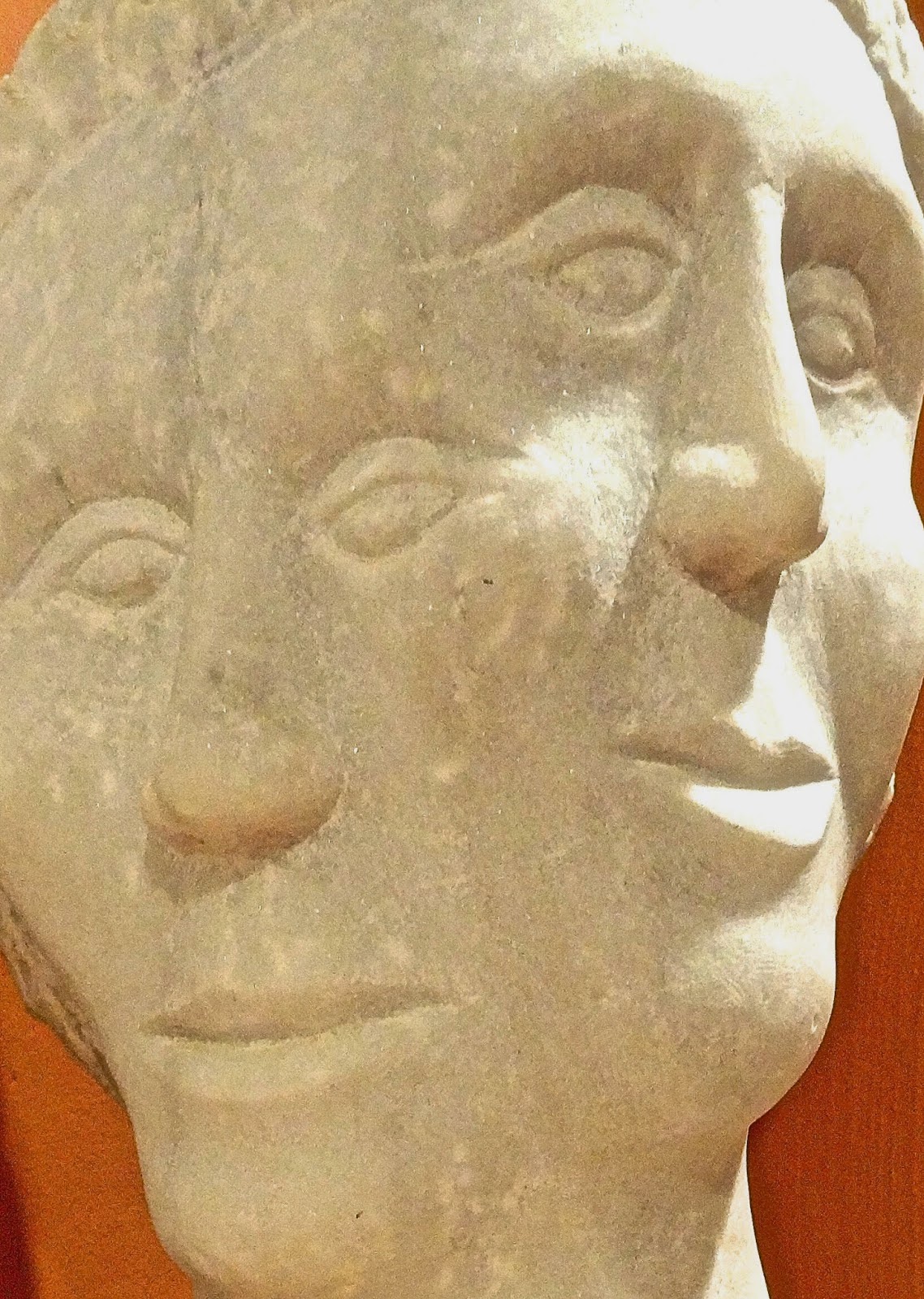
The village sculptor at work

Aristeidis Metallinos of Ano Korakiana by Jan Bowman (Sept 2014)
As a generous present for a small favour my friend Jan has sketched the laic sculptor Aristeidis Metallinos, working from a photo lent by Angeliki Metallinos, his grand-daughter. It’s been good to get a note from the academic who wrote about him in 1985 – now Dr. Eurydice Antzoulatou-Retsila, since 2009 professor and Dean of the School of Cultural Studies of the University of Peloponnese in Kalamata – 300 kilometres south east of here. Her email spoke of meeting the sculptor in early 1982 ‘during my scientific fieldwork’. She thanked me for my interest and asked me to please let her know ‘if you think I could be of help in your research about Metallinos and his work.’...
I had felt, at that time, very lucky to have discovered him. At that period I was curator at the State Museum of Greek Folk Art in Athens and I had thought that his work could be the subject of a monographic museum, which actually his family created. I have not visited the village since then, although I was professor at the Ionian University for several years…speaking to my students about his work.
From me: …I am so delighted that I have heard from you as I can always imagine that sheer hard work in academia these days (I am semi-retired from Birmingham University aged 72) makes it almost impossible to respond to questions that are not about the work of the moment.
I have been trying to assist the family, in particular Angeliki Metallinos, the laic sculptor’s grand-daughter, to help put her grandfather a little more on the map.
But for your essay about him, Aristeidis Metallinos is more or less unknown even in Corfu; even in Ano Korakiana. That may be because his work, as you may know, was not only a commentary on the history and fast-changing pastoral economy of Corfu and his village but also involved strong, even pungent, illustrations of his contempt for the establishment – everywhere in the world but also closer to home.
This is perhaps still a sensitive matter long after the artist’s death…
I love the village where we now stay for under half the year. I am Philhellene, infected by my dad via his second marriage in 1949 to Maria Roussen, an Athenian… I lived with my mother and stepfather, but dad invited me to Greece in 1957 - a callow 16 year old. I made a four day train journey via Venice to Athens to be met by the lovely relatives; then sent on a tour of the great sacred places with a young Greek guide whose joy and pride and enthusiasm in what she showed us, is with me always. Except the Acropolis I’ve never returned. They live in my imagination free of the resented attentions of a million other admiring sight-seers.
The help I sought from you, if I may be allowed to pursue this, is whether the ribald, Chaucerian, erotic and subversive element of Metallinos’ work fitted with your impressions of him in 1982 as a laic sculptor associated with Corfiot folklore. There seem to have been two sides to the man as he admits in that ’double-faced' self-portrait
You saw his relief satirising the 'Saint of Preveza’ and perhaps some other pictures of his work...in this area that I am treading  softly.
That’s me - the double faced (cat.92) ~ Aristeidis Metallinos 1980
I’ve had helpful advice from Dr Alexandra Moschovi at Sunderland University. I spent a half-day with her in Newcastle a few weeks ago. She showed me how Aristeidis’ work could in several cases be linked to contemporary events in the 1970s and 1980s. She reminded me that, especially in the 70s, there was still the memory of censorship from the Stone Years and that the sculptor may have been perceived as being a dangerous rule breaker, even risking the reputation of his village and family and others.
On the precautionary principle, I am assuming all this is not entirely in the past. The sculptor lies with his second wife Eleni in the churchyard of Eklisia Paraskevi just below the village, his ‘ museum' just visible through the cypress trees between the church and the village above.
The current plan I have agreed with Angeliki who has the support of her parents Andreas (son of the sculptor) and Anna…is to work on a catalogue describing each of the works. At some time in the next two years I would greatly appreciate being able to share our progress on this with you and in the meantime I hope our research into Aristeidis Zach. Metallinos has your blessing.
I hope you will forgive me using your first name. There is no disrespect intended and I am well aware that without your academic reputation we would not even have been able to get a small piece about the sculptor in Wikipedia. Thank you so much for coming back to me. Kindest regards…
*** ***
We ate a late supper in Handsworth on Wednesday evening, Guy, Emma, Amy, Richard, Lin and I around our kitchen table...
...Oliver has finally gone to sleep upstairs in our room. In the morning he’ll wake to climb from his cot and into our bed. But nanny and grandpa will have left. Downstairs new Hannah, is for the moment in the centre, before Amy gets her to sleep in the bouncing cradle, one with a battery that makes it vibrate. When that’s not enough Guy puts his smartphone playing a modern lullaby – white noise - beside the cradle - the same comes from radio telescopes probing galaxies.
Supper over, all packing done and case weighed to regulation 20 kilos, tickets and passports checked, we with Guy to Digbeth coach station. Two hours to Luton. A crowded wait in long queues of familiar strangers. A flight at dawn and a landing through cloud into a rain-swept world where we picked up a car and drove up, via Lidl, to blessed Ano Korakiana. It rained and rained. The second night I woke to thunder and lightning. Lin stood at the French windows - a woman in black against its constant flicker. Rain pounded our tiles, brimming the gutters, flowing over their length in shining streams, flowing over the balconies to splash on plaka and concrete below.
In the sunny morning we continued tidying the garden; pruning and bagging a three month spread of Bougainvillaea and Wisteria, and, with extending loppers bought from Technomart near Gouvia, cutting back the tops of the lemon and orange tree where they grew higher than the balcony.
That wood balcony that affords such views of Corfu, the sea and mainland Greece, is crumbling.
Morning in Corfu
.No Greek would regard it as anything but a temporary structure. To halt the effects of time we've bought Resoltech - a kind of archaeological wood treatment that demands careful application.
Resoltech 1010 and hardener 1014
Instructions are on the internet and we've consulted friends here who have used it.

Sunday, 28 July 2013

Back to Birmingham

Last summer - Mum, Lulu, Oliver, Cookie, Amy and Oscar

My mother's bedroom emptied of all but carpet and curtains; and every crevice, corner, surface, shelf and cranny of the rest of Brin Croft, dusted and scrubbed. Woe to spiders, and other small beasts caught in the nozzle of my searching vacuum. I'm much acquainted with the dust of my mother's house, knowing it in ways that would have been strange when I sojourned there with her, with family and dogs. Lin has been my stalwart companion. The weather has been lovely; high summer in the Highlands without the swelter of England; like warm air rising the wind blows from the south west under cloudy skies. It’s timeless this sound of wind outside the city; the self same wind that impressed me in childhood, that I hear as the surge of trees and leaves, as surf impressing gravel. It gusts ebbs and flows banging doors left ajar, tipping over things carelessly lent, making startling crashes, turning the washing into rippling pennants “Make haste. England expects”.
Oscar has watched us puzzled and even dismayed, knowing 'something's going on' that makes all different; bereft of the joy of long walks through the woods, riverbanks, moors and meadows of Strathnairn. There's been a hierarchy of disposal ending at the Highland Council Recycling Centre off Henderson Road. Before that we've laid out in the carport, for collection by the charity Newstart Highlands
an incalculable miscellany, left after a two day garage sale that has seen people from up and down the Strath directed by leaflets and canvassing up driveways and through clusters of dwellings, including a word through the car window to people on the road
"I'm clearing my mother's house at Brin Croft. Come and have a cup of tea. Lots of bargains!"
I left the selling to Lin who's much better at it. Earlier in the week Guy and Amy helped take two hire-van loads over the Keswick Bridge to Dingwall & Highland Markets. Then they headed south to spend a night at the Rowan Tree Hotel to visit Alvie Church where they'd married three years ago.
I auctioned those items that were not wanted by Roger Milton, Auldearn Antiques, including things valued higher for probate then Roger would pay. Our lawyer, who I saw last Monday, wanted me to have sent these to Bonhams in Edinburgh.
"What? Send them six time further to raise hardly the price of getting them there?"

Tired out but relieved, we turned off the electricity; read the meter; turned off the water and with a final load of rubbish to dump in the wheelie bins at the end of the lane, we loaded our picnic and drove away. It was 5pm on Tuesday. We'd been clearing Brin Croft over most of nine days. We've no need for the gadget on this familiar journey south, but I set the satnav. It's almost fun to have this disembodied female voice counting off waypoints on our route, noting our speed and ETA and the miles we've covered. At the stores I kissed and hugged Isobel; shook hands with David and waved as we  drove away down the B851 to the A9 - for good.
B851 - Google street view of Inverarnie Stores and the track to Brin Croft
The Highlands is becoming foreign - shift of connection with place. Mum made the places she lived. Going to the Highlands was going to stay with her. Now we’ve cleared a property with a familiar postcode. Not a tremor of sadness assailed me. Mum would have wanted little grief at her departure. I was born in her and knew her for 70 years in all the changes of my life and her good and adventurous life; her only unfinished business the momentum that was inseparable from her character; that little spurt of energy that came with handing over a baton bejewelled with understanding and future joys. I need no souvenirs; her memorial is inside. Lucid until the final days of laboured slumber, she'd slowed in her last two years and had to lean on more people than suited her style; almost - and of course unjustly for those involved - resenting the attentions she needed. Death was, as for Epicurus, a natural irritant to be faced with courage and irritation and frustration as a tedious unavoidable interruption of her journey. She said goodbye in so many words to everyone who mattered, without being literal. It was mysterious.
I’m almost glad of the work involved in handling her estate. I’d dreaded ‘going through her things’, but I’ve not been on my own in the business of fetching, carrying, sorting, phoning, emailing and making journeys to the Highlands. Lin is my strength; also my accountant, lawyer, driver and adviser. I’ve grown closer to my stepsister, Fiona, through regular conversations in the last seven months. I’ve been discreetly tended by my children, my attention caught by the new life that began the year mum died - Oliver born in April 2012, in time to be dandled on her knee and crawl on her bed.
Bay and I at Coignafearn

My sister’s reaction to mum’s death is as different and as bewildering as she is from me, and perhaps our mother. Dutiful in caring for mum in the long weeks that preceded her death, Bay hurried away after the formal ceremonies, uninterested – so far as I could see – in the longer procedures of so great a bereavement, preferring to license the clearance men.
On Saturday Colin had again cut and raked the grass along the drive and around Brin Croft. The key was with the estate agent; the house as ready as we could get it for prospective buyers; almost a property again; certainly no longer an inkling of mum's home. She's long away.
In the particulars it's called the 'Master Bedroom'
...and we left a few things in the sitting room
Above Blair Atholl, south of Drumochter Pass, we joined a stationary queue before easing by a score of urgently blinking blue lights and the grisly remnants of a road collision that had occurred 6 hours earlier - a shiny black amputated car roof alone on the grass; two people dead in one vehicle, one in the other - the injured and dead long removed. I read of familiar calls to lay down dual carriageway for the whole length of the road rather than alter the fatal impatience of impulsive drivers.
We were back in England by 2.00pm on Wednesday morning. I unloaded Lin's car in the light of the street lamp outside our house, unknotting a cat's cradle of spider hooks and string from the roof, carrying things gently up the sloping drive to lay them in the hall and sitting room, before heading for bed in the light of dawn.
*** *** ***
Wednesday morning I was chatting to my nurse at the blood donor centre, putting the world to rights and speculating on the name of the new royal baby. Gracie brought up in Mauritius was saying that she'd been embarrassed to pull carrots from the ground and bring them muddied to her home...
"Yet I, Gracie, am ashamed I cannot be more successful doing just that"
At reception, as I left for other errands in town, I was handed my award for 100 donations - a number arrived at in January - a pretty little lapel badge, which I probably won't wear. Bound to get lost. I'm proud of being a donor yet waver at a badge. Might it be a means to reassure people wondering about becoming donors - a painless charity?
I had two talks to give - one a tour of Handsworth Park for members of Sheldon Library. We met at the park gates - seven people around my age, interested, curious, enthusiastic. I spoke as usual of what's involved in creating a trusted green space; what's involved maintaining an urban park with so many other goods - education, health, transport, you name it - competing for cash from a diminishing pool of public finance. We gazed about us enjoying the sunny scene amid the greenery. How I love this park! I know that comes over when I talk about it how it first came about over a hundred years ago.
Visitors from Sheldon with Mark Bent in the Sons of Rest, Handsworth Park
We ended the tour at the Sons of Rest where Mark and his family served us tea and cakes and I circulated old pictures and maps of Handsworth Park, and told them how the building where we sat was saved from demolition with days to spare via a petition of 400 signatures we'd raised from people in the park queuing for loos during a Vaisakhi Festival.
In the early evening I cycled across town towards Moseley to give a talk to 20 members of the Balsall Heath Local History Society. The Chairman reminded me that a payment was involved. "How much?" I said, only half-joking "do you want for me to talk about Handsworth Park?"
My talk was based on my account of the founding of Handsworth Park
"If you had one pound - in what proportions would you spend it on health. education, policing and parks? Unless you can show that money directed to parks is good for health, that it educates people and increases social cohesion, the money will go to those services rather than to the park. That argument had to be made when Handsworth Park was founded in the 1880s. It had to be made again to restore the park in the late 1990s, early 2000s."
A talk about Handsworth Park: Patrick introduces me; Socks the cat lies on the chair beside him

The morning tour didn't go close enough to the edge of the park pool to show that thousands of dead fish - roach - were floating belly up; a fatal reduction in oxygen caused by days of hot weather. On my way home after the tour I met Allen Broad, who leads the park's grounds maintenance staff, driving to the depot "It's happening in Cannon Hill Park too"
Dead roach in the park pool
25/7/13 - Dear Counclllors. Please please emphasis getting the aerator motor that blows oxygen into the water of the Handsworth park pool going again. Don’t just clear up the dead fish. Stop them dying in the first place! I don’t think other city ponds have aerators (oxygenators).  Handsworth Park got them as a result of the lottery refurbishment. Use them please. You can’t install aerators in canals or in Cannon Hill park where fish are also dying in the hot weather. In Handsworth Park we should be able to resolve this problem of fish die-off in hot weather. The motor that drives the aerators is on the island in the pool and the pipe system extends under the surface of the water with six outlets in the centre of the pond. Simon
*** *** ***
The ivy on the apple tree - cut through at the base two weeks ago - is starting to wilt. Tree and ivy have co-existed so long I wonder, unscientifically, if the tree missing its creeper, and fail to thrive.

Amy came round to leave Oliver with us before heading off for a ten hour shift.
"An old lady of 93 died yesterday. She'd had someone coming round to do her garden for years. While the gardener was working she'd sit in her car and read a book. That's where she died. Where she was found...in this weather. 90% of our work involves domestics and things like this."
Our cop's off to work
*** *** ***
An email from Jan Bowman:
Dear Simon I hope all is well with you and family, and that you're enjoying the sunshine, whether here or the Mediterranean. I thought you might like to know that a print of Richard and Flea made it into the RBSA's portrait exhibition this month. I attach a photo of it, hanging in good company.  Exhibition is on till 24 August. There's some nice stuff in the gallery; worth a visit -- if you aren't in Greece! All best wishes. Jan

Jan's sketch of me:

*** *** *** ***
Celebration of Agios Paraskevi in Ano Korakiana
Στο πανηγύρι της Αγίας Παρασκευής
Γράφει ο/η Κβκ   
28.07.13

s_parask072013c.jpg
s_parask072013a.jpgΛίγη ώρα πριν από την έναρξη του (χθεσινού) πανηγυριού της Αγίας Παρασκευής, οι ετοιμασίες βρίσκονται σε πλήρη εξέλιξη. Η Διοίκηση και μέλη του Συλλόγου φορώντας τα διακριτικά σκούρα μπλουζάκια, φροντίζουν για τις τελευταίες λεπτομέρειες: φωτισμός του χώρου, ψησταριές (για σουβλάκια αλλά και για αρνιά), αναψυκτικά, παρασκευή λουκουμάδων κλπ. Καθώς το φώς της ημέρας χάνονταν αρχίζει να καταφθάνει ο κόσμος, που λίγο αργότερα θα γεμίσει τον υπαίθριο χώρο με τα τραπεζο-καθίσματα, περνώντας πρώτα από τη μικρή εκκλησία για το άναμα ενός κεριού. Η ορχήστρα των «Φαιάκων» δεν θα αργήσει να «σηκώσει» τον κόσμο με τους νησιώτικούς ρυθμούς και η διασκέδαση θα κρατήσει μέχρι τις πρώτες πρωινές ώρες. Όπως θα τονίσει και ο Πρόεδρος της Φιλαρμονικής Σπύρος Σαββανής, η συνάθροιση και η τόνωση των κοινωνικών σχέσεων, η συνέχιση της παράδοσης, αλλά και η ενίσχυση του Συλλόγου, είναι η ιδιαίτερη συνεισφορά  του πανηγυριού αυτού στο χωριό μας, τη δύσκολη εποχή που διανύουμε.Και πραγματικά, το πανηγύρι αυτό αποτελεί μία ευκαιρία συνάντησης των Κορακιανιτών που βρίσκονται τις μέρες του καλοκαιριού στο χωριό...
Όμως, για να είναι όλα στην εντέλεια, οι προετοιμασίες ξεκίνησαν από τα χαράματα (χθες)...(φωτο από Δώρα Μεταλληνού)
s_parask072013d.jpg
Preparations started at dawn - neighbour Lefteri opposite Papa Kostas (photo: Dora Metallinou)

s_parask072013b.jpgΣτο ζεϊμπέκικο διέπρεψε ο χωριανός μας Κώστας Νικ. Σαββανής, χορεύοντας και τραγουδώντας το άσμα «Καλύτερα να με ζηλεύουνε παρά να με κακολογούνε»!>

We've missed another party in the village! My rough translation: 
Shortly before the start (yesterday) of the festival of Agias Paraskevi, preparations, begun at dawn, were in full swing - management and Association members wearing distinctive dark shirts, caring for the latest details: ambient lighting, barbecues (for souvlaki and lamb), soft drinks, donuts, etc. As daylight faded more and more people, after visiting the small church to light a candle, filled a great spread of tables and chairs and in no time local musicians are lifting our spirits with island rhythms and the party will last until the wee hours....the President of the Philharmonic Association, Spyros Savani, reminded us of this festival's special contribution to the village, encouraging neighbourliness, sustaining tradition, and strengthening the Association, in difficult times. 
Our fellow villager Costas Nik. Savvanis excelled himself at the Zeibekiko, dancing and singing the song "Better to be jealous than cast aspersions".
Aleko D adds: Now I give you a small explanation of the Zeibekiko Ζεϊμπέκικο dance - Greek folk dance (rhythm 9/4) and undoubtebly one of the most popular. The name derives from Zei (one of the names of Zeus) and the Phrygian word 'bekos' meaning 'bread'. It symbolises the union of the Spirit with the body and is danced in honour of Greek Gods. It is a solo dance and it's offensive to be interrupted by another dancer. Sometimes the dancers perform feats like standing on a glass of wine or a chair or picking up a table with their teeth! (I am sure you've seen this). The other point which I would like to correct while looking at your blog's translation, you wrote 'Celebration at Agios Paraskevi in Ano Korakiana. Agios is a man Saint and Agia Paraskevi (Αγίας Παρασκευής) is a woman Saint. So when looking at a church: Αυτή (η εκκλησία) είναι η Αγία Παρασκευή and not Agios, or Αυτή (η εκκλησία) είναι ο Αγιος Στέφανος. You say αυτή because εκκλησία is feminine [Join my classes, now starting end of October and you will learn about out all these confusing issues!]
*** *** *** ***
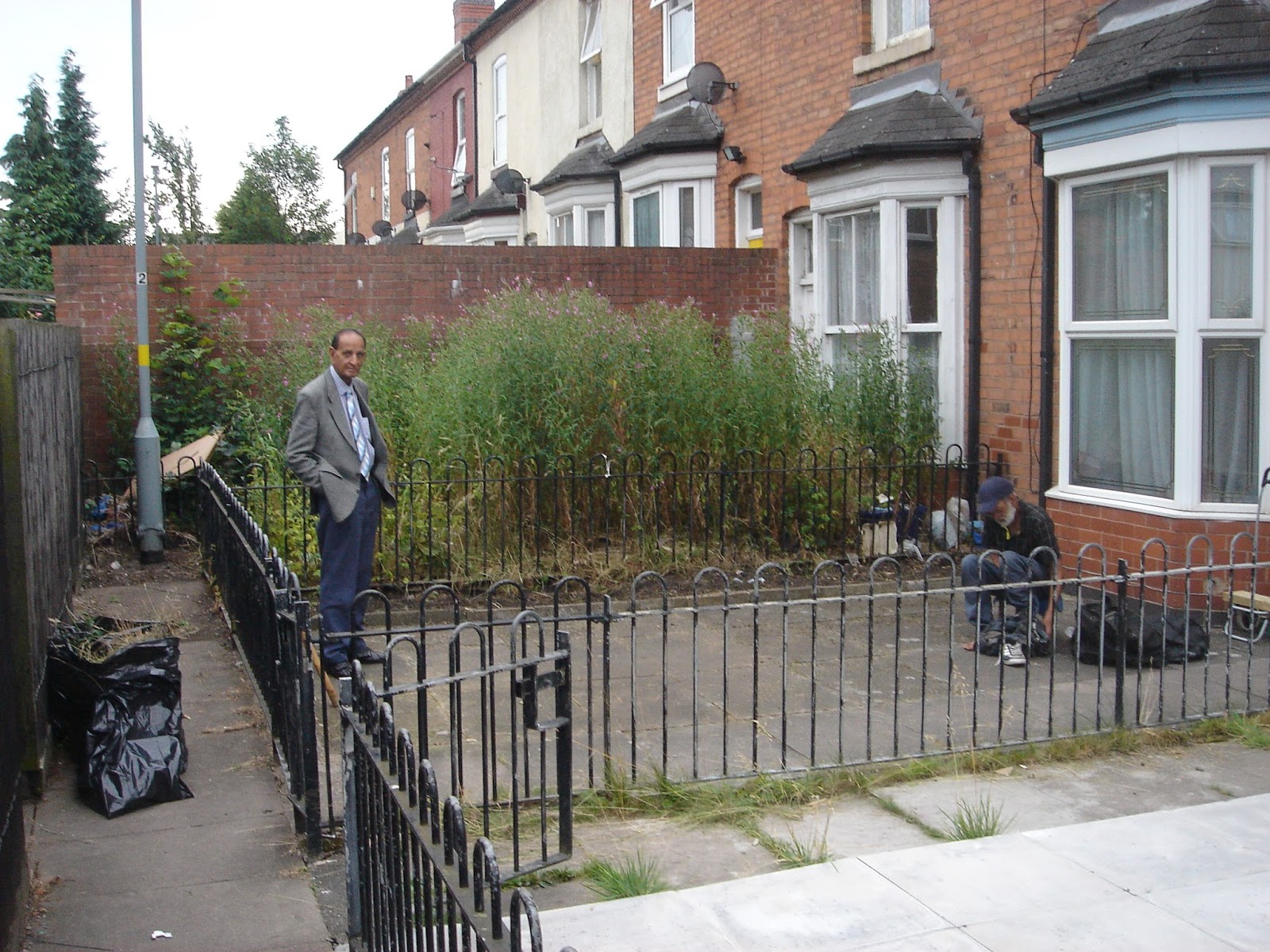
We continue the work of Handsworth Helping Hands - this weekend a garden cleared, is waste removed, and two beds moved from one house to another...
Awake and smelling the coffee! HHH van with Oscar aboard at the Holford Depot weighbridge, completing Veolia paperwork after unloading garden waste and household clearance rubbish with our Charity Waste Free Tipping Authorisation...

Back numbers

Simon Baddeley