Total Pageviews

Showing posts with label Findhorn. Show all posts

Sunday, 20 January 2013

Indivisible

I was becoming increasingly uncertain of how to get where I was going, seeing none of the streets or buildings I was expecting round the next corner. I’d left our boat sitting on the mud at Hammersmith, the family aboard. We needed a part and I was looking for a chandlers before the end of the flood. My phone kept slipping apart; an old model. Far too large. I wandered through a canal tunnel noting how clear its shallow water was from the towpath. Eels were wriggling as they fed on creatures in the mud. Part of my phone became detached. I tried to put it together again so I could phone that I’d be late back, especially as I was supposed to be having supper with Leslie who’d grown hirsute after his sex change operation and now seemed beardier than when she was a man. There were people I didn’t know round her table in a dim lit study lined with books. I tried to make excuses as I knew the family were waiting for me on the boat but the first dish was already going round – a leather bound book; inside, instead of pages, white fish in cream sauce ('But yet the body is his book' Donne The Ecstasy) I tried to eat but time was getting so far ahead of me I made excuses and left. It was dark. I worked my way through strange streets seeking the river, but over and over again I lost my way and the sides of the streets seemed to move forward with me so that I stayed in the same place even as I strove to walk. I asked a man how to get to the Thames. He was bemused.
“Where is this?”
“Harrow-on-the-Hill”
I was miles from the boat. We’d have long missed the ebb. I’d no money. It was too late for buses and trains. I tried to start walking south reckoning I could make it back by first light but could make no progress. My phone was now in two parts and useless. How I wished this was all a bad dream, but it was real. I could see no way of ever getting out of the place I was. I woke with relief. In the darkness of early morning I hugged Lin. The boat was not on the muddy shore of the Thames but beside the harbour at Ipsos from which she was lifted late last year in readiness for her refurbished engine.
Summer Song ashore at Ipsos
**** ****
I send my sister Bay a text ‘Travel well. X S’.
She, on her way west across the Atlantic, replies ‘Thank you love you. Bx’
Lin, Amy and Richard have held my hand – wonderfully – even as they too grieve, and mum’s step daughter Fiona; so also my Greek side who sent cards and phoned and didn’t mind me phoning them; friends too have been kind, especially Amy’s best friend Liz.
Mum's terrier Bibi at the gate by the field next to Brin Croft
Marjorie-Ann, my mother’s enduring friend since the 1940s, wrote a few weeks ago. She was unable to get to Scotland. I’d sent her a service sheet and an obituary.
‘Yes I can well imagine that it must feel extraordinary B suddenly not being there – she was such a ‘present’ person: vivid, beguiling, exceptional in so many ways that it is difficult to take in the fact that she has gone….it must have been immensely comforting to her to have you both with her, although I can understand that it doesn’t really offer much consolation to you. The truth is, consolations are few, and in my experience, only come with time (one being that the pain goes finally, but the love remains). You say you always knew ‘that one day it would end’, but actually it hasn’t quite ended, has it? I think you will find – as time passes, that B will be, is, part of you now until you die. How could it not be so when two people are very close? Also, remember that nothing can take away your experience of her, what you had - have had. A mother who was also a loved friend and a marvellous human being?’
A friend wrote how she still talked to her father who died over twenty years ago. I so miss being able to talk and write to mum. I did, since I learned to write from my boarding school aged six. A file at Brin Croft is full of my letters from different places. I have many of mum's letters - that distinctive handwriting, sensuously curved, invariably a broad nibbed fountain pen, aquamarine ink.
How should – how can Bay and I, as Mum willed, divide her things between us? A sofa or a bed neither of us want is no problem. We donate or sell and divide the sale price. But what of things indivisible...
Things indivisible


...things we would not want to buy off one other; whose value can no more be measured than a child or a stone picked up on the edge of a river on a winter walk long ago, or a shard from Palestine, a lock of hair, lace from Venice, and things I don't know about but which my sister and her children and mine may?
“Will you have this?”
“No you have it”
“No you”.
And what about books, read and enjoyed over the years?
“Will you have this one?”
“No you”.
For the time being these sit on many shelves as mum left them. And what of her files – our multitude of letters, photographs, her collected notes, especially on the Findhorn, where over forty years we’ve picnic’d and walked – Cawdor, Drynachan Lodge, Dulsie Bridge, Shenachie, Tomatin, Coignafearn, Findhorn Bay where the river meets the Moray Firth? In March 1995 Bay wrote a poem (or is it a psalm?) for the book mum was always planning about the river but never started. Bay found it in the file and read it at the Memorial Service
This river is like a sumptuous pathway to Heaven
The sun and moon illuminating her voyage
Sparkling like a stream of stars.
A superb, massive,diverse, twisting road of glistening water
Banked by beauteous pink rocks
Edged by verdant low meadows.
Shimmering, racing and full of fisherman’s hopes
As she makes her determined way to the ocean.
Massive boulders sometimes shunt her progress
But always the grand lady flows on
Gathering evermore strength and depths
Evermore beauty and gaiety.
Such splendour and grandeur I have never seen.
Sheep, cows, birds and lambs sip at her edges,
Roots, reeds and grasses draw water from her banks
Pebbles and rocks are rubbed by her gentle touch.
The sky colours her with beautiful tones.
She always welcomes one with her warm curves.
She meanders through giant, low valleys.
She gushes and tumbles through deep ravines.
She has the strength of a giant
The gentle touch of a baby’s finger.
She is serene, regal and tranquil.
She is rugged and bold
As she scrambles along full of a myriad of rich colours.
She has an innate friendliness that draws you to her
With a desire to explore and discover
Her multitude of secret, hidden parts.
Her deep, mysterious pools that nestle at her banks.
Her spreading, flat expanses with transparent pebbly bottoms.
She is like a chronicle of life from birth to eternity.
She flows with state and jubilance.
She holds historical tales that we may never learn
But in our curious minds we wonder
Who, in ancient days lived by her banks.
Marvelled at her abundance and life giving gifts.
Who watched her passing on her triumphant way to the sea.
What of the eager fish who leap up her waters to spawn their young
The osprey, buzzard and kestrel who dip swiftly for food.
The heather clothed moorlands purple at her sides.
She reflects the shadows of the high, mighty grand spruces
That draw their life’s blood from their friend below
And awake to her welcoming gurgles as they genuflect to her waters.
As the sun goes down on this very regal river
Shadows can be seen from fluttering leaves trembling on her ever moving surface. Sadly I briefly leave her banks and company.
Happily I know that I will return to her loving embrace.
The Findhorn at Coignafearn

Thursday, 6 January 2011

Έπιφάνεια: the blessing of the waters

It's Epiphany - ἐπιφάνεια. Thanassis Spingos put my picture on the Ano Korakiana website...
Συννεφιά το πρωί και λιακάδα από το μεσημέρι και μετά, το αντίθετο από το χιονισμένο τοπίο στις Ορεινές περιοχές στη Σκωτία, όπου ο φίλος μας Ο Σάïμον Μπαντελέï απολαμβάνει τον περίπατό του...
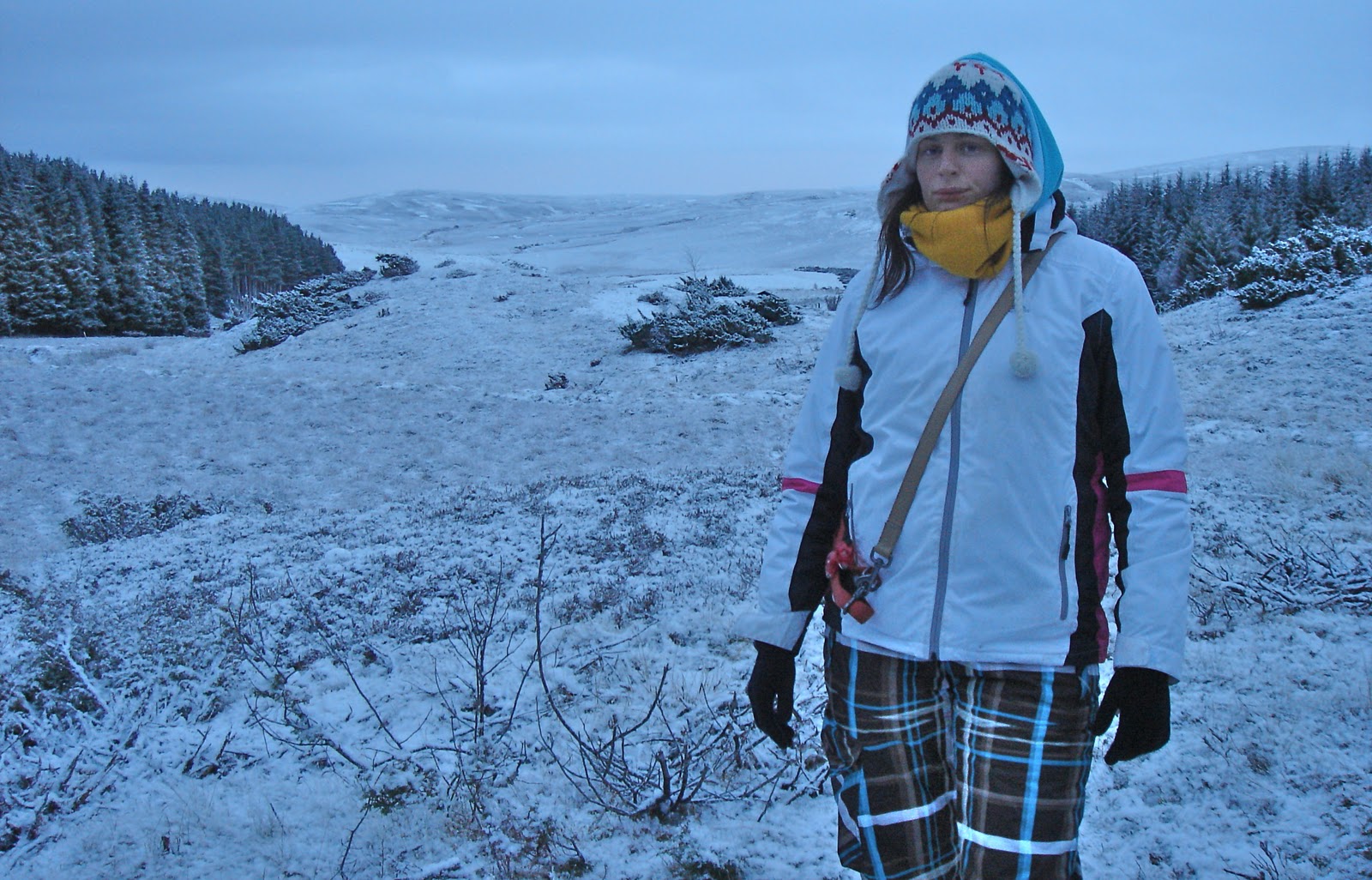
Cloudy in the morning sunshine from midday onwards, the opposite of the snowy landscape of the Highlands in Scotland, where our friend Simon Baddeley enjoys a walk ...
I think on impulse that only our part of Greece compares to the Highlands - in any weather any season. What pleasure to be walking with dogs, daughter and son-in-law (his photo of me) amid this sparse landscape, a chill wind and the sound of water where Allt a'Mharcaidh winds down the centre of Glen Kyllachy to meet the Findhorn just past the stone bridge at Garbole. The road from Farr had been icy, piled snow rubbing the underneath of Guy's car, and falling steadily for an hour. On the lower ground the air cleared.
We walked the dogs. Increasingly used to each other they ranged in four, in pairs and separate, ever exploring but never going more than a hundred yards from us as we strolled back towards the deer fence that marched with the burn. "I'm surprised we've seen no deer" said Amy, "they should be on the lower ground in this weather." "I've seen none, but for a glimpse in the woods yesterday - a flash of red." "That may be where they are." Amy put her dog Malo - the Brittany spaniel - on a lead as we came back to the car, though we'd have seen another vehicle a mile away. My dog Oscar picked a quarrel. The two joined in a snarling knot for a seconds. "It's always when you put a dog on a leash that happens!" I said "It doesn't help that both bitches are coming into season." "Yet when they are out here they seem to forget about sex." "Obviously not." The banks of the Findhorn were strewn with sheets of ice thrown off by the river during the thaw of the last few days, but the water level's already down from a day ago; the weather getting colder.
"You know I was listening to a podcast in which Aris Roussinos, who'd rather run an olive oil plantation on ancestral land in Corfu, makes his current crust as a TV development producer - a job my stepfather did as well as actually broadcasting. Aris was speaking about the 'massive crisis' in TV broadcasting (10.14 in the Word podcast 20 May '10 with a reference to Aris' article 'Why do they commission this rubbish' here, and the removed YouTube 'Monkey Tennis' episode here) and the struggle to invent programmes that would keep up viewing. "It starts with a catchy title", he'd said. You need that to catch a commissioning editor's short attention scanning hundreds of ideas ... I don't think Amy or Guy were listening to me. "Aris spoke about an idea for a film about gay Taliban - (from 16.50 in the podcast) "not that new so... " Was our TV always moving wallpaper; the idiot's lantern - with some magnificent exceptions? I suppose anyone my age has had to watch Reithian principles consumed by market society. That BBC TV should endure as a public service was always unlikely. It's so-called elitism was what I liked. Most of the public are paying for and not listening to the only broadcasting (as distinct from narrowcasting - the small mammal that is replacing it) I want to hear - Radio 4. I wonder why I can't buy a radio set that reads no other channel so uninterested am I in any other wavelength...but my solace is the thought of the hundreds and thousands who have better things to do and do them. *** Getting bewildered and vexed by radical Islam, I read Pankaj Mishra and about Europe and the Eurozone read through this series in't Guardian. There's nowt so queer as folk and life's more complicated than that...and please may I discover a Greek version of these phrases. And from Dan McQuillan - 'geek - social issue mash-up - bringing those tribes together' - co-founder of Internet.Artizans - linked on this blog - I come across discussion - under the uninviting term digital reverse development - which suggests way of diffusing ideas and practices of self-help and localism from poor to rich, third to first world - 'new organisational design, mass involvement; from waves of superficial on-line engagement to lasting social change without building another bureaucracy. What's run out of steam? What's emerging?' Warmth woke a butterfly that settled on my bedside table - a tortoise shell from the buddleia my mother planted earlier in the year. I let it out indoors hoping it'll find a cooler spot to return to winter sleep.
** ** ** And on 6th January Guy and Amy said "Come with us to see the waterfall above Contin." They took me through a light snow storm over Kessock Bridge into Ross-shire. The sky cleared just off the road to Dingwall. We came to a small parking area; path that led through snow down a steep bank between rimed birches to The Falls of Rogie - first the sound and then the river tumbling over glistening rocks. "We came here in summer and saw salmon leaping" said Amy as we gazed from a small suspension bridge, whose swinging so worried dog Lulu that Guy had to carry her over.
 ***
It's not Sunday but it is cloudy and I want an excuse to hear Greek - sung and spoken. Συννεφιασμένη Κυριακή, μοιάζεις με την καρδιά μου που έχει πάντα συννεφιά, Χριστέ και Παναγιά μου. Όταν σε βλέπω βροχερή, στιγμή δεν ησυχάζω. μαύρη μου κάνεις τη ζωή, και βαριαναστενάζω. Είσαι μια μέρα σαν κι αυτή, που χασα την χαρά μου. συννεφιασμένη Κυριακή, ματώνεις την καρδιά μου. Impossible to translate; literal OK, but to capture the intention and emotion requires talent....αλλά ακριβώς έτσι μπορώ να ακούσω την αγαπημένη Έλληνες μίλησαν και τραγούδησαν - Σωτηρία Μπέλλου - a singer, especially of rebetiko, daughter of a priest, died in 1997. 

Friday, 21 March 2008

Phaedo

Windy, snowing, murky and lots of time to stay indoors reading with occasional forays accompanied by dogs. Yesterday we went east to Dulsie Bridge to see an old friend of my mother and stopped on the way home to view the churning waters of the Findhorn as they passed beneath the narrow and graceful bridge that takes the road from Drynachon to the coast at Nairn or towards Inverness. It's a defile of barely 15 metres following a broad shallow stone strewn stretch of rippling water. The river suddenely deepens, backs up and swivels peaty brown but clean through a zigzag of birch strewn granite cliffs. It roars and rumbles, to my delight - the safe spectator - peering into the miniature turbulence, while the terriers dash too and fro hoping for rabbits leaving hardly a yard unsniffed, before we clamber back in the car and head for the warmth of Brin Croft, crumpets, tea and a read of the distant news. * * * My eldest sister phoned my mother from New York and told of crises "It's dreadful here. Two friends have lost everything..." * * * Lin phoned the other evening to tell me of the delightful coincidence of having, as tenants among the several who’ve applied to one of her two flats in Birmingham, two Greeks, one from Corfu and another from Thessaly - the latter bearing the name, would I believe it, after our favourite song in Elytis' Axion Esti - of 'Swallow' -'Ena To Chelidoni' - "...after which I was named" he said. These seem like signs, certainly delightful happenstance. Others would say it was a sign of the times and the closer ties between Britain and Eastern Europe. * * * I have finished Phaedo, in which Plato imparts the story of Socrates’ death via an imagined conversation that occurs in Phlius, inland just west of Corinth in the Peloponnesus (109A-118, references from the 1578 edition of Plato by Henri Estienne) in which Phaedo of Elis, a witness, tells Echecrates, a fellow philosopher, what happened in the prison in Athens. Towards the end of day just before he chooses his time to take the hemlock, as voted by the democratic government of Athens, Socrates, describes the world in language different from the precise arguments of the earlier discussion with his companions in his cell. The spherical earth is in equilibrium in:
“a uniform medium … vast in size. We who dwell between the river Phasis (which flows from the eastern shore of the Black Sea near Poti where I’ve not been, though I’ve seen the Bosporus) and the Pillars of Hercules (the Straits of Gibraltar through which I’ve often passed – though only once in my own boat in 1965) inhabit only a minute portion of it…like ants or frogs round a pond; and there are many other peoples inhabiting similar regions… the real earth is…variegated and marked out in different colours, of which the colours we know are only limited samples, like the paints artists use; but there the whole earth is made up of such colours, and others far brighter and purer still. One section is a marvellously beautiful purple. Another is golden. All that is white of it is whiter than chalk or snow and the rest is similarly made up of the other colours, still more and lovelier than those which we have seen. Even these very hollows in the earth, full of water and air, assume a kind of colour as they gleam amid the different hues around them, so that that there appears to be one continuous surface of varied colours.” ’
Socrates’ description goes on for minutes, describing the mingling diversity of this cosmos, its mighty flows of redemptive and retributive rivers, the multiplicity of its inhabitants in many stages of life, with the limited view of us ants and frogs in a prison cell – and Socrates doesn’t mean the cell they are all in at the time. Then he says it’s about time to have a bath to save the women ‘“the trouble of washing me when I am dead”’. He goes out and, Plato - avoiding the scene - writes of Socrates seeing his children – ‘two little sons and one big boy’ - and the women of his household, then returning to his friends.
The warder arrives:“I’m sure you’re not angry with me" he says, "but with them, because you know who are responsible. So now, goodbye, and try to bear what must be as easily as you can.’ As he spoke he burst into tears, and turning round, went away. “Goodbye to you too” said Socrates “What a charming person! All the time I’ve been here he’s visited me, and sometimes had discussions with me, and shown me the greatest kindness” Then Socrates has Crito send for the man with the poison, who comes in to his cell. He asks him what he should do. “Just drink it and then walk about until you feel a weight in your legs, and then lie down. Then it will act of its own accord.” Socrates takes the cup ‘without a tremor’ and says “I pray the gods that my removal from this world to the other may be prosperous.” With these words, quite calmly and with no sign of distaste, he drained the cup in one breath. Up till this time most of us had been fairly successful in keeping back our tears, but when we saw that he was drinking, that he had actually drunk it, we could do so no longer. In spite of myself the tears came pouring out, so that I covered my face and wept broken-heartedly – not for him, but for my own calamity in losing such a friend. Crito had given up before me, and had gone out when he could not restrain his tears. But Apollodorus, who had never stopped crying even before, now broke out into such a storm of passionate weeping that he made everyone in the room break down, except Socrates himself, who said “Really, my friends, what a way to behave! Why that was my main reason for sending away the women, to prevent this sort of disturbance; because I am told that one should make one’s end in a tranquil frame of mind. Calm yourselves and try to be brave.” This made us feel ashamed and we controlled our tears…the man who had administered the poison felt Socrates legs and pinched them and asked if he could feel. Socrates said “No”. He felt him again and said that when the numbness reached his heart Socrates would be gone. The coldness was spreading about his waist when Socrates uncovered his face – for he had covered it up – and said “Crito, we ought to offer a cock to Asclepius (the god of healing). See to it and don’t forget.” “No it shall be done. Are you sure there’s nothing else?” Socrates made no reply, but after a little while he stirred and when the man uncovered him, his eyes were fixed. When Crito saw this he closed his mouth and eyes. Such was the end of our comrade, who was we may fairly say, of all those whom we knew in our time, the bravest, and also the wisest and most upright man.
There are many thoughts I have. I hear rumours of Socrates' volatile relationship with his wife, Xanthippe, about whom he has nothing but good words, but who has since been slandered. I wonder at the joyful certainty with which this man, about to die and devoted to acknowledging his own perplexity, describes the unseen cosmos to his friends. Surely this was a consolatory paean for them. How far has Plato, as would any historian, altered his ageless account of the end of his mentor? What can I make of the traditional view that Socrates and even more Plato were anti-democratic? I do, influenced by Maine, accept that democracy, in its many forms, is 'only a system of government' and depends as much as monarchy on the integrity of those it empowers, and the ingenuity of those who have designed and and maintained the checks and balances that best resist the corrupting effects of power - whether of the monarch or the people. * * * One of my Japanese students, Eriko Inagaki came up by train from Glasgow and stayed with us from noon to 5.00pm. After lunch we took her to Dores to gaze on Loch Ness. She e-mailed me later:
..Again thank you so much for your kindness. I am always impressed with British people's good taste. And that, in most cases there is one extra room for visitors. We do not have such custom but I want to take in your welcoming attitude for guests and especially foreigners. I was also moved to see Margie's impartial treat for me despite the fact that she is a carer for Barbara. Barbara astonished me by her beauty and dignity! I want to get older like she does. Your childhood was extremely charming. I will tell about it to C*** since we are planning to meet soon, after I go back. Your talk about British climate (not severe to put people in danger) reminded me of the Japanese essayist 'Tetsuro Watsuji'. He wrote an essay on climate from three perspectives - meadow (Western Europe), desert (Arab) and monsoon(Asia). Concerning meadow, he says by and large the climate in Western Europe is temperate and rational, which is evident if you look at trees having their regular shape, not disturbed. It is free from humid and killingly hot weather, and that, even in winter the temperature does not change through the course of the day so people are not affected by big change within a day. He concludes by saying that it is relatively easier to control nature in Western Europe. When I read this essay, i thought he had generalised too much and there must be exceptions. Especially due to climate change, there will be some cases where his categorisation do not apply to. What do you think of his viewpoints? 
Dear Eriko. I was delighted by your sweet words, as was Margi and my mum. We were all delighted you came but how I wish we could have shown you more of the Highlands. Charles II (who was in exile in France during our Commonwealth after the execution of his father, Charles I), said that he missed the English climate "for a gentleman may go out of doors at any time of the year in ordinary clothes and not suffer discomfort." It may be an exaggeration but I think it's substantially true - a product of our Gulf Stream climate, which doesn't benefit France. We are maritime like Japan, but we do not get regular typhoons or hurricanes and tsunamis happen only every 50 years or more when a coincidence of very high tides and winds blowing in the same direction builds up the height of the sea. The last time such a thing happened in my lifetime was 1953 in East Anglia. I think Watsuji is pretty accurate - though I'm not sure people would call our weather 'rational'. It's apparent unpredictability is why the British are so often talking about the weather. It may not kill or injure you, but it can be the reason why you have a good or a bad wedding, parade, cricket match, horse race or village fête! We have all these cards celebrating a 'white Christmas' but I never knew such a Christmas until I went to the USA. One thing the English weather does very well is a wet grey breezy chilly day that makes everything slightly damp - and this works best in the long streets of old industrial towns where the buildings and the people are something like the weather. The other side of that is fresh spring day, when it is nearly summer, in early May when there is a clear sky and a fresh dew on the ground and on the new flowers and blossom, and the birds are singing so that it seems like the first day of the beginning of the world. T.S.Eliot famously wrote that 'April is the cruellest month, breeding lilacs out of the dead land...'. This is because April can seem, for several days, like May and the coming summer, and then you get a sudden frost that can kill many budding flowers. It's not rational! With climate change (whether long term or cyclic) many of the traditional signs, never entirely predictable, are less and less reliable. We are mowing grass in November. There are flowers budding in the winter and birds and insects tied to particular months appear nearly all year. Whether we will suffer more extreme conditions as a result of climate change is yet to be seen. The area where you visited when you came to Inverness was once covered by ice 12 miles deep. That was over 10,000 years ago. The results of that glaciation can be noted on the ground in Strath Nairn and other Scottish valleys. I had a friend, now dead, called James Gindin who, among other books, wrote one called The English Climate, at the same time as he was writing the biography of one of our very English novelists, John Galsworthy. I hope you get to visit Scotland again and I hope we may meet in Tokyo in June and that you will continue sending e-mails. I send my best wishes to C***. Thanks so much for the book on local government in Japan. I am reading it very carefully. Do you need it back? Bon voyage and kindest regards. Simon

Back numbers

Simon Baddeley