Total Pageviews

Showing posts with label Eastern Europe. Show all posts

Thursday, 26 January 2012

By the fire

...I shall be found by the fire, suppose,
O’er a great wise book as beseemeth age,
While the shutters flap as the cross-wind blows,
And I turn the page, and I turn the page,
Not verse now only prose!

Till the young ones whisper, finger on lip,
“There he is at it, deep in Greek:
Now, then, or never, out we slip
To cut from the hazels by the creek
A mainmast for our ship!”

I shall be at it indeed, my friends!
Greek puts already on either side
Such a branch-work forth as soon extends
To a vista opening far and wide,
And I pass out where it ends.

I have wondered why I hear so little about the social and economic crisis in the rest of Eastern Europe – why so little wider news spreads from Romania, Bulgaria, Kosovo, Macedonia - former Yugoslav republic of, Serbia, Hungary, Bosnia, Croatia, Albania, Slovakia, the Czech Republic. We get a programme mocking Greek misdeeds “Go Greek for a Week” – but why not the same for Romania or Slovenia? It lacks the ring, or perhaps these other European nations have found a way out - their governments accepting; their citizens resigned to deep austerity as the price of ECB or IMF support, or as likely they’ve discovered oil, copper, gold and diamonds outside Budapest, or Chişinău in Moldova, in the Carpathian mountains north west of Bucharest, in the plains between Black Sea Burgas and riverless Sofia, in the eastern Adriatic archipelago’s of old Yugoslavia under the Dinaric slopes, in the pebbles of the Drina’s many tributaries, beneath Lake Prespa or Lake Scutari near the coast of Montenegro. Unlike Greece these are small European countries that nobody quite knows, while Greece is a great public fantasy, in George Soros’ recent analysis in the NYRB, a ‘fantastic object’, at the core of another such object of desire – The European Union. “Except the blind forces of nature, nothing moves in this world that is not Greek in origin” said my great great grandfather. In this fantasy, this northern dream, Greece’s strength brought her into the Eurozone; yet now her threat to that larger fantasy would have her expelled. Europe, Ευρώπη, Europa’s eponym – Ευρώπα. Greece lied to join the Eurozone, but who else lent themselves to Pases’ florin; allowed  themselves to be deceived. “How can we exclude the land of Socrates?” said one of Brussel’s great-and-good. The 'small' nations of eastern Europe - as Nevillae Chamberlain once described Czechoslovakia - are outside the fantasy of Greece but not its present circumstances. Global voices, as ever, affords a view of the world not dominated by what editors judge makes the news. In hock they are as much as beloved Greece; a ‘tsunami’ of rioting is reported in Romania; in Skopje too; the government of Hungary is giving itself autocratic powers; my friend Danica in Belgrade says things are worse in Serbia than in Greece. These unfamed populations are suffering the effects of the same recession, riven with varying degrees of corruption and ill-balanced relations between public and private sectors, bearing unemployment, insolvency, bankruptcy, personal hopelessness, greater incidence of suicide, depression, domestic strife, personal desperation, xenophobia, extremism, rejecting the great European fantasy.
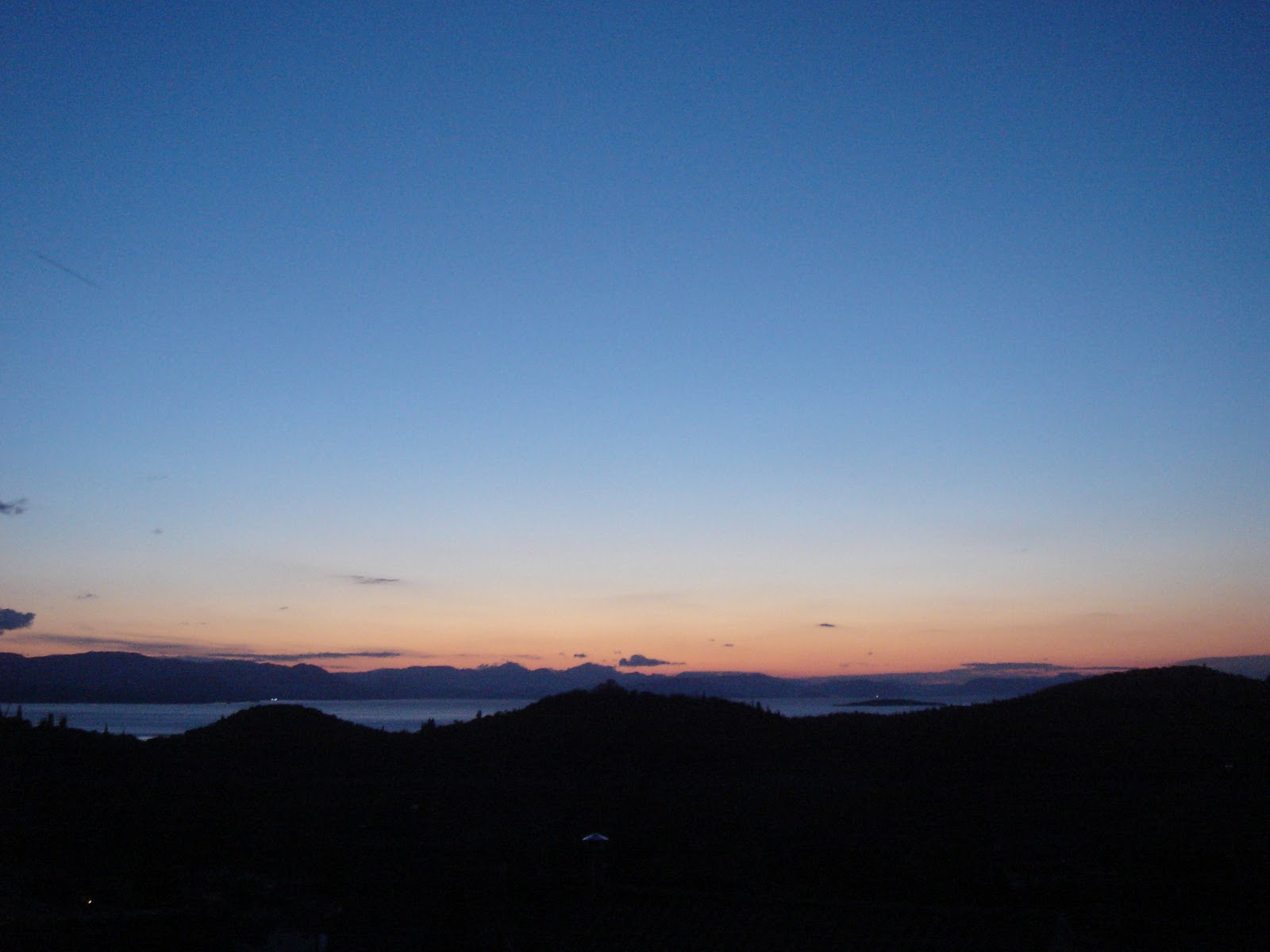
Realms of gold, rosy-fingered dawn - Keats', Chapman's, Butler's or Homer's?
*** *** ***
Last Sunday evening Ano Korakiana welcomed the New Year with the cutting of the New Year cake - Vassilopita, a crowd at Luna D'Argento below the village. There were dances from all the Ionian Islands - Kerkyra of course, but Cephalonia, Levkada and Zakinthos too - all with changes into local costumes, involving every age. The leading light in developing the event was Nike Kedarkou, introduced on the village website as the new teacher - της νέας δασκάλας.
Πραγματοποιήθηκε την Κυριακή 22 Ιανουαρίου 2012 η εκδήλωση της Φιλαρμονικής Κορακιάνας για την κοπή της πρωτοχρονιάτικης πίτας του Συλλόγου, στην αίθουσα του «Luna d’ Argento». Στο πλαίσιο της εκδήλωσης έλαβε χώρο μια ωραία παράσταση του χορευτικού συγκροτήματος του Συλλόγου υπό τη διεύθυνση της νέας δασκάλας Νίκης Κεντάρχου και με γενικό τίτλο «Του Γενάρη το φεγγάρι παρά ώρα μέρα μοιάζει». Η παράσταση περιείχε αναφορές στις εορτές του μήνα, συνοδευόμενες από τοπικούς και γενικότερα επτανησιακούς χορούς

*** ***
And yesterday I succumbed to firewood. Instead of collecting and cutting it all myself, I ordered a ton delivered to the top of the steps off Democracy Street - €120's worth. The truck blocked the street for less than ten minutes as two Albanian lads threw down my logs. I transferred these with help from little Katerina and her yia-yia, to a neat space below the now rain-proofed veranda. The smell of this heap of olive wood which burns so hot, cut from the biannual copsing, and split to fit our stove, makes me feel secure, though when I spoke to her yesterday afternoon by skype, I could see Linda grimace 'Why buy when we can collect?'

Saturday, 20 March 2010

The Itchen


My sister, mum and great grandmother at Itchen Abbas in 1944
After I'd finished a day's tutoring a rewardingly enthusiastic group of local government professionals in the King Charles Suite at the Guildhall in Winchester, I cycled out of town on the Alresford Road, turned left down back roads towards Easton until I came to a road bridge over the Itchen. I munched a Cornish pastie I'd bought in town staring at the water, a swan working its way upstream sifting the riverbed - it's head below water for a minute at a time. It began to drizzle. A footpath by the bridge meandered across damp wormcast fields separated by wooden kissing gates - slightly tricky to negotiate with the folding bicycle - towards an avenue of gnarled lime trees, home to crows, that runs between the road through Itchen Abbas and the river.
The light was going. On the avenue I turned down where I remembered the land flattened into water meadows, passing through a gate, left my bicycle by a heap of ivy covered logs; strolled past Grey's Plot towards the river. It was running fast and high. I remember, gazing into its swift crystalline water - a first inkling of being in harm's way when I was four; when I'd wandered down here as children could without causing anxiety. I'd lie on my stomach peering over this bridge watching the dappled wild trout inches from my face, edging across the gentler summer current, drifting back with the stream for an instant almost stroking the crowfoot, resuming station, unworried by the small break in the even shadow of the bridge on the sunlit gravel.
As a child I lay, face down, head over the edge of this bridge gazing into the water
The past was far away; something gone. After a few moments I wandered up The Limes - Grey's Lea - to the Winchester road, gazed for a moment at Bignell's Cottage in the gloom. The present was too intrusive - the rain, the constant rush of passing cars, the plethora of signage, the dominating roar, like distant falls, of traffic on the M3 to recover an inkling of an intimation of childhood ... 'the things which I have seen I now can see no more.' It mattered not a jot. Revelations come when they want, unplanned; unlike this small pilgrimage to a place I'd visited only once before in over 60 years. I was content with my present ride and walk. The rain fell more strongly as I cycled back to Winchester in and out of the dark, dazzled by passing headlights, passing tyres splashing my waterproof trousers, rain seeping into my shoes. "This is become the land of car people" I muttered, but I'd enjoyed the ride; enjoyed getting back to my hotel room, putting out my wet things to dry, settling in to read Ismail Kadare's The Siege - written in Albanian in 1970 it's taken over thirty years to get his work first into French and then into English, a reminder of Albania's continuing impenetrability and fascination. And now, on a recommendation of Danica, who met him and lived near him in Belgrade, I've gone and ordered a tricky sounding book called Dictionary of the Khazars by a Serbian writer, Milorad Pavić who died last year. I can almost date my interest in the Balkans - October 2008 - alongside a wider curiosity about Eastern Europe. I saw this article by Tim Judah in my mother's last edition of the New York Review of Books, Vol 57 (4), 11 March 2010 - At Last, Good News from the Balkans [see also Balkan Insight]:
If you only want bad news from the Balkans, it is easy enough to find. You can read the next few lines and then read something else. Bosnia is on the brink of war again. Kosovo's independence is 'a failure.' Serbs are scheming, unredeemable extreme nationalists, and organized crime is everywhere. In the last few years I have come to understand that many people outside the region actually want to believe the worst: they want black and white when, like everywhere else, real life is a shade of grey. I am not arguing that, fourteen years after the end of the Bosnian and Croatian wars and almost two years since Kosovo declared independence, serious problems do exist. It is just that in many respects things are not as bad as commonly believed.
** * **

I was flown from Inverness on Wednesday, leaving the last of the snow, stopped for a few hours in Birmingham to pack and collect things for teaching, a poached egg on top of a welsh rarebit from Lin, then cycled to New Street to catch a train to Winchester for two days on 'Managing with Political Awareness' for Hampshire County Council.
I dislike CrossCountry Rail; noisy trains, dirty lavatories, crowded with little space for luggage, a management that exudes indifference to passengers. I dislike the trainline too*, having the nerve to buy advertising that presents rail passengers who buy tickets at the station as sheep. Even so I enjoy train travel, suppressing my ire at the state of our railways, sitting back and thinking of better times. It's even possible that Lord Adonis, were he given the time, which is unlikely right now, could breath a new spirit of reform into this intractable mess. (*June 2012 and I now use the Trainline website almost exclusively. V. user-friendly)

Dropped off at Winchester

Saturday, 4 October 2008

Starting to learn the map of Eastern Europe

The map in my head of Eastern Europe is vague. A large area east of old West Germany and Italy which now includes parts of what was once the Soviet Union and, of course, the Balkans through which we will make our next journey to Corfu in January 09. Cities - Vilnius, Minsk, Leipzig, Dresden, Warsaw, Krakow, Graz, Budapest, Belgrade, Bucharest, Zagreb, Sarajevo - resound in significance, but their location in relation to each other eludes me, like those towns in western Europe to which American's affix the country; 'London-England', 'Paris-France'.
[16/10/08 Back to the future: Eastern Europe's experience of recession] [15/11/08 Balkanology: Architecture & urban phenomena in SE Europe: 'Since the collapse of the socialist economic system in ex-Yugoslavia and Albania and the war that lead to the split of Yugoslavia, a new form of urbanisation typified by extensive informal building activity has appeared on the territory. Taking advantage of sketchy legal frameworks and governments initially too weak to enforce rules and regulations, inhabitants have taken the issue of housing shortage in their own hands, they started building new dwellings from scratch and adapting existing edifice for their own purposes.']
As we waited in the ferry terminal at Igoumenitsa on Tuesday evening I looked at maps. Here was one of Epirus - the mainland province of Greece we see from Ano Korakiana. To my delight a rail route diverts from the mainline between Thessaloniki and Athens to Makrynitsa, then west to Kardetsa before turning north to Kalambaka from where, after visiting the monasteries at Meteora, we can take a bus via Trykala to the coast at Igoumenitsa. On the ferry to Ancona there was a wall map of Europe. I checked distances between Athens and other eastern capitals - beginning to make sense of the line Warsaw-Poland, Prague-Czech Republic, Bratislava-Slovakia, Budapest-Hungary, Bucharest-Rumania, Ljubljana-Slovenia, Zagreb-Croatia, Sarajevo in Bosnia-Herzegovina, Belgrade in Serbia, Tirana in Albania, Skopje in FYROM, The Republic of Macedonia - the country with the contested name that borders the Greek province of Macedonia [25/11/08 e.g. Μακεδονία] - then Sofia in Bulgaria. Then east of this line, running north-south from the Baltic are the smaller countries of Estonia (Talin), Latvia (Riga) and Lithuania (Vilnius), with the exclave of Russia (Kalingrad), whose existence was unknown to me, squeezed between Lithuania and Poland, followed southwards by Belarus (Minsk), Ukraine (Kiev) on the Black Sea and another small landlocked state squeezed between Rumania and Ukraine - Moldova (Chişinău), and marching on Moldova's eastern border with Ukraine, the frozen conflict zone of Transnistria (Tiraspol). I'd not heard about this place until today and the ominous phrase 'frozen conflict' wasn't in my lexicon. It's an obvious offspring of 'cold war'. Where 'thaw' implied conciliation, here it means conflict breaking out. We'd had the idea of flying to one of the cities of Poland or a country further south, then going on via rail and bus to Greece. Back in Birmingham we studied the cheapest flights to Eastern Europe with rail connections southward and came up with Sofia, from where trains go to Thessaloniki south to Athens. I began when looking for these to find out the unreliability of the web, so convenient for arranging rail travel in Western Europe. Linda booked us two return air fares from Luton to Sophia by Wizz Air Hungary - one we hope survives until next year. Our flight gets in around 0050 and the first bus into town and the mainrail station - number 84 - runs at 0500 [information at Sofia Airport site in English]. We'll need to bivvy down until the first bus to town. That was straightforward but it took a while to find the Sophia-Thessaloniki timetable via a link on Bulgarian Railways' website. From Thessaloniki we catch one of two daily Athens trains south via Larissa, ours leaving at 0700. OSE Hellenic Railways website was unhelpful, so I'm unsure when we get to Larissa. For Larissa to Kalambaka, I found, from another site that athough there is a rail route, the bus is probably simpler for this part of our journey to Corfu:
Larissa to Kalambaka: The bus will take you to Trikkala in one hour, price: €4, first at 0630, they run almost hourly until 1930. Then it is 30-min and €1.8 to Kalambaka; buses leave every 30-min. (ask at info booth in Larissa for direct bus to Kalambaka...there are some...then you do not have to change at Trikkala). Buses leave the main station in Larissa, 150 mtrs north of Pl.Laou at Olympou & Georgiadou.
We will find a place to stay at Kalambaka so we can visit Meteora before going on to Igoumenitsa. The same site helped us on this:
Kalampaka to Igoumenitsa ... There are 2 buses you can take: 0850 and 1520 from Kalambaka to Ioannina (3 hrs) €10.50. If you take the 1520] to Ioannina you should still be in time to catch the 2000 bus to Igoumenitsa. Believe the cost is about €8 additional. 2hr trip. If you are looking to leave Igoumenitsa for Corfu the night you arrive... you better hurry, the last ferry of the night leaves for Corfu around 2200 ... It will likely wait for late arrivals off that last bus, but it won't wait too long and it won't wait IF it is filled. Hopefully you will be taking the morning bus out of Kalambaka and not worry about it. Good luck. Calh taxidi. Denny
It disappointed me is that the celebrated Man in Seat 61 hyperlinks to Greece and Bulgaria, though directing me to these country's rail services, said nothing about the inadequacy of their websites. A helpful man at the Greek National Tourist Office in London apologised for the OSE website while assuring me of my itinerary to Corfu this way. The Rail Europe office who have been helpful in the past could not help with rail travel in Eastern Europe, nor could International Rail to whom Rail Europe referred me. * * * An e-mail to All Experts:
Dear Denny. Your other answers on getting to Kalambaka and on to Igoumenitsa have been very helpful, but the OSE website is not so helpful. Can you tell me when the early afternoon train from Thessaloniki arrives in Larissa, for us to connect with a bus to Kalambaka on 21 Jan 09? Also when does it stop, morning and afternoon, in Larissa on the way back to Thessaloniki? Best wishes, Simon & Linda
Answer from Denny:
Yiasou Simon, thanks for the question. I am not quite sure why you want to do that ... Why not just take the bus from Thessaloniki to Trikala (3hrs. 6 per day. 0800-2100 daily. €15), then take the bus to Kalambaka from Trikala. Every 40 min. 30 min ride. Under €2. Taking the train from Thessaloniki into Larisa to catch the connecting bus to Trikala/Kalambaka will require you get to Thessaloniki train station by 1000 to catch the 1030 to Larisa. It is a 2-hour train ride (€5). Gets you into the Larisa station at the 5-way intersection on Panagoula about 1230 in the afternoon. Then from the 5-way intersection, walk about 600m to the gas station bus stop on the left, still on Panagoula. The 1-hour trip by bus to Trikala makes at least 3 runs between 1300 and 1930. Price €4. (So you will save money this way, as about €11 is the cost of the train/bus combination vs. about €17 going bus all the way from Thessalonika. So it will be cheaper but not as convenient. good luck Simon. Calh taxiedi Denny
* * * I enjoyed the opportunity on flickr to describe why I own five Brompton folding bicycles. * * *
I was scanning the excellent blog - An American in Athens. Engaged to a Greek citizen (I think) Kat quotes national comments, and telling stats, on corruption in Hellas, quoting Transparency International's Corruption Perceptions Index (CPI). Greece scores - ever so slightly - better on corruption measures than some of the enlargement EU countries of Eastern Europe. In my old age I should be in a better position to be widely understanding of human weaknesses, but how I detest public corruption, especially as practised among the prosperous, wont to whinge priggishly about danger in the streets and squares of the world while gutting the commons; snatching from the public purse; sharing smug self-justification to excuse their criminality - and 'oh so sorry' - shrewdly commodified repentance - on the few occasions they do get their just desserts. * * *
Phone chat with my mother in Scotland. She told me that at the start of September four friends of one of her best friends, related to each other, went walking in the woods. They collected and ate some cortinarius speciosissimus, (two pictures on the right) possibly mistaking the fungi for chanterelles (two pix on the left) which are delicious. I pick them when I'm in Strathnairn. I've had trouble noting differences between false (bottom pic: less egg yolk yellow, slightly slimmer stem) and real chanterelles. Fungi are seldom like the neat pictures in guide books. I suppose CS could be mistaken for chanterelles. Trouble is, where the false chanterelle is merely tasteless and tough, CS can be fatal or make you very ill.

Back numbers

Simon Baddeley