
Angele,
Leftheri's cousin, finds insects. We saw him catching them from foliage on the fig tree behind us; after dark peering with the other children – and us – at fireflies, small lanterns, flashing inside a jar. Mark beckoned me outside his front door the other evening, as we finished supper with him and Sally. A pair of swallows perched in easy reach,
unalarmed but mildly vexed at being woken by our curiosity. Far off on the
Kerkyra Sea five sailing boats are working up the centre of the narrows towards
Kalami disappearing between forested hills and the barer shores of Albania –
sundappled under lofty nimbus. I can sit in the sun and close my eyes and almost drowse, dipping in and out of nearly seven decades – what a thing this memory to have it there with voluntary and involuntary access, drifting on the
liminal margin. Jack was talking about one of the few times he’d seen the enemy “If you
weren’t infantry you only saw them as prisoners. Then we were curious to see them.” This time he was in an AA battery early in WW2 with report over the radio of a German plane hedge hopping for the coast. The relaying of co-ordinates between spotters and guns was getting good by then the land divided into imaginary grids. “We realised as the grid codes were radio’d through it was coming our way…then, it came …almost over our heads. I saw the pilot. A boy. I shall never forget the look of fear on that face.” It was the only time J told me anything about the war that
wasn’t funny or fascinating stuff on the back of an envelope about strategy – El
Alamein, D-Day, the German’s last ditch breakthrough in the
Ardennes, analyses I borrowed years later to try to make sense of Market Garden. The way he said it echoes, surfaces, so that I even feel compassion for that dying pilot (“He went down a few fields away.”), his parents, feeling the
pity of war the poet taught and gratitude for the peace we’
ve enjoyed for a lifetime. Dad was in an ambulance near
Nijmegen 4 October 1944, in and out of consciousness, deep wounded by shrapnel while reconnoitring orchards on foot. Beside him lay two SS soldiers, casualties of the same skirmish. Dad’s sergeant-major was sat beside him in the ambulance. “There was so much blood. He was sure I was dying” so dad told my Greek half-sister from his deathbed 22 years later, confessing he watched helpless and horrified as his NCO “finished them both off with a bayonet.” I still wonder if that
wasn’t the same Guards sergeant who approached me in Westminster Abbey, taller even than me, in his bearskin (or is that just my memory?), red tunic,
Coldstream buttons during a royal wedding there (I was an usher; tail coat, wing collar etc…smell of innumerable cut flowers). “Excuse me Sir. Are you by any chance related to John
Baddeley….thought so. Spitting image. I was your father’s sergeant. Remember me to him…must be away.”
Rumours: 99 planning officials arrested for corruption on the mainland; foreclosures on loan cars and foreign mortgaged houses on the island; EU threat of financial penalties if the island’s new EU funded hospital by
Gouvia is not completed by Christmas '09 but there’s a problem of recruiting medical staff to EU standards; a journalist from a Greek Sunday paper is doing a feature on why British residents of Greece are returning to the UK. Friends, who are among those, have been contacted to be among the four to be interviewed on Corfu. How to say it? We embrace the faltering of the market. So much excess - faltering, slowing, stumbling, and so many possibilities of things that were once opposed becoming, at long last, common sense.
* * *
I woke just before six on Mayday from a dream without violence or bereavement. I was on campus and arrived at a meeting about to start. Some of my colleagues were there with others I
didn’t know, but some who ought to be there
weren’t, so wondering if I’d come to the wrong meeting I left and checked another room where I found more of my colleagues and our director (in actuality, long retired) and a number of those half-known people from sibling schools (we don’t call them faculties), whose names I catch on circulars, at a meeting that had already begun. I slipped back along a corridor and saw two of the colleagues I’d have expected at the second meeting coming out of the first. They were speaking of a new memo. J said to C or was it the other way round “she’s saying it was a bad mistake”. “Who? What?” C pointed vaguely to an anodyne remark that said nothing of the sort buried at the bottom of the file he held. “Vivienne
Westwood” he said. I guessed, with wrenching dismay, that I’d stumbled on a moment in campus politics – or politics anywhere – where two meetings have been arranged at the same time, humiliatingly
unbeknownst to some of the key players. Our small part of the university was to disappear, the victim of an accidental mix of arbitrary decisions about university reorganisation begun far above the heads of those at either meeting. As I wondered back towards the second meeting in the wake of J and C we ran into our Director and others coming out of it. “Vivienne
Westwood. Is she…?” I asked. “Yes and she’s a really nice person…” His defining self-possession displaced by unfamiliar disquiet. Don’t blame her he’d implied. He and the rest there wandered, silent or twittering beneath an almost palpable cloud of consequence, into another room. I still
didn’t understand what was happening, had happened, but intuited its irreversibility – a part of the university I’d worked all my life, that had existed successfully for over forty years was gone. I
wasn’t sure if I should follow but no-one was paying me attention in the buzz so I wandered in. A roast beef and Yorkshire pudding buffet was laid out in a high floor room overlooking a tree filled panorama of
Edgbaston – the
Muirhead Tower from which we’d moved decades ago to another building but where interdepartmental meetings occurred. The food looked good but was insipid - the beef grey and tough. Our director, sat across the room, said something I
didn’t catch then directed a question to me I
didn’t hear. J, beside me, muttered “I think he’s asking you about the Institute.” (0630 The eastern sky over
Epirus is growing lighter behind grey overcast). Rather hesitantly I said something like “I’m angry. But I’m not angry with anyone – not in a personal way. I’m just angry that…” People were listening, some seemed embarrassed at my hesitancy, and then, in my dream, my mind and tongue seemed to engage and I could speak and I awoke in the dark.
It has always seemed strange that some humans feel diminished by discoveries which make reality more, rather than less, mysterious, as though religion were only about propitiation; science only about explanation. Both are about discovery. Did I always know this and was lucky enough to have no-one disabuse me? As a small child I saw the sky at night, wondered where it ended and realised even if it did, beyond was infinity – a word I
didn’t know. I saw a green woodpecker on a gravel path when I was three and thought God would let me pick it up. I walked forward and picked it up and looked into the green pillow of small feathers like miniature brushstrokes between its shoulders and knew, for sure, it was God. Then I think I was called in for tea.
* * *
Zorba the Greek – a wonderful film remaindered by its success in creating a stereotype of the Greek character that Kazantzakis never intended (the book’s narrator played in the film as an English introvert is also Greek - a young intellectual) – begins with it raining chair legs – καρεκλοπόδαρα - (‘cats and dogs’ to us) on a Piraeus quay, a damp crowd huddled with their bags in the waiting room for a stormy passage to Crete. I like that. It’s not what foreigners – especially northerners - expect of Greece.
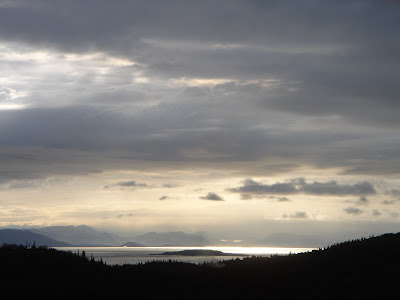 Epirus from Corfu on a February morning
Populations north of the olive belt – the mainly Protestant areas of Europe - have, for half a century, been mass consumers of Mediterranean summers, encouraged by authors who invented a seemingly timeless Hellenic paradise – Henry Miller, Lawrence and Gerald
Durrell, Patrick Leigh-
Fermor – fast supplemented by
commodifying images (postcards, bathroom prints, posters, dishcloths, ashtrays) of azure sea, dazzling sand, hot stone, ancient ruins,
plaka’d villages of blue and white houses clustered on steep hills, icons in small glinting churches, vine shaded gingham tables loaded with delicacies, good cheap wine, its people, for half a century, content to include among their ardent transient visitors, that
social indulgent strain in the northern population that uses alcohol to escape rather than meet the world. No wonder that, amid this celebration of heat, light and - for the Protestants – a rare chance to strip to their knickers (U.S.: panties) out-of-doors, the Hellenic year has been compacted by the economics of tourism into four or five summer months, losing six, even eight months of autumn, winter and early spring, with its teaming rain, frost, chill winds, snowy massifs shedding blue-grey torrents, towering nimbus, lightning and thunder and grey weeks when the washing stays indoors, or, even when it’s mild, too cool for short sleeves. Unlike my dad, my stepfather said once that he preferred not to venture into ‘the olive belt’, but how he’d have enjoyed Greece between October and April.
* * *

Nick phoned Thursday morning. “Your 600 thigh tiles. Want to come over and see where they’re stacked”. We drove four kilometres to the old house he’s restoring on a lane above the road through
Skripero amid a
higgle-
piggle of old houses,
apothikis and tumbled garden walls, open to a panorama stretching from the sea at
Ipsos in the east to the crags above
Paleokastritsa, fringed by luscious greenery up to Mount
Tsouka which rises 700 metres above the village. We picked our way down a short steep path to the centre of site. “Take care. Nancy was walking down here when she was eight months pregnant.” Typical Nancy. If there was a Greek
Sound of Music we know her part. Ian, his builder, who’s also helping restore Mark and Sally’s house by St George’s Church in the centre of
Ano was at work “This wet’s messed up work”.

This morning it was clear, fresh, warm. The view from the fine windows in the grand upstairs room towards the compact villages of
Doukades and
Liapades, on the high saddle between us and the island’s western shore, presented us three separate landscapes – more enticing than the long rectangle of a ‘picture window’ lessening the contrast between bright outside and dark interior. The house is robust but long exposed to the weather. “The staircase is rotten but Ian can copy it. Stonework’s loose. We’
ve found rats’ nests in the masonry”. Sub-woofed house music booming from a neighbour’s house. “He’ll have grown up a bit by the time we move in proper. Might even be playing classical.” Concrete, iron rods, and metal grids are marrying in with the older walls. The picture’s clear: "this’ll go there, that here." The work looks daunting but exciting. “When do you hope to complete?” asked Lin. “We’re hoping part can be lived in by Christmas.” The thigh tiles Nick’s offering us gratis, which we need to replace the ones taken from our
apothiki when our roof was remade, are neat stacked below the lane. “You can throw them up to each other.” Nick grinned. He’s peak strength and confident with it “OK I know a man. I’ll let you know.”
Saturday morning I was at Nick’s by 1100 and with help from Nick, Mohamed - Nick's man - and Lin moved over 600 tiles from
Skripero to a stack at 208 in five journey’s and hardly kept anyone waiting, as we unloaded them at the stop of the steps off Democracy Street. Mohamed from Morocco, helped translate the best conversation we've had with Katerina - he speaking to her in Greek and then back to us in French. It allowed us to say to Katerina and vice
versa how much we'd been wanting to explain to one another.

* * *
Thursday morning: Sun, warm, the sound of
childplay, greetings as people pass in the street, grown-ups chatting – half familiar words like “
perimeni,
tora,
milaou,
orea,
zestos,
ella-
ella,
kanite,
mazi” - breaking off conversation to call to the children – “
pethia!
grigora,
elatho.” Sparrows, pigeons, swallows, cats reclining on shed roofs; lizards – for safety on freeze-dash-freeze; a cloud of flies sorting through the discarded greenery of fruit and salad and egg shells on our compost; a red admiral hesitatingly opening and closing its wings, appearing and disappearing in the same spot of sun. A dreamy torpor. Sounds mingling with light and the sudden waft of orange blossom, jasmine and…many more flowers, colourful and wild, outside my mean olfactory range, tended by myriad bees. Smoke rises from a distant bonfire, to catch a breeze that ruffles the nap of the glassy sea turning it blue. Distantly a ship floats slowly behind a green hill on the way to the port, while another emerges, moving with similar languor against the backdrop of hazy mainland mountains towards the channel between Corfu and Albania.
Sweeping, letting the earwig run clear, finding one of the smaller stones collected from the shore at Agni the other day; a piece of wire; making a wasp trap to hang under the veranda, as I’
ve seen with the funnel top of a smaller bottle inserted in the side of a larger, then sugar water, wine a spoon of tempting honey; hanging washing in the sun; gathering plants – by bins or from deserted gardens – to plant here; collecting windfall lemons or shaking some down for friends; more sweeping outside and inside (“I’ll leave that web by the stairs” “No. It’ll build another and can you see a fly in it?” “They’
ve all been eaten” “No. Spiders leave little desiccated corpses after they’
ve sucked the fly’s insides out” “Clear the web!”).
We completed laying the wire frame for the
plaka, (Behind the hardware star by
Tzavros we found a sand and cement supplier; asked about laying our remaining
plaka. €8.50 for 50 kilos of cement mixed 5/1 with sand. Can that be? No! We're being teased). Rescued a
trayful of good dusty bar glasses from a bin at
Pyrgi – some for us, some for neighbours; an umbrella and an injured director’s chair. The glasses sparkled. The umbrella needed a strut refitting; a little rust removal and a hanger on its straight handle - one of the small lengths of loose rope John had spliced. A rod from the
apothiki cut to length with the angle-grinder fitted the groove in the chair that held the seat; a split clamped, glued and screwed and a few squirts of
WD40 to have it folding and unfolding again.
Mr
Leftheris accepted six of the glasses and came round with a round sweet loaf for St.George’s day advising, at my request, on the vine growing lustily up a column of our veranda. He pointed to several tiny clusters of white grapes already forming - “
Krassi!’. I signalled our intent to run wires for it under the veranda. “No” he signalled “
ilios,
ilios.” The dictionary gave us ‘sun’. Of course.
* * *
I’m enjoying yet another Alan
Furst –
Dark Voyage – and I’m two thirds through John Reed’s account of the Russian revolution, at chapter 9 ‘Victory’; last night a horror film over an
omelette - worse than Philip K Dick’s
Screamers the evening before, about interplanetary war in which one side have invented intelligent robot burrowers that cut attackers to bits, evolving, autonomously, into an indiscriminate menace, masquerading as vulnerable children to enter the bunkers of surviving humans.
Vinyan features a stylish couple, taking a costly ride from Bangkok to the
outland littorals of the Andaman Sea in futile search of ‘a white child’ - the son they lost to the tsunami. Their local guides - violent, calculating, bereft by the same disaster- try to sell them a surrogate who calls “mummy, mummy” to the desperate mother and angry deceived father. They travel on by boat, then – abandoned - on foot amid beauteous but sinister seascapes, through forsaken villages, muddied, sweating under warm torrential rain, hallucinating glimpses of their child wandering in misted jungle, until lost, starving, maddened and divided he encounters a hoard of feral orphans. The last he hears from her as she appears staring at him accusingly, encircled, almost voiceless, across the growing frenzy “You let him go. You let him go.” After, she stands in crazed ecstasy above the children as, with small bloodied hands, they stretch to touch and caress a new found mother. “William Golding started all this with…” I said, washing up, “
Lord of the Flies” said Lin from upstairs “Coffee?”
In bed I turned too suddenly and struck my face on a corner of the bedside table bruising my face. In the night I dreamed about
Fred Emery turning up in England to visit me and other ex-colleagues, chatting in that vague but friendly way that put me at ease even when I wasn’t sure what he was saying. He had a sheave of pictures - I remember there was a brilliant
Australian artist whose work he’d bought – of which I could make little, but these were not Nolans. They were formulaic wash landscapes with a pretentious self-regarding signature. Then I saw a good painting - no signature - and suddenly realised it was one I’d given Fred that he still had after forty years.

He went indoors to chat with others. I sat outside wondering if I should go in so as not to miss the rest of his short visit, but half grasping he was going, going and had indeed been long gone. Then, abruptly he came out again. “I’ve got to be going.” He was hiding his face with one hand. There was some blood. He mumbled apologetically “I need to be off. Sorry mate.” He was dissolving. I stared. Emelyn, his wife, and another woman both whom I’d noticed earlier, came out with a wheelchair and cheerfully helped Fred into it and wheeled him away repeating apologies.

Over 600 Corfiot tiles brought from Skripero
* * *
On 30 April 2009, the
South Australian Parliament formally recognised the
mass murder of Christians in
Anatolia:
That, whereas the genocide by the Ottoman state between 1915-1923 of Armenians, Hellenes, Syrian and other minorities in Asia Minor is one of the greatest crimes against humanity, the people of South Australia and this House –
(a) join the members of the Armenian-Australian, Pontian Greek-Australian and Syrian-Australian communities in honouring the memory of the innocent men, women and children who fell victim to the first modern genocide;
(b) condemns the genocide of the Armenians, Pontian Greeks, Syrian Orthodox and other Christian minorities, and all other acts of genocide as the ultimate act of racial, religious and cultural intolerance;
(c) recognises the importance of remembering and learning from such dark chapters in human history to ensure that such crimes against humanity are not allowed to be repeated;
(d) condemns and prevents all attempts to use the passage of time to deny or distort the historical truth of the genocide of the Armenians and other acts of genocide committed during this century;
(e) acknowledges the significant humanitarian contribution made by the people of South Australia to the victims and survivors of the Armenian Genocide and the Pontian Genocide; and
(f) calls on the commonwealth parliament officially to condemn the genocide.
Dean Kaliminiou,
Australian lawyer, writer and journalist of Greek descent. celebrates this motion:
... I sympathise with members of the Turkish community who will feel enraged at the South Australian Parliament’s recognition. After all, they, just like us, share nationalistic myths about the destiny and character of their race. They, just like us, have been brought up to think that there race is noble, just, courteous and of great benefit to mankind. An official recognition of the genocide shatters such myths just as it calls them into question. As a corollary, why does official Greek historiography skim over the massacre of innocent Turks during the taking of Tripolitsa, or the atrocities committed by the Greek army in Asia Minor? Simply because the Greek people are also, to some extent, informed by the same nation-building myths. What the recognition teaches the Turkish community, as well as us, is that crimes against humanity are not committed by races. They are committed by human beings...
Note: Earlier reflection on these events at 'empty chair by a window' and 'internal polity'.
εαν ταις γλωσσαις των ανθρωπων λαλω και των αγγελωναγαπη δε μη εχω, γεγονα χαλκος ηχων κυμβαλον αλαλαζον.

 The other morning I was helped by my neighbour, Katerina, to make up and apply an asvesti mix. Using a big brush we covered the first five feet of three citrus tree trunks.


