Total Pageviews

Showing posts with label Cyprus. Show all posts

Tuesday, 26 March 2013

Handsworth Park History Tour

Aftab Rahman:  Hey Simon that image looks really good. We have thrown a stone in the pond and now we will see the ripples.
Simon: Yes indeed and it's our pond and we watch those ripples - assiduously! Let no-one assume that in thinking up and developing a Heritage Trail for East Handsworth and Lozells, we not are also recognising, as did those Victorian predecessors whose lives we are striving to recover, that we live amid the pathologies that beset all cities, and that our project is not some detached indulgence but one which directly - and with the same concern and commitment as characterised the concerns of our ancestors in this area - addresses the conditions presented by deprivation and its effects in misery, crime, anomie and ill-health. The money invested in this project is an investment in reducing crime, and in improving education and health.

On Saturday morning I was guide for a history tour of Handsworth Park - at first called Victoria Park, like many others at the time, in honour of the Queen. The chilly weather and the snow, still falling now and then, did not deter over 15 people turning up. I've been doing tours of Handsworth Park for years.
A photo of the opening - in pouring rain - of Victoria Park Extension on 30 March 1898
This one was included in a more ambitious enterprise dreamed by my friend Aftab Rahman of Legacy West Midlands. Handsworth Park is one of ten other places with historical resonance included in the East Handsworth and Lozells Heritage Trail (see local press)


Aftab designed a poster for the project, set up a website and includes many pictires of places on the Heritage Trail on the pages of Facebook.

Legacy WM won a Heritage Lottery Fund (HLF) grant to develop a heritage trail for Lozells and East Handsworth training 15 volunteers in a greater appreciation and understanding of local history so they can give guided tours. Legacy WM is working with South and City College to develop an accredited course, being run at St Mary's Convent, with the aim of launching the trail on the 25th May 2013. Once trained the volunteers will give guided tours to the community, people across the city and visitors to Birmingham, tours that will include
This was how Tom Rowley described the tour in The Telegraph in February....

Birmingham's new tourist trail - but will coach parties want to visit East Handsworth?

Do tourists really want a guided tour of the once riot-scarred streets of Birmingham?

A snowy day in Handsworth: Aftab Rahman with Tom Rowley on Hunters Road, Handsworth


Walking tours of Oxford begin by the gates of Trinity College. In Bath, the eager participants gather at the Pump Rooms, and in Edinburgh the route starts at the foot of The Mound, near the Royal Mile. But our rendezvous today is the Asian Resource Centre.
I’m the first visitor to sample Britain’s newest – and most controversial – walking tour, and my eager guide, dressed in hardy boots and a baggy cagoule, is Aftab Rahman. Rather than lingering by a Bridge of Sighs, though, the two-hour route will see us walk through two of the country’s most deprived and notorious neighbourhoods – Lozells and East Handsworth – in search of their industrial heritage.
The wards, two miles from Birmingham city centre, are not an obvious tourist draw. One in four of the population is unemployed and a recent police newsletter warns of anti-social behaviour, prostitution and drugs. More than four-fifths of locals are from ethnic minorities. It was here that racial and economic tension sparked the riots in 1985, when two brothers burnt to death in the Post Office they ran and 45 shops were looted. In 2005, further rioting claimed another two lives and injured a police officer.
It is perhaps surprising, then, that the Heritage Lottery Fund has given £38,000 to launch the tour. When it begins in May, volunteers in Victorian garb will guide visitors around the area for free each Saturday.
The local MP, Khalid Mahmood, thinks it is a huge waste of money. “We’re talking about the middle of Birmingham,” he sighs. “I don’t think it is picturesque. We haven’t got the sort of sites they have in York, for example. Of course we have some history, but we’re not in that league. We’ve got to understand where we are. We’ve got better things to spend that money on than walking a group of Japanese tourists around.”
Lottery funding should go towards regenerating the area or helping residents find jobs, he argues. “I think they should provide pamphlets for people to explore the area themselves. Then visitors could interact with local businesses and put some money back into the community.”
Undeterred, we set off in driving snow, and Aftab dismisses Mr Mahmood’s concerns. “The MP should be promoting his own area, not putting it down,” he tells me, as we pass the “Eat Well” Caribbean vegetarian takeaway on Hamstead Road.
Aftab, 42, emigrated from Bangladesh to Lozells with his family when he was six. He admits that the area has generated a bad press over the years. “I came here in 1976 and it wasn’t always rosy,” he recalls. “There was a lot of violent racism in the early days and the riots when I was 15 were devastating. Shops were burnt down, there were petrol bombs and stand-offs with the police.”
Walking tours in unlikely areas are a recent phenomenon and not confined to the West Midlands. Visitors to Belfast will soon be offered a walkabout that includes a dozen sites associated with the worst atrocities of the Troubles. Last year, an enterprising bus company launched a £15 tour of the M25. The chance to spend four hours in a jam seems unlikely to become a major draw. Aftab, on the other hand, is determined that his tour will work. “Ultimately, I want people from London and across the world to come,” he insists. “We have enough to showcase here for the world to see.”
It is impossible not to be cheered by Aftab’s enthusiasm. Whether he is pointing out Soho House, a grand Georgian home where the industrialist Matthew Boulton lived in the 1700s, or “one of only six bandstands in the West Midlands” in the park, he is proud to call himself a local.
Aftab, a former youth worker with Worcester city council, is an energetic supporter of the community and has set up several charities to help young people into work. He will run the walking tour in his role as director of Legacy West Midlands, an organisation he set up to promote the area’s history.
But some of Aftab’s showpieces are, frankly, of limited appeal. The “first Halal slaughterhouse in the West Midlands”, where customers used to be able to select a chicken to be killed, is, perhaps, of minor cultural interest. Similarly, a row of nine Georgian houses, sympathetically restored, have little to commend them beyond charming sash windows.
But the route also takes us into St Mary’s convent on Hunters Road. Built in 1841, it is the work of Augustus Pugin, more famous for much of the interior design of the House of Commons. Two of the nuns greet Aftab warmly and show us Flemish carvings and a grandfather clock by Pugin.
Our final stop is St Mary’s church, back on Hamstead Road. The Norman tower is magnificent but Aftab heads straight to a marble mausoleum where James Watt, the Scottish engineer and inventor whose improvements to the steam engine were key to the Industrial Revolution, is interred.
“This is what my trail is all about,” he says. “We have these hidden gems here that people don’t know about. It is beautiful and we need to make a song and dance about it. People think of Lozells and East Handsworth as a riot hotspot with gang affiliation. But it is not like that. Give this area another 10 years and it will be one of the most desirable places to live. What was Brixton like 10 years ago? The community is growing slowly and it is just a matter of time. Give it a chance.”
Our tour may be over, but Aftab will never tire of walking around his neighbourhood – even if coachloads of tourists fail to turn off the M40 at Junction 16.
**** ****
“We’re talking about the middle of Birmingham," said Khalid Mahmood “I don’t think it is picturesque. We haven’t got the sort of sites they have in York, for example. Of course we have some history, but we’re not in that league. We’ve got to understand where we are. We’ve got better things to spend that money on than walking a group of Japanese tourists around.”
Our MP's words angered Lin
"He's rubbishing his own constituency'
I enjoy quotes like this though. They are a challenge. Handsworth, modern Handsworth where we've lived since 1979, has a reputation I rather enjoy, not only because it discourages visits by the kind of people who made comments like this below Rowley's carping piece...
....as you can work out for yourself, the area is a dump. you could work out your own guided tour out with a book on birmingham architecture. i wouldn't recommend someone white do it, as your safety could not be guaranteed. it still has a black presence so mugging is a distinct possibility, and it is now overwhelmingly muslim, so not to be recommended for non muslim women, especially white women, as some of these people regard non muslim women as easy meat (especially if you happen to be very young, white, and from a dysfunctial background). thinking about it, as a brummy i have to say it would be better to take a trip out to worcestershire or gloucestershire and see what england use to/should look like. birmingham is rapidly looking more like a 3rd world country, and i can't see why anyone wishing to sight-see england would want to look at that. sorry to disappoint.
...but much more important because the history that resides in this area is entirely formidable. I've been taking people around Handsworth Park, including my entranced Japanese students, for decades, telling them how "in this place the modern world was invented"
Showing my Japanese students around Handsworth

For years I've lived amid the echoes of this astounding source. Only in the last twenty years or so have I begun to grasp the causes and consequences strewn around me - this place where the industrial revolution was seeded. 
Another history tour of Handsworth Park (photo: Lee Southall)
I cherish the concealment that hides this significance from so many people, including our MP who talks unknowingly of "understanding where we are". It may seem a paradox but I don't want this area to become a museum replete with commodified history. I value it too much for its present life including its risks and the things that anger me as well as those things in which I rejoice. 
Our home in Handsworth

I'm protective, even possessive, cherishing Handsworth the way I might cherish a chest of private family treasures that, as an old man, I might ease open with false reluctance in response to the pleas of curious grandchildren, encouraging their small eager fingers to touch and hold; their ears to listen, uncritically, to my crafted accounts of amazing things; their innocent eyes to gaze untroubled, wondering and happy at what one day they will be taught as 'history'.


Talking about Handsworth Park in the Sons of Rest -  run now as a café by Mark Bent and family


** ** ** ** **
Dear All. I enclose the Minutes of the Handsworth Helping Hands meeting on 21 March’13
I have collected the HHH van from Mike and parked it at the compound in the usual place. The new battery started the engine instantly even though it had been sitting with both leads connected in very chilly weather for nearly a week.
As it is for extra assurance I have disconnected one battery lead and also ensured that the jump leads previously in the back of the van have been left in the driver’s cabin.  The driver’s log is up to date.
By the way Mike T has now heard from Michelle Climer, via Luke Kennedy (Assistant Service Manager, BCC Fleet and Waste Management) that unless there is a shift of policy, or some specific discussion of the idea, we cannot use our charity waste disposal licence for any waste other than that we can carry in the van
QUOTE: Hello Luke. The charity permit is not transferable, it has been issued on a specific set of criteria. Charity permits cover small quantities of waste from charitable activities, not the clean up of areas and any further work, especially on a larger scale would need to be discussed in detail.  The cost to the Birmingham City Council is quite considerable and would need to be considered against operations that we already provide in the area. Regards, Michelle Climer, Waste Data & Operations Manager, Veolia- 0121-303-7377 END QUOTE
Best wishes, Simon
Thursday night's meeting of Handsworth Helping Hands

**** ****
A note from Waseem, one of our ward councillors:
Hi Simon, Received this email this afternoon with the attachment in response to my email to the chair of planning and licensing & public protection committees. Doesn't really say anything positive on how an elderly resident is protected.  Many thanks. Best wishes, Waseem Zaffar, Councillor for Lozells & East Handsworth Ward
Dear Cllr Waseem Zaffar Thank you for sending me the copy of James Wagstaff’s letter of 25 March 2013, also copied to Cllrs Sharp and Dring, in which he responds to your concerns about work at xx Beaudesert Road, Handsworth (refs: 2012/1754/ENF & 2012/05049/PA)
Over six months a woman in her 80s living alone since her husband was taken into care has suffered life threatening harassment in the form of dangerous building and excavation involving heavy falling debris, late night noise, trespass on and damage to her home at the hands of an uncommunicative and insensitive neighbour while we, also her neighbours (Simon Baddeley, Chair Beaudesert Road Residents), her ward councillors (Cllrs Mahmoud Hussain, Hendrina Quinnen and Waseem Zaffar), along with officers (Philip Whittaker, Maxine Brown, Katie Moriarty as well as Waheed Nazir, Director of Planning and Regeneration, Chair of Planning Cllr Mike Sharpe and James Wagstaff, Principal Enforcement Officer at Birmingham City Council) have found themselves powerless to help her as she continues to receive demands from that same neighbour to complete the work he began without any attempt to meet or consult with her before he began major extension work on his property with the consequences that followed.
There has to be something seriously wrong if local government with its formal duty of care for vulnerable people can only suggest to this old lady that she resort to civil action to gain redress for the injustices perpetrated against her.
As you may imagine I could not agree more that James Wagstaff’s exculpatory letter says nothing 'positive on how an elderly resident is protected.’
I am happy for you to circulate my thoughts on this miserable situation.
Yours sincerely, Simon Baddeley
Excavation damage to and trespass on a neighbours property 
....and a comment from my friend Jan D:
as always you hit the nail on the head .As far as this sorry saga is concerned it is shameful and sadly illustrates the parts of local government I do not like and tried with only various degree of success to confront in my time. I can't help feeling that this is the response of a middle ranking bureaucrat and jobs-worth who is hiding behind rules and regulations to justify doing nothing and covering his back. No doubt everything in the letter can be evidenced and I suspect it has been 'authorised' by the legal department who generally speaking are pathologically risk adverse and defensive. It fails to address the issue which is the Council's Duty of Care to Vulnerable people and as such you may have grounds to take action against the council on these grounds.You could draw it to the attention of the Director of Adult Services who is Peter Hay, but whereas they may help the old person they would not on their own have powers to deal with the neighbour. This require a council-wide response. I think the only options now are a sustained publicity campaign and civil legal action. Not a happy scenario! Best of luck, J 
*** *** ***
Aleko Damaskinos, unsuperstitious and collector of unconsidered trifles sends this from Corfu about το Στριγγοπούλι, πάτσα νυχτόβιου αρπακτικού - a nocturnal predator, probably the tawny owl, but perhaps a barn owl:
CORFU SUPERSTITIONS
The bird that 'brings death'
A bird that nobody talks about is this one…
Nobody has ever seen it, but only hears it in the night!
It is called the striglopouli (The screaming bird).
If anyone hears its call near their house it means that some member of the family will die! If though the bird is shot and killed the curse will be lifted!
Nobody has ever managed to do this, and then they would then know what this bird looks like!
*** *** ***
In Athens Greek Independence Day celebrations on 23 March were sombre, overshadowed by news from Cyprus. As I'd expect Nick Malkoutzis writes as intelligent a piece as I've yet read about the financial mess there. While I ponder the idea that Cyprus, an economy hardly the size of Minneapolis (as a friend observed), has in this crisis sent shivers across the globe not to mention the repute of the Eurozone; that dubiously enriched Russian oligarchs are getting a just haircut and therefore "so what?'; and being sure that if I'd been making decisions made by the  'technocrats' in recent days I’d have made the situation worse and the only lessons is one that reinforces the old ballad....
It’s the same the whole world over:
It’s the poor what gets the blame.
It’s the rich what gets the pleasure;
Ain’t it all a bloomin’ shame. 
Nick writes:
At the beginning of last week, Cypriot politicians insisted they would not choose a 'suicidal' option for their country. By the end of the week, they picked one that would inflict mortal wounds instead.
Nicosia’s handling of its unprecedented predicament has been cataclysmic. But the approach adopted by the European Union and International Monetary Fund to Cyprus’s problems has also been disastrous. The eurozone has been building up to an omnishambles moment throughout the debt crisis and it finally struck in a small island state in the Eastern Mediterranean.
The agreement arrived at in Brussels early Monday, following hours of talks involving Cypriot officials, eurozone finance ministers and EU and IMF chiefs, is being billed as the least worst option after all sides took successive wrong turns on the way. That may be the case but it will be little consolation to thousands of Cypriots who have lost a big chunk of their deposits and face uncertain times ahead.
For those looking at the longer-term picture, the island is in for years of extreme difficulties. Its banking system and concomitant services made up about half of the island’s economy. This has now been obliterated. Depositors are unlikely to trust Cypriot banks for some time to come and young Cypriots will have to choose to become something other than lawyers, financiers and accountants. Many will have to consider a future away from their homeland, which faces a double-digit recession in 2013 and more years of economic contraction ahead....
*** *** ***
Lovely and satisfying reactions in Thurrock a few days ago - just one example of across the board reaction among participants to a seminar on Managing in Political Space
I'm invited to do further work on this later in the year.

Thursday, 17 March 2011

Heading back to England

That'll be our ferry to Igoumenitsa
Wednesday: Spent the morning tidying the house. Our Greek advances. I explained to Vasiliki we were only away for fourteen days. I said when we'd be back, how we were travelling, where we were going on the way. But I wavered when trying to say when I would return.
"Πρέπει να γεράσω..." I started to say.
"No" said Natasha who has English, "Say 'γεράσω γυρίσω' not 'γεράσω'. Γεράσω means 'old man'" "αλλά είμαι γεράσω...και γυρίσω!" I said.
Lefteri and Katerina carried our cases to the car after we'd made our goodbyes to neighbours. We headed down to the Old Port to take a small ferry 15 miles to the mainland where we'd get a larger Anek Lines boat overnight to Italy.
We came into Igoumenitsa after dark, making the same tedious walk from where the Corfu boats dock to the big ferry terminal. "You walked?" "Why not go by car?" "Take a taxi" "There must be a courtesy bus. surely". "No we don't want to pay €5 to catch a taxi to go one kilometre," so it's a scruffy stroll with our luggage under yellow lights along the edge of a busy dual carriageway that beside the airport-scale concrete apron separating the buildings of Igoumenitsa from the sea. As we walked we saw scurrying groups of transients - illegal immigrants - being observed by the local police as they hung around the edge of the wide road. A mobile unit twinkled its blue lights; edged closer to the crowd, eventually turning on a siren to disperse the crowd into shadowed alleyways, shooing them out of sight for a while. In the sour interior of the main ferry terminal interminable soccer played on screens. Lin wandered to get duty free ciggies. Came back "There are two lads going through the bins outside. Shall I take them some food?" "Sure. Leave your bag with me." She fished out some cheese pies from our travel picnic. Coming back. "Yes they were looking for food. They seemed very surprised when I offered them the pies though." "Well yes. I'm afraid dear Greece is running out of her legendary hospitality. The world's too crowded."
Thursday: Here on the ferry ploughing steadily north in fine weather towards Ancona, the Japanese disaster is ever present in the news, in thoughts. Is it as obscene to think of this as helping focus attention on a sustainable future of renewable energy, as it is for a notorious TV commentator in the US to suggest God's sending messages to Japan? (Piece posted on Global Voices by Chiki Ogiue about filtering false rumours - some malicious - about events in Japan]
On the ferry to Ancona we slept on the floor in the airline seats lounge and thought about what things we have do back in Birmingham.
***
The ferry was an hour late getting into Ancona. We had 15 minutes from disembarkation to catch our train north. It's the 150th anniversary of Italian Reunification which may have explained why there were no buses, no taxis. I pleaded expressively with passing motorists. A small two door saloon carrying three  people stopped for us.
We squeezed in with many thanks to the young driver - Francesco - and made our train to Bologna, where we changed for another to Mestre; then another to Treviso, where we caught Bus 6 to the airport. You should buy tickets before boarding in Italy. Rushed, we bought tickets on the bus, reaching over the driver's booth with our remaining small change. I tried to frank our ticket in the yellow box with a slot in the bus but it was too limp. I pointed back at us and muttered to an Italian couple who'd given us helpful directions "stupid foreigners." But they had the same problem. "Stupid locals!" muttered the young man.  To catch our plane we had to jump a long queue of people waiting for later flights, making  it to check-in as final calls to East Midlands were called over the chattering concourse. A skeleton staff hurried us through security to our gate. I was hot and exhausted, delighted with the big orange from our garden which I peeled and took apart inside a plastic bag sucking flesh and juice into my parched throat. Through the flight I'd been reading Balzac's Cousin Bette.  Wonderful stuff; glued to it through our flight including the turbulence over Belgium. Jill met us at the airport. We were home by 11.00pm.
*****
One of my errands while back in England is to travel up to Darlington to meet someone who's told me that when he was a lot younger he recorded a number of Old Country episodes along with the commercials going out at the town. Mark D Taylor has them on a VHS tape and I'm going to borrow and digitise it. He emailed me:  Hello Simon. I have been looking at some of the clips of Jack Hargreaves on your site, great to see them. Jack Hargreaves was a hero of mine, as he was too many others. I can remember watching "Out of Town" aged 7 with my friend Glenn, eager to see what stories would unfold each week. It was partly due to these programmes I began fishing and later shooting. (Incidentally I am now 56). The reason I write is regarding some recordings I made of "Old Country". I still have them on tape and also have them transferred to DVD. The quality is not fantastic, but they are watchable. Would you like a copy? Regards Mark

I replied asking if I could borrow his video.
Dear Simon. Just an update for you on the programmes I have on my VHS tape. They are from the "Old Country" series broadcast by Channel 4. There are 25 in number, and are approx 15 mins long. I have listed the subjects covered below. You may already have some of them. My tape is probably had more, but I hurriedly recorded film called "The Other Side of The Hedge" over some of the original recordings I made, although an interesting film, I wish I had found a blank tape at the time! 1 Blagdon Horse, 2 Sea Bass Fishing, 3 Pigeon Shooting (Doug Matthews), 4 Reed Barn, 5 Water Mill, 6 Walking with "Ghost" - Meadler Tree, 7 Poaching Rod. (I love this story!), 8 Grayling Fishing, 9 Building a Gypsy Cart, 10 New Forest Ponies, 11 The Plough, 12 Lurchers, 13 Rabbiting Dog (Spider), 14 Working Pointers, Brittany Spaniel, 15 Brittany Spaniel - Training & Shooting, 16 Horse Harness - How it fits, 17 Dogs - Training, 18 Sheep Fair, 19 Birds - Kingfisher (David Boag), 20 Shepherds Sale, 21 Country Objects, 22 Fishing Tackle Development, 23 Fishing Gravel Pit & Dace, 24 The Tarrents (Dorset), 25 Circus. Regards Mark 
Now to see if Mark's VHS tape can produce better quality than I have at the moment. The five minute episode, also recorded at the time by a viewer,  in which Jack talks about goats is an example of the current quality I hold. Sound's good but the picture leaves quite a bit to be desired:

Ian Wegg has reminded me that the 16mm film at South West Film and Television Archive could produce far higher quality film if only we could dig out a complete episode of what JH broadcast live.

From Ian Wegg:
Hi Simon. The issue of Stan Bréhaut’s comment about the film (in the archive) being “unusable” was something I was going to bring up. That has always worried me little but my interpretation is slightly different. I understand the film itself is Agfa “reversal” film, i.e. there were no negatives. All the editing was done on the same physical material that came out of the camera. I therefore concluded that what Stan meant was they were restricted to using the films as originally “cut up” and no further editing was possible on them. I can see there are considerably more than the films used in the 28 commercial releases in the SWFTA collection. I assume, given the evidence of the “exploding bait box” example, that these are usable. It is worth mentioning that (I understand) well preserved good 16mm film stock is capable of producing picture resolutions to HD standards. A Blu-Ray release of Jack’s material would be a very exciting prospect! Regards, Ian.
I've set up an informal JH Committee:
Dear Ian. I’m taking the liberty of using your latest findings to circulate both your letter and my reply to the rest of the “JH Committee” - with the exception of John Peters whose email I’ve still to recover. I want to loop him in as he’s the one whose research for his friend Richard Hill led me to Jennie and the SWFTA and the recovery of the 'exploding' bait box episode. Mark D Taylor will know that he now holds an especially treasured possession in the form of a VHS of Old Country programmes he recorded from the TV when younger. I’m arranging to travel to Durham to meet him (hi Mark!) when I get back to UK...Your research, Ian, has helped confirm what good research often – if frustratingly – does, which is to establish what can’t be done, doesn’t exist or isn’t true! But it took me far too long to grasp the significance of Stan Bréhaut’s remark that most of the film held at SWFTA is that recovered by JH from a defunct Southern TV some of which he used to remake the 28 episodes listed by Paul Peacock to which you refer (I’m copying this to Paul P) - but which without JH’s shed commentary is ‘unusable’. I know there are others who will argue we can still make good use of what we have got, but I think we agree that what we seek are ‘originals’. An important  question is whether among the SWFTA tapes there are the masters of C4’s Old Country series (Jennie-Roger at SWFTA?), A good question is whether the tapes on Betamax are indeed these, as you conjecture ,or the masters of the 28 on Paul Peacock’s list? It would be just great if they were the former, and of course useful if the latter, but not of the same interest given our shared wish to discover original full episodes of programmes that went out live (which as we know the 28 on PP’s list never did).  I repeat myself because I need to go over these facts to get a grasp of why this has become such a complicated challenge. To anyone who says “but there are JH programmes on commercial DVD already” it is necessary to explain the particular thing these lack, that they never went out live and JH’s special forte and love as a broadcasting craftsman was live TV. It was dangerous. It allowed mistakes and it tested his talent for telling a tale as it emerged. In this sense he treated each episode like a theatrical performance, which helps explain his remark to an interviewer who asked why he always seemed so relaxed on air “I didn’t sleep on Thursday night for 21 years.” He embraced the risk. (my italics) That said, I was told by Phil Wade, son of the late Steve Wade, who directed and produced the 28 list with JH, that when they were running the OB films in the schoolhouse studio and JH, having spoken from the ‘shed’ they’d set up in the studio in the Meon Valley schoolroom, continued his commentary over the films, he never once faltered and they never had to stop to record a second take. “Your stepdad did each episode off-air as though he was broadcasting live” said Phil to me a few years ago. By the way Ian don’t ever apologise to me for “lack of communication”. I am incredibly lucky to have you and a small band of the most assiduous enthusiasts seeking out, always with the possibility that our search will come to naught (which might amuse JH – not in an unpleasant way, but as evidence of his love for ‘live’ TV before so much that was broadcast was routinely taped), copies of JH’s enormously productive activity that has now disappeared – except for short extracts often of poor quality – existing only in the purer form we seek in the memories of those who when younger enjoyed what Jack had to say and show. If we fail that is reward enough for me, but I do think another generation might enjoy some of this material, not to mention people now in the 50s and over who’d like to see it again and perhaps show it to their grandchildren.  As a researcher most of my life, I’m enjoying our pursuit, more and more intrigued by what could be viewed as its frustrations. Perhaps we shall between us meet with some success and we can all meet up in the flesh to celebrate over a jug or two of cider, some sea bass cooked over a faggot of fennel and whatever else takes our fancy. As ever I will be delighted to hear from you, as and when, and my best wishes to all to whom this is copied in our JH committee. Best wishes. Simon
*****
Waiting for me in the pile of post in Handsworth was a DVD sent me by Dee Edmonds of Crocodile Media. They're paying royalties for using some of Jack's archive film to assemble a feature about country themes on TV. I never associate JH with anywhere inside what he called 'the olive belt' ("it's south of my natural latitudes") yet here was an old B & W clip of him, with burnt-in time code (BITC), looking at country life in Cyprus. I think this must have been during winter some time in the mid-1970s.
Jack Hargreaves in Cyprus

Saturday, 26 June 2010

"Ένα απόγευμα στην Κέρκυρα"


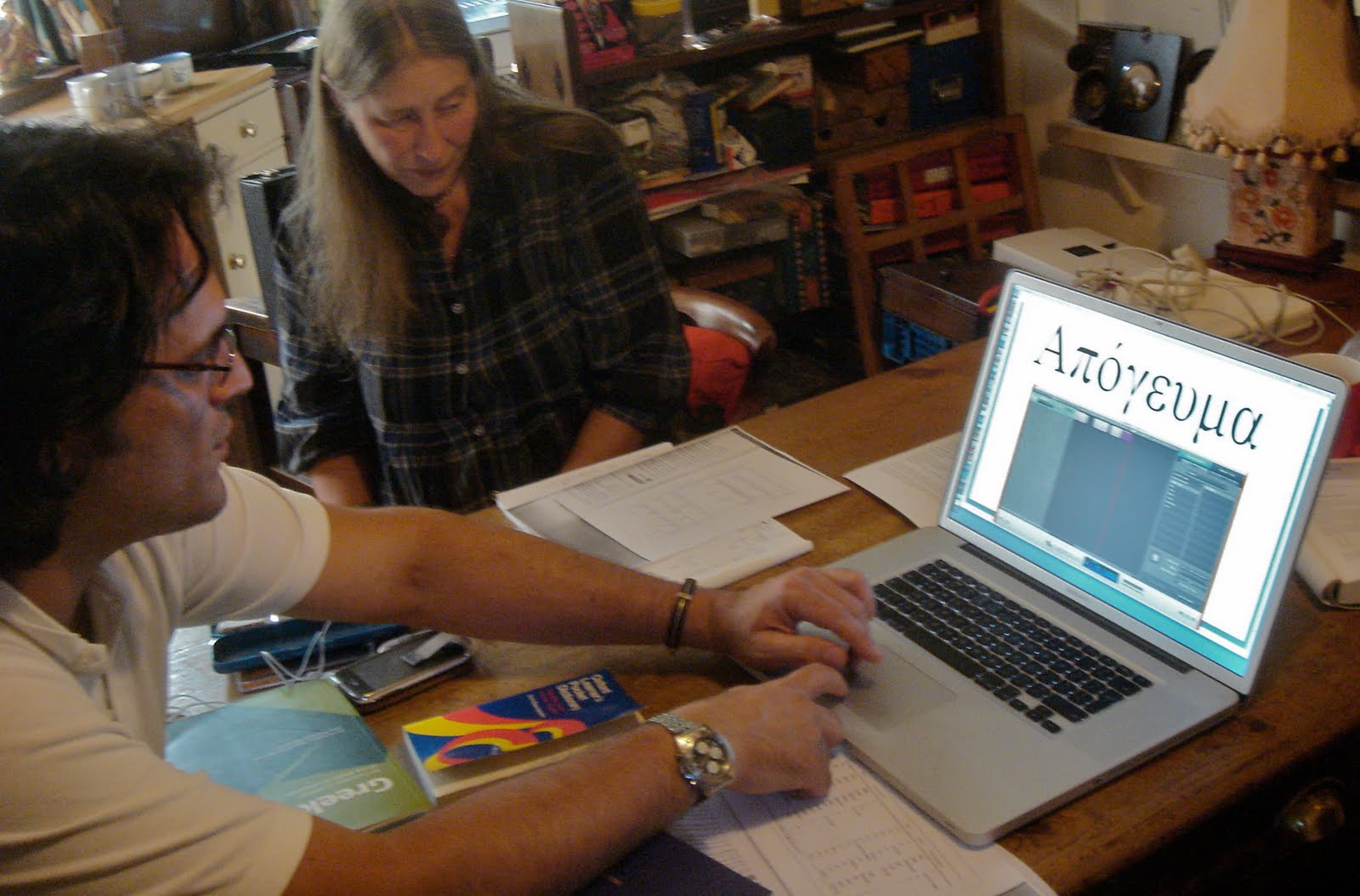
The reason we don't say "Good afternoon" when in Greece isn't because no-one's around in the afternoon, though we know all Greece slumbers from around noon until the evening, but because compared to "good morning - καλημέρα" and "good evening - καλησπέρα" and "goodnight - καληνύχτα", saying "good afternoon - χαλο απόγευμα" feels tricky - and none of the translation programmes actually gives the phrase back as 'Good afternoon". Hm? For our second Greek lesson Niko had us listening to ourselves on the vocal track on Garageband to practice speaking - in this case saying the word for 'knife - μαχαίρι' - and other tableware - and "Good afternoon" - with its tricky set of vowels - which we were also writing up on screen, getting accustomed to shifting to Greek fonts and pulling up a Greek keyboard layout at the foot of the screen.
We also visited the Ano Korakiana website to practice reading and making sense of what we read about a celebration at Luna D'Argento involving two choirs from Corfu and Cyprus, the Ano Korakiana band - the Spyros Samaras Philharmonia - its president Dr Savvanis, also Andreas Metallinos - paying tribute to his talented ancestor the sculptor Arestides Zach. Metallinos - and a long happy dinner in the company of the President of Cyprus - Dimitris Cristophias - 'surrounded by friends you feel you've known for years'.
Για το βράδυ της ίδιας ημέρας είχε προγραμματιστεί μια συνεστίαση στο «Luna D’Argento» για τα μέλη των δύο χορωδιών. Οι γυναίκες της Χορωδίας του χωριού μας είχαν ετοιμάσει έναν νοστιμότατο μπουφέ, ενώ πολύ καλό ήταν και το κοκκινέλι κρασί του Τάκη Σαββανή. Στην εκδήλωση αυτή γράφτηκε στην ουσία ο επίλογος της συνάντησης. Ο Πρόεδρος της κυπριακής Χορωδίας εξέφρασε τις ευχαριστίες του για την πολύ καλή φιλοξενία, ενώ ο Αντιδήμαρχος Αθηένου, πρότεινε την αδελφοποίηση των δύο Χορωδιών και περιοχών. Ειδική δε αναφορά και ευχαριστίες αποδόθηκαν από τους Κυπρίους στον παπα-Κώστα Φαϊτά. Στη συνέχεια, ο Πρόεδρος της Φιλαρμονικής, Σπύρος Σαββανής εξήρε το ήθος των Κυπρίων φιλοξενουμένων και για μια ακόμη φορά αναφέρθηκε στη σημασία και το συμβολισμό των εκδηλώσεων που πραγματοποιήθηκαν το τελευταίο διάστημα σε Κορακιάνα, Μουδανιά και Δήμο Αθηένου, ενώ ο Ανδρέας Μεταλληνός αναφέρθηκε στα γλυπτά που είχε φιλοτεχνήσει ο πατέρας του, εμπνευσμένος από τον Κυπριακό Αγώνα. Τέλος, όλες οι πλευρές αναφέρθηκαν στις προσπάθειες που κατέβαλε η Σοφία Μαρτζούκου για την επιτυχία της διοργάνωσης. Στη συνέχεια το γλέντι «άναψε» για τα καλά και η διασκέδαση κράτησε μέχρι τις πρώτες πρωινές ώρες, μέσα σε μια ζεστή και πολύ φιλική ατμόσφαιρα, ανάμεσα σε ανθρώπους που θαρρείς πως γνωρίζονταν από χρόνια.
Note: See 'crucial role of education for a united Cyprus'
** ** **
On Thursday I took the train down to Winchester to film a political-management conversation. Astute timing by their PAs - given the extra pressures created by the June 22 Budget - had got me forty five minutes to capture something of the working relationship of the Leader and Chief Executive of Hampshire County Council for the second tranche of in-house events on 'Managing with political awareness' (scroll down for ref to feedback on the last tranche) I'm running there in July. This is the first time I've used HD on one of these films and to my relief have been able to process and edit the film for CD, both as a MOV file - less quality of course, though not bad - and as a DVD as well as keeping the conversation on my hard-disk for shared analysis of leadership at the apex during the actual seminars. All this on a laptop which suggests that the big machine I've used in the past for film processing is becoming unnecessary - especially as I can store the archive on an external hard-drive and even 'cloud it' with Vimeo HD - restricting viewing to myself or, if those filmed allow, placing a film in the public domain.
Cllr. Ken Thornber, Leader, & Andrew Smith CEO
*** ***

Email from Alan & Honey:
Hi, Simlin. Here's some shots of your balcony with the new railing....In the picture you can see the wood which is holding in the cornice which I will remove on Monday or Tuesday. I'll send you the pictures of that then. I was over there all day with Michael when he was installing the railings. He takes a lot of pride in his work and therefore he was very particular about everything...Some of the things he gave you beyond what the other people were going to do is a stronger, thicker top rail and he brought it further beyond where they were going to take the rails down the steps, as you can see in the picture.
On Tuesday, when I remove the shuttering for the cornice, I will also be removing the scaffolding so that I can start on the entrance porch. I've made all the side mouldings for the steps. Now all I have to do is attach them. Ha, ha! It's another fine mess you've gotten me into, Ollie! Oh, and I forgot to say that while I was over there yesterday, I plastered the inside frame of the door and made it look much neater. Just needs a touch up of paint now. x A (H) [See 28 April before image]
Mikali's railings: το μπαλκόνι είναι εξαιρετική, και αυθεντικά;
*** ***
AP 25 June 10: Greek pension reform plans from Andreas Loverdos

Wednesday, 5 September 2007

In Greece

Wednesday at 208 Democracy Street: I wake before 6.00 which is just before 8 here. This morning is grey and even damp from a short rain (predicted even last Saturday) while we slept, brought, as usual, by a rare southerly breeze.

Most bad things in Greece come from the north (totalitarians and the m*lt*mi with its moaning delivery of suicide and household mayhem) but the issue in Greek foreign policy since WW2 has been an island to the south east. The British relinquished their governing role in 1959, satisfied to an agreement that gave them a military base in Cyprus and bars for our lads. Tension between Cypriots, locked in their children’s history books, and stands by Greek and Turkish governments in defence of their own, as this is understood, on the island and on the two mainlands, has stymied reliable peace. Memory of the feud – great acts of chopping and shooting between villages – has made old men and women weary of the fervent young, so ready, if licensed by their elders, to set upon each other, in uniform for their state or as bandits for their friends. Internal politics in Turkey and Greece are swayed by great men’s views on ‘the problem of Cyprus’. Some young mainland Greeks scorn the trouble bringers – ‘Cypriots, ttch!’ The Aegean pot is stirred by the great powers protecting our ultimate driver. A river intractable runs through it from the Middle East. Until our economies eschew carbon and we live instead on the bounty of sun and the wind we live under the satrapy of oil.

* * *

And now comes more sweet rain. When we go to the cottage people say “you’ve brought the rain” with reproach, but in Korakiana it’s only a blessing and we must hope for more.

* * *
Tuesday 4 September at 208 Democracy Street
The train journey to Gatwick and the flight passed most of Monday. We arrived at Corfu in the night. Kostas’ son met us with the hire car. We drove to Ipsos and dropped in on the café there for an indoor smoke and a drink. V was just tidying up to go home. Dg sat at the counter as he had when we left and J pointed to the collection box for the victims of fire mentioning ‘one boy they bought in with firelighters – 65 years!’. We wandered across the road and drove up the jetty to see ‘Summer Song’ lying quietly at her mooring. Amplified sound came from the strip but most places seemed lightly patronised, except where a coach party milled in one long bar.

At Ano Korakiana, at one in the morning, Lin dropped me off with the luggage and parked further up the village. I found the keys in their place. The house held the day’s heat. I surrendered to the air conditioner. There was building dust and detritus everywhere and much incomplete, but the upstairs room with its divider out is a great improvement. The replaced window stood wide open to the cooler night and a moonlit view of the sea and hills and a landscape dotted with too many lights. I made us tea and coffee. Lin wiped surfaces. I was glad we’d anticipated there’d be ‘a few things to be done’.

I woke just before 8. Wandering to the balcony I shade my eyes, gazing only momentarily to the east, where the sun has already turned the view to dazzling monotones, assailing the house through windows left unshuttered by the previous builder, leaking through the ones that are protected. The clock ticks in the kitchen. Lin sleeps. I make myself a cup of tea bracing for the heat, wondering what to wear. M. texted he was coming round with G. They sat over coffee and tea, new bread and honey, I’d got from the shop.
Lin paid part of what we owed for work to date. M. will come tomorrow to try and finish more of the top room. Gossip about the island. Police heavies from the mainland have visited to enforce laws on things like bad driving and parking habits and not wearing helmets on motorbikes. Local police not wanting to stir things with fellow islanders treated many infractions as customary, and tolerance on such things has long been part of tourism, but the state is putting its foot down to avoid paying more fines to the EU, whose Regional Structure Fund has benefited Greece since she joined. Brussels is now saying ‘what’ve you been doing with all the cash you’ve had from our shared pot? Didn’t you know when you dipped into it that there were conditions? Where’s the structure? Rule of law? Regulatory frameworks? Your borders have had the protection you get from full membership of the union. The Euro emphasises that, making a mockery of neuroses, once justified, about the ‘Macedonian Question’. Do you seriously think the place under the conditional name FYROM is going to invade, invest Thessalonika and march on Athens? Grow up. Stop the corruption. End the pervasive clientelism that blights your democracy. Stop the seedy relaxed attitude to the rule of law!’ Of course I wouldn’t countenance such views’ being too used to what pots tell kettles.

* * *

Evening of Tuesday 4 Sept: The house, although we’ve not wanted at first to admit it to ourselves, is more of a mess than we’d expected. The Apothiki is a fish skeleton of nailed lengths of wood, lathes and debris from the upstairs building work. ‘Who would have known the old wall to have so much rubble in it?’ There ‘s a pile of broken tiles and odds and ends on the balcony. Furniture wears a fine dust from the sanded floor, which is incomplete, as are the walls with wires loose and rough surfaces. Builders’ odds and ends have been plonked down all over. The garden looks more of a mess than when it was rubble. To top this there’s been a fire in the land below our house that was once overgrown. From the balcony you can see a couple of dead trees, others badly scorched. Mrs Leftheris greeted us and shook her head at the devastation.

To add to our chagrin I was stung by a wasp and trod on a nail. Blood dripped on the path until Lin found a pad for my heel. The wasp must have been weary so I didn’t go into antiepileptic shock as I did once. We tidied and tidied. Now there’s a pleasant waft of salad in preparation, plus fresh bread, and wine. Supper of tzadziki, ham, salad of tomatoes, onions, peppers and feta, with a chilled retsina. Lin wondered if there was some music and I dug out on my laptop some of the lute music from Iraq that Dhiaa has sent me when I asked him about his favourites, interspersed with songs from Miki Theodoraki’s setting for Axion Esti – near East mingling with Middle East. It’s strangely moving to hear these sung in German given their context.

* * *

J said ‘business has been shite’ this summer. G. said middle Europeans – Croats and others from Yugoslavia come to Corfu with their food and drink in their baggage. ‘They stand outside bars chatting and dancing and drinking. enjoying the lights and music but not spending any money. They even bring their own water!’

Back numbers

Simon Baddeley