Total Pageviews

Showing posts with label granddaughter. Show all posts

Saturday, 26 July 2014

Far to go

Hannah Rowan Hollier born at 00.14 the morning of Thursday 24th February (photo: Richard Baddeley)

After the excitement on Thursday I went to London for the afternoon - Birmingham Snow Hill to Marylebone ... dawdling for my 10.14 train to London, I decided to photo myself alongside the statue between the platforms. A professor of dentistry with a classy camera asked to take a picture of me taking a selfie. He emailed it to me and but edited it with eyes askance in B & W on his Flickr stream.
With John McKenna's Commuter at Snow Hill Station (photo: Damien Walmsley).
From Marylebone I cycled north towards Hornsey to see Francis Niemczyk. I wanted a touch-look-talk at his place - to view the kit he's using to synchronise the ageing 16mm film and 1/4" reel-to-reel tape from my stepfather's archive of Out of Town programmes. Round Regents Park it was still sunny but humid. The forecast rain clouds were gathering. Kentish Town Road, Fortress Road, Junction Road to Archway, and urban heat brought the overcast to breaking point. There was lightning and thunder and on Hornsey Rise - a downpour; rivulets riding down the gutters; vehicles fecklessly throwing up sheets of drenching spray I dodged by walking the pavements until I could shelter below a petrol station canopy; dispense myself a milky coffee and choc cookie, before free-wheeling down Crouch End Hill, through the Broadway and along Park Road to Francis' side street. He's on night shift these days, sleeping from about 8.00am to 4.00pm. I followed him through the house to his garden shed so's I could see the kit he's using on the film and tape [links to the back story - the material and my journey to collect it from the West Country in April 2010)

The process of restoring the material I inherited from my stepfather is taking time. It's nearly a year since the first synchronisation (actually the second, as the restored episode that gave me the original idea of what might be done, was completed in May 2010 by Roger Charlesworth at SWFTA). Although we now have a list of the tapes that go with the films and Lin and I, in June 2013, duct taped a dozen pairs of tapes and film, based on the numbers pasted on them at SWFTA, and had five of these pairs taken to London for Francis to work on, only one pair has yet been synchronised. This sample, just over for four minutes, has been done perfectly, and gives an idea of what's involved.


The restoration process is nothing if not tricky, painstaking; even tedious.
"The atmos sound's not a problem but the spot sounds - like a hammer blow or a gate shutting - are"said Francis. He's lots of other film work, hitches with his machines, and he needs to work nights ... We discussed the possibility that after he's synchronised the next two pairs of sound tapes and film over the next fortnight, he focus on digitising sound tape and film and leaves the synchronisation for the moment. Then I suggested we see if it's possible to enlist additional helpers - people who might not have the technology or the skills to transfer the delicate 16mm film and the reel-to-reel sound tapes to DVDs, but do have the craft and perseverance required to work on synchronising the digitised sound to the digitised image on the archive material if provided with pairs of DVDs for each episode. One volunteer has described this in an email to Francis:
Hello Francis. My name is ***. I live in Maryland and became acquainted with Simon Baddeley and his efforts to rescue heretofore neglected and forgotten Out of Town material through his group on Facebook
One of the obvious problems Simon faces is the enormous amount of time and potential expense of stitching back together Stan Bréhaut’s MOS material with Jack’s extant recorded narratives. While Simon has made us aware of some of the technical challenges (e.g. sometimes having to time compress or dilate the narrative to match the flow of the picture), much of the effort appears to be the grunt work of cleaning up noise and persistently fiddling with the timing to get a good match.
Several of us in the circle of Jack’s fans have the digital tools and experience to be able to help with this on a volunteer basis, once the original digitalizations  are made. I suggested to Simon that he might farm out some of this raw material to us to accomplish some of the tedium. The would be little risk in trying this as all that would be passed to us are working copies of the original rips – and they can easily be passed to and worked on anywhere in the world. 
For myself, I was involved with website production for about 15 years which did involve a fair bit of video and sound editing & have use of a fairly powerful machine and the complete Adobe CS6 suite of software. For sound I move back & forth between Sony & Adobe, depending on the tools needed.
You are the one in the position to digitalize the precious originals and to judge which pieces require your technical expertise and which can be passed on to patient and reasonably capable enthusiasts. 
I am suggesting the following process for yours and Simon’s comment and discussion:
1. Proceed with mass digitalization of material before getting involved with the editing of individual pieces.
2. Do whatever tape to picture pairing can be done or identify a range of possibilities.
3. Provide reasonably detailed technical specifications for the finished product,
4. Send out pairs of rips to potential volunteers & let us do an “apprentice pieces” to see if further cooperation with this or that volunteer has potential.
Perhaps this will free you up to do the most challenging work and let the project progress in a more timely and economical way.
Thanks for your attention & I look forward to your reply. If you think it a go, we can arrange a telephone chat. Cheers, ***
From Hornsey I cycled south - knowing I can never get lost in London - ending up on the Holloway Road, then Camden Road where the rain returned more persistently and I had to shelter in a bus stop where I continued reading my Harris on Dreyfus, pondering the character of George Piquard, the author's interesting narrator,  as successive buses loaded and unloaded wet passengers until a let up...

...in the rain allowed me to continue into Friday evening Camden Town where the one way system fooled me into nearly cycling north again towards Chalk Farm and no-one I asked knew the way south
Passing through Camden Town on Friday evening
I had a sweet supper with family just off the Edgware Road and later cycled fast - the conversation difficult to break off - to Euston to catch a fast train back to New Street.
*** ***
I had a bizarre exchange about a hair-split on the difference between a primary and a secondary source. A didact let fly on a letter copied me by Richard Pine that he''d received from Seamus Heaney. The dialogue on a Wiki Talk page, its owner insisting the letter be removed at once. I disagreed - suggesting the letter was in the public domain permitted by the Heaney estate, quoted by Pine's publisher. This editor replied:

You asked for my suggestions; I replied. If you don't want the facts don't ask for them. Obviously, you are way out of your depth. I find it sad that someone whom claims to have degrees resorts to a website to publish their thoughts. If you can't contribute according to our norms, take your ball and go home. Chris Troutman (talk) 23:44, 23 July 2014 (UTC)
Chris, Such an intemperate and, frankly rude response is unacceptable. You owe Simon an apology. Andy Mabbett (Pigsonthewing); Talk to AndyAndy's edits 13:38, 24 July 2014 (UTC)
Chris, you have a reputation for speaking bluntly, but I have not seen you behave rudely before. I ask you to consider your words to Simon and make proper overtures to him regarding them and your behaviour in this thread. Even when we have a strongly held opinion we may not express it rudely. Fiddle Faddle 13:56, 24 July 2014 (UTC)
@Pigsonthewing: @Timtrent: So you two have been called upon because my "rather didactic advice" offends someone? Here's some more didactic advice for everyone: WP:PRIMARY and WP:SPS describe this letter as a primary source of questionable verifiability. Without provenance, I think the letter is problematic at best. My degree is in history. The study of history teaches us that a letter written contemporaneously to the subject period is a primary source. Primary sources are not to be used in tertiary sources because they require secondary source analysis, which is meant for qualified individuals, not hobbyists.
On wiki all editors are hobbyists; no one here is an expert even if they really are. Wikipedia is not set up with "verified" accounts; therefore, editors cannot argue from a position of authority. I don't take the word of anyone online, anyway. On Wikipedia we argue the facts independent of users.
Sibadd came to my talk page and asked for my advice. I provided it. That user chose to then argue with me about same and complain when my response was brusque. I didn't nominate anything for deletion or threaten to interfere. I didn't even raise an issue on the article's talk page. I registered an opinion and I wasn't degrading, demeaning, or hostile when doing so (in my opinion). And yes, Timtrent, I will be just as vehement in person; I find such intimation otherwise to be insulting. Sibadd's argument about the letter holds no water with me and I don't understand why a user that's been registered since 2006 doesn't understand these policies, guidelines, and essays or my reaction to their argument. While I have been trying to attract academics to Wikipedia as a Campus Ambassador, I reinforce the clear understanding that Wikipedia is functionally different. I don't care if you hold the Lucasian chair, you're just another editor cobbling together secondary sources on wiki. I do find it sad when academics mistake Wikipedia as an alternative. Adrianne Wadewitz never did that; she contributed encyclopedic knowledge and adhered to our rules, as we all should.
I am disappointed that for the amount of time I take considering how to respond, toning-down my initial response, and assuming good faith that I'm still perceived as some kind of reckless bomb-thrower. So, if my response doesn't meet your needs, take it to a noticeboard. I'd be content with an IBAN from all interested parties.Chris Troutman (talk) 02:22, 25 July 2014 (UTC)
I had not expected a rationale for rudeness to be attempted. I have no issue with your opinion being held strongly, nor with that opinion being expressed assertively. I have an issue with your rudeness to the editor. You can be as blunt as you wish up to but not passing the point of rudeness. I don't care one fig for anyone's degrees. I don't care whether the letter is out or in. I don't care about the article, though I care about articles. I do care about the way people behave towards others. I very much doubt I will say more on the matter in a timely manner, I am travelling today and tomorrow. After that the matter will have cooled and not be helped by being re-raised, so I think any further response form me will be unwarranted. I simply express my surprise and distaste for your behaviour, and for your reinforcing it. It is not your message I quarrel with; it is one you are entitled to deliver. It is your mode of delivery. Fiddle Faddle 05:05, 25 July 2014 (UTC)
Good to find out about Adrianne Wadewitz, and I'm glad other Wikipedia editors responded, reminding me of Jimmy Wales' and Andrea Wekerle's 2009 article on 'keeping a civil cybertongue...
...we need to create an online culture in which every person can participate in an open and rational exchange of ideas and information without fear of being the target of unwarranted abuse, harassment or lies. 
*** *** ***
Ah! The troubles of the bourgeoisie in peaceful Britain, as fire rains on Palestine, we are in the absurd situation of having such a backlog at Birmingham Registry Office that Guy and Amy cannot register the birth of Hannah Rowan, our grand-daughter, within the legal time limit for registering a new birth. The first available appointment is 28th August - a date Guy found after finally finding an unengaged phone slot on Monday morning - constantly ringing and ringing for nearly 40 minutes - will not allow time to get Hannah her compulsory passport, an application for which a birth certificate is essential. So will Amy be able to stay with us in Greece in September or even October?  I've written - via Facebook - to our MP, Khalid Mahmood, who's replied swiftly asking for details and saying he's on the case.
These delays on papers, the trickiness of proving you exist in the matrix...reminds me of Richard Pine's response on reading the wikipedia editors' exchanges about the letter from Seamus Heaney (SH):
Simon - not clear who the authors are, but obviously Chris Trouthead is a nasty person.
The stuff about the letter is BOLLOX - it's tantamount to saying the latter is a forgery, or never existed in the first place. Especially since SH is no longer with us to verify it.... What pathetic small-minded hypocrisy. RP
Now that's interesting. Is Richard's incivility, in a private email, that I've made public in a blog, a tertiary, secondary or primary source?  Is it possible I faked the letter and this email?  Is Seamus Heaney a real person? (continued on p.94)
**** **** ****
Lin and I went round to inspect a garden in Stamford Road that seems a fair candidate for Handsworth Helping Hand's assistance. There's been flytipping into the end of the garden from premises on Putney Road. We need to see if we can stop that, as well as contacting the Housing Agency responsible for the garden next door - get that tidied at the same time if possible.


*** *** ***
I'm as entranced as anyone by some stories in which animals are made like people - The Wind in the Willows especially - but I'm vexed by endless smiles and animals that look nothing like animals.

When I was six, Jack, who'd just started living with us, gave me a Christmas present laced with a treasury of illustration - Richard Lydekker's Royal Natural History in 6 volumes, published in 1896.

Now and then I've immersed myself, and my children and now my grandson in this magical bestiary in which the animals don't speak human, don't smile cheerfully and are, irrefutably, denizens of a feral universe...


Oliver's hardly two and half, for goodness sake, but I wanted some imprinting of images to compete with patronised animals, animated cars and Thomas the Tank Engine and friends, for all my tender spot for railways and steam trains; indeed any trains.
Lightning McQueen

Wednesday, 5 March 2014

Executive summary

I caught this morning ...

I rose in the morning sun shone through the stained glass of our house. I saw the dress Lin had bought in Corfu in January. I felt prescient; a micro-second of incandescent content. She'll be a strong woman μια ισχυρή γυναίκα.
*** ***
Here, in a well-filled nutshell, is the driving force for changing Greece.

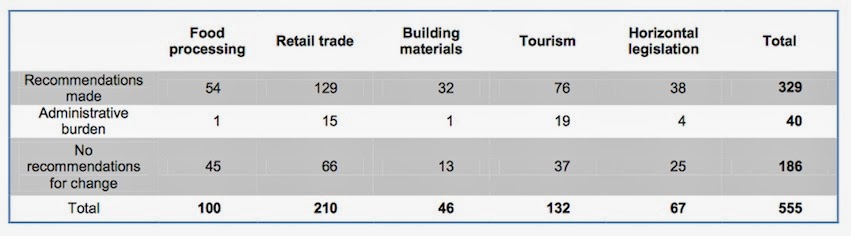
The work undertaken by the Greek authorities in recent years to reinforce competition law and strengthen the Hellenic Competition Commission  Ελληνική Επιτροπή Ανταγωνισμού, to simplify business administration and to liberalise professional services, has demonstrated their political willingness to address existing regulatory barriers to competition that have contributed to holding back the economic recovery.The Organisation for Economic Co-operation and Development (OECD) Competition Assessment of Laws and Regulations in Greece project, through the scrutiny of legislation in four sectors of the Greek economy – food processing, retail trade, building materials and tourism – has led to the identification of 555 regulatory restrictions. These regulations were selected as being potentially harmful to competition from the original 1053 legal texts chosen for analysis, using the OECD's Competition Assessment Toolkit. In total, the report makes 329 specific recommendations to mitigate harm to competition.1 In addition, 40 provisions were found to constitute an administrative burden on businesses.
Summary of the legal provisions analysed by sector 
If the recommendations detailed in this report are implemented, benefits to consumers in Greece and to the Greek economy should arise in all four sectors. Throughout the project, we have thought to identify the sources of those benefits and, where possible, provide quantitative estimates. Such estimates are made on the basis of experiences of deregulation in other countries in some instances, or by relating conservative estimates of efficiency gains to the overall size of the business activity affected. More specifically, if the particular restrictions that have been identified during the project are lifted, the OECD has calculated a positive effect to the Greek economy of around €5.2 billion. This estimated amount stems from the nine broad issues that we were able to quantify (representing 66 provisions out of 329); in other words, the full effect on the Greek economy is likely to be even larger. The amount is the total of the estimated resulting positive effects on consumer surplus, increased expenditure and higher turnover, respectively, in the sectors analysed, as a result of removing current regulatory barriers to competition.
In addition, we consider that the cumulative, long-term impact on the Greek economy of lifting all the restrictions identified as harmful, including those that were more technical in nature (for instance regulations on foodstuffs), should not be underestimated, since the rationalisation of the body of legislation in these sectors will also positively affect the ability of businesses to compete in the longer term, provided that the recommendations are implemented fully.Such benefits generally take the form of lower prices and greater choice and variety for consumers. Often this will result from entry of new, more efficient firms, or from existing suppliers finding more efficient forms of production under competitive pressure.
Naturally, in some cases there will be a trade-off in terms of the cost of implementing the recommendations. The OECD work has focused entirely on analysing the harm to competition from the regulatory restrictions identified, and how to mitigate it; but in some cases there is likely to be some cost involved in reforming the legislation. It may be the case, for instance, that a funding gap will be created by the lifting of levies on goods or services previously used to finance pension funds. The OECD work on competition assessment does not calculate these costs. Rather it is a study that assesses the harm to competition from the restrictions identified, mainly to consumers, but also to Greek businesses that cannot compete freely. The harm can therefore be thought of as the overall loss of efficiency to the Greek economy.

Key recommendations (out of a total of 329 recommendations)
  • Repeal obsolete and outdated legislation for the four sectors analysed, especially from the Code of Foodstuffs and Beverages.
  • Abolish all barriers to entry that have been identified. These include the strict licensing requirements in the asphalt sector; minimum requirements for storage, or minimum capital requirements in the building materials sector; numerous barriers to investment in tourism activities, such as geographical restrictions or minimum quality requirements; limits on tourist coach activities; restrictions on offices of travel agents; limits to the trade of blended olive oils; and so on.
  • Abolish any requirement to seek price approval or to submit prices to the authorities or to trade and industry associations for all tourist activities.
  • Remove all third-party levies and fees. These include the tax on advertising and the levies on flour and on cement.
  • Fully liberalise Sunday trading, including for stores above 250m2, shopping malls and outlets.
  • The five-day restriction on the shelf life of milk should be lifted. The product’s use-by date should be determined by the producers, according to their pasteurisation methods and the relevant EU regulation. Milk cartons should be clearly stamped with the date of production and the valid-to date.
  • Prices of over-the-counter medicines (OTCs) and dietary supplements such as vitamins should be liberalised. This should be done in conjunction with a full liberalisation of the distribution channels.
  • Retailers should be able to decide freely on shop promotions and discounts, including on the determination of periods of seasonal sales.
  • The regulation of cruises should be relaxed by lifting the round-trip restriction on cruises leaving a Greek port, so as to allow passengers to embark the cruise at one port and disembark at another port.
  • The five-mile restriction on moorings should be lifted, allowing marina operators to compete with nearby commercial or fishing ports on prices.
  • Finally, horizontal regulations that hamper or thwart the proper functioning of markets should be removed to allow competition to drive efficiency gains and increase productivity across all sectors of the Greek economy.
Provided all the recommendations are fully implemented, the benefits to the Greek economy will include the emergence of more competitive markets, resulting in faster productivity growth over time. In this report we do not attempt to estimate this effect. However, in Australia, which undertook a broad programme to remove regulatory barriers to competition in the 1990s, there have been significant benefits. In 2005 the Productivity Commission examined the effects of selected pro-competitive reforms and calculated that, by enhancing productivity in particular sectors, they had boosted Australia’s GDP by about 2.5% above levels that would have otherwise prevailed. Increased competition in the Greek economy resulting from our recommendations can arise in several different ways, such as:
  • removal of barriers to competition between existing suppliers;
  • removal of constraints upon the ability of existing suppliers to compete;
  • removal of restrictions on the entry of new suppliers, or innovative forms of supply; and
  • reduction of costs that are particularly likely to hinder competition, for example because they make it harder to advertise, or impose heavy costs on smaller or newer suppliers in the market.
However, to ensure that these benefits will eventually benefit the Greek consumers, it is important that the suggested measures are fully implemented. Partial lifting of restrictions will yield only partial results. Moreover, this should be seen as only the first part of a much longer process. The OECD Competition Assessment project carried out an ex post assessment of existing legislation and found valuable and meaningful results. To safeguard these results for the future, regulatory impact assessment (RIA), with a particular focus on competition impact assessment of new legislation at the drafting stage, should become an integral part of the policy-making process. 
    Notes
  1. 1. In 186 cases we make no recommendation. In these cases the restriction was found to be proportional to the policy objective, or the restriction stems from harmonised EU legislation. In some cases, the restrictive provision was abolished during the course of the investigation, and hence no recommendation was made in the final report. All cases are clearly signalled in Annex B.
  2. 2. These regulations do not have a direct bearing on competition; nonetheless, they constitute burdens on businesses and clearly affect the business environment. The OECD is undertaking a joint project with the Greek Ministry of Administrative Reform and e-Government to measure and reduce the administrative burden in 13 sectors. The restrictions identified were passed on to the Greek government. 
(extract) ...Despite some undisputable improvements in the business environment over the past few years, SMEs in Greece are still faced with a number of chronic problems that hold up their unrestrained development. The most important of these problems include:
• difficult access to outside financing
• complicated and time-consuming procedures to establish a firm
• excessive regulation and “red tape”, that create a disproportionate administrative burden on small firms as compared to larger firms
• a complicated and unfair taxation system that discriminates against entrepreneurial activities 4
• an ineffective public administration
• unfair competition, exacerbated by regulated markets, illicit trade and the persistence of a number of “closed professions”, where free access is denied (e.g. lawyers, notaries, accountants, pharmacists, etc.)
• a low-skilled workforce (only 1.2% of the adult labour force participates in lifelong learning)
• excessive non-wage labour costs due to high employers’ social security contributions (43,9% of the wage bill, one of the highest proportions in the EU)
• lack of technical support from the state authorities
• social security problems (low pensions, inadequate coverage, sustainability problems).

Gov't strives for a deal with troika amid persisting rifts


Marathon talks between government officials and troika envoys over the weekend made progress in some areas but the two sides remained far from an agreement, sources indicated on Monday, stressing however that the goal remained to reach a deal before next Monday’s Eurogroup summit.
“It’s a tough situation,” a senior government official told Kathimerini on Monday following talks that began on Sunday at 8 p.m. and finished in the early hours of Clean Monday. “We’ve still got a long road ahead,” the official said, adding that all technical-level proposals by the Greek side had been exhausted and it was time “for a political decision.”....

*** *** ***
Greek Reporter 5 March 2014:  
Samaras, Venizelos Meet On Troika Rift
As a logjam over unresolved reforms remains with international lenders,  Greek Prime Minister Antonis Samaras is set to meet with his Deputy Premier, PASOK Socialist leader Evangelos Venizelos, on March 5 to try to find a way to break it before Eurozone finance chiefs meet next week over whether to okay release of a pending nine billion euro installment.
The government has committed to 80% of 153 undone reforms recommended in a so-called Toolkit from the Paris-based Organization for Economic Cooperation and Development (OECD) but that hasn’t satisfied the Troika of the European Union-International Monetary Fund-European Central Bank (EU-IMF-ECB).
Also on the table is a dispute over how much more money Greek banks need on top of the €50 billion from $325 billion in two bailouts. The estimates range from €5-20 billion and are holding up a resolution on the talks and as the Bank of Greece this week is set to reveal the results of stress tests on state financial institutions.
Samaras and Venizelos are scheduled to talk a day after intense negotiations between the Troika’s envoys and Greek ministers, led by finance chief Yannis Stournaras, who also briefed the Premier.
After all the major structural reforms that have been plodded through, the negotiators are also down to minutiae as well, including lender demands to extend the shelf life of milk – essentially to allow sales of expired products – and to let supermarkets sell non-prescription drugs, an idea fiercely fought by pharmacists who want to keep a monopoly.

Kathimerini editorial 4 March 2014:
A country of vested interests
Certain Greek politicians are finally willing to talk about a fact that previously was never mentioned in public dialogue. This is a country of comfortably entrenched vested interests that are battling to make sure that absolutely nothing ever changes. The only thing they are interested in is maintaining the kind of privileges they gained under particularly nontransparent circumstances. We, the consumers, however – people who end up paying hefty prices for numerous consumer goods in order to keep these vested interests and privileges alive – have proved incapable of developing our own, efficient anti-vested interest network. That is why, on the one hand, we allow all the various lobbies representing the vested interests to monopolise public dialogue, while on the other we fail to provide sufficient support to those very few politicians who are willing to make the kind of difference that would prove beneficial to us all.
*** *** ***
Lin phoned. I was enjoying Lurleen's sweet and savoury pancakes at Livingstone Road Allotments clubhouse and nattering to Denise.
Lurleen cooks pancakes at Livingstone Allotments

When was I coming home, she wanted to know.
"In about half an hour....So?"
She'd been to Good Hope for Amy's latest scan
"A girl" I don't think Lin was surprised. She knew already.
A grand-daughter in July

I shared the news with the lunch club.
"I don't mind if it's boy or girl, but I like the idea of a pigeon pair"
Later talking to Rob in the club I asked him if anyone was planting.
"No-one. Put potatoes in now they'll rot."
*** *** ***
On Tuesday we were babysitting Oliver. When it was my turn we - Oliver, Oscar and I - went to the park and looked at trees, birds and lots of damp grass. I watched Oliver inspecting puddles, tramping up and down in shallow muddy pools, unwilling to catch up, so we could go to the playground before walking home.
Oliver enjoying paddling in Handsworth Park

We dropped in on John Rose's house - three down from ours. Cup of tea and chat, Oscar and Dieter, best of friends, wandering in and out of the garden. A neighbour, George, came round - a bit shaky, just out of hospital. A beer for him and then one for me. Oliver picked biscuits from a pile John had put on the table and fed the dogs, wandered around interesting himself as we talked about the scourge of high cost short term lending. John has been part of the new Archbishop of Canterbury's campaign to help show how private loan companies work. He and others have been mystery shopping for loans, swimming with sharks, and reporting back on the results.
"As financial regulations have tightened in the US, these companies have migrated here"
The archbishop, Justin Welby, worked in the oil industry; he understands finance; has an informed headstart in pressing for tighter financial controls over payday loan companies preying on the poor; rules that come in this April with stricter regulation which should level the ground for Credit Unions to offer similar loans at far lower interest.
It was a pleasant interval, Oliver amusing himself as John, I and George, put the world to rights.
"A pretty pass we've come to making fun of the poor"
"Like going to Bedlam to mock the mad. A spectacle. Poverty porn - and all in the best possible taste"
"It's not as if we don't see people here who are poor, see them in their variety, some dead souls, others hustling, others in quiet retreat. Meantime the very rich have done a swell job getting the surviving poor to hate the one's that struggle and fall"
I had in mind my dialogue with Jan Didrichsen, continuing....a letter last Spring:
Dear J. I suspect that as April's welfare reforms begin to bite, we will encounter, even more than usual, the ugly habit of demonising the poor - about which I know no better remark than this - from the great American writer, Herman Melville, who spent time on a US warship in the 19th century and encountered the justification of the officer class for flogging the lower deck. Such cruelty was essential given the dangerous and depraved behaviour such punishments were designed to quell.
‘Depravity in the oppressed is no apology for the oppressor; but rather an additional stigma to him, as being in large degree, the effect, and not the cause and justification of oppression’ Chap 14 ‘White Jacket’
"The trouble is that there's no narrative, no story robust enough, John. There's the Marxist stuff. Private Eye is better; articulate, wry, researched. The story being told at the moment is the one that says being poor is your own fault. But on top of that is a layer of ironic cruelty. Poverty is now an entertainment. It's like that ground breaking Tiger in your tank ad for petrol, The punters did the advertising. They paid for it. That was a famous first. Now the punters confess in entertaining ways that their condition is of their own creation. It's brilliant. We take punters being billboards for granted now. So the obscene gap between the rich and the poor.  It makes the story of fault so much more convincing! The fib - a good semi-truth - has such currency among us, yet composed and recomposed in places with spotless floors and high views, disseminated assiduously by the media of the mighty. Poverty is panem. Povery is the circus. Hunger games."
Wetness

*** ***
Why I like/dislike Facebook - there's so much work to be done...

Simon Baddeley added 2 new photos.
Just watched 'Ikuru' filmed in 1952 - a Japanese film that reminded me of 'It's a Wonderful Life' (1946) - a reminder that there are better things to do than take to making blue crystal meth when you get terminal cancer - much as we enjoyed 'Breaking Bad'
Like ·  · 


Back numbers

Simon Baddeley