On Sunday - which felt like the first day of the summer - I spent a couple of hours scything and tidying a deserted allotment on the Victoria Jubilee Allotments at the request of the committee who've found a new prospective tenant after the council had sent the plotholder a notice of quittal. Apparently he'd protested against it, his removal taking months.
 The plot was waist high in dock and brown nettles ready to spread their seed across the rest of the site. As I worked my way up the gentle slope I saw there'd been little work on it since I did a similar clearance a year ago. Half way up like an archaeologist I started to encounter the shapes of shallow raised beds edged with loose planks. Before that I'd uncovered lengths of shredded plastic, numerous plastic bottles and metal drink cans - signs of careless retreat. Cut grass had been left rotting in breached plastic bags. A large plastic rectangle lay in the grass - out of the rectangle of bare earth beneath it a wood mouse dashed for cover leaving a posse of slugs in the sunlight - some the large Spanish browns. It was part of a pre-assembly shed erected at least a year ago, collapsed by wind. I scythed around a forlorn clump of fruitless strawberries in the centre of the plot arriving at a larger mess that included a tattered folding chair and a three-seater swinging hammock on a rusted frame where I guess the plotholder had imagined relaxing with friends to survey their work.
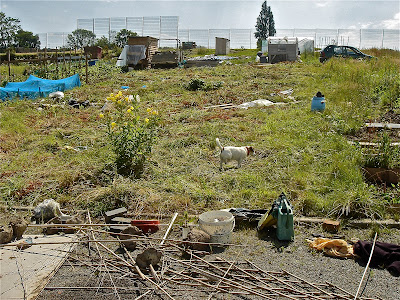 Pallets had been knocked together to create a container for compost. This was already full of rubbish to which I added what I picked up. There'd been a plastic shed.
 Its double doors with a rusty padlock on the latch were lying half way down the plot. Its main sections lay bent on their metal supports, laced with sturdy nettles. There was a boulder sized piece of flaking polystyrene - perhaps part of the packaging for the shed and bamboos fixed in shallow concrete cones for stability lying in the undergrowth with bricks, a hardened quarter sack of unused cement - hazard to my scythe. I might have been an archaeologist but that this site was hardly a year old. Instead of being interesting, I was vexed at sifting through evidence of inability to stay the course. I composed rebukes - barring the excuse of sudden illness, disability or bereavement - "how come you started off so keen and then gave up leaving this mess?" "This is worse now than if you'd never started" I thought - ashamed - of projects I'd abandoned; coming up against limitations of will, guilty but relieved at walking away from my initial plans, face to face excuseless with laziness, lack of will, foolish miscalculation of what was involved, limits to my ability. Encouraged by a publisher I outlined a book and its chapters; even assayed part of a first chapter, using tricks to procrastinate, until one morning in Scotland at the office of the quarry manager near Daviot, I faxed the commissioning editor in Milton Keynes. They'd already advertised my publication. Colleagues were assuming it - or perhaps they weren't. Nothing was ever said but I'd learned, and so had they. This gardener had also lost the plot or never found it. I was as vexed at him as at myself; tidying his messy failure, placing a few usable objects inside the piled remains of his shed - a rusty pointing trowel, three single gloves, a watering can repaired with duct tape, a couple of plastic buckets, a three way plastic frame joint, a sheaf of short green frame struts and some light wood trestling. Adjoining plotholders asked me if I was taking over the plot, thanked me for the tidying, shared my grumbles.
 *** ***
"I told him about it, but he's not been near for months. I've removed the stuff from my plot but we need to get it clear from this one."
R showed me the horsetail, holding one of the small green plants with slender root quite delicately, reluctant to let me handle it without realising its true nature.
"Careful. Don't put it on the ground"
He took it back; put it in a small plastic bag containing horse-tail already dug out.
"If we can get it out now we may be able to keep it away"
R has circulated emails to other plotholders about the persistent habits of this weed - fauna from the Lower Cretaceous its spreads by spore rather than seed. I was getting almost vexed by his preoccupation.
"So it's worse than Adolf Hitler?" I asked
"Yes of course. He's dead"
Earlier Robin had sent me part of an exchange from a handyman forum - one of these lass-laddie places on the web with tags - Tobe, Foggie, Sluggit, Only-me, Bludall - ribald with nipples, bums, balls, intensified punctuation and gnomic slogans 'Keep your face to the sun so you cannot see the shadow'
Since I've been developing 'attitude' toward 'weeds' that compete with what I want to grow, i've realised there's not a plant - weed or otherwise - that isn't useful for something. It turns out Horsetail is praised as rich in silica, good for for hair, skin and nails. Couch grass - another nuisance - is good for bladder and prostate infections. Ground elder is supposed to lessen rheumatic pain, diarrhoea, burns, and painful joints. Animals over the ages have evolved symbiotic relationships with innumerable plants. Humans as they've become more detached from nature have forgotten about connections that were once a part of common sense, though the pharma industry is ever sifting the soup of bio-active compounds in wild plants for their therapeutic potential.
*** ***
On our plot the bees have arrived, surrounded with the agreed eight foot enclosure to protect gardeners and park users as agreed in May. John Rose had made this up from plastic piping which he and I fixed at one end to the park fence before covering with netting.
On Sunday evening Gill brought in the hive and already the bees - a new colony of European Honey Bees, Apis mellifera - are sending out scouts.
 *** ***
I was sat having a cheese on toast and a mug of tea at the park cafe when i was joined by a man and his eight years old grandson on their bicycles, which they propped beside mine. We chatted about how long we'd lived in Handsworth; our ages - he 66 - and where we'd come from; he Jamaica in 1962. The boy told me he was going there, for the first time, in a few weeks, his first journey in a plane. I spoke of being 70 and of our grandson Oliver and how I looked forward to taking him around the park on a day such as this.
"What if you pass away before?" said the boy innocent of the standing chill, the small unfocused blur on the edge of vision this bright jocund afternoon.
His grandpa and I laughed
"Ah yes indeed"we chorused
"The Bible says three score years and ten is the allotment so I'm on borrowed time" I added
*** ***
In Ano Korakiana a meeting for a talk and discussion about a book...

Dr Savannis on the left, then in the front row Sebastiano Metallinos and behind him Katya Spingos and various other neighbours we know, with the village Papas, Kostas, right foreground and Katya's daughter Melina in the front...
**** ****
Saturday midday I was at the Soho Foundry Tavern with The Friends of Black Patch Park who had a stand at the Romany event organised by Ted Rudge, author of Brum Roamin'.
Ted has been clearing some of the unknowns from the initially dubious notion that the great Charlie Chaplin might have born on Black Patch Park before it was a park, before the Romany were driven from it...
 ...born not in London as formally recorded, but in a vardo on the Black Patch in April 1889.
"The connection's getting closer - around 80%" Ted told me, especially since 2012 release of MI5 records their fruitless enquiries into Chaplin's birthplace prompted by the US in the 1950s, Intelligence officers were unable to confirm that Chaplin really was born at his supposed place of birth - 287 (or was it 289?) Kennington Road, London, SE11 6BY - where there's currently a blue plaque. A bit of paranoia - like not taking public records at face value - is good for research. Ted arranged for Michael Chaplin with his wife, the artist Patricia Betaudier, to visit the Black Patch earlier in the year. I suspect there are good reasons why this will remain a mystery, but it's a nice one - more probable for what may come from Ted's continuing pursuit of the remaining loose ends.
[?] wire=work
Charles Chaplin had innumerable letters from fans; all disappeared. One letter from Jack Hill in the mid-1970s Chaplin kept, in a locked drawer, as attested by his son Michael. There will always be rebuttals and I've heard already that he kept many letters suggesting where he was born and that it was normal in the 1890s for poor children not to have birth certificates. Charlie might even have been ashamed of Gypsy origins. Unlikely. He might have favoured the fantasy of being born in a Gypsy caravan. He kept Jack Hill's letter - perhaps with others. All said, that he was born is more important than where.
Our group, the Friends, have been hoping the recovery of Black Patch Park can ride on the restoration at some time in the future on James Watt's Soho Foundry - over one road from the north boundary of the Patch.
A connection between Charles Chaplin and the Black Patch Gypsies, whose modern descendants are reconciled with the descendants of the giorgios who threw them violently from the Patch to create a municipal park and sports ground, cannot but be good for the future of this gem of a green space in dystopian Smethwick.
 A year ago I was a guest in a caravan - a modern one - on the Black Patch and was told of a sighting of Queen Henty.
***** *****
Some things in life are bad
They can really make you mad
Other things just make you swear and curse.
When you're chewing on life's gristle
Don't grumble, give a whistle
And this'll help things turn out for the best...
And...always look on the bright side of life...
Always look on the light side of life...
On John's Corfu World is posted a Youtube clip of Let's Look on the Bright Side of Life - Δες τη φωτεινή πλευρά της ζωής - in sign language filmed around Corfu Town. Opening scene, Anna Lou la Archontidou asleep on a bench on Ethnikis Antistaseos Εθνικής Αντιστασεως - looks like dawn but it's sunset over Trompetta, Execution Island in the middle ground and further doleful intimations amid the cheeriness.
Ξημέρωσε ξανά κι η μέρα που περνά
ανάποδη σου βγαίνει και πονά
πάντα χαμογέλαγες και τώρα καταριέσαι
σμίξε τα χειλάκια μη βαριέσαι
Σφύριξε χαρούμενα μπορείς
δες τη φωτεινή πλευρά της ζωής…
*** *** ***
My allotment is on the other side of a fence from Handsworth Park. Sunday afternoon after several hours gardening I was tempted by the sounds of the Simmer Down festival; downed tools and went with Lin and Richard to wander the crowds.
 Handsworth Park works when you have it to yourself - as I often do. It also works when overflowing with people, full of the sound of talk, deep base reggae and waft of barbecued chicken.
 I hankered for jerk chicken. It's expensive and I'm never sure which BBQ queue to join. I chose one, waited 20 minutes; finally, for £10, I got too servings of luke warm rice in polystyrene boxes. The meal was minutely garnished with unexceptional commercial sauce and nice enough looking chicken thighs until we found the flesh still pink around the bones. Wrong queue. Taken home these - cooked another twenty minutes - served for supper.


Email from Robin to plotholders on our allotments: Dear All, I am concerned about some horsetail that is on [xxxx's plot] but which he doesn't seem to be up to dealing with adequately. He was panicky and denialistic about it, says he is stressed. Unfortunately he didn't give me any means of contacting him and I couldn't do anything on his plot without his agreement.Robin on a plot across the track from us, sharer of our shed, suggested I be a helpful witness as he 'trespassed' on xxxx's plot to dig out an infestation of horse tail.
"I told him about it, but he's not been near for months. I've removed the stuff from my plot but we need to get it clear from this one."
R showed me the horsetail, holding one of the small green plants with slender root quite delicately, reluctant to let me handle it without realising its true nature.
 |
| Equisetum arvense, the Field Horsetail, Oblivion Horsetail or Common Horsetail |
He took it back; put it in a small plastic bag containing horse-tail already dug out.
"If we can get it out now we may be able to keep it away"
R has circulated emails to other plotholders about the persistent habits of this weed - fauna from the Lower Cretaceous its spreads by spore rather than seed. I was getting almost vexed by his preoccupation.
"So it's worse than Adolf Hitler?" I asked
"Yes of course. He's dead"
Earlier Robin had sent me part of an exchange from a handyman forum - one of these lass-laddie places on the web with tags - Tobe, Foggie, Sluggit, Only-me, Bludall - ribald with nipples, bums, balls, intensified punctuation and gnomic slogans 'Keep your face to the sun so you cannot see the shadow'
From Tobe in Pembrokeshire: What The HELL Is this??????????? Ok so ive seen some weeds before, and then ive seen some more but this stuff is a pain in the b*stard arse! ive tried regular weedkiller and its thrives on the stuff, i can almost hears whispering 'more more' as im walking away. In all seriousness tho its growing through a patch of tarmac and lifting it, am due to have all drive tarmac'ed but aint until this stuff is dead. Please please someone tell me they have had it and killed it!!! Cheers, Tobe!!
Reply came from Bludall - a woman - with this quote: Tenacious to life through hundreds of millions of generations; impervious in its armour of silica and older than most hills; this survivor from an era when primitive amphibians were state-of-the-art and Tyrannosaurus 200 million years down the line, is very difficult to kill. Mechanical methods vary in efficacy from making matters worse to limited success following persistent and repeated work. There are no known biological agents useful in its control and it responds to herbicides in a very inconsistent manner...
From Slugster: Horse tail is not indestructible - it's hard to get rid of and it takes time and patience but it is possible. Use Deep Root weed killer - crystals that you dissolve in water and then spray (get a cone thing over the sprayer nozzle to make sure it doesn't hit your other plants) I had some ground at the front of the old house in Scotland and it was infested with it. I sprayed with this stuff every two weeks for three months and it died off and never came back...What people forget it is starts growing from under the soil and the weed killers don't penetrate - they have to touch green foliage. So you have to keep treating it until you are SURE there is nothing left under the soil waiting to come up....and Robin is trying to fight this monster single handed armed with just a fork. We're Eloi - Morlock prey, trying to ward off zombie monsters with rolled up copies of The Guardian. Later as a favour I was scything the overgrown part of Jeevan's plot - a second one she's working with her dad, infested at its railway end with horsetail that's spread into or from neighbouring plots. "I need you to clear the longer grass and weeds so I can see the stuff and get an idea what we're dealing with."
Since I've been developing 'attitude' toward 'weeds' that compete with what I want to grow, i've realised there's not a plant - weed or otherwise - that isn't useful for something. It turns out Horsetail is praised as rich in silica, good for for hair, skin and nails. Couch grass - another nuisance - is good for bladder and prostate infections. Ground elder is supposed to lessen rheumatic pain, diarrhoea, burns, and painful joints. Animals over the ages have evolved symbiotic relationships with innumerable plants. Humans as they've become more detached from nature have forgotten about connections that were once a part of common sense, though the pharma industry is ever sifting the soup of bio-active compounds in wild plants for their therapeutic potential.
*** ***
On our plot the bees have arrived, surrounded with the agreed eight foot enclosure to protect gardeners and park users as agreed in May. John Rose had made this up from plastic piping which he and I fixed at one end to the park fence before covering with netting.
 |
| The bees have arrived |

I was sat having a cheese on toast and a mug of tea at the park cafe when i was joined by a man and his eight years old grandson on their bicycles, which they propped beside mine. We chatted about how long we'd lived in Handsworth; our ages - he 66 - and where we'd come from; he Jamaica in 1962. The boy told me he was going there, for the first time, in a few weeks, his first journey in a plane. I spoke of being 70 and of our grandson Oliver and how I looked forward to taking him around the park on a day such as this.
"What if you pass away before?" said the boy innocent of the standing chill, the small unfocused blur on the edge of vision this bright jocund afternoon.
 |
| Handsworth Park |
"Ah yes indeed"we chorused
"The Bible says three score years and ten is the allotment so I'm on borrowed time" I added
The days of our years are threescore years and ten; and if by reason of strength they be fourscore years, yet is their strength labour and sorrow; for it is soon cut off, and we fly away. Psalms 90:10
Αἱ ἡμέραι τῶν ἐτῶν ἡμῶν ἐν αὐτοῖς ἑβδομήκοντα ἔτη ἐὰν δὲ ἐν δυναστείαις ὀγδοήκοντα ἔτη καὶ τὸ πλεῖον αὐτῶν κόπος καὶ πόνος ὅτι ἐπῆλθεν πραΰτης ἐφ' ἡμᾶς καὶ παιδευθησόμεθα. Ψαλμοι 90:10We pondered longevity and its opposite in our families. I mentioning my mother being 95. I was also thinking of the reaper's current account - of an octogenerian neighbour sectioned; going of his own accord to a ward in Moseley for examination, his wife dropping over to tell us all about the confused day of his departure and the forgetfulness that had her husband threatening violence to get the key of a car he was forbidden because of his worsening condition; what he calls, having been a boxer as a young man, 'punchdrunk'.; another neighbour called in for more checks after a consultant, scanning first test results opined "there's something going on, we need to follow up". His wife has been web-checking the consultant's conjecture of 'something' in the immune cells needing checks - one of many possible types of lymphoma, an increasing cancer. We've been following news of the illness of other friends and their relatives - someone left alive but unconscious hooked to life support without probability of waking. There's other news close and far; my mother's 95 all a rage at close of day.
*** ***
In Ano Korakiana a meeting for a talk and discussion about a book...

Dr Savannis on the left, then in the front row Sebastiano Metallinos and behind him Katya Spingos and various other neighbours we know, with the village Papas, Kostas, right foreground and Katya's daughter Melina in the front...
Στο επίκεντρο του ενδιαφέροντος της συντροφιάς του κελιού του Άη-Θανάση βρέθηκε τη φορά αυτή το βιβλίο της Μάρως Βαμβουνάκη «Το φάντασμα της αξόδευτης αγάπης». Ένα βιβλίο που προσπαθεί να προσεγγίσει τα προβλήματα των σύγχρονων ανθρώπων, υποστηρίζοντας ότι η ευτυχία πρέπει να αναζητηθεί σε αξίες και όχι στην ύλη. Αποσπάσματα από το βιβλίο διάβασε ο παιδίατρος Σπύρος Σαββανής, για να τα σχολιάσουν στη συνέχεια δύο νέοι του χωριού, φοιτητές, ο Δημήτρης Τσιριγώτης και η Μελίνα Σπίγγου, που κλήθηκαν για πρώτη φορά να συμμετάσχουν στους κύκλους των συζητήσεων που διοργανώνονται στο μικρό αυτό χώρο, εδώ και τρία χρόνια. Βέβαια, λόγω της ζέστης, η εκδήλωση έλαβε χώρα στον προαύλιο χώρο, με τρατάρισμα πορτοκαλάδας από τους υπεύθυνους της Εκκλησίας.

The Saint Thanasis' Companions focused their attention on a new book; this time - Maro Vamvounaki's The Ghost of Unspent Love. The book endeavours to approach the problems of contemporary life, arguing that happiness should be sought in values rather than material goods. Paediatrician Spyros Savvanis read excerpts from the book and two young people of the village, Jim Tsirigotis and Melina Spingou, both students, commented on them. It was the first time that these two young people were invited to participate in one of the discussions regularly held in this small space for the last three years. Because of the heat the event took place outside, in the courtyard, and fresh orange juice was served courtesy of the Church people (thanks to Anna Varna for translating, tho' I'm responsible for the result)
Saturday midday I was at the Soho Foundry Tavern with The Friends of Black Patch Park who had a stand at the Romany event organised by Ted Rudge, author of Brum Roamin'.
 |
| Ted Rudge's stand in the marquee, back of the Soho Foundry Pub on Saturday |

"The connection's getting closer - around 80%" Ted told me, especially since 2012 release of MI5 records their fruitless enquiries into Chaplin's birthplace prompted by the US in the 1950s, Intelligence officers were unable to confirm that Chaplin really was born at his supposed place of birth - 287 (or was it 289?) Kennington Road, London, SE11 6BY - where there's currently a blue plaque. A bit of paranoia - like not taking public records at face value - is good for research. Ted arranged for Michael Chaplin with his wife, the artist Patricia Betaudier, to visit the Black Patch earlier in the year. I suspect there are good reasons why this will remain a mystery, but it's a nice one - more probable for what may come from Ted's continuing pursuit of the remaining loose ends.
 |
| Transcript of Jack Hill's letter - original in the Chaplin estate |
[?] wire=work
Charles Chaplin had innumerable letters from fans; all disappeared. One letter from Jack Hill in the mid-1970s Chaplin kept, in a locked drawer, as attested by his son Michael. There will always be rebuttals and I've heard already that he kept many letters suggesting where he was born and that it was normal in the 1890s for poor children not to have birth certificates. Charlie might even have been ashamed of Gypsy origins. Unlikely. He might have favoured the fantasy of being born in a Gypsy caravan. He kept Jack Hill's letter - perhaps with others. All said, that he was born is more important than where.
Our group, the Friends, have been hoping the recovery of Black Patch Park can ride on the restoration at some time in the future on James Watt's Soho Foundry - over one road from the north boundary of the Patch.
 |
| The Friends of Black Patch Park at the Soho Foundry Pub |

 |
| Giorgios - Ron and Phil - and Gypsies - Michelle and Bridget and families - on the Black Patch |
Some things in life are bad
They can really make you mad
Other things just make you swear and curse.
When you're chewing on life's gristle
Don't grumble, give a whistle
And this'll help things turn out for the best...
And...always look on the bright side of life...
Always look on the light side of life...
On John's Corfu World is posted a Youtube clip of Let's Look on the Bright Side of Life - Δες τη φωτεινή πλευρά της ζωής - in sign language filmed around Corfu Town. Opening scene, Anna Lou la Archontidou asleep on a bench on Ethnikis Antistaseos Εθνικής Αντιστασεως - looks like dawn but it's sunset over Trompetta, Execution Island in the middle ground and further doleful intimations amid the cheeriness.
ανάποδη σου βγαίνει και πονά
πάντα χαμογέλαγες και τώρα καταριέσαι
σμίξε τα χειλάκια μη βαριέσαι
Σφύριξε χαρούμενα μπορείς
δες τη φωτεινή πλευρά της ζωής…
*** *** ***
My allotment is on the other side of a fence from Handsworth Park. Sunday afternoon after several hours gardening I was tempted by the sounds of the Simmer Down festival; downed tools and went with Lin and Richard to wander the crowds.


