*Wittgenstein's notes say such concepts as 'God, beauty, justice, love' are essential in being a human, but speaking of them cheapens our understanding of them. Other means of expression take over when words fail to express; other forms of art - poetry, rituals.I first saw the seashore as a toddler. I was on a day trip with mum from York in May 1944 when Dad, his armoured regiment of Shermans maneuvering on the moors preparing for invasion, had a brief furlough. On the sand at Bridlington - or was it Scarborough - there were caltrop shaped tank obstacles mixed with barbed wire; the sea unapproachable. I first saw the sea as it should be when I was about 5 or 6 on a coach we'd boarded in London taking my great grandmother, Lucy Halkett (1866-1966) and my 4 year old sister for a week in Bournemouth. The driver stopped the coach on a gentle slope above the town on the edge of the New Forest so all on board could catch a glimpse of the start of their holiday - first sight of a blue horizon distinctly above the intervening trees. It was so wonderfully straight. ‘The sea!’ the children cried, other passengers too "the sea!". That was on a single highway like all the roads of the time before the coming of bypasses, dual carriageways and motorways.May has been different in Greece this year - 2025. News from home in Gloucestershire is of sunshine for days. Here it’s been cool. The shallow valleys below Ano Korakiana chilly in the evening. There've been regular showers and full nights of rain - all of which, with the hot times between 11.00 and 5.00 has been good for vegetables and the gift of wildflowers in the uncut meadows and along the verges I pass almost every day on my bicycle.
A road between Doukades and Skripero On May 1st Lin and I observed the tradition of turning a bunch of collected wildflowers and grasses into a wreath to display on the wall of the house, celebrating Πρωτομαγιά - a pre-Christian ritual coaxing food from the soil, not needed at the moment. The sun dries out the wreath in no time. On midsummer evening the wreaths are piled together and burned as young people leap together over the smoke and flames. It still happens. Our rather temporary Papas Evthokimos, unmarried and and just out of a monastery forbade the celebration which under Papa Costas - here 30 years until he died to lie beside St Athanasios Church - was allowed even encouraged - in the appropriative style of Christianity - in the yard of Agios Georgios, the village’s main church.
“Why do people go to church?” asks our Dutch friend Gerard, bemused. I enjoy such questions and the surrounding silence.
“Whereof one cannot speak, thereof one must be silent*” said the philosopher. Wittgenstein didn’t intend to limit enquiry or shy away from reason but he had a wise recognition of its potential clumsiness - note his imperative ‘must’ - treading softly in places where intuition has the greater reach. It was about being polite. Jenny, with Dutch no-nonsense puts me to gentle shame if I break silence with some derivative anthropological explanation “Simon, You are only interested in these things because you are very old and soon you will be dead.” Which is probably true. In the dusk of my long life I’m a lapsed atheist. I enjoy listening to famous atheists speaking of the utter ‘lack of evidence’ and, in Richard Dawkins’ case, kind puzzlement that anyone should be so mentally ‘avid’, as to need more than the ability to see and explore the wondrous beauty of the universe - infinite layers of the macro and micro - revealed again and again over eons by science and sweet reason.
View from Ano Korakiana towards Vido Island on the edge of the Sea of Kerkyra
I sit on our balcony here and gaze across the horizons - to the east the sea of Corfu, as serene as an inland lake (some visitors mistake it so), between us - inland just over three miles - and the mainland of Epirus. With my old East German Zeiss monocular I examine distant fishing boats, and even smaller pleasure boats hired in season and yachts out for a day sail or cruising further between the town and Benitses or Cassiopi, north and south or further to the mainland port of Sayada or Parga or Preveza or other Ionian islands, Levkada, Paxos, anti-Paxos, Ithaca, Cephalonia and Zakinthos.The sea of Kerkyra lies just south of the channel between Corfu and Albania, a small diversion from the larger Adriatic, leading by a gentle course change eastwards to the port of Igoumenitsa whose ferries ply daily between Greece and the Italian ports of Bari, Brindisi, Ancona and Venice. We’ve sailed on all those routes over the 20 years we’ve lived here - now accredited ‘residents’ of Greece. I see in a compressed view the smaller ferries - sometimes three even four at a time - coming and going to and from Igoumenitsa 40 kilometres away to Corfu, steering on azimuth.Watched for a while their courses follow a long gentle curve between the mainland and here, hiding all but their upper works behind the woods on Vido island opposite Corfu's main port. I glimpse occasional coasting tankers bringing fuel to the marina at Gouvia; also cargo ships carrying I don’t know what since I don’t see them dock in Corfu. Colossal cruise ships glide like moving tower blocks between the Tyrrhenian, and Adriatic to the Aegean sea and the Gulf of Corinth, docking for the day in Corfu, their passengers boarding coaches to the Old Port Square to join a leisurely bustle up and down the city's narrow paved streets.
'... Far off like floating seeds the ships
Diverge on urgent voluntary errands;
And the full view
Indeed may enter
And move in memory as now these clouds do,
That pass the harbour mirror
And all the summer through the water saunter....' from Auden's 'On this Island'
The shore of the Sea of Kerkyra at Ipsos (photo: Richard Baddeley)
Showing posts sorted by date for query "clouds collected". Sort by relevance Show all posts
Showing posts sorted by date for query "clouds collected". Sort by relevance Show all posts
Wednesday, 25 June 2025
'On this Island...'
.jpg)


Monday, 18 February 2019
Age
 |
| Lydbrook Valley, Gloucestershire looking north towards Courtfield |

It’s a boundary
that recurs in the paintings of our friend Steven Outram, who works in an old
church hall on the opposite side of the valley.
 |
| 'It seems like forever' Steven Outram |
Oscar and I climb slowly, pacing ourselves, towards the stile. Beyond it, the landscape opens to a panorama; nearly twenty
miles away I can often see the grey outline of the Brecon Beacons; in the middle
ground, the tower of English Bicknor church, amid fields of cattle and sheep. Earlier
clouds had thinned. We had sun for our walk. Over the wet turf of Lydbrook’s
small airfield, there are two runways mown flatter, surfaces fancied by Oscar
who not so long ago would scout through deep tangled bracken and bramble.
A
family was walking the same field. I
heard the chatter of happy children. Oscar and I strolled slightly askance
towards the same field gate, letting the band of ramblers and their dog advance
and disappear.
 |
| Herefordshire towards the Brecon Beacons |
We descend from the larger landscape to the combe, edged by the road past Eastbach Court. I enjoy this
Queen Anne house, slightly grudging the investment apparent in its excellent maintenance, walled
garden, out-lying barns, stables, Dower House and steward’s cottage - each
address indicated by push-bells next to a bright red post box with the initials
VR - with the time of daily collection - embedded in the stonework of the
modest gates. But here’s no local farming squire embroidered into the landscape
and lives of an ageless community. We’ve walked Bell Hill over thirty
years and seen this house change owners three times.

The morning is beautiful.
Occasional cars slow for us, as I walk upwards; Oscar on a lead until we’ve
ascended to the forest’s plateau. What may have been Eastbach Court’s home farm
marches beside a rough track back into the woods above Lydbrook. I follow it
into the trees, bright sun beams sliced by tall spruce, signs of leaf mould
turfed over by foraging wild boar.

Passing Nigel Aston’s old car yard – hulks
of many models rusting on a bulldozed track just above our path, we arrive on
the steep path down Bell Hill between the beech wood above Rock Cottage, at one
point sliding on my bottom over leaves, mast and twigs.
 |
| The slope down Bell Hill through the slender beech |
At home again. Lin has
fed the wood stove more of our well seasoned ash, cut four years ago, sawn and
split in the summer.

A day later the rest of the family arrived. Linda and I become 'Nan' and 'Grandpa', 'Mum' and 'Dad'. The cottage becomes turbulent. To let grown-ups stay in bed, I'm steward - for drinks, cereals, toast, getting dressed and resisting the spreading disorder of objects that accompanies the activities of children.
"Right everyone, A walk! Coats and boots"
With the two dogs, Oscar and Cookie, and three children we set off up Bell Hill inventing the ten foot rabbit that lives here.
"Keep your eyes peeled. Listen carefully. Be not afeard. Bell Hill and the woods are full of noises, "
They know we're making things up. The sky is cloudless.
 |
| Hannah, Oliver and Sophia on the way to Eastbach |
"You know that on the other side of this hill there's an enormous bison"
We retrace the walk I made, walking along a sloping track beside heifers and a placid Black Angus bull, the dogs on leads.
"There's the bison!" I show them a construction placed on a rise across a field.

"Do you want to see it close?"
"No, no, no!" in chorus. I knew we'd be trespassing.
Along the Eastbach road we troop north along Probert's Barn Lane, the narrow road - in places grass along its centre - that crosses back into the Lydbrook Valley.
 |
| Probert's Barn Lane |
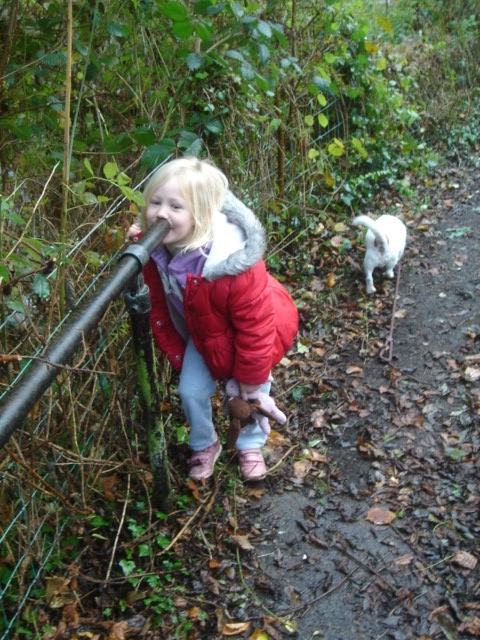

... cross the dangerous road through the village, with tremendous care, and ascend the opposite hill on a narrow path to where the railway ran in and out of the Forest of Dean.
"There's a ghost train runs along here! Can you hear a train?"
 |
| Waiting for the ghost train that runs through the Lydbrook Valley |

"What about the ten foot rabbit?"
"It's scared of the train. It lives over the way where we walked before"
"It's coming" shouts Oliver "Get on the train. Quick"
Safe on the train, we head toward the river. We descend by many steps to the Wye, collecting interesting fruit and seeds and leaves.

Beside the river there are ducks and a pair of swans scavenging, neck dipping for seconds at a time, by the opposite bank.
So home on the pavement up to the centre of the village, up the Bell Hill path.
"Have you seen the mess the wild boar have made of our lawn"
"It's the ten foot rabbit"
"No! Wild boar rooting"
Indoors the grown ups are about, well fuelled wood fire warming the room.

"Where are we going today?"
Making decisions about this will go on a while. I sit back with a mug of tea. The children lay out their samples, examining what they've collected.

*** *** ***
Εορτή Αγίου Ισιδώρου
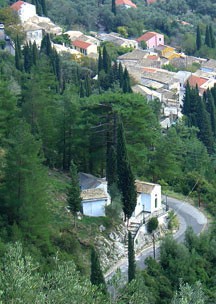
Παρά το δυνατό νοτιά, ο κόσμος γέμισε απόψε το εκκλησάκι του Αγίου Ισιδώρου πάνω από τη Βενετιά, για να παρακολουθήσει το Μεγάλο Εσπερινό, παραμονή της εορτής του Αγίου. Το ψαλτήρι, όπως πάντα πλήρες, με ανάμικτο «τοπικό» και «βυζαντινό» ιδίωμα, με τον Γεώργιο Κένταρχο και το Σπύρο Τσιριγώτη στο Ανάγνωσμα της «Σοφίας Σολομώντος».
|
Memo to myself re Birmingham City Council's plans to decommission Walsall Road Allotments - a petition. It was started by my friend Betty Farrugia, Secretary, for many years, of WRA - probably the best allotment site in the West Midlands. She it was who persuaded me to have an allotment myself, after we'd saved the Victoria Jubilee Allotments near my home in Birmingham. [By 21.00 on Tue 19th Feb 6.700 signatures had been attached to the petition: 8006 by 01.00 22/2/19]; 10274 signatures by 15.30 on 28th Feb 2019.
 |
| Walsall Road Allotments threatened by plans for Birmingham's 2022 Commonwealth Games |
Wednesday, 9 May 2018
Tasks

I’ve clambered through the kitchen window to weed the small gulley between our house and the neighbour’s wall, lopping their overhanging fig branches to give light to WC and kitchen windows. I’ve tightened my Brompton’s front wheel that was beginning to wobble on its bearings – something I noticed as I freewheeled down the zig-zag road from Sokraki, stopping only to sit for a few moments in the cool quiet of the tiny church of Ag Isadoras on the ninth bend up from Ano Korakiana.
 |
| Ag. Isadoras above Ano Korakiana |
“You are the first!”
I’ve checked our bank account to bring our statement up to date and ensure payment of our standing orders for water and electricity. Cycling home I stopped at Rolando’s shop in Kontokali to have a look at his electric bikes. He insisted I try one. Out of curiosity I did. You peddle. The bike takes off on its own, gently, soundlessly and powerfully. Very tempting but – apart from prices of €2000+ - I don’t want one. Peddling starts the battery driven motor. Once going I’d stop relying on my own faltering strength, whose testing is two thirds the joy and a third the pain of cycling. If an ascent is too hard I’ve the time to get off and walk.
I work through books – Mia Gallagher's Hellfire, Edna O’Brien's The Little Red Chairs, Katie Hayes' Lindbergh’s Legacy, Michael Wood's In Search of Shakespeare, James Herbert’s The Secret of Crickley Hall.
Harder work, for longer perusal and reference, is a book, found for me by my friend Mark, authored in 2017 by the Swedish biologists, now living here, Marie and Bo Stille The Herpetofauna of Corfu and Adjacent Islands. The book cost me €30. Far from being simply a catalogue of species - comprehensive though it is on that score - the book goes far beyond that, comprehending with charts, maps and descriptions of habitats – geology, geography, climate, vegetation - describing, also, the human culture including environmental legislation and three finely written pages on ‘Humans, snakes and fear’. That such fear is instinctive remains despite years of research, unproven. The authors suggest fear of snakes is more likely the product of ideas than genetics.
The positive thing with a behaviour transmitted by ideas and not by genes is that it is relatively easy to change one idea for another when new knowledge becomes available. Consequently the fear that makes us indiscriminately kill snakes, including those that are not harmful to us, should in most cases be easy to overcome. However, oral tradition still has a stronghold in many cultures and old stories of snake dangerousness keep on spreading. (pp 315-316)

Two years ago a part-time neighbour here was kind enough to walk up to our house and warn me, for the sake of the children he emphasised, that there were snakes on the path between our homes. He held up, for my inspection, a jar containing two beheaded slow worms. The other day a friend told me he’d killed two snakes on his plot.
“I knew because they had that black stripe down their backs”
We found a picture in the Stilles’ book
“That’s it!”
It was, as clearly illustrated in the book, a juvenile Anguis graeca or Greek Slow worm Ελληνικο χονακι ‘completely harmless’.
The Stilles' book can be bought with an accompanying poster - €3 - showing pictures of all Corfu's snakes and slow worms, too often mistaken for and often killed, along with other harmless snakes. One snake, only, on Corfu is venomous - the horned viper - a creature no more dangerous than its cousin, the British Adder. Potholes offer greater hazard.
This book is about faith, hope and love. I judge it as significant for the missionaries and disciples of our spreading belief in the world's environment, as St Paul's Letters to the Corinthians in the New Testament was, and is, to Christianity. When I was 16 in 1958, my stepfather, amid one of our many long conversations during my growing up, suggested that a ‘new religion’ was emerging across the world; one that held as its central tenet, that the survival and salvation of mankind depended on his stewardship of the earth - a faith supported by science but, being near unprovable, still a ‘faith’.
“It’s called ‘environmentalism’. It grows from a move away from drawing up lists of natural species to understanding their ‘ecology’ - our own included!”
I remember this, while having little understanding, at the time, of what Jack was talking about.
 |
| Using the multi-tool to smooth a windowframe |
There are louvred exterior window shutters that are near indestructible, their colour running right through like words in 'Brighton Rock'; to be bought on the internet, delivered by courier; maintenance a damp cloth. On our house some of our windows are metal, but others are wooden with hard wood shutters at least forty years old, perhaps much older. Louvre slats increase their surface area. Stand back, and I can see the joiner’s small variations during their making, increased by repairs.
 |
| One of my gravings |

It takes time to maintain wooden shutters. Lifted from the pintles on their wooden frames (those too need maintaining), I lay them on a plastic sheet under the veranda. I sand the roughest looking surfaces down to the wood, and, where necessary, replace rotted parts; apply filler in cracks and small holes; let it dry then wipe down with white spirit and apply colourless preservative which serves as primer and holding for undercoat on surfaces where the old paint is sound. After the undercoat comes the pleasant labour of applying Corfu green surface gloss. Each of two coats takes 24 hours to dry. I leave it longer.

** ** **
With my friend Dave I’ve replaced a beam supporting our wooden balcony. When we walked there last year Lin and I saw a dip in the decking and assumed a normal settling. Then Mark, visiting, noted how one of two supporting beams had fallen four inches, where it entered the centre of one of its brick support columns. He inserted an Acrow prop to secure the balcony over the winter.


On a stepladder Dave sawed through the centre of the damaged beam. Both pieces slid easily from the support columns, to be lowered to me. The cavity at the top of one of the column harbours an ants’ nest, whose inhabitants in their constant activity had reduced one end of the beam to a splintered stub, which, if it had given any further would have led to the collapse of one half of the balcony.
 |
| Ant work |
“Seems they’ve left that alone. But keep an eye.”
We lift the new beam into place; tap away some old mortar; perfect fit; unscrew the Acrow, and lower the jack, deftly catching the substitute plank, as the new beam starts its job.

From above, it’s the power drill with screw driver again - zzzz zzzzz- done, zzzzz zzzz- done, zzzz zzzzz - done; the shims and decking replaced; the decking now pleasingly level; job completed in 3 hours. Cups of tea had helped us through the morning. Now we broke two cans of lager.
“Finished in the cool of the morning, Dave. You made it look easy!”
***** *****
It’s not the best idea to ‘battle’ against nature. For the first time in ten years we experience the deprivation of abundant fresh oranges and lemons - one of the delights for a northerner in Greece. Since last spring, citrus scale insects have infested the under surfaces of the leaves on our two lemon trees and one blood orange.
 |
| Not a disease - an infestation |
Scale insects are a pest familiar in the citrus industry. They occurs in the USA and all over southern Europe. Not all citrus trees are affected. On walks we’ve see many unaffected trees, bearing the abundant lemons and oranges we had come to take for granted. Last spring, on advise, Lin mixed dissolved bars of olive soap in boiling water, mixed with oil to hold the olive solution on the foliage. We sprayed as widely as we could reach with a hand pump sprayer lent by Mark. The insects turned to black mush which dried up. On new growth the scale insects return, the male insects travelling, the female clustering and immobile once on their leaves. We sprayed and sprayed at regular intervals. Still new insects return; in small numbers at first, but in clusters that visibly increase. I have watched them gathering. As well as spraying, I’ve hung sticky fly papers in the branches. In days they’re covered, sometimes, to my regret, with a trapped lacewing or bee, but mostly thousands and thousands of scale insects. My neighbour’s orange tree has no fruit nor blossom, but seems clear of scale insects. What’s their vector? Where are they coming from? Why are they on some trees and not on others? Some people here have pollarded their trees drastically. Others have even felled them – which might work for disease but can have only limited effect on spreading insects. Others have employed pest controllers who’ve applied traditional toxic sprays as for other pests, but this like our non-toxic olive soap solution, kills the insects only for more to return. I long for signs of the arrival of predator insects, enjoying scale insects as a welcome feast. Many ants roam the branches but they’re lapping the honeydew in the mould, leaving the under leaf pests unmolested. They may even, as I've read, have a symbiotic relationship with the scale insects, moving them about to new trees, or replacing them on leaves we've temporarily cleared by spraying.
“We need Ladybirds” says Lin.
I cannot just leave the trees alone, hoping that nature will take its course – since with all leaves coated in black mould preventing photosynthesis I will be watching our trees die.

Symbiosis of ants and other insects: One of the most common is the herding or farming of sap feeding insects 'homopterans' such as aphids, scale bugs and mealy bugs. ... By stroking the back of some aphids with their antennae, the ants can induce a honeydew droplet. The ants may move the insects to areas on the plants with the best sap.*** *** ***
On the 1st May I was standing on the balcony and a neighbour saw me and called ‘Kronia Polla. Proto Maio!” I’d clean forgotten. I went foraging for flowers from verges, walls and abandoned gardens returning with flowering garlic, violets, a pink mallow flower, yellow and white daisies, sprigs of jasmine and wild sage called Lantana Camara - dry thorny stalks bearing bunched florets of many tiny multi-coloured flowers. I found roses, wall flowers, and from a flourishing Bird of Paradise plant, two orange azure flowers like parrots’ heads, sweet peas, clover, blue flowered comfrey prickly to pick, a lily from our garden and a deep purple leafed plant bearing a tiny pink flower. I fixed these with green string in granny knots to a wired circle of long stalks from the invasive pelargonium on the wire fence in our small garden.
 |
| Spring 2018 - all my own work |
 |
| Λάμπατα στον Άη-Γιώργη - 22 June in Ano Korakiana |
**** **** ****
On a Sunday I cycled to Dukades – 5 kilometres west, as the crow flies - to sit in the platea in the shared shade of a Jacaranda and a Lime tree sipping chilled village wine with two of my neighbours, absorbing languid conversation, noon sun seeping through the greenery, sparkling our glasses.
“Look how the sunlight dapples my white wine. If a cloud comes it doesn’t seem as good. Go away cloud!”
Our talking turned on gender fluidity, so normal but with vexatious implications for architecture and competition; vulture capitalists feasting on Greece. How much profit, if any, seeps into the surroundings of these grand hotel projects? Morecambe! Where my neighbours knew one another in primary school. Solar energy - why isn’t Greece’s free resource, so much scarcer in the north, being tapped into by everyone? Will they ever sort out the ethical programming of driverless cars? Who will the software save first, the children in the car or the old couple who walk out in front of it? “Hm? That’s a bit of a no-brainer”; peculiar neighbours and the kindness of strangers; bitcoins and the end of money “Monitor every transaction and human ingenuity will invent alternative ways of doing business”; fake news, filter-bubbles, ‘likely stories’ and urban myths; and letters to Agony aunts.. 'Dear Marge. I’ve suffered from dropsy since childhood. An orphan, abused by carers, my relationships end in desertion. Help…’ ‘Dear Marge. A servant on one of our yachts persists in wiping the condensation off the champagne before removing the cork with such a noisy pop. Help’ …’Dear Marge. Can you help us with scale insects on our lemon trees? They’re spoiling our lives….’
A Sunday afternoon torpor, impossible north of the olive belt.
“We’ll go home and light the BBQ. Will you join us?”
They headed off by car, while I descended from the village via the road down to Paleo, pedalling away towards Doctor’s Bridge, but long before there, I spied a left turn down a narrow road signed ‘Corfu Donkey Rescue’. At last I’d found, after instructions from Mark, a road that went direct, if curvedly, to Skripero, with hardly an ascent.

I cycle gently between green hedges, trees forming shady tunnels, passing gaps through which I see meadows of flowers stirred by the afternoon breeze from the mountains. If I hold my breath the sound of bees comes from everywhere. I see butterflies, small birds, and, gliding on thermals, two eagles, mewing at one another where their separate circling intersects. In the distance, spread across the slopes beneath Trompetta, I see the separate parts of Ano Korakiana – Mougades, the Bear (where we live), and Venetia. An aeroplane passes over ahead, ascending northward
“Poor sods”
One of the difficulties of not believing is that I have no-one to thank for such happiness, so I do anyway, following pagan instinct - 'pagan' being the old name, so I was told by Richard Pine, for a villager.
“Blessed Mary, mother of God, pray for this sinner, now and at the hour of my death" and I, a Protestant.
****** ****** ******
On another Sunday Mark, John and Karen and I had Sunday lunch at ALS by the shore at Pyrgi. I cycled there through Ag Markos. Clouds with rain and wind and even some thunder during the night were clearing, leaving the shallow sea lapping the gravel beach near our table, limpid yet still blue over white and grey round stones, slightly ruffled so far as the horizon that underlies the mountains of Epirus across the Sea of Kerkyra.
 |
| Mark, John, Karen and Simon |
In a month I’ll be finding it too hot this close to the shore, but now the climate was perfect, on a par with high summer in England, nearly shirt-sleeve weather.
“I passed you on the way” said Mark, who’d promised to drive me back later, bike folded in the back. We had beer, for me the green topped Ionian Beer I like, and later village rosé in a big carafe. Starters: courgette balls, saganaki - fried cheese, squid, and garlicky mashed potatoes - skordalia, and a rocket salad with balsamic vinegar and shavings of strong cheese. Bread too, fresh for Sunday; then, after just the right interval, whole sea bass twice, similar sea bream, and veal in wine sauce - sofritto. All around us, Greek families and friends. Though visitors are arriving, planes and coaches coming and going, the holiday season has yet to speed up. People are still preparing premises, smartening frontages, laying planks on jetties, raising flags and signs.
On the way home Mark took the low road one which I cycle and walk, becoming a gravel track through deep woods, undergrowth and overhanging greenery.
“You do know there’s been a landslip ahead?”
When we got to where rain had washed away the ground supporting a concreted stretch of our road, he went on foot to inspect. Then before I had time to be a sensible coward drove over the stretch at risk, making mock panic noises.
 |
| Rain-made landslide undercutting the rough track between Pyrgi and Ano Korakiana |
“The concrete has a metal grid reinforcing it. They’ll need to build a supporting wall and in-fill. Quite a job and expensive.”
Near where our route turned up to join the Ag Markos road, Mark steered suddenly left along a gravel track I’d not noticed before and brought us to a church low on the eastern edge of Ano Korakiana whose cemetery was covered in poppies, white daisies and delicate blue flowers, almost hidden beneath, the whole waving in the wind among the white marble gravestones with their artificial flowers, photos of the departed and small lamps.

We drove on, and stayed until after dark, sitting quietly in the garden at Karen's and John's below the village. A mass of grey cloud came charging over the mountains, surging before a north west wind, but still no rain. The trees rustled and bent. The air grew almost chilly.
“Home?”
Back in the house I slept early. The street lights were out, the village in darkness. Shapes and tones and now and then lightning and thunder
 |
| A windy evening at 208 Democracy Street |
Friday, 24 November 2017
First world problems
 |
| Arthur Rackham - an illustration from Peter Pan in Kensington Gardens |
Magpies leap around inside the frieze of black branches at the bottom of the garden. Unruly wind stirs a medley of orphan leaves; stripping the trees of the few that remain, reminding me of infancy. Some I’ve gathered on our front lawn where a few rainless days will dry them, so I can run the mower over them, bagging their grated remains to join the compost on my allotment or use them for mulch, food for worms.

The weather’s mild. Lin complains “it’s cold” so now I start inroads on the logs I cut and split in summer; lighting the wood stove in seconds – top-down – the warmed flue whistling, wind drawing up the first flames, crackling, roaring. I’ve worked through my in-tray since we came home. On recommendation from CS, improver and restorer of houses, I brought in Wayne and Barbara of Genesis to clear all our roof gutters. Booked an eye test to check a small cataract in my left eye, made appointment for a flu jab, and for the dentist; filled in the form for my 126th blood donation, confirmed an appointment with Mr Martin Sintler at City Hospital to assess me for an operation on the inguinal hernia I developed in August.
On Monday, recruited from the 1000elders, I kept an appointment with Dr Benoit Smeunink at QE Hospital to be briefed, and sign consent forms, for participation in the ‘Bed-Rest Study’ in the New Year – official title Exercise 'prehabilitation': A novel intervention to protect against disuse-induced muscle atrophy and sarcopenia in the old.
The drift of government policy is to keep those of us who might otherwise be reliant on the burdened NHS, healthy and fit until we drop painlessly and naturally - what ever that means - dead (like in the movies!). The main killers of the elderly are heart disease, cancer, chronic obstructive pulmonary disease, strokes, Alzheimers, diabetes, pneumonia, flu, nephritis - a kidney thing, septicemia - and there's another list of illnesses that contribute. The whole population is susceptible to the same dangers, but getting older increases susceptibility, hence so much research on reducing the ill-effects of 'slowing down', and in this case, being confined to a hospital, and worse, to a bed, after a procedure. How can I avoid sarcopenia, or worse, cachexia? Like an old horse, once I lie down, the chances of getting back on my feet lessen. The vet can gently finish off a horse, but I could be bed-ridden, with occasional wheel-chair forays, for an unpredictable age.

Other things, vexing in their banality; long spells sitting in our kitchen half-heeding recorded phone messages, pressing handset keys between sales talk, wrestling gently with human respondents working to a script, striving to sort confusion between energy company Npower, who we’ve left, and energy company Solarplicity, who we’ve joined, about gas and electricity supplied to Rock Cottage during what appears to be a difference between the two companies’ switch-over dates and their use of estimated meter readings as against the actual readings they were sent by me - an issue also described as 'cross metering' or 'erroneous transfers'. Solarplicity says switch over was 3rd Aug for gas and electricity. Npower says it was 2nd Aug for electricity and 17th Aug for gas, and insist this is confirmed on the 'national data base', an entity I can't even find on the web, but which may be the National Meter Data Base or could it be the Meter Point Administration Service (MPAS)? I'm being mailed court order threats from Npower – on and off the most complained-about of all energy companies in Europe - in pursuit of gas and electricity bills for whose payment I have dated receipts. The sums involved are under £5. The transfer process began mid-July 2017. Over these four months consider the cost of our time and their time pursuing this ageing company-made error. Result of our time (Lin and I share this sort of chore) on the phone so far? Agreement by Npower to stop phoning (they even phoned us in Greece) and mailing demands – until the dispute is resolved.
24/11/17 Your reply from npower. Your account number:12601** Code: E1*T. Hello Mr Baddeley. Thank you for contacting us about your account. I am sorry to learn that you have not received a resolution for your complaint. I am aware from reviewing your account that this is still ongoing. Our Complaints team is working on resolving this for you and I have made them aware that you have contacted us again about this issue. Rest assured, Mr Simon Baddeley, we will be in touch soon. Your unique reference number for the complaint is 12601**47, please quote this should you wish to speak to our Complaints team directly on 0800 316 9328. They are available from 8am to 6pm Monday to Friday and 8am to 2pm Saturday. If you prefer, you can email complaints@npower.com. Thank you for your patience in this matter, Mr Simon Baddeley. I am confident that this will be resolved for you shortly. Kind regards Chris Thewlis, Customer Services Director, Customer Services‘Our’ (No! ‘your’) problem according to Solarplicity - another 25 minutes on the phone - is that the sums involved are too small to ‘raise a dispute’, which means we can’t recruit them in stopping Npower in their system’s automated tracks. Fascinating as a symptom of the times, this tiresome ‘first world problem’ vexes but doesn’t worry me. If it ends up in court – unlikely - I shall, as both of us have in the past, enjoy telling this well documented fiasco to a court. (We’ve never lost a case). There are places where, in a different world, I might be trying to get Linda out of solitary confinement based on mistaken identity, or travelling to the Hague to bear witness against Ratko Mladić for the murder of our child.
29/11/17 Email from npower, to back up a phone call from the company, that looks to have sorted 'our' problem:
Unique Reference Number: 10157*** Dear Mr Baddeley. Further to our telephone conversation this afternoon, I can confirm that in line with our agreement, I have now removed the outstanding gas balance of £28.47.* * * * * *
As I have been unable to contact Solarplicity directly with regards to the closing meter readings, I have confirmed that we could either continue to contact your new supplier and re-agree a new final meter reading. Alternatively, we could remove the balance however, no further amendments would be made to the final meter readings.
You have confirmed that you would be happy for me to remove the outstanding balance without agreeing a new meter reading with your supplier. Therefore, I have applied a credit balance to your account today and this leaves nothing to pay.
I can confirm both your gas and electricity accounts have now been closed to a £0.00 balance.
If you’d like to discuss this with me, please call me direct on ****etc. Kind Regards, Bev Young, Specialist Advisor, Executive Liaison Team
A meeting was held at Dot’s care home the other day. Anticipated this last fortnight, it was to determine whether Staffordshire NHS Trust could continue to pay for my dear mother-in-law’s care, or whether this should be handled by Staffordshire County Council’s Social Services who would seek funding from the family. Amy, our daughter was at the meeting at the care home, attended by an NHS manager and nurses who look after Dot. She phoned us to say the NHS, after 17 months at the care home, would no longer pay for Dot’s care. We await a rubber stamp to this decision after which we have about 6 weeks to continue paying the care home out of Dot’s inheritance, such as it is, or make alternative arrangements.

“Yes” said Lin "and we can clear the sitting room at our house, put in a bed and all that’s needed, and have a visiting and occasional live-in carer service.”
Dot can hardly stand, let alone get about, but she can be gently moved from bed to wheelchair. She can feed herself but her care must involve washing and therapy to deal with the risk of sores from spending most of the time bed-ridden, as well as “going to the loo and all that”. Now should be payback for all the National Insurance Dot's paid through her long life but what’s been paid out so far, for her care in old age and disability, can no longer be paid, and the state wants, now, to dip into her savings. Arthur, her husband of 70 years, died in April 2016 at 98. She’s regularly visited by her grandchildren, her niece Janice, and Lin and I and the grandchildren, and also Oscar dog, who is welcome at the care home.
“I knew the NHS wouldn’t continue funding” said Lin, “Mum’s situation didn’t meet their criteria”
Just before we left Corfu, there came a message from Epirus asking if it was true that XX, a mutual friend we knew had been ill, was confined to a care home in Perama. We made some enquiries, located the place and visited - a 15 minute walk across the causeway from below Kanoni. I promised after our visit to write to him, care of another friend, he being without phone, radio, tape player, books or computer (not wanting them even when offered)...adding that I'd put the letter on the internet to ensure that, one way or another, he'd get to read it, or, at least, have it read to him:
xxxxx
House of
Elderly Care
Perama
Gastouriou,
Dear Xx
I’m sending
this via our friend Yy, who promised to bring you and, if necessary,
read you this letter. I’d prefer to hand write, but the letter may be easier to
read, typed. I’ve used larger than normal font; your description of me as
‘distinguished’, as I sat at your bedside, being a measure of your disability.
I’m so glad
we met you again just before we headed back to England. Despite your circumstances, you entertained
us for two hours with the same thoughts and words that marked our first
acquaintance.
We’re back
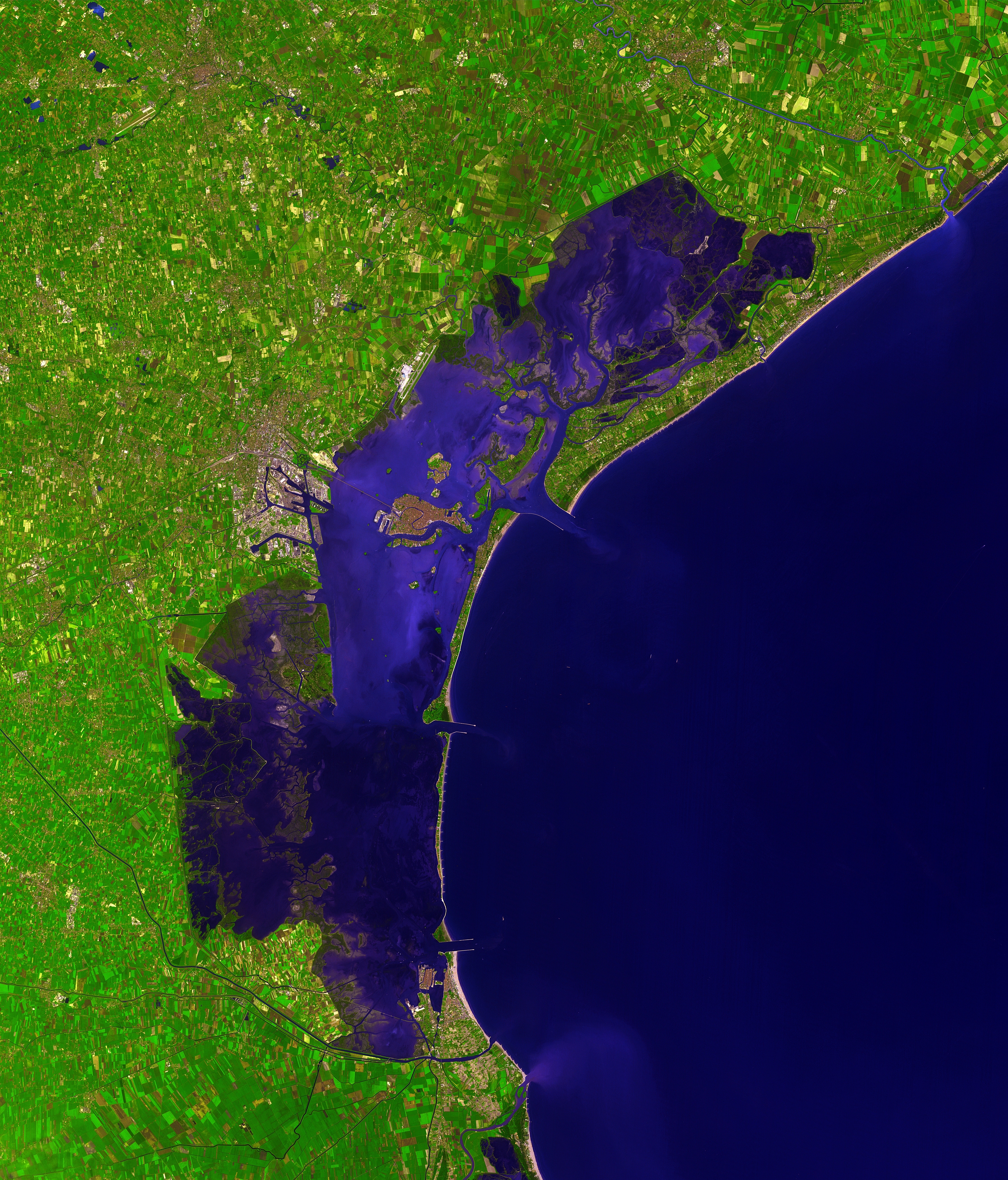
in Birmingham after three days in Venice, chased up the Adriatic, from
Igoumenitsa, by a gusting gale.
 |
| Passing the Karaburun Peninsula, on Anek Line's F/B Asterion, before a southerly gale |
Those big ferries are floating warehouses with
noisy accommodation. They clang, echo and rumble, almost ignoring the sea. We
snoozed in armchairs, among truck drivers.
As our ship
approached Fustina, the clouds pealed back, revealing distant peaks across the
horizon – snow-topped Dolomites. Lin and I roamed the lagoon by water-bus. On
Torcello we ascended the restored campanile of the island’s Byzantine
cathedral.
A young man at the ticket office said we could ascend the tower, but
its belfry was open only “to priests and children under 6”. Only at the top,
having breached this rule, and admired a sunlight panorama of marsh and water
from the vertiginous belfry, did we grasp the Italian leg-pull. “Only priests
and small children! Ha!”
 |
| Up the campanile of Santa Maria Assunta |
Venice sparkled.
One afternoon, we sat in the sun at Pellestrina, a village on the narrow lagoon
spit, sipping coffee and local wine, hearing the sound of Adriatic surf from over the
mighty sea wall that protects the city and its islands.
Back in
England we’re working through in-trays; the largest challenge - arranging to
move my bed-ridden mum-in-law from her care home, for which the NHS will no
longer pay, to a room in our house, which will be equipped with kit and care
brought in to help us out, leaving Lin, when I ask her if we can be in Corfu
for next Easter, saying, of our next flight, already paid, “I hope so”.
Lin’s mum has been a wonderful grandma. Like you, it’s not good to see
her bedridden. She’s without her husband of 70 years, who died 17 months ago.
These things are tests of character. Mine not hers.
There’s junk
mail, bills to be paid, and jobs to be done – like cleaning out house gutters.
The wood I collected, sawed and split last August is feeding a wood stove in
the kitchen....Lin and I
are working on your escape plan. We’ve got you faked papers, cunning disguises
and skeleton keys, and a scooter that will be left near the end of the causeway
to Kanoni, where you will be met - password ‘λοιπόν’ - and escorted to a safe
house until the hue and cry has died down. Love, Simon & Lin XX
 |
| Ernest Hemingway with the sculptor Toni Lucarda on Torcello 1948 (Archivo Cameraphoto Epoche. NYRB Oct 2017) |
 |
| On Torcello - we crossed the ditch on the planks |
 |
| The other side of the sea-wall at Pellestrina |
 |
| On Pellestrina - a long narrow strip of an island at the edge of the Lagoon of Venice |
Subscribe to:
Posts (Atom)