Total Pageviews

Showing posts sorted by date for query "1994 I invited". Sort by relevance Show all posts

Wednesday, 27 June 2012

'Tom' Maitland and his successors

A message on Flickr:
Hello Simon, as I'm just back from Corfu I did a search on Maitland and the first thing on Google was your photo page! You mention research on the protectorate - have you written anything on this issue? Thanks, joanne
Hullo joanne. Thanks for your interest in my interest. I gave a talk a few years ago at the Durrell School on the different British High Commissioners and some of the circumstances around their time in office. This starts with Sir Thomas Maitland (1816-23), though the first Commissoner (Maitland, typically, added the 'High') was Sir James Campbell).
[Use pause to view specific slides and images] 
You may already have seen my references to Maitland and to Ionian Lord High Commissioners on flickr and also on my blog Democracy Street:
Apart from my interest in this subject my search for more history was spurred by a request from a neighbour and local historian in the village of Ano Korakiana, asking if I could find a particular letter in the UK archives about the Ionian Protectorate (my help in this was the fine scholar who I mention often - Eleni Calligas*). Here is a reference tho' to that 'letter' or 'petition' which several years later I've still not found tho' the search for it has taken me to interesting places.
Search around in my blog for further references to Maitland - an unnattractive fellow; an ill-mannered manipulative bully who, despite being the governor of a protectorate, tried to treat the ionian islands as a British colony**. Best wishes, Simon
Walter Frewen Lord - author of Sir Thomas Maitland - Mastery of the Mediterranean (1897) - provides a credible account of his subject's behaviour towards the Swiss engineer De Bosset; one incident that especially supports my ill-opinion of Maitland. Lord is by no means prejudiced against his subject, treating Maitland as just the official to sustain 'mastery of the Mediterranean' and British standing among the Ionians. Charles Philippe De Bosset was an Ionian road builder. His tale should be rehearsed lest the building of the Ionian road network - an excellent project - be credited to Maitland rather than recorded as something that happened despite him as a result of the endeavours of a hard working professional.
Colonel De Bosset 
Maitland who wasn't keen on 'foreigners' meant to drive De Bosset out of Corfu. De Bosset reported himself to the new Lord High Commissioner, and was immediately invited to dinner, and afterwards, on the 6th of February 1817, to a ball.
In the ball-room Maitland pointedly and deliberately approached the colonel; and the other guests fell away out of respect and left His Excellency and his victim face to face, with no one within earshot. Hence we have only De Bosset's word for what followed. But there are such volumes of evidence on the whole case, and De Bosset's word was so continually and fully substantiated, that we cannot avoid noticing his account of this short interview, and indeed it is only too likely a story.
 "Colonel De Bosset,'" said the great man, "I am very glad to welcome you to Corfu, and to say that I think you had much better go away. You have many enemies here, and you would do better if you went away as soon as possible."
The unhappy man could only stammer incoherently in reply to so fierce an assault ; whereupon Maitland, smilingly and ingratiatingly, with every possible mark of affectionate attention, repeated his menace. De Bosset could only bow, and leave the ball. Next morning he called on the military secretary and asked what it all meant. After so broad a hint, he said, there was nothing to do except to go. Perhaps the Lord High Commissioner had some plan to that end that he might fall in with. But Hankey*** would not help him.
"There was nothing in it all" he said; everybody had noticed how drunk His Excellency was, no doubt he had forgotten all about it by now. But no man in De Bosset's position could rest satisfied with such an answer.
"It may be," he replied, "that His Excellency was drunk, although personally I cannot think it. His speech was quite plain, startlingly plain, and no drunken man could so command his features as to threaten me with ruin while apparently he was overwhelming me with compliments."
But Hankey stood by his chief. Sir Thomas was drunk, and there was an end of it.
"Granted, then," said De Bosset, "since you will have it, that His Excellency was drunk, there still remains a proverb that you will be acquainted with, and that I take leave to remind you of, in vino veritas : and there is the question to which I have received no answer — How am I to go away?"
It is to be presumed that the military secretary had his cue, for he would say nothing. It was not Maitland's intention that De Bosset should be honourably retired; he meant to expel him ignominiously. When this had been achieved, and the quarrel thus artistically rounded off, the unhappy man made his way to England and waited on the Duke of York.
"Nobody," said His Royal Highness, "could take away an officer's commission except His Majesty, and the colonel might rely upon his assurance as commander-in-chief that this would not be done without the fullest investigation." 
De Bosset recovered his reputation though the sense of grievance he had experienced in his encounters with Maitland runs through his book - Parga, and the Jonian Islands comprehending a refutation of the various Mistatements on the Subject: with a report of the Trial between Lieut. Sir Thos. Maitland ... and the Author. Maitland was discredited in ways that would probably not have bothered him. The Ionians lost a road builder.

*Eleni Calligas (1994) The Rizospastai (Radical-Unionists): Politics and nationalism in the British Protectorate of the lonian Islands, 1815-1864 - follow this link to her Phd thesis.
**…the despotism erected by Maitland in the lonian Islands was not solely the result of his own initiative. Earl Bathurst (Secretary of State for the Colonies) laid down the general policy, with which Maitland was in complete agreement, and Maitland distinguished himself by the ingenuity with which he carried out these orders. W.C.Dixon (1969) The Colonial Administrations of Sir Thomas Maitland, New York.  Ref in Eleni Calligas (1994) p.34
***Lieutenant-Colonel Sir Frederick Hankey, Secretary to the Lord High Commissioner of the Protecting Sovereign etc
*** *** ***
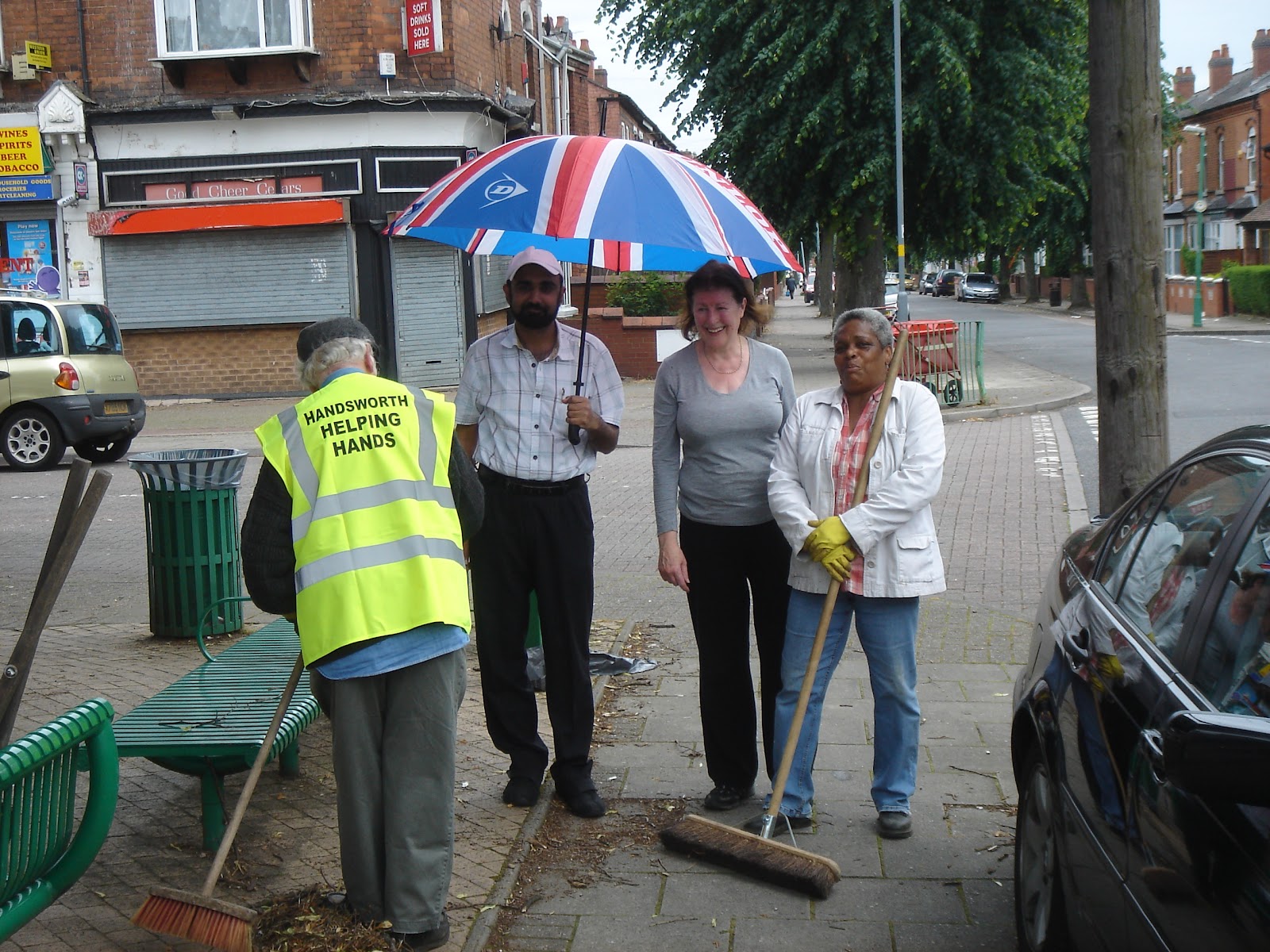
Mike, a passing supporter, Denise and Lurleen - helping tidy Church Vale
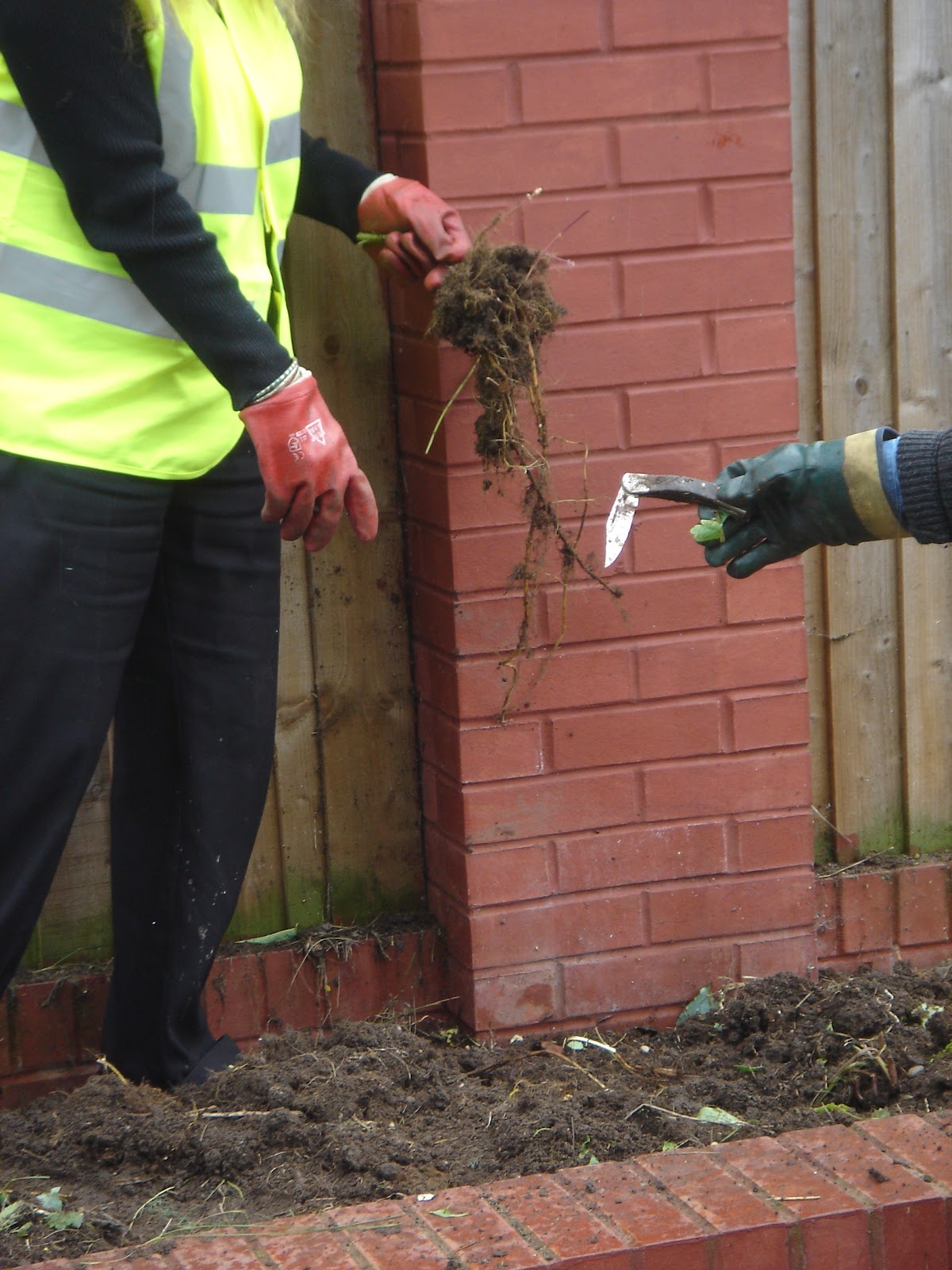
Knife in the nettles - bagged and handed in to the police
We found a knife deep in the nettles in a flowerbed full of nettles on the edge of Church Vale in Handsworth. It was bagged up, untouched, and dropped off at Thornhill Road Police Station.  Handsworth Helping Hands team were exploring the nature of litter and dust in one part of their area, tidying up with some help from our local Councillor Waseem Zaffar, who's been awarded the MBE for services to the voluntary sector...
Mike, Rajinder, Oscar, Simon, Lin, Waseem, and John in Church Vale, Handsworth
The Council waste contractor sent a refuse truck and crew to collect heavy rubbish like furniture and building material.
Cleared of litter and nettles, prepared for replanting
We collected 40kilos - according to the weighbridge at the Holford tip - of small stuff along with two small crates of bottles and plastic for recycling. There was trash in nooks and corners that had not been cleared for months or even years - such detail; an urban archaeologist's dream; crimp bottle tops, fag-ends - nicotine and spliff - ring-pulls, gum wrappers, many other sweet wrappers, newspapers, plastic bags, fliers, tissues in every stage of decay, cans, bottles - plastic and glass (all recycled) - coupons, fast food wrappings and cups of paper and polystyrene, odds and ends of cellophane, string, plastic lighters...all these in kilos collected in grey plastic bags mainly by hand. Church Vale has recycling bins and four litter bins dotted in a space hardly 60 yards by 50. As we left after tidying as best we could an old man who'd gazed in our direction as we went about our worthy work dropped his fast food wrapper and cardboard box in the gutter between two litter bins 20 yards apart. As E.M.Forster might have said "Only collect"
Dropping off 40 kilos in-grey sacks at Holford Drive Waste Collection Centre
There is a rich litter on the psychology of littering with myriad proposals about persuading people to keep their neighbourhood clean. I recall a friend of friend - a US psychologist (I'll find his name) working with the Australian Parks Service, with a record of valued work in Scotland and other parts of the world - who said it wasn't helpful to just get vexed about this. "You get angry about litter because you project onto the person who does it the feelings of shame you'd have if you or your children were to do the same thing. Understand, Simon, that people who drop litter are coming from a different place than yours. Until you understand their behaviour, you cannot begin to find effective ways of persuading people not to do it". Here's an example of one 'nudge' against litter  - make litter bins orange. Hm.
See Nudge: Improving Decisions about Health, Wealth, and Happiness by Richard Thaler and Cass Sunstein. It's all about libertarian paternalism = the union of two political notions commonly viewed as being at odds. The book's theories, research and suggestions are interesting some governments including ours. I like humming a tune from a hymn whose 17th century words - George Herbert's - I like a lot. I learned it as a child -
...nothing can be so mean,
which with this tincture, "for thy sake,"
will not grow bright and clean.
A servant with this clause
makes drudgery divine:
who sweeps a room, as for thy laws,
makes that and the action fine.
*** *** ***

Hardly finished the clean-up on Church Vale I'm with Aftab Rahman and Jo Burrill in a meeting room at the Birmingham Asian Resource Centre (BARC) at 110 Hamstead Road, so Jo can go over the £200  Bronze award from the Small Environmental Grants Scheme prepared by Aftab on behalf of Legacy WM - a pilot project in partnership with Victoria Jubilee Allotments and Legacy WM to raise awareness of recycling, composting, growing food and cooking them. "I've never been audited in such detail for so small a sum" murmured Aftab. But funding everywhere is getting tougher along with its oversight. Even for our £200 it makes sense.  The grant will be used to help...
...work with young people from the Bangladeshi Youth Forum and older people from B,ham Asian Resource Centre to demonstrate what can be done in people’s gardens and how food can be prepared.  We will host two cooking days in the Victoria Jubilee Allotments and raise awareness of the benefits or eating organic food and encourage people to take similar initiatives in their own homes.  It will also look at the negative impact of fast food on health....
Jo went over Legacy WM's eligibility - charity number and account details for instance. Aftab will bring cooking and catering kit to the Victoria Jubilee Allotments. I'm liaising with the Allotments' Association and plotholders to arrange a day in August and another in September for Aftab to visit the VJA site and prepare meals from crops brought him by gardeners. After the meeting I took Jo, Aftab and Ashok (manager of BARC) for a walk around the VJA, to see where a table could be set up for cooking, to meet a couple of gardeners on the busiest plots and check the range of vegetables growing there as well as to show them over my plot  - which at least had about seven different things (other than weeds) growing on it - onions, potatoes, cabbages, sprouts, broad beans, runner beans, with seeds of parsnip, tomato and spinach and several young fruit trees, blue berry shrubs, a vine and a clematis and the flowers Lin has planted in narrow beds at the top of the plot.
Aftab has also won rather more money for a project conceived last year - a heritage trail in Lozells and East Handsworth with which I assisted. This area has some amazing historical buildings that have played a significant role in shaping modern Britain.  For example ‘St Mary’s Church’ was where Mathew Boulton met as part of the Lunar Society, the Birmingham Asian Resource Centre building was the ‘Toll House’ that collected taxes on route to ‘Aston Manor’ and there is St Mary’s Convent which was designed by Pugin. There are a number of other, very significant buildings in the area. Our aim is to identify these buildings and establish the roles that they had when they were built and look at what they are used for now.  We will work with the people that occupy the buildings now, and establish their knowledge of what the premises were used for.  We will also work with historians to get their perspective.  We will write a book/booklet with this information. This was my supporting letter:

Dear Aftab
HERITAGE TRAIL IN LOZELLS AND EAST HANDSWORTH
My family and I have lived in Handsworth since 1979. I’ve worked at Birmingham University since 1973, where I remain a part-time visiting lecturer attached to the Institute of Local Government Studies. Outside my university work, I’ve been involved in voluntary work over many years, starting the Handsworth Allotments Information Group, campaigning to save urban growing space, submitting evidence to the Parliamentary sub-committee on ‘The Future for Allotments’. I am a supporter of Living Streets, previously the Pedestrian Association, and of campaigns for improved transport and safer conditions for walkers and cyclists. I have written a history of the founding of Handsworth Park, co-founded Handsworth Park Association in 1992, given evidence to the Environment Sub-committee on ‘Town and Country Parks’ and featured in BBC documentaries about allotments.
I am enthusiastic about your proposal to develop a Heritage Trail in Lozells and East Handsworth. There are many layers of history in this area – past and in the making. It is important for people’s sense of identity and place, and therefore community, that they should have opportunities to align the trajectories of their own journey to this area with those of the people who have preceded them.
We recognize the importance of signs, maps and landmarks for navigating the present - whatever our means of getting about. A Heritage Trail, designed as you intend, will transform an ordinary journey into time travel.
In the hands of enthusiastic and knowledgeable guides, such as the ones you plan to train, those fortunate enough to participate will be able to enrich their sense of place, gaining sensitivity to their own part in its rich history.
For participants, from inside and outside Handsworth and East Lozells, a trail of the kind you have in mind – one that can be followed by everyone in ways that include access for those with limited mobility - offers an opportunity to re-create, in a defined area of the city, an account of the industrial revolution, the connections forged here to a novel global economy, life endured through the ordeals of war, fascinating changes in the composition of the area’s inhabitants as this inner suburb became the one we know today.
In recent decades the narrative of this, and other inner suburbs of Birmingham, has too often been recounted as urban pathology. We who live here know its ‘notoriety’ is grossly exaggerated, even groundless; that this place is rich in good surprises. A Heritage Trail through its places and spaces – of which you had space to mention just a few - will be a means of imparting a truer and deeper picture of the area, embedding, in the course of an entertaining tour, wonderful stories about ourselves and our neighbours; our ancestors and theirs.
I am happy to support this initiative, willing to join any steering group that might help the project into fruition, and willing to offer my voluntary support as you develop your proposal. Yours sincerely, Simon Baddeley
*** *** ***
And still it rains - and thunders - pouring, rattling even seeming to roar on the roof, spurting from the down pipes, pouring over the rim of the water butt and the roof gutters, clattering and rumbling, grey on grey...
...and then the rain stops, the clouds open to the sun. I gently picked up carried a grounded bumble bee that had landed through the opened door of our conservatory to a drying step. it's gone on its way...before the clouds reconvened and rain and thunder returned.
*** *** ***
Our ward member, Councillor Waseem Zaffar, has now had a meeting with Ghaz Hussein about the continued delay on the delivery of playing fields to the area (background) and replied to me and Sted Wallen:
Simon/Sted. I have met with Ghaz this afternoon to discuss a number of things including the section 106 money for developing the Victoria Jubilee Playing Fields. Ghaz is as disappointed as us that this project hasn't been completed. I can assure you that he is on the case and is working on the implementation of this project. I suggest we give Ghaz 3-4 weeks before we all meet to determine progress with this as I think Ghaz will be in a position by then to report a lot more than if we met in the next week. What do you think? Many thanks, Waseem Zaffar Waseem,
This is very good  news, that Ghaz is going to try and get some answers and hopefully we can make some progress after several years Simon , myself and others have said the developer must deliver on what was agreed. The developper has already starved our community of a much need asset and we must not only get them to deliver but pay the required compensations...take full responsibility for failing to deliver on the conditions of the planning application which allowed them to build their houses. I am please that finally we may get some answers...and hopefully our playing fields and associated facilities. Many thanks and look forward to our meeting with yourselves in 3 weeks or so. Regards, Sted

Dear Waseem. Thanks for this. I agree. Unless there’s anything you or Ghaz would want to share about reasons for the delay but which should remain private I will assume i can continue to report ‘progress’ on my blog. My anxiety is that there is some legal clause hidden in the 2004 S106A that lets Persimmon off the hook on delivering the full contract, and that part of the ‘hook’ is that its existence has to be kept confidential. We came across something like a decade after, in connection with a flawed grounds maintenance contract for Handsworth Park in the early 1990s. The previous grounds maintenance contractor’s lawyers had BCC over a barrel when it came to enforcing the terms of a contract with too many loop holes for exceptions. I only learned about this because one of my graduate students writing an essay on compulsory competitive tendering (CCT) and by then working for another council explained the flaws in Brum's original grounds maintenance contract, so that during those years local people here who complained vehemently about problems in Handsworth Park were blanked by members and officers legally forbidden to reveal the real reasons why work that should have been done was not being done. Best wishes, Simon
Victoria Jubilee playing fields site off Crick Lane, Handsworth~ 28 June 2012

Wednesday, 28 January 2009

Homework for here and there

It’s been raining a good deal. The house remains dry and warm. I’ve paid an electric bill in town and our water rate at the council offices in Ipsos – both bills collected for us from the shop where Democracy Street turns downhill. We’ve started putting down the marble skirting in the upstairs sitting room – bedding it in silicone propped by matches to allow for movement in the floor. Mr Leftheris advised against marble edging above wood but we think we can get away with it this way.In the day while we work or read we have music from Hajidakis, Theodorakis’ Axion Esti and Rembetika from Smyrna plus Bob Marley, Mozart, Dixie Chicks, Vaughan Williams, Kinks, Maurice Jarre, Jimmy Cliff, Callas, Billie Holiday, Azure Ray, Ladysmith Black Mambazo, Blondie, Kings of Leon, and marches (mainly funeral) from one of the Corfu bands, to mention just a few – songs and music chosen by Amy and Richard as well as both of us. Each evening we’ve had a stunning selection of films to watch – Appaloosa, The Spanish Prisoner, Burn after Reading, Changeling, Seance, The Proposition. The big fig tree on the empty property beside the house has been cut down over Christmas. Its roots, said Mrs Leftheris, were lifting the concrete on the path to her and our front doors. We and they get more light but less shade. Within hours of arriving Bubble and her grown kittens, Double and Trouble, called round.We were invited to Sunday roast at Mark and Sally’s down the street. Arrived late afternoon, left very late. Talked, ate, drank. Drank, ate, talked. What was so delightful was that we could get away with breaking the rule about discussing religion and politics at table. We might have even touched on money. There were seven grown-ups, though you mightn’t have guessed it all the time, one delightful child but 6 months old and Teal, Mark’s beautiful black Labrador. Venerable G played the rebel from the valleys for a good part of the evening and even Lin joined in my suggestion that not all English people are perfidious though it was a truth widely known that no Welshman can be trusted to tell the truth, prompting G to repeat a slander about how many Welshman it took to kill a score of Englishman which drew from me the reminder that in Chester the law still allowed an Englishman to kill a taffy trespassing into the town. “With a bow and arrow” said G, which brought us to whose arrows fell on the French cavalry at Agincourt to greater effect. For G it was a Welsh victory. “Come off it G” I cried “you’ve got such a Celtic chip. Our greatest queen was a Tudor and where did she come from? Who beat the Plantagenet Richard at Bosworth Field to succeed him as King but Henry Tudor from Wales?” but there was no silencing him, nor wish to, until I admitted to being 80% Scots. “Well why didn’t you say so? Scots are Celts” says G. “Oh no” says I bent on provocation “my family’s probably more Norman” “Mine too” chips in Lin diverted momentarily from a grown-up conversation at the other end of the table. This led to us explaining to G the difference between Normans and Saxons and the continuing tension between the two to this day, but he dismissed this as a distraction, so I mentioned my great admiration for Winston Churchill and G rising to the bait began to speak of the rogue who’d ordered the Anglo-Saxon army to crush the striking miners at Tonypandy, which finally drew from Nancy, the only Hellene among us, the remark that we were behaving like Greeks, which undoubted compliment spurred a chorus from the whole table of “Lloyd-George knew my father, father knew Lloyd-George…” Arm-in-arm, Lin and I staggered a hundred yards home around one-o-clock wondering how Nancy’s daughter, that little girl who, on and off had watched the evening’s proceedings with bright intelligent eyes, would remember our happy evening, and we hadn’t even got on to the Irish.We learned that a friend of our supper companions, a lawyer, had been crossing the road by San Rocco Square a few days ago. Perhaps her mobile rang. M spoke of her being momentarily distracted. A truck ran her down, widowing her husband, half orphaning three children. The truck driver - distraught - lies in a mental ward. Such a cruel thing seems closer, not only because of acquaintance with the dead, but because this is an island more than half of which we see with a glance from our windows. * * * * My e-mail to Dhiaa – 19 Jan 09
Dear Dhiaa. I need to talk with you soon about these things. And this... S
Dear Simon, I'd love you to see this. In the links you sent me, I have seen nobility and self-denial at work. He reminded me of a very fascinating story of a man whose name was al-Hurr bin Yazid al-Riyahi (in English it means ‘the free’) who with less than an hour favoured death with Imam Hussain to leading the governor's army against him. Best Dhiaa
Dear Dhiaa, You will see from my blog that separating Judaism from the acts of the Israeli government has been difficult because of what I learned as a child. I had felt that if I came to speak against Israel I would be rejecting Judaism – from which I have learned so much - and expressing racist views about Jews, with consequences that all the world has seen in Europe’s dark century. I am in a moral limbo, made self-censored before the evidence of my eyes and ears about the terrible things happening in Gaza. I burden our friendship by sharing with you such moral hesitation. I like to be reminded by Obama – his inauguration today – who quoted in his memoir from 1 Chronicles 29:15 ‘For we are strangers before thee, and sojourners, as were all our fathers: our days on the earth are as a shadow, and there is none abiding.’ Once we were strangers to each other and know I think we travel together and I count myself fortunate that we have met and that I can tell you things that make me happy but also things that are less good. Thank you for telling me about ‘the free’. My best wishes to your dear family. Simon
Dear Simon, I highly appreciate your understanding and moral obligations toward other faiths. I am not cajoling you: On Sunday evening, our Iraqi community assembled at xxx Church to recite the Quran and Du'aa for the rest of the soul of a deceased Professor in Iraq (the father of a woman in our community), we also remembered the Martyrdom of Imam Hussein and the lessons learned from that episode. Some side exchanges took place between me and some other Iraqi friends who came from Holland and other parts of Europe; we talked about Britain, Birmingham and the co-existence and ethnic and religious tolerance in this country. No body was watching, no authority was observing and no personal gains were sought. We said the truth bluntly because we also felt morally obliged to say the truth. That was so subtle and delicate an issue: to distinguish between the UK policy since the 1920s towards Arabs, the Middle East and Muslims, and the way the British government treats Muslims and other foreigners on its soil. In the Middle East - probably because we are free of the guilt of the Holocaust - we never mixed between Judaism as a respected/ acknowledged religion and Zionism as a movement that will definitely ruin the whole world if it continues to be unchecked. There are Jews still living in most of the Arab and Muslim countries; there is a well-established Jewish community in Iran as well. In the Middle East the Jews have never suffered any consequences due to their faith, they have always been part of the community if not among its elites. In Iraq, Jews were merchants and goldsmiths; they had never been subject to boycotting or hatred. I think the three main world religions (Christianity, Islam and Judaism) can and must save the world, because they are also capable of destroying it. Every time I remember you - since I knew you - I thank Allah for this friendship. As I told you once, it was a turning point in my (and my family's) life. Please, take care and pass our kindest regards to your dear family. Dhiaa
Dear Dhiaa. Thank you for your generous reply. You say in beautiful words and logic “I think the three main world religions (Christianity, Islam and Judaism) can and must save the world, because they are also capable of destroying it.” What responsibility to place on such frail and wayward shoulders! A limited understanding of history has formed my views. Without deleting what I feel I know as truthful, I must enrich my grasp of a deeper and wider history which I have only heard about as ‘noises off’, distracting from the main drama. Now knowledge that I have long either ignored, viewed as irrelevant to, or which seemed to create ugly distortions in, my understanding of the story I had learned, must be assimilated into a richer narrative – one in which there are more ambiguities, contradictions and inconsistencies, and where human fallibility and misjudgement play a stronger part than in my simpler drama of heroes and villains engaged in an eternal conflict between good and evil. Such moral simplicities are for God who can offer redemption, not men, unable and unwilling – most of the time - to discern such bright distinctions (...and even God spoke from the whirlwind...Can you hook Leviathan? Book of Job). I did not think for one moment you were cajoling me. You’ve never done that, nor has it ever been part of our friendship. It was I who first read, then saw, Gerald Kaufman’s speech at the debate on Gaza, on 15 January, for myself. Only later, I received, your reference to the video of the Rabbi protesting. The timing seemed typical of the ways our communications coincide. The Rabbi’s distress is expressed, during a demonstration in the street, with fervour. His pain at the cruelty of men makes him distraught. He is like a reed, blown upon so strongly, it cannot hold a note. I’ve known for a long time that there are Rabbi’s who have opposed the state of Israel since its inception. Kaufman influences me because though equally distressed he speaks almost quietly and with such clarity and from such a wealth of experience and principles. He has for a long time struggled with his loyalty to the idea of an Israeli state and has not abandoned that position, but his words express, with dignity, the pain of a dissolving dream; sadness at the way successive Israeli leaders have colluded with and driven policies that undermine the humane principles that for him are inextricable from allegiance to Judaism. Kaufman has, like so many Jews, been forced to stand outside the shining city on a hill because it has been occupied by ordinary men - not guilty of crimes on the scale that were visited by the Nazi’s and their allies on Jews, but – and this was where I have felt so uncomfortable since I still believe the comparison invidious - possessed of a banality that has parallels with that which Hannah Arendt so acutely perceived as a defining the unimaginative thinking of a man like Adolf Eichmann. Kaufman rightly complained of the actions of the Israeli government in Gaza “They are not simply war criminals; they are fools.” It was Arendt who said Eichmann deserved the death penalty less for his direct involvement in genocide than for his lack of imagination – his banal incapacity to understand, as he pursued his career in the Third Reich, the consequences of his thoughts and the actions that followed. We are all capable of that, but his myopia fell into a uniquely malign category – or did it? Is there a reproach in what you and others are saying about century old Western European policies towards the Middle East? Where my thinking has been as dull is on that issue ‘so subtle and delicate’ that you were discussing at xxx Church. I have so little grasp of the distinction between ‘UK policy since the 1920s towards Arabs, the Middle East and Muslims, and the way the British government treats Muslims and other foreigners on its soil.’ I am perhaps like a liberal in the 1920s confused by the need to defend sovereignty in pursuit of the principles of the League of Nations while also confused by the problems for minorities created by the intensification of ethnic nationalism. I could try to imagine assimilation as the right route in some countries but the creation of a new nation for those without a homeland. Jews, as you say, were able to live safely and even successfully in many European countries at the price, to them, of assimilation – a measure that ultimately failed hideously under national socialism’s genetic methods of murdering even the most ‘German’ of Jews. From what you tell me it seems as if Jews could co-exist in many Muslim countries without being required to convert; that assimilation or co-existence did not mean abandoning faith and theology. I think this is the lesson many European leaders (and peoples) have re- learned now – and which was part of their earlier culture prior to the rise of European nationalism – that our strength must derive from our diversity. That anyone who obeys the law can succeed in the secular polity of a country in any walk of life regardless of their religion or ethnicity (and many other distinguishing differences) and indeed if they respect due process of law can partake in those processes that may lead to changes in the law. The trouble with this, I am learning, is that there are men who dislike a state that derives from the work of jurists; that in the late 19th century and early 20th century in Europe there were men and groups who derided constitutions created by lawyers. They wanted something more exciting, more zealous, less democratic, less humane. They saw ‘due process’ as a kind of weakness, inadequate as a means of realising grander goals than the well-run polity, in which civil assemblies can strive to negotiate their differences. They found such deliberations boring – language having, in their minds, no relationship to action, they exploited language for monologues, diatribes and subterfuge, spreading contempt for words among the people, turning the agora into a parade ground. As you know I spoke of the banality of evil – a concept capturing the ordinary ways evil begins with small incivilities of thought, words and action. But pondering Arendt’s wise invention, I’ve acquired faith in its converse - the banality of good. We are – even in wise maturity - children of our times, trapped like flies in the fixative of global trends, blind to the implications of our loyalties, as unable to see our way as most of our wisest predecessors, yet now and then separate and ordinary actions by men and women unknown to history may have determined - in ways I can only know by faith and conjecture - that a matter of import took a turn for the better rather than the worse. Tolstoy struggled with this – that a great battle might turn on the courage or cowardice of one human being who would themselves be unaware of their deed, seeking, expecting and knowing no renown but acting on some principle learned in their heart beyond the reach of history – the banality of good. Best wishes to your family. Simon
* * * E-mail from Karen L. 21/01/09 re Lozells and East Handsworth Ward meeting on 21 January
Simon. I attended the ward committee meeting. I came in late and left soon after the item on the allotments. Alan Orr outlined the facts - I think you know most of them already. Said the sports pitches were starting in a week or so and would hopefully be ready in spring. There might be some changes regarding the changing rooms (unspecified) Said that regrading work would start on the allotments within 2 weeks and that if everything went to plan they could be ready as early as the summer, but that would depend on legal bureaucracy etc. Both councillors asked him questions. Kim Brom (I assume it was she) asked him how come after so long and so many promises how could we have any faith that Persimmon would do anything now? He said that in the past, Persimmon and/or its subsidiaries have not had any specialist dealing with this issue, whereas now it's the dedicated role of one man and that man wants to get it all done by the end of the year. He said that if they didn’t make progress the council would start enforcement proceedings. I asked whether they had a cut-off point for starting enforcement and he said no, they would just see what happened. A lady called Rachel who knows you asked whether they were following normal project planning methods of simply making sure that they had the relevant timetables for planning stages etc planned in for the sports pitches and allotments to make steady progress. She suggested that if no progress had been made by the next ward committee meeting, they should start enforcement proceedings. I should have thought of that myself. Mahmoud Hussain then requested that Alan come back to the following ward committee and report on whether there was progress, and that this should be a standing item until it is resolved. 3 other members of the public asked questions about the sports pitches or allotments so the councillors will have been made fully aware that people are bothered about it...That was about it I think - Rachel might know more. I didn't stop around to discuss it with anyone as I had a lot to do this evening but Rachel came over and introduced herself as I was getting into my waterproofs...Hope that was all better than nothing anyway! Karen
E-mail from Rod Ling to whom I copied Karen’s account of the ward meeting
Simon. Thanks. I'm copying Geoff into this correspondence as he takes an interest in the VJA as well. Rod
From Simon to Philip Singleton, BIG City Plan and HAIG supporters:
To: Philip Singleton, BIG City Plan Team, 16th Fl. Alpha Tower, Suffolk St., Queensway B1 1TU inquiries@birmingham.gov.uk Re: BIG City Plan Work in Progress Public Consultation: 12 Dec 2008-6th Feb 2009 From: Simon Baddeley, Handsworth Allotments Information Group (HAIG), s.j.baddeley@bham.ac.uk Thank you for inviting views on the BIG City Plan. Handsworth Allotments Information Group (HAIG) speaks as a voluntary research and campaigning group, formed in 1994 to oppose the development of housing on the private Victoria Jubilee Allotments next to Handsworth Park. We have links to similar groups across the city and maintain links with others in the UK and beyond interested in urban food growing. We celebrate Birmingham’s reputation as ‘an allotment city’ with a tradition of encouraging local food growing. We offer these comments at the end of a ten-year campaign that will see Persimmon Homes, as part of a S106A, handing over to Birmingham City Council whose planning committee brokered the agreement, the largest new public allotment site in the UK since the Second World War. We suggest that policies and values that have protected and encouraged food growing in the inner suburbs – should be adapted so as to be applicable to the areas covered by the BIG City Plan. These comments are submitted as a digitised attachment to an e-mail – enabling us to include URL links to support our comments. Any final plan for which the BIG City Plan (BCP) is the blueprint, will be realised in circumstances that could be very different from those that held at the time that plan was conceived – conditions that add urgency to those elements, absent from the current blueprint, that could see the emergence of an agricultural sector in our city centre. Green space figures in the BCP as parks, gardens and tree-lined squares decorating their built surroundings, but current land values inside the plan’s boundary make the idea of releasing any of this space, and indeed yet more space, such as derelict land scheduled for building, for even temporary agriculture, out of the question. The BCP offers a means to make such a vision imaginable. Academics around the world are beginning to circulate terms like 'coming famine' and ‘peak oil’ when referring to western modern, post-industrial, cities. We suggest, on both the precautionary principle as well as for its inventiveness, Birmingham should have contingency plans for feeding its population, formulated in the same detail and with the same urgency as the WW2 domestic front initiative ‘Dig for Victory’, or subsequent peacetime civil defence plans. We should try to anticipate a bold response to depression, not just recession, especially in planning the future of a city in which finance and banking have come to play such a part. This emergency response which some might call alarmist, promises impetus to existing plans to reduce our city’s carbon-footprint, shortening food-miles, moving us faster towards the global vision of sustainability. A conceptual shift in attitudes to land usage in Birmingham’s centre, driven by a sense of urgency over the state of the economy, can be an example to the region and beyond, mitigating the effects of depression on citizens, complementing other moves to make Birmingham cleaner and greener. Existing policies in Birmingham that relate to allotments and smallholdings – a key dimension of urban agriculture along with city farms and gardens - should become applicable in the city’s core, supplemented by initiatives to bring more land in the area into short and long term cultivation. We are unaware of any strategy in Birmingham for urban agriculture (though we acknowledge questions 17 and 18 in the consultation circular as those touching on this). London is leading on releasing land for food growing with a number of initiatives that recognise the high premiums associated with inner city land. Its policies in this area, which we would like to see matched by Birmingham’s and included in the BCP, are part driven by Whitehall’s realisation that the 1908 Smallholders and Allotments Act’s 'requirement to provide' is now impeded by a loss of slack in the system. This is unprecedented – at least since the 1940s. Allotments are full up in many places especially in the capital. The Greater London Authority has published a report on this problem (scroll down to see 'A lot to lose'). There are lengthening waiting lists in other cities, including Birmingham with its hitherto generous post-war allotment provision. Birmingham’s Big City Plan (BCP) – in the summary circulated for comment – makes no reference to agriculture. In the capital, Rosie Boycott has been appointed by the newly elected Mayor of the Greater London Authority (GLA) to act as a public champion for an agency called London Food. Tim Lang, Professor of Food Policy at London’s City University and advisor to DEFRA, is tasked with pushing a policy to reduce food miles. In Middlesbrough a policy has emerged devoted to the idea of ‘the edible city’, promoting urban farming on an ambitious scale - developed around a comprehensive audit of existing and future agricultural land in the city and its surroundings. The edible-city programme is complemented by policies aimed at employment and recreation for an ageing population (‘don’t vegetate, grow vegetables’), at improved health, environmental education and sustainability. We need thinking within the BCP that will prompt Birmingham’s political leadership to exceed such initiatives. Another GLA policy called Capital Growth (‘Two thousand and twelve new food growing spaces for London by 2012') focuses on identifying growing spaces in the capital that includes allotments and city farms, but also targets waste land and domestic gardens – exploring short term leasing and legal arrangements that could even include compulsory purchase. Birmingham’s planners, in collaboration with local university geography departments, could create an equally specific audit of land available – short and long term – for agriculture within the BCP boundaries. This may have been done already but it’s not part of either the BCP or indeed the latest Structure Plan – prepared at a time when allotments were still seen primarily for recreation rather than part of urban agriculture in a different world. There is talk in London’s centre, where land prices are astronomic, of finding ‘meanwhile’ gardens, popular in New York in the 1980s – releasing, for cultivation, land temporarily taken over by the city in lieu of unpaid taxes from landowners in financial difficulty. Economic pressures on landowners suggest such possibilities should figure in the BCP. There is a politics of city agriculture and urban food growing in London and other cities for which there could be an equivalent, special to Birmingham, using the BCP as one of its expressions – prompting policies that will encourage inner city and city centre people to grow at least some of their own food. We move that Birmingham’s Scrutiny function should explore this further. City centre agriculture must be included in a credible BCP. At the debate in Westminster Hall on 5 November 2008, the Government said they would not impose time scales on local authorities’ duty to provide allotments, on the grounds that Whitehall is already accused of not allowing local authorities sufficient autonomy. The ball is in our court.
[Back to the future - 4 March '09 - A diversity of ideas - city home food produce - and fashions - sobriety chic - mentioned on David Barrie's blog] [This on 10 March about Van Jones joining Obama's administration to give impetus to a Green agenda] [Back to the future - 15 March '09 - see Cuban farming, evolved under blockade fover a generation, as a model for urban agriculture in the west]
[Birmingham City Council consultation portal ~ 28 January 2009]

Sunday, 30 November 2008

No overall control

1. In 1994 I invited the leaders of Hertfordshire County Council's three main parties and their Chief Executive to talk about how they were handling the challenge of running the council when no party had an overall majority. John Metcalf speaks of the problem, in a hung council, of getting predictability into the decision-making process rather than
"... leaving it to an alliance at the last minute in the Council because not only does that make it difficult for us, it also, I think, makes it difficult for the officers and the structure of the Council, that they don’t know early on what - which - decision is going to come out, which way to bend things, and so on. OK, on the whole, we’ve found them helpful and co-operative in trying to give an early indication of where - which - way we are going."
Those in the film are (L to R) Chris White, Leader of Lib Dems, John Metcalfe, Labour Leader, Brian Briscoe, Chief Executive and Robert Gordon, Conservative leader. 2. Where there is a clear majority administration, how should officers work with opposition politicians? In UK local government a manager's duty is to the whole council. In the extract below, Lin Homer, Chief Executive of Suffolk County Council, talks with Councillor Sue Sida-Lockett, leader in 2000 of the county's Conservative opposition. Sue asks Lin how she deals with being given information that she might "quite wish to share with everybody else" but which she can't "because I wouldn't be happy with it". Lin argues that a local government officer should be able "work with all members while driving one set of members' agendas harder and faster...". Two people of integrity discuss the challenge of judging what information an officer should and not share with other members across party lines - and how sometimes you get it wrong. [Lin Homer and Cllr Chris Mole, Leader of the same council, in conversation - click, scroll down] 3. How does a manager get a feel for what a politician wants? It can be compared to a dance, a pas de deux, a delicate circular process in which a political wish - a 'steer' - meets legal, technical and financial constraints as these are explained by a manager. In this case we can observe a process of making government in which politician and manager negotiate a balance between the need for the officer to serve the whole council - according to codes of practice - and the reality of being expected, as a manager, to give special attention to the needs of the majority party and, within that, the needs of a smaller ruling group or even simply the leader. In this conversation member and officer strive to close the gap between the officer's desire and duty to communicate as widely as possible with members, including the opposition, and a senior and ruling politician's claim to special attention. Made in 1993 long before the major political reorganisation of 2000 this conversation between the late Cllr.Sheila Baguley, Chair Leisure Services, Ipswich Borough Council and Bill Hewlett, Group Manager, Housing/Social Need shows a negotiation around the place of social services in the future governance of the area that remains familiar, regardless of time and place.
Bill Hewlett: - I’ve got to make sure that there’s an opportunity for that (members’ political views) to influence the shape and direction of the model that we come up with (for providing social services at Borough level). Cllr.Sheila Baguley: So your role would actually be facilitating and allowing that input to go in. Do you not think you put in some of it as well? BH: Yeah I do. Inevitably. Is anybody apolitical? The idea of an officer being totally professional and - I think it’s hard. I think at the end of the day what I’ve got to recognise is that I’ve got to take account of your own wishes but also the wishes of the minority party - SBg: Hm BH - em - who I think as - as you’ve said in previous times could well be my future employers - em - but it also recognises from my point of view that no one group or one person has a monopoly of the ideas and as so often is the case if you can actually involve others in testing out your hypothesis - whatever - you can actually improve the model - em - and doing it by testing it out with other - other members from other political parties - em - may point towards areas where your particular model - your particular desires could be frustrated.(pause) Now the question I have then what do I share with you and what do I share with - with the other political party. And it comes down to personal credibility I suppose and the degree of trust that exists between an officer and a member - SBg: hm BH: And - em - it can be a little blurred but at the end of the day I think it does - it - you and I - our relationship is - is one of - two people recognising they’re coming from different directions. And - and we know that we won’t meet in all parts — SBg: yuh BH: but there - there’s a lot of common ground. There will be a lot of common ground if I was to speak to the minority party spokesman on that issue as well and - but there would be differences and I suppose what - what I would be aiming to do is to highlight some of those differences - which I could bring out in discussions with you and with them. - SBg: Yes. I mean - I think it is right that - that oppositions have a chance to comment on things - and they do occasionally come up with good ideas. Not often, but I mean occasionally - you see I can make a joke about it and you laugh but you don’t - no - yes all right - yes, but I think - I think there is - there are times when there would be something said and I think this - BH: yeah SBg: - is what we would need to work on, when I would need to say to you “This has got to be kept within a certain framework.” BH: Yup SBg: And that means the majority party, maybe even the leader and myself and perhaps one other committee chairman, and - and to keep it tight for those very reasons I would need you to accept that without - almost without questioning in a way
.
This film marked the moment when, in trying to understand political-management dynamics, I stopped asking questions of those being filmed. I had grasped that instead of trying to get people to tell me about their working relationship, I should try to make a record of them having that relationship. This film did start with me asking questions. After a while I realised Sheila and Bill were having a conversation with each other and not with me. Transcription is from: Baddeley, S (1998) 'Constructing trust at the top of local government', in Andrew Coulson (ed.) (1998) Trust & Contracts: Relationships in local government, health & public services (Policy Press:Bristol) (4) 55-78 e-mail for a copy: s.j.baddeley@bham.ac.uk
4. I've always enjoyed showing this forthright description by a leading councillor of what makes a good officer, Filmed at Birmingham in the mid-1980s it's been great for opening up a discussion. Patricia Kirwan, a Tory councillor, respected by those who worked for her and by her constituents, became unable to continue in the political world of the Council she served after she had persistently challenged what, several years later were shown to be the corrupt, improper and ultimately innefficient practices of her Council's Leader.
PK: If I was on an interviewing panel and there were four candidates one of whom I knew was a rampaging left-winger I probably wouldn’t vote for his appointment no matter how able because there simply wouldn’t be any meeting of minds. Now I’m not saying that any officer working for me has to be a Conservative. No way. But there has to be no moral objection to working for me and implementing Conservative policies as they are perceived.
SB: Right-well-where I’m going with this is that even though I’m Tory and you’re Labour if you’ve written me a manifesto I can say “Right, now I think I know what you want.”
PK: Then you should do it.
SB: If I’m going to try and pick up the emotional content-
PK: You shouldn’t be working for me.
SB: Right I mean-er-
PK: You should go and work for Camden.
SB: Right-so-but in a sense I can’t pick it up from something written. I do need to know you better to know what it is that you want to achieve and I’ve got to understand.
PK: You have something written. You’ve got to talk to somebody. You’ve got to have a drink with somebody. You’ve got to sit down and discuss things with them. You’ve got to know each other warts and all because you’ve got to know each other’s strengths and weaknesses - if you’re going to work well together. (continues)
5. The working relationship between a specialist Department head and his Chair, what would since 2000, be between a Director and the relevant Portfolio holder, is quite as important. In 1996 Cllr Eve Brook, Birmingham's Chair of Social Services, allowed me to film a conversation with her Director Richard Evans....  
I recall that as they did this interview I was, as well as attending to the camera, keeping an eye on my daughter who sat drawing in one corner of Richard's office. Part of me wonders if her presence encouraged Richard and Eve, who died only a year later, to be forthcoming about the rapport that gave impetus to their joint leadership. There's a striking quote early in this clip from Eve
One thing I absolutely know about the relationship between a chief officer and a chair - or certainly me and any chief officer I might have - is if I didn't like them personally I would have a great deal of trouble working with them. I would find it almost impossible.
More film extracts with notes are posted at 'relations that make government' and see here for a brief note on my interest in leadership in government

Back numbers

Simon Baddeley